

QuickEmailVerification vs ZoomInfo: You're Comparing Two Different Tools
You exported 5,000 contacts from ZoomInfo, ran them through QuickEmailVerification, and 30% came back invalid. Now you're wondering why you're paying for two tools that should each be solving the other's problem.
Here's the short version: you're comparing a bicycle to a freight truck. QEV is a standalone email verifier - it checks addresses you already have. ZoomInfo is a B2B sales intelligence platform that happens to include email data. The global inbox placement rate sits around 83.5%, meaning roughly one in six emails never reaches an inbox. That gap is why this comparison exists at all, even though these tools barely overlap.
30-Second Verdict
- Pick QEV if you already have email lists and just need to clean them for under $25/mo.
- Pick ZoomInfo if you need enterprise sales intelligence - intent data, org charts, technographics - and can justify $15K+/year.
What Each Tool Actually Does
QuickEmailVerification is a pure-play email verifier trusted by 191K+ businesses. Upload a list in CSV, TXT, XLS, XLSX, or ODS format, and it runs syntax validation, MX record checks, SMTP mailbox verification, catch-all detection, disposable flagging, and role-based filtering. It processes 100,000 emails in about an hour. QEV also uses anti-greylisting technology to reduce false negatives - a detail most verifiers gloss over - and automatically deletes uploaded data after 90 days for compliance. No database, no prospecting, no intent signals. It cleans what you give it.
ZoomInfo is a full B2B data platform built on 500M contact profiles and 100M company profiles. It processes 1B buying signals monthly, integrates with 80+ systems, and bundles intent data, technographics, and org charts. Email verification isn't a standalone feature - it's handled through NeverBounce, which ZoomInfo acquired in 2020. You're not buying a verifier. You're buying an intelligence engine that includes contacts.
Feature-by-Feature Breakdown
| Feature | QEV | ZoomInfo |
|---|---|---|
| Email verification | ✅ Full stack | Via NeverBounce |
| Bulk upload | ✅ CSV/TXT/XLS/XLSX/ODS | ✅ |
| Real-time API | ✅ REST | ✅ |
| Catch-all detection | ✅ | ✅ |
| Disposable detection | ✅ | ✅ |
| Anti-greylisting | ✅ | ❌ |
| Contact database | ❌ | ✅ 500M profiles |
| Intent data | ❌ | ✅ |
| CRM integrations | Zapier + API | 80+ native |
| Chrome extension | ❌ | ✅ |
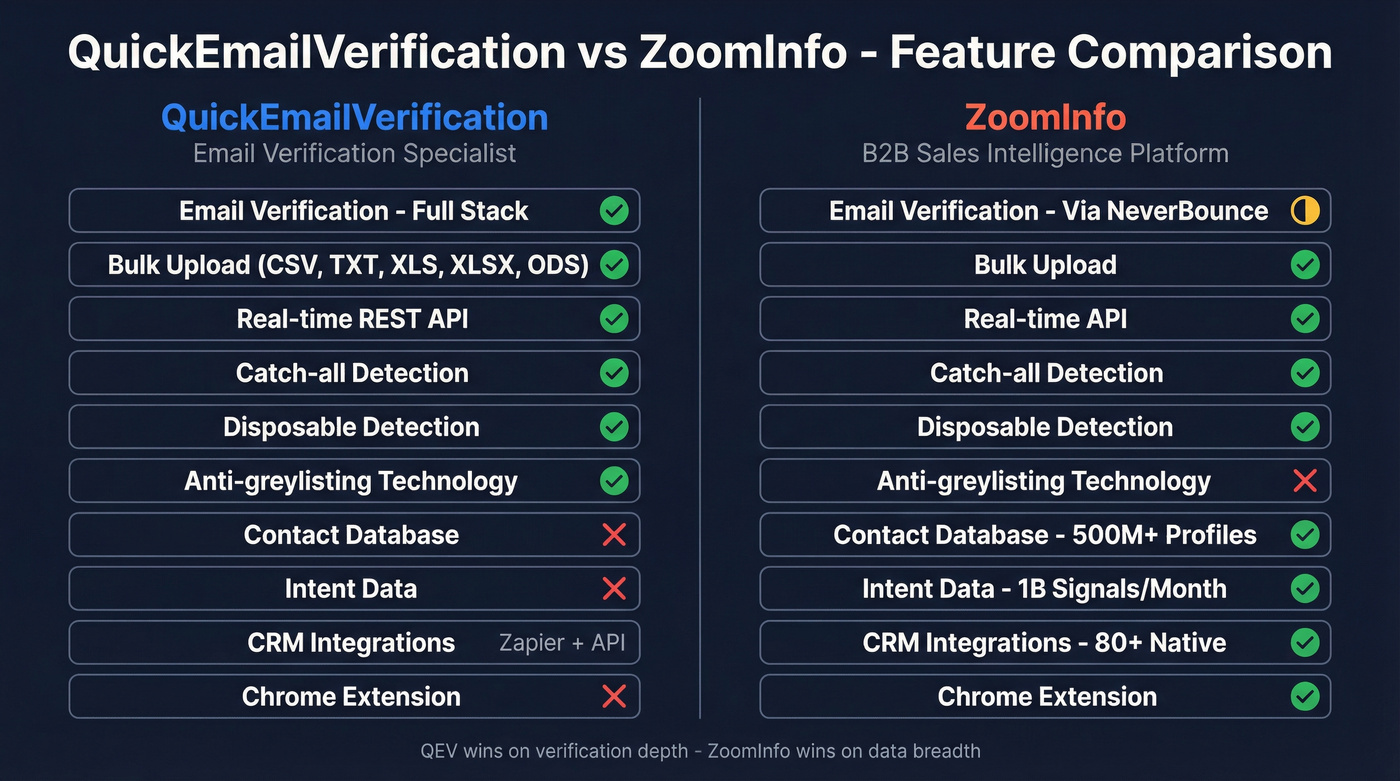
The asymmetry is obvious. QEV checks every verification box. ZoomInfo checks every data box.

Why run ZoomInfo exports through QEV when you can start with pre-verified data? Prospeo's 5-step verification delivers 98% email accuracy at $0.01/email - no second tool, no stale contacts, no $15K contracts.
Kill the two-tool stack. Get verified emails from one platform.
Pricing - The Real Numbers
| Tool | Plan | Cost | Per Email |
|---|---|---|---|
| QEV | Free tier | $0 (100/day) | $0.00 |
| QEV | PAYG | $4/500 credits | $0.008 |
| NeverBounce | PAYG | $8/1,000 credits | $0.008 |
| NeverBounce | Growth | $49/mo (10K) | $0.005 |
| ZoomInfo | Professional | ~$15K-$18K/yr | ~$3.00+ |
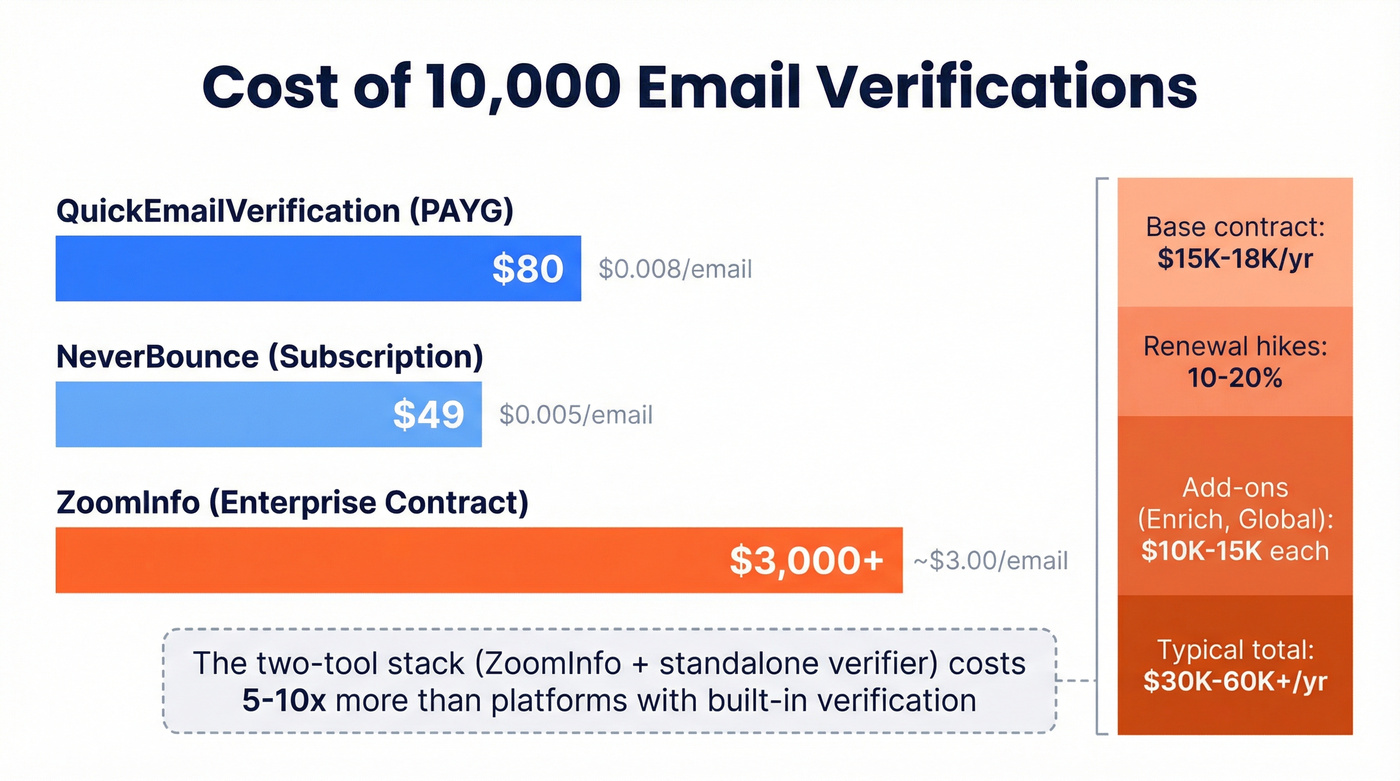
Let's do the math on 10,000 verifications. QEV costs $80. NeverBounce costs $80 standalone or $49 on a subscription. ZoomInfo? Using the commonly cited entry benchmark of ~$15K-$18K/year and ~5,000 bulk credits, your effective cost per credit lands around $3.00-$3.60. Run out mid-contract, and overage pricing often sits around $0.25-$0.50 per credit.
In our experience, the two-tool stack of ZoomInfo plus a standalone verifier consistently costs 5-10x more than platforms that bake verification into the data layer.
The hidden costs on ZoomInfo add up fast. Renewal hikes of 10-20% are standard. Add-ons like Enrich ($10K-$15K/year) or Global Data (~$10K/year) stack on top. Most teams end up at $30K-$60K+ after seats, credits, and modules. If you're negotiating, push hard - discounts of 30-65% off list price are common, especially at renewal. ZoomInfo's pricing still isn't public and is typically quote-based, which tells you everything about their negotiation leverage.
Hot take: If your average deal size is under $15K, ZoomInfo's annual contract will eat your margin before the data pays for itself. Most SMB and mid-market teams are better served by self-serve platforms with transparent pricing.
Accuracy - What Tests Show
A Reddit benchmark from January 2026 tested 17 services across 272 disposable email checks. QEV scored about 8 out of 16 providers detected. NeverBounce scored the same - 8/16. The average across all tools was just 59%.
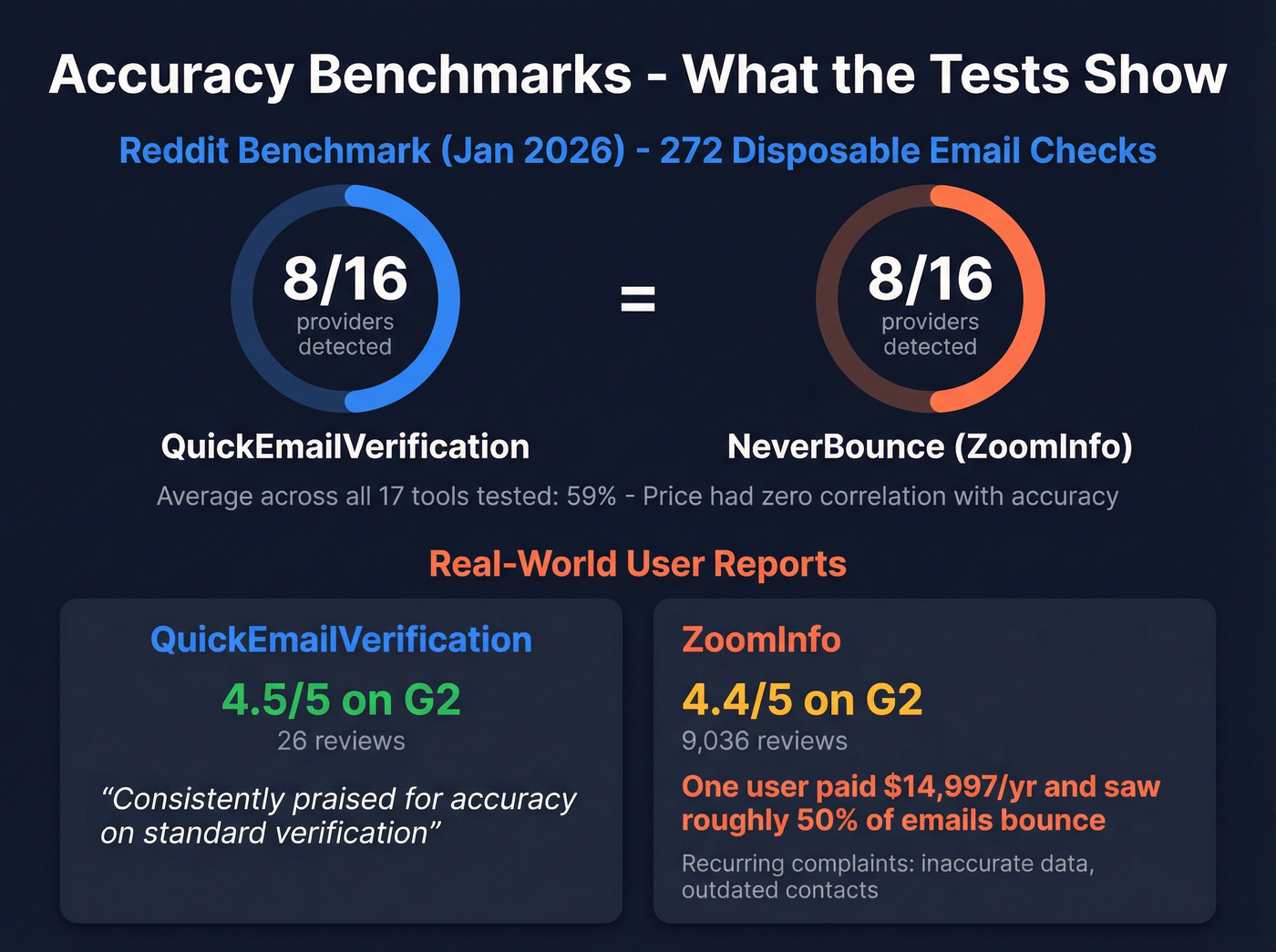
The key finding: price had zero correlation with accuracy. A $4 tool performed identically to the verification arm of a $15K platform, at least for disposable detection.
On ZoomInfo's side, the accuracy complaints are louder. One user on r/Entrepreneur reported paying $14,997/year and seeing roughly 50% of emails bounce. Across 9,036 G2 reviews, "inaccurate data" and "outdated contacts" show up as recurring cons. QEV's G2 profile is smaller - 26 reviews, 4.5/5 - but consistently praises accuracy on standard verification. One common complaint: QEV can feel pricey at higher volumes, where subscription verifiers start to win on unit economics.
Here's the thing. QEV verifies what you give it. ZoomInfo has to source the data first, and that's where staleness creeps in.
Who Should Use Which
Pick QEV if you already have email lists and just need to clean them. Your verification budget is under $25/mo, and you don't need to find new contacts - only validate existing ones. QEV's anti-greylisting and encrypted storage with 90-day auto-deletion make it solid for compliance-conscious teams.
If you're trying to protect deliverability while scaling outbound, it helps to understand your email bounce rate and the basics of an email deliverability program.
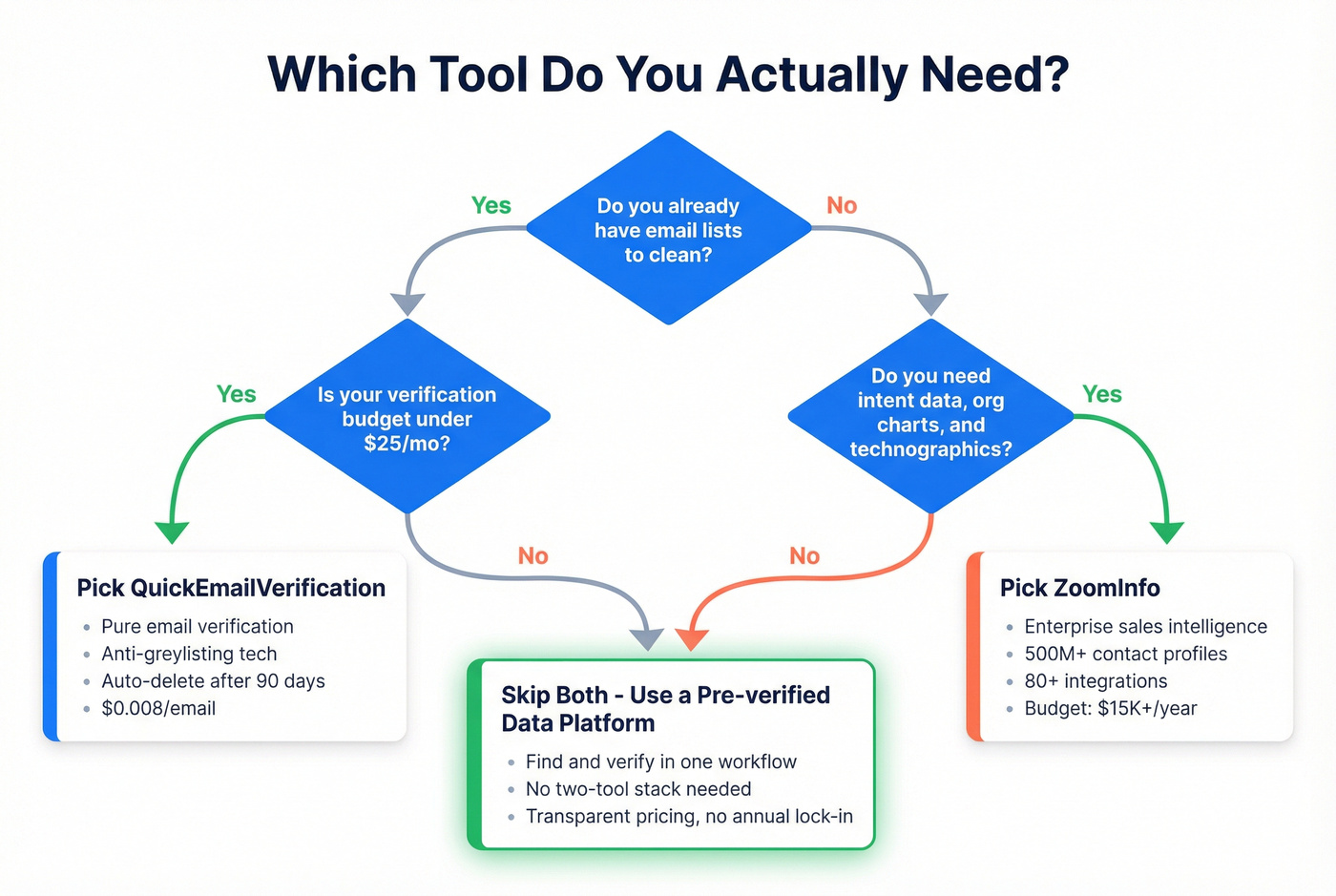
Pick ZoomInfo if you need enterprise sales intelligence, intent data, and org charts. Your team can justify $15K+/year and will actually use the platform's breadth - ABM programs, technographics, buying signals, the full suite. If you're only using ZoomInfo for contact emails, you're lighting money on fire.
Skip both if you need verified B2B emails without the enterprise price tag or the two-tool stack.
The Third Option
The real question isn't QEV vs ZoomInfo. It's whether you should be verifying emails at all - or starting with verified data in the first place.
We've seen teams go from a 35% bounce rate to under 4% by switching to pre-verified data instead of layering a verifier on top of a stale database. That's not a marginal improvement. That's the difference between a healthy sending domain and one that's circling the drain.
If you're rebuilding your outbound motion, start with a tighter lead generation workflow and proven sales prospecting techniques so you’re not paying to clean bad inputs.
Teams using Prospeo cut bounce rates from 35% to under 4% without a standalone verifier. 300M+ profiles, 7-day data refresh, and proprietary verification built in - starting at $0.01/email with no annual contract.
Stop verifying bad data. Start with good data instead.
FAQ
Is NeverBounce the same as ZoomInfo for verification?
NeverBounce is ZoomInfo's verification arm, acquired in 2020. Standalone, it charges $0.008/email - identical to QEV's rate. If you're paying $15K+/year for ZoomInfo primarily for verification, use NeverBounce directly and save 99% of the cost.
Can QuickEmailVerification find new emails?
No. QEV only verifies emails you already have - it has no contact database or prospecting features. For teams that need to find and verify contacts in one workflow, combined platforms like Prospeo or Apollo are better fits.
Is ZoomInfo worth it just for email verification?
Not even close. ZoomInfo's value lives in its intelligence layer - intent data, org charts, technographics. For verification alone, QEV or NeverBounce cost 99% less at $0.008/email. ZoomInfo only makes sense if your team will use the full platform across ABM, enrichment, and buying signals.