

Real-Time Buying Signals: The 5 That Matter (and Why the Rest Are Noise)
A sales leader on r/sales put it bluntly: "I'm coming round to the idea that 90% of the 'intent triggers' we're paying for are useless." Over on r/growmybusiness, practitioners complain they spend more time building signal infrastructure than running campaigns. The real-time buying signals industry has a noise problem - and it's costing teams actual pipeline.
The Short Version
Only five buying intent triggers consistently drive action: job changes, funding, hiring sprees, pricing-page activity, and tech stack changes. Everything else is background noise until you stack multiple signals on the same account.
Signals expire. If you aren't reaching out within 48 hours, you're giving faster competitors the opening. And most intent platforms hand you company names, not contacts - so you still don't know who to email. That's where the workflow breaks.
Why Buying Signals Expire
Research across 3,500+ B2B buyers found that roughly 70% of the buying journey happens before a seller is ever contacted. In 8 out of 10 journeys, the vendor preferred at the end of that silent selection phase wins the deal.
That window is compressing. The 2026 Buyer Experience Report - nearly 4,000 buyers surveyed - shows average buying cycles dropped from 11.3 months to 10.1 months, and the point of first contact shifted from 69% to 61% of the journey. Buyers are reaching out earlier, but the winning vendor is already on the Day One shortlist 95% of the time. If you aren't detecting intent signals in real time, you aren't on that shortlist.
The 5 Signals That Actually Convert
Most guides list 10-15 signal types. That's a taxonomy exercise, not a prioritization framework. We've watched these five drive the most meetings when teams build a simple "signal to contact to outreach" workflow.
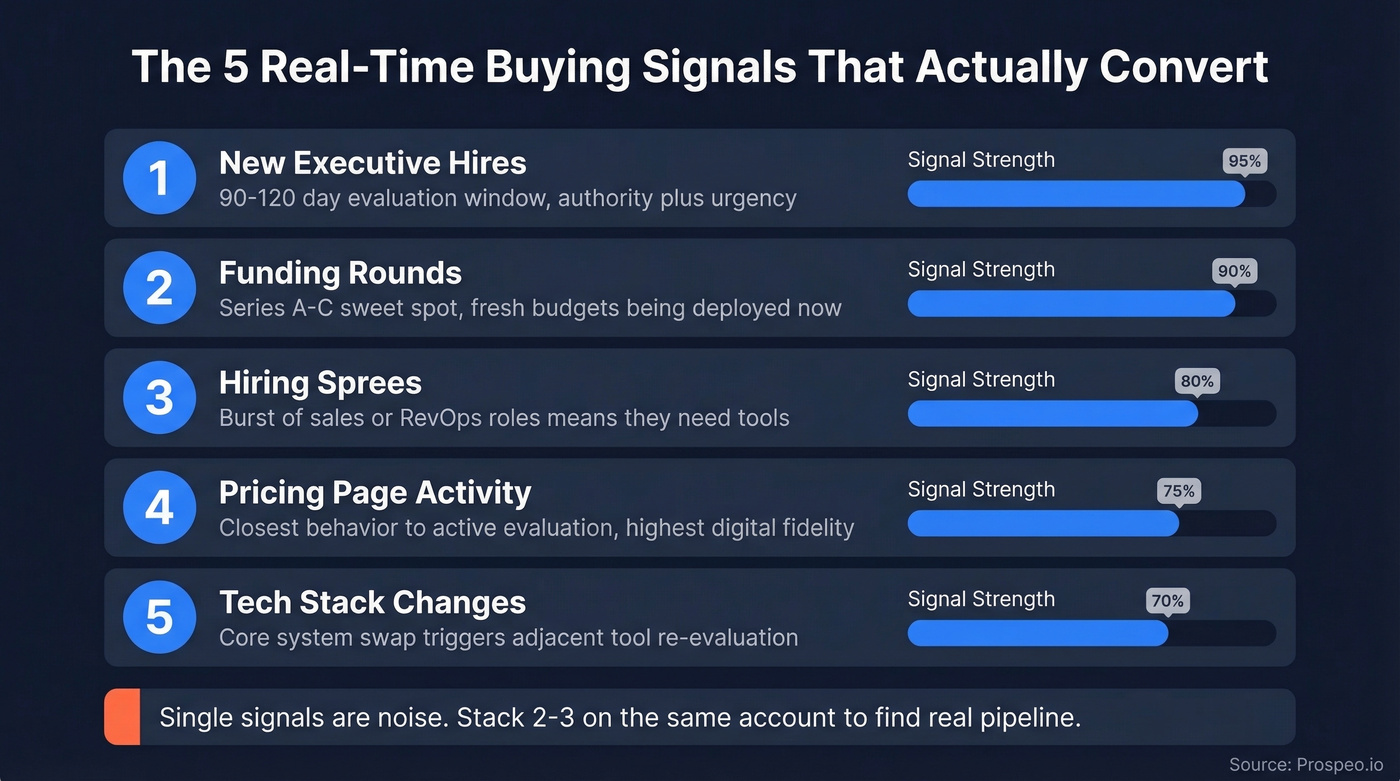
New executive hires are the most reliable trigger in B2B. A new VP of Sales or CRO typically has a 90-120 day window to evaluate changes, and they're actively reassessing tools and vendor relationships. This is the "new sheriff" signal, and it works because the person has both authority and urgency to make moves.
Funding rounds are nearly as strong. Fresh capital means new budgets, and Series A through C companies hit the sweet spot of money plus urgency. A company that just closed a $30M Series B isn't sitting on that cash - they're spending it.
Hiring sprees tell you a company is building infrastructure. When you see a burst of sales or RevOps roles posted, they usually need tools to support that growth. Pricing-page activity and demo requests are among the highest-fidelity digital signals because they're the behaviors closest to evaluation. And tech stack changes signal a workflow rebuild; when a core system changes, adjacent tools often get re-evaluated too.
Here's the thing: single signals are noise. Two or three stacked on the same account - say, a new CRO at a company that just raised a Series B and is hiring SDRs - that's pipeline.

Stacking buying signals only works if you can reach the right person before the window closes. Prospeo pairs 15,000 intent topics with 300M+ verified profiles - so you go from surge alert to verified email in one step, not a 45-minute research project.
Turn buying signals into booked meetings before the 48-hour window closes.
How to Score Signals
Raw signals without a scoring framework just create a louder inbox. The model that works: Depth + Frequency + Seniority + ICP Fit, a framework Leadfeeder's team has documented well.
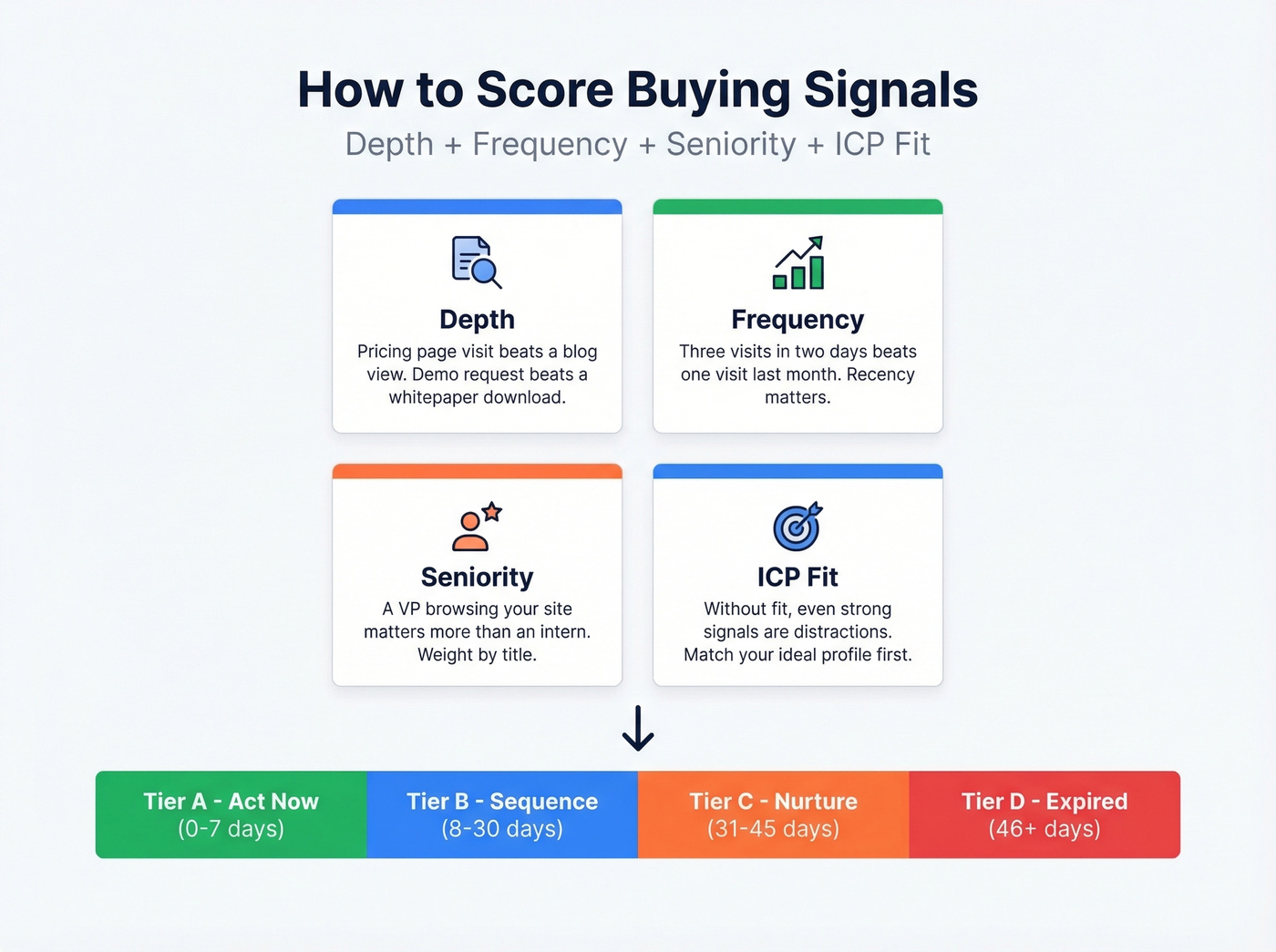
Depth means a pricing-page visit outranks a blog-post view. Frequency means three visits in two days beats one visit last month. Seniority means a VP's engagement matters more than an intern's. ICP fit means the account actually matches your ideal customer profile - without fit, even strong signals are distractions.
| Tier | Signal Profile | Decay Window | Action |
|---|---|---|---|
| A | 3+ signals, senior buyer, ICP match | 0-7 days | Immediate outreach |
| B | 2 signals, mid-level, ICP match | 8-30 days | Sequence enrollment |
| C | 1 signal, ICP match | 31-45 days | Nurture / monitor |
| D | Weak signal or poor fit | 46+ days | Expired - deprioritize |
The operational benchmark: a 48-hour activation SLA for Tier A signals. After that window, you're losing the advantage of recency. Only 24% of teams report exceptional ROI from intent data - most of that gap is a timing and scoring problem, not a data problem.
The Account-Level Trap
Let's walk through a scenario we've watched play out dozens of times. An SDR gets a Slack alert: "Acme Corp surging on 3 intent topics." Great. Now what? They spend 45 minutes digging through the company's org chart, guessing email formats, bouncing messages. By the time they find the right contact, the signal is five days old and a competitor has already booked the meeting.
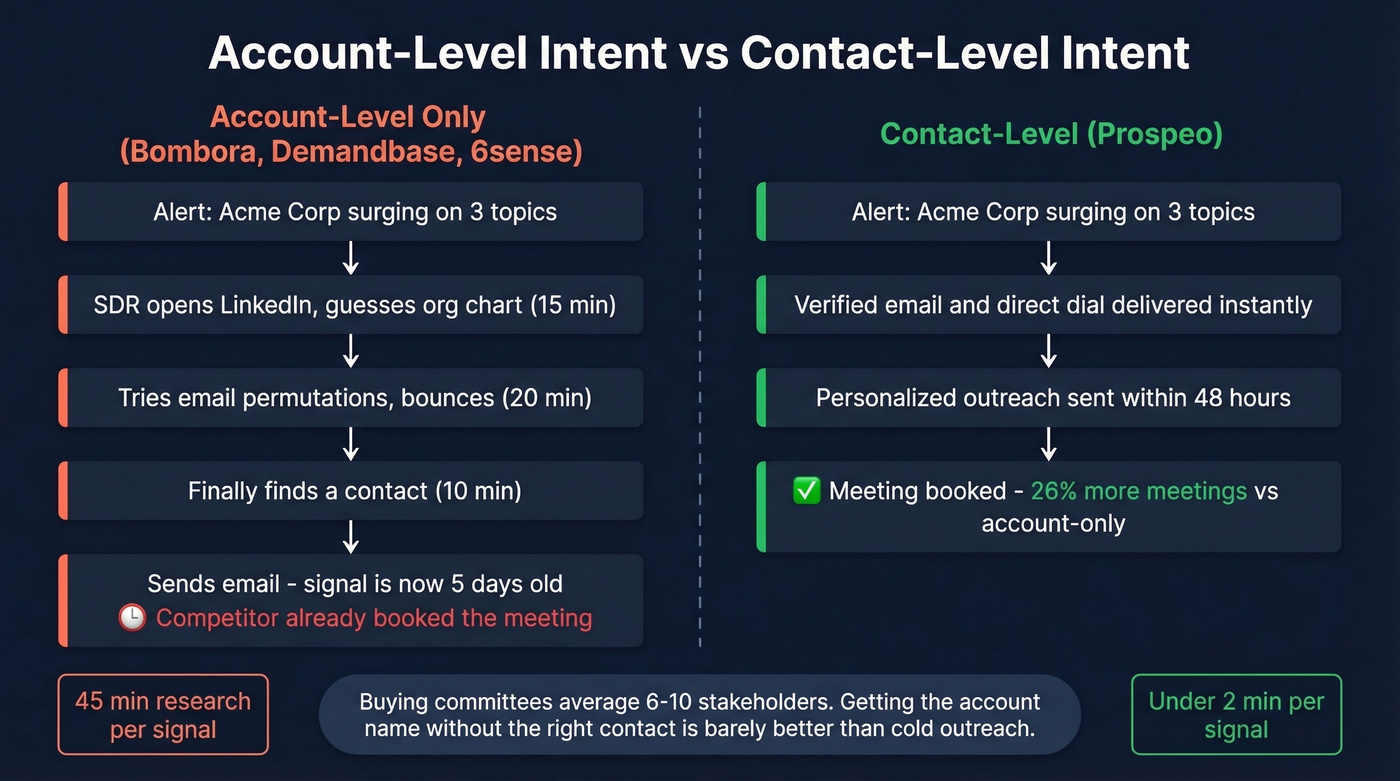
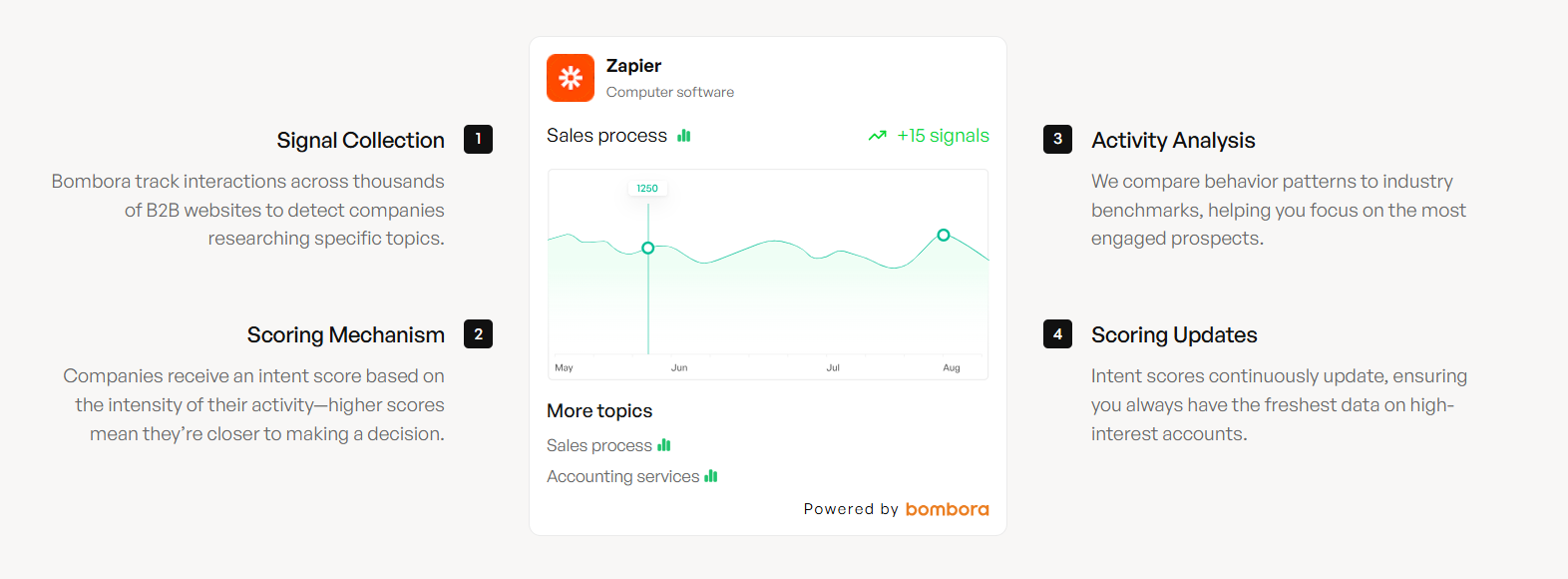
This is the fundamental gap with platforms like Bombora and Demandbase. Both provide account-level signals - which company is surging - but neither provides contact-level data. You get a to-do list, not a workflow. Buying committees average six to ten stakeholders, and getting the account name without knowing which stakeholder is driving evaluation is barely better than cold outreach.
There's a deeper problem too: intent data can become a self-fulfilling prophecy. Vendors aggregate signals, teams target those accounts, engagement rises, and the vendor claims credit. Circular logic dressed up as attribution.
Prospeo closes this gap by pairing intent signals with verified contact data in one step. It covers 15,000 intent topics and matches them against 300M+ professional profiles - so instead of getting an account name and starting a research project, you get the surging account plus the decision-maker's verified email and, when available, a direct dial. Data refreshes every 7 days versus the 6-week industry average, and it starts free with no annual contract required.
What Intent Tools Actually Cost
Not a single other article ranking for this keyword includes real pricing. Here's what you'll actually pay.
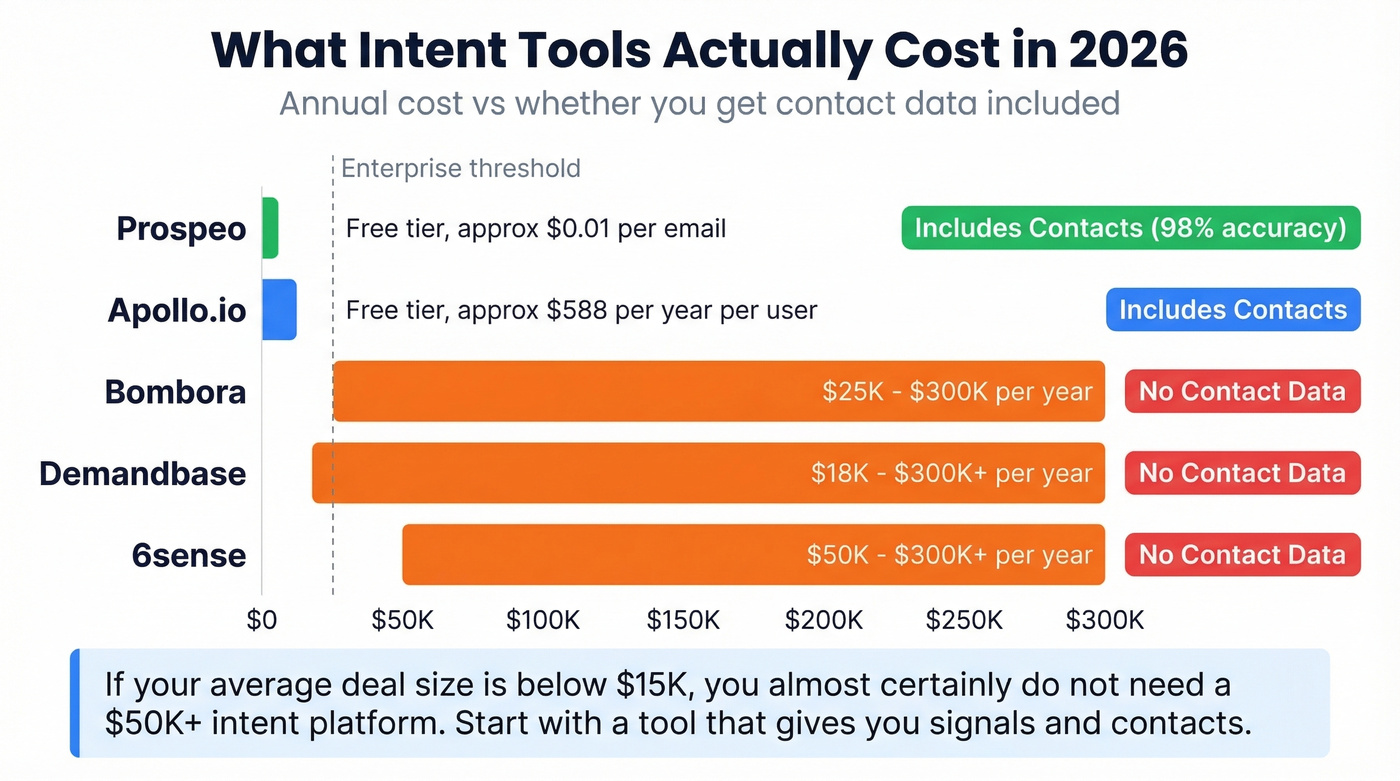
| Tool | Annual Cost | What You Get | Contact Data? |
|---|---|---|---|
| Prospeo | Free tier; ~$0.01/email | Intent + verified contacts | Yes (98% accuracy) |
| Apollo.io | Free tier; ~$49/user/mo paid | Basic intent + contacts | Yes |
| Bombora | ~$25K-$300K/yr | Account-level surge | No |
| Demandbase | ~$18K-$300K+/yr | Account-level intent + ABM | No |
| 6sense | ~$50K-$300K+/yr | Enterprise ABM platform | No |
If your average deal size sits below $15K, you almost certainly don't need a $50K+ intent platform. The signal-to-noise ratio at that contract value rarely justifies the spend. Start with a tool that gives you signals and contacts, then upgrade to enterprise ABM platforms when your deal sizes warrant it. Skip the enterprise options entirely until you're closing six-figure deals consistently.
Bombora's median contract runs about $24,750/year based on Vendr benchmarks across 34 purchases. The Forrester Wave Leaders for B2B intent data in Q1 2026 include Intentsify, 6sense, Bombora, Informa TechTarget, and Demandbase - all enterprise-priced, all account-level only.
Turning Signals Into Meetings
Four steps - not 45 minutes of manual research.
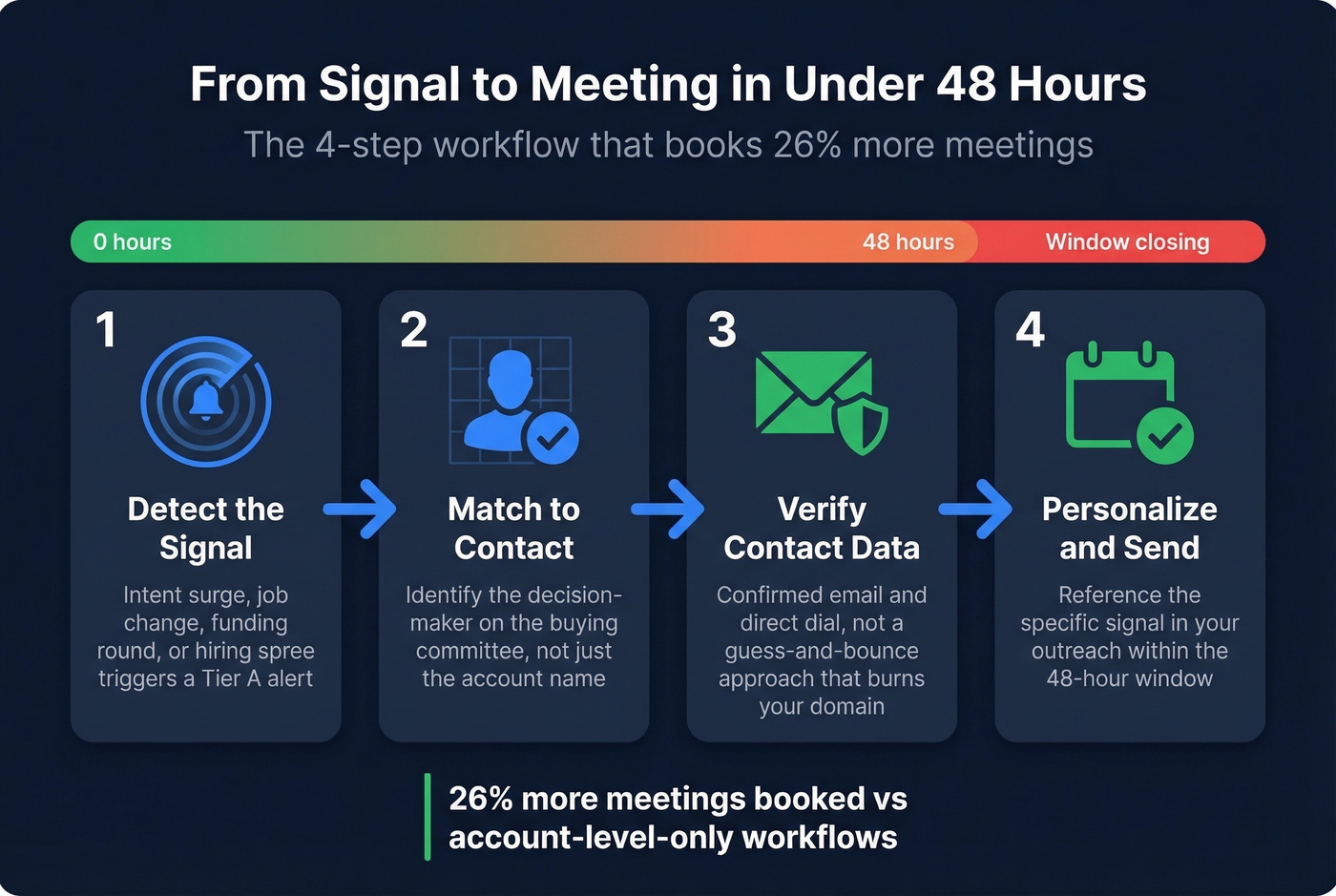
1. Detect the signal. Intent surge, job change, funding round - whatever your Tier A trigger is.
3. Verify contact data. Confirmed email and direct dial - not a guess-and-bounce approach. Bad data kills domain reputation, and we've seen teams burn sender domains over a single batch of unverified emails.
4. Personalize and send within 48 hours. Reference the specific signal: "Saw you're scaling the SDR team after your Series B - here's how we help teams like yours ramp faster."
Teams running this workflow book 26% more meetings compared to account-level-only approaches because they eliminate the research detour that kills signal freshness. Real-time buying signals only create value when you can act on them before they decay - and acting means reaching a person, not just flagging a company.
If you want to operationalize this end-to-end, it helps to standardize your sales prospecting techniques and keep a tight lead generation workflow so signals don't die in handoffs.
Most intent platforms hand you a company name and charge $50K+ for the privilege. Prospeo gives you the surging account, the decision-maker's verified email (98% accuracy), and a direct dial - refreshed every 7 days, starting at $0.01 per email. No annual contract required.
Get contact-level intent data at 90% less than enterprise platforms.
FAQ
How quickly do buying signals expire?
High-priority signals like pricing-page activity decay within 7 days. After 45 days, most signals are effectively expired. The competitive benchmark is a 48-hour activation window for Tier A accounts - teams that hit that SLA see 2-3x higher connect rates than those acting on week-old data.
What's the difference between first-party and third-party signals?
First-party signals come from your own properties - website visits, demo requests, content downloads. Third-party signals track research behavior across external sites. First-party is higher-fidelity but lower-volume; third-party gives broader coverage. The best workflows layer both for a complete picture of buyer intent.
Can small teams use intent data without enterprise budgets?
Yes. Prospeo pairs intent signals with verified contact data on a free tier - no $25K+ annual contracts required. Apollo.io also offers a free tier with basic intent starting at $49/user/month on paid plans. For teams with average deal sizes under $20K, these self-serve options outperform enterprise ABM platforms on ROI.