

RemoveBounce vs ZoomInfo: Different Tools, Different Problems
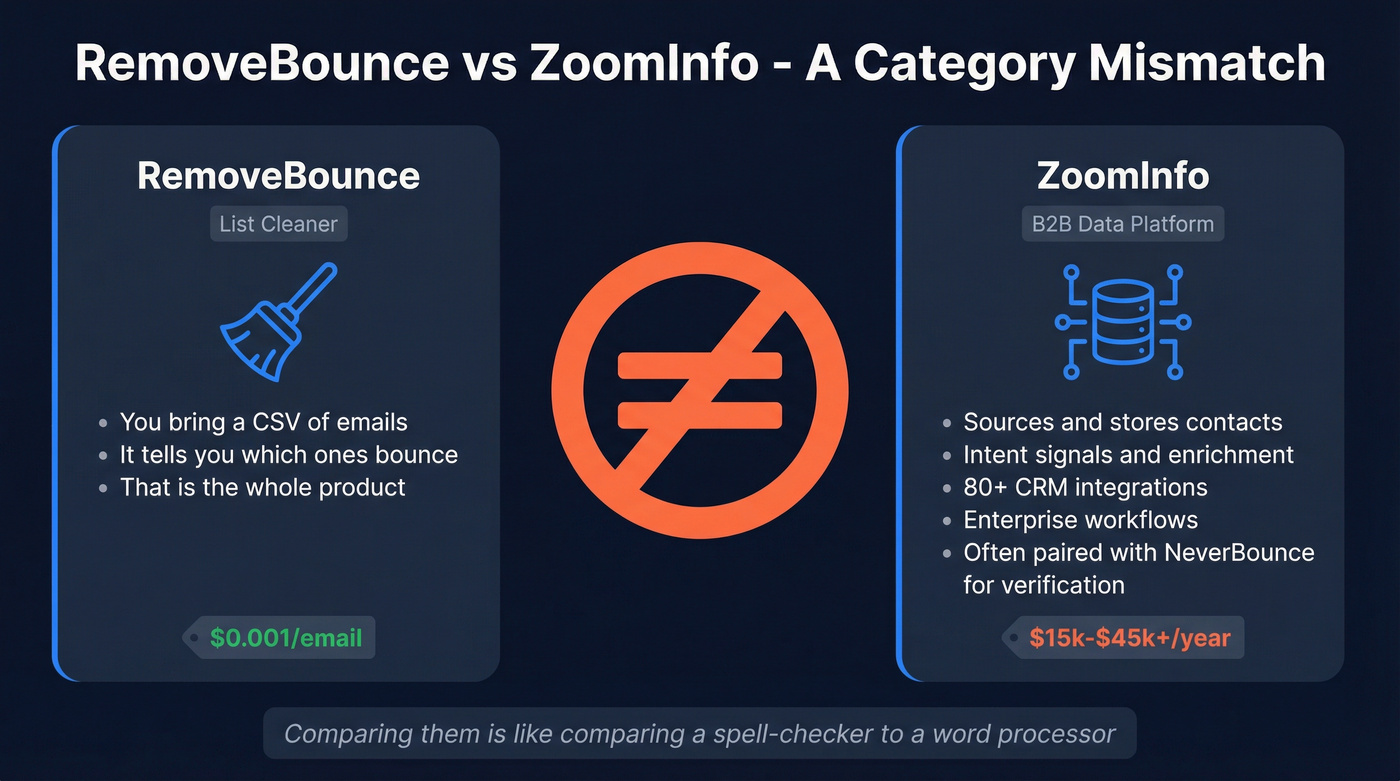
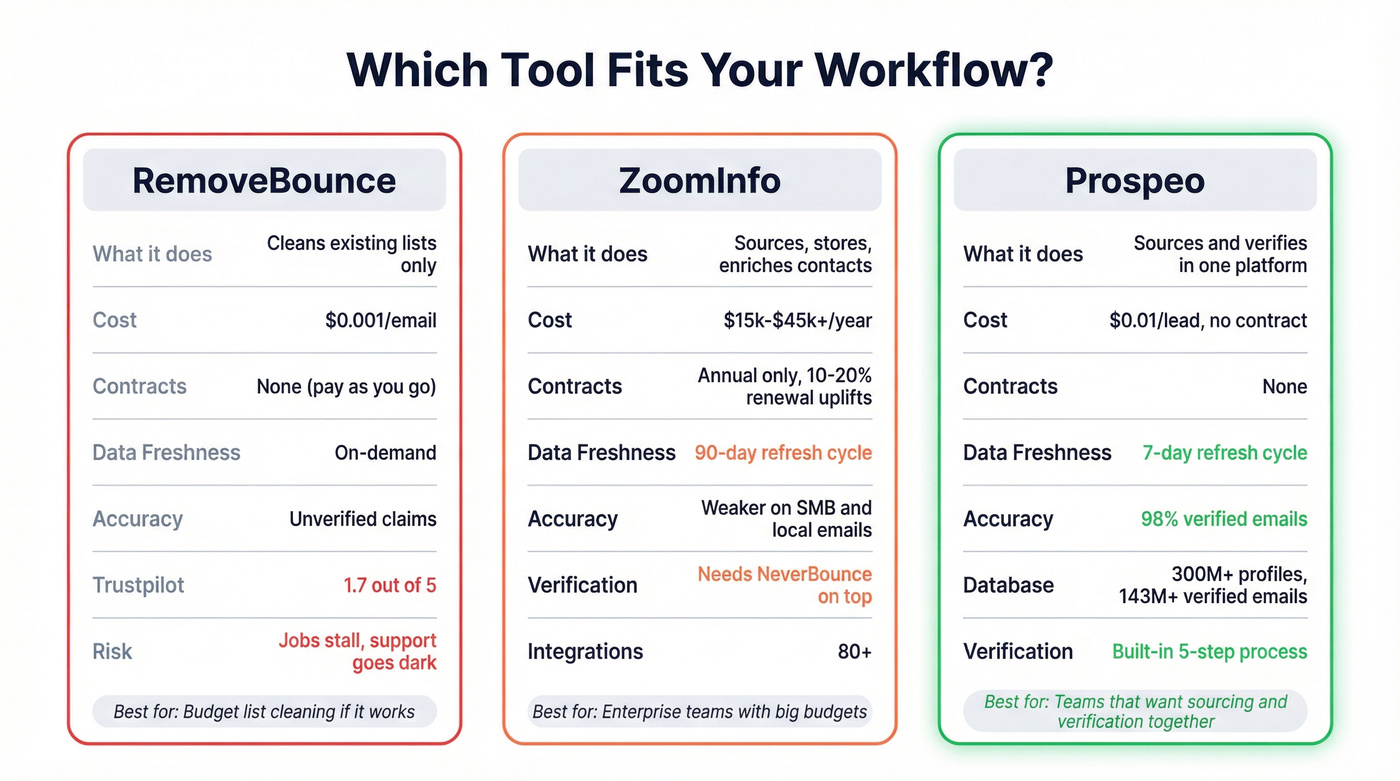
This is a category mismatch. RemoveBounce is a budget email list cleaner that runs about $0.001/email at the 5,000-email tier. ZoomInfo is a $15k+/year B2B data platform with intent signals, deep company/contact data, and 80+ integrations. They don't compete. If you're weighing one against the other, you're probably asking the wrong question entirely.
Pick RemoveBounce if you have an existing list and need the cheapest possible verification - but know the risks (1.7/5 across 22 reviews on Trustpilot, jobs that stall mid-process).
Pick ZoomInfo if you need a full B2B contact database with intent signals, CRM integrations, and enterprise-grade workflows - and have the budget for it.
Skip both if you want verified B2B emails without a $15k contract or an unreliable verifier. Prospeo delivers 98%-accurate, pre-verified emails at ~$0.01/lead with no contract.
Why This Comparison Doesn't Work
RemoveBounce is a standalone list cleaner. You bring it a CSV of emails, it tells you which ones bounce. That's the whole product. ZoomInfo is a B2B data platform that sources, stores, and enriches contact data - and many teams pair it with NeverBounce for list verification (NeverBounce was acquired by DiscoverOrg, now ZoomInfo, back in 2019). Comparing them is like comparing a spell-checker to a word processor.
RemoveBounce - What You Get
Use this if you have a massive, dirty list and your only priority is spending the absolute minimum to clean it. At $5 per 5,000 emails, it's one of the cheapest pay-as-you-go bulk verifiers out there.
Skip this if you value reliability. RemoveBounce's Trustpilot score is 1.7/5 across 22 reviews, and the complaint pattern is consistent: verification jobs stall mid-process, users report getting stuck at 9%, support goes dark, and multiple reviewers use the word "scam." Older reviews from 2020-2021 praised speed and support, but the 2022-2024 cluster trends sharply negative. On Capterra, it sits at 3.0/5 with a single incentivized review calling it the "cheapest bulk email verifier" but noting it's "not easy to configure."
Features are basic: bulk verification, spam-trap detection, disposable email detection, and API access. Pay-as-you-go pricing scales linearly - $10 for 10k emails, $50 for 50k, $100 for 100k, up to $1,000 for a million. No annual contracts, no credit card required to start. But cheap doesn't matter if the job never finishes.
If you want a deeper breakdown of pricing, reliability, and alternatives, see our RemoveBounce review.
ZoomInfo - What You Get
Skip this if you're a small team that just needs verified emails. You'll pay $15k-$45k+/year across Professional, Advanced, and Elite tiers, locked into annual contracts with 10-20% renewal uplifts. Teams that negotiate hard report 30-65% off list price, but you're still looking at five figures annually.
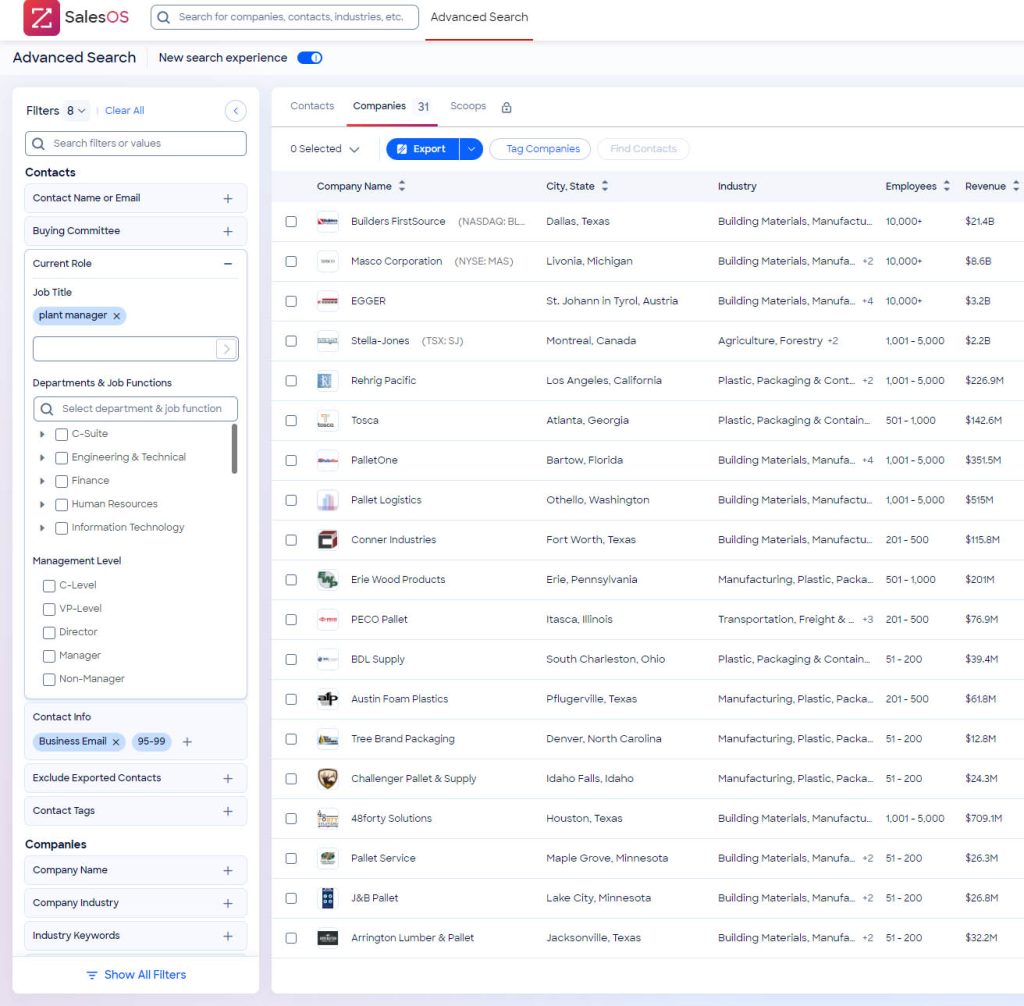
ZoomInfo's database covers 500M+ contact profiles with 80+ integrations. For list verification, many ZoomInfo users run NeverBounce before uploading contacts into their CRM. NeverBounce pricing starts at $0.008/email at up to 10,000 validations, with lower per-email rates at higher volumes.
The platform validates emails on an update cycle of roughly every 90 days, which is a real problem. Emails go stale in days when contacts change jobs, not months.
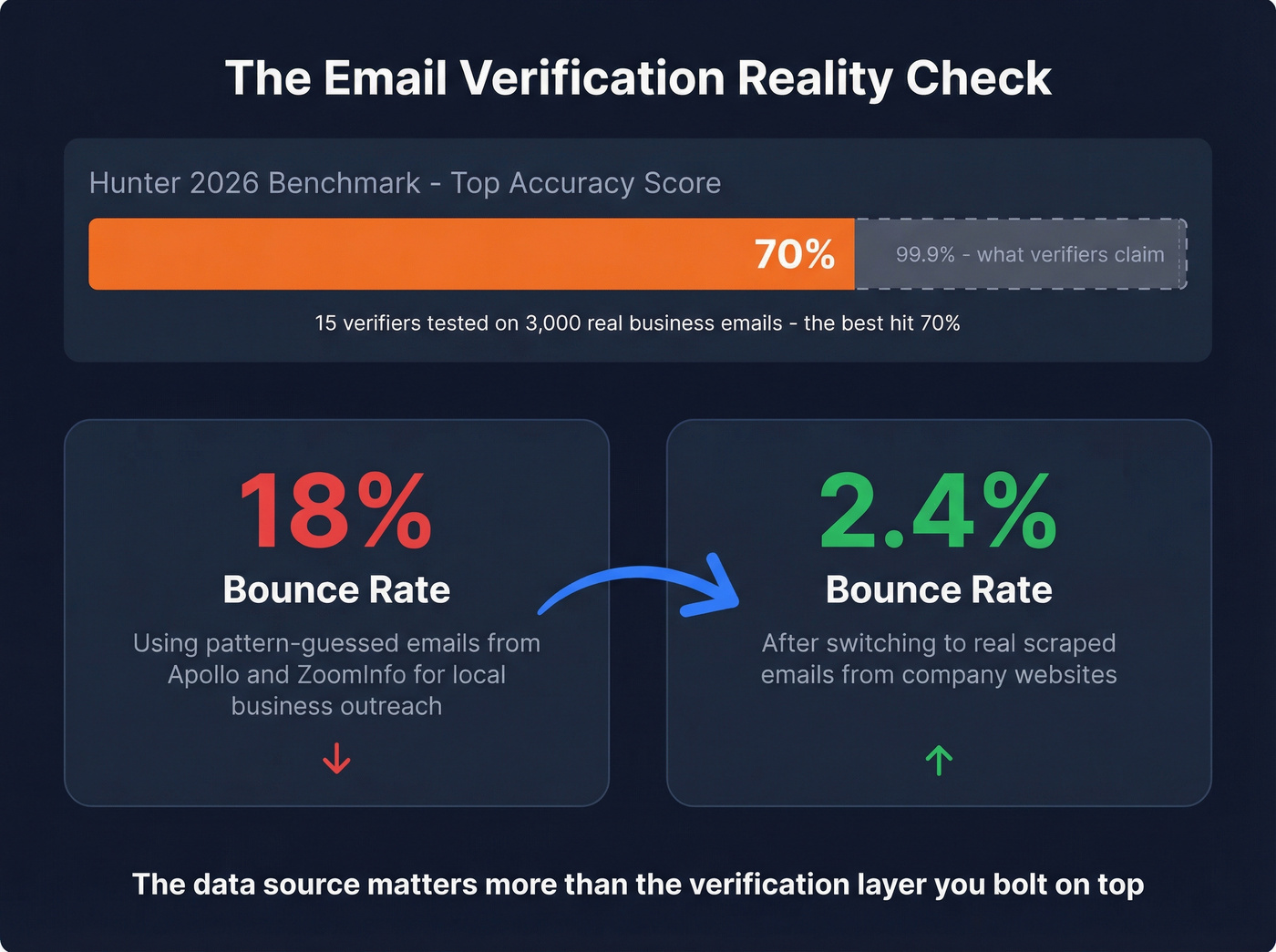
One Reddit user reported an 18% bounce rate using Apollo and ZoomInfo for local business outreach - the emails were pattern-guessed (john@domain.com). After switching to scraping real emails from company websites, their bounce rate dropped to 2.4% and reply rates jumped from 1.2% to 4.8%. We've seen this pattern repeatedly: the data source matters more than the verification layer you bolt on top.
If you're evaluating other databases in this category, start with our guide to sales prospecting databases.

ZoomInfo refreshes data every 90 days. RemoveBounce stalls at 9%. Prospeo refreshes 300M+ profiles every 7 days with 98% email accuracy - sourcing and verification in one platform, no $15K contract required.
Replace your verifier and your data platform for $0.01/lead.
Side-by-Side Comparison
| Factor | RemoveBounce | ZoomInfo |
|---|---|---|
| What it does | Cleans existing lists | Sources + stores contacts |
| Pricing | ~$0.001/email (at 5k tier) | $15k-$45k+/yr |
| Contracts | None (pay-as-you-go) | Annual only |
| Verification | Standalone bulk | Often paired with NeverBounce |
| Freshness | On-demand | ~90-day cycle |
| Ratings | Trustpilot 1.7/5, Capterra 3.0/5 | Strong platform, weaker SMB/local email accuracy |
| Best for | Budget list cleaning (if it works) | Enterprise data platform |
The Accuracy Problem
Here's what nobody in the verification space wants you to hear: Hunter's 2026 benchmark tested 15 verifiers on 3,000 real business emails. The top accuracy score was 70%. Not 99.9%, not 95% - seventy percent. Hunter's own tool topped the list, so take the exact rankings with a grain of salt, but the ceiling matters more than the order.

A practitioner on r/coldemail tested roughly 100 leads across multiple verifiers and found results differed for about 40% of them. Let's be honest about what that means: you probably don't need a standalone verifier. You need better source data. And verification is only half the equation - without proper SPF/DKIM/DMARC setup, even verified emails land in spam. Best practice is to verify 24-48 hours before send, not just quarterly.
For bounce-rate targets and what “good” looks like, use our email bounce rate benchmarks and fixes.
Here's our take: If your average deal size is under five figures, you almost certainly don't need ZoomInfo-level infrastructure. And if you're relying on a $5 verifier with a 1.7-star rating, you're not saving money - you're deferring the cost to your domain reputation.
What to Use Instead
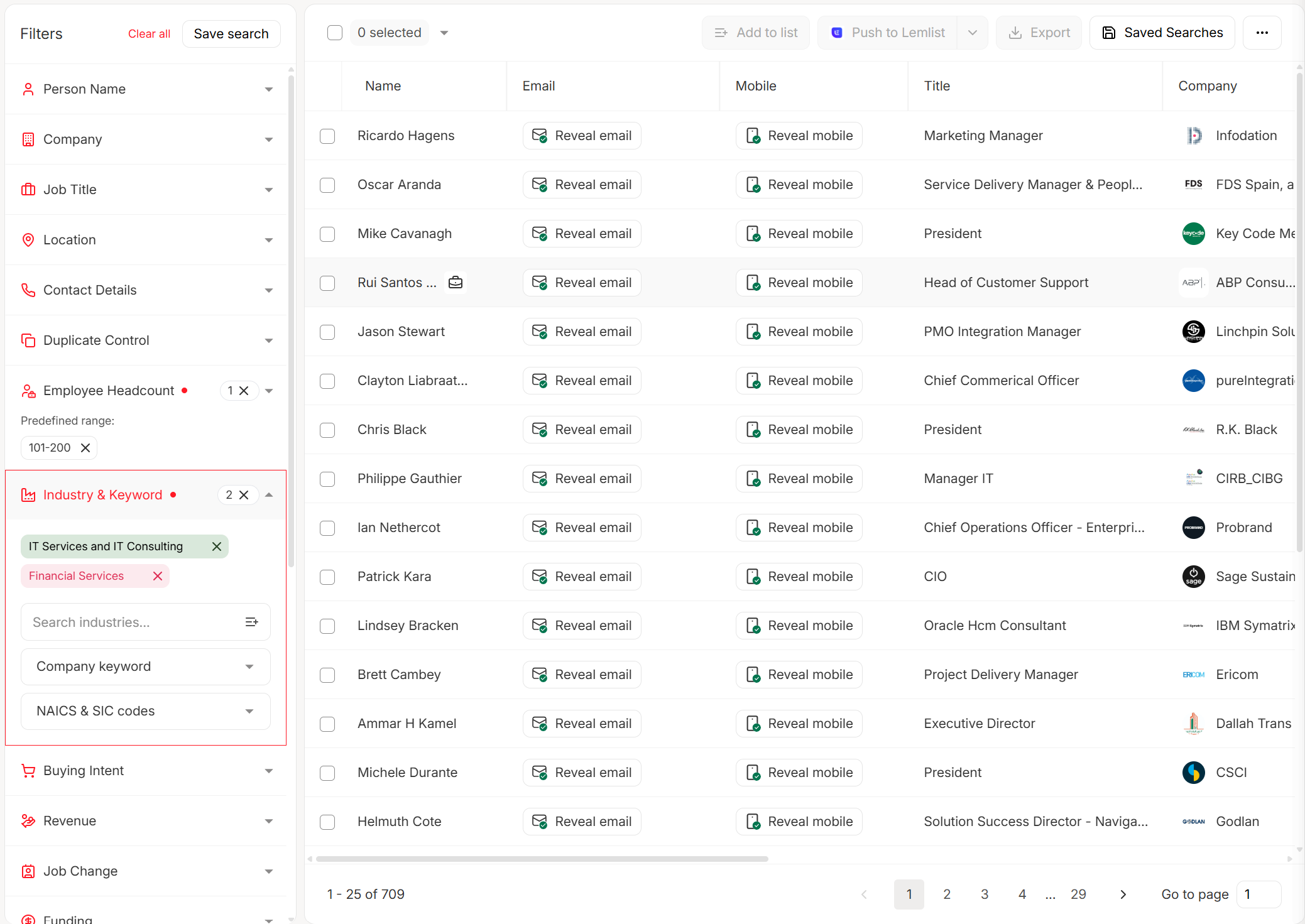
If you're stuck between a $5 verifier that stalls at 9% and a $15k platform that still needs separate list verification, there's a middle path. Prospeo combines sourcing and verification in one platform - 300M+ professional profiles, 143M+ verified emails with 98% accuracy, refreshed every 7 days instead of every 90. Its proprietary 5-step verification process includes catch-all handling, spam-trap removal, and honeypot filtering, so you're not bolting a separate cleaner onto questionable source data. At ~$0.01/lead with no annual contracts, it eliminates the need for both a separate verifier and a five-figure data platform.
If you’re building a modern outbound stack, pair this with proven sales prospecting techniques and a clean lead generation workflow.
If you truly just need standalone list cleaning and nothing else, ZeroBounce is a safer bet than RemoveBounce - better support, better track record, and pricing that starts at $39 for 2,000 credits with monthly plans like ZeroBounce ONE at $99/month for 10,000 credits.
That 18% bounce rate from pattern-guessed emails? Prospeo's proprietary 5-step verification - with catch-all handling, spam-trap removal, and honeypot filtering - keeps bounce rates under 4% for 15,000+ teams.
Stop bolting a cheap verifier onto bad source data.
FAQ
Is RemoveBounce a good alternative to ZoomInfo?
No - they solve different problems entirely. RemoveBounce only cleans existing email lists; ZoomInfo sources and stores B2B contacts. If you need both sourcing and verification without the enterprise price tag, Prospeo combines them at ~$0.01/lead with 98% email accuracy and a 7-day data refresh cycle.
Does ZoomInfo verify emails automatically?
ZoomInfo validates emails in its database on roughly a 90-day update cycle, and many teams layer NeverBounce on top for additional list cleaning before outreach. For cold campaigns, 90 days is too slow - emails go stale in days when contacts change jobs. Tools with weekly refresh cycles catch those changes faster.
Is RemoveBounce legit?
It's a real service, but its 1.7/5 Trustpilot score across 22 reviews tells the story. Recent complaints cite jobs stalling mid-process and unresponsive support. Always test a small batch before committing any meaningful volume - and consider ZeroBounce or Prospeo's built-in verification as more reliable alternatives.