

Best Revenue Analytics Software in 2026, Sorted by What You Actually Need
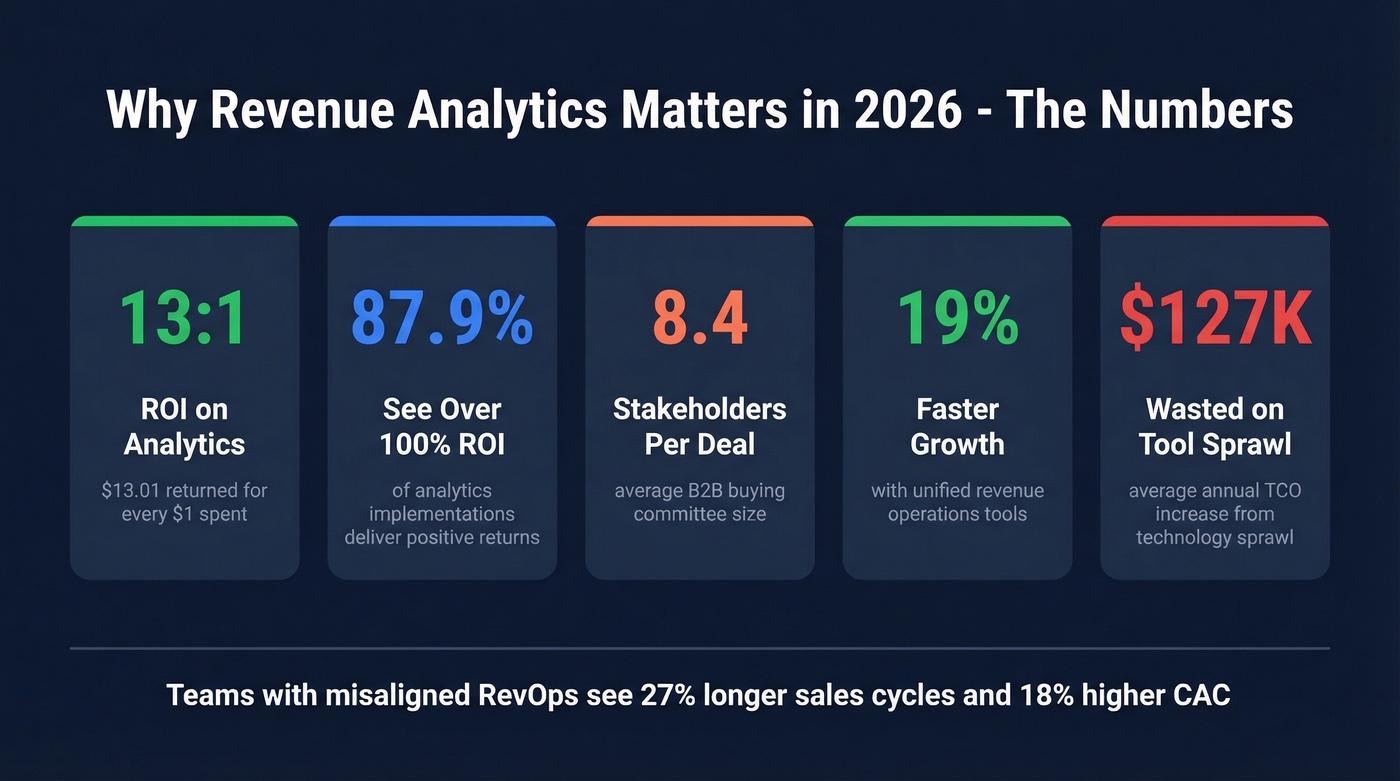
You're prepping for a board meeting, and someone asks why pipeline coverage is 2.8x but closed-won is flat. You pull up three dashboards. None of them agree. The average B2B deal now involves 8.4 stakeholders, yet your revenue analytics software can't tell you which ones are engaged. Here's the thing: analytics delivers over 100% ROI in 87.9% of implementations - but only when the underlying data is solid and the tool matches the problem.
This roundup covers B2B SaaS only. No hotel pricing tools, no generic BI listicles.
Our Picks (TL;DR)
| Use Case | Pick | Why |
|---|---|---|
| Data quality foundation | Prospeo | 98% email accuracy, 7-day refresh |
| Pipeline forecasting | Clari | Best forecasting engine, 4.5/5 G2 |
| Conversation intelligence | Gong | 4.8/5 G2, 3.5B+ interactions analyzed |
| SaaS subscription metrics | ChartMogul | Free up to $10K MRR, best API |
| CRM-native analytics | HubSpot Sales Hub | Free tier, fast setup |
The 4 Types of Revenue Analytics (Plus One)
Revenue analytics software isn't one category - it's at least four, and most guides lump them together in ways that waste your time. Understanding the taxonomy saves you from buying a forecasting tool when you needed a subscription dashboard.
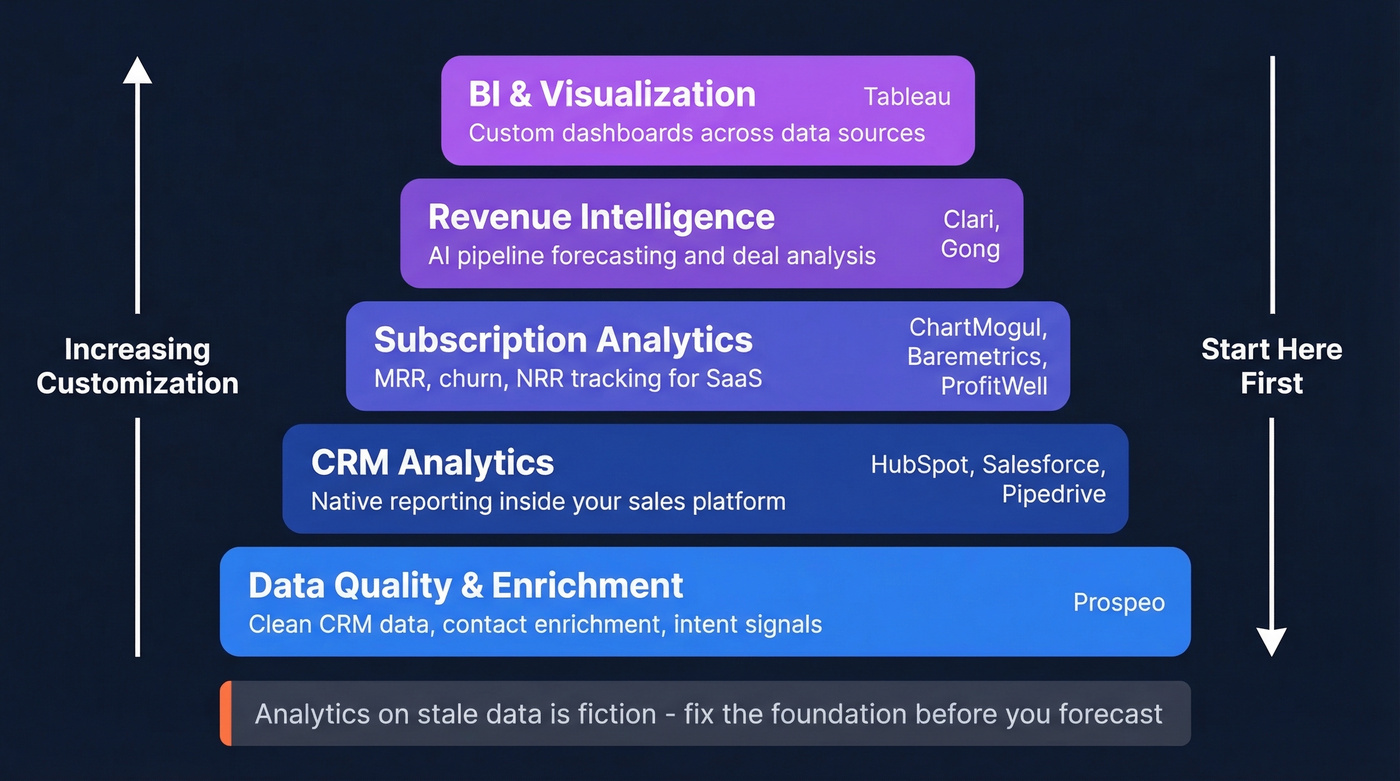
- Revenue Intelligence - AI-powered pipeline forecasting and deal analysis (Clari, Gong)
- Subscription Analytics - MRR, churn, NRR tracking for SaaS (ChartMogul, Baremetrics, ProfitWell)
- CRM Analytics - native reporting inside your sales platform (HubSpot, Salesforce, Pipedrive)
- BI & Visualization - custom dashboards across data sources (Tableau)
- Data Quality & Enrichment - the foundation layer that makes everything above work
Organizations with unified revenue operations tools grow up to 19% faster. But unification means nothing if the underlying data is stale. That's why data quality sits at the base of this stack.

Every revenue analytics tool on this list depends on accurate CRM data. Prospeo enriches your contacts with 50+ data points at a 92% match rate - refreshed every 7 days, not every 6 weeks. Snyk cut bounce rates from 35% to under 5% and grew AE-sourced pipeline 180%.
Fix the foundation before you forecast. Start at $0.01 per email.
Master Comparison
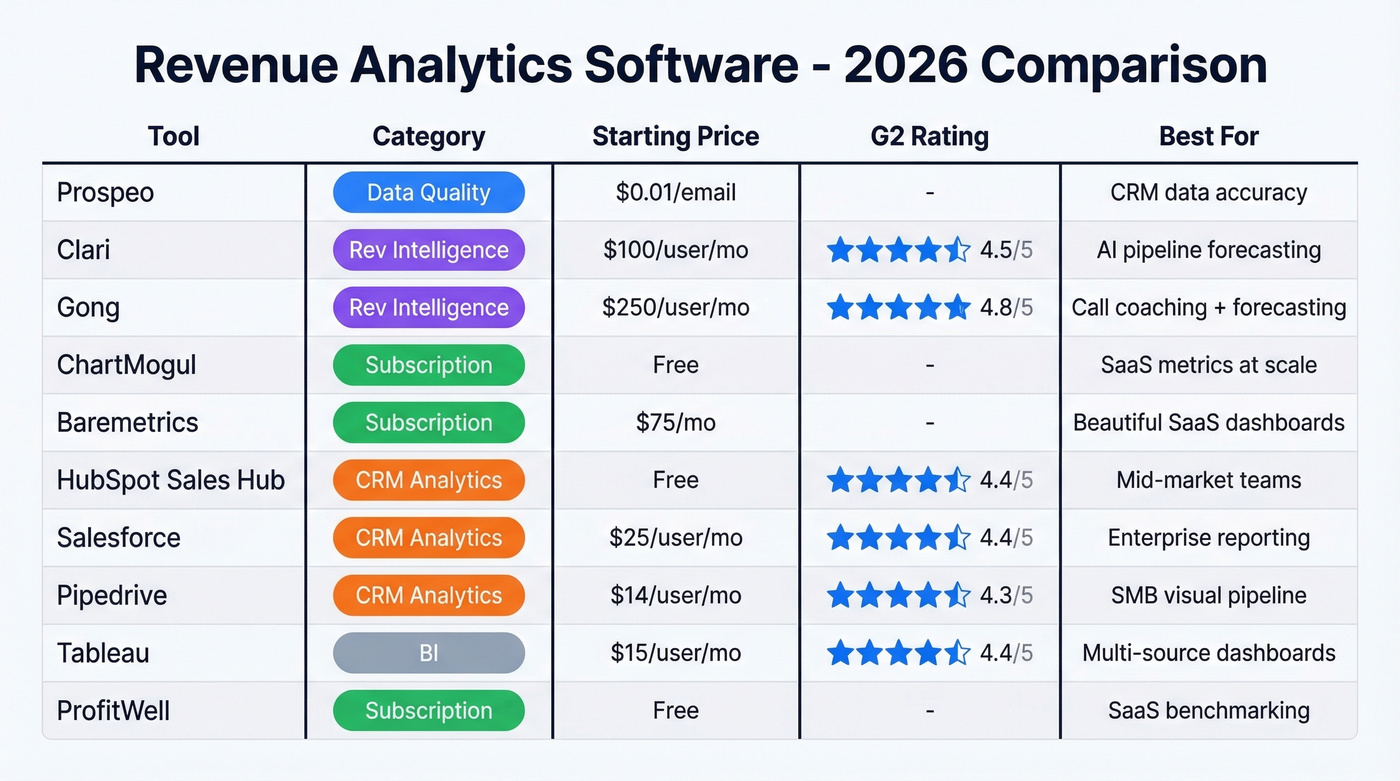
| Tool | Category | Starting Price | G2 | Best For |
|---|---|---|---|---|
| Prospeo | Data Quality | ~$0.01/email | - | CRM data accuracy |
| Clari | Rev Intelligence | ~$100/user/mo | 4.5/5 | AI pipeline forecasting |
| Gong | Rev Intelligence | ~$250/user/mo | 4.8/5 | Call coaching + forecasting |
| ChartMogul | Subscription | Free | - | SaaS metrics at scale |
| Baremetrics | Subscription | $75/mo | - | Beautiful SaaS dashboards |
| HubSpot Sales Hub | CRM Analytics | Free | 4.4/5 | Mid-market teams |
| Salesforce Sales Cloud | CRM Analytics | $25/user/mo | 4.4/5 | Enterprise reporting |
| Pipedrive | CRM Analytics | $14/user/mo | 4.3/5 | SMB visual pipeline |
| Tableau | BI | $15/user/mo | 4.4/5 | Multi-source dashboards |
| ProfitWell | Subscription | Free | - | SaaS benchmarking |
Best Tools by Category
Data Quality & Enrichment
Prospeo
Every analytics tool on this list produces garbage when 20-35% of your CRM records are stale. We've seen teams spend $40K on Clari only to realize their pipeline forecasts were wrong because half the contact data was outdated. Prospeo fixes this upstream.
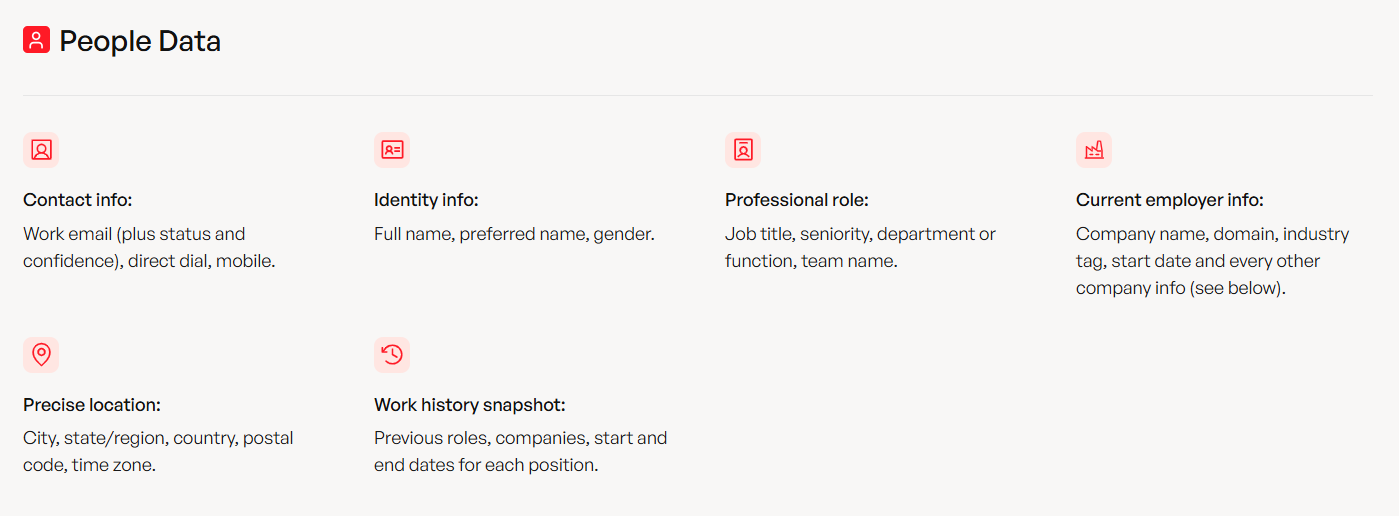
The platform covers 300M+ professional profiles with 98% email accuracy and a 7-day data refresh cycle - the industry average is six weeks. Enrichment returns 50+ data points per contact, with a 92% API match rate and an 83% enrichment match rate. Intent data tracks 15,000 topics via Bombora so you can layer buying signals on top of clean records.
Pricing runs about $0.01 per email with a free tier of 75 emails/month plus 100 Chrome extension credits/month. No contracts, no sales calls required. When Snyk adopted this approach, bounce rates dropped from 35-40% to under 5% and AE-sourced pipeline jumped 180%.
Use this if: you're about to invest in any analytics platform and your CRM data hasn't been cleaned in the last 30 days.
Skip this if: you genuinely don't do outbound and your CRM is already enriched weekly through another provider.
Revenue Intelligence
Let's be honest about revenue intelligence platforms: they're excellent at telling you what happened - which deals slipped, which reps are behind - but most still struggle to explain why. The best ones are closing that gap with AI, but set expectations accordingly.
Clari
Clari is the dominant pipeline forecasting platform. The Salesloft merger, closed December 2025 at roughly $450M combined ARR, makes it an even bigger bet on consolidation. Gartner's first-ever Magic Quadrant for Revenue Action Orchestration validated the category that same month. A Forrester TEI study pegs ROI at 398% over three years, and the 4.5/5 G2 rating is earned - Clari is known for 98% forecast accuracy in enterprise deployments.
The cost reality: Clari Core pricing runs $100-$120/user/month. A 10-person team should budget $25K-$40K for Year 1 including implementation, and renewals climb 10-20% annually. G2 reviewers flag 10-15 hours/week of RevOps admin time for mid-size deployments. There's no public pricing page - you'll talk to sales.
Bottom line: If you've got 50+ reps and pipeline visibility is a board-level concern, Clari is the answer. For teams under 100 employees, the ROI math doesn't work.

Gong
Gong earns the highest G2 rating in this roundup at 4.8/5, trained on 3.5B+ sales interactions. It's best for teams running heavy phone and video sales who need conversation intelligence alongside forecasting. The unified license runs roughly $250/user/month plus a $5K annual platform fee, bundling call recording, outreach, and pipeline forecasting.
Skip Gong if you're a small team or don't rely on recorded calls. At that price, you're paying for coaching infrastructure you won't use.
Subscription Analytics
ChartMogul - Best for Most SaaS Companies
ChartMogul is where most SaaS companies should start, for one simple reason: it's free up to $10K MRR, with no feature gates that make the free tier useless.
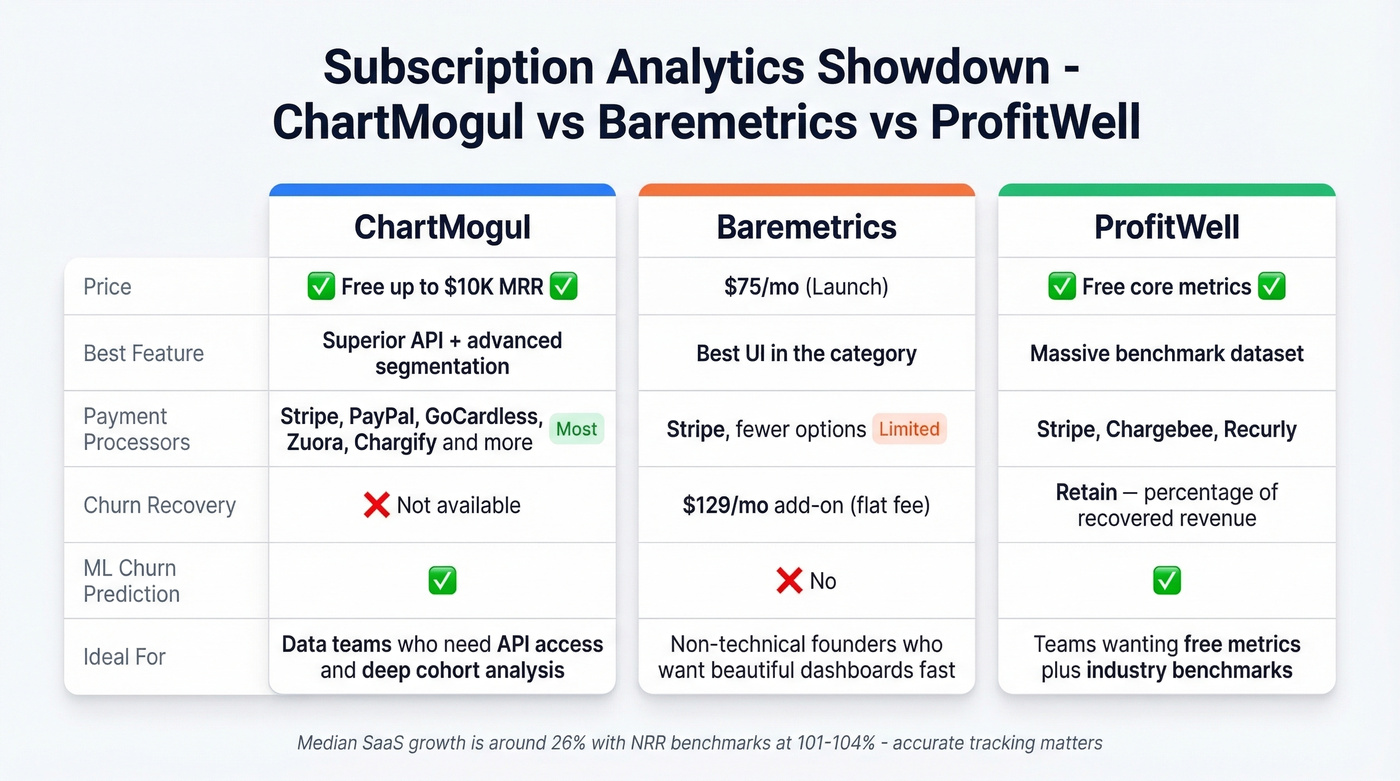
Once you outgrow free, pricing scales reasonably - $100/month at $10K-$75K MRR, $300/month at $75K-$300K MRR, $599/month above that. The API is superior to Baremetrics, and ChartMogul supports more payment processors than most alternatives, including PayPal, GoCardless, Zuora, Chargify, and Stripe. Advanced segmentation lets data teams slice cohorts the way users in r/SaaS constantly complain other tools can't handle. With median SaaS growth around 26% and NRR benchmarks hovering at 101-104%, having a tool that tracks these metrics accurately matters more than ever.
If churn is the metric you argue about most, start with a proper churn analysis workflow before you buy more dashboards.
Baremetrics
Baremetrics has the best UI in subscription analytics. Non-technical founders love it, and setup takes 5-10 minutes via Stripe OAuth. Pricing starts at $75/month for Launch (up to $360K ARR), $255/month for Growth, and $1,152/month at Scale. The Payment Recovery add-on at $129/month is genuinely useful - ChartMogul doesn't offer anything comparable.
The tradeoffs: pricing scales with your MRR and gets expensive fast, there are fewer payment processor integrations than ChartMogul, and there's no ML-powered churn prediction.
ProfitWell
Free core SaaS metrics, now owned by Paddle. The benchmark dataset is massive, which makes ProfitWell useful even if you use another tool for primary reporting. The Retain product charges a percentage of recovered revenue rather than a flat fee - a model that aligns incentives better than Baremetrics' flat $129/month recovery add-on.
CRM & Sales Analytics
HubSpot Sales Hub
HubSpot's free CRM tier includes enough reporting for most mid-market teams to skip buying a separate analytics tool entirely. Paid plans start at $20/user/month, and the 4.4/5 G2 rating reflects genuine ease of use. If you're already in the HubSpot ecosystem, native analytics here will save you from stitching together a BI layer you don't need.
If you're still evaluating platforms, it helps to compare a few examples of a CRM before committing.
Salesforce Sales Cloud & Pipedrive
Salesforce Sales Cloud at $25/user/month (4.4/5 G2) remains the enterprise standard - powerful analytics, but you'll need dedicated admin resources to build and maintain reports. Pipedrive at $14/user/month (4.3/5 G2) is the opposite bet: best visual pipeline for SMBs, limited on advanced analytics, but if you're a 5-person sales team, it's all you need.
If forecasting is the core pain, you’ll get more value from dedicated sales forecasting solutions than from generic reporting.
BI & Visualization
Tableau
Starting at $15/user/mo with a 4.4/5 G2 rating, Tableau is the right choice when you need custom dashboards pulling from multiple data sources - CRM, billing, product analytics - into one view. It doesn't replace category-specific tools, but it connects them. For teams already deep in the Salesforce ecosystem, the native integration is a real advantage.
How to Choose the Right Tool
If your average deal size is under $15K, you probably don't need Clari or Gong. A clean CRM, HubSpot's free analytics, and ChartMogul will get you 80% of the insight at 5% of the cost. The revenue analytics arms race has convinced too many teams they need enterprise tooling for mid-market problems.
If your pipeline feels “fine” but revenue is flat, check for common sales pipeline challenges before blaming the tools.
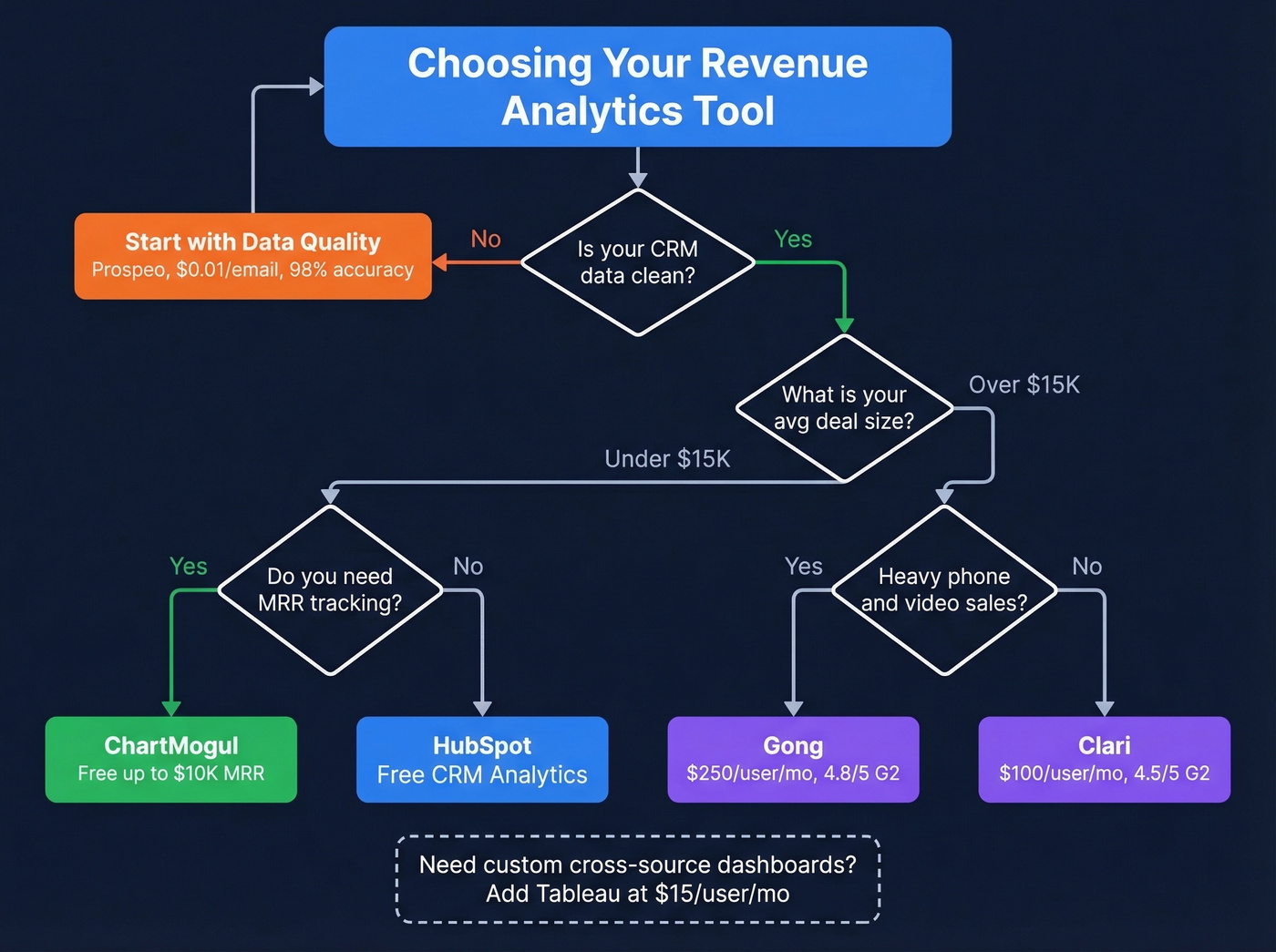
Three questions simplify the decision:
What revenue question are you answering? MRR tracking points to subscription analytics. Pipeline forecasting points to revenue intelligence. Custom cross-source reporting points to BI. Don't buy a Swiss Army knife when you need a screwdriver.
What's your budget? Free options exist in every category. You don't need to spend $40K to get started. Teams with misaligned revenue operations see 27% longer sales cycles and 18% higher CAC - but the fix is often better data and process, not more software.
Is your CRM data clean? If not, start there. Analytics on stale data is fiction. Technology sprawl increases TCO by $127,000/year on average - don't add another dashboard on top of bad data. One thread on r/B2BSaaS put it bluntly: "We spent six figures on attribution software before realizing our CRM contacts were 40% outdated."
In our experience, the teams that get the most from revenue analytics software are the ones that invest in data quality first and tooling second. If you need a structured approach, start with data-driven selling and then instrument the stack.
Spending $40K on Clari or Gong won't fix stale data. Prospeo covers 300M+ profiles with 98% email accuracy and intent signals across 15,000 topics - so your forecasts reflect reality, not last quarter's contacts.
Revenue intelligence starts with data you can trust. No contracts, no sales calls.
FAQ
What's the difference between revenue analytics and revenue intelligence?
Revenue analytics is the broad category covering any tool that measures, tracks, or forecasts revenue - including subscription dashboards, CRM reports, and BI tools. Revenue intelligence is a sub-category focused specifically on AI-powered pipeline forecasting and deal analysis, like Clari and Gong. All revenue intelligence is revenue analytics, but not vice versa.
What's the best free revenue analytics tool?
ChartMogul (free up to $10K MRR) for subscription metrics, ProfitWell (free core metrics) for SaaS benchmarking, and HubSpot (free CRM tier) for sales reporting. Prospeo's free tier includes 75 verified emails per month - enough to audit your CRM before committing to a paid analytics platform.
How long does implementation take?
Subscription tools like Baremetrics and ChartMogul connect via Stripe OAuth in 5-10 minutes. CRM-native tools like HubSpot and Salesforce are ready immediately if you're already on the platform. Enterprise revenue intelligence platforms like Clari and Gong typically take 6-8 weeks for full deployment including data integration and team training.
Can AI replace dedicated revenue analytics platforms?
Some founders use ChatGPT for basic revenue analysis - forecasting, cohort breakdowns, churn modeling on exported CSVs. It works for quick ad-hoc analysis, but it can't replace real-time dashboards, automated pipeline tracking, or team-wide visibility. Think of generative AI as a complement for one-off questions, not a substitute for systematic revenue measurement.