


7 Revenue Grid Alternatives Worth Evaluating in 2026
Revenue Grid does a lot of things well - activity capture, Salesforce sync, pipeline visibility. It carries a 4.6/5 on G2 across 573 reviews, with strong marks for ease of use (51 mentions) and customer support (29 mentions), plus consistent praise for Salesforce integration. But the complaints tell a consistent story: slow loading, glitches requiring troubleshooting, and Salesforce integration issues - ironic for a tool built around Salesforce.
Public pricing sits at $30/user/month for Activity Capture 360, $49/user/month for Knowledge Capture, and $149/user/month for Ultimate. The base tier is reasonable. The top tier? Harder to justify when the fundamentals are frustrating people.
Here's what actually deserves your attention.
Quick Picks
| Need | Pick | Starting Price |
|---|---|---|
| Activity capture | Cirrus Insight | $14/user/mo |
| Full sales engagement | Outreach | ~$100/user/mo |
| Conversation intelligence | Gong | ~$133/user/mo + platform fee |
| Revenue forecasting | Clari | ~$100/user/mo (quote-based) |
| CRM-native engagement | HubSpot Sales Hub | ~$100/user/mo |
| Enterprise sequences | Salesloft | ~$180/user/mo |
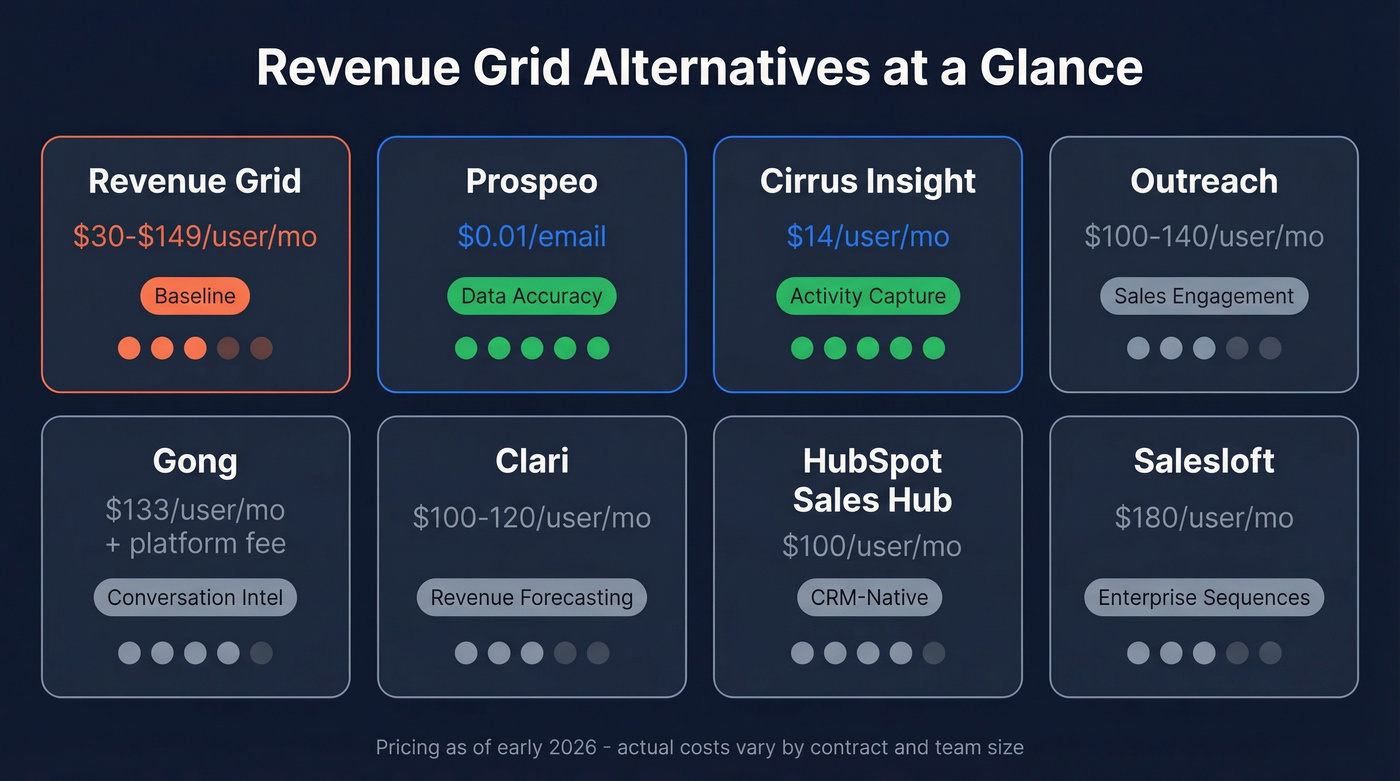
If you only need activity capture synced to Salesforce, Cirrus Insight at $14/mo is the obvious move. If your real problem is stale contact data feeding your CRM, fix that upstream first - no amount of activity capture helps when the emails in your sequences are bouncing.

Every tool on this list - Revenue Grid, Outreach, Salesloft - performs worse when your CRM is full of stale contacts. Prospeo's 7-day data refresh and 98% email accuracy eliminate the bounce rate problem before it reaches your sequences. At $0.01 per email, it costs less than a single bounced message costs your domain reputation.
Fix the data layer first. Everything downstream gets better.
Best Revenue Grid Alternatives for 2026
Prospeo
Use this if: Your real problem isn't activity capture - it's that the contact data feeding your CRM is stale, bouncing, or incomplete.
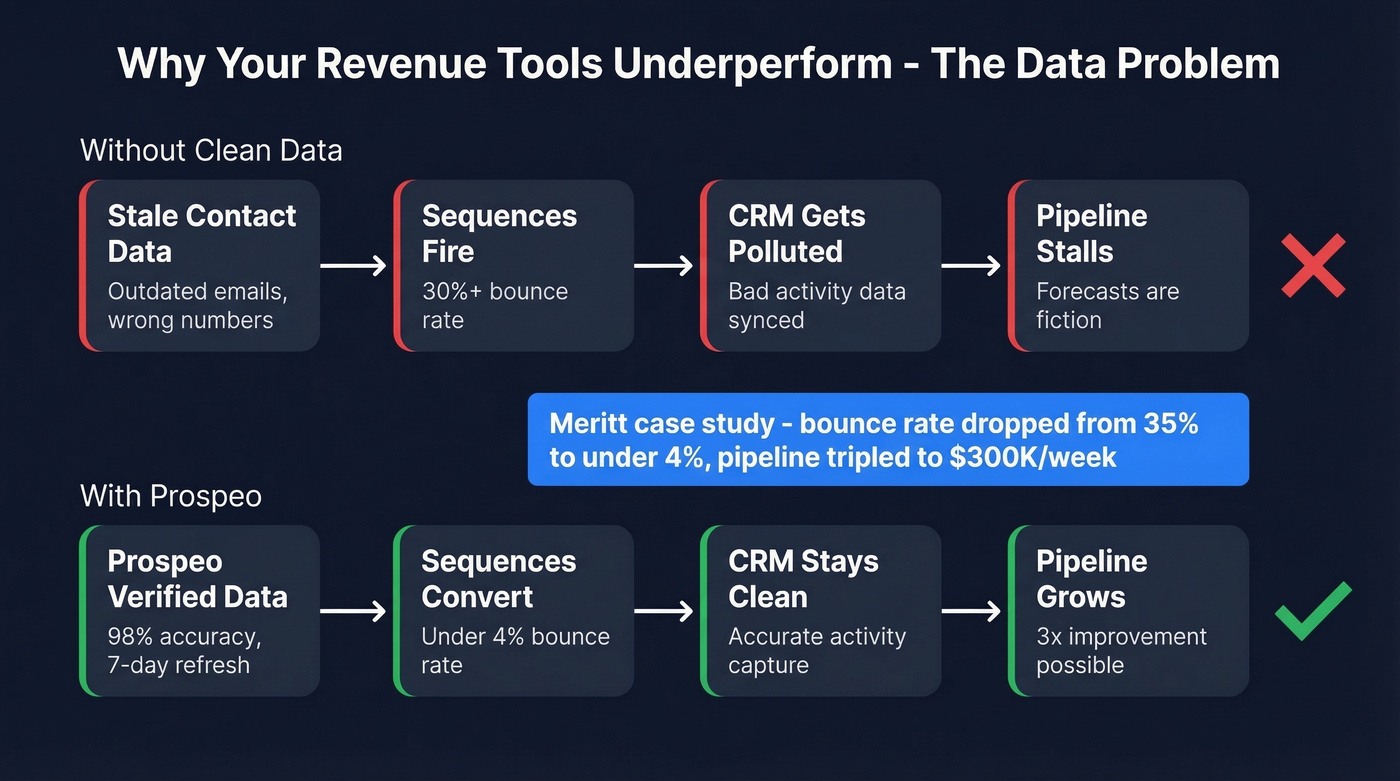
We've seen this pattern dozens of times: a team invests in a revenue platform, builds out sequences, syncs everything to Salesforce, and then watches bounce rates climb past 30% because the underlying data is garbage. Activity capture is useless if the emails and phone numbers in your sequences are wrong.
Prospeo fixes that upstream. The platform covers 300M+ professional profiles with 98% email accuracy and a 7-day refresh cycle - the industry average is six weeks. That includes 143M+ verified emails and 125M+ verified mobile numbers with a 30% pickup rate. At roughly $0.01 per email, it's a fraction of what enterprise data tools charge. The free tier gives you 75 verified emails per month with no credit card and no contract.
Pair it with Cirrus Insight or your CRM's native logging and you've got both layers covered: accurate data going in, reliable sync keeping it current. Native integrations with Salesforce, HubSpot, Smartlead, Instantly, Lemlist, Salesloft, Outreach, Clay, Zapier, n8n, and Make mean it slots into whatever stack you're already running. One customer, Meritt, saw their bounce rate drop from 35% to under 4% and their pipeline triple from $100K to $300K per week - the kind of improvement that makes every downstream tool work better.
Cirrus Insight
Use this if: You're on Salesforce, you want clean activity capture, and you don't need pipeline intelligence or sequencing.
Cirrus Insight syncs emails, attachments, calendar events, and tasks directly to your Salesforce org - not to a third-party database. It supports every Salesforce edition and cloud, and over 3,000 organizations run it today.
Skip this if you need forecasting, deal intelligence, or multichannel sequences. This is a sync tool, not a revenue platform.
Pricing is straightforward: $14/user/mo for Salesforce Sync, $21 for Pro (adds sidebar and scheduling), and $49 for Expert with email blasts, buyer signals, and tracking. G2's alternatives page tags Cirrus Insight as "more expensive" than Revenue Grid, but the base Salesforce Sync plan at $14 vs Revenue Grid's $30 tells a different story. You can also buy different seat counts per feature, so not everyone needs the Expert plan.
This question comes up regularly on r/salesforce - teams running Microsoft/Outlook stacks want to know whether Cirrus or Revenue Grid handles activity capture better. If you want a lower-priced, Salesforce-native sync setup, Cirrus is the cleanest place to start.

Outreach
Outreach is the deepest sales engagement platform on the market. Sequences, A/B testing, analytics, deal management, and forecasting - all under one roof. For 50+ rep orgs running complex multichannel cadences, it's built for that scale.
The cost reflects it. Base Engage pricing runs $100-$140/user/mo, with add-ons for meeting intelligence ($30-$50), deal management ($30-$50), and forecasting ($20-$40). A 50-user Engage deployment lists at roughly $72K/year before negotiation, and 15-35% discounts are common. Implementation costs $5K-$25K. Annual contracts only.
Let's be honest: if you only need activity capture, Outreach is a sledgehammer for a nail. G2 reviewers flag it as slower to reach ROI than Revenue Grid, which tracks - there's a lot of platform to configure before your reps see value.
If you're building a modern outbound motion, your sales engagement platform choice matters less than whether your team can execute consistently.
Gong
Best-in-class conversation intelligence. Gong offers call recording, deal insights, and coaching tools that change how managers run pipeline reviews. G2 reviewers tag it as easier to set up than Revenue Grid.
The pricing model is a three-part hit: platform fee ($5K-$50K/year), per-user licenses (~$1,360-$1,600/user/year), and onboarding ($7.5K-$28.5K). A 10-user deployment runs roughly $28,500 in year one. This isn't a Revenue Grid replacement - it's an upgrade to a different category entirely. Only worth it if conversation intelligence is the specific gap you're trying to fill.
Clari
Clari plays in revenue forecasting and pipeline management, not activity capture. If you're leaving Revenue Grid because you need better forecast accuracy and deal visibility, this is the upgrade path.
Pricing is quote-based, starting around $100-$120/user/mo, but total costs reach $200-$310+ once you add modules and professional services ($15K-$75K implementation, 8-16 week timeline). Clari claims 448% ROI and 15% faster deal cycles. If People.ai is also on your radar, it covers similar ground with a focus on activity data; pricing is enterprise quote-based, typically $20K-$100K+/year.
If forecasting is the real gap, compare it against other sales forecasting solutions before you commit.
HubSpot Sales Hub
If you're already on HubSpot's CRM, Sales Hub is the path of least resistance. Professional includes 15 deal pipelines, while Enterprise supports up to 100 and adds custom objects plus predictive lead scoring.
Pricing runs around $100/user/mo for Pro and around $150/user/mo for Enterprise. It's not a direct Revenue Grid replacement - it's a "why am I using a separate tool when my CRM does this?" play. The integration overhead is minimal, which matters more than most feature comparisons suggest.
If you're still deciding on the CRM layer, it helps to look at real examples of a CRM and what they cover natively.
SalesLoft
Salesloft competes directly with Outreach in the enterprise engagement space. Advanced tier benchmarks at roughly $180/user/mo, with Premier running 20-40% higher. The dialer is an add-on.
If you're evaluating both Outreach and Salesloft, trial both and let your reps pick based on UI preference. The feature sets are nearly identical at this point - the decision comes down to which workflow your team actually enjoys using daily.
Choosing by Budget
Here's the thing: most teams overspend on sales tools because they buy a platform when they need two focused tools working together.
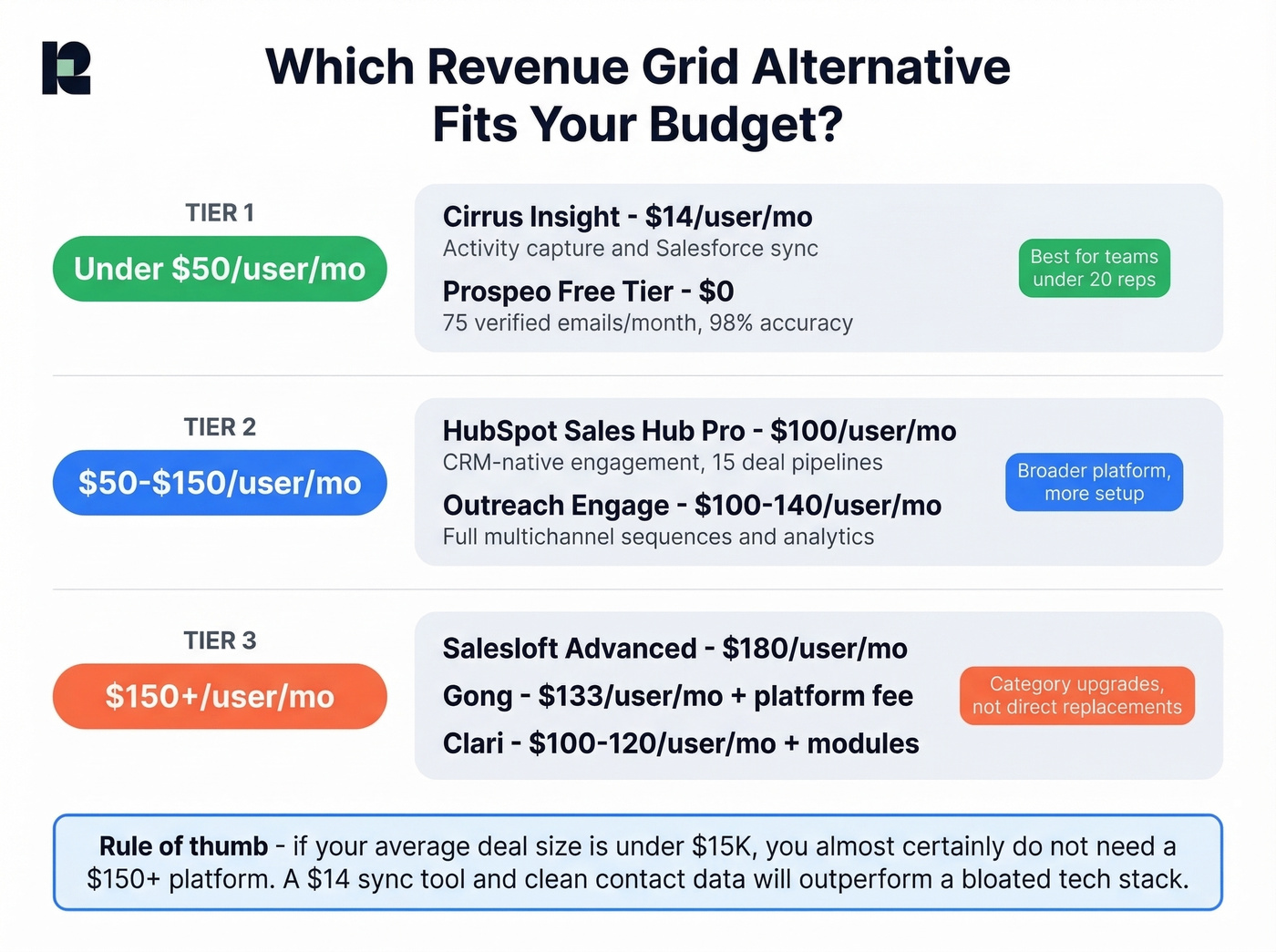
Under $50/user/mo: Cirrus Insight for activity capture plus Prospeo's free tier for data accuracy. We've seen teams get most of the value they wanted from Revenue Grid at a fraction of the cost with this combo - clean data going in, reliable sync keeping Salesforce current, and nothing extra cluttering the stack.
$50-$150/user/mo: HubSpot Sales Hub Pro or Outreach's base tier. You're getting a broader platform but paying for features you won't need yet if your team is under 20 reps.
$150+/user/mo: Gong, Clari, or Salesloft. These aren't Revenue Grid replacements - they're category upgrades. Budget accordingly, and make sure the specific capability gap justifies the spend.
If your average deal size is under $15K, you almost certainly don't need a $150+/user/mo revenue platform. A $14 sync tool and clean contact data will outperform a bloated tech stack that your reps half-use.
If bounce is part of the pain, start with email deliverability and email bounce rate fundamentals before you blame the engagement tool.
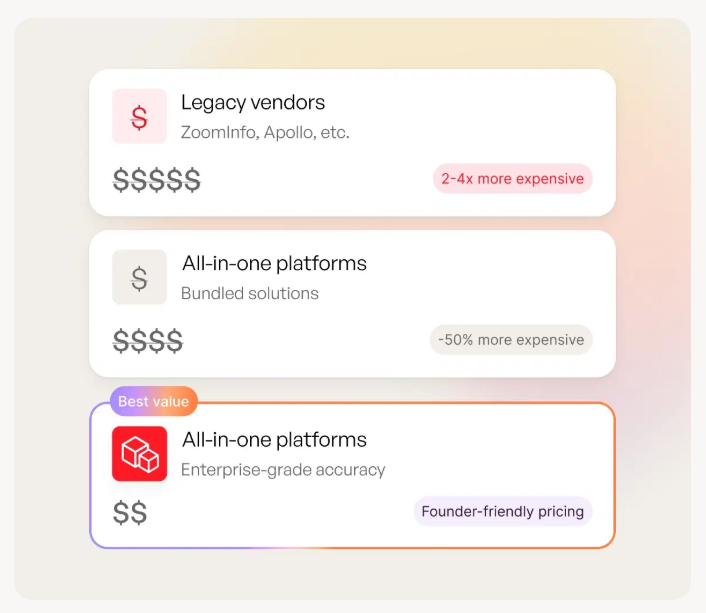
Meritt dropped their bounce rate from 35% to under 4% and tripled pipeline to $300K/week - not by switching engagement tools, but by fixing the contact data feeding them. 300M+ profiles, 143M+ verified emails, 125M+ verified mobiles, native Salesforce and HubSpot integrations. No contract required.
Start with 75 free verified emails - no credit card needed.
FAQ
Is Revenue Grid worth the price?
At $30/mo for activity capture, it's reasonably priced. The $149 Ultimate tier is harder to justify given persistent loading and sync complaints on G2. Most teams only need the base tier - and Cirrus Insight does that job for $14/user/mo.
What's the cheapest alternative to Revenue Grid?
Cirrus Insight at $14/user/mo for Salesforce Sync is the cheapest direct replacement for activity capture. Prospeo's free tier handles contact data verification at zero cost - 75 emails per month with 98% accuracy, no credit card required.
Can I replace Revenue Grid with multiple focused tools?
Yes, and many teams should. Pairing a focused activity capture tool like Cirrus Insight ($14/mo) with a data accuracy layer like Prospeo (free to $0.01/email) gives you cleaner CRM data and reliable sync without paying for an all-in-one platform you'll only half-use. That's the approach we recommend for teams under 50 reps.