

The Best Revenue Operations Tools in 2026 - With Actual Pricing
A RevOps lead we know ran a stack audit last quarter. Twelve tools, $180K in annual spend, and the forecasting platform was pulling from a CRM where 40% of contact records hadn't been updated in six months. The forecast was fiction.
That's not unusual. 47% of RevOps professionals rate their stack ROI as average or worse, and 75% cite data inconsistencies as their biggest frustration. The market's consolidating fast - the Clari-Salesloft merger closed in late 2025, Highspot and Seismic announced intent to merge in early 2026, and Gartner published its first Magic Quadrant for Revenue Action Orchestration. The tools are converging. The question isn't which category to buy into. It's which specific tools earn their seat.
Our Picks (TL;DR)
- Prospeo - Best for data enrichment and CRM accuracy. 98% email accuracy, ~$0.01/email, free tier available.
- Clari - Best for revenue forecasting. Starts ~$820/user/year. G2 4.6/5.
- Gong - Best for conversation intelligence. G2 4.8/5. Budget $28K+ year one for small teams.
Top RevOps Tools for 2026
Prospeo - Data Enrichment & Verification
Use this if you need a data quality layer that keeps your CRM fresh - not just at import, but continuously.
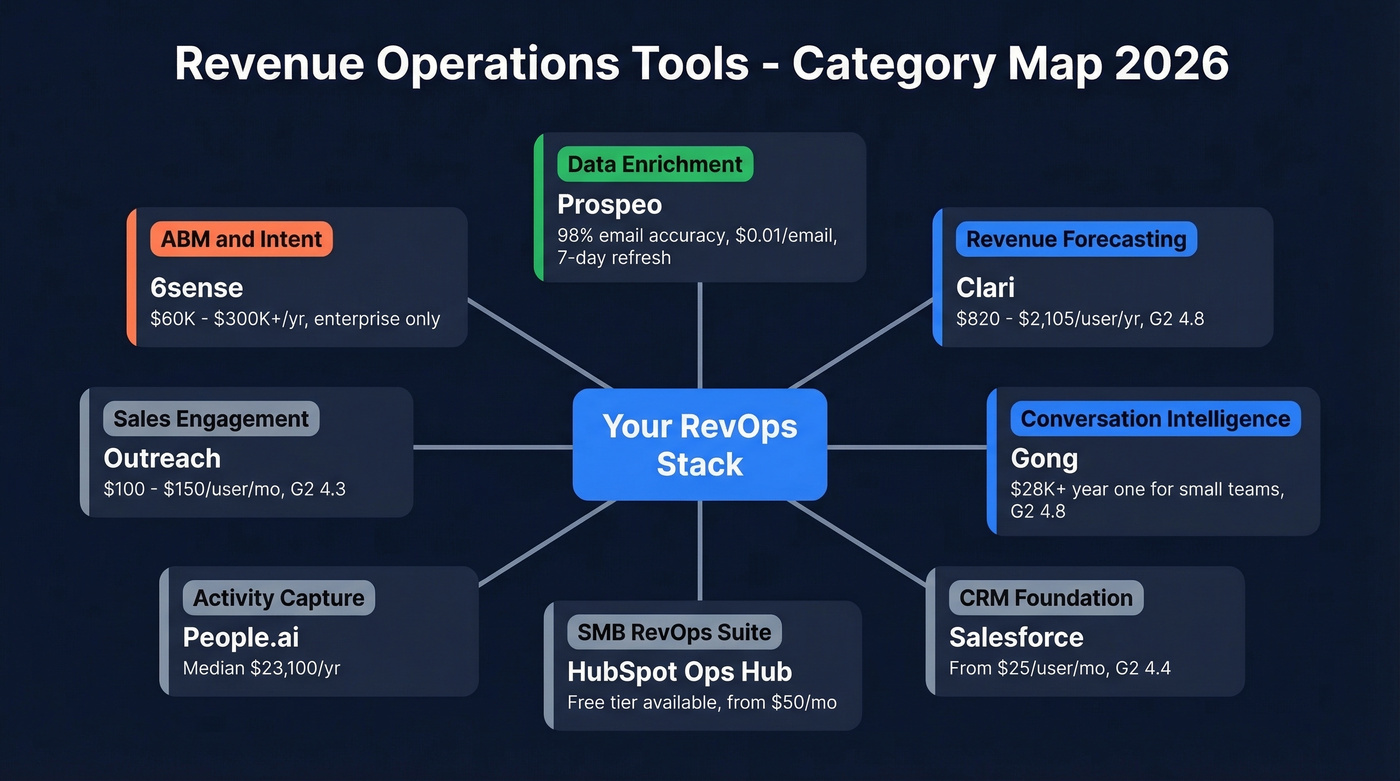
Prospeo covers 300M+ professional profiles and 143M+ verified emails with 98% accuracy, plus 125M+ verified mobile numbers hitting a 30% pickup rate. The 7-day data refresh cycle is the real differentiator here; the industry average sits around six weeks, which means most enrichment tools are feeding your CRM stale records by default. CRM and CSV enrichment returns 50+ data points per contact at a 92% API match rate, and 83% of leads come back with usable contact data. You also get native integrations with Salesforce, HubSpot, Smartlead, Instantly, Lemlist, Clay, Zapier, and Make, plus intent data covering 15,000 Bombora topics for layering buyer signals on top of firmographic filters.

Pricing is credit-based at roughly $0.01 per email, with a free tier (75 emails/month + 100 Chrome extension credits/month). No contracts, no sales calls required.
Here's a concrete example: Snyk's 50-person AE team was running bounce rates of 35-40%. After switching to Prospeo, bounces dropped under 5%, and AE-sourced pipeline jumped 180%.
Skip this if you need a full-suite GTM platform with built-in sequencing and a dialer. Pair it with Outreach or Smartlead for the engagement layer.
Clari - Revenue Forecasting
Clari is the category leader for pipeline and forecast calls, especially after the Salesloft merger gave the combined company ~$450M ARR and a broader engagement footprint. Pricing runs ~$820/user/year for Essentials and ~$2,105/user/year for Growth based on Vendr negotiation benchmarks. A full Copilot deployment for 100 users lands around $161K/year. Implementation adds $15K-$75K and takes 8-16 weeks depending on complexity. G2 rating: 4.6/5.

Skip this if you're under 50 reps. The 60% over-purchase rate in year one is real - teams buy modules they don't need and waste $30K-$50K before they figure out what they actually use.
Gong - Conversation Intelligence
Gong's G2 rating (4.8/5, Top Trending) isn't accidental. The product genuinely surfaces deal risk and coaching insights that other tools miss. But the pricing model punishes small teams.

Three layers hit your budget simultaneously: a mandatory platform fee ($5K-$50K/year depending on team size), per-user licenses ($1,200-$3,000/user/year), and implementation ($15K-$65K). A 5-person team should budget ~$28K in year one. A 50-person team hits ~$170K. Expect year-one costs to land 40-60% above your initial seat math once fees and services are included. Contracts lock you in for 2-3 years with 5-15% annual renewal uplifts and early termination penalties of 50-100% of remaining value.
Skip this if you're a startup with fewer than 10 reps. The platform fee alone makes per-seat economics brutal at small scale.
Salesforce Sales Cloud - CRM Foundation
Calling Salesforce a RevOps tool is like calling a foundation a house - technically accurate, practically misleading. It starts at $25/user/month, and deployments that add Revenue Cloud + Agentforce can run ~$500-$650/user/month. G2 rates it 4.4/5 across 25,480+ reviews. Most RevOps stacks either run on Salesforce or were built to avoid it. Table stakes, not a differentiator.
HubSpot Operations Hub - SMB RevOps
The path of least resistance for SMBs that want CRM, automation, and data quality in one platform. Free tier available, paid plans start around ~$50/month. Native workflow automation handles deduplication and basic data formatting without a separate tool. For teams under 30 who don't want to manage five integrations, it's the pragmatic choice.
People.ai - Activity Capture
Automates activity logging - emails, meetings, calls - and maps them to pipeline. Vendr benchmarks across 47 purchases put the median contract at $23,100/year, with a range from $2,300 to $117K. Best for enterprise teams that need automated CRM hygiene without relying on reps to log activities manually.
Outreach - Sales Engagement
Multi-channel sequencing across email, phone, and social with strong workflow automation. Mid-market teams typically pay $100-$150/user/month on annual contracts. G2 rates it 4.3/5. It's the execution layer between your data platform and your CRM.
6sense - ABM & Intent
Enterprise-only ABM and intent platform. Pricing runs $60K-$300K+/year depending on modules and account volume. Worth evaluating if you're running account-based strategies at scale with dedicated ABM headcount. Overkill for everyone else.

47% of RevOps teams rate their stack ROI as average or worse - and stale data is the #1 reason. Prospeo refreshes 300M+ profiles every 7 days (not 6 weeks), returns 50+ data points per contact at a 92% match rate, and plugs directly into Salesforce and HubSpot. Snyk's 50 AEs cut bounce rates from 35% to under 5% and grew AE-sourced pipeline 180%.
Stop forecasting on fiction. Start with data that's actually current.
Pricing at a Glance
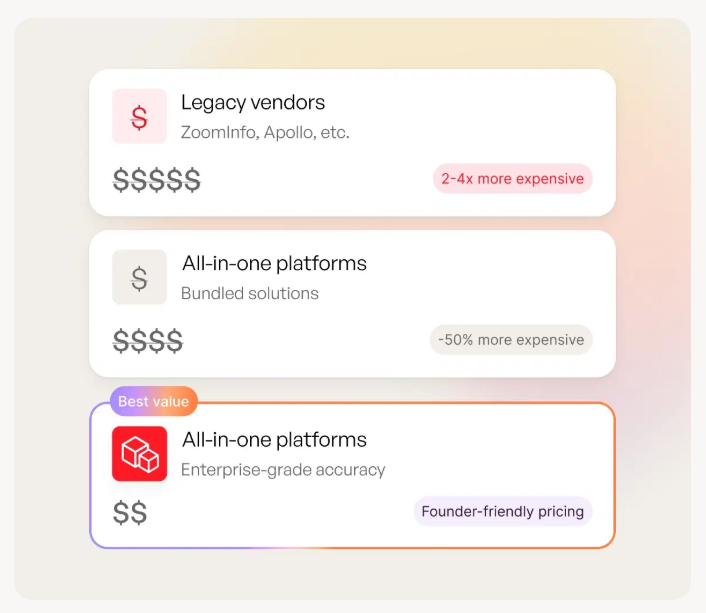
| Tool | Typical Annual Cost | Contract Terms | G2 Rating |
|---|---|---|---|
| Prospeo | ~$0.01/email; free tier | No contract | - |
| Clari | $820-$2,105/user/yr | Annual; volume discounts at 75+ users | 4.6/5 |
| Gong | $1.2K-$3K/user/yr + platform fee | 2-3 yr lock-in; 5-15% annual uplift | 4.8/5 |
| Salesforce | From $25/user/mo | Annual | 4.4/5 |
| HubSpot Ops Hub | From ~$50/mo; free tier | Monthly or annual | - |
| People.ai | Median ~$23,100/yr | Custom; typically annual | - |
| Outreach | ~$100-$150/user/mo | Annual | 4.3/5 |
| 6sense | $60K-$300K+/yr | Annual; enterprise contracts | - |
Build Your Stack by Team Size
You don't need ten tools. You need four that talk to each other.
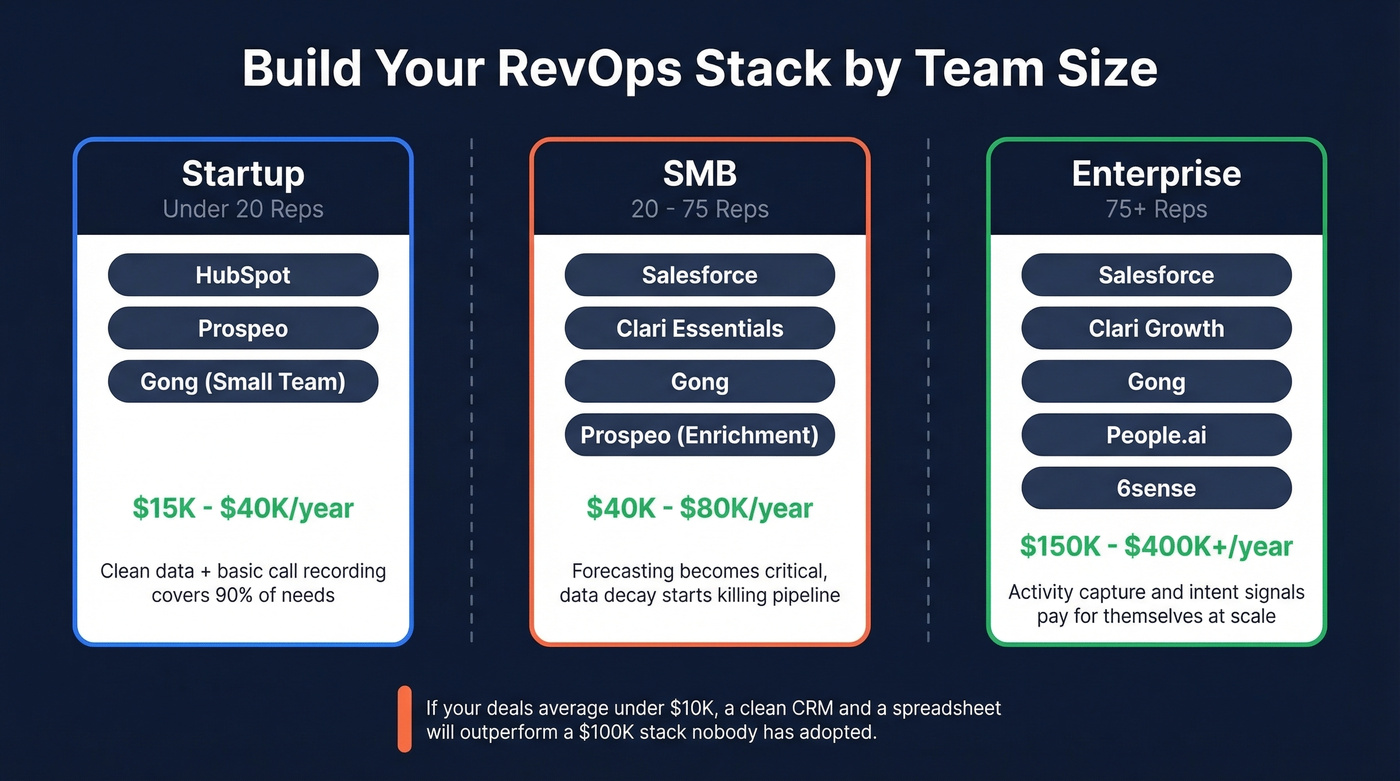
Startup (under 20 reps): HubSpot + Prospeo + Gong (small team plan). Total: ~$15K-$40K/year. At this stage, clean data and basic call recording cover 90% of what you actually need.
SMB (20-75 reps): Salesforce + Clari Essentials + Gong + a dedicated enrichment layer. Total: ~$40K-$80K/year. This is the stage where sales forecasting becomes critical and data decay starts killing pipeline. We've seen teams at this size lose 15-20% of their pipeline to bad contact data alone.
Enterprise (75+ reps): Salesforce + Clari Growth + Gong + People.ai + 6sense. Total: $150K-$400K+/year. At this scale, automated activity capture and intent signals pay for themselves.
Let's be honest about something: if your deals average under $10K, you probably don't need Clari or Gong at all. A well-maintained CRM with clean data and a spreadsheet forecast will outperform a $100K stack that nobody's adopted. Only ~4% of RevOps teams report using AI extensively, and only a third have automated more than half their processes. The bottleneck is almost never the tool - it's the data and the discipline.
Mistakes That Kill RevOps Stacks
Over-purchasing in year one. 60% of Clari buyers initially over-purchase, wasting $30K-$50K on features they never activate. We've watched teams blow through budget on revenue operations software that sits untouched for a full contract cycle. Start with the lowest tier that solves your immediate problem. Upgrade when you've proven adoption.
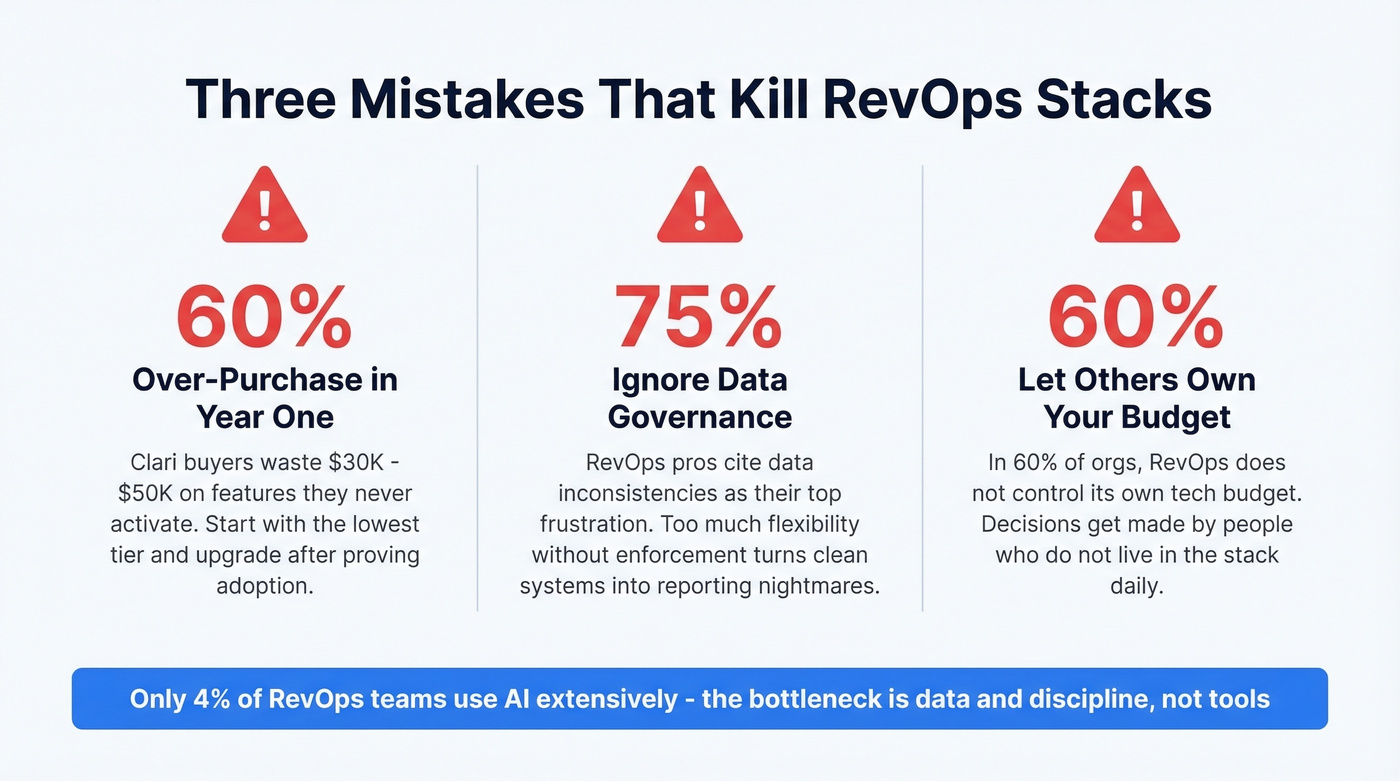
Ignoring governance. A RevOps practitioner on Reddit put it bluntly: too much flexibility without enforcement turns a clean system into a "reporting nightmare." Set field-level rules, enforce them, audit quarterly. This isn't glamorous work, but it's the difference between a stack that compounds value and one that compounds confusion.
Letting someone else own your budget. In 60% of organizations, RevOps doesn't control its own tech budget. That means purchasing decisions get made by people who don't live in the stack daily. Fight for budget ownership - or at minimum, veto power over what gets added and renewed.
You're spending $100K+ on forecasting, engagement, and conversation intelligence - but none of it works if 40% of your CRM contacts are stale. Prospeo's enrichment layer costs ~$0.01/email with no contracts, delivers 98% email accuracy, and keeps every record fresh on a 7-day cycle. It's the cheapest line item in your stack and the one that makes every other tool perform.
The highest-ROI RevOps tool is the one that makes every other tool accurate.
FAQ
What's the average payback period for RevOps tools?
G2 data puts the average payback period at roughly 9 months, with about 70% user adoption across implementations. Teams that have had RevOps in place for 3+ years report stronger results - 63% say their stack directly supports revenue growth. The key is adoption, not just purchase.
Do I need a dedicated enrichment tool?
Yes. When 75% of RevOps professionals cite data inconsistencies as their top frustration, the answer isn't "maybe." Stale records degrade forecasting, outreach, and routing downstream. A 7-day refresh cycle and verified emails prevent the decay that makes every other tool in your stack unreliable. Free tiers let you validate before committing budget.
How much should a mid-market team budget?
A core stack - CRM, enrichment, forecasting, and conversation intelligence - typically runs $40K-$80K/year for a 20-75 person revenue team. Gong's platform fee hits smaller teams disproportionately hard, so negotiate multi-year terms and start with essential tiers to keep year-one spend controlled.