

You're in a board meeting at a $3-5M ARR SaaS company, and the CEO wants to know exactly how much pipeline lift to expect from "investing heavily in sales automation tech." Not vague promises - actual percentages, timelines, and hidden costs. Revenue leaders on Reddit ask the same question constantly: "What's the actual pipeline increase percentage, and how long to ROI?" Meanwhile, 20-70% of CRM projects fail outright, and the automation tools stacked on top of them fail even more quietly.
Revenue pipeline automation isn't a technology problem. It's a sequencing problem, and most teams get the sequence wrong.
Three Things Before You Read Further
- Revenue pipeline automation only works when the data feeding it is clean. Start there, not with workflows.
- You need five tools, not fifteen: CRM + engagement platform + orchestration layer + data provider + revenue intelligence.
- The biggest ROI comes from automating the MQL-to-SQL handoff - a 15-21% blended conversion rate across industries. A 5-point improvement at that stage lifts revenue up to 18%.
What Is Revenue Pipeline Automation?
Revenue pipeline automation uses software to move prospects through your full revenue lifecycle - from first marketing touch through sales close to customer expansion - with minimal manual intervention at each handoff.
Three related concepts get confused constantly. Revenue automation covers the full client lifecycle: lead capture, proposals, billing, payments. Revenue management automation focuses on pricing optimization and forecasting. Revenue recognition automation is an accounting function, dealing with compliance after payment hits the books. When people say "revenue pipeline automation," they mean the first one, applied across marketing, sales, and customer success.
The key difference from plain "sales pipeline automation" is scope. Sales pipeline automation starts at opportunity creation. Revenue pipeline automation starts at the first anonymous website visit and extends through renewal. That full-funnel framing makes it a RevOps discipline, not just a sales ops project.
Why It Matters in 2026
Organizations running unified revenue operations tools grow up to 19% faster than those stitching together siloed systems. That's not a marginal edge - it's the difference between hitting plan and missing by a quarter.
Over 55% of sales leaders say inaccurate forecasting costs them revenue targets every quarter. Reps spend 71% of their time on non-selling tasks: data entry, CRM updates, meeting prep, internal reporting. And 45% of teams have already adopted a hybrid AI-SDR model, blending human judgment with AI-driven research and outreach.
With average CRO tenure at roughly 18 months, you don't have time for a multi-year automation rollout that breaks on quarter three. If you aren't finding ways to automate pipeline stages now, you're structurally slower than competitors who are.
2026 Pipeline Benchmarks
Before automating anything, you need to know what "normal" looks like. Here are benchmarks compiled from 40+ studies:
| Metric | SMB / Mid-Market | Enterprise |
|---|---|---|
| Visitor to Lead | 1.4% | 0.7% |
| Lead to MQL | 41% | ~35% |
| MQL to SQL | 39% | 31% |
| SQL to Opportunity | 42% | 36% |
| Opp to Close | 39% | 31% |
| Lead-to-Customer | 2-5% | 2-5% |
| Median Cycle | ~84 days | 84+ days |
| Win Rate | 20-30% | 20-30% |
The 15-21% figure cited earlier represents the blended cross-industry benchmark; segment-specific rates run higher as shown above. Either way, this stage is where most pipelines bleed out. Improving that conversion by just 5 percentage points lifts total revenue up to 18% - the single highest-ROI automation investment most teams can make.
Channel matters too: SEO-sourced leads convert MQL-to-SQL at 51% vs. 26% for PPC. Worth factoring into your automation priorities.
There's also a brutal time dimension. Opportunities closed within 50 days carry a 47% win rate. After 50 days, that drops to 20% or lower. Speed through the pipeline isn't just nice - it's the primary predictor of whether you win.
Data Quality Comes First
Here's the thing: the entire automation stack sits on a hierarchy. Data, then Reporting, then Insights, then Predictions. Skip the foundation and everything downstream breaks. You can't forecast accurately if your CRM data is garbage. You can't route leads correctly if contact records are stale. You can't automate follow-ups if half your emails bounce.
And 92% of companies acknowledge that key data sits outside their centralized systems - meaning most automation runs on incomplete inputs from day one.
Less than 40% of organizations fully implement their CRM in a way that drives reliable data flow. That's not a CRM problem - it's a "common data language" problem. When one team defines "opportunity created" as "had a discovery call" and another defines it as "received a signed NDA," your win rates and cycle metrics become meaningless. Automation amplifies that inconsistency at scale.
Picture this: an SDR makes 200 calls in a day. Forty numbers are wrong. Thirty email follow-ups bounce. That's 35% of their activity wasted before any selling happens, and it's a data problem, not a skills problem. Snyk's 50-person AE team - each prospecting just 4-6 hours per week - saw bounce rates drop from 35-40% to under 5% after switching to Prospeo, with AE-sourced pipeline up 180% and 200+ new opportunities per month. A 7-day data refresh cycle versus the six-week industry average is the difference between reaching real people and shouting into the void.
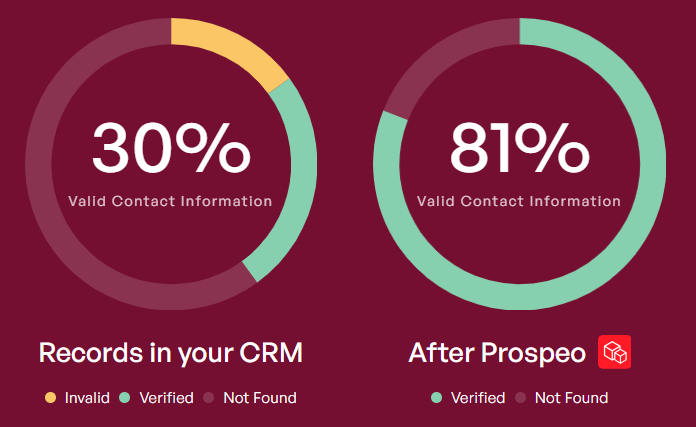

You just read that 35% of SDR activity gets wasted on bad data. Snyk cut bounce rates from 35-40% to under 5% and grew AE-sourced pipeline 180% with Prospeo's 7-day refresh cycle and 98% email accuracy. Revenue pipeline automation starts with data that actually connects you to real buyers.
Stop automating on top of garbage data. Start with Prospeo.
Stage-by-Stage Playbook
Pipeline stages should reflect buyer decisions, not seller activities. Here's a probability-mapped framework with the automations that matter at each stage:
| Stage | Win Probability | Key Automation |
|---|---|---|
| Qualified Lead | 10% | Auto-routing by territory/industry |
| Discovery Complete | 20% | Activity capture, meeting notes sync |
| Solution Presented | 40% | Follow-up sequence triggered |
| Evaluation Active | 60% | Deal rot alert (14-day threshold) |
| Proposal Under Review | 75% | Proposal-opened triggers stage advance |
| Verbal Commit | 90% | Contract generation triggered |
| Contract Sent | 95% | Signature reminder sequence |
The automations that deliver the most value aren't exotic. Activity capture alone eliminates 60-70% of manual CRM data entry. Deal rot alerts at 7, 14, and 21 days of inactivity surface stalled deals before they die quietly. Weighted-stage forecasting improves accuracy by 25% over gut-feel methods.
Automated follow-up sequences increase close rates by 30-40%, but only if they're varied - monotonous sequences see 80% lower response rates, so build in variation. If you need a starting point, use proven sales follow-up templates instead of improvising.
Here's a stat that should haunt every sales manager: 80% of sales require five or more follow-ups, but 44% of reps give up after one. Automation doesn't just improve efficiency - it enforces the persistence that humans naturally abandon. We've tested dozens of follow-up cadence structures, and the ones that actually work combine automated touchpoints with human-triggered steps at decision moments. Set your pipeline coverage ratio target at 3-4x your revenue goal, and let stage-triggered sequences do the work of keeping deals moving.
The 2026 Revenue Pipeline Automation Stack
You need five layers. Not fifteen tools - five layers, each with one primary tool.
| Layer | Tool | Starting Price | Best For |
|---|---|---|---|
| CRM | HubSpot | Free, ~$890/mo for Marketing Hub Pro | 80% of teams |
| CRM | Salesforce | ~$25-300/user/mo | Enterprise customization |
| Engagement | Outreach | ~$100-150/user/mo | AI coaching + sequences |
| Engagement | Salesloft | ~$100-150/user/mo | Teams already in the ecosystem |
| Orchestration | Zapier | Free, ~$20/mo paid | Startup-friendly |
| Orchestration | Make | Free, ~$10/mo paid | Complex multi-step logic |
| Orchestration | Workato | ~$10K-50K/yr | Enterprise governance |
| Data | Prospeo | Free, ~$0.01/email | Verified emails, mobiles, enrichment |
| Data | Bombora | ~$25K-50K/yr | Intent signals (15,000 topics) |
| Intelligence | Gong | ~$100-150/user/mo | Conversation analytics |
| Intelligence | Clari | ~$1K-3K/mo | Revenue forecasting |
CRM: Ask One Question
Do you need deep customization? If yes, Salesforce - but budget $50-150K/year for licenses plus admin. If no, HubSpot. Free CRM to start, ~$890/month for Marketing Hub Professional where most of the automation value lives. That covers roughly 80% of teams. Skip this if you're under $1M ARR and still closing deals from a spreadsheet - you've got bigger problems than CRM selection. If you’re still evaluating options, here are examples of a CRM with real pricing.
Engagement: Speed Over Features
Outreach's AI coaching closes deals 11 days faster on average and lifts win rates by up to 10 percentage points on deals over $50K. Salesloft offers similar capability. Pick the one your team will actually use - the best engagement platform is the one reps don't circumvent. If you’re rolling this out, follow a structured plan for implementing a sales engagement platform.
Orchestration: Simpler Than You Think
High-performing RevOps teams automate nearly 70% of repetitive workflows. Zapier is the startup default. Make handles more complex multi-step logic at a lower price point. One B2B SaaS company improved lead routing accuracy by 30% using multi-branch triggers - that's the kind of lift orchestration delivers when you use it to handle pipeline stage transitions instead of asking reps to manually update fields.
Data: The Upstream Input That Makes Everything Work
Let's be honest: most teams overspend on intelligence tools and underspend on data quality. A $150/user/month conversation analytics platform is worthless if your reps are calling wrong numbers and bouncing emails. Fix the inputs first. If you’re comparing vendors, start with a shortlist of data enrichment services and validate accuracy on your own ICP.
Intelligence: Layer On Last
Gong and Clari are powerful - after your CRM data is clean and your pipeline stages are defined. They're useless without reliable inputs. We've seen teams spend six figures on revenue intelligence only to discover their stage definitions were inconsistent across regions, making every AI-generated forecast meaningless. If forecasting is the main pain, look at dedicated sales forecasting solutions before adding more tooling.
AI in Revenue Pipeline Automation
Where AI actually helps and where it creates expensive problems:
Worth automating: research and personalization (90% time reduction), predictive lead scoring (138% ROI vs. non-predictive), forecasting (20-50% more accurate than manual), activity capture, meeting scheduling, and follow-up sequencing.
Keep human: discovery conversations, pricing negotiations, strategic account planning, relationship-building with buying committees, and any decision where context changes the answer.
The 45% of teams running hybrid AI-SDR models are getting it right - AI handles research, personalization, and initial outreach while humans handle everything that requires judgment. The contrarian take that keeps proving true: AI on a messy CRM amplifies the mess. If your opportunity definitions are inconsistent and your contact data is stale, predictive models will confidently predict the wrong things. If you want a practical framework, start with modern lead scoring that’s tied to stage conversion, not vanity engagement.
The 50-day win-rate cliff means speed matters more than sophistication. A simple automation that moves deals through stages faster will outperform a complex AI forecasting model sitting on top of dirty data every time.
Five Automation Mistakes That Kill Pipeline
Automating broken workflows. If your manual process is chaos, automation gives you faster chaos. Map the workflow first, fix it, then automate.
CRM data distrust. When reps don't trust the data, they build shadow spreadsheets - and your automation runs on fiction. Less than 40% of organizations fully implement their CRM. That's the root cause.
Qualification theater. MEDDIC fields filled for compliance, not decisions. We've seen teams where every deal has "Economic Buyer: identified" but nobody can name the person. Automation can't fix performative data entry. If you use MEDDIC, align the team on MEDDIC sales qualification so fields reflect real buyer progress.
Automation overkill. Forty-seven Slack notifications per deal, automated emails on every stage change, three reminder sequences running simultaneously. [70% of companies struggle](https://www.glyphic.ai/post/5-revenue-execution-mistakes-costing-your-team-pipeline - and-how-to-fix-them) to integrate sales plays into their CRM - adding more automated noise makes it worse.
Automating judgment instead of labor. Automate data entry, routing, and follow-up scheduling. Don't automate whether to discount, when to escalate, or how to handle a competitor objection. Those require context that no workflow engine has.
Every day a deal sits past 50 days, your win rate drops from 47% to under 20%. Speed through the pipeline depends on reaching the right person the first time - not bouncing off stale emails. Prospeo delivers 143M+ verified emails and 125M+ mobile numbers at $0.01/email, with no contracts.
Compress your sales cycle by reaching real buyers on the first attempt.
Revenue Pipeline Automation FAQ
How long does it take to show ROI?
Most teams see measurable impact within 60-90 days, primarily through reduced manual data entry (60-70% elimination) and fewer missed follow-ups. Full pipeline velocity improvements typically take 2-3 quarters as historical data accumulates for accurate forecasting and stage-conversion analysis.
What's the minimum stack needed?
Five tools: a CRM (HubSpot for most teams), an engagement platform (Outreach or Salesloft), an orchestration layer (Zapier or Make), a data provider for verified contact data, and a revenue intelligence tool (Gong or Clari). Start with CRM + data quality, then layer on engagement and intelligence.
Should I automate if my CRM data is messy?
No. Fix the data first. Automation on dirty data accelerates bad outcomes. Start with a data audit, standardize field definitions across teams, and run enrichment to fill gaps. Then automate. The Data-to-Reporting-to-Insights-to-Predictions hierarchy means skipping the foundation breaks everything downstream.
What's the difference from sales pipeline automation?
Sales pipeline automation starts at opportunity creation and focuses on moving deals to close. Revenue pipeline automation covers the full lifecycle - from first anonymous website visit through marketing qualification, sales close, and customer expansion. It's a RevOps discipline that spans marketing, sales, and customer success rather than living in one department.
How much does it cost?
For a 10-person sales team, expect $2,000-5,000/month for a solid mid-market stack: CRM (~$890/mo for HubSpot Marketing Hub Professional), engagement platform ($1,000-1,500/mo), orchestration ($20-200/mo), data provider ($100-500/mo), and intelligence ($1,000-3,000/mo). Enterprise stacks with Salesforce, Workato, and full Gong deployment run $150K-300K/year. Start with CRM + data quality - you can add layers as pipeline matures.