

RevOps as a Service: What It Costs, When It Works, and When It Doesn't
Your VP of Sales just told the board pipeline is down 30%. The CRM isn't the problem - you don't have the operational infrastructure to diagnose what is. You posted a RevOps Manager job, got 200 applicants, and can't tell who actually knows Salesforce admin from who just listed it on their resume. That's the moment most companies start searching for revops as a service - and getting 10 pages that all say "book a call."
We're going to give you the real numbers instead.
The Short Version
If you're $5M-$50M ARR and don't have a RevOps hire, start with a fractional provider at $5K-$10K/month. Past $50M ARR, hire in-house but use a provider for the first three to six months to build the foundation. Either way, fix your data first. Bad CRM data kills revenue operations before they start.
What Outsourced RevOps Actually Means
RevOps as a service is a fractional or managed team that owns the systems, processes, and data infrastructure connecting your sales, marketing, and customer success functions. Instead of hiring a full-time Director of RevOps and waiting months for them to ramp, you get an experienced operator or team on a monthly retainer.
The scope varies by provider, but a solid engagement typically covers forecasting and pipeline analytics, territory design and lead routing logic, attribution modeling and lifecycle automation, plus CRM administration and comp planning. Operatus, for example, structures work across Sales, Marketing, and Customer Success categories with defined project types like forecasting, territory design, lead routing, and attribution.
Here's the key distinction: you're buying judgment and execution, not just hours. A good fractional RevOps team doesn't just build dashboards. They diagnose why your funnel leaks, fix the plumbing, and document everything so an eventual in-house hire can take over without starting from scratch.
Why Companies Outsource Revenue Operations
The math is straightforward. Companies that align their go-to-market operations around a unified RevOps function see 36% higher revenue growth and up to 28% more profitability, a widely cited Forrester benchmark. But building that function from scratch takes time most growth-stage companies don't have.
Consider the context: only 43% of cloud software sales pros hit quota in Q4. That's not a talent problem - it's an operational one. Reps are working without clean routing, accurate forecasting, or functional handoffs between marketing and sales.
Ramp time is the other reason outsourcing wins early. Fractional RevOps ramp time is typically one to two weeks. A full-time hire often takes three to six months to become productive - and that's assuming you hired the right person. The risk asymmetry is massive: a bad full-time hire sets you back six months plus $20K-$40K in sunk recruiting costs. A bad fractional engagement? You're out of a three-month minimum and you move on.
One r/SalesOperations thread puts the failure mode bluntly: RevOps done badly is just "a new title for a siloed mess" - more overhead meetings, unused dashboards, no actual process improvement. Outsourcing to a team that's done this repeatedly reduces the odds of that outcome.
The Real Cost: Fractional vs. In-House
This is the section most articles skip. Let's put real numbers on the table.
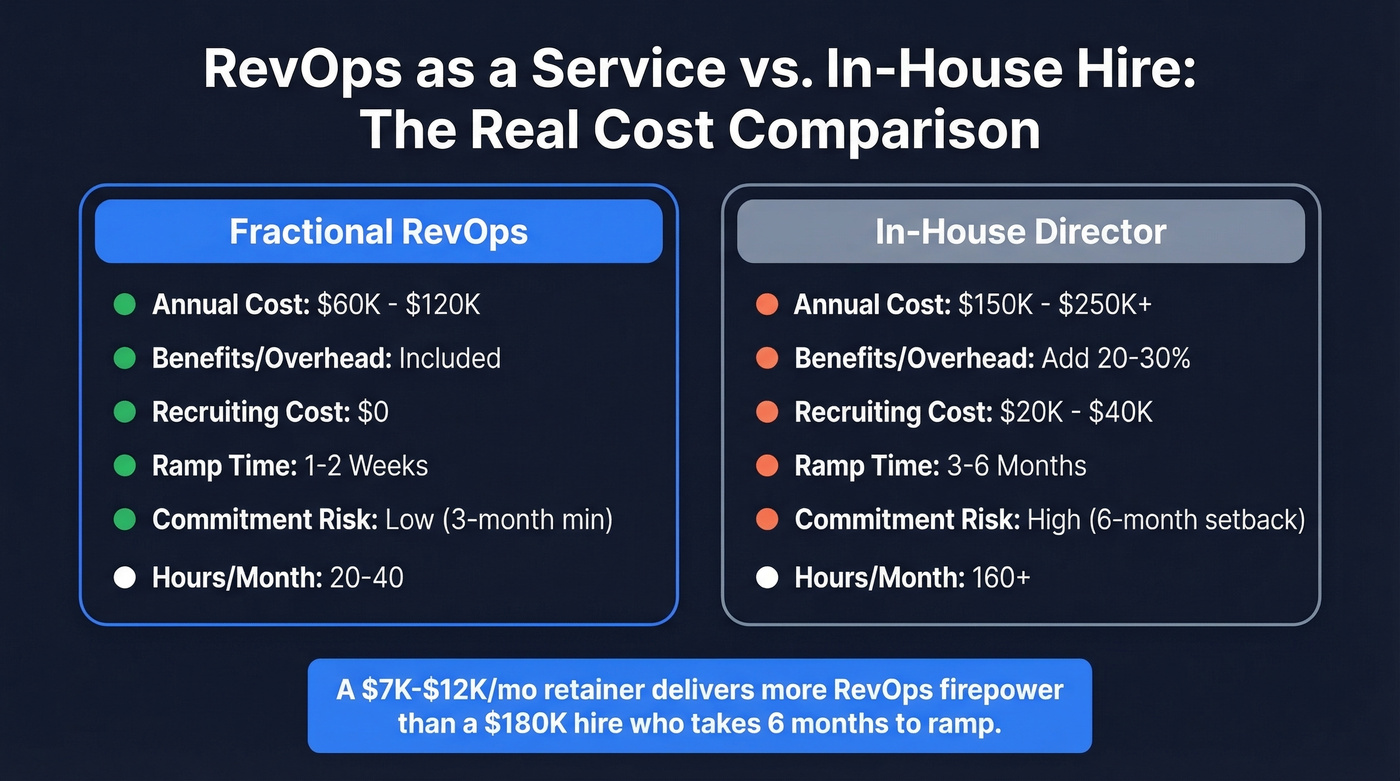
| Fractional RevOps | In-House Director | |
|---|---|---|
| Annual cost | $60K-$120K | $150K-$250K+ salary |
| Benefits/overhead | Included | Add 20-30% to salary |
| Recruiting cost | $0 | $20K-$40K |
| Ramp time | 1-2 weeks | 3-6 months |
| Commitment risk | Low (3-month min) | High (6-month setback) |
| Hours/month | 20-40 | 160+ |
A $7K-$12K/month retainer gets you more RevOps firepower than a $180K hire who takes six months to ramp. That's not a knock on full-time hires - it's just the math of specialization versus ramp time.
For concrete pricing, Activate the Magic is one of the few providers that publishes tiers openly. Their packages run $7.2K/month for a Director of RevOps plus junior analysts covering one GTM function, $12K/month for VP-level leadership plus a full team across your whole GTM org, and $18K/month for an embedded department with multi-system ownership. They use a points system where 1 point equals 3 hours of support work, 2 hours of build/analysis, or 1 hour of strategy.
Now compare that to the in-house alternative. RevOps Manager salary benchmarks from Cirra show $100K-$160K base for managers with under 3 years of experience, jumping to $150K-$235K for those with more tenure. Add 10-20% bonus, 25% benefits loading, and $30K in recruiting fees, and you're looking at $175K-$350K fully loaded for your first hire. In SF or NYC, push those numbers up another 20-30%.
The fractional model isn't cheaper per hour. It's cheaper per outcome, because you're skipping the ramp, the mis-hire risk, and the benefits overhead.

You read it above: bad CRM data kills revenue operations before they start. Prospeo enriches your CRM with 50+ data points per contact at a 92% match rate - with emails verified to 98% accuracy on a 7-day refresh cycle. Whether you're building RevOps in-house or outsourcing, clean data is the foundation.
Fix the data layer before you fix the funnel.
When to Outsource vs. Hire vs. Hybrid
The decision isn't binary. It's a spectrum based on your stage and complexity.
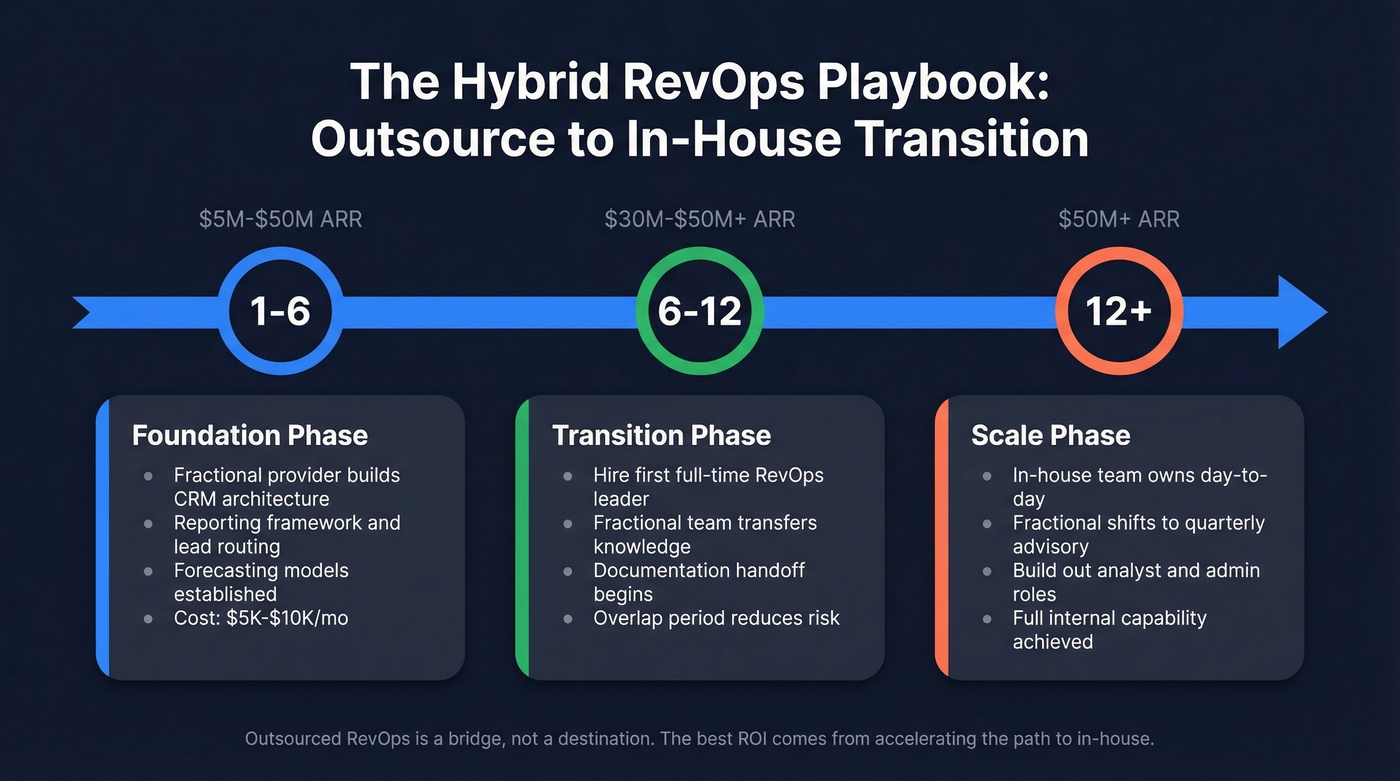
Outsource if you're Series A-B, running $5M-$50M ARR, and need 20-40 hours/month of RevOps capacity. You're defining the role, not filling it. A fractional team builds the playbook, documents the processes, and proves what "good" looks like before you commit to a full-time salary.
Hire in-house when you're past $50M ARR, need 40+ hours/week of dedicated capacity, and have a complex multi-product or multi-segment GTM motion that requires daily oversight and deep institutional context. The typical build sequence: Manager first for process and alignment, then Data Analyst for forecasting, then Systems Admin for CRM and integrations.
Go hybrid - and this is the path we recommend most often. Month 1-6: fractional provider builds the foundation (CRM architecture, reporting framework, lead routing, forecasting models). Month 6-12: hire your first full-time RevOps leader while the fractional team transfers knowledge. Month 12+: the fractional provider transitions to a quarterly advisory role.
Let's be honest about something: outsourced revenue operations isn't a strategy - it's a bridge. The companies that treat it as a permanent substitute for building internal capability eventually hit a ceiling. The ones that use it to accelerate their path to an in-house function get the best ROI.
When Outsourced RevOps Fails
Both models have failure modes. Understanding them upfront saves you a painful lesson.
Outsourced RevOps breaks down when:
- Nobody internal owns strategy. The provider executes, but there's no one setting direction. You end up with beautifully built processes that don't align with where the business is going.
- Consultant rotation kills institutional knowledge. Your fractional lead leaves, a new one picks up the engagement, and you spend a month re-explaining your business.
- The company treats it as permanent instead of a bridge. After 18 months, you've spent $150K+ and still don't have anyone in-house who understands the systems.
- There's no data handling agreement in place. You're giving a third party full CRM access. If they aren't SOC 2 compliant or don't have a clear data handling policy, that's a liability, not a partnership.
In-house RevOps breaks down when:
- The first hire is too junior. You need someone who can set strategy and execute. A RevOps analyst without senior direction becomes a Salesforce admin who builds reports nobody reads.
- The team becomes reactive ticket-takers. Without executive sponsorship and clear scope, RevOps devolves into "fix this dashboard" and "add this field" requests.
Skip providers who jump straight to execution. One r/revops thread lays out a trust-building sequence that shows up a lot in practice: audit, then implementation, then monthly retainer. Providers who skip the diagnostic are selling hours, not outcomes.
Red Flags When Evaluating Providers
Before you sign anything, check for these:
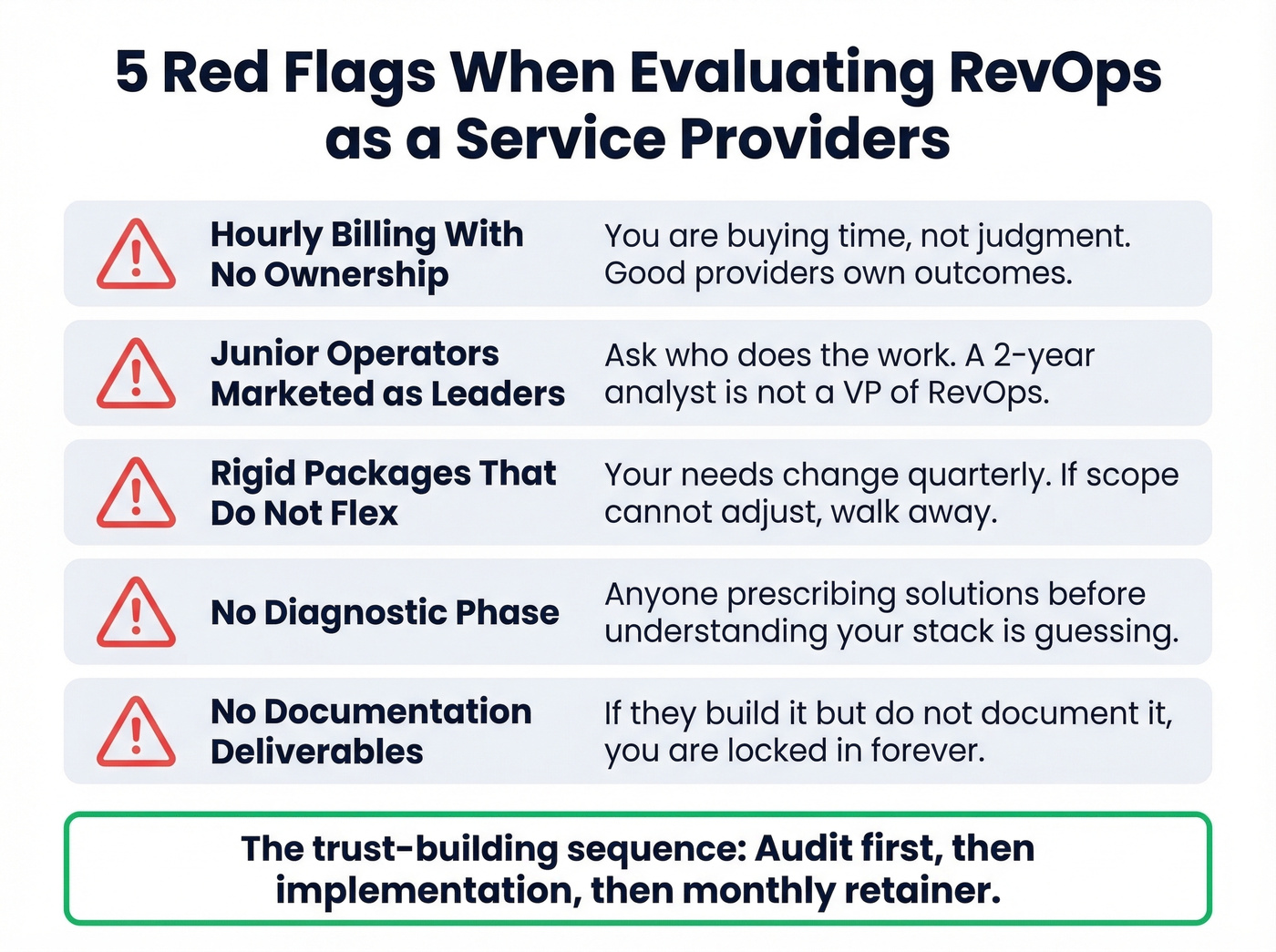
- Hourly billing with no ownership. You're buying time, not judgment. A good provider owns outcomes, not timesheets.
- Junior operators marketed as fractional leaders. Ask who's doing the work. If the "VP of RevOps" on the proposal is a two-year analyst, walk away.
- Rigid packages that don't flex. Your needs will change quarter to quarter. A provider that can't adjust scope is selling a product, not a service.
- No diagnostic phase. Anyone who prescribes solutions before understanding your stack, data, and processes is guessing.
- No documentation deliverables. If they build it but don't document it, you're locked into the engagement forever. That's a feature for them, not for you - and it should include data quality documentation like field definitions, enrichment rules, and dedup logic, not just process maps.
Providers Worth Evaluating in 2026
The fractional RevOps market has matured considerably, and the right provider depends on your stack and stage, not a generic ranking.
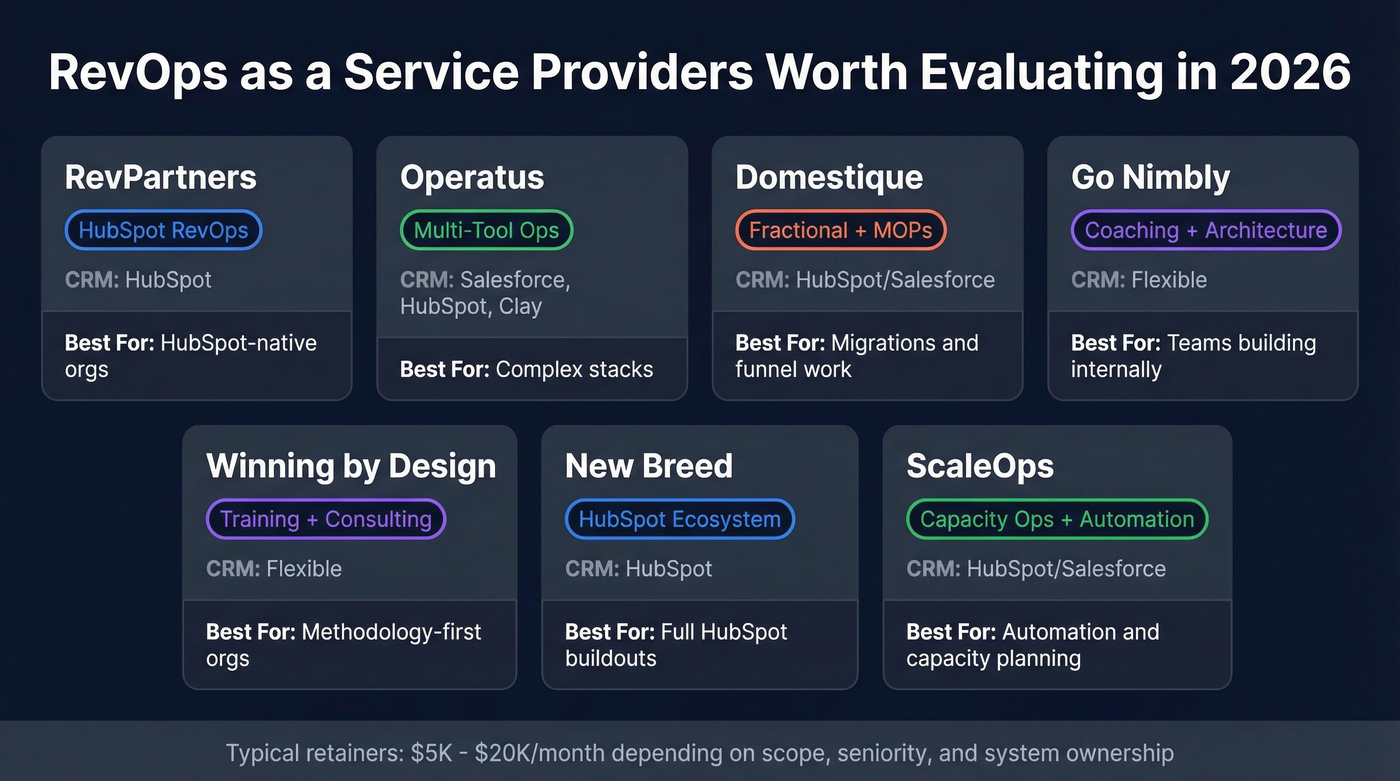
| Provider | Specialty | CRM Focus | Best For |
|---|---|---|---|
| RevPartners | HubSpot RevOps | HubSpot | HubSpot-native orgs |
| Operatus | Multi-tool ops | Salesforce, HubSpot, Clay | Complex stacks |
| Domestique | Fractional + MOPs | HubSpot/Salesforce | Migrations, funnel work |
| Go Nimbly | Coaching + architecture | Flexible | Teams building internally |
| Winning by Design | Training + consulting | Flexible | Methodology-first orgs |
| New Breed | HubSpot ecosystem | HubSpot | Full HubSpot buildouts |
| ScaleOps | Capacity ops + automation | HubSpot/Salesforce | Automation + capacity planning |
For HubSpot shops, look at RevPartners or New Breed. Need Salesforce depth? Operatus or Domestique. Want someone to coach your team rather than do the work? Go Nimbly or Winning by Design. ScaleOps is building toward capacity modeling plus automation.
Most don't publish pricing. Across the market, expect retainers to land around $5K-$20K/month depending on scope, seniority, and how many systems the provider owns. The FirstPageSage provider ranking evaluated 50+ candidates and is a decent starting point for due diligence.
The Data Problem Nobody Talks About
Here's our hot take: if your average deal size is under $10K, you probably don't need a $15K/month RevOps provider. What you need is clean data and a simple process. And even if your deal size justifies the spend, the biggest RevOps failure mode isn't bad tooling or wrong process - it's bad data.
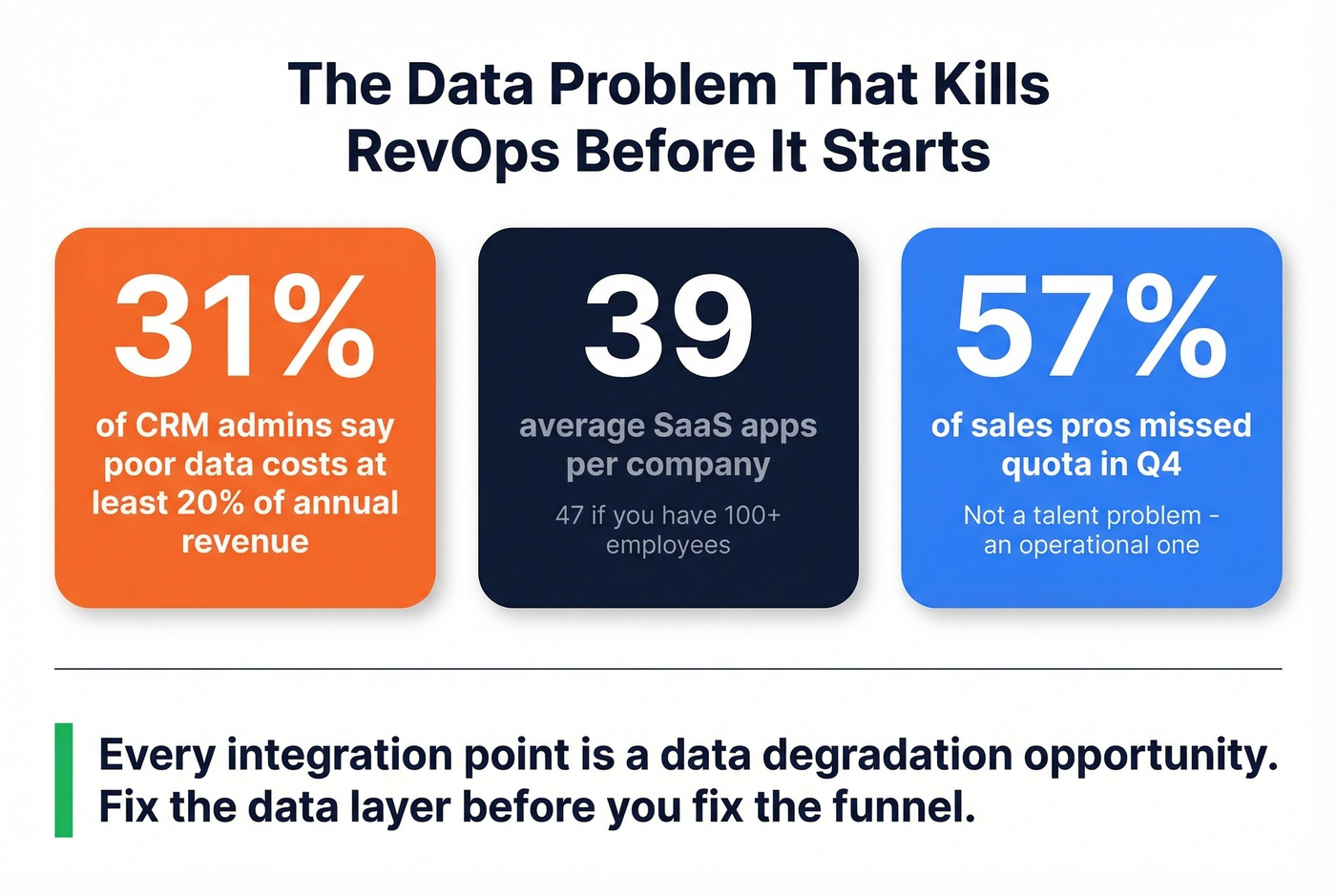
31% of CRM admins say poor-quality data costs at least 20% of annual revenue. The average company runs 39 SaaS apps - 47 if you're over 100 employees - and every integration point is a data degradation opportunity. Duplicate records, stale emails, wrong titles, missing phone numbers. This rot compounds silently until your forecasting model is built on fiction and your lead routing sends enterprise prospects to the SMB team.
RevOps without a data quality strategy is rearranging deck chairs.
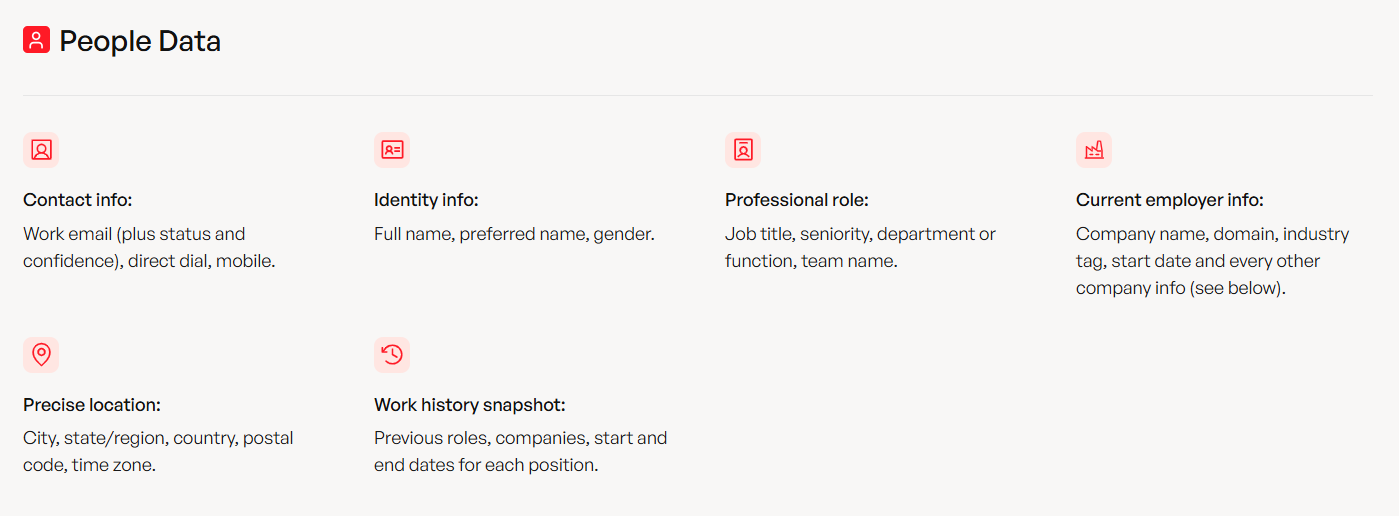
This is where most engagements should actually start: get the data right before you build anything on top of it. Prospeo covers this foundation with 300M+ professional profiles at 98% email accuracy, CRM enrichment returning 50+ data points per contact, and a 7-day refresh cycle versus the 6-week industry average. Native integrations with Salesforce, HubSpot, Clay, and Zapier mean it slots directly into whatever stack your RevOps provider is building.
We've seen teams spend $15K/month on a fractional RevOps provider and still run sequences off a CRM full of bounced emails and disconnected numbers. Fix the data layer first. Everything else your RevOps team builds - the routing, the scoring, the attribution - depends on it.
Your fractional RevOps team can build perfect lead routing and forecasting models - but none of it matters if reps can't reach buyers. Prospeo gives your ops stack 143M+ verified emails and 125M+ direct dials with a 30% pickup rate, all at $0.01 per email. No contracts, no sales calls required.
Give your RevOps investment data that actually connects reps to buyers.
FAQ
What does RevOps as a service typically include?
CRM administration, pipeline reporting, lead routing, forecasting, territory design, lifecycle automation, and process documentation. Scope depends on your provider and tier, but a solid $7K-$12K/month retainer covers both strategy and execution across your full GTM stack.
How much does fractional RevOps cost?
Expect $5K-$18K/month depending on scope and seniority. Single-function engagements start around $5K-$7K. Full-team engagements with VP-level leadership run $12K-$18K. Most providers require a three-month minimum commitment.
Can I transition from outsourced RevOps to an in-house team?
Yes - it's the most common and recommended path. Use a fractional provider for three to six months to build the foundation (CRM architecture, reporting, routing), then hire your first full-time RevOps leader during the knowledge transfer window.
How do I keep CRM data clean during a RevOps transformation?
Start with an enrichment and verification layer before building anything else. Prospeo returns 50+ data points per contact at a 92% match rate, with a 7-day refresh cycle that prevents decay. Pair that with deduplication rules and mandatory field validation at the point of entry - your routing and scoring models are only as good as the data underneath them.