

The Best CRM for RevOps - Real Pricing and Honest Opinions
Every CRM demo looks like a selling tool. But when you're choosing a CRM for RevOps, what matters is whether it works as a data system that makes your team faster - or quietly taxes them every day.
A MarketingOps survey of 250+ pros found 47% rate their stack ROI as average or worse. That's not because people picked the wrong buttons. It's because most advice on revenue operations CRMs is vendor propaganda that ignores architecture, ownership cost, and data quality. And 60% of RevOps teams don't even control their own tech budget, which means the CRM decision often gets made by someone who'll never administer it.
Our Picks (TL;DR)
- Best for speed-to-value (SMB/mid-market): HubSpot - fast implementation, high rep adoption, native ops tooling.
- Best for complex enterprise motions: Salesforce - the most flexible data model when revenue architecture gets messy.
- Best for keeping CRM data accurate: Prospeo - the enrichment layer every CRM needs so reports and routing aren't built on decayed records.
What RevOps Actually Needs From a CRM
Most teams pick a CRM based on rep UI preferences. That's a mistake we've watched play out dozens of times. RevOps should pick based on operational architecture - and on how well the CRM bridges sales and finance data, since that's where attribution and forecasting actually live.
Here's the five-layer checklist we use in bake-offs:
- Data architecture: Can it handle your objects, relationships, and governance without becoming a Frankenstein org? (If you're standardizing this, a unified data architecture is the real unlock.)
- Integration ecosystem: Native connectors plus middleware friendliness. Only 20% of teams with poorly integrated tools report satisfaction.
- Automation engine: Routing, lifecycle stages, SLAs, dedupe, enrichment triggers - without brittle hacks.
- Reporting: Can you trust pipeline and forecast numbers without rebuilding everything in a BI tool? (This is where revenue analytics discipline matters.)
- Total cost of ownership: Licenses are only 30-40% of 5-year cost. Implementation, admins, apps, and cleanup are the real bill.
One more reality check: only 4% use AI extensively in RevOps today. Don't buy a CRM because the AI demo was cute.
The Big Three Compared
| Criteria | Salesforce | HubSpot | Dynamics 365 |
|---|---|---|---|
| Starting price | $25/user/mo (Starter) | $0 (free tools) - $2,000/mo (Enterprise) | ~$65/user/mo |
| RevOps sweet spot | $10M+ ARR | $1M-$15M ARR | MS-first orgs |
| Impl. timeline | Months | ~2-4 weeks | Months |
| Adoption reality | Slower | Faster | Mixed |
| Best for | Complexity | Speed | MS ecosystem |
Salesforce for Revenue Operations
Use this if: you're Series B+, $10M+ ARR, multi-product, running territories, or you need the CRM to behave like a configurable platform - not an app. Revenue operations Salesforce implementations shine when you need granular control over objects, permissions, and cross-functional reporting across sales, CS, and finance.
Pricing runs $25-$550/user/mo depending on edition. The sticker price is only the beginning. Real TCO includes $200K-$500K for implementation, roughly 1 admin per 75-100 users, and $20K-$80K/yr in AppExchange dependencies once the org matures. Salesforce also pushed a 6% price increase across key editions recently, and that trend compounds at renewal. The consensus on r/salesforce is that most orgs underestimate ongoing admin costs by at least 2x, and the threads about "we bought Salesforce and now nobody uses it" are painfully common.
Here's the thing: Salesforce is the most powerful CRM on the market, but power without governance is just expensive chaos. A Salesforce org without a dedicated ops person becomes a reporting argument generator - we've seen it happen at companies that should know better. (If you're building routing/scoring on top, use a real Salesforce lead gen playbook.)
Skip this if: you don't have an ops bench to run it.
HubSpot CRM + Operations Hub
Use this if: you're Series A to mid-B, $1M-$15M ARR, 5-30 reps, and you want adoption plus marketing-sales alignment without a six-month implementation saga.
Pricing ladders matter here. Free Data Tools -> Starter at $15/seat/mo -> Professional at $720/seat/yr -> Enterprise at $2,000/mo. The gotcha is tier lock-in. One "small" requirement - governance, sandbox, custom objects - can force a jump from Starter to Professional, and that jump is roughly $705/seat/year in list price terms.
Adoption is where HubSpot embarrasses most CRMs. One practitioner comparison pegs HubSpot at 85% adoption in month one vs. Salesforce at 40% after six months. That matches what we see across our customers' stacks: HubSpot wins when RevOps needs behavior change, not just a new database. G2 backs this up with a 4.5/5 rating across 572 reviews for HubSpot's Data Hub. (If you're running account plays, an ABM CRM setup pairs well here.)
Skip this if: you need a highly bespoke object model. HubSpot scales, but it scales best when you keep revenue architecture disciplined.
Microsoft Dynamics 365
Dynamics 365 is the sleeper pick RevOps people don't discuss because Microsoft doesn't market "RevOps" the way SaaS vendors do. In practice, it's absolutely viable when you treat Dataverse + Power BI + Power Platform as the operating system and the CRM is just one layer.
Pricing runs ~$65/user/mo for Sales Professional and ~$105/user/mo for Enterprise. The real value shows up when your org already lives in Outlook and Teams and you want unified data across sales, service, and ERP.
Skip this if: you're not already in the Microsoft ecosystem. The value proposition collapses without Outlook, Teams, and Power BI as your baseline.

Your CRM choice matters, but 75% of RevOps teams say data inconsistencies are their biggest challenge. Prospeo enriches Salesforce and HubSpot natively - 300M+ profiles, 92% match rate, 50+ data points per contact. At $0.01/email, it costs less than one bad forecast.
Stop building RevOps reporting on decayed records.
Budget Alternatives
Freshsales works for SMBs wanting a modern CRM without enterprise overhead. Expect $9-$59/user/mo with AI lead scoring and clean visual pipelines. The tradeoff: fewer native integrations and less RevOps-grade customization depth.
Pipedrive is the "get out of spreadsheets" CRM teams actually stick with, at $14-$99/user/mo. Great for pipeline visualization, but not a RevOps platform. No native marketing hub, limited custom objects, and you'll outgrow it once routing and multi-team reporting become non-negotiable. (If you're scaling pipeline process, pipeline coaching helps avoid chaos.)
The Data Layer Most Teams Ignore
Let's be honest: the CRM you pick matters less than the data flowing into it. Most CRM "problems" are data problems wearing a workflow costume.
That MarketingOps survey found 75% cite data inconsistencies as their biggest challenge. B2B data decays at roughly 25% annually - people change roles, companies reorg, and your "clean" CRM turns into a museum of former employees. We've run bake-offs where the CRM choice barely mattered because the real win came from fixing data inputs: verified emails, fewer duplicates, better routing, and reporting that stopped drifting week to week. (If you're evaluating vendors, start with the best B2B data platforms landscape.)
Prospeo solves this with 300M+ profiles, 98% email accuracy, and CRM enrichment that returns 50+ data points per contact on a 7-day refresh cycle. It delivers a 92% API match rate, and 83% of leads come back with contact data. Native integrations with Salesforce and HubSpot mean enrichment isn't a CSV circus. At roughly $0.01/email, it's nothing compared to what you spend on CRM seats and the downstream cost of bad attribution. (If email quality is the bottleneck, compare against an email scrubber workflow.)
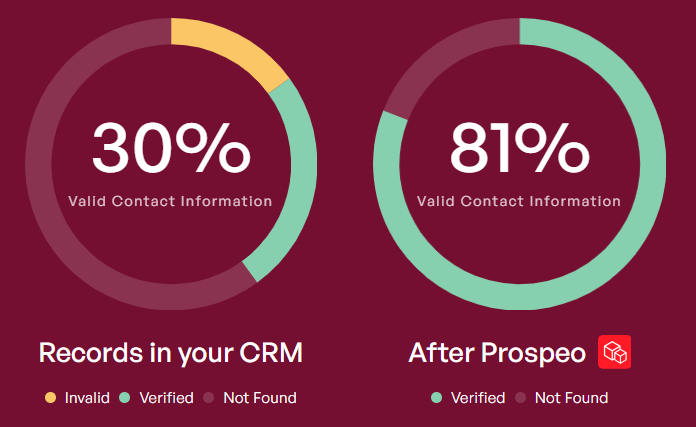
B2B data decays 25% annually. That means your routing, attribution, and pipeline reports degrade every quarter. Prospeo's 7-day refresh cycle keeps your CRM current - not the 6-week industry average. 83% of enriched leads return with verified contact data.
Make your CRM the single source of truth it was supposed to be.
Don't Blow Your Implementation
Most CRM rollouts fail the boring way: adoption, governance, and scope. I watched a 200-person SaaS company burn four months migrating dirty data into Salesforce, only to spend another three months cleaning it back out. Don't be that team.
- Ghost exec sponsor - Put a real name on the steering committee and make them show up monthly.
- Migrating dirty data - Dedupe, normalize, and enrich before you import. This alone saves weeks of post-launch firefighting. (If you're defining who owns what, map it to RevOps roles early.)
- Scope creep - Freeze requirements. Ship "good enough" workflows first.
- One-and-done training - Train at launch, then reinforce with weekly office hours for 6-8 weeks.
Phased rollout works: core CRM, then pipeline automation, then finance/ERP. Teams that boil the ocean usually end up boiling morale.
The Decision Framework
For Series A to mid-B, $1M-$15M ARR, 5-30 reps: pick HubSpot for speed and adoption.
For Series B+, $10M+ ARR, multi-product, territories, heavy integrations: pick Salesforce for architecture and control.
Already Microsoft-native? Pick Dynamics 365 and lean into Dataverse.
If your average deal size is modest and your team is lean, you probably don't need Salesforce-level infrastructure. HubSpot will get you further, faster, and cheaper. Whatever CRM for RevOps you choose, pair it with a continuous enrichment layer so data hygiene becomes a system - not a quarterly fire drill. (If you’re rationalizing tools, start with a lean RevOps tech stack.)
FAQ
Is a CRM the same as a RevOps platform?
No. A CRM handles system-of-record duties and workflow execution. A full RevOps stack also needs enrichment, middleware like Zapier or Make, analytics, and automation tools layered around the CRM to unify sales, marketing, and CS data.
When should we migrate CRMs?
Migrate when your ops team spends more time maintaining workarounds than improving revenue architecture, or when growth has outpaced the platform's data model. For most teams, that inflection hits between $8M and $15M ARR.
How do I keep CRM data clean long-term?
Automate enrichment and verification continuously - not in quarterly cleanups. A 7-day refresh cycle on contact data beats any manual audit and keeps routing, scoring, and attribution accurate between reviews. RevGenius has solid community threads on building these workflows if you want peer examples.
What's the biggest hidden cost of a RevOps CRM?
Implementation and ongoing administration, not licenses. Salesforce TCO runs $200K-$500K for implementation alone, plus roughly one full-time admin per 75-100 users. HubSpot is lighter, but tier upgrades can double your per-seat cost overnight.