

Account-Based Marketing CRM: The 2026 Setup Playbook
Your VP just announced the ABM initiative. You open the CRM. Half the target accounts have no contacts attached, the other half have emails from 2021. The ABM platform demo is next Tuesday, and you're staring at a database that can't support a mail merge, let alone a multi-threaded account play.
This is where most account-based marketing CRM setups die - not in strategy, but in data quality. 69% of CRM records are out-of-date, and no ABM platform on earth can fix that for you.
What You Need (Quick Version)
- Best mid-market ABM CRM: HubSpot (Marketing Hub Professional + Sales Hub Professional) - ABM tools available starting around $800/mo on the Professional tier
- Fix your data first. Before you spend a dollar on an ABM platform, run your target accounts through an enrichment tool to fill missing contacts, verify emails, and flag stale records.
- Minimum viable ABM stack: CRM + enrichment tool + manual plays. You don't need a $60k platform to start.
Why Your CRM Outranks Your ABM Platform
Most teams get the buying order backwards. They evaluate 6sense, Demandbase, and RollWorks before checking whether their CRM can actually support account-level workflows. That's like buying a race car before building the road.
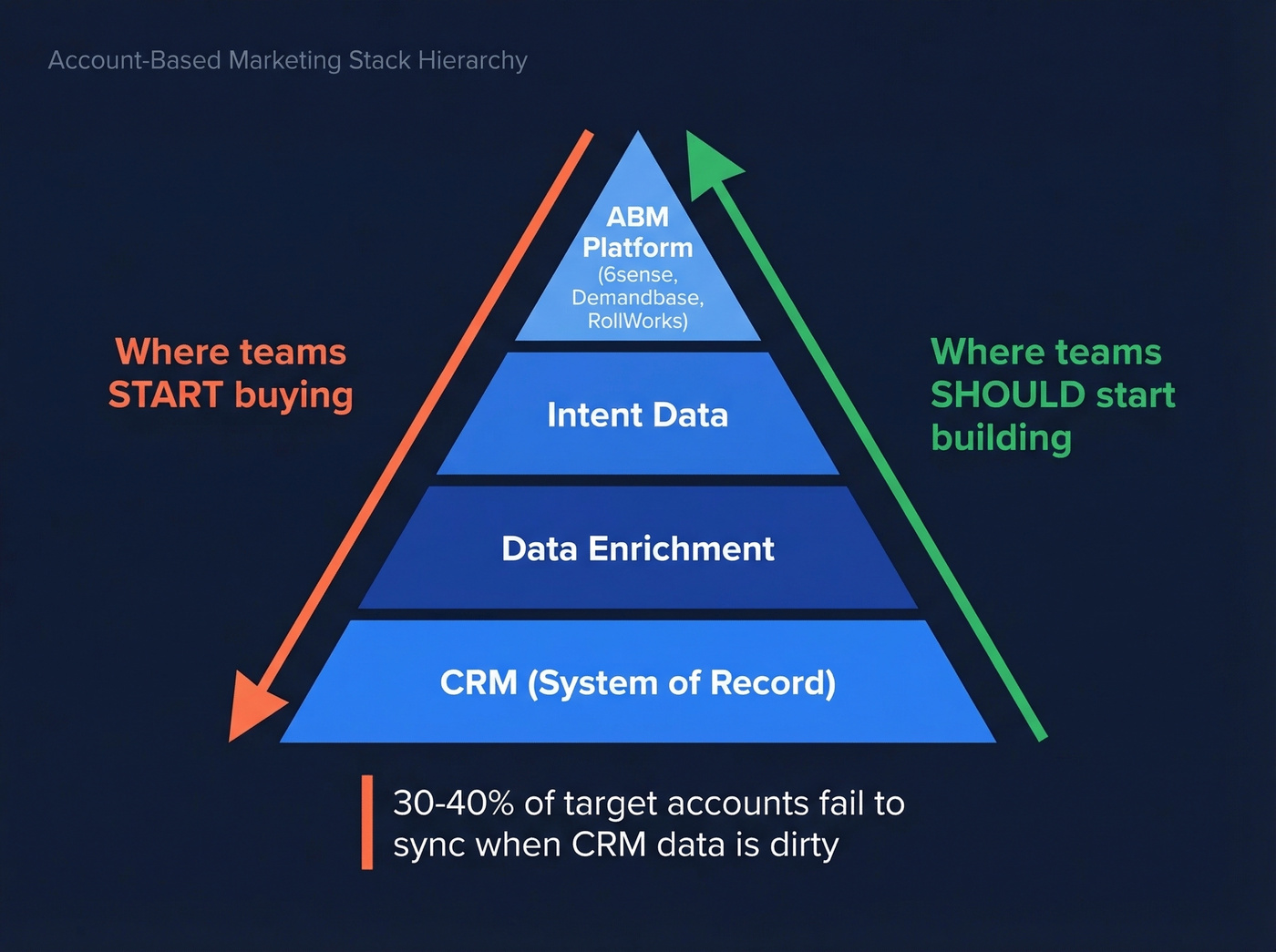
Your CRM is the system of record. Every ABM platform pulls from and pushes to it. Poor data integration causes 30-40% lower account match rates, meaning a third of your target accounts won't even sync correctly with your shiny new platform. Organizations invest $35,000 to $1M+ annually on ABM solutions, and picking the wrong one wastes 6-12 months. But the platform isn't the real risk - the CRM data underneath it is.
Get the foundation right, and even a scrappy ABM motion outperforms an enterprise stack built on garbage data.
Here's the thing: if your average deal size is under $25k, you almost certainly don't need a dedicated ABM platform. A clean CRM, a good enrichment tool, and disciplined manual plays will outperform a six-figure tech stack sitting on dirty data every single time.
Choosing the Right CRM for ABM
ABM tooling breaks into four categories: core CRM platform, intent data, enrichment, and orchestration/ads. Your CRM is the foundation layer - everything else plugs into it.
HubSpot - Best for Mid-Market
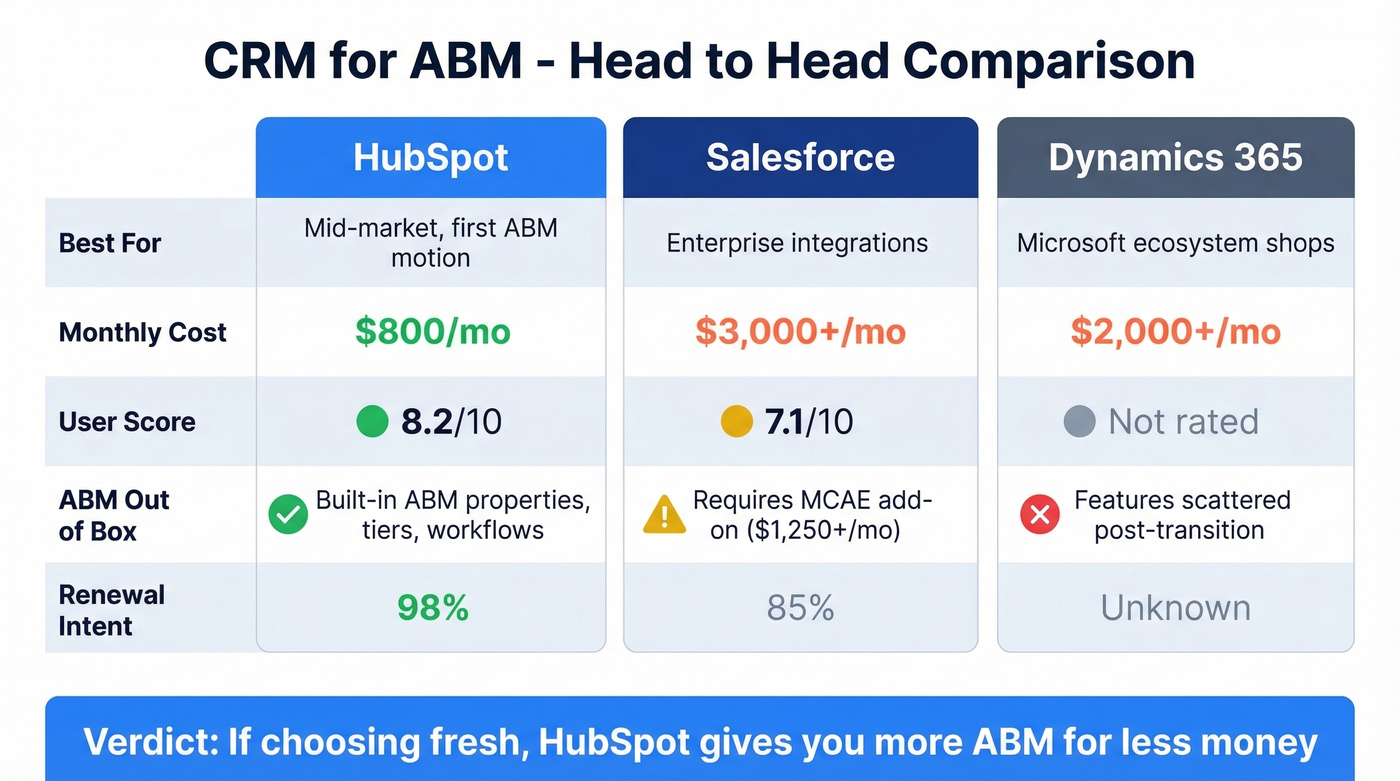
HubSpot is the obvious pick for teams under 500 employees running ABM for the first time. ABM setup ships with Marketing Hub Professional/Enterprise and Sales Hub Professional/Enterprise, starting around $800/mo. You get default ABM properties (like Buying role, Target account, and Ideal customer profile tier), default ABM segments, and a workflow template for assigning tiers based on criteria like annual revenue.
The user numbers back this up. HubSpot ABM scores an 8.2/10 composite across 55 reviews on SoftwareReviews, with 98% planning to renew and 86% likely to recommend. You can connect LinkedIn Ads to sync target account segments directly to matched audiences for ABM ad targeting, and the integration extends to enrichment tools and intent data providers, making it straightforward to pipe third-party signals into your account scoring workflows. The catch? HubSpot is contact-centric by default, so true account scoring requires rolling up contact engagement to the company level - doable, and we'll cover it in the scoring section below.
Salesforce - Best for Enterprise
Salesforce owns 21.8% of the global CRM market because it integrates with everything. If you're running 6sense or Demandbase, Salesforce has the deepest native integrations.
Cost is where it gets complicated. Sales Cloud runs $25-$330/user/mo. Marketing Cloud Account Engagement (formerly Pardot) starts at $1,250+/mo separately, scoring just 7.1/10 with 85% renewal intent. A 10-person sales team on Enterprise plus Marketing Cloud is already north of $3,000/mo before adding an ABM platform. If you're already on Salesforce, stay. If you're choosing fresh, HubSpot gives you more ABM out of the box for less money.
Dynamics 365 - Proceed With Caution
Dynamics 365 has ABM capabilities on paper - account segments, account-targeted journeys, and account/contact lead scoring. But the transition from "Dynamics 365 Marketing" to "Customer Insights - Journeys" has created real confusion. Reddit threads in r/Dynamics365 flag that ABM features are harder to find post-transition, and older documentation references removed Outbound marketing features.
If you're locked into the Microsoft ecosystem, Dynamics works. Budget ~$65-$105/user/mo for Sales plus ~$1,500+/mo for marketing, and expect extra configuration time. Skip it otherwise.
| CRM | ABM Starts At | Monthly Cost | User Score | Best For |
|---|---|---|---|---|
| HubSpot | Professional (with the right Hubs) | $800/mo | 8.2/10 | Mid-market ABM |
| Salesforce | Enterprise + MCAE | ~$3,000+/mo | 7.1/10 | Enterprise integrations |
| Dynamics 365 | Sales + Marketing | ~$2,000+/mo | Not rated | Microsoft shops |
Build an ABM Scoring Model
Skip generic intent scores. The best ABM scoring models come from your own CRM data - specifically, your closed-won opportunities from the past 12-18 months. Pull those deals, extract the contact roles involved, and identify which personas appear in 80%+ of wins. That's your scoring blueprint.
You need three layers of CRM fields:
| Account-Level | Contact-Level | Opportunity-Level |
|---|---|---|
| Industry/sub-industry | Job title/seniority | Stage history |
| Employee count & growth | Department/function | Close date (won/lost) |
| Revenue/funding stage | Last activity date | Deal size/product mix |
| Tech stack | Email engagement | Sales cycle length |
| Geo/segment | Meeting attendance | Win/loss reason |
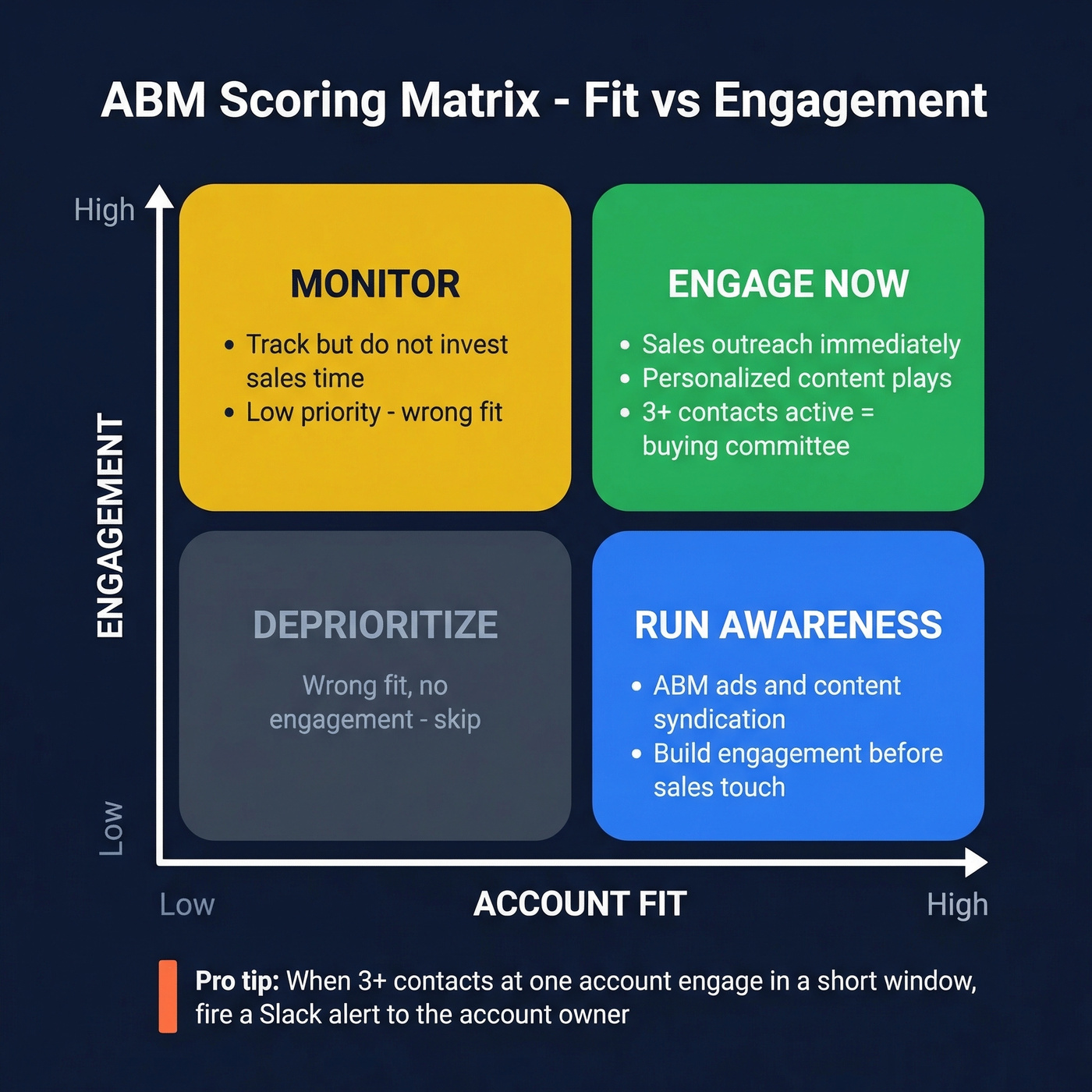
Once you've got the data, build a simple fit + engagement matrix:
- High Fit + High Engagement = engage now (sales outreach, personalized content)
- High Fit + Low Engagement = run awareness plays (ads, content syndication)
- Low Fit + High Engagement = monitor, don't waste sales cycles
The multi-threading signal is critical. When 3+ contacts at the same company engage within a short window, that's a buying committee warming up. Set up a workflow to fire a Slack alert to the account owner when this threshold hits. New exec hires, funding rounds, and repeat visits from multiple personas are high-signal. A single website visit or email open without a click? Noise. Weight accordingly.
Track these KPIs weekly: account engagement rate, pipeline velocity on target vs. non-target accounts, account coverage (contacts per target account), and marketing-influenced pipeline.

69% of CRM records are stale - and that kills ABM before it starts. Prospeo enriches your target account list with 50+ data points per contact, 98% email accuracy, and a 7-day refresh cycle so your buying committees never go dark. At $0.01/email, cleaning your entire ABM list costs less than one hour of a consultant's time.
Fix your CRM data before your ABM platform demo on Tuesday.
Why ABM Fails in Your CRM
Four mistakes kill ABM programs over and over.
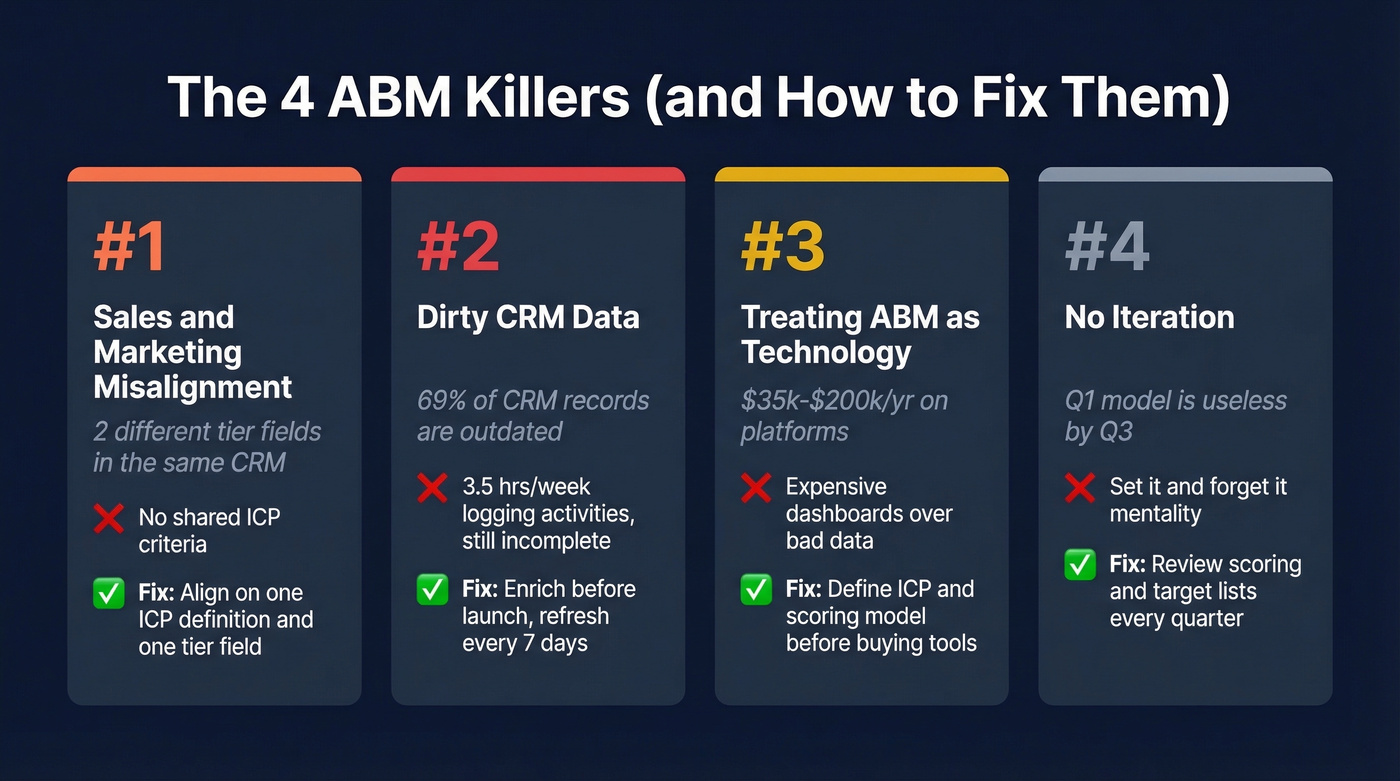
Sales/marketing misalignment. Marketing builds a target account list. Sales ignores it. Nobody agrees on ICP criteria. The CRM has two different "tier" fields because nobody coordinated. ABM practitioners on Reddit consistently say this is the #1 failure mode - not technology, but organizational alignment.
Dirty CRM data. CRM users spend 3.5 hours/week logging activities and still admit the data's incomplete. You can't run account scoring on records missing job titles, with bounced emails, or listing contacts who left two years ago.
Treating ABM as technology. Buying 6sense doesn't mean you're doing ABM. Without a defined ICP, aligned target accounts, and a scoring model, the platform just gives you expensive dashboards over bad data.
No iteration. Teams that don't review scoring thresholds and update target lists quarterly watch their programs decay. We've seen it happen - a scoring model that worked in Q1 becomes useless by Q3 because the market shifted and nobody recalibrated.
The fix for dirty data is straightforward: enrich before you launch. Prospeo's CRM and CSV enrichment returns 50+ data points per contact at a 92% API match rate, and a 7-day refresh cycle keeps records current instead of rotting. Native Salesforce and HubSpot integrations make this a plug-in, not a project.
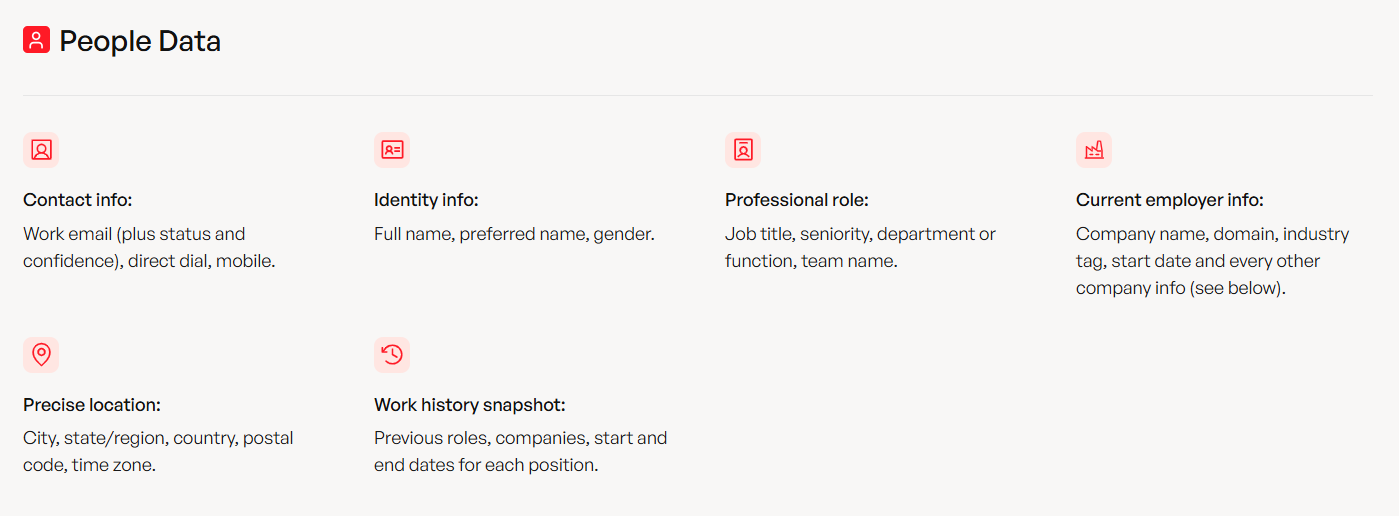
Multi-threading requires actual contacts. Prospeo's database covers 300M+ professionals with 30+ filters - job title, department headcount, funding stage, technographics - so you can map every buying committee member and push verified emails straight into HubSpot or Salesforce. 92% match rate on enrichment. No stale 2021 emails.
Build complete buying committees in minutes, not weeks.
What ABM Actually Costs in 2026
ABM platform pricing is notoriously opaque. Here's what published data and community discussions reveal:
| Platform | Starting Price | Typical Enterprise | Contract Terms |
|---|---|---|---|
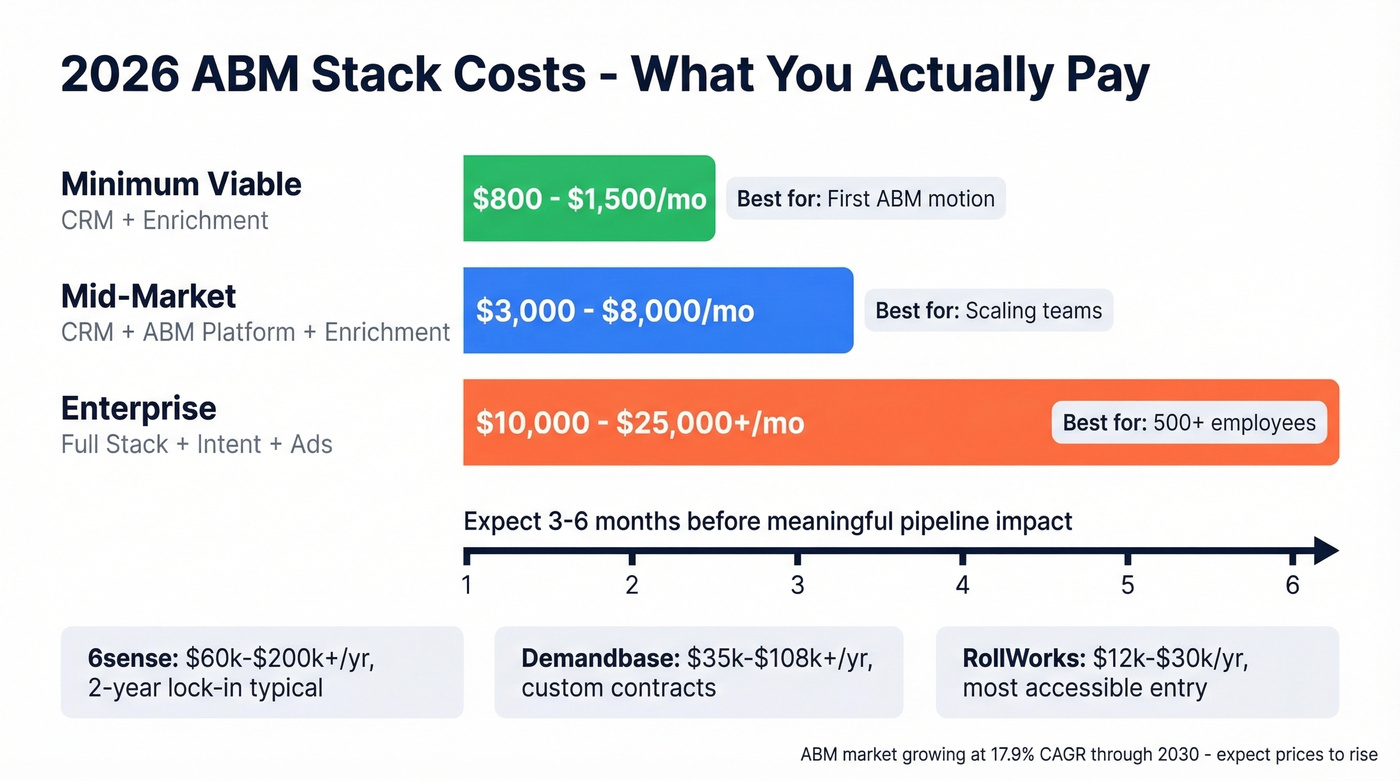
| 6sense | Free (50 credits/mo) | $60k-$200k+/yr | 2-year typical on larger tiers |
| Demandbase | ~$35k/yr | ~$58.5k-$108.6k+/yr | Custom |
| RollWorks | ~$1k-$2.5k/mo | ~$15k-$30k/yr | Custom |
The ABM market is growing at 17.9% CAGR through 2030, which means vendors have pricing power and they know it. 6sense credits don't roll over month-to-month, and upgrading from the free tier can mean a $120k first-year commitment with a two-year lock-in. Demandbase's full ABX Cloud Ads & Orchestration bundle runs ~$63k/yr before premier services.
Your total stack cost breaks down like this:
| Stack Level | Components | Monthly Cost | Best For |
|---|---|---|---|
| Minimum Viable | CRM + enrichment (~$0.01/email, no contract) | $800-$1,500/mo | First ABM motion |
| Mid-Market | CRM + ABM platform + enrichment | $3,000-$8,000/mo | Scaling teams |
| Enterprise | Full stack + intent + ads | $10,000-$25,000+/mo | 500+ employee orgs |
Expect 3-6 months before seeing meaningful pipeline impact from any ABM program. Budget for that runway.
Running ABM Without an Enterprise Platform
You don't need a $60k+ platform to run ABM. We've watched teams build effective programs with nothing more than HubSpot Professional and a solid enrichment tool.
The workflow looks like this: build your target account list in HubSpot using ICP criteria - industry, revenue, headcount, tech stack. Enrich those accounts to fill in buying committee contacts, because verified emails and intent signals tell you who to reach and when. Set up fit + engagement scoring using the model above. Run personalized sequences through your outreach tool. Measure account engagement at the company level weekly.
If you want to scale this without buying an enterprise platform, focus on tightening your target account lists and standardizing your lead scoring rules.
This scrappy stack won't give you programmatic ad orchestration or predictive revenue models. But it covers ICP tiering, account scoring, contact discovery, and personalized outreach - which is 80% of what makes ABM work. Start here, prove pipeline impact, then justify the enterprise platform spend with data. Let's be honest: most teams that jump straight to a six-figure ABM platform end up using 20% of its features while struggling with the same data problems they had before.
ABM Reporting and Visibility
Once your CRM foundation is solid, the next question is visibility. You need to know which accounts are progressing, which are stalling, and where marketing spend is actually influencing pipeline.
In HubSpot, the built-in ABM reporting templates - account overview, buying committee coverage, and target account engagement - cover most mid-market needs. Salesforce teams typically layer on a tool like 6sense or Demandbase for intent-level reporting, then pipe those insights back into CRM dashboards. Whichever path you choose, make sure your reporting answers three questions weekly: which target accounts are engaged, which have pipeline, and which need more contacts added. If you can't answer all three from a single dashboard, your reporting setup isn't done yet.
To keep leadership bought in, tie ABM dashboards to pipeline health and pipeline velocity metrics, not vanity engagement.
FAQ
Can I run ABM without a dedicated platform?
Yes. HubSpot Professional plus a CRM enrichment tool covers ICP tiering, account scoring, and personalized workflows for under $1,500/mo. Prove the motion works before committing $60k+/year to a dedicated ABM platform.
Which CRM is best for account-based marketing?
HubSpot is best for mid-market teams - ABM tools ship on the Professional tier at $800/mo with an 8.2/10 user score. Salesforce wins for enterprises needing deep integrations with 6sense or Demandbase.
How long until ABM produces pipeline results?
Expect 3-6 months for meaningful pipeline impact from a well-executed program. Dirty CRM data or misaligned sales and marketing teams can waste 6-12 months. Fix data quality and organizational alignment first.
What's the minimum budget for an ABM stack?
A minimum viable stack - CRM plus enrichment - runs $800-$1,500/month. Mid-market stacks with a dedicated ABM platform cost $3,000-$8,000/month. Enterprise deployments with intent data and ad orchestration run $10,000-$25,000+/month.