


Ringy Pricing, Reviews, Pros and Cons: The Full Breakdown
Every review site shows a different price for Ringy (formerly iSalesCRM) - $99, $109, $119. If you're trying to figure out what this CRM actually costs before committing, that inconsistency is maddening. We went to Ringy's actual pricing page so you don't have to play detective. The real number is $119/mo, and that's before add-ons and usage overages push the bill higher.
30-Second Verdict: Ringy is a solid sales CRM with a built-in dialer and texting for solo insurance agents doing moderate outbound volume. The $119/mo base is competitive, but usage overages and add-ons can push real costs past $200/mo fast. Email capabilities are genuinely weak. If phone + SMS is 80%+ of your outreach and you're under 2,000 minutes of calls and 2,000 texts per month, Ringy works. If you need strong email or you're budget-constrained - skip it.
What Ringy Actually Costs
Here's the full line-item breakdown:
| Item | Cost |
|---|---|
| Base plan | $119/mo |
| Power Dialer add-on | +$70/mo |
| Call Scripting add-on | +$10/mo |
| AI Tools add-on | +$10/mo |
| Included outbound | 1,000 min + 1,000 texts |
| Overage: calls | $0.01/min |
| Overage: texts | $0.01/text |
| Email sending | $0.001/email |
| Local phone number | $1/number/mo |
| Inbound calls & SMS | Free |
| Video meetings | Free, unlimited |
Unused minutes and texts roll over, which is a nice touch. But the metered overages are where things get sneaky.
| Profile | Monthly Cost |
|---|---|
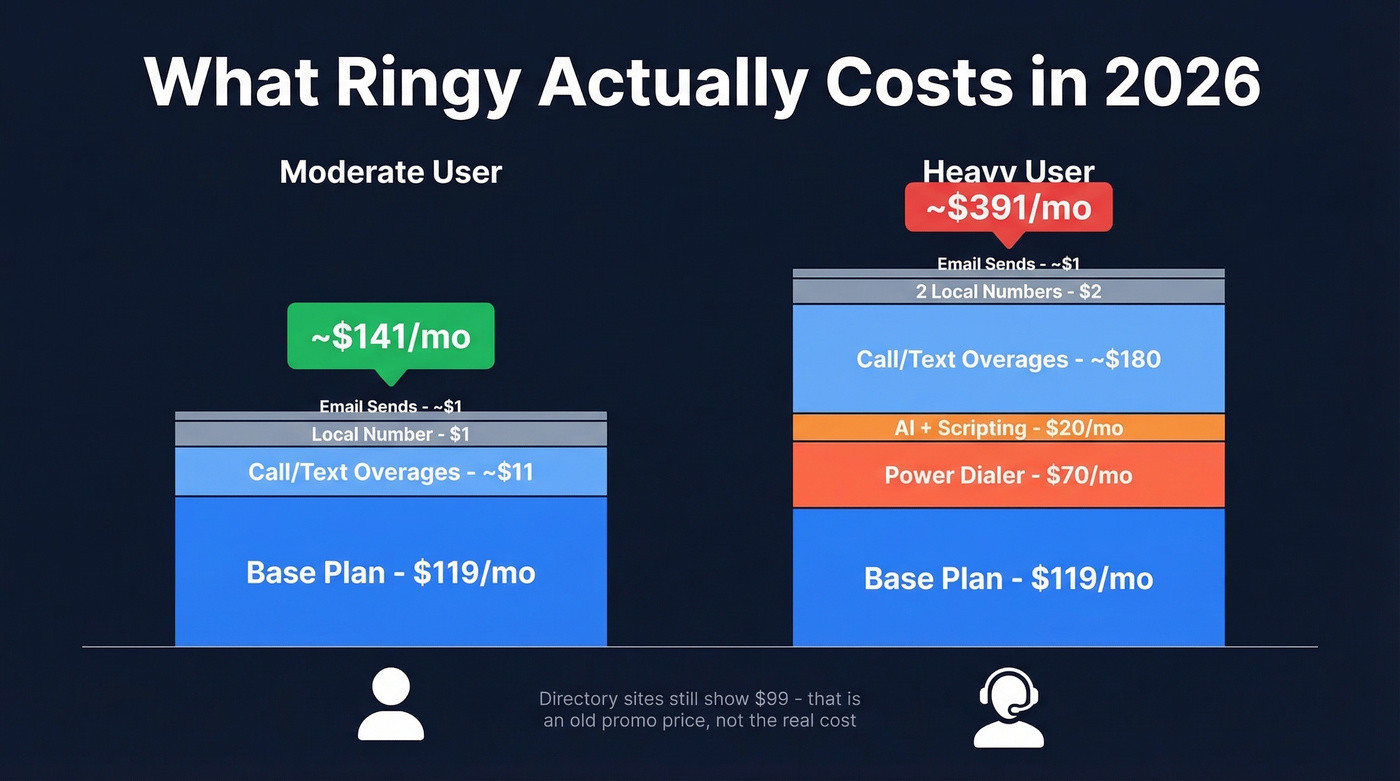
| Moderate (solo agent, ~2K min + 2K texts, 1 local number, ~1K emails) | ~$141/mo |
| Heavy (power dialer + AI + scripting, ~10K min + 10K texts, 2 local numbers) | ~$391/mo |
The moderate user pays about $20 in call/text overages, plus a local number and email sends, on top of the $119 base. The heavy user - stacking Power Dialer ($70), AI Tools ($10), Call Scripting ($10), and burning through 10,000 minutes and texts - lands near $391/mo. That's a big jump from the "$99" shown on GetApp.
Ringy does advertise a limited-time offer for $20 off for 6 months, which temporarily drops the base to $99/mo. Third-party directories often lag behind vendor pricing updates, so it's common to see older "starting at" numbers floating around. Don't trust them.
What Real Users Say
On G2, Ringy sits at 4.6/5 across 57 reviews - but 52 of those 57 come from insurance professionals. It's an insurance CRM wearing a general-purpose label. On Capterra, the rating drops to 4.3/5 across 155 reviews, with a value-for-money sub-score of just 3.7/5. That's the lowest category score, and it tells you everything about how users feel once the bills start stacking.
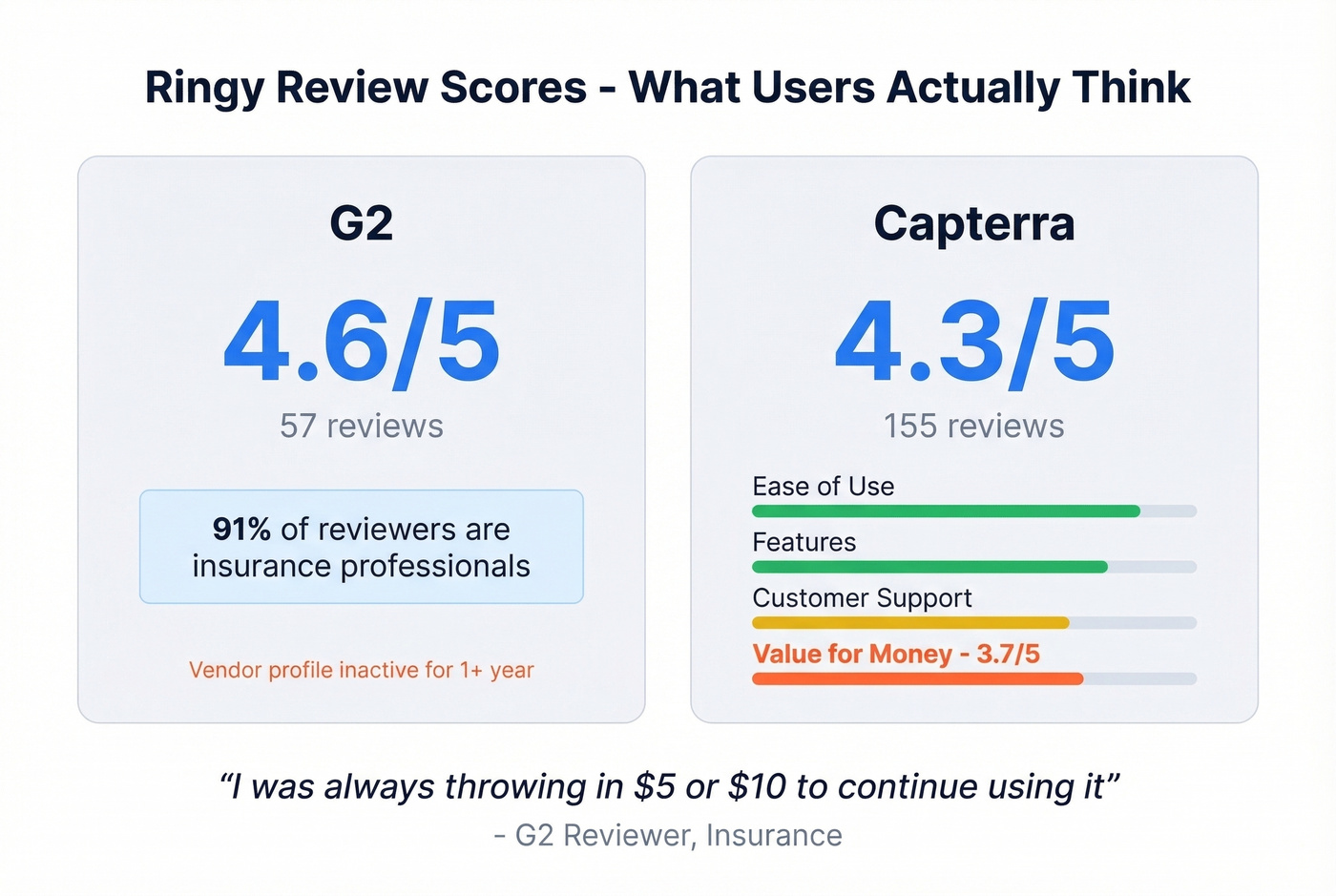
Ringy's G2 profile hasn't been actively maintained by the vendor for over a year.
One G2 reviewer in insurance put it bluntly: "My biggest problem was understanding how the money I spent was translating to minutes texts etc. I was always throwing in $5 or $10 to continue using it." That's the metered billing model in action - functional, but confusing when you're trying to forecast costs.
Ringy Pros and Cons
Pros:
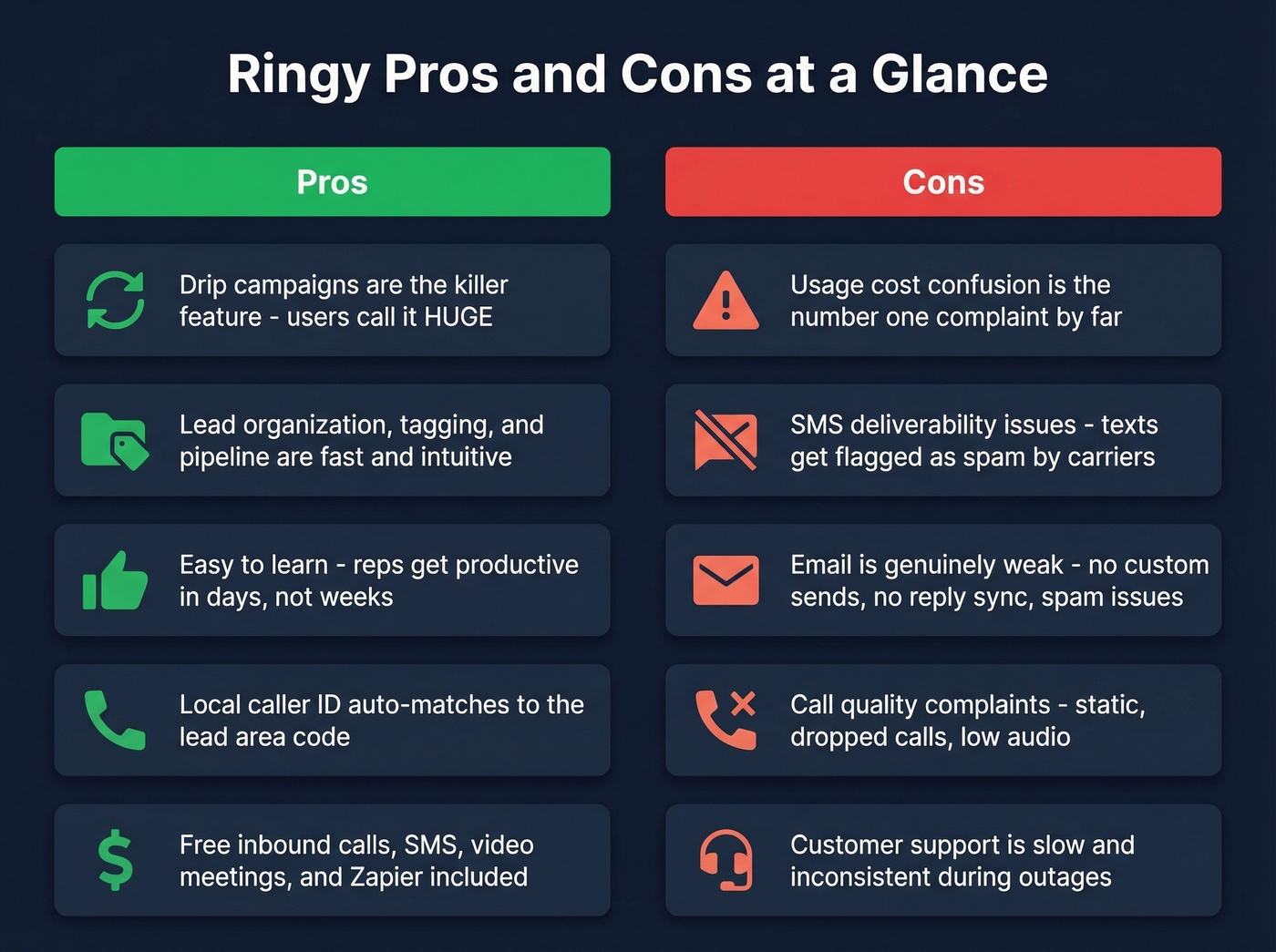
- Drip campaign automation is the standout feature. Users call it "HUGE" - automated text and email sequences that run in the background while you work the phones. (If you want better sequencing across channels, see sequence management.)
- Lead organization is well-built. Tagging, dispositions, and pipeline management are intuitive and fast - the kind of basics you also get in the best contact management software.
- Ease of use is the most consistent positive across every review platform. Reps get productive quickly.
- Mobile texting on the go is a real workflow advantage for field agents, though the mobile app can't disposition leads - so drip campaigns won't trigger until you're back at your desk.
- Local caller ID automatically matches a local number to the lead's area code.
- Free inbound calls and SMS, unlimited video meetings, and Zapier connectivity at no extra charge.
Cons:
- Usage cost confusion is the #1 complaint. The metered billing model catches people off guard, and Ringy doesn't make it easy to track spend in real time.
- SMS deliverability issues frustrate users - texts get blocked without clear explanation. This is usually a TCPA compliance issue, not a software bug. Carriers flag SMS as spam when recipients haven't properly opted in.
- Email is weak. You can't send a custom email from within a lead record, replies don't sync back, and users report emails landing in spam with flat formatting. If email is a core channel, you’ll want to understand email deliverability basics before blaming the CRM.
- Call quality complaints surface repeatedly - static, dropped calls, and low audio quality.
- Customer support is inconsistent. Multiple reviewers flag slow response times and poor outage handling.
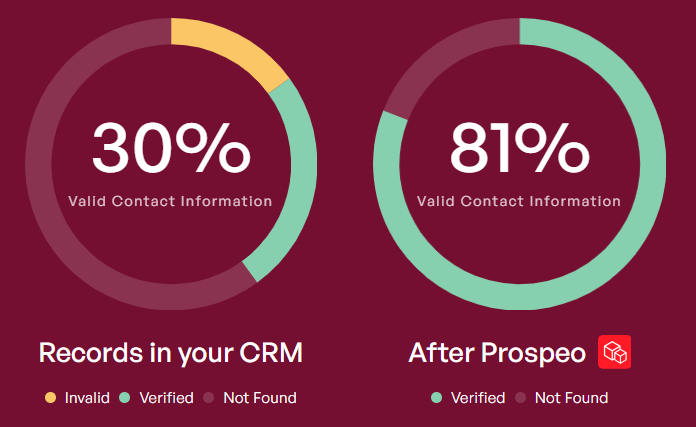

SMS getting blocked? Emails bouncing? Before you blame Ringy, check your data. Prospeo delivers 98% email accuracy and 125M+ verified mobile numbers with a 30% pickup rate - so your CRM actually connects you to real people instead of dead ends.
Stop feeding bad data into your CRM. Start with contacts that connect.
Who Should Use Ringy
Solo or small-team insurance agents running phone + SMS as their primary outreach channels - that's the sweet spot. If you're doing moderate volume under 2,000 minutes and 2,000 texts per month, the base plan is competitive and the drip automation saves real time. Ringy's own data says 97% of texts are opened, which helps explain why phone-and-text CRMs outperform email-heavy workflows for insurance outreach. Reddit's r/InsuranceAgent threads show agents actively evaluating Ringy alongside GoHighLevel and Close, and it's a real contender in that niche.
Skip if you need strong email workflows, you can't absorb surprise overages, or you're a high-volume shop pushing 10K+ minutes and texts monthly. At that volume, the metered costs erode Ringy's price advantage fast.
Here's the thing: Ringy is the right CRM for maybe 5% of sales teams - insurance agents who live on the phone and barely touch email. For everyone else, the metered billing model is a trap disguised as flexibility. If you’re still comparing options, it helps to look at a few examples of a CRM with clearer pricing models.
Fix Your Data Before Switching CRMs
A lot of the SMS blocking and email bouncing that Ringy users complain about isn't a CRM problem - it's an upstream data quality problem. We've seen this pattern over and over: teams blame the tool when the real issue is stale or unverified contact data hitting the system. Before you switch platforms, check your contacts. Prospeo verifies emails at 98% accuracy and covers 125M+ verified mobile numbers with a 30% pickup rate. Clean data means fewer bounces, fewer carrier blocks, and more conversations that actually connect. The 7-day data refresh cycle also means you're not dialing numbers that went stale weeks ago - a common culprit behind the call quality complaints Ringy users report. If you’re evaluating vendors, start with a shortlist of data enrichment services.
Alternatives Worth Considering
If calling is your entire workflow and you want best-in-class call quality, Kixie ($35-$95/user/mo) deserves a trial. It holds a 4.8/5 on G2 across 850+ reviews and is the purest dialer-first option on the market. If you’re building a more repeatable outbound motion, pair any dialer with a documented cold calling system.
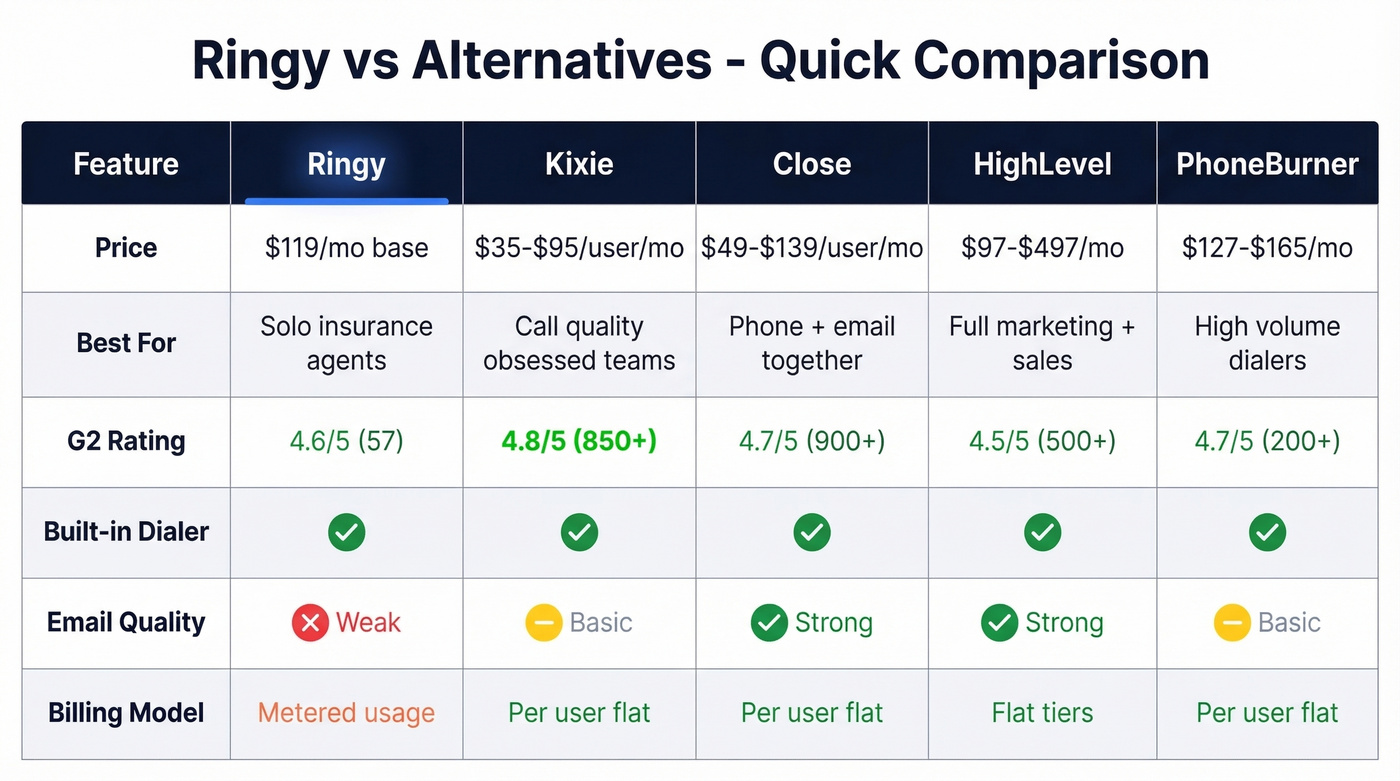
Close ($49-$139/user/mo) is the pick for insurance teams who need email alongside phone. Transparent per-user pricing, built-in calling, SMS, and email that actually works - everything Ringy's email should be but isn't. In our experience, Close is where most teams land after outgrowing Ringy's email limitations. (If you’re tightening your process, these sales prospecting techniques help you get more out of any CRM.)
HighLevel ($97-$497/mo) is a full marketing + sales platform - funnels, landing pages, and automation alongside calling. Overkill for agents who just need a dialer, but if you're building a lead-gen machine, it's the move. If you’re trying to keep costs down, you can also stack a CRM with free lead generation tools.
The closest price anchor is PhoneBurner ($127-$165/mo). Ringy is cheaper at the base tier with more included features, but PhoneBurner's call quality reputation is stronger. The price gap narrows fast once you add Ringy's add-ons and overages. For teams that outgrow all of these, HubSpot Sales Hub (free-$150/user/mo) is the heavier-weight option with a full CRM ecosystem behind it.
Ringy's metered billing stings worse when half your calls hit disconnected numbers. Prospeo refreshes all contact data every 7 days - not every 6 weeks like most providers - so you stop burning minutes and texts on stale leads.
Every overage dollar on a bad number is money you lit on fire.
FAQ
How much does Ringy cost per month?
Ringy's base plan is $119/mo in 2026. Add-ons like Power Dialer (+$70), AI Tools (+$10), and Call Scripting (+$10) push it to $209/mo before usage overages. The plan includes 1,000 minutes and 1,000 texts; overages run $0.01 each. Directory sites showing $99 typically reflect an older figure or a temporary promotional discount.
Is Ringy good for insurance agents?
Yes - 52 of 57 G2 reviews come from insurance professionals, making it a de facto insurance CRM. It's purpose-built for phone + SMS outreach with drip campaigns and local caller ID. Best fit for moderate-volume agents under 2,000 minutes and texts per month. High-volume shops should compare HighLevel or Kixie instead.
Why do my Ringy texts get blocked?
Usually a TCPA compliance issue, not a software bug. Carriers flag SMS as spam when recipients haven't properly opted in - pre-checked opt-in boxes don't count. Verifying contact data before import also helps. Tools like Prospeo catch invalid numbers upstream so carriers see cleaner sending patterns from your account.