

Route to Market: The Cross-Industry Strategy Guide for 2026
Your CEO just asked why you're in 12 markets but only profitable in 3. The answer is almost always the same: you scaled channels before proving unit economics. Companies with a formal route to market playbook see 3x more revenue growth than those winging it - yet fewer than a third actually have one. The gap isn't strategy. It's the operational path between your product and your customer.
Route to market (RTM) is how your product physically and commercially reaches the buyer. The core thesis is simple: pick one channel, prove unit economics, then expand. Everything below serves that idea.
What Is Route to Market?
RTM covers everything downstream of demand creation: channel selection, distribution partnerships, logistics, trade marketing, partner management, and the measurement systems that tell you whether any of it's working.
Most people encounter RTM in an FMCG context - distributor networks, retail execution, outlet coverage. But it applies everywhere. A SaaS company choosing between product-led growth and a channel partner program is making an RTM decision. A manufacturer deciding between OEM relationships and Amazon Business is making an RTM decision. The product and the customer stay the same; the route between them is the variable.
Think of it as plumbing. Your go-to-market strategy decides what water flows and where it needs to go. Your route to market builds the pipes.
RTM vs Go-to-Market Strategy
These terms get swapped in planning meetings constantly, and it causes real confusion. They're related but distinct. GTM sparks demand. RTM fulfills it.
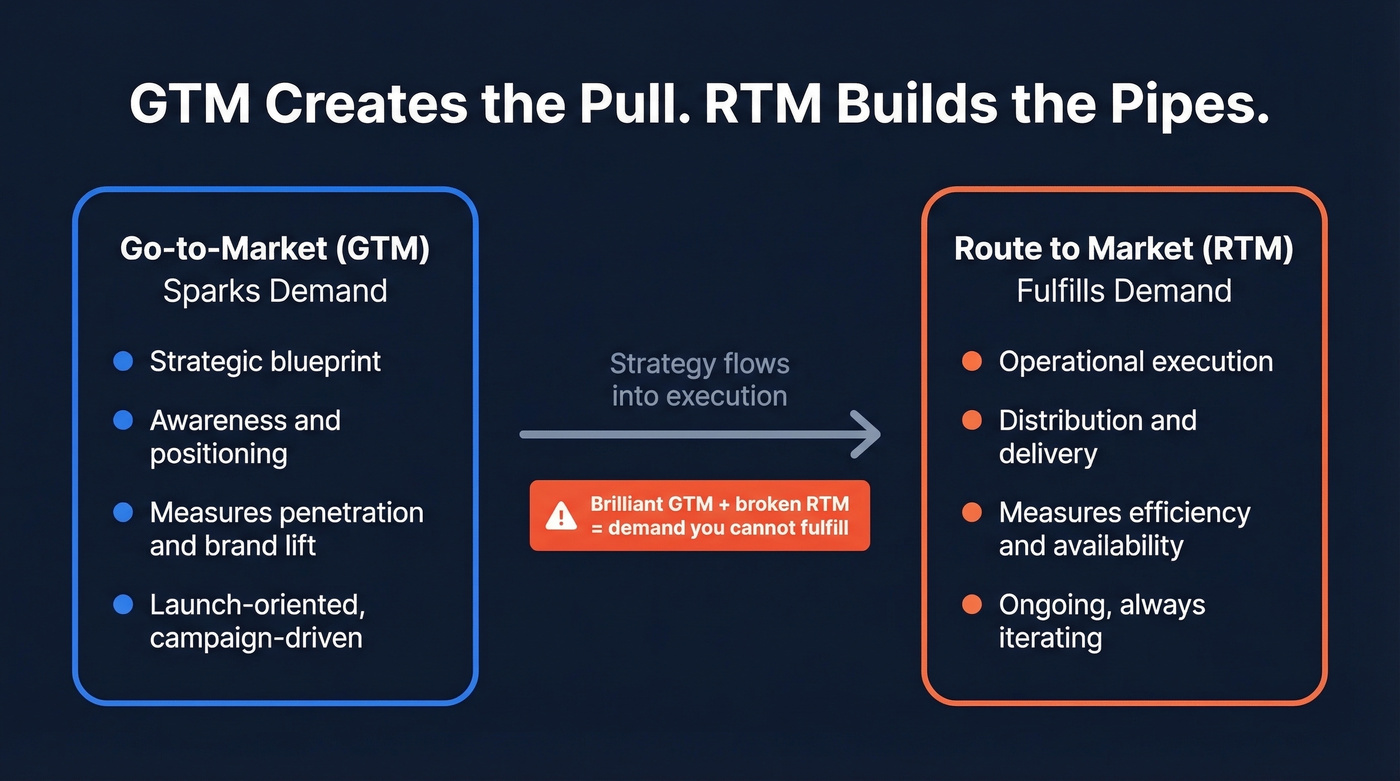
| Dimension | Go-to-Market (GTM) | Route to Market (RTM) |
|---|---|---|
| Scope | Strategic blueprint | Operational execution |
| Focus | Awareness & demand | Distribution & delivery |
| Measures | Penetration, brand lift | Efficiency, availability |
| Timeframe | Launch-oriented | Ongoing, iterative |
A brilliant GTM strategy with a broken RTM means you've created demand you can't fulfill. We've seen this happen more than once - marketing generates pipeline, but the channel can't convert or deliver. That disconnect kills momentum faster than any competitor.
Common RTM Models
There are really only three models. Everything else is a variation.
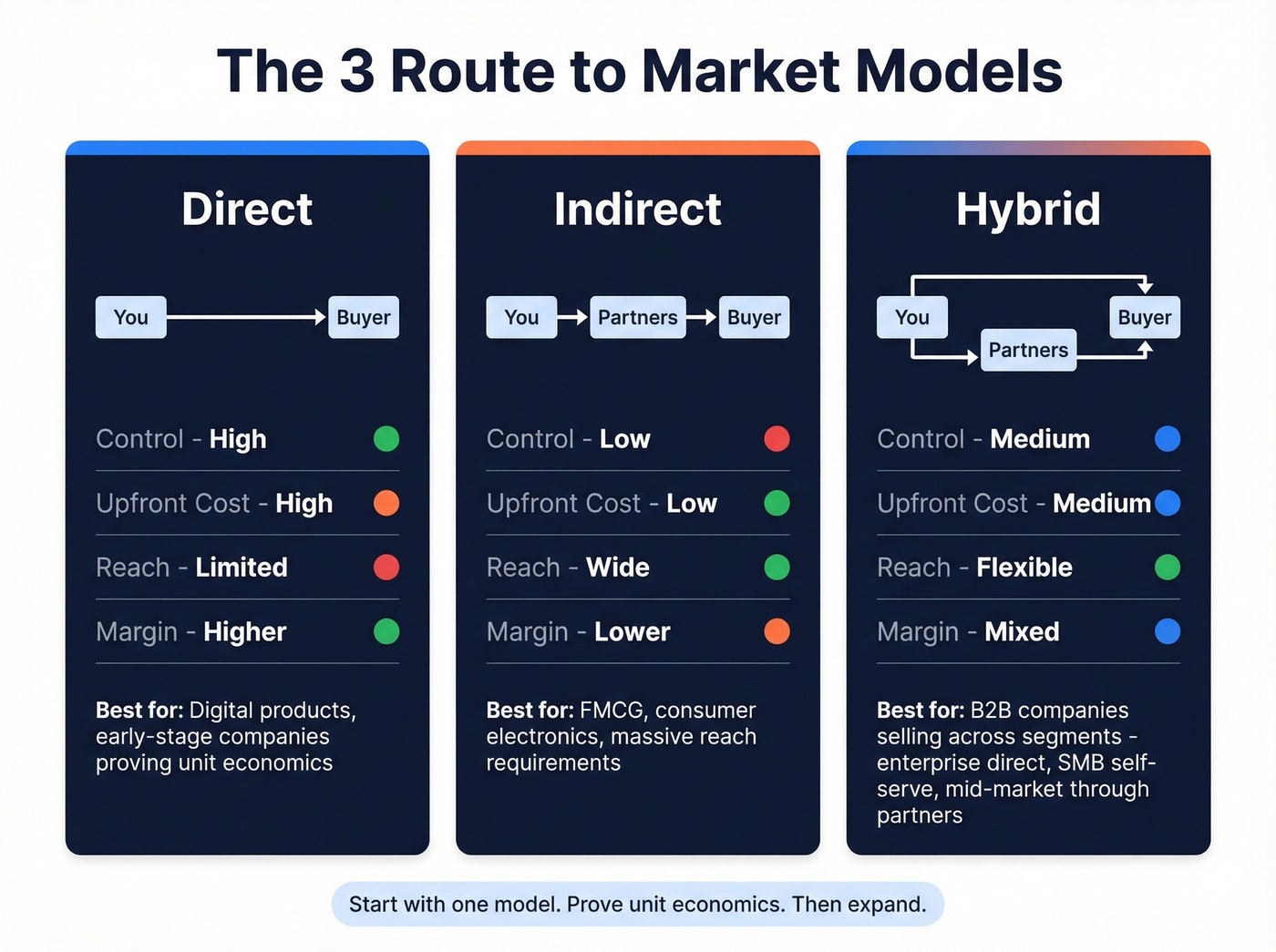
| Model | Control | Upfront Cost | Reach | Margin |
|---|---|---|---|---|
| Direct | High | High | Limited | Higher |
| Indirect | Low | Low | Wide | Lower |
| Hybrid | Medium | Medium | Flexible | Mixed |
Direct means you own the entire path - your sales team, your logistics, your customer relationship. Digital products almost always start here. The margins are better, but you're capped by your own capacity.
Indirect means intermediaries handle distribution. Packaged goods, consumer electronics, and apparel typically run through indirect channels because the reach requirements are massive. You trade margin and control for speed, and customer relationships become shallower by design.
Hybrid is where most B2B companies land eventually. You sell enterprise deals directly through field sales, run SMB through a self-serve channel, and push mid-market through channel partners. The complexity is higher, but so is the ceiling. The key decision factors - per Capital One's analysis - come down to cost structure, product type, required market reach, and how much the customer relationship matters to your business model. Some overlap between channels isn't a failure; it often signals adequate market coverage. The problem is when channels compete for the same buyer without coordination.
How to Build an RTM Strategy
Most RTM failures aren't strategy failures. They're sequencing failures. Teams try to be everywhere from day one instead of proving one channel works first.
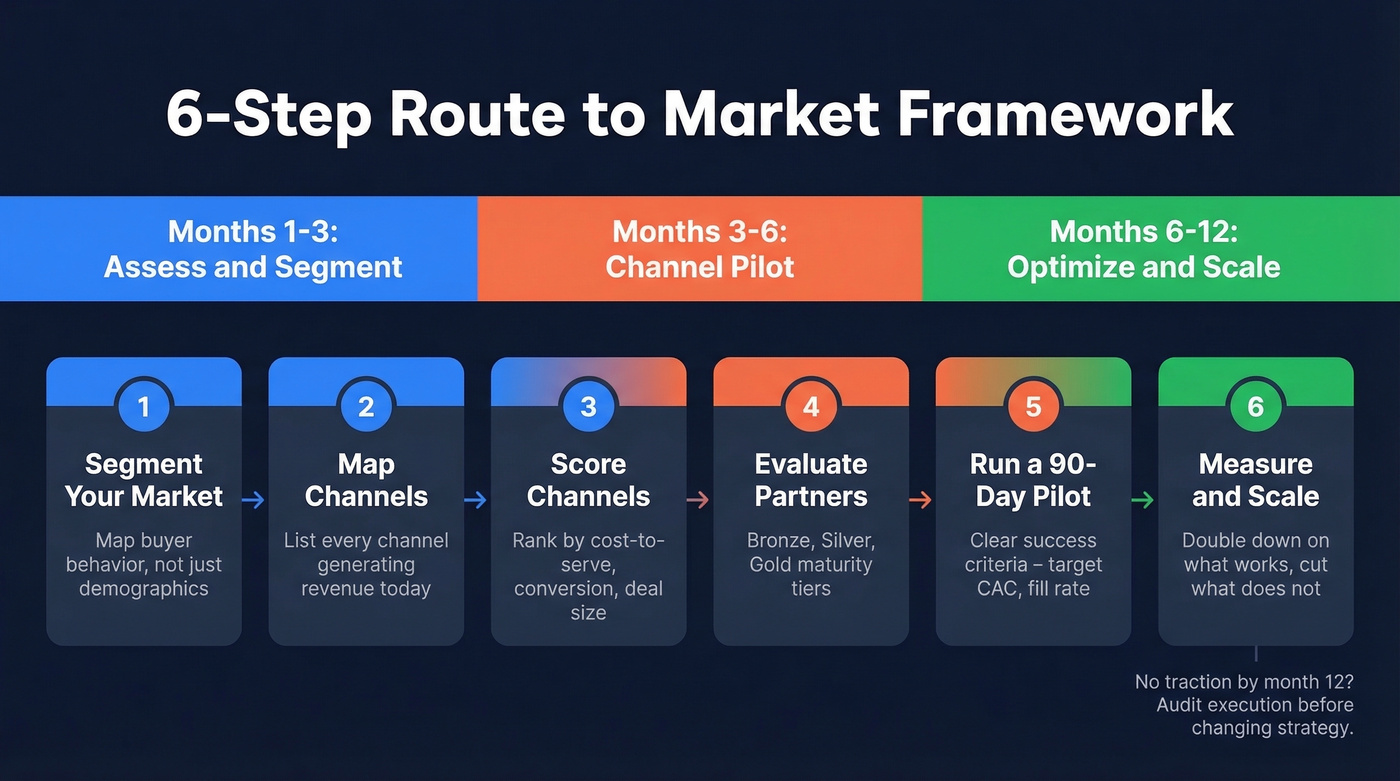
The Enchange methodology breaks RTM into four phases across 20 steps. We've compressed that into a 6-step framework that works whether you're selling software or snack food.
A realistic timeline: Months 1-3 for assessment and segmentation. Months 3-6 for your channel pilot. Months 6-12 for optimization and scale. If you haven't seen traction by month 12, audit execution before changing strategy.
Step 1: Segment Your Market
Before you pick channels, you need to know who you're reaching and where they buy. This isn't just demographics - it's buying behavior. How does your target customer discover products in your category? Do they research online and buy offline? Do they expect a sales conversation, or do they want self-serve?
The most common question in founder communities is "should I go direct first or through partners?" The answer is almost always direct. Prove unit economics before adding intermediary complexity.
For B2B, segment by the buying committee, not just the economic buyer. Gartner's research puts the typical B2B purchase at [6-10 decision-makers]. Think of it as a product x territory x purchase-type matrix: what you sell, where you sell it, and how the buyer wants to buy it. Your RTM needs to serve all three dimensions.
Steps 2 & 3: Map and Score Channels
List every channel currently generating revenue. Then score each one on cost-to-serve, conversion rate, average deal size, and time-to-revenue. Most companies discover that the majority of their revenue comes from one or two channels, and the rest are expensive distractions.
Cost-to-serve is the metric that matters most here. A channel that generates $500K in revenue but costs $450K to operate isn't a growth engine - it's a jobs program. Be ruthless about this math.
Step 4: Evaluate Partners
If your RTM involves intermediaries - distributors, resellers, channel partners, agencies - you need a structured way to assess them. The Enchange distributor assessment model uses a Bronze/Silver/Gold maturity framework across demand management, inventory management, sales capability, and IT infrastructure.
Bronze partners handle basic order fulfillment. Silver partners actively sell and manage territory. Gold partners operate as true extensions of your commercial team. Know which tier each partner falls into, and invest accordingly. Pouring resources into a Bronze-tier distributor hoping they'll magically become Gold is one of the most common and most expensive mistakes in RTM execution.
Here's the thing most guides skip: watch out for exclusivity contracts and minimum volume agreements. A distributor who demands exclusivity before proving they can hit volume targets is a red flag, not a committed partner.
Steps 5 & 6: Pilot, Measure, Scale
Pick your highest-scoring channel. Run a 90-day pilot with clear success criteria: target CAC, conversion rate, fill rate - whatever matters for your model. If the unit economics work, double down. If they don't, diagnose why before expanding.
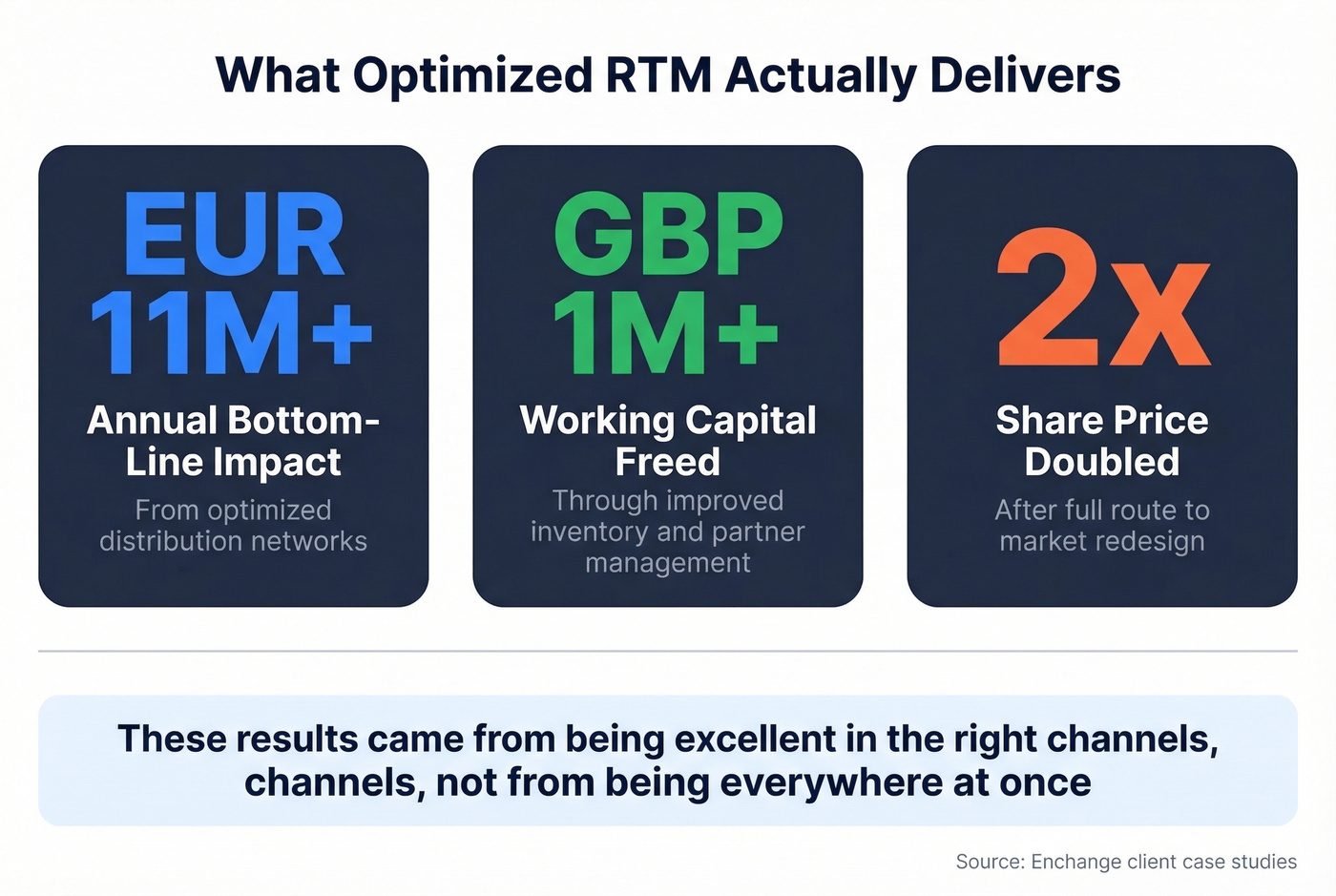
Enchange's clients have seen bottom-line impacts exceeding EUR11M per year from optimized distribution networks, working capital improvements of GBP1M+, and one client doubled its share price after a full RTM redesign. Those numbers don't come from being in every channel. They come from being excellent in the right ones.

Your RTM strategy depends on reaching the right buyers through the right channels. Prospeo gives you 300M+ profiles with 30+ filters - buyer intent, technographics, headcount growth, funding - so you can segment your market and map channels with real data, not guesswork.
Stop building routes to buyers you can't actually reach.
Industry-Specific RTM Playbooks
FMCG
FMCG is where RTM is most commonly discussed, and it's still the most operationally complex version. In many markets, the model is distributor-led: you partner with distributors who service retail outlets, and your field team handles retail execution - merchandising, shelf placement, promotional compliance.
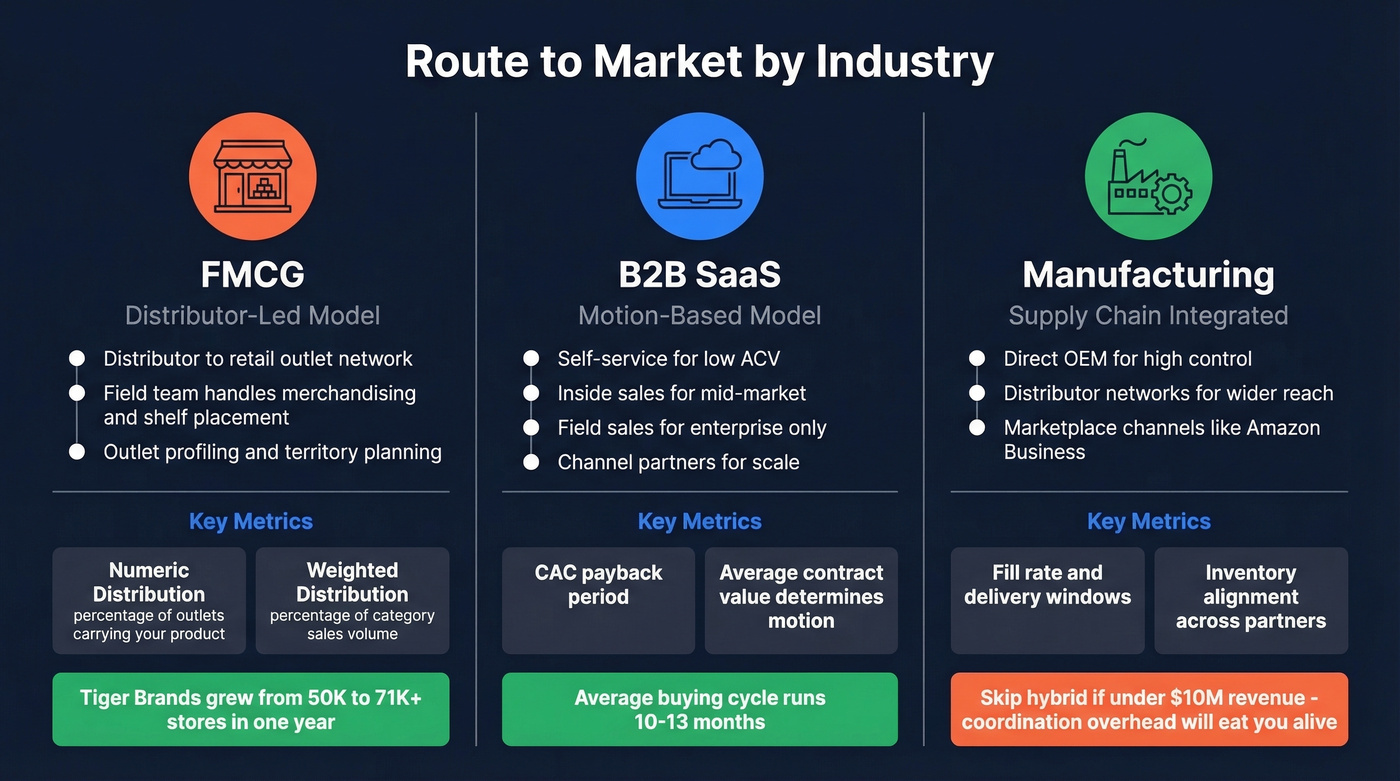
The numbers that matter are numeric distribution (the percentage of relevant outlets carrying your product) and weighted distribution (the percentage of category sales volume those outlets represent). Tiger Brands demonstrated what focused execution looks like when they expanded from 50,000 to 71,000+ stores in South African townships within a single year. That kind of growth requires systematic outlet profiling, territory planning, and distributor management - not just adding headcount.
A less obvious failure mode: poor inventory visibility at the outlet level. If you can't see what's on the shelf frequently enough, your field team is flying blind and your promotional spend is wasted.
B2B SaaS
SaaS RTM is a choice between four sales motions: self-service, inside sales, field sales, and channel sales. Most companies end up running two or three simultaneously, segmented by deal size.
The buying cycle in B2B SaaS runs 10-13 months on average. That's why product-led growth has become so popular - it lets users validate the product before the buying committee gets involved. Dropbox validated demand with a demo video before building the full product. Slack started as an internal tool and iterated with early adopters. Both proved the channel before scaling it.
Let's be honest: if your average contract value sits below ~$15K, you probably don't need field sales. PLG plus inside sales will get you further, faster, and cheaper. Save the enterprise motion for enterprise deals.
For teams where outbound is a core channel, the entire motion lives or dies on contact data quality. Bad data means burned domains, wasted SDR hours, and pipeline that never materializes. We've watched teams switch from manual list-building to verified databases and cut bounce rates from 35% to under 4% within weeks.
Manufacturing
Manufacturing RTM is inseparable from supply chain strategy. The commercial decision and the logistics decision can't be made independently.
The three dominant models are direct OEM relationships for high control with limited scale, distributor networks for wider reach with less margin, and marketplace channels like Amazon Business for massive reach with minimal relationship depth. The mistake we see most often is treating RTM as purely a sales problem. If your distribution partner can't maintain inventory levels or meet delivery windows, your sales team's work is wasted. Manufacturing requires tight alignment between commercial, operations, and logistics - and that alignment needs to be designed, not assumed.
Skip the hybrid model if you're under $10M in revenue. The coordination overhead will eat you alive. Pick direct or indirect, prove it, then consider adding complexity.
RTM KPIs: Measuring Performance
The best framework for measurement is a KPI tree: start with the business objective, work down to the strategy, then to tactics and the KPIs that track them.
| KPI | Target Range | Goal |
|---|---|---|
| Inventory turns | 6-12/year | Higher = healthier |
| DSO | 40-50 days | Lower = faster cash |
| Fill rate | 95%+ | Leading indicator |
| Stockout frequency | <2% | Revenue protection |
For FMCG, add numeric distribution, weighted distribution, and in-store availability. For B2B, track CAC by channel, pipeline velocity by sales motion, and win rate by motion. Fill rate and stockout frequency are leading indicators across every industry - if those start slipping, revenue problems follow within a quarter.
Common RTM Mistakes
Scaling before proving unit economics. The most expensive mistake. You can't optimize 12 channels simultaneously. Pick one, prove it works, then expand.
Blind partner onboarding. Adding distributors or resellers without profiling their capabilities, territory coverage, or financial health. This is how you end up with partners who take your inventory and sit on it.
SKU-basket mismatch. Pushing the wrong products through the wrong channels. A premium SKU in a discount outlet destroys brand equity. An enterprise product through a self-serve channel creates support nightmares nobody budgeted for.
Cross-functional silos. Sales, marketing, and supply chain operating independently is the norm, not the exception. RTM requires all three aligned on channel strategy, with a single owner who has authority across functions.
Feeding channels garbage data. Look - the biggest mistake isn't choosing the wrong channel. It's choosing the right channel and feeding it stale contacts, low match-rate enrichment, and SDRs manually hunting for emails. Data refresh cycles matter. Platforms that update weekly catch job changes and bounces before they cost you pipeline.
The RTM Technology Stack
Your strategy is only as good as the systems executing it.
CRM is the foundation. Salesforce for enterprise, HubSpot for mid-market - pick one and commit. Your CRM is where channel performance data lives, and it's the system of record for every downstream tool. (If you're still evaluating, start with these examples of a CRM.)
Contact data quality is the layer most teams underinvest in. For outbound channels, Prospeo's 300M+ professional profiles with 98% email accuracy and a 7-day refresh cycle mean your SDRs aren't burning cycles on dead leads. It plugs directly into Salesforce, HubSpot, Smartlead, Instantly, Lemlist, Clay, Zapier, and Make - so the data flows where your workflows already live. If you're comparing vendors, see data enrichment services and lead enrichment.
BI and analytics tools like Tableau, Looker, or Power BI power your performance dashboards. Route optimization software matters for field sales teams covering physical territories. Order management systems round out the stack for companies running indirect distribution. For territory planning, sales mapping software can help.
A lean tool stack with clean data flowing between systems outperforms an expensive platform where data sits in silos. Every time.
Scoring channels on cost-to-serve and conversion rate requires accurate contact data at every stage. Prospeo delivers 98% email accuracy on a 7-day refresh cycle - so your pilot channels run on fresh data, not stale lists that inflate your CAC and kill unit economics.
Prove unit economics faster with data that's refreshed weekly, not monthly.
FAQ
How long does an RTM strategy take to show results?
Most strategies need 6-18 months to produce measurable impact. The first six months cover channel piloting and baseline data collection. If you haven't seen traction by month 12, audit channel economics and partner performance before scrapping the plan entirely.
What's the difference between route to market and distribution strategy?
Distribution strategy is a subset of RTM. Route to market covers the full commercial path - channel selection, partner management, pricing architecture, and measurement. Distribution focuses specifically on logistics and intermediary management within that broader framework.
Can small businesses have an RTM strategy?
Yes - a solo founder selling through one channel already has one, just undocumented. Formalizing it forces you to evaluate whether your current channel is actually the most efficient path to your customer. We've seen $5K/month founders discover that Shopify DTC outperforms marketplace fees by 30%+ once they actually run the numbers.
What tools help execute an outbound RTM channel?
At minimum: a CRM, a sequencing tool like Instantly or Lemlist, and a verified contact data platform. Prospeo's free tier gives you 75 emails per month to test data quality before committing budget. The sequencer sends the emails; the data platform ensures those emails reach real inboxes instead of bouncing.