

Sales and Operations Alignment: The 2026 Process Playbook
If your orders doubled overnight, your company would implode. Not because of a talent problem - because sales and operations alignment doesn't exist. Nobody knows what info transfers at closed-won, nobody owns the gap, and the blame cycle starts before the ink dries on the contract. 53% of companies still experience broken handoffs where leads fall through the cracks between departments. That's not a communication issue. It's a process failure.
What You Need (Quick Version)
Three non-negotiable artifacts:
- A standardized handoff document - what info transfers from sales to ops at closed-won, who owns it, what's required vs. optional. (If you need a starting point, use a handoff template to standardize the fields.)
- A monthly S&OP cadence with the 5-phase review cycle.
- An internal SLA with weekly reporting between departments.
If you implement one thing, make it the monthly S&OP cadence. Everything else builds on top of it.
What Aligning Sales and Ops Actually Means
Half the advice on this topic covers sales-marketing alignment. Different problem entirely. Sales and operations alignment is about what happens after the deal closes - making sure what sales promised is what ops can actually deliver, on time, at margin.
The formal name is S&OP, a monthly process that forces demand forecasts, supply capacity, and financial targets into a single plan. Companies that run it well gain a shared view of reality instead of two competing versions of the truth. The informal version is simpler: get the people who own demand and the people who own supply into the same room, with the same numbers, on a regular cadence.
The Cost of Getting It Wrong
When sales and ops aren't aligned, cash leaks quietly. Expedite freight, excess inventory, overtime, markdowns - none of these show up as "misalignment costs" on a P&L, but they eat EBITDA all the same. The downstream effects compound fast: inventory chaos from bad forecasts, customer dissatisfaction from broken delivery promises, profit erosion from emergency shipping, and team burnout from blame cycles that never resolve.
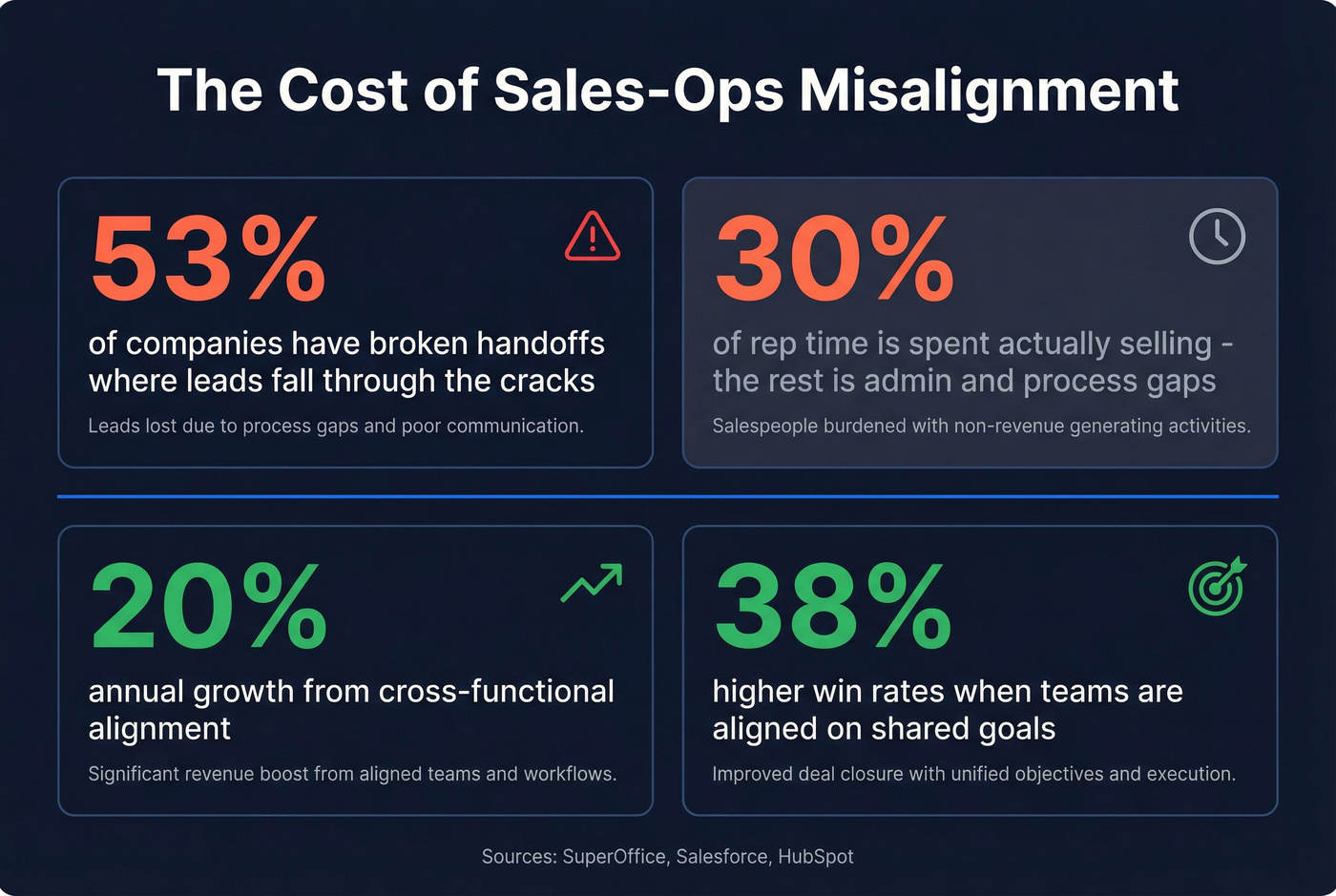
Cross-functional alignment drives measurable results. Sales and marketing alignment alone is associated with 20% average annual growth and 38% higher win rates. Meanwhile, reps spend about 30% of their time actually selling - the rest disappears into admin work. And the "handoff black hole" problem is real: one practitioner described a gap between "MQL" and "closed won" where nobody knows what happened. Gartner analyst Michael Youssef put it bluntly: "S&OP is the single most important and critical cross-functional process" for driving revenue and profitability.
The S&OP Framework
S&OP runs on a monthly cycle with five phases:
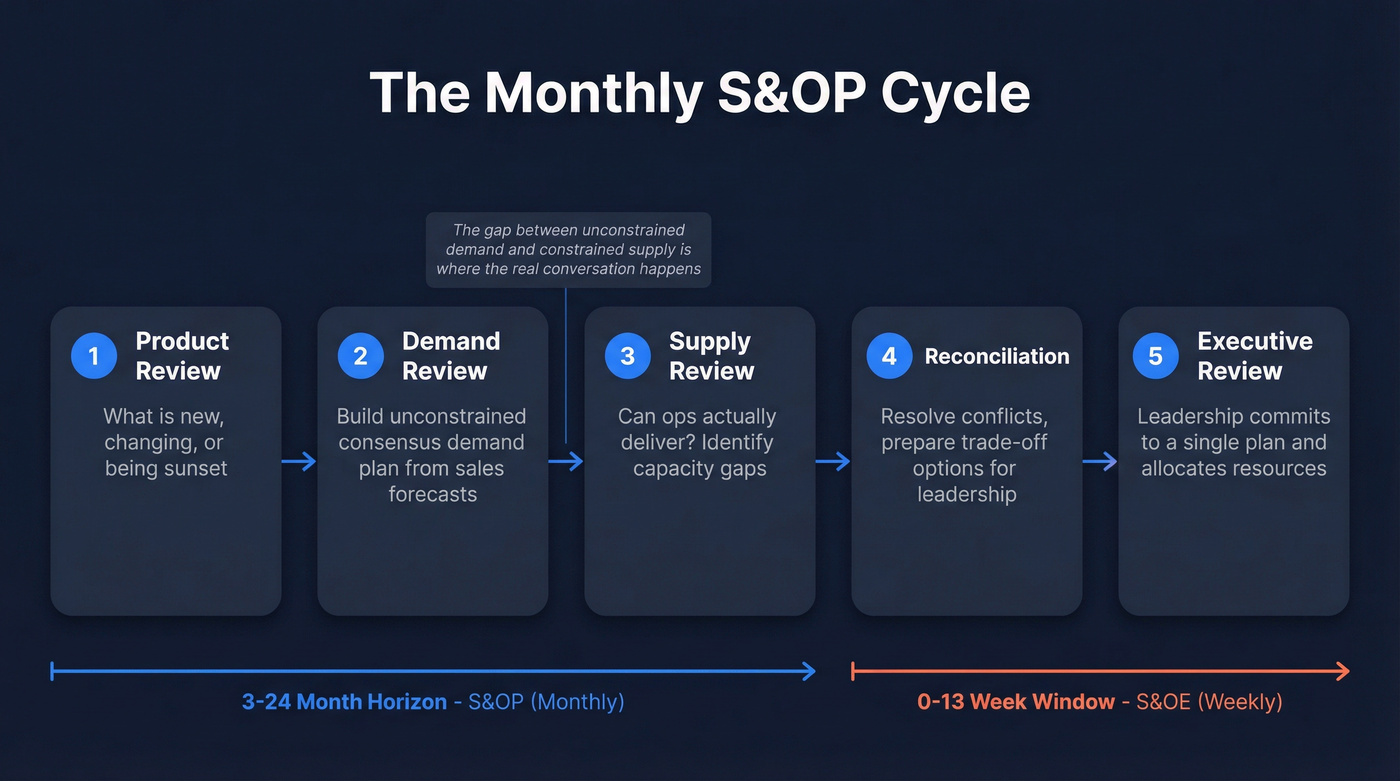
- Product Review - what's new, what's changing, what's being sunset.
- Demand Review - build an unconstrained consensus demand plan (what sales expects, before supply constraints).
- Supply & Resource Review - can ops actually deliver that demand? Where are the gaps?
- Pre-S&OP / Reconciliation - resolve conflicts, prepare trade-off options.
- Executive Review - leadership commits to a single plan and allocates resources.
The key concept is unconstrained vs. constrained demand. Sales builds the forecast they believe in. Ops applies reality. The gap between those two numbers is where the real conversation happens - it reveals lost opportunity vs. unrealistic expectations.
S&OP covers a 3-24 month horizon. For near-term execution in the 0-13 week window, you need S&OE - weekly check-ins that catch deviations before they become crises. One without the other leaves a blind spot.

Broken handoffs start with bad data. When sales closes a deal on contacts that bounce, ops inherits the mess. Prospeo's 98% email accuracy and 7-day data refresh mean the contact info in your CRM is actually current - so the handoff document your SLA depends on isn't built on stale records.
Fix your data before you fix your process.
Seven Practices That Drive Alignment
Start With the Internal SLA
Most alignment advice buries this at the bottom. Don't.
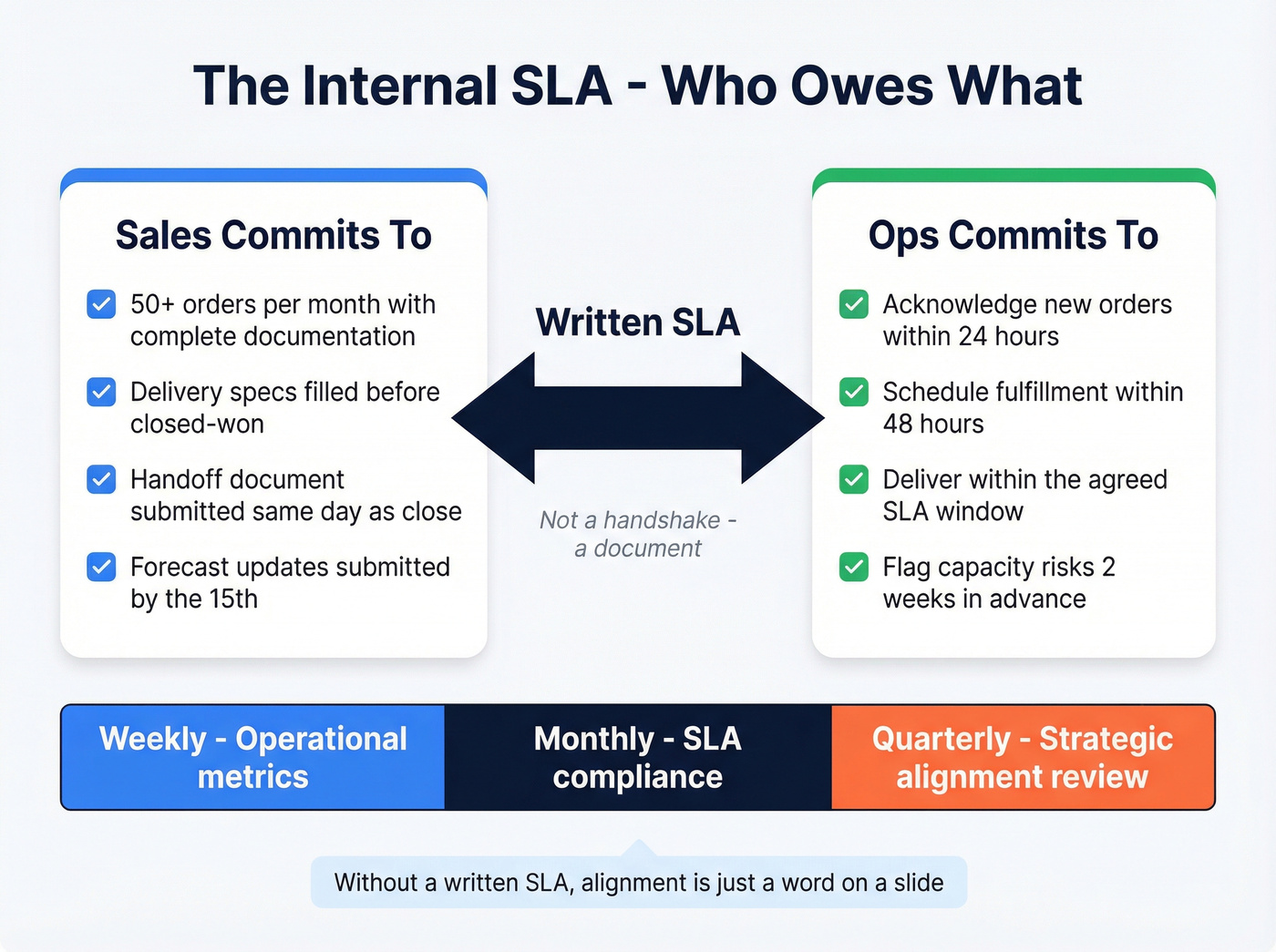
The SLA is the single most concrete thing you can implement this week. If sales commits to 50 new orders per month with complete handoff documentation, ops commits to acknowledging within 24 hours, scheduling within 48 hours, and delivering within the agreed window. Report weekly on operational metrics, monthly on SLA compliance, quarterly on strategic alignment (many teams formalize this in a QBR). HubSpot offers a free sales SLA template that can be adapted for ops handoffs. Without a written SLA, "alignment" is just a word on a slide.
Standardize the Handoff
Define exactly what information transfers from sales to ops at closed-won. Required fields, ownership, format. If a rep can close a deal without filling in delivery specs, your handoff is broken. We've seen teams go through three or four iterations of their handoff template before it sticks - that's normal, and it's a sign the process is actually being used.
Integrate Your CRM and ERP
Sales lives in the CRM. Ops lives in the ERP. If those systems don't talk, you're running alignment on spreadsheets and Slack messages. Demand planning is a top digital investment priority for 74% of supply chain leaders, and a practical first step is connecting the systems that hold demand and supply data. (If you're still evaluating platforms, it helps to review examples of a CRM and what they integrate with.)
Build Forecasts Together
Here's what bad forecasting looks like: sales submits a number, ops ignores it and plans off last year's actuals, and both teams are surprised when reality matches neither. Good forecasting means ops pressure-tests the demand plan against capacity, and sales understands what's actually deliverable. Use historical data, customer feedback, and market signals - then reconcile in the same room. If forecasting is the root issue, use a dedicated sales forecasting solution instead of spreadsheet guesswork.
Run Real S&OP Meetings
Not status updates. Real meetings where demand, capacity, and risks are discussed, trade-offs are surfaced, and decisions get made. If your S&OP meeting is a slide deck nobody reads, you don't have S&OP. You have a calendar hold.
Align on Shared KPIs
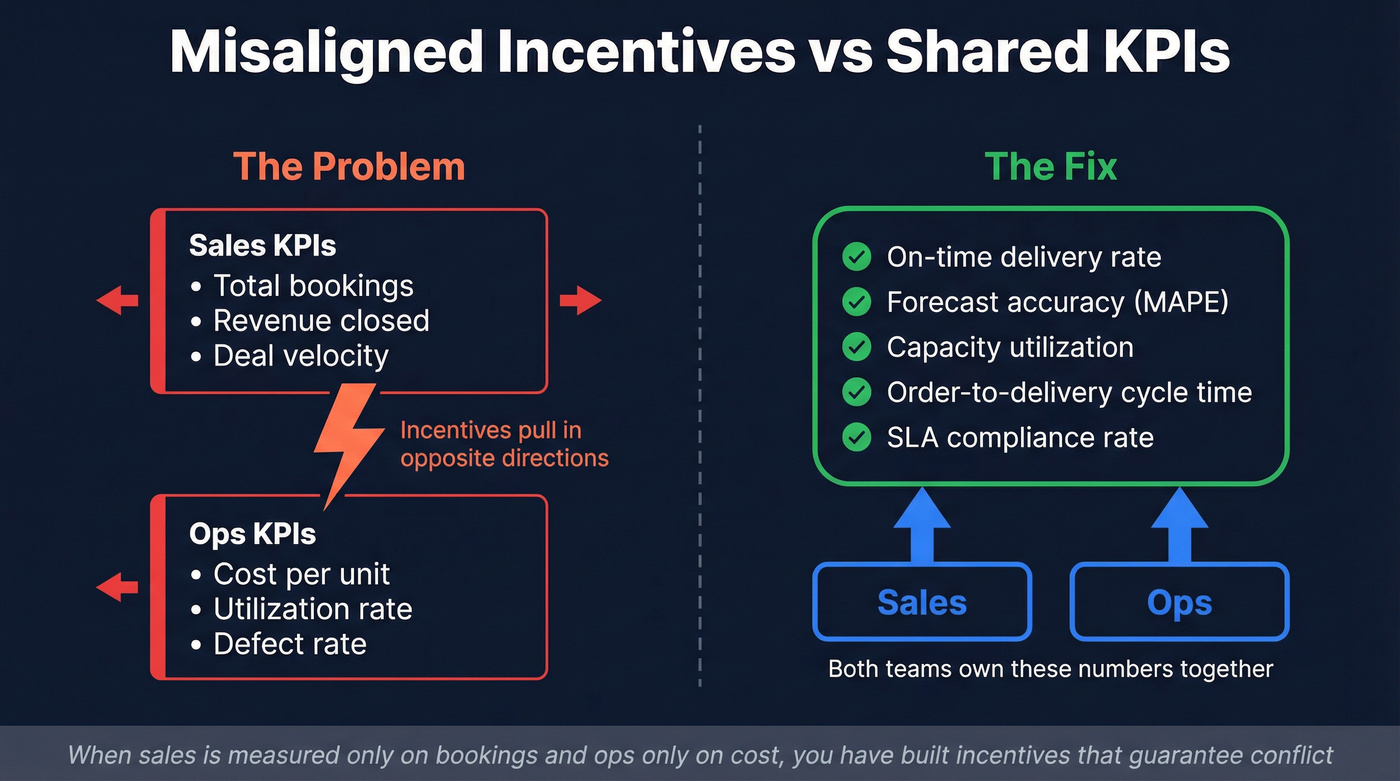
Both teams should own on-time delivery, forecast accuracy, and capacity utilization. When sales is measured only on bookings and ops only on cost-per-unit, you've built incentives that pull in opposite directions. The consensus on r/sales and r/supplychain is consistent: misaligned incentives cause more damage than misaligned processes. To operationalize this, track a shared set of sales operations metrics across both teams.
Iterate the Playbook
No process survives first contact with reality unchanged. Run quarterly retros. In our experience, the best-aligned teams treat their playbook as a living document - they rewrite sections constantly based on what's actually breaking.
Mistakes That Kill Alignment
Three failure modes show up repeatedly:
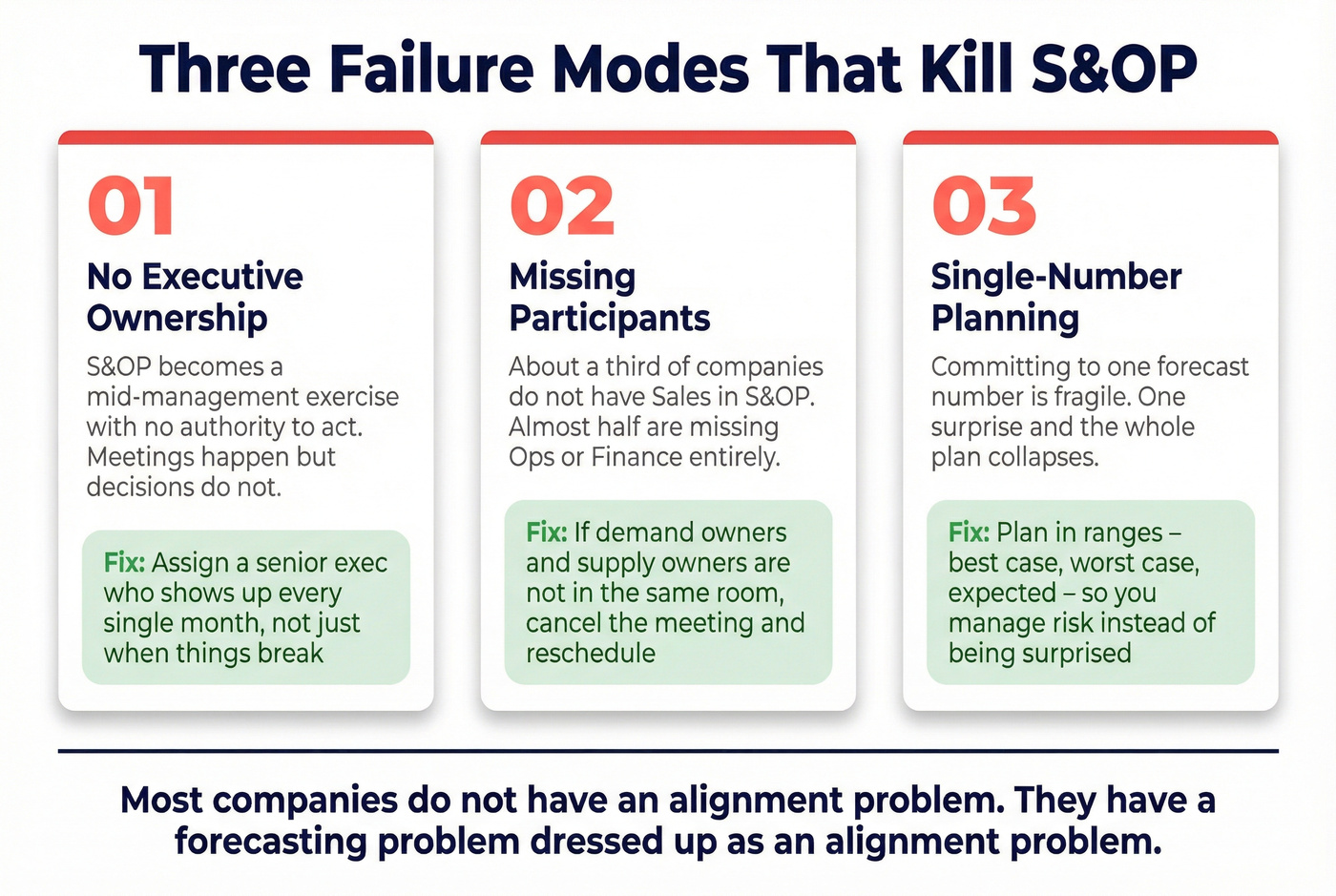
No executive ownership. S&OP without exec engagement becomes a mid-management exercise that nobody has authority to act on. Someone senior needs to own the process and show up. Every month. Not just when things go wrong.
Missing participants. About a third of companies don't have Sales engaged in S&OP, and almost half are missing Ops or Finance. If the people who own demand and the people who own supply aren't in the same room, you have a planning exercise, not S&OP.
Single-number planning. Committing to one forecast number is fragile. Plan in ranges - best case, worst case, expected - so you can manage risk instead of being surprised by it.
Let's be honest: most companies don't have an alignment problem. They have a forecasting problem dressed up as an alignment problem. Fix the forecast first - give ops a number they can actually plan against - and half the finger-pointing disappears on its own.
Benefits When S&OP Works
When the process is running well, the payoff extends far beyond fewer arguments in the conference room. Tighter inventory management, shorter order-to-delivery cycles, more accurate revenue forecasts, and higher customer satisfaction scores all follow. Companies also see reduced expedite costs and overtime because ops can plan proactively instead of reacting to surprises.
The biggest win is less visible but more valuable: leadership gets a single set of numbers to make decisions against. No more reconciling three different spreadsheets from three different departments.
Data Quality: The Prerequisite Nobody Mentions
Your S&OP process is only as good as the data feeding it. AI-powered forecasting can deliver 15-20% higher forecast accuracy, but none of that matters if your CRM is full of stale contacts and outdated company info. Every forecast and handoff built on bad data is compromised from the start.
This is where tools like Prospeo fit in - enriching CRM records with 50+ data points per contact on a 7-day refresh cycle at 98% email accuracy. When both sales and ops work from the same verified source of truth, handoffs stop breaking because the underlying records are days old, not months. (If you're comparing vendors, start with these data enrichment services.)
Skip this section if your CRM hygiene is already solid and your data refresh cycle is under two weeks. For everyone else, fixing the data layer is the prerequisite that makes everything above actually work.
Your CRM-to-ERP integration is only as good as the data flowing through it. Prospeo enriches every contact with 50+ verified data points at a 92% match rate - giving both sales and ops a single source of truth instead of two competing spreadsheets.
One accurate dataset. Zero blame cycles. Starting at $0.01 per email.
What This Looks Like in Practice
A manufacturing plant was running on-time delivery in the low 80s with monthly overtime exceeding 20%. Classic symptoms: mistrust of the ERP, finger-pointing between departments, sales overpromising while ops scrambled to keep up.
They created a dedicated S&OP champion role, invested in training through CPIM and CPF certifications, and shifted from reactive firefighting to collaborative planning with scenario-based forecasts. Over the following quarters, service levels improved and overtime pressure eased. We've reviewed several turnarounds like this, and the pattern is always the same - the biggest change isn't a tool or a template. It's getting sales and ops to stop blaming each other and start planning together.
FAQ
What's the difference between S&OP and S&OE?
S&OP is a monthly strategic process covering a 3-24 month horizon where cross-functional trade-offs are decided and a single plan is committed to. S&OE operates weekly on a 0-13 week window, catching near-term execution deviations before they snowball. You need both - S&OP sets direction, S&OE keeps you on course.
Which KPIs should sales and ops share?
On-time delivery, forecast accuracy, capacity utilization, order-to-delivery cycle time, and SLA compliance rate. These five metrics create shared accountability and break the blame cycle. When both teams own the same numbers, finger-pointing loses its footing.
How does CRM data quality affect sales-ops alignment?
Stale CRM data produces bad forecasts and broken handoffs - ops can't plan around contacts and deal details that are months out of date. Keeping records current with a regular refresh cycle and verified contact data gives both teams a single source of truth. Clean data is the invisible prerequisite for every alignment process described above.