

How to Build Sales Battle Cards Reps Actually Use
You spent three weeks building your sales battle card. You interviewed product, pulled G2 reviews, formatted it beautifully in Notion. Then you checked the analytics: four views. Three were you. The fourth was your manager, who skimmed it and never came back.
That's the reality for most battlecards. A Klue audit of 150+ battlecards found only 43% included talk tracks and just 19% included supporting evidence. Reps aren't ignoring your cards because they're lazy - they're ignoring them because the cards don't answer the question they actually have at 11am on a Tuesday: what do I say right now?
The Short Version
- Build cards for your top 3 competitors only. Each fits on one screen. Use the Know-Say-Show framework: context + talk track + proof asset.
- Put cards in-workflow (CRM first) - not a shared drive. If it takes more than 30 seconds to find, reps will ignore it.
- Update every 30-60 days (quarterly at minimum). One wrong stat mid-call and the card is dead to that rep forever.
What Is a Sales Battle Card?
A sales battle card is a one-page cheat sheet designed to be scanned before or during a live call. It gives reps the competitive context, talk tracks, and proof points they need to handle a specific competitor - fast.
It's not a competitive intelligence doc. Those run 10 pages and live in a folder nobody opens. It's not a product one-pager, which is about you, not the competitor. And it's not a sales playbook, which covers your entire process end to end. The distinction matters because most cards fail by trying to be all three - too long, too abstract, and too far from the actual conversation a rep is having.
Why Battle Cards Matter
Here's the thing: 33% of deals are lost directly to a competitor, and nearly half of those losses are winnable. Meanwhile, 47% of deals involve three or more vendors being evaluated simultaneously. Your reps are in competitive situations constantly, and most of them are winging it.
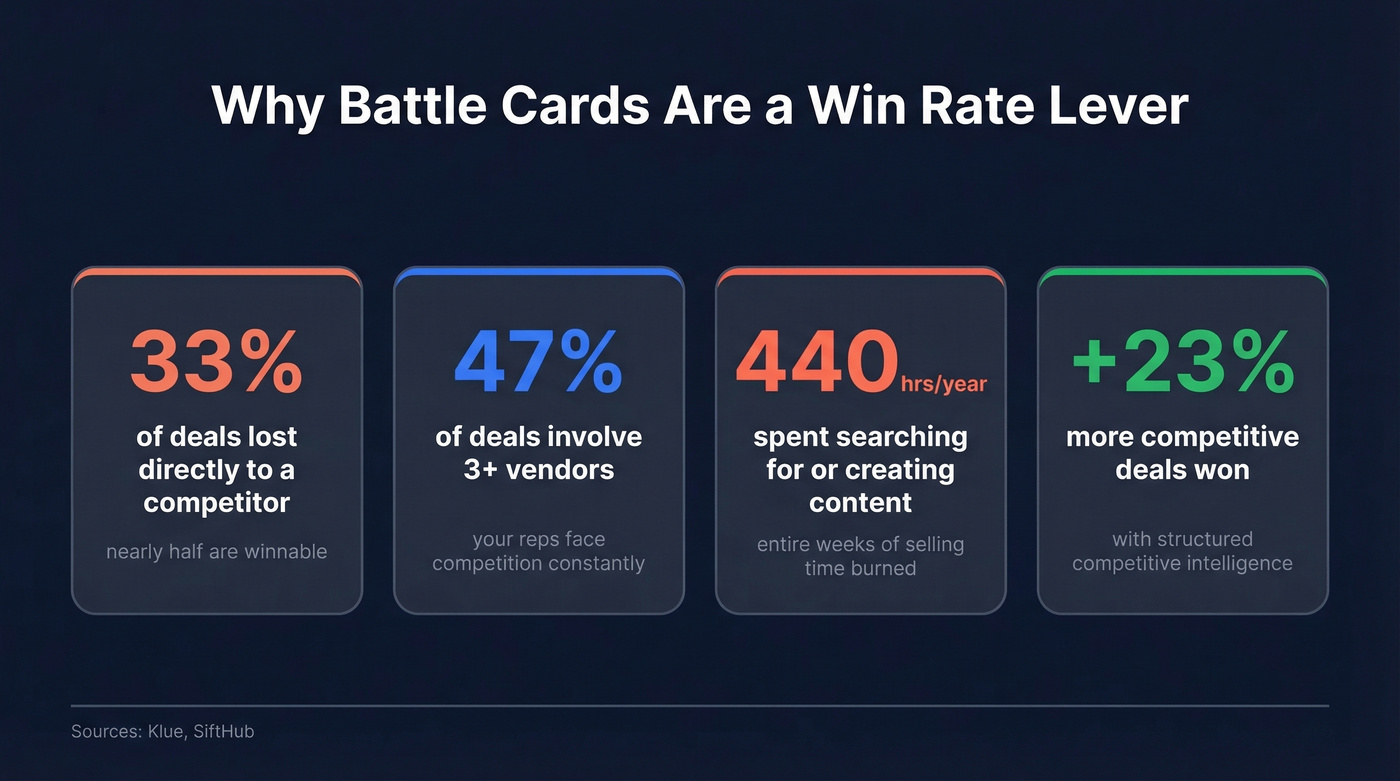
76% of organizations now have a dedicated enablement function - up from 32% five years ago - yet most still can't get reps to use the content they produce. Revenue teams spend an estimated 440 hours per year searching for or creating content. That's entire weeks of selling time burned hunting for a pricing comparison or an objection response that should've been at their fingertips.
Teams using structured competitive intelligence win 23% more competitive deals. Battle cards aren't a nice-to-have enablement project. They're a direct lever on win rate.
Why Most Battle Cards Collect Dust
78% of organizations are building battle cards, but fewer than 65% are confident reps use them regularly. The gap between "built" and "used" is where most enablement programs die. Three things kill adoption:
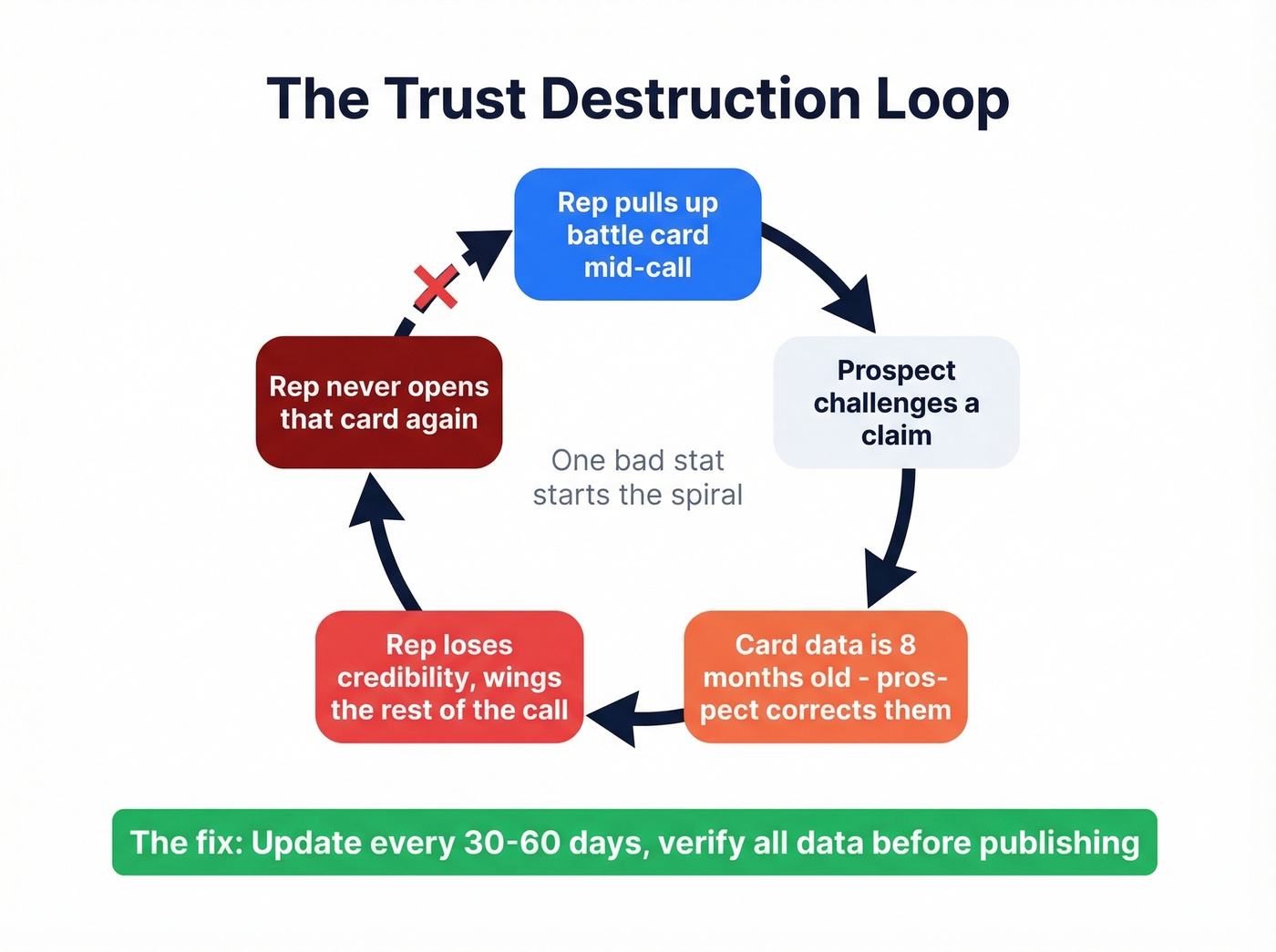
Outdated content destroys trust. Picture this: your AE is mid-call, the prospect challenges a pricing claim, the rep pulls up the card, and the competitor's pricing is eight months old. The prospect corrects them. That rep wings the rest of the call and never opens that card again. One bad stat creates a trust-destruction loop that's almost impossible to reverse.
Poor accessibility. If finding the card takes more than 30 seconds, reps default to their own scripts. A card buried three folders deep in Google Drive might as well not exist.
Built for marketers, not sellers. Only 30% of marketing-created content is ever used by sales. Most cards are written by product marketers who care about positioning nuance. Reps care about "what do I say when they bring up Competitor X's new feature?" If your card reads like a competitive analysis brief instead of a cheat sheet, it's built for the wrong audience.
That trust-destruction loop doesn't just apply to competitive positioning. Battle cards often reference account data - company size, tech stack, contact info - that decays just as fast as competitor pricing. Keeping that foundational layer accurate through verified data sources and regular refresh cycles is what separates cards reps trust from cards reps abandon.

For enablement leaders, the fix isn't just better content - it's behavior change. The ADKAR framework (Awareness, Desire, Knowledge, Ability, Reinforcement) is worth studying. You're not distributing a document; you're changing a habit.
What to Include
Stop building "comprehensive" cards. Build focused ones. Every component should pass the Know-Say-Show test:
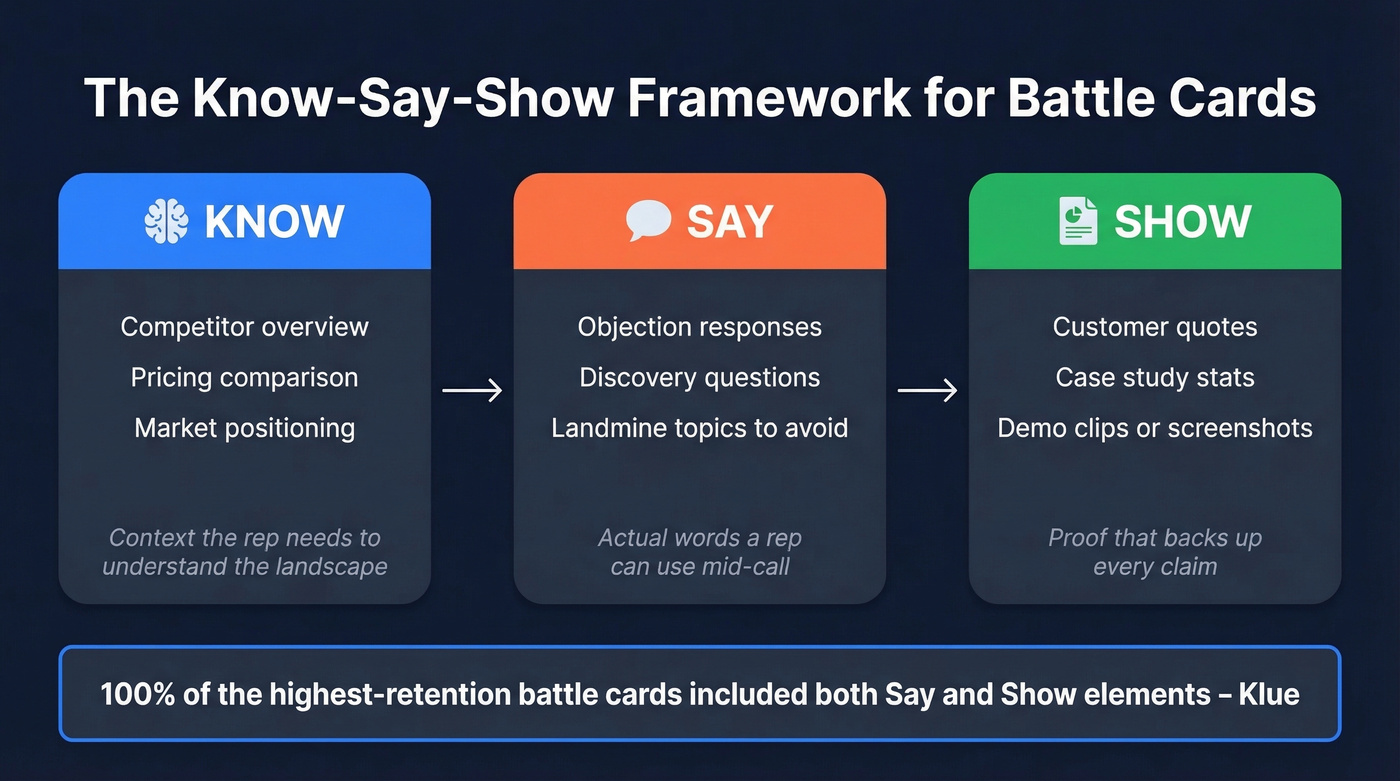
- Know = context the rep needs to understand the competition
- Say = the actual talk track - words they can use mid-call
- Show = the proof asset that backs it up (case study, stat, demo clip)
Klue's data is unambiguous: 100% of the highest-retention battle cards included both Say and Show elements. Cards with only Know content - background context without talk tracks or proof - had the lowest adoption.
Here's what belongs on the card:
- Competitor overview (Know): two to three sentences. Who they are, who they sell to, what they lead with.
- Your USPs vs. theirs (Know + Say): not a feature matrix - a positioning statement a rep can actually say out loud.
- Objection responses (Say): the three to five most common objections when this competitor comes up, with scripted responses.
- Discovery questions and landmines (Say): questions that steer the conversation toward your strengths. Also flag topics where you consistently lose so reps know what to avoid. (If you need a starting point, use a bank of discovery questions.)
- Proof points (Show): micro case studies, stats, or customer quotes that back up your claims.
- Pricing comparison (Know): what the competitor charges, how it compares, and how to frame the value gap.
If it doesn't fit on one screen, cut something. Everything else goes in a linked appendix.

One wrong stat mid-call kills a battle card forever. Prospeo's 7-day data refresh cycle and 98% email accuracy mean the account data powering your cards - company size, contacts, tech stack - stays current, not eight months stale.
Stop arming reps with decaying data. Start with verified intelligence.
Real Battle Card Examples
Most guides tell you what to include. Let's look at what actually works, drawn from Dock's curated archive of 24 real examples.
Cisco Webex vs. Zoom
What if your card didn't mention a single feature? Cisco built this one around a persona - "Thema, Remote Worker" - and reframed the competition around security and IT control. The card includes coaching-style discovery prompts like "Ask about MFA for Apple Macs, Samsung devices, or general IoT machines." Persona-led framing forces reps to think about the buyer's world, not your product's feature list. This is the approach we'd steal first.
Parallels vs. Citrix
A tight two-page table format with checkmarks, designed around a "30 seconds" pitch discipline. No narrative, no fluff - just scannable comparison rows with feature parity and specific wins highlighted. The table format works when your competitive advantage is breadth plus targeted wins. It forces brevity in a way that narrative cards never do.
Netskope Partner Card
This one leads with buyer questions - qualification-first - and includes micro case studies showing company size, use case, and why they won. Leading with buyer questions means the card doubles as a discovery guide, not just a defensive tool. If your reps struggle with discovery, steal this structure.
Salesforce Direct Connect
Opens with buyer fear statements: "I don't know when I can text a prospect..." Then walks through who, when, and why, plus practical details like pricing, setup, and timing. Starting with the buyer's anxiety - not your product's strengths - makes the card immediately relevant to the conversation the rep is actually having. This is the most underrated approach in the batch.
How to Create a Battle Card
Five Steps to Your First Card
- Pick your top 3 competitors. Not 10. Not "all of them." The three that show up most in competitive deals. Expand later.
- Gather intel. Win/loss interviews are gold. Supplement with G2 reviews, competitor websites, and sales call recordings. Your reps already know what prospects say - ask them.
- Structure with a framework. Know-Say-Show is the default recommendation. Pick one and stick with it across all cards for consistency.
- Write in sales-ready language. If it sounds like a press release, rewrite it. The test: could a rep read this sentence out loud on a call without sounding weird? If not, cut it.
- Get feedback from your top AE before distributing. Not your VP of Marketing. Your best closer. If they wouldn't use it, nobody will.
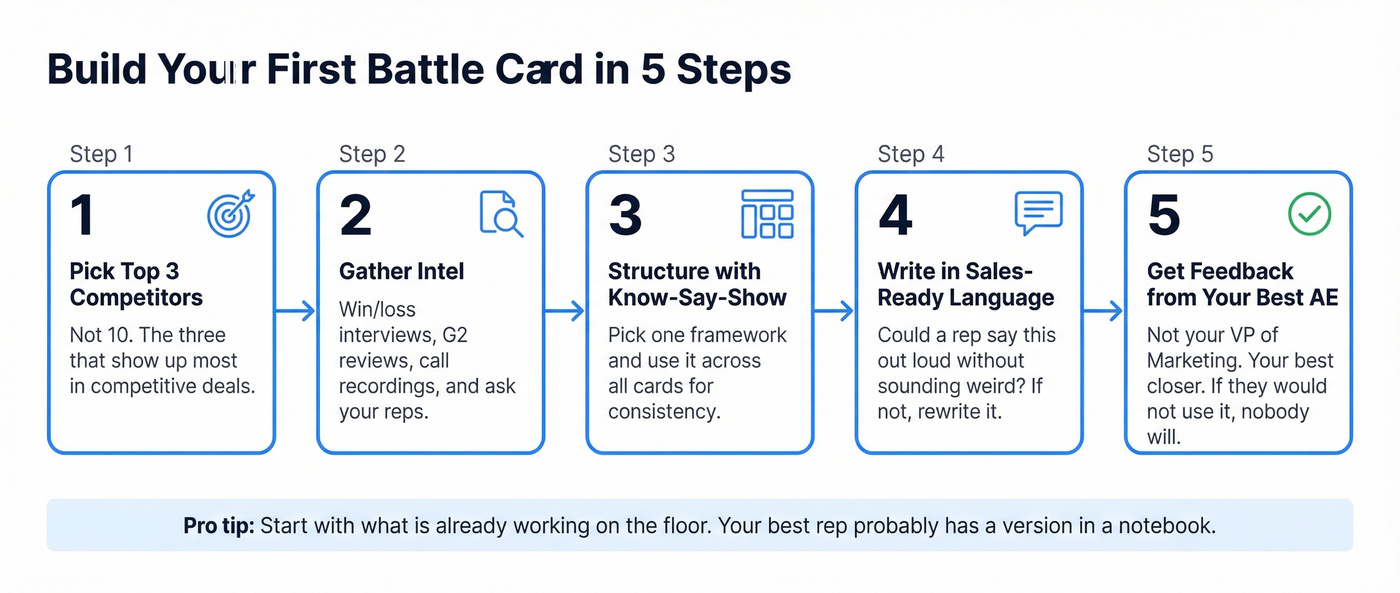
We've seen teams spend weeks perfecting a card in isolation, only to learn their best rep already has a better version scribbled in a notebook. Start with what's working on the floor.
Build One with AI in 15 Minutes
A solo founder on Reddit shared a workflow using Google Gemini worth replicating:
- Run a "deep research" prompt on the competitor - features, pricing, alternatives, sentiment, ICP.
- Feed your own product info into the conversation and ask for a structured comparison.
- Generate a single-page layout using the canvas/document feature.
The whole process takes under 15 minutes. But always fact-check AI output before deploying - AI hallucinations in a battle card destroy rep trust faster than having no card at all. One fabricated pricing number or invented feature claim, and you've poisoned the well.
Frameworks Compared
Three frameworks dominate the battle card world:
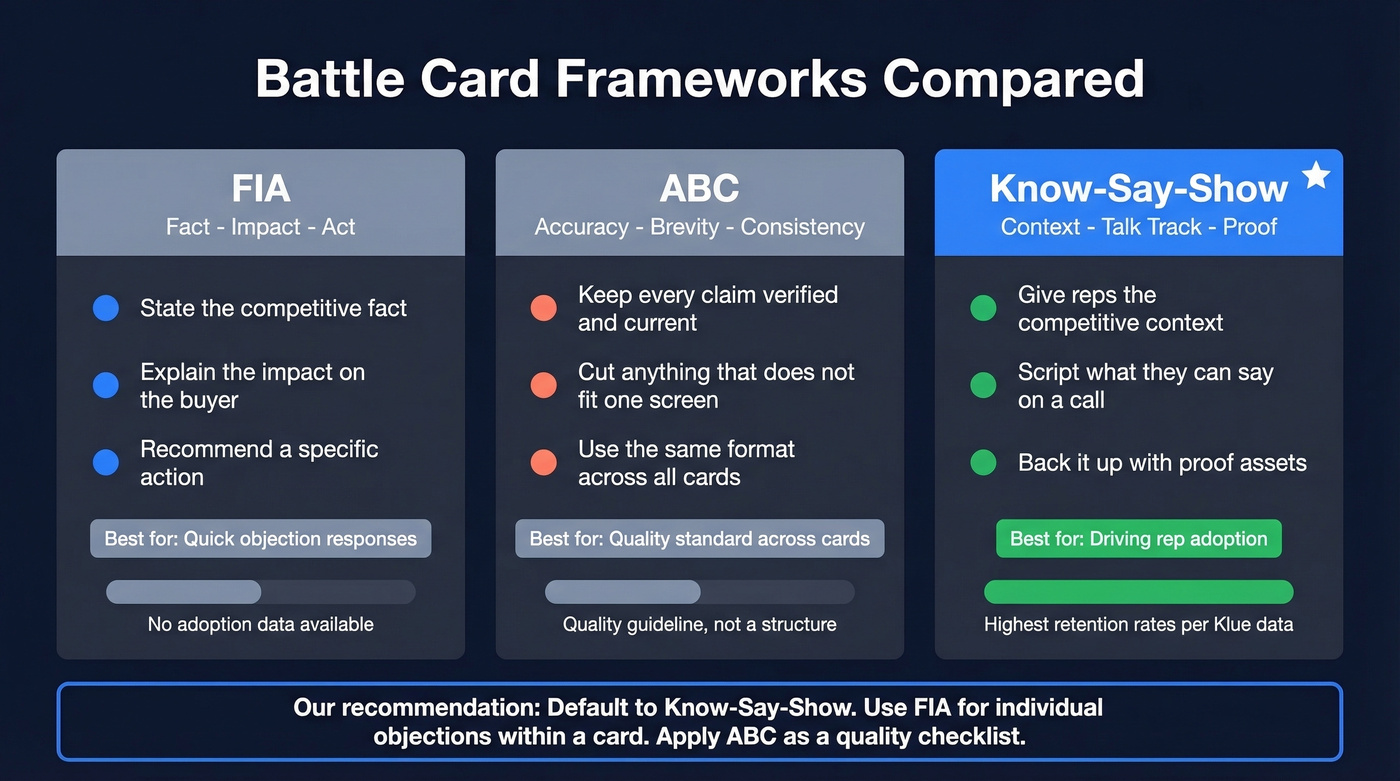
| Framework | Structure | Best For |
|---|---|---|
| FIA (Fact-Impact-Act) | State fact, explain impact, recommend action | Quick competitive responses |
| ABC (Accuracy-Brevity-Consistency) | Keep it accurate, keep it short, keep it uniform | Maintaining card discipline |
| Know-Say-Show | Context, talk track, proof asset | Driving adoption |
Our recommendation: default to Know-Say-Show. It's the only framework with data backing its adoption impact - Klue's audit found that cards built this way had the highest retention rates. FIA works well for individual objection responses within a card, and ABC is more of a quality standard than a structural framework. They're complementary, not competing.
Distribution and Adoption
Building the card is half the battle. Getting reps to use it is the other half - and it's the half most teams botch.
Put cards inside your CRM. Make battlecards accessible inside Salesforce or HubSpot and keep a single source of truth. If your card lives inside the opportunity record, reps see it when they need it. If it lives in a shared drive, it's invisible. Maintain one canonical version and actively discourage local copies. (If you're standardizing your stack, see examples of a CRM.)
Slack or Teams bookmarks. Pin cards in your sales channel. When a rep types "how do we handle [Competitor X]?" the answer should already be bookmarked above.
Role-model from top performers. Have your best AE demo how they use the card in a real deal. Peer influence beats top-down mandates every time. If your #1 closer says "I use this before every competitive call," adoption follows.
Run the 30-second test: can a rep find the right card, open it, and locate the relevant section in under 30 seconds? If not, fix the access path before you fix the content.
Measuring Battle Card ROI
Kompyte customers averaged up to a 30% increase in win rate after deploying battle cards. That's a compelling headline number, but measuring your own ROI requires more nuance.
The cleanest methodology: compare competitive win rates before and after deployment. Better yet, compare deals where cards were actually used versus deals where they weren't - adoption-aware measurement catches the difference between "we have cards" and "reps use cards."
Track these KPIs:
- Competitive win rate - the north star (tie it back to your overall sales conversion rate)
- Rep usage frequency - are cards being opened?
- Time-to-first-use after launch - adoption velocity
- Deal velocity in competitive situations - are deals closing faster?
If your win rate in competitive deals hasn't moved after 90 days, the problem is almost certainly adoption, not content.
Battle Card Tools Compared
CI platforms don't publish pricing because they want you on a sales call. Here's what teams actually pay:
| Tool | Best For | Pricing | Key Strength |
|---|---|---|---|
| Prospeo | Data accuracy layer | Free tier; ~$0.01/email | 98% email accuracy, 7-day refresh |
| Playwise HQ | SMBs / startups | Free to $450/mo | Affordable, free tier |
| Crayon | Enterprise CI | ~$15K-$47K/yr | Competitive monitoring |
| Klue | Win/loss integration | ~$16K+/yr | CI + win/loss analytics |
| Kompyte | Mid-market teams | ~$12K-$30K/yr | Measurement-focused |
| HubSpot Templates | Starting from zero | Free | No-cost starting point |
Look, a well-structured Google Doc with accurate data beats an unused $30K platform every single time. For a Series A company, start with a template and invest in data quality. For a 50-person sales org tracking 10+ competitors, Klue or Crayon earn their price through automation and analytics. But most teams overinvest in the platform and underinvest in the data feeding it.
Prospeo sits in a different lane - it's not a battle card builder. It's the data accuracy layer that keeps contact and company info referenced in your cards current, with 300M+ professional profiles, 98% email accuracy, and a 7-day refresh cycle that solves the stale data problem killing card trust. (If you're evaluating providers, start with data enrichment services and best B2B company data providers.)
Great battle cards need great proof points. Prospeo gives you 50+ enrichment data points per contact, technographic filters, and intent signals across 15,000 topics - so every card is backed by real buyer context, not guesswork.
Build battle cards with data reps actually trust - starting at $0.01 per lead.
FAQ
What's the difference between a battle card and a sales playbook?
A playbook covers your entire sales process end to end; a battle card is a one-page cheat sheet for a specific competitor, designed to be scanned in 30 seconds. Think rulebook vs. pocket reference card.
How often should you update battle cards?
Every 30-60 days in fast-moving markets, quarterly at minimum. Assign a named owner for each card - if nobody owns it, nobody updates it.
Can you create a battle card with AI?
Yes. Tools like ChatGPT or Gemini can generate a solid first draft in under 15 minutes. Never deploy without fact-checking - AI hallucinations destroy credibility faster than having no card at all.
What's the ideal length?
One screen. If a rep has to scroll, you've already lost. Prioritize talk tracks and objection responses over background context. Everything else goes in a linked appendix.
How do you keep battle card data accurate?
Assign ownership, set a review cadence, and use verified data sources with short refresh cycles - ideally weekly, not monthly. Pair that discipline with a quarterly content review and you'll stay ahead of most teams.