How to Build a Sales Call Agenda That Actually Closes Deals
It's Tuesday morning. Six calls booked, four will be wasted. Not because the product's wrong or the prospect's unqualified - because the rep opened with "So, tell me about your business" and spent 25 minutes talking about features nobody asked for. 71% of senior managers say meetings are unproductive. Reps spend roughly 70% of their time on non-selling tasks. A clear sales call agenda with a confirmed next step typically improves stage-to-stage conversion by 5-15%.
A tight agenda won't fix everything. But it fixes the thing you can actually control: what happens when someone picks up.
What Every Agenda Needs
Every structured call needs three things:
- The PPO framework to open the call - Purpose, Plan, Outcome. Thirty seconds, max.
- A timeboxed structure so you don't ramble past the 15-minute mark while the prospect checks Slack.
- A confirmed next step before you hang up. "We'll circle back" isn't a next step. A calendar invite is.
Templates for discovery, demo, and closing calls are below. One benchmark to keep in mind: top performers talk 43% and listen 57%. Your agenda should enforce that ratio, not fight it.
The PPO Framework Explained
Most agendas are just bullet points with no scripts, no data, and no plan for when the call goes sideways. The PPO framework - Purpose, Plan, Outcome - fixes that in 30 seconds flat. It also gives you a reliable answer to the question every new rep asks: how do I start a sales meeting without sounding robotic or losing control of the conversation?
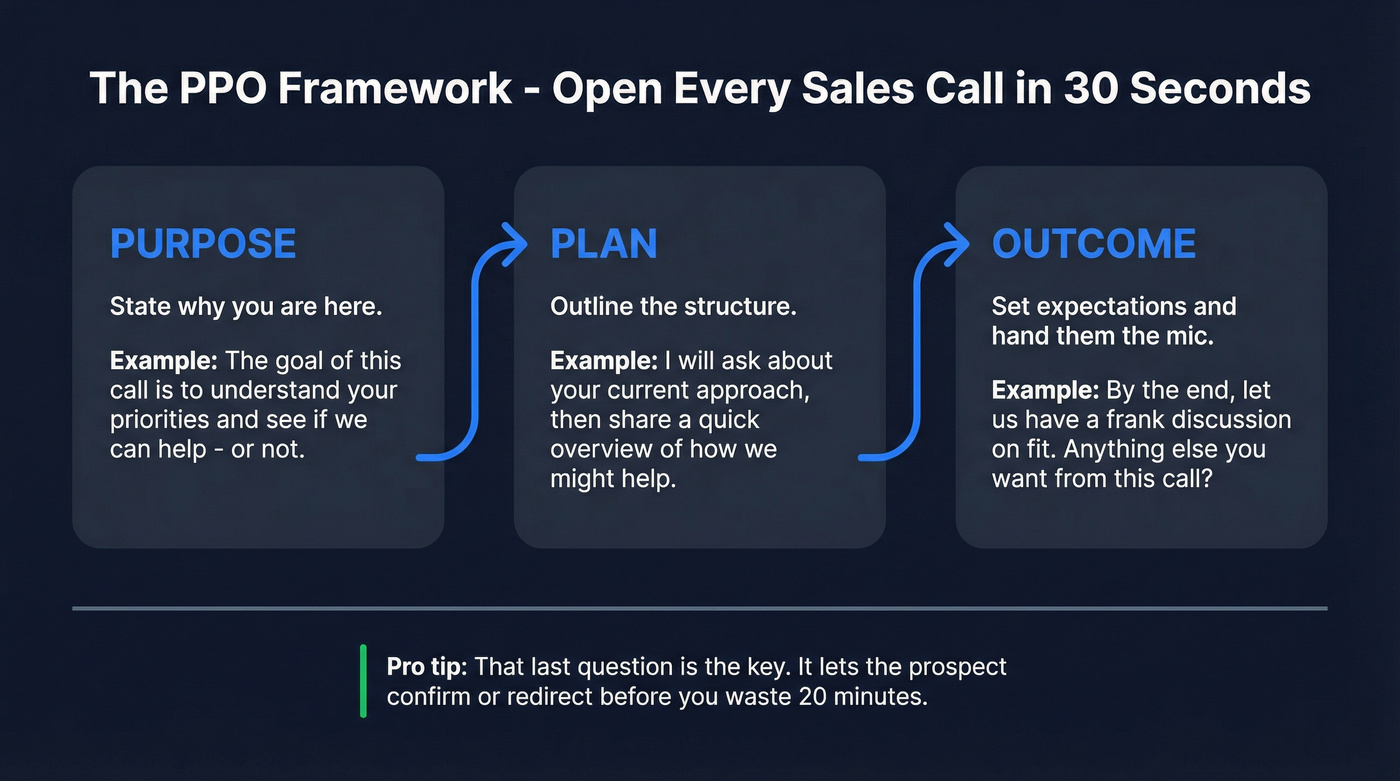
Here's the word-for-word script, adapted from 30MPC's research:
Purpose: "Here's the agenda for today. The goal of this call is to get a sense of your priorities and see if we can support them - or not."
Plan: "I'd love to gain more clarity on how you're approaching those things today and share a bit about where we can help, even if that means a 5-minute overview toward the end of the call."
Outcome: "By the end, I'd love to have a frank discussion around whether or not you felt we could be a fit. Is there anything else you wanted to get out of this one?"
That last question is the key. It hands the prospect a microphone. They'll either confirm or redirect - and both outcomes are better than discovering 20 minutes in that they wanted something completely different.
When they push back with "just show me the demo": Don't panic. Say: "Absolutely - let me make sure I show you the parts that actually matter to your situation first." The prospect who says "demo me now" has already done research. Respect that, but don't skip discovery entirely.
3 Copy-Pastable Templates
Stop building "flexible" agendas. Flexibility is code for "I didn't prepare." Build a tight structure, share it with the prospect, and let them tell you what to change.
Discovery Call (30 Min)
Open with the PPO script above, then follow this structure:
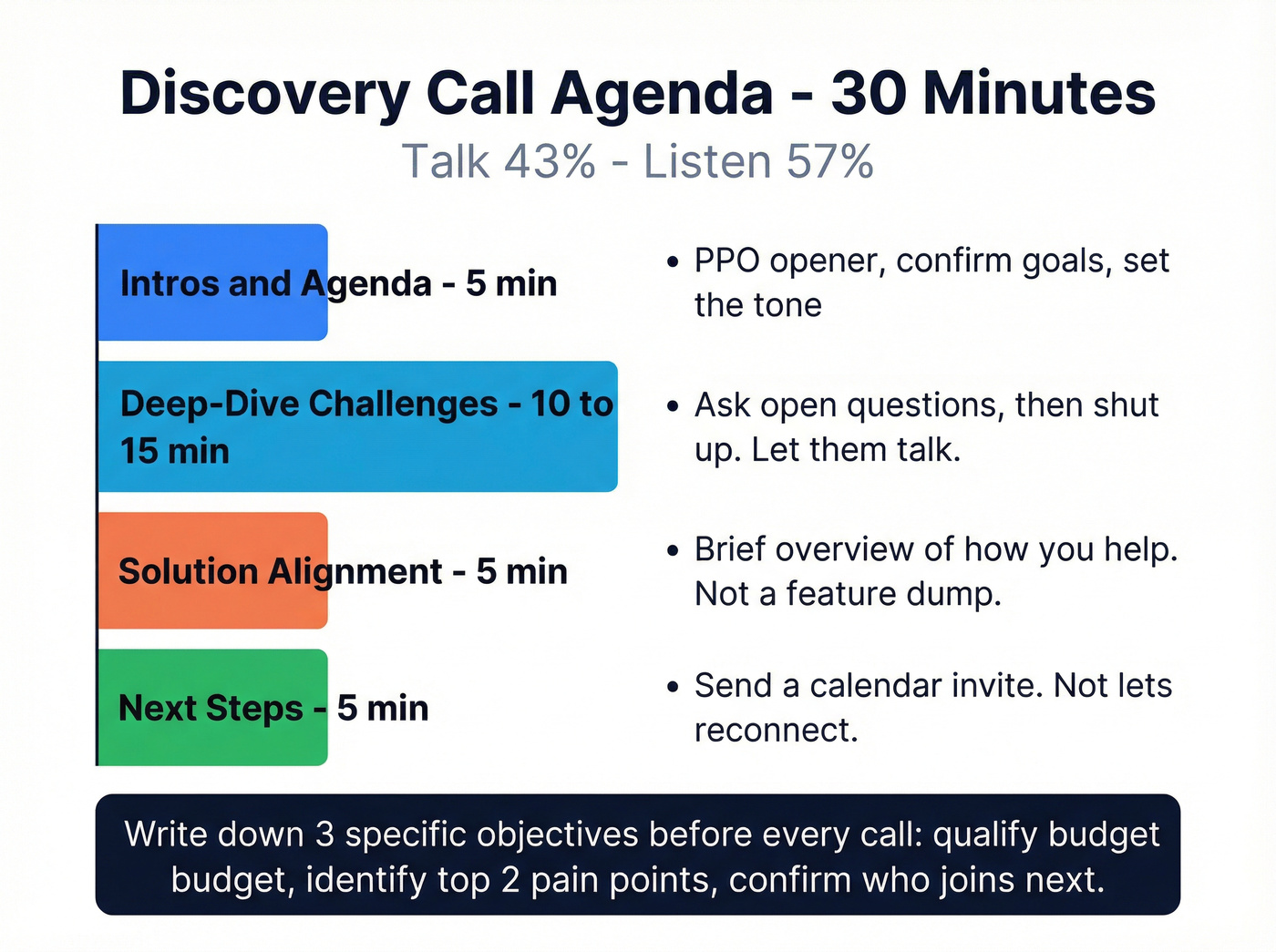
| Block | Time | What Happens |
|---|---|---|
| Intros & agenda | 5 min | PPO opener, confirm goals |
| Deep-dive challenges | 10-15 min | Ask, then shut up |
| Solution alignment | 5 min | Brief "here's how we help" |
| Next steps | 5 min | Calendar invite, not "let's reconnect" |
The beginning of a sales call sets the tone for everything that follows. The opener that works: "I want to make sure this call is valuable for you. Here's what I had in mind - does that sound good? Anything specific you'd like to cover?" This line, adapted from Mixmax's template library, signals respect for their time and surfaces hidden priorities early.
Your sales call objectives for discovery should be specific and measurable. Not vague goals like "learn about the prospect." Strong examples: qualify budget authority within the first 10 minutes, identify the top two pain points driving the evaluation, and confirm whether a technical stakeholder needs to join the next call. We've found that writing these down before every call keeps you focused when the conversation inevitably drifts into tangents about their org chart or last vendor's failures.
Product Demo (45-60 Min)
Enterprise and SMB demos need different pacing. Enterprise demos typically add 10-15 minutes for stakeholder alignment - mapping who's involved in the decision, what procurement or security reviews look like, and whether legal needs a separate call. SMB deals usually compress that block to about 5 minutes or skip it entirely. Here's the enterprise structure:
| Block | Time | What Happens |
|---|---|---|
| Goal alignment & recap | 10 min | Confirm pain from discovery |
| Live tailored demo | 25 min | Show their use case, not yours |
| Pricing & decision process | 5-10 min | Who else needs to see this? |
| Next steps | 5 min | Calendar invite for next meeting |
Closing / Negotiation (30 Min)
80% of B2B deals require at least 5 follow-ups, and buying groups now involve 8-13 stakeholders. If you're only talking to one champion, you're not closing - you're hoping. Multi-threading can lift win rates by roughly 130%.
Your closing agenda has to account for that reality:
| Block | Time | What Happens |
|---|---|---|
| Recap & outstanding concerns | 5 min | What's changed since last call? |
| Address objections | 10 min | Handle the real blockers |
| Pricing & contract terms | 10 min | Specifics, not ballpark |
| Confirm decision & next steps | 5 min | Signature date or bust |
How do you handle pricing discussions without derailing the conversation? Timebox the pricing block to 10 minutes and anchor it to the value you've already established. Never lead with numbers before the prospect has articulated the problem you're solving.

A perfect agenda means nothing if you're calling the wrong person. 30% of B2B contacts go stale every year. Prospeo refreshes data every 7 days - not every 6 weeks - so your pre-call research hits a real decision-maker with a verified email and direct dial.
Stop prepping calls for prospects who left the company last quarter.
Send the Agenda Before the Call
If you're not sending the agenda beforehand, you're volunteering for no-shows. Gong's guidance is clear: a pre-call agenda saves time on introductions and prompts buyers to invite the right counterparts. If your SE is joining, the prospect should know - so they bring their technical lead.
Sharing an agenda also gives prospects a graceful exit. They can reschedule instead of ghosting. Sending it typically reduces no-shows by 10-20%.
Schedule the call for the afternoon. Gong Research Labs found that a 4pm slot has 30% greater show-up odds than an 8am one. Avoid weekends entirely - no-show rates are 4x higher.
Here's the thing most people miss: before you send the agenda, verify the contact. If your prospect changed roles three months ago, no amount of preparation saves that call. Prospeo's 7-day data refresh cycle means you're checking against current records, not stale CRM data from last quarter. A two-minute check before you hit send is worth more than a 30-minute call to a dead number.

Benchmarks That Matter During the Call
The 60/40 talk-to-listen advice floating around most sales blogs is wrong. Top performers are closer to 43% talking, 57% listening. Average reps hit 65-75% talk time. Poor performers blow past 80%.
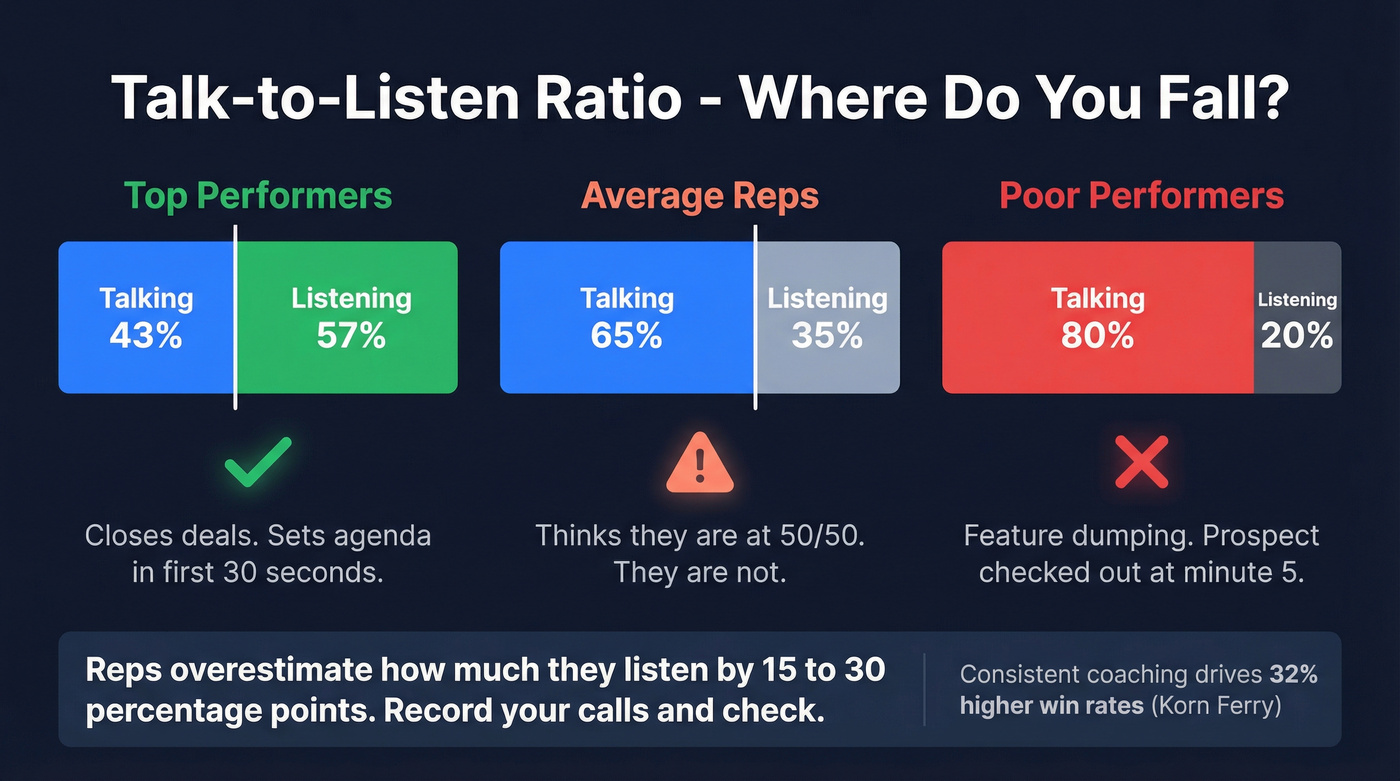
The worst part? Reps often overestimate how much they listen by 15-30 percentage points. They think they're at 50/50 when they're actually at 75/25.
Recording your calls and reviewing the ratio is the fastest coaching lever available. Consistent sales coaching drives 32% higher win rates and 28% higher quota attainment, per Korn Ferry's research. In our experience, the reps who record and review their talk-time ratio improve within two weeks - sometimes faster. The calls that close are the ones where the agenda was set in the first 30 seconds and the rep had the discipline to stop talking after asking a question.
Mistakes That Kill Deals
No confirmed next step. "We'll think about it" isn't a next step. A calendar invite with a date, time, and attendee list is.
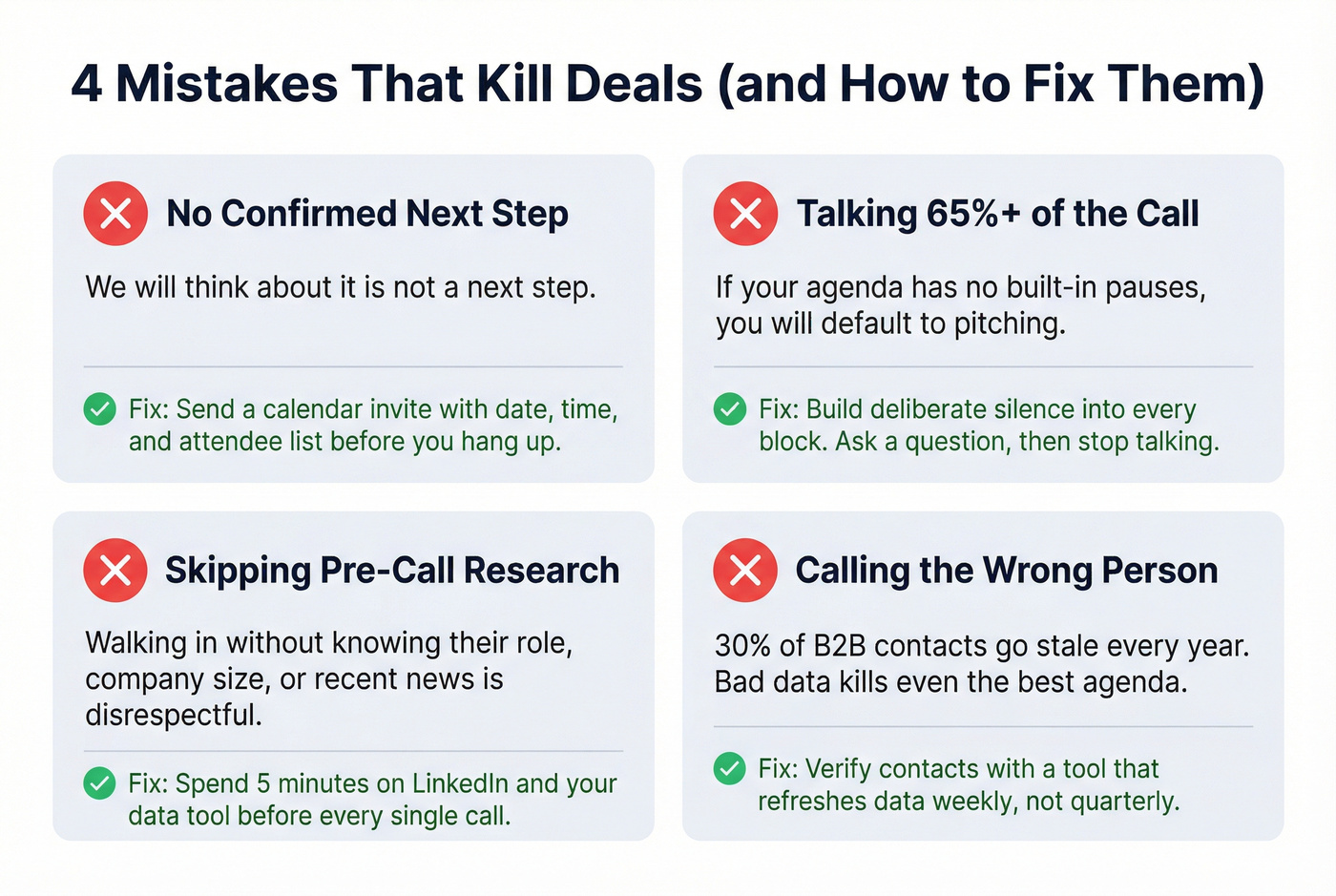
Talking 65%+ of the call. If your agenda doesn't have built-in pauses and questions, you'll default to pitching. Build deliberate silence into every block.
Skipping pre-call research. Walking into a call without knowing the prospect's role, company size, or recent news is disrespectful. Use a pre-call research checklist so prep doesn't slip.
Calling the wrong person or a dead number. Bad data kills agendas. Verify contacts before every call so you're reaching the right person at their current role - not where they worked last quarter. If you're seeing decay, start with B2B contact data decay benchmarks and fixes.
Let's be honest about something the consensus on r/sales echoes constantly: if your average deal size is under $15k, you don't need a 60-minute demo with a 12-slide deck. You need a 15-minute discovery call with a tight agenda and a confirmed next step. Most teams over-engineer the process and under-prepare for the conversation. Skip the elaborate multi-call sequence for deals that should close in two touches.
You just built a closing agenda that accounts for 8-13 stakeholders. Now you need verified contact data for every one of them. Prospeo gives you 98% accurate emails and 125M+ verified mobile numbers - at $0.01 per email, no contract required.
Multi-thread your deal with verified emails and direct dials for the entire buying committee.
FAQ
How long should a sales call agenda be?
Keep it to 4-6 items max. A discovery call fits comfortably in 30 minutes with 4 timeboxed blocks. Anything longer than 6 items signals you're trying to cover too much in one conversation - split it into two calls instead.
Should I share the agenda with the prospect beforehand?
Always. Pre-call agendas reduce no-shows by 10-20% and prompt buyers to invite the right stakeholders. Send it 24 hours before the call via email with a one-line summary of the meeting's purpose.
How do I verify a prospect before building my agenda?
Check their current role, company size, and likely pain points using a data platform with fresh records. Prospeo refreshes contact data every 7 days and returns 98% verified emails, so you're prepping for the right person - not someone who left six months ago. Your CRM's enrichment features or a quick check on the company's website can supplement this.