Cold Lead Generation: A Systems-First Playbook for 2026
Cold lead generation isn't about finding the perfect email template. A RevOps lead we know ran a 3-tool bake-off last quarter - the "best" database created 4,000 duplicate contacts in Salesforce in five days. The cheapest one had better phone connect rates. Across 16.5M cold emails tracked by Belkins, the average reply rate was 5.8%, down from 6.8% the year before. The teams still hitting 7%+ aren't better writers. They've got better systems.
Why Most Cold Outreach Fails Backwards
Most guides start with subject lines and copywriting frameworks. That's backwards. Cold leads sit before MQL - they haven't raised a hand yet, which is exactly why your system matters more than your pitch. Define a tight ICP so you're emailing 50 people who fit, not 1,000 who don't. Source verified data with a 7-day refresh cycle. Send from properly warmed infrastructure that won't get flagged after week one.
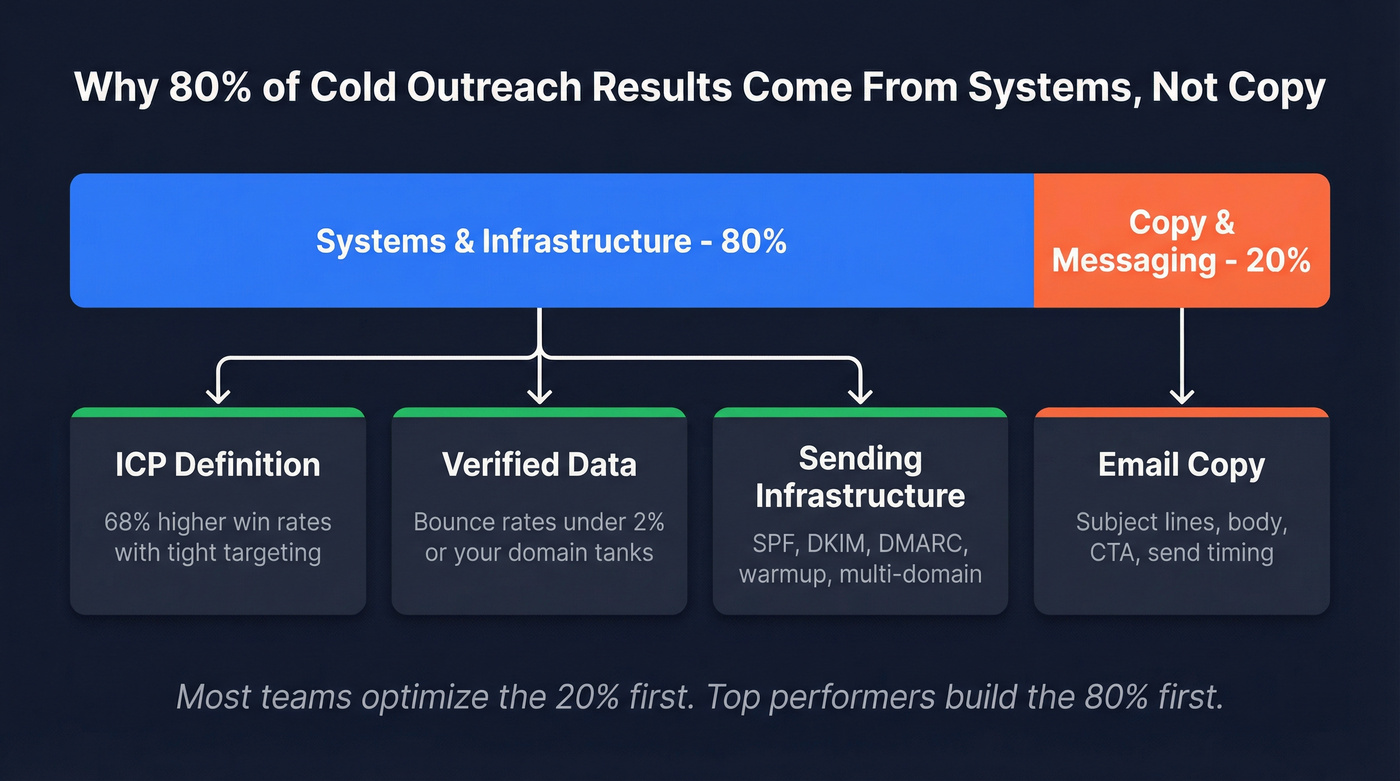
Data quality and infrastructure account for roughly 80% of your results. Copy accounts for the other 20%.
Define Your ICP Before You Touch a Tool
Companies with well-defined ICPs see 68% higher win rates. That's the gap between pipeline that closes and pipeline that just fills dashboards.
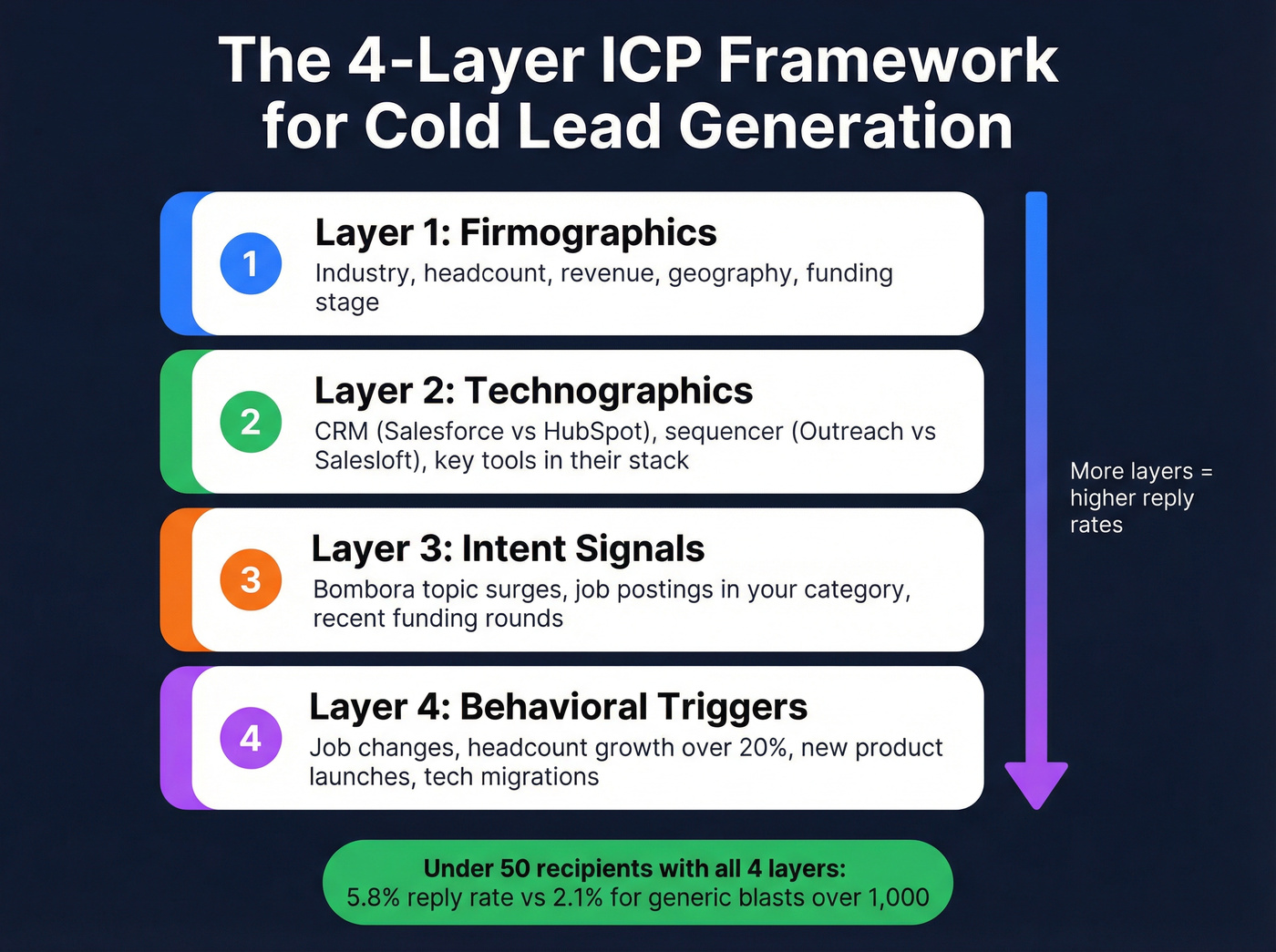
Your ICP needs four layers: firmographics like industry, headcount, revenue, geography, and funding stage; technographics such as Salesforce vs. HubSpot or Outreach vs. Salesloft; intent signals from Bombora-powered topic surges, job postings, and recent funding; and behavioral triggers like job changes, headcount growth, or new product launches.
Intent data is the most underused lever in cold outreach. Most teams stop at job title + industry and wonder why reply rates are flat. Layering in even basic signals - "company is actively researching your category" - separates targeted campaigns from noise. Small campaigns under 50 recipients hit that 5.8% reply rate benchmark. Generic blasts over 1,000 contacts drop to 2.1%.
Build a Verified Lead List
Here's the scenario nobody talks about. An SDR loads 2,000 contacts into their sequencer. Three hundred bounce. That's a 15% bounce rate, and their domain reputation tanks overnight. Deliverability drops from 85% to 60%. Every email after that, even to valid addresses, lands in spam. One bad list killed the entire quarter's outbound.
Hard bounce rates above 2% can trigger that same cliff in a single campaign.

Stack Optimize built to $1M ARR using Prospeo as their data layer. Client deliverability stayed above 94%, bounce rates under 3%, zero domain flags across all clients.

Stack Optimize built to $1M ARR with bounce rates under 3% and zero domain flags. The difference? Prospeo's 5-step email verification and 7-day data refresh - not the 6-week-old records that tank your sending reputation overnight.
Stop killing domains with stale data. Start with 75 free verified emails.
Set Up Sending Infrastructure
Safe Daily Sending Limits
| ESP | Technical Limit | Safe Limit |
|---|---|---|
| Google Workspace | 2,000/day | 100-150/day |
| Microsoft 365 | 10,000/day | 100-150/day |
| GoDaddy | 250/day | 50-75/day |
| Free Gmail | 500/day | Don't use it |
The scaling play is multi-domain, not higher volume. Five domains at 100 emails/day gives you 500 daily sends without torching any single domain's reputation. Never send cold email from your primary corporate domain.
Warmup and Compliance
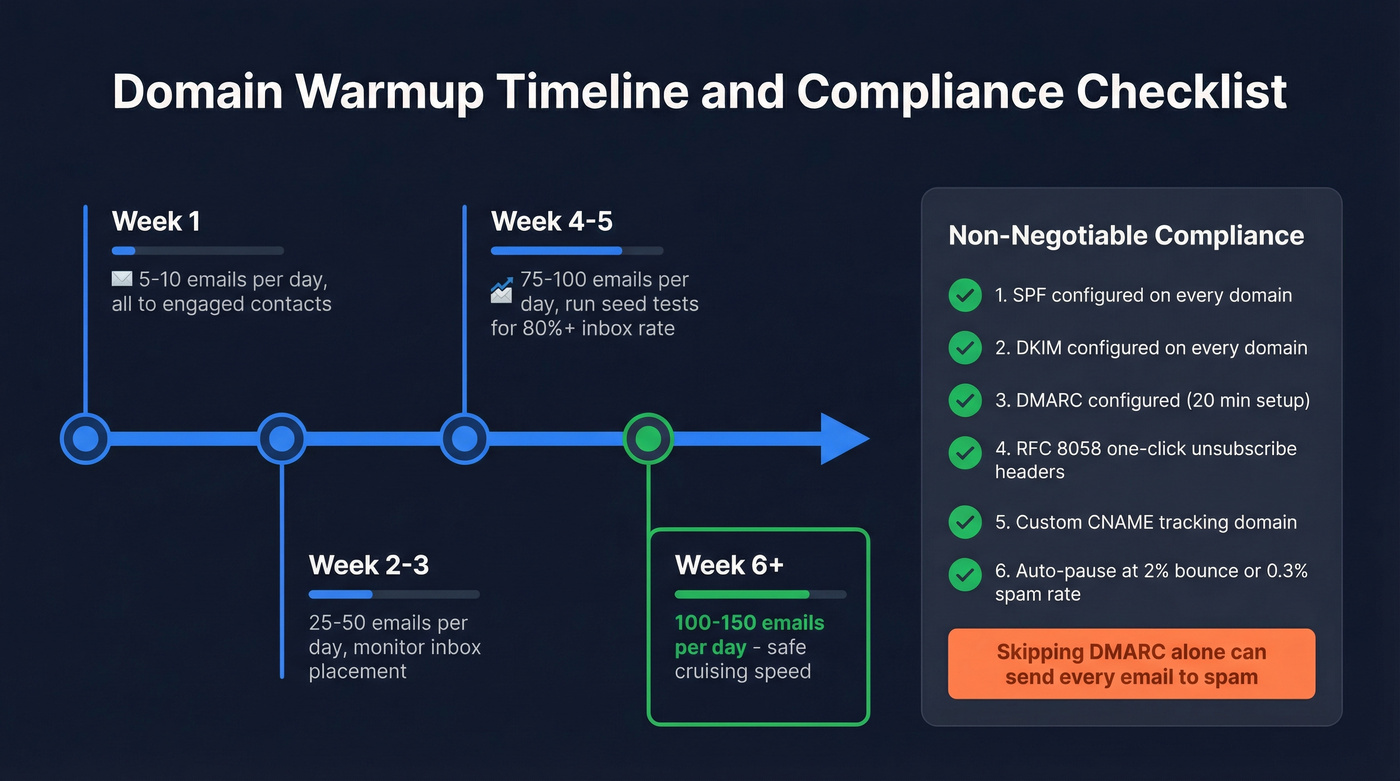
Start new domains at 5-10 emails per day. Ramp over 4-6 weeks with consistent daily volume. Don't scale until you're hitting 80%+ inbox placement on seed tests.
Remember that team getting a 1.2% reply rate who blamed their copy? Their deliverability was sitting at 60% because nobody checked bounce rates before scaling. The copy was fine. The infrastructure wasn't.
The compliance checklist is non-negotiable in 2026:
- SPF, DKIM, and DMARC configured on every sending domain
- RFC 8058 one-click unsubscribe with List-Unsubscribe and List-Unsubscribe-Post headers
- Custom tracking domain via CNAME to isolate your reputation
- Auto-pause rules when bounce exceeds 2%, spam rate approaches 0.3%, or inbox placement drops
Look, the fact that teams still skip DMARC setup and wonder why they're landing in spam is maddening. It takes 20 minutes to configure and it's the single highest-leverage deliverability fix you can make.
Write Cold Emails That Get Replies
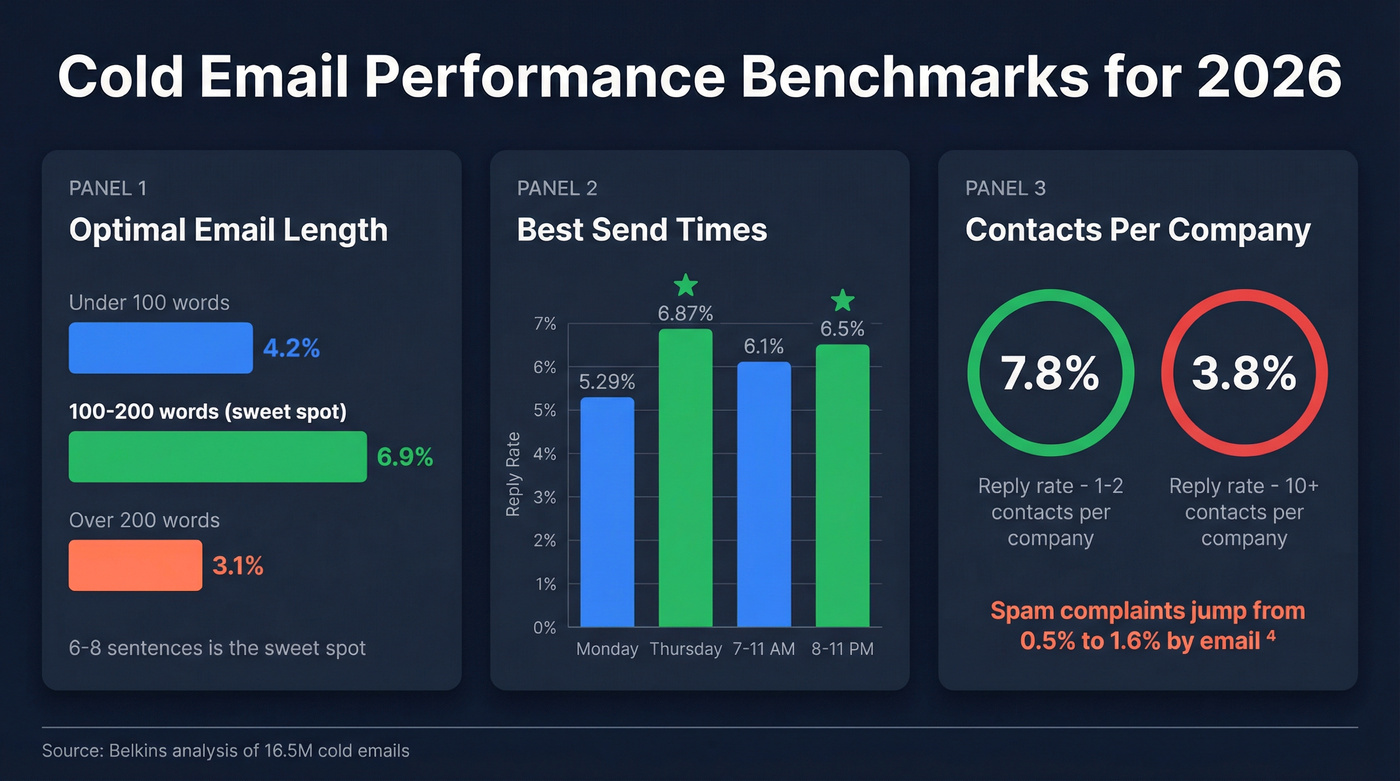
Emails with 6-8 sentences and under 200 words hit a 6.9% reply rate - the sweet spot. Open rates dropped from ~46% in early 2024 to ~31-32% by year's end, which means your subject line earns the open but your body copy earns the reply. Longer emails don't just perform worse; they signal you haven't done your homework on the prospect.
Open with a specific observation about their company - not a compliment, an insight. State the problem you solve in one sentence. Close with a low-friction ask like a 15-minute call, not a full demo.
Thursday is the peak day at 6.87% reply rate versus Monday's 5.29%. The 8-11 PM send window is the top-performing slot, and mornings from 7-11 AM also perform well.
Here's the counterintuitive finding: one-touch sequences outperformed multi-touch. Spam complaint rates rise from 0.5% on the first email to 1.6% by the fourth. Email 1-2 contacts per company - that's a 7.8% reply rate - rather than carpet-bombing 10+ contacts at the same org, which drops to 3.8%. The consensus on r/sales backs this up: more follow-ups don't just annoy prospects, they actively damage your sending reputation. We've seen the same pattern across our own outbound campaigns.
The Right Tool Stack for 2026
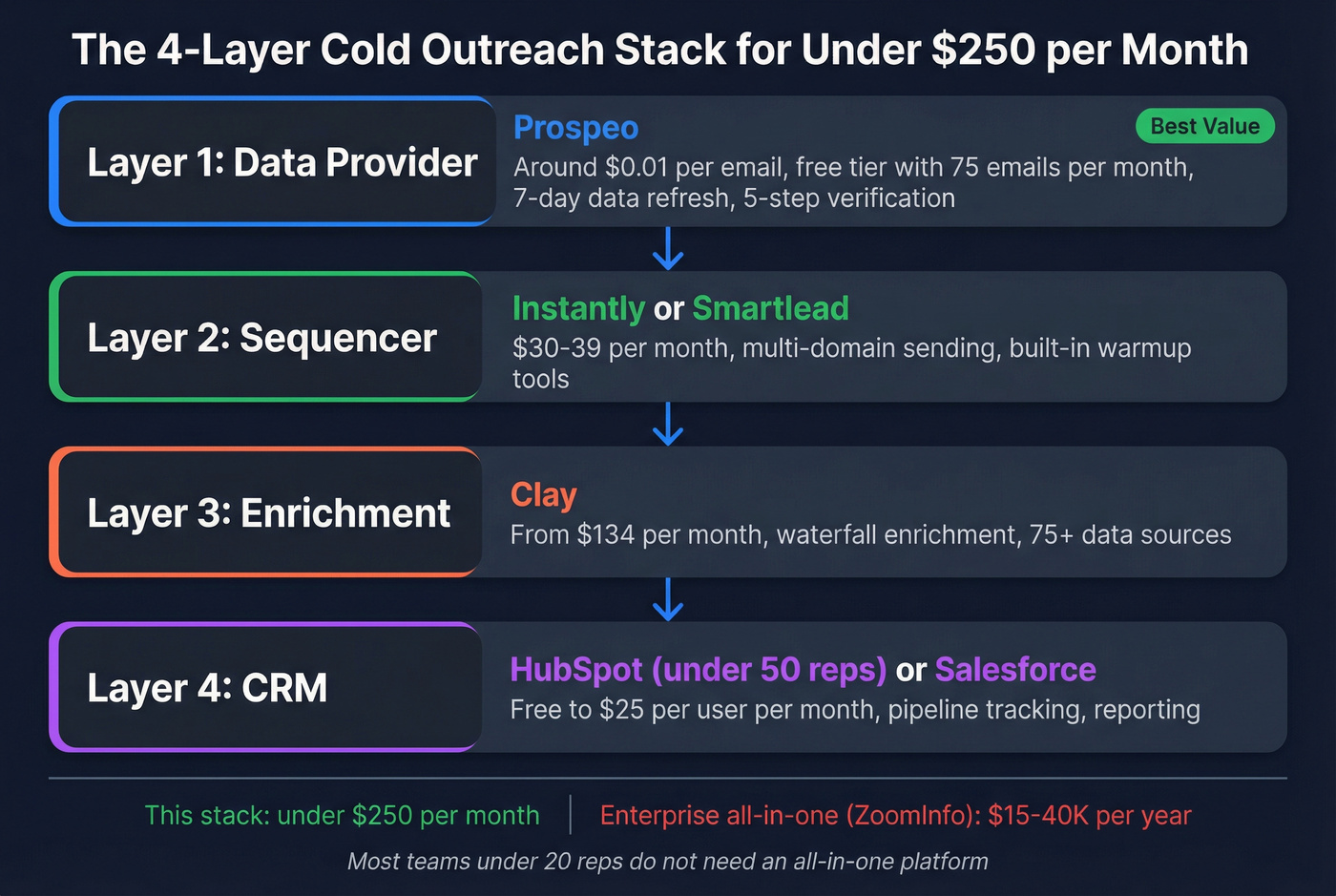
| Layer | Tool | Starting Price |
|---|---|---|
| Data provider | Prospeo | ~$0.01/email, free tier |
| Sequencer | Instantly / Smartlead | ~$30-39/mo |
| Enrichment | Clay | From $134/mo |
| CRM | HubSpot (under 50 reps) / Salesforce (if you're already on it) | Free-$25/user/mo |
Apollo at $49/user/mo works as an all-in-one starter if you want database + sequencing in one tool, though data accuracy won't match a dedicated provider. ZoomInfo sits at the enterprise end - $15-40K/year depending on seats and modules, with 500M+ contacts and 1B monthly buying signals - and makes sense only if you need intent data, chat, and workflow automation bundled together.
Let's be honest: most teams under 20 reps don't need an all-in-one platform. They need accurate data, a reliable sequencer, and a CRM that doesn't fight them. That four-layer stack covers it for under $250/month. If your average deal size sits below five figures, skip the ZoomInfo-level spend entirely.
You just read that small, targeted campaigns hit 5.8% reply rates while generic blasts drop to 2.1%. Prospeo gives you 30+ filters - buyer intent, technographics, job changes, headcount growth - to build those tight ICP lists at $0.01 per verified email. No contracts. No sales calls.
Build your first ICP-targeted list in under 5 minutes.
Cold Lead Generation FAQ
What's a good reply rate for cold email in 2026?
The benchmark is 5.8% across 16.5M emails. Small, targeted campaigns under 50 recipients consistently hit that mark. Generic blasts over 1,000 contacts drop to 2.1%. Targeting depth is the biggest lever - not subject lines.
How many cold emails can I send per day?
Stick to 100-150 per day per Google Workspace or Microsoft 365 mailbox. Scale with multiple domains - five domains at 100/day gives you 500 daily sends - rather than pushing a single domain past safe limits. Free Gmail accounts shouldn't be used for cold outreach at all.
What's the cheapest way to get verified B2B contact data?
Prospeo's free tier includes 75 verified emails per month, scaling at ~$0.01 per lead. Compare that to enterprise providers charging $15-40K/year for data that refreshes every 6 weeks instead of weekly. For teams running campaigns under 10,000 contacts/month, a self-serve data provider is the clear value play.
How do I prevent my domain from getting blacklisted?
Keep hard bounce rates under 2% per campaign, configure SPF/DKIM/DMARC on every sending domain, and never send cold email from your primary corporate domain. Use dedicated outbound domains warmed over 4-6 weeks, and auto-pause sequences if spam complaint rates approach 0.3%.