The Complete International Sales Playbook for 2026
Global B2B eCommerce hit $32.11T in 2025 and is projected to reach $36.16T this year. Cross-border eCommerce alone runs $1.21T and is growing at 8.71% annually. Meanwhile, 84% of sales reps missed quota last year, and 89% of B2B buyers report at least one stalled deal in the past twelve months. The math is straightforward - if your domestic market is saturated and your reps can't hit number, scaling international sales isn't a nice-to-have. It's the growth lever most B2B companies haven't pulled yet.
But "go international" is easy to say and brutal to execute. Longer sales cycles, unfamiliar compliance regimes, buyer expectations you didn't plan for, and prospect databases that simply don't cover the markets you're entering. The average B2B buyer now interacts with 13 pieces of content before engaging with a vendor - eight vendor-created, five third-party - and that content needs to land in the right language, currency, and cultural context. We've watched teams burn six figures trying to expand globally without a playbook. Here's the one we'd hand them.
What You Need (Quick Version)
- Pick one market first. Don't spray across three continents simultaneously. Validate product-market fit in a single region, build the playbook, then replicate.
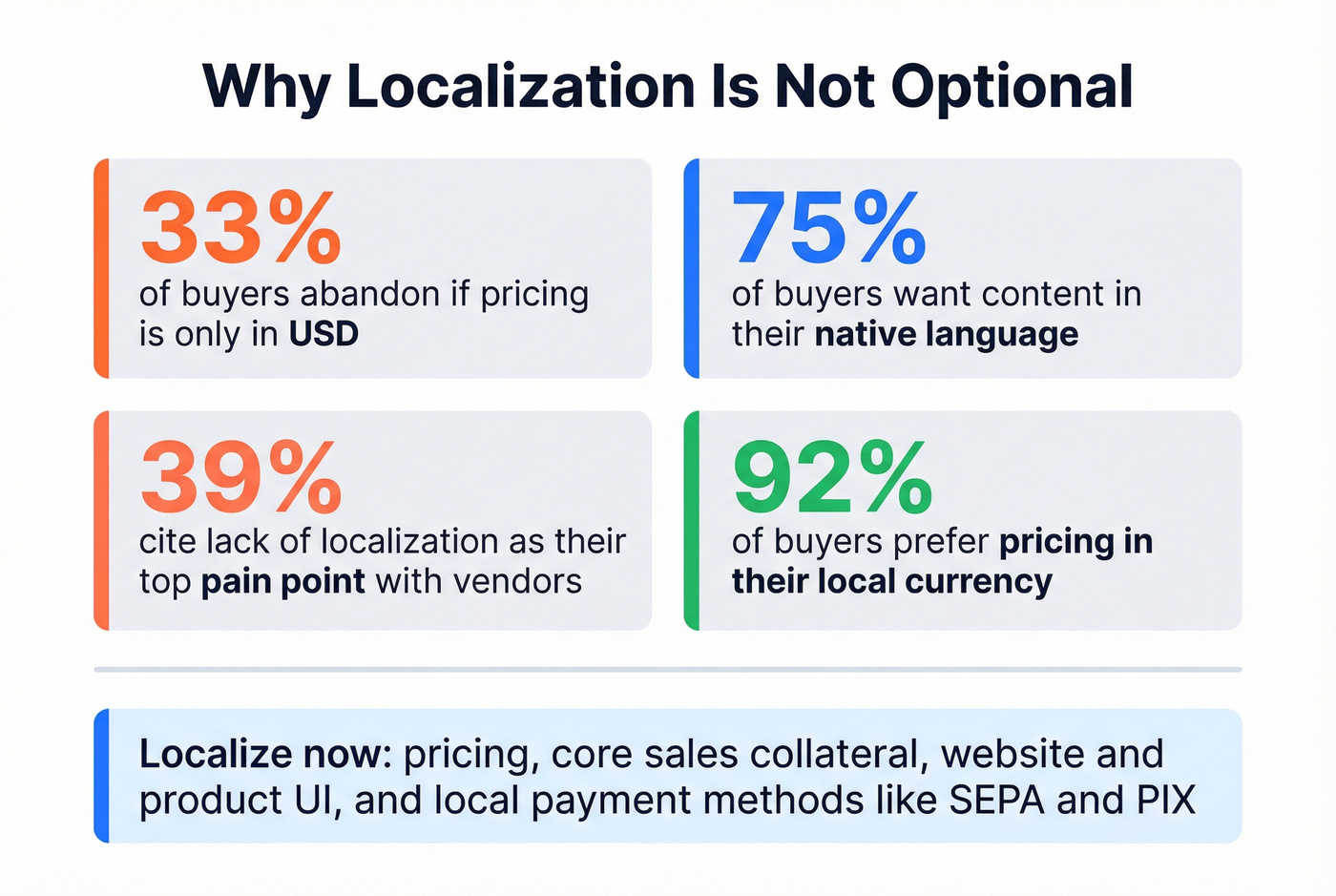
- Budget for localization from day one. 33% of buyers abandon if pricing is only in USD. 75% want their native language. This isn't optional.
- Build prospecting infrastructure before hiring reps. Your domestic database won't cover new markets. Verify contacts before your reps start dialing - one customer, Meritt, tripled pipeline from $100K to $300K per week while dropping bounce rates from 35% to under 4% by getting this right. (If you're tightening data quality, start with email verification and a repeatable prospecting workflow.)
- Get export compliance sorted now. The September 2025 BIS rule change expanded ownership-based export restrictions and tightened due diligence expectations. Ignorance isn't a defense.
- Measure with the right KPIs from week one. Not month one. International feedback loops are longer, so you need earlier signals.
What Selling Internationally Actually Means
International sales is the process of selling products or services to buyers outside your home market. That sounds simple, but the operational reality is anything but. You're dealing with different legal systems, currencies, languages, cultural norms, buying committee structures, and compliance requirements - often simultaneously.
The HBR readiness framework assesses international readiness across seven attributes, including attitude, aptitude, magnitude, and latitude. Companies that score well across all seven succeed at global expansion 77% of the time. Companies that don't? 31%. That gap is driven entirely by preparation.
Here's the thing most teams underestimate: cross-border sales cycles run 20-50% longer than domestic ones. Buying committees average seven people for mid-sized firms, and when you layer in legal review, procurement complexity, and localization requirements, deals stretch fast. The hardest part usually isn't the selling - it's the data. Finding verified contacts in markets where you have zero network is the bottleneck that kills momentum before it starts.
How B2B Buying Changed Globally
The buyer you're selling to internationally in 2026 looks nothing like the buyer from 2020. Gartner projects that 80% of B2B sales interactions now happen through digital channels. Buyers use an average of 10 interaction channels - up from just 5 in 2016.
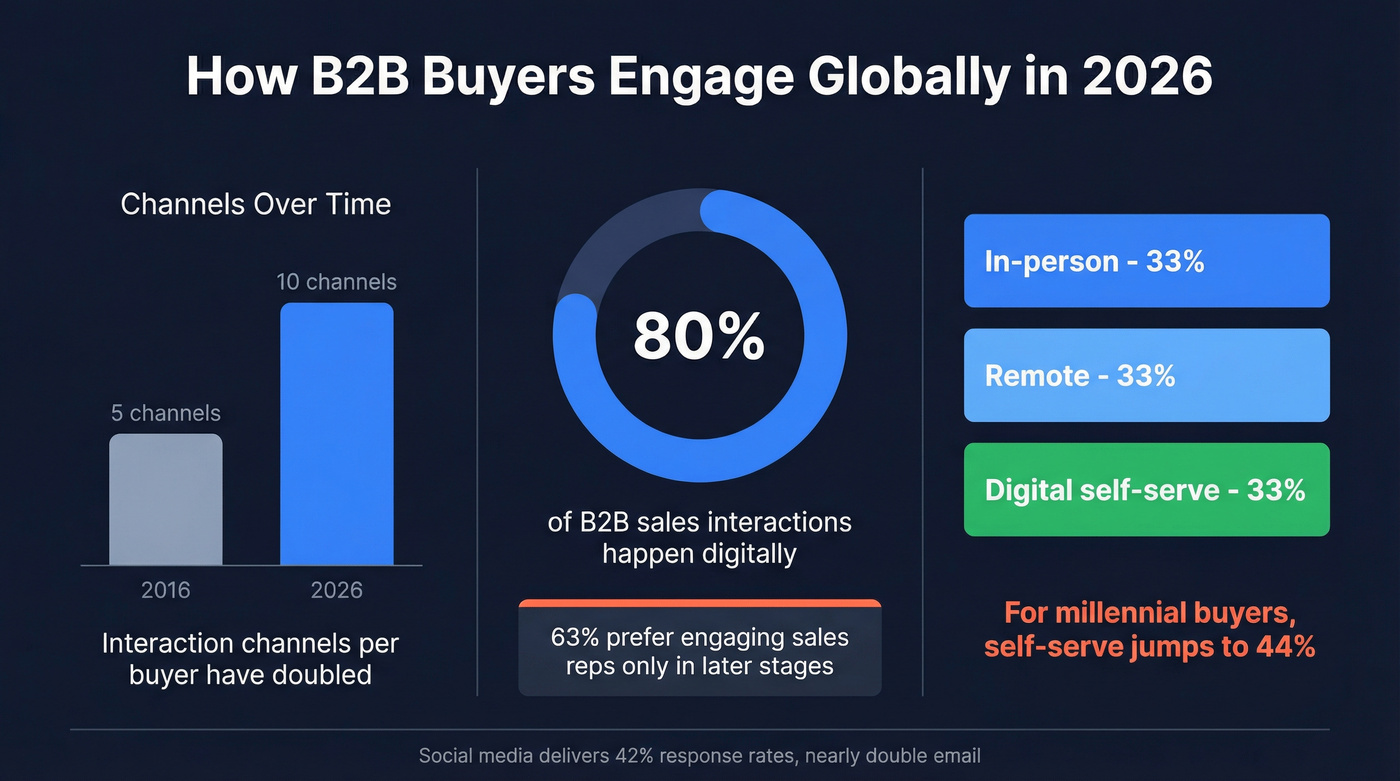
The shift runs deeper than channel count. Nearly two out of three buyers now prefer engaging vendor salespeople only in later buying stages - a 17 percentage-point jump year over year. They're doing their own research first, which means your localized content, pricing pages, and self-serve demos need to do the selling before your rep ever gets a call.
McKinsey's rule of thirds still holds: at any stage of the buying process, roughly one-third of buyers prefer in-person, one-third prefer remote, and one-third prefer digital self-serve. For millennial buyers, that self-serve preference jumps to 44%. And over 50% of B2B buyers will switch suppliers if they don't get a smooth cross-channel experience. Your global GTM motion needs to support all three modes from day one.
Social channels are outperforming email in some markets. HubSpot data shows social media delivers 42% response rates - nearly double what email pulls. And 90% of companies are sticking with hybrid sales models because hybrid approaches can drive up to 50% higher revenue growth than single-channel motions. If you're entering a new market with only one channel, you're leaving pipeline on the table.
The 7-Step Global Sales Playbook
1. Pick One Market and Win It
The temptation to launch in three markets simultaneously is strong, especially when the board is pushing for aggressive revenue targets. Resist it.
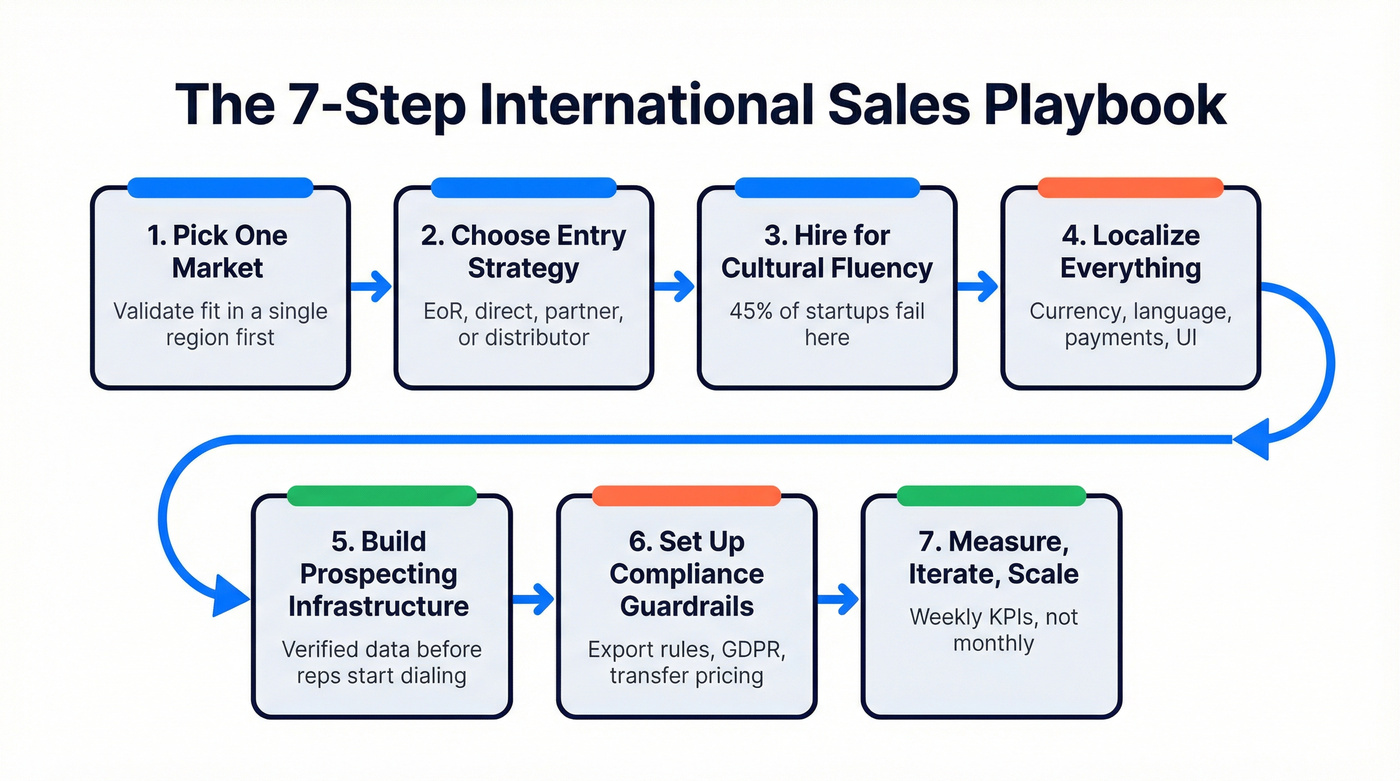
We've seen this pattern repeatedly: a company spreads resources across the UK, Germany, and Australia at the same time, and 18 months later they've got mediocre traction in all three instead of a repeatable playbook in one. Pick the market with the best combination of product-market fit, accessible buyer data, and manageable compliance requirements. Win it. Document what worked. Then replicate. IFZA's research on global expansion reinforces this - phased growth with performance tracking at each stage dramatically reduces the risk of overexpansion.
2. Choose Your Entry Strategy
| Model | Speed | Cost | Control | Best For |
|---|---|---|---|---|
| Direct sales | Slow | High | Full | High-ACV enterprise |
| Distributor | Medium | Medium | Partial | Physical products |
| Channel partner | Fast | Low upfront | Limited | SMB markets |
| Employer of Record | Fast | 10-15% payroll | High | Testing new markets |
| Local entity | Slow | Highest | Full | Comitted markets |
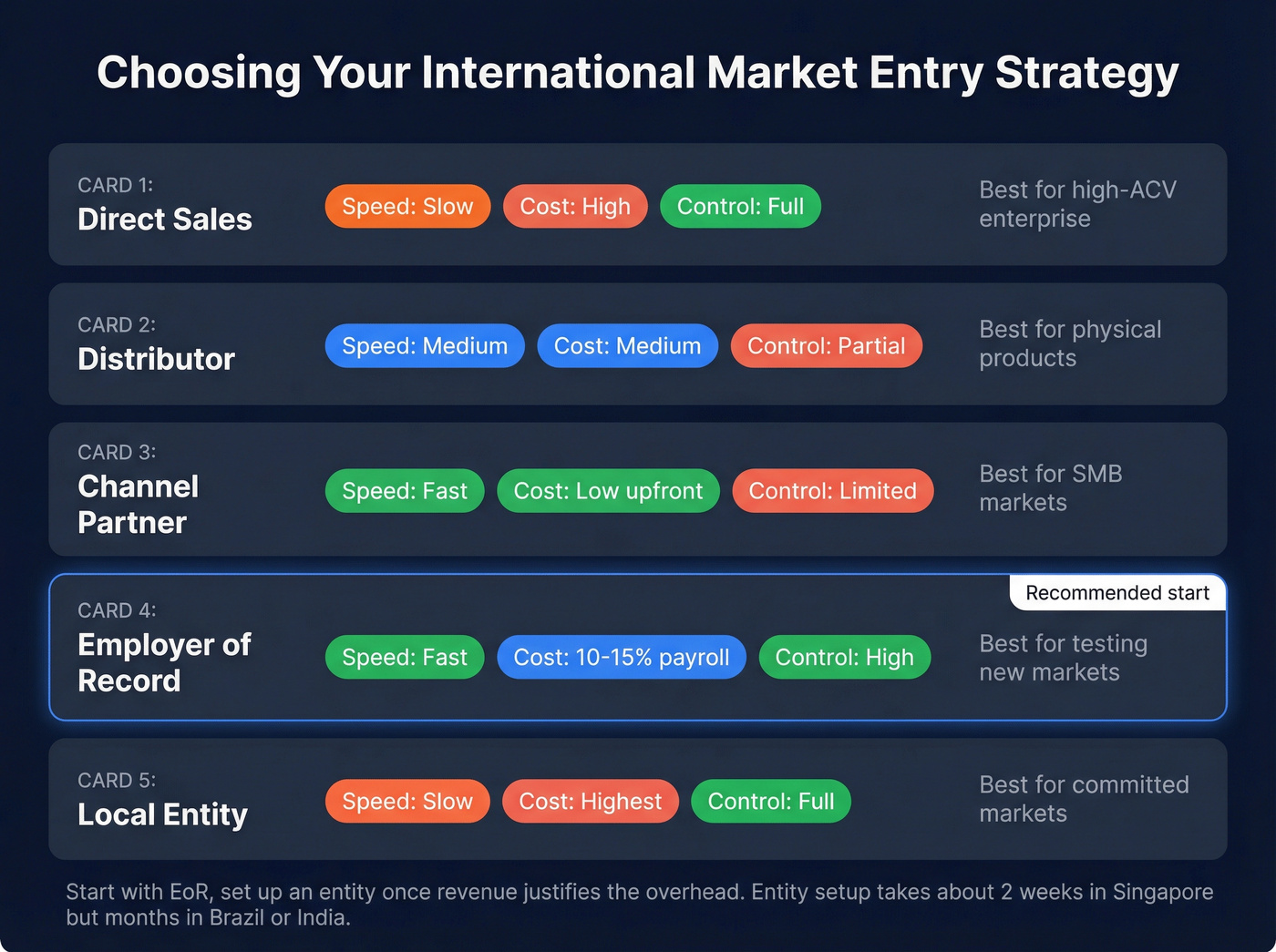
Employer of Record services (Deel, Remote, Oyster) are the fastest path for most B2B SaaS companies. EoR fees typically run 10-15% of payroll, and you can hire without setting up a legal entity. Entity setup timelines vary wildly: about two weeks in Singapore, but several months in Brazil or India. Start with EoR, set up an entity once revenue justifies the overhead.
3. Hire for Cultural Fluency
About 45% of startups report setbacks from failing to adapt to local customs and communication styles. This isn't a soft problem - it directly impacts close rates, partner relationships, and customer retention.
Hire local. Provide cultural awareness training. And be realistic about change fatigue inside your own organization - Gartner data shows employee willingness to support organizational change dropped from 74% to 44% over the past several years. Your domestic team may not be as enthusiastic about supporting the expansion as you'd like.
4. Localize Everything
Localize now:
- Pricing in local currency - 92% of buyers prefer it, 33% abandon USD-only
- Core sales collateral in the local language - 75% want their native language
- Website and product UI for your target market
- Cross-border payment methods like SEPA in Europe and PIX in Brazil
Can wait:
- Full marketing site translation for secondary markets
- Localized case studies (use global ones initially)
- Region-specific blog content
The numbers are clear: 39% of B2B buyers cite lack of localization as their top pain point with vendors. Tools like Smartling, Phrase, and Lokalise handle translation and localization workflows - expect to pay $1K-$5K+/month depending on volume and language pairs.
5. Build Your Prospecting Infrastructure
This is where most international expansions quietly fail. Your domestic database - whether it's ZoomInfo, Apollo, or something else - probably has thin coverage in your target market. You send reps into Germany with a list of 500 prospects, 200 emails bounce, and suddenly your sender reputation is damaged before you've booked a single meeting. (If this is a recurring issue, fix B2B contact data decay and run a deliverability-first email deliverability checklist.)
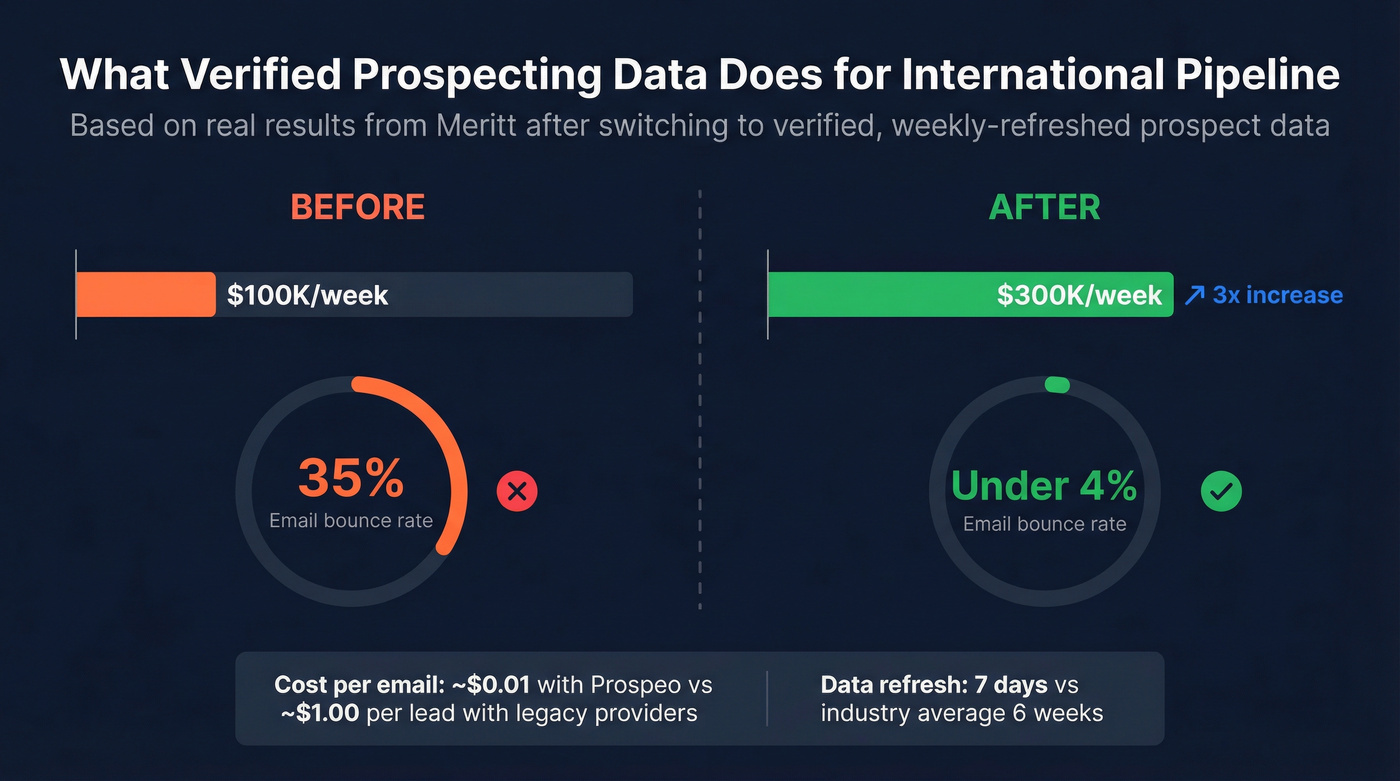
The industry average data refresh cycle is six weeks. In a new market where contacts change roles frequently and your initial data quality is uncertain, six-week-old data is essentially stale on arrival. We've found that weekly refresh cycles and intent-based filtering make a massive difference here - Prospeo's 7-day refresh and 30+ search filters, including buyer intent powered by Bombora, let you build targeted, verified prospect lists from scratch in any region. Meritt used exactly this approach to triple their pipeline while dropping their bounce rate from 35% to under 4%.

The cost difference matters too. At roughly $0.01 per email versus ZoomInfo's ~$1 per lead, you can afford to build larger prospect lists in new markets without blowing your budget on data alone. If you're evaluating vendors, compare options in our guide to sales prospecting platforms.
6. Set Up Compliance Guardrails
Compliance isn't the exciting part of selling globally, but it's the part that can shut you down. The BIS interim final rule effective September 29, 2025 expanded export restrictions to non-U.S. entities owned 50% or more - directly or indirectly - by parties on the Entity List or MEU List. We break this down in the compliance section below. The headline: strict liability applies.
Layer in GDPR for European markets, transfer pricing considerations to avoid double taxation, and local employment law if you're hiring, and you've got a compliance surface area that requires professional help. Don't wing it. (For outbound specifics, use our practical guide to GDPR for Sales and Marketing.)
7. Measure, Iterate, Scale
Track your international KPIs weekly, not monthly. Global markets have longer feedback loops - a deal that stalls in week three won't surface as a problem until month two if you're only reviewing metrics monthly.
Build scenario plans for three outcomes: flat growth, contraction, and rapid expansion. Each requires a different resource allocation and hiring plan. The discipline of weekly review is what separates teams that scale from teams that retreat after 12 months. If you're struggling to keep forecasts tight across regions, build a system around pipeline predictability and deal forecast accuracy.
Compliance for Cross-Border Selling in 2026
Most guides on selling internationally skip compliance entirely. That's irresponsible given the regulatory changes in the past year.
The BIS interim final rule effective September 29, 2025 is the biggest shift. It extends U.S. Export Administration Regulations to entities 50% or more owned - directly or indirectly - by parties on the Entity List or MEU List. Nearly 3,500 listed parties are in scope across those lists. The rule adds "Red Flag 29," which creates an affirmative duty to ascertain ownership percentages when you can't determine ownership and you know, or have reason to know, a listed party has partial ownership. If you can't determine ownership and have reason to believe a listed party is involved, you must obtain a license or exception.
This operates under strict liability. "We didn't know" isn't a defense.
Your compliance checklist for new markets:
- Screen all prospects and partners against Entity List, MEU List, and OFAC SDN lists
- Engage local counsel before first sale - not after first problem
- Automate trade compliance tracking for audits, training, and documentation
- Use tax treaties and local advisors to avoid double taxation
- Enter markets in phases to limit exposure
- Ensure GDPR compliance for any European market: data processing agreements, opt-out mechanisms, lawful basis for processing
Budget 5-10% of your international expansion costs for legal and compliance. It's cheaper than a violation.

Finding verified contacts in new markets is the bottleneck that kills international expansion. Prospeo gives you 300M+ profiles across every major region, 125M+ verified mobile numbers with a 30% pickup rate, and 98% email accuracy - all refreshed every 7 days. Meritt used this data to triple pipeline from $100K to $300K/week while cutting bounce rates from 35% to under 4%.
Stop guessing. Start reaching real buyers in every market you enter.
The Global Sales Tech Stack
91% of companies with 11+ employees already use CRM software. The question isn't whether you need a tech stack - it's whether your current stack supports cross-border operations.
| Category | Top Picks | Approx. Cost | Best For |
|---|---|---|---|
| CRM | Salesforce, HubSpot, Zoho | Free-$300/user/mo | Pipeline management across regions |
| Prospecting & Data | Prospeo, ZoomInfo, Apollo | $0.01/email-$40K+/yr | Building verified prospect lists globally |
| Localization | Smartling, Phrase, Lokalise | $1K-$5K+/mo | Translation and content workflows |
| Communication | Zoom, MS Teams | $13-$25/user/mo | Cross-border calls with translation/captions |
| Automation | Zapier, Make, Clay | Free-$99/mo | Workflow orchestration across tools |
For CRM, the pick depends on your stage. Salesforce if you're enterprise and need territory management across regions. HubSpot if you're scaling and want fast implementation. Zoho if you're bootstrapping and need something functional at minimal cost.
For communication, Microsoft Teams' captions and translation features are genuinely useful for cross-border calls. Not perfect, but they bridge the gap until you've hired native speakers.
Let's be honest about data spend: if your average deal size is under $10K, you probably don't need a $40K/year data contract. A self-serve platform with strong global coverage and transparent pricing will get you further, faster - and won't lock you into an annual commitment before you've validated the market.
Common Pitfalls and Fixes
Scaling too fast without validating one market. Set a revenue threshold - $500K ARR or 50 customers - before expanding to market two.
Ignoring local entity setup timelines. Start EoR immediately, begin entity paperwork in parallel if you're committed to the market.
Underestimating FX risk. Hedge exposure with forward contracts or options. Monitor cash flow in local currency, not just converted USD.
Sending reps into markets with stale data. Use a data provider with weekly refresh cycles. The "500 prospects in Germany, 200 bounced" scenario destroys sender reputation and rep morale simultaneously. If you're seeing bounces spike, start by diagnosing hard bounces.
Assuming your domestic playbook transfers directly. Treat each new market as a startup. Run discovery, test messaging, iterate on positioning before scaling outbound volume.
Ignoring change fatigue internally. That 74%-to-44% drop in employee willingness to support change initiatives is real. Your domestic team may actively resist supporting global expansion - through deprioritization, not sabotage. Build internal buy-in into your project plan the same way you'd build a pipeline plan.
Global Deal Execution: Pipeline to Close
Generating pipeline in a new market is only half the battle. Cross-border deals introduce variables that don't exist domestically: multi-currency contracts, legal review across jurisdictions, procurement teams operating on different timelines, and signoff chains that involve stakeholders in multiple countries. Enterprise deals in the UK, for example, often require navigating both internal procurement and external regulatory review simultaneously, which can add weeks to a cycle that already runs longer than your domestic average.
The fix is process discipline. Standardize your deal stages globally but allow regional flexibility on timelines and approval workflows. Build mutual action plans with every prospect that explicitly account for cross-border review steps. And make sure your CRM tracks deal slippage by region so you can spot systemic bottlenecks early rather than treating every stalled deal as a one-off.
Career Path in International Sales
Sales represents nearly 13% of all jobs in the US. If you're building a career in this field, international experience is one of the fastest ways to differentiate yourself.
The standard progression runs SDR to Account Executive to Enterprise AE to Sales Manager to VP of Sales to CRO. Approximate OTE ranges for global roles: SDRs typically earn $55K-$75K, AEs $90K-$140K, Enterprise AEs $150K-$250K+, and VP/CRO roles scale well beyond that depending on company size and region. Compensation structures shift as you move up - expect a 50/50 base-to-variable split for AEs and 60/40 for enterprise roles. (If you're mapping roles and expectations, see our breakdown of SDR job meaning.)
Timelines vary, but the typical pattern runs SDR to AE after 12-18 months of consistent pipeline generation, AE to Enterprise AE after 2-3 years managing deals with 6-12 month cycles, and Enterprise AE to leadership roles in another 2-4 years. International enterprise sales cycles run 6-12 months on average. The complexity is higher, but so is the deal size and the career capital you build. If you're an AE looking to accelerate into leadership, volunteering for international territory is one of the smartest moves you can make.
KPIs That Actually Matter
| KPI | What It Measures | Target Benchmark |
|---|---|---|
| Lead conversion rate | MQL to SQL efficiency by region | >25% for warm markets |
| Time-to-opportunity | Pipeline creation speed in new markets | <30 days from first outreach |
| Forecast accuracy | Predicted vs. actual close | Within 10% variance |
| Content-influenced revenue | Localized content ROI | >30% of pipeline touched |
| Pipeline coverage ratio | Pipeline health vs. quota by territory | 3x minimum |
| Deal slippage rate | Deals pushing past expected close | <10% of active deals |
| Initiative adoption rate | Global rollout compliance | >80% within 90 days |
Track these weekly. If your pipeline coverage ratio drops below 3x in a new market, that's an early warning signal that your prospecting infrastructure or messaging needs adjustment. Don't wait for a missed quarter to figure that out.
Are You Ready? A Quick Scorecard
Before you commit budget, answer these honestly:
- Do you have validated demand signals from the target market? Inbound inquiries, partner referrals, or competitor presence all count.
- Can your product handle local currency, language, and compliance requirements today? Not "with six months of engineering work."
- Do you have budget for 6-12 months of pre-revenue investment? International markets don't pay back in quarter one.
- Is your leadership team aligned on a single-market-first approach? Board pressure to launch in three regions simultaneously is the #1 expansion killer.
- Do you have prospecting data coverage in the target region? If your current provider can't give you verified contacts, you're starting blind.
Score 4-5 yes answers and you're ready to move. Score 2-3 and you've got prep work to do. Score 0-1 and international expansion should wait.
Your domestic database won't cover international markets. Prospeo's 30+ search filters - including buyer intent across 15,000 topics, technographics, and headcount growth - let you build targeted prospect lists in any region at $0.01 per email. No contracts, no sales calls, GDPR compliant out of the box.
Build verified prospect lists in any market before your reps start dialing.
FAQ
How long before international sales generate revenue?
Expect 6-12 months before first closed deals in a new market. Cross-border cycles run 20-50% longer than domestic due to legal review, procurement complexity, and localization requirements. Budget for at least two quarters of pipeline-building before expecting consistent revenue.
Do I need a local entity to sell abroad?
Not initially. Employer of Record services like Deel, Remote, and Oyster let you hire local reps without entity setup. EoR fees run 10-15% of payroll. Set up a formal entity once revenue justifies the overhead - typically after $500K+ ARR in that market.
What's the biggest mistake in global expansion?
Spreading too thin across multiple markets simultaneously. Pick one, build a repeatable playbook, hit your revenue threshold, then replicate. Every team we've seen skip this step regrets it within 18 months.
How do I find verified contacts in new markets?
Most domestic databases have thin coverage outside the US. You need a provider with strong global data and frequent refresh cycles - stale contact info in an unfamiliar market will burn your sender reputation before you've booked a single meeting. Look for 98%+ email accuracy, weekly data refreshes, and filters that let you target by region, intent signals, and company growth indicators.