

What Is a Sales Champion? How to Find, Test, and Build One
A RevOps lead we know ran a perfect demo last quarter. The prospect's director was nodding along, asking all the right questions, promising to "take this upstairs." Six weeks later, the deal was dead - the director had zero influence over the actual decision-makers.
That's the difference between a coach and a sales champion. Confusing the two is the most expensive mistake in complex B2B sales.
The Short Version
A sales champion is an internal advocate inside your prospect's organization who has influence, a personal stake in the outcome, and the willingness to sell on your behalf when you're not in the room. Most reps confuse a coach (helpful but powerless) with a champion. Below: the data, the tests, and the playbook to tell the difference - and to build champions from scratch.
The key stat: Gong's analysis of 1.8 million deals shows multi-threaded deals boost win rates by 130%.
What Does "Champion" Mean in MEDDPICC?
In the MEDDPICC framework, the "C" stands for Champion - the person inside the buying organization who has power, influence, and a personal reason to push your deal forward. They're not just rooting for you. They're actively selling internally: building consensus, navigating objections from procurement, and getting you access to the economic buyer.
A quick note on terminology. Simon-Kucher uses "sales champions" to describe top-performing companies that consistently hit revenue targets. That's a different concept entirely. When we talk about a champion here, we mean the deal-level advocate - the person inside the account who fights for your solution because their career benefits from it.
The champion isn't optional in complex sales. They're the mechanism through which deals move through 10-person buying committees, legal reviews, and budget approvals. Without one, you're selling blind.
Why Champions Matter in B2B Deals
The data here isn't subtle. Gong analyzed 1.8 million new business deals closed in 2024 and found that closed-won deals have roughly 2x as many buyer contacts as closed-lost deals. For deals over $50K, multi-threading boosts win rates by 130%. Large strategic deals that close involve an average of 17 contacts in the buying group.
Now layer in the Challenger data. Modern buying committees average ~11 people and can balloon to 20. Buyers are already [57% through their journey](https://www.linkedin.com/business/sales/blog/b2b-sales/how-sales-can-win-before-57 - of-the-buyers-journey-is-over) before they engage a vendor, and the buying group spends just 17% of its total evaluation time with all vendors combined. Here's the number that should keep you up at night: 38% of purchase attempts end in no decision at all.
That's the environment your champion operates in. A strong internal advocate isn't just helpful - they're the difference between a closed deal and a "no decision" that quietly dies in committee.
The 7 Champion Personas
Not all internal advocates are created equal. Challenger's research team assessed 700 customer stakeholders across 135 attributes and identified seven distinct personas.
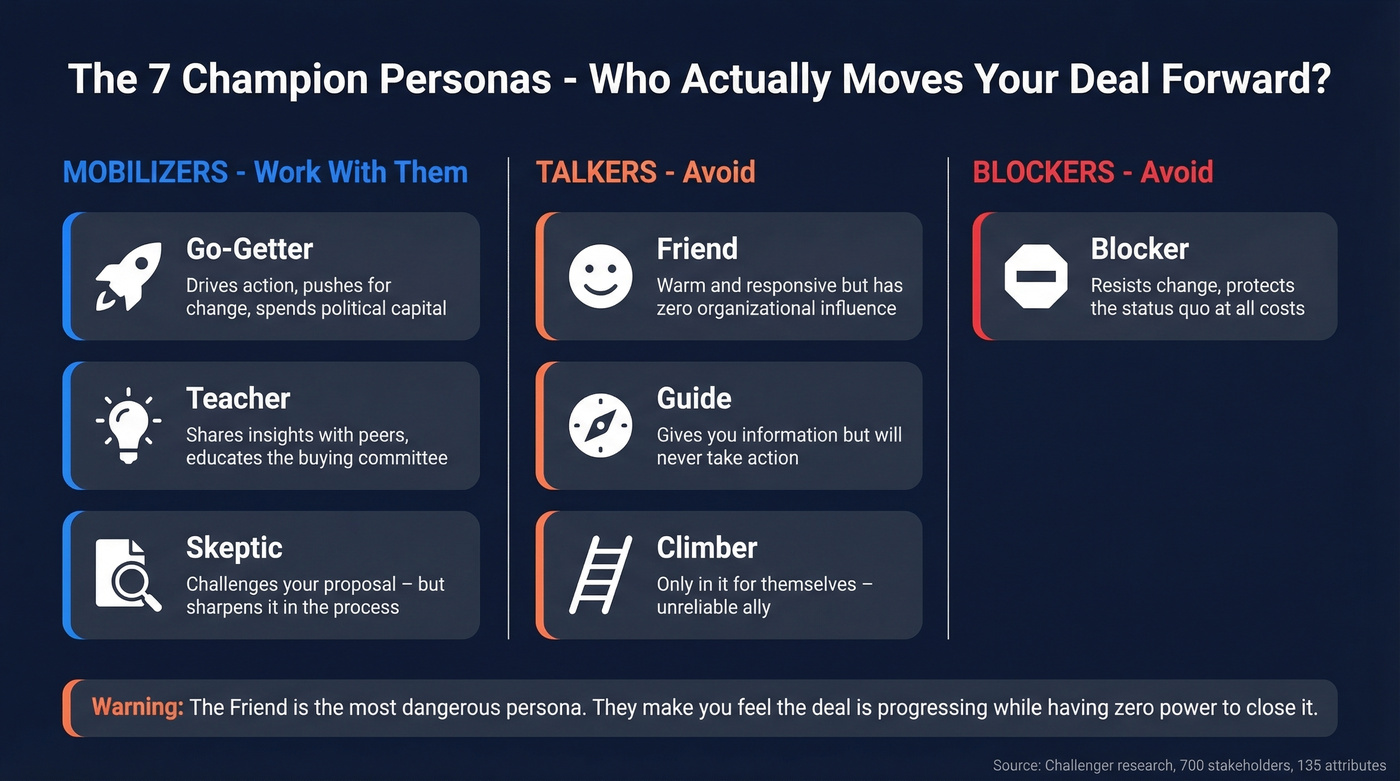
| Persona | Type | Behavior | Work With? |
|---|---|---|---|
| Go-Getter | Mobilizer | Drives action, pushes for change | Yes |
| Teacher | Mobilizer | Shares insights, educates peers | Yes |
| Skeptic | Mobilizer | Challenges ideas, sharpens proposals | Yes |
| Friend | Talker | Accessible, agreeable, no influence | Avoid |
| Guide | Talker | Gives info, won't take action | Avoid |
| Climber | Talker | Self-interested, unreliable ally | Avoid |
| Blocker | Blocker | Resists change, protects status quo | Avoid |
The three Mobilizers - Go-Getter, Teacher, and Skeptic - are the personas most likely to move deals forward. They push for change, challenge the status quo, and are willing to spend political capital.
Here's the thing: the Friend is the most dangerous persona in your deal. They're warm, responsive, and always available for a call. They make you feel like the deal is progressing. But they have zero organizational influence and will never go to bat for you when procurement pushes back or the CFO asks hard questions. We've seen reps build entire forecasts around Friends. It never ends well.
Champion vs. Coach: How to Tell
Picture this: it's week eight of your deal. Your main contact has been enthusiastic from day one - forwarding your emails internally, sharing competitive intel, always taking your calls. But every time you ask for an introduction to the VP who actually signs, they deflect. "Let me find the right time." "She's been traveling."
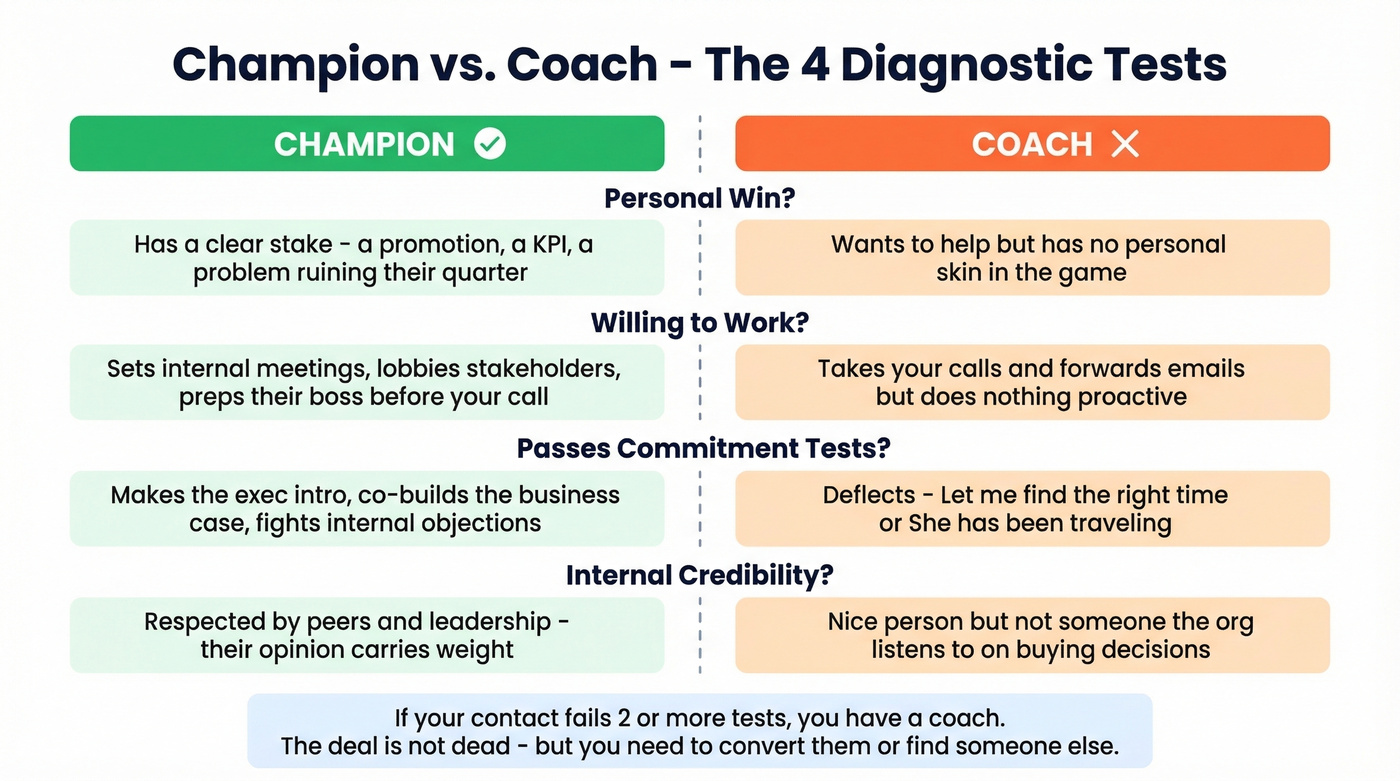
That's a coach, not a champion. A coach keeps you informed. A champion gets you access.
Four diagnostic questions from Leading Sales separate the two:
- Is there a defined personal win for them? Champions have skin in the game - a promotion, a KPI, a problem making their life miserable.
- Are they willing to do work? Setting internal meetings, lobbying stakeholders, prepping their boss before your call.
- Have you tested commitment with a specific ask? An exec introduction, help building the business case, support during an internal debate.
- Are they credible and respected internally? A champion with no organizational credibility is just a loud coach.
If your contact fails two or more of these, you've got a coach. That doesn't mean the deal is dead - it means you need to convert them or find someone else. Three conversion tactics work: create a personal win they care about, involve them in the mutual action plan so they feel ownership, and progressively test their commitment with small asks before the big ones.
One more risk worth naming: becoming personal friends with your champion can actually reduce deal control. When you're too close, you avoid holding them accountable on timelines and commitments. Keep it professional.

Multi-threading boosts win rates by 130%. But you can't thread contacts you can't reach. Prospeo gives you 98% accurate emails and 125M+ verified mobile numbers for every stakeholder on the buying committee - from your champion to the economic buyer.
Map the entire buying committee with verified contact data in minutes.
How to Validate Your Champion
SalesHood's framework gives you seven concrete tests. The best part? Your prospect doesn't know you're running them - they feel like natural conversation, not qualification gates. Run through these before you mark anyone as "Champion" in your CRM:
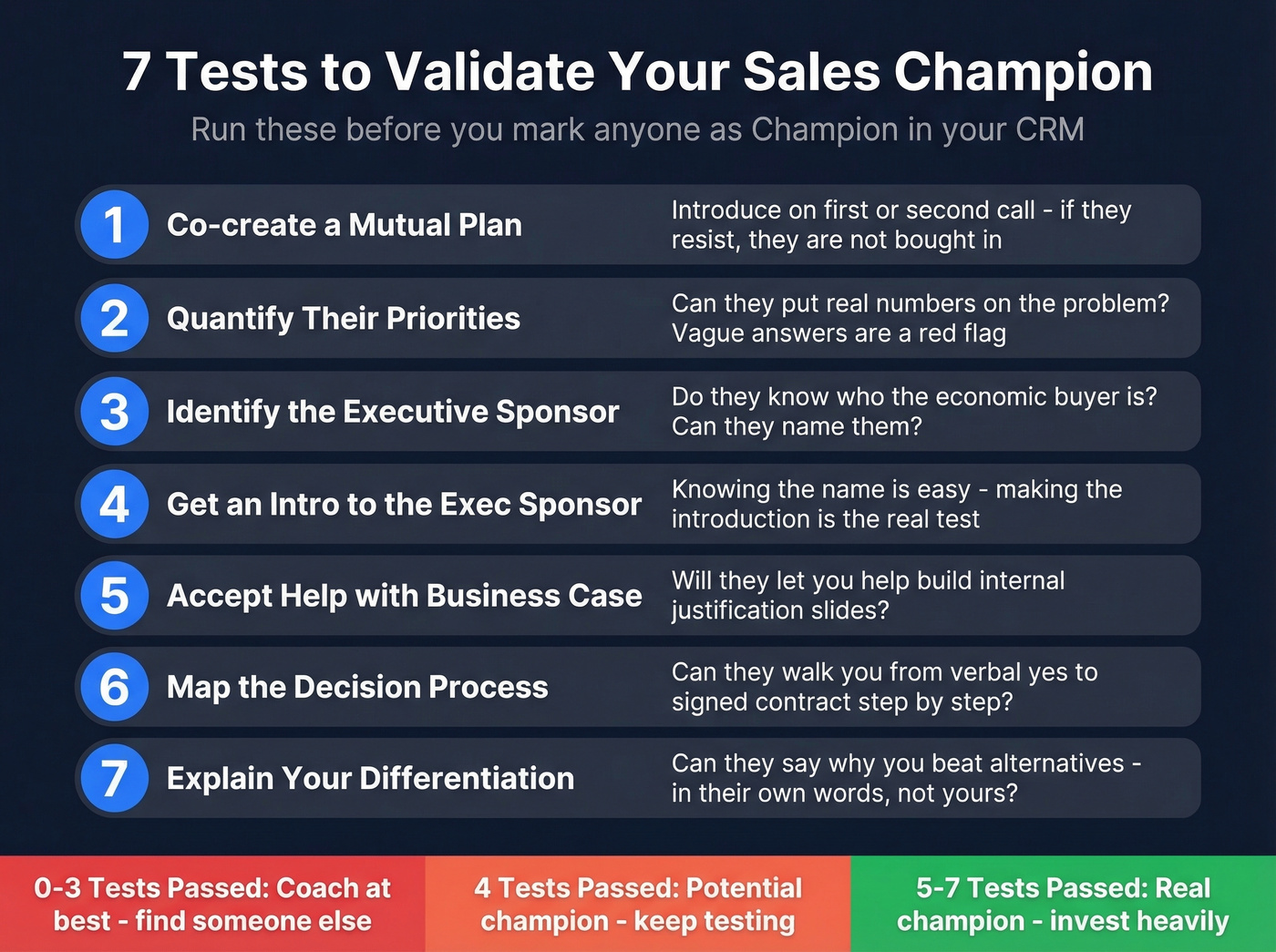
- Co-create a mutual plan. Introduce this on the first or second call. If they resist, they're not bought in or don't have the authority to commit.
- Quantify their priorities. Can they put numbers on the problem? "We're losing $200K/quarter in manual processes" beats "we'd like to be more efficient."
- Identify an executive sponsor. Do they know who the economic buyer is? Can they name them?
- Get an intro to the exec sponsor. Knowing the name is one thing. Making the introduction is the real test.
- Accept help with slides and justification. Will they let you help build the internal business case? Champions welcome this because it makes them look good.
- Map the decision and procurement process. Can they walk you through every step from verbal yes to signed contract?
- Explain competitive differentiation. Can they articulate why your solution beats the alternatives - in their own words, not yours?
Build these into a CRM field or deal-qualification checklist. A champion who passes five or more tests is real. Three or fewer? You're working with a coach at best.
5 Red Flags of a False Champion
A false champion can burn 3-6 weeks per deal before you realize you've been investing in the wrong person. Watch for these:
They don't know the decision process. If they can't explain how their company buys software, they're not close enough to power to help you.
They speak in generalities. "The team likes it" and "everyone's excited" are red flags. Real champions name specific stakeholders and their positions.
They can't articulate ROI or urgency. If they can't explain why this matters now - in business terms - they won't sell it internally.
They block access to senior stakeholders. This is the biggest red flag. A real internal advocate wants you in front of decision-makers. Someone who gatekeeps is protecting their position, not advancing your deal.
They disappear at proposal stage. When pricing, legal, and procurement enter the picture, a false champion goes quiet. A real one leans in harder.
Five validation questions to pressure-test: Who else is involved in this decision? How do decisions like this typically get made here? What happens if nothing changes? Who signs the final budget? What do you need to feel confident advocating for this internally?
The Champion Enablement Kit
Your sales champion is selling for you in rooms you'll never enter. Arm them properly. Flowla's framework organizes this around five principles - clarity, context, proof, relevance, and visibility - and translates them into five assets every champion needs.
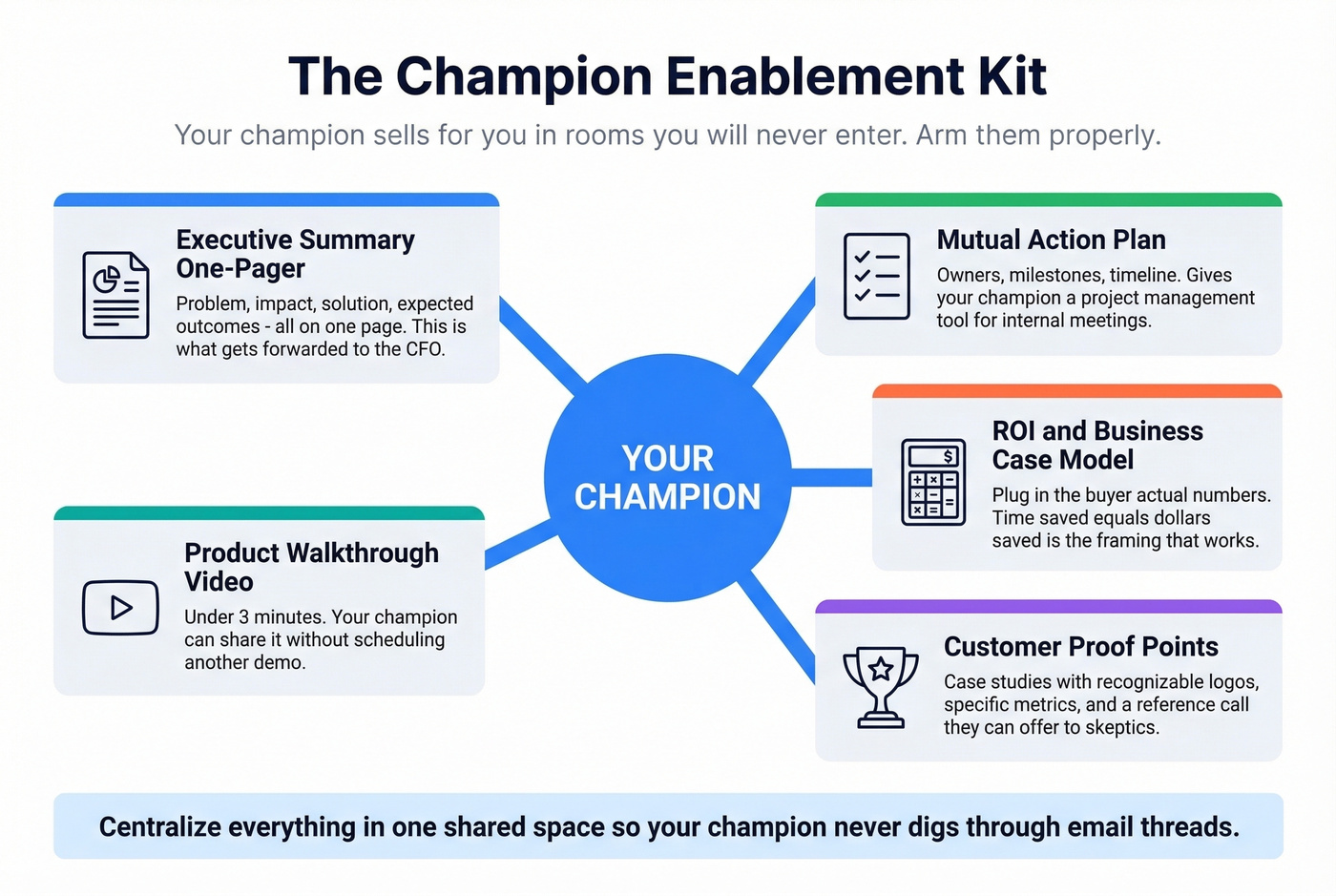
Executive summary one-pager. Problem, impact, solution, expected outcomes - all on one page. This is what your champion forwards to the CFO.
Mutual Action Plan. Owners, milestones, and timeline. Makes the deal feel real and gives your champion a project management tool they can point to in internal meetings.
ROI/business case model. Plug in the buyer's actual numbers. "Time saved equals dollars saved" is the framing that works. Generic ROI calculators don't.
Customer proof points. Case studies with recognizable logos, specific metrics, and - ideally - a reference call your champion can offer to skeptics on the buying committee.
Product walkthrough. A short video or screenshot recap your champion can share without scheduling another demo. Keep it under three minutes.
Centralize everything in one shared space so your champion never has to dig through email threads to find the business case you sent three weeks ago.
You Don't Find Champions - You Build Them
Let's be honest: if your deal size is above $25K and you're waiting to "find" a champion, you've already lost. The best reps create them.
The Challenger methodology - Teach, Tailor, Take Control - is built on this premise. Instead of building relationships and hoping someone emerges as your advocate, you lead with insight that reframes how the prospect thinks about their problem. You tailor that insight to each stakeholder's specific priorities. And you take control of the conversation rather than deferring to the buyer's process.
The data backs this up. In Challenger's research, nearly 40% of star performers were Challengers, while Relationship Builders - the reps who focus on being liked - produced just 7% of top performers. And 53% of buyer loyalty is attributed to the sales experience itself, not the product or the brand.
Stop trying to be liked and start teaching. A prospect who learns something valuable from you has a personal reason to champion your deal - you made them smarter in front of their boss.
Multi-Threading Beyond Your Champion
Even the best champion is a single point of failure. People change jobs, go on leave, get reorganized into different departments. If your entire deal depends on one person, you're one reorg away from starting over.
Gong's data is clear: won deals have 2x the buyer contacts of lost deals, and large strategic deals average 17 stakeholders. Meanwhile, 78% of salespeople who use social selling outpace competitors who don't. Your internal champion gets you in the door, but you need to build relationships across the buying committee - finance, IT, end users, procurement - through every channel available.
The practical problem? Half your emails bounce, direct dials go to voicemail, and your multi-threading strategy dies before it starts. Reaching 10+ stakeholders requires accurate contact data for every person on the org chart who touches the decision. In our experience, tools like Prospeo make this manageable: search by company, department, and seniority using 30+ filters to get verified emails and direct mobile numbers for the full buying committee, with a 7-day data refresh cycle so you're working off current records.
If you're building this into your outbound motion, pair it with account-based selling and a repeatable set of sales prospecting techniques.

Your champion just gave you the exec sponsor's name. Now you need their direct line - not a generic info@ address. Prospeo's 30+ search filters let you find decision-makers by title, department, and company, with emails verified on a 7-day refresh cycle. At $0.01 per email, reaching the full buying group costs less than a coffee.
Turn every champion intro into a verified contact in one click.
FAQ
What is a sales champion?
A sales champion is an internal advocate inside a prospect's organization who has influence, a personal stake in the outcome, and the willingness to sell on your behalf when you're not in the room. They actively build consensus, navigate objections, and get you access to the economic buyer - unlike a coach, who provides information but lacks the power or motivation to advance the deal.
What's the difference between a champion and an economic buyer?
A champion influences and advocates internally - building consensus and navigating objections across the buying committee. The economic buyer holds budget authority and signs the contract. You need both; the champion is how you reach the buyer.
Can you have more than one champion in a deal?
Yes, and for deals above $50K you should. Multiple mobilizers protect against turnover and strengthen consensus across departments. Gong data shows won deals average 2x the buyer contacts of lost deals.
How do you get verified contact data for the full buying committee?
Use a B2B data platform with company-level search filters to pull verified emails and direct dials for every stakeholder. Prospeo covers 300M+ profiles with 98% email accuracy and a 7-day refresh cycle, which is useful when you need to multi-thread beyond your primary champion quickly.