

Sales Collateral That Actually Gets Used: A 2026 Playbook
Marketing spent six weeks building a new case study library. Design polished every slide. The VP of Sales rolled it out on a Monday. By Friday, three reps had already reverted to their own decks - the ones saved locally on their laptops from 2024.
Forrester's research tells us most sales collateral files get used fewer than 10 times. That's not a content problem. It's a relevance problem, a distribution problem, and a governance problem rolled into one.
What You Need (Quick Version)
Most teams don't need 50 assets. They need six that work:
- One case study per buyer persona
- One one-pager per product
- An ROI calculator
- An internal battle card
- A proposal template
- A 90-second demo video
Get those right, distribute them to verified contacts, and measure what influences pipeline. The rest of this article shows you how.
What Is Sales Collateral?
It's any prospect-facing material designed to move a deal forward - case studies, one-pagers, pricing sheets, demo videos, proposals. The stuff your buyer sees. That makes it different from marketing collateral, which lives upstream in brand awareness and lead generation.
It's also narrower than sales enablement collateral, which Seismic's taxonomy defines as the broader category including internal playbooks, training decks, and competitive intelligence. The materials we're focused on here are specifically external - the content your champion forwards to their CFO at 9 PM to justify the purchase.
Why It Matters
95% of purchasing decisions are directly influenced by content. 82% of buyers review an average of five pieces before making a purchase. And 67% of buyers rely more on content now than they did a year ago. Your reps aren't closing deals in a vacuum - buyers are reading your materials, comparing them to competitors', and making judgments before the next call happens.
Speed matters too. Outreach's data found that deals closed within 50 days carry a 47% win rate, compared to 20% or lower after that threshold. B2B sales materials that accelerate buyer confidence compress cycle time. Content that confuses them extends it.
HubSpot's State of Sales report reinforces the pattern: 59.9% of sales teams are on track to meet or surpass revenue targets, with 68% reporting improved lead quality year over year. The teams winning aren't the ones with the biggest content library - they're the ones equipping reps with the right materials at the right moment.
Why Most Collateral Fails
We've seen the same five failure modes across dozens of teams:
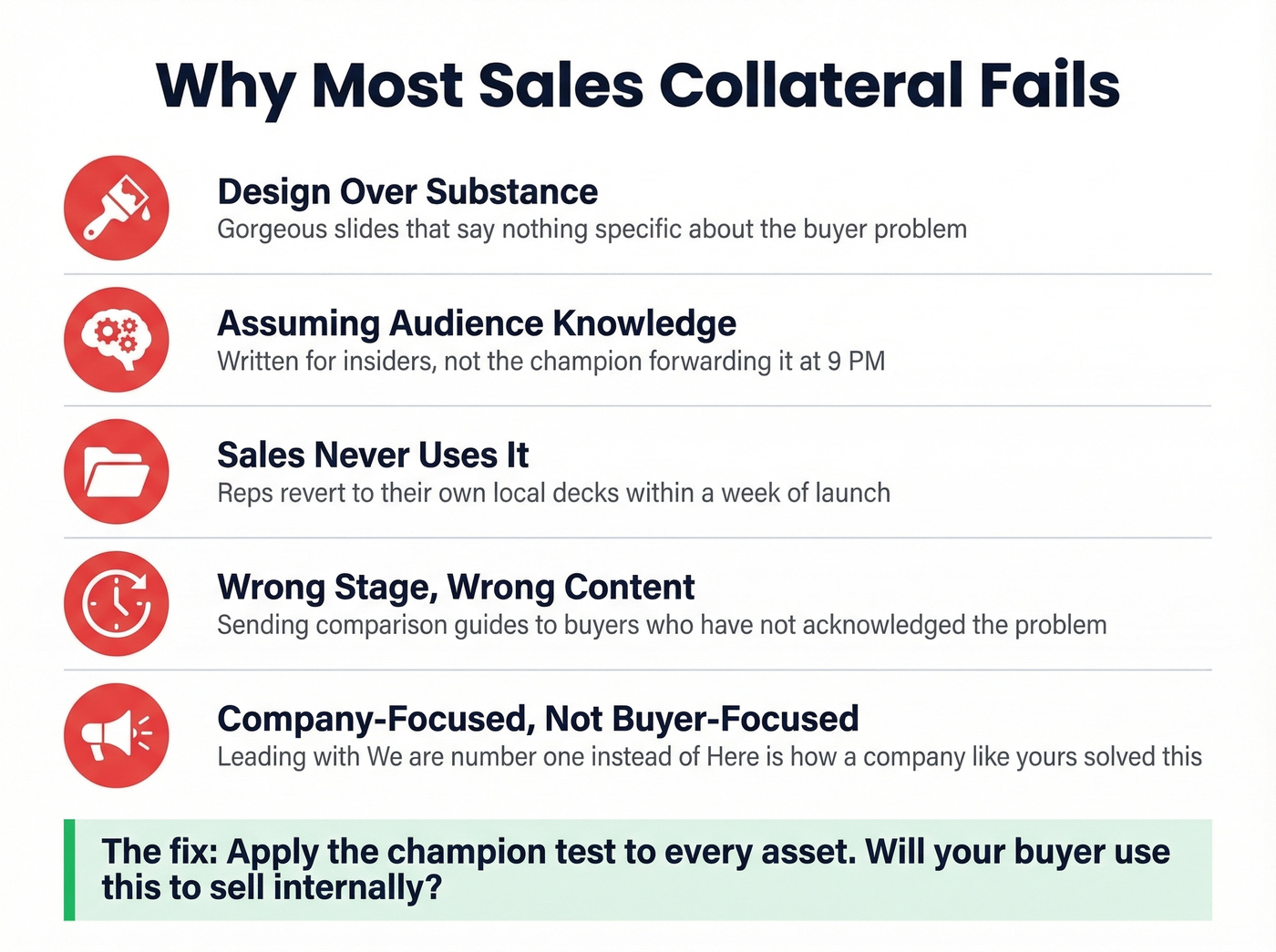
Design over substance. The deck looks gorgeous. The messaging says nothing specific. Reps can't use a beautifully designed slide that doesn't address the buyer's actual objection.
Assuming audience knowledge. Marketing writes for people who already understand the product. If your one-pager requires context only an internal employee has, it's useless in a forwarded email.
Sales doesn't use it. This is the big one. There are entire closets of unused assets across B2B companies. One r/SaaS thread describes the same breakdown: marketing creates a master deck, sales customizes it, and within weeks everyone has their own version saved locally. Nobody knows which is current. Reps end up pitching with inaccurate information that damages brand credibility.
Wrong content at the wrong stage. Sending a product comparison guide to someone who hasn't acknowledged they have a problem yet doesn't just waste time - it can actively derail a deal.
Company-focused instead of buyer-focused. If your case study leads with "We're the #1 platform for..." instead of "Here's how a company like yours solved this problem," you've lost the reader. The classic HBR insight still holds: marketing shouldn't throw collateral over the wall to sales and hope for the best.

You just read that 35% bounce rates kill collateral campaigns before buyers ever see them. Prospeo's 5-step email verification drops bounce rates below 4% - so your case studies, one-pagers, and ROI calculators actually land. At $0.01 per email, verifying your entire prospect list costs less than one wasted send.
Stop crafting perfect collateral for inboxes that don't exist.
Collateral Types by Buyer Stage
Not all content belongs at every stage. Here's how the core types map:
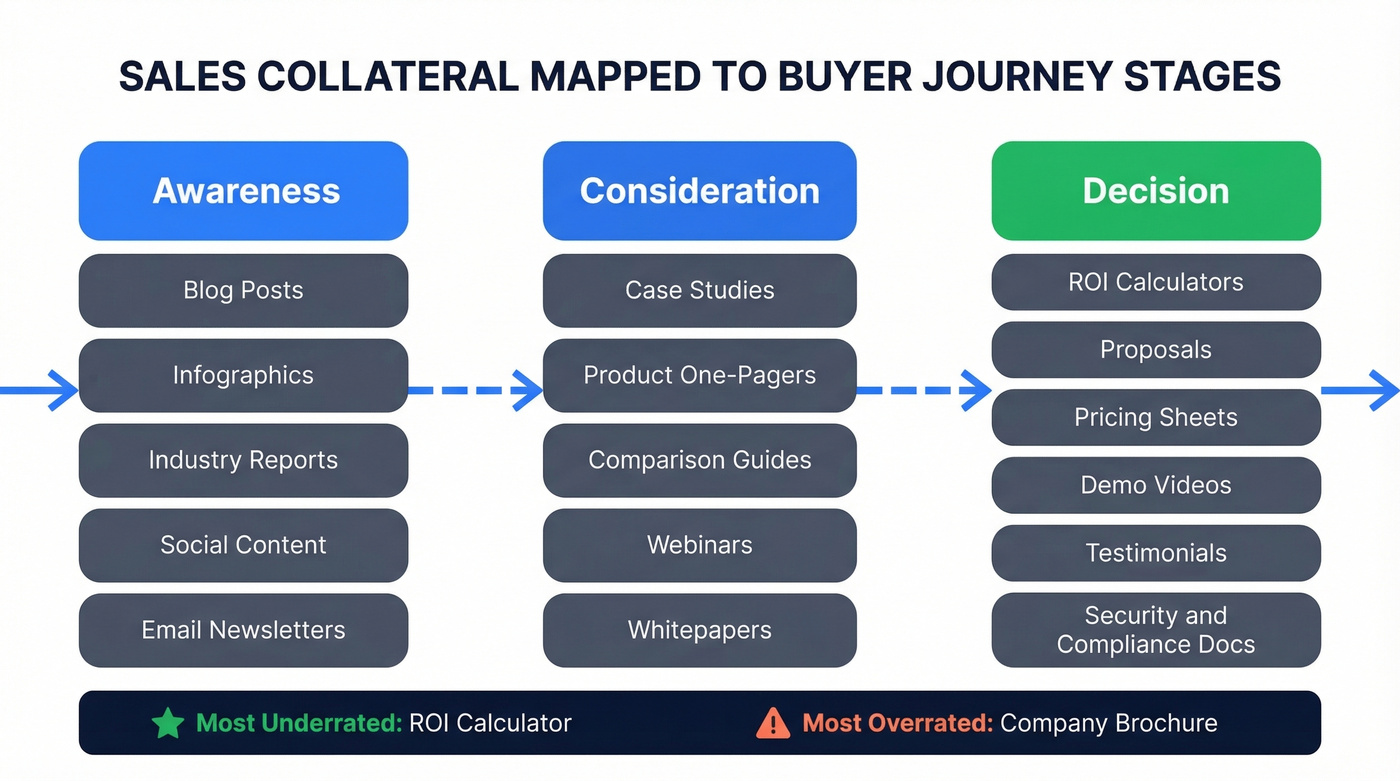
| Awareness | Consideration | Decision |
|---|---|---|
| Blog posts | Case studies | ROI calculators |
| Infographics | Product one-pagers | Proposals |
| Industry reports | Comparison guides | Pricing sheets |
| Social content | Webinars | Demo videos |
| Email newsletters | Whitepapers | Testimonials |
| - | - | Security/compliance docs |
The most underrated asset on this list? The ROI calculator. Nothing moves a deal from "interested" to "approved" faster than a spreadsheet the buyer can plug their own numbers into. The most overrated? The company brochure. Buyers don't forward brochures to their procurement team.
Best Practices for Content That Gets Used
Constraints produce better work. Keep sales decks to 20 slides max. Limit text to roughly 30 words per slide. A prospect will spend about 10 minutes skimming a 20-page deck - that's 30 seconds per slide, so every slide needs to earn its spot.
Video is table stakes in 2026. 75% of customers are more likely to buy after watching a video explaining the product. A 90-second demo video that shows the product solving a real problem outperforms a 40-slide deck every time.
For structure, the persuasive template that consistently works: Introduction, Problem, Solution/Benefits, Case Studies, CTA. We apply what we call the "champion test" to every piece - will your buyer's internal champion use this to sell for you inside their organization? If the answer is no, rewrite it until the answer is yes.
Don't overlook repurposing. A single whitepaper can become a blog post, an email sequence, three social clips, and a one-pager. Most teams create too much net-new content and underutilize what already works.
Here's the thing - the best content in the world fails if it reaches a dead inbox. Before distributing any collateral campaign, verify your prospect list. Prospeo's real-time verification catches invalid emails, spam traps, and catch-all domains with 98% accuracy. One customer, Meritt, saw their bounce rate drop from 35% to under 4% after switching. A 35% bounce rate means more than a third of your materials never arrive.
Governance and Measurement
Version Control That Scales
Picture this: an AE is preparing for a $200K demo tomorrow. They search the shared drive for the latest financial services case study. They find three versions - one from 2023 referencing a feature that no longer exists, one with last year's pricing, and one that's clearly a draft. They use the wrong one.
This happens constantly once teams scale past a handful of reps. You need a single source of truth with approval workflows, clear naming conventions, and search that actually works. In one r/SaaS thread, the diagnosis is blunt: past ~$1M ARR, collateral management becomes a full-time job.
KPIs That Matter
Stop measuring downloads. Start measuring influence:
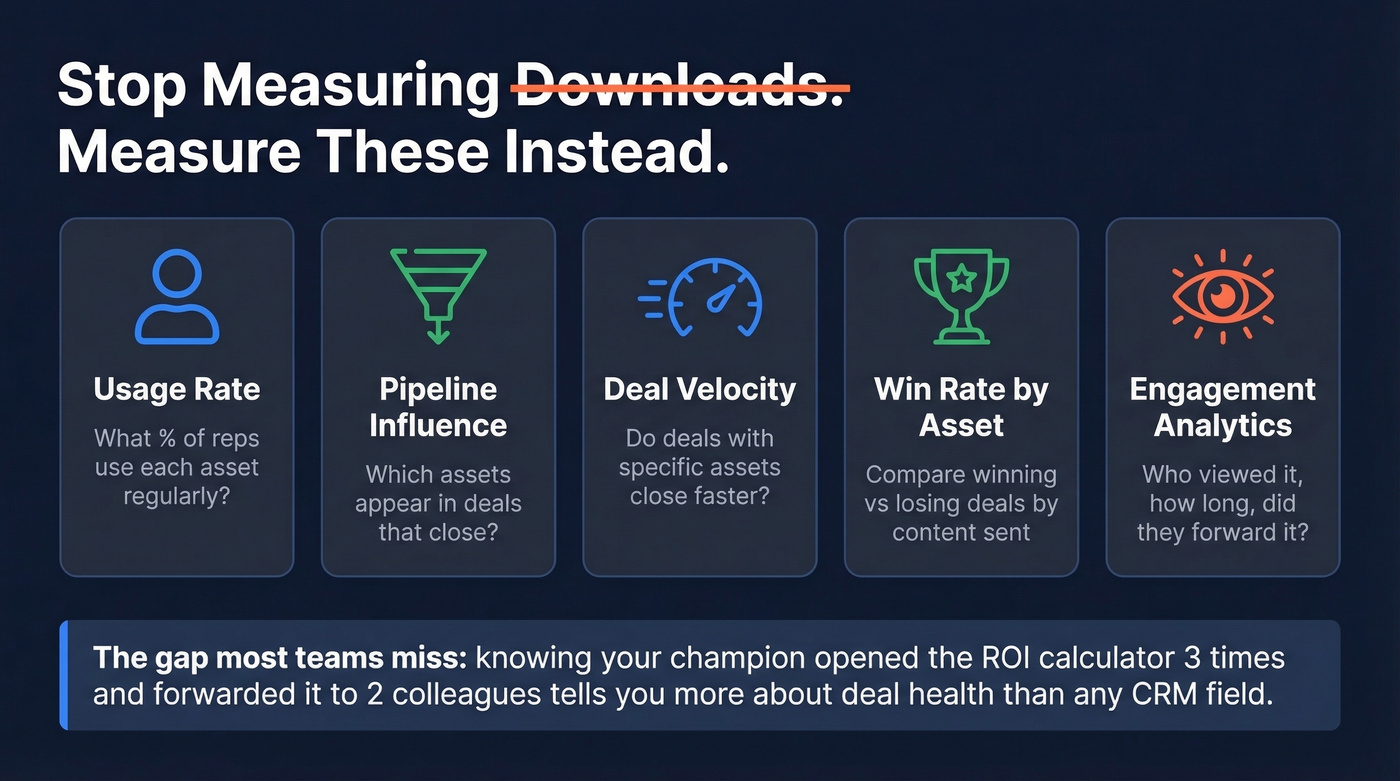
- Usage rate - what percentage of reps use each asset regularly?
- Pipeline influence - which assets appear in deals that close?
- Deal velocity - do deals where specific assets are shared close faster?
- Win rate by asset - compare winning deals vs. losing deals by which content was sent
- Engagement analytics - who viewed the content, how long they spent on each page, and whether they shared it internally
That last one is the gap most teams miss. Knowing that your champion opened the ROI calculator three times and forwarded it to two colleagues tells you more about pipeline health than any CRM field.
AI and Collateral in 2026
SPOTIO's 2026 State of Field Sales Survey paints a clear picture: 26% of field sales teams now use AI for content and proposal generation, 30% for email personalization, and 33% aren't using AI at all. Adoption is real but far from universal.
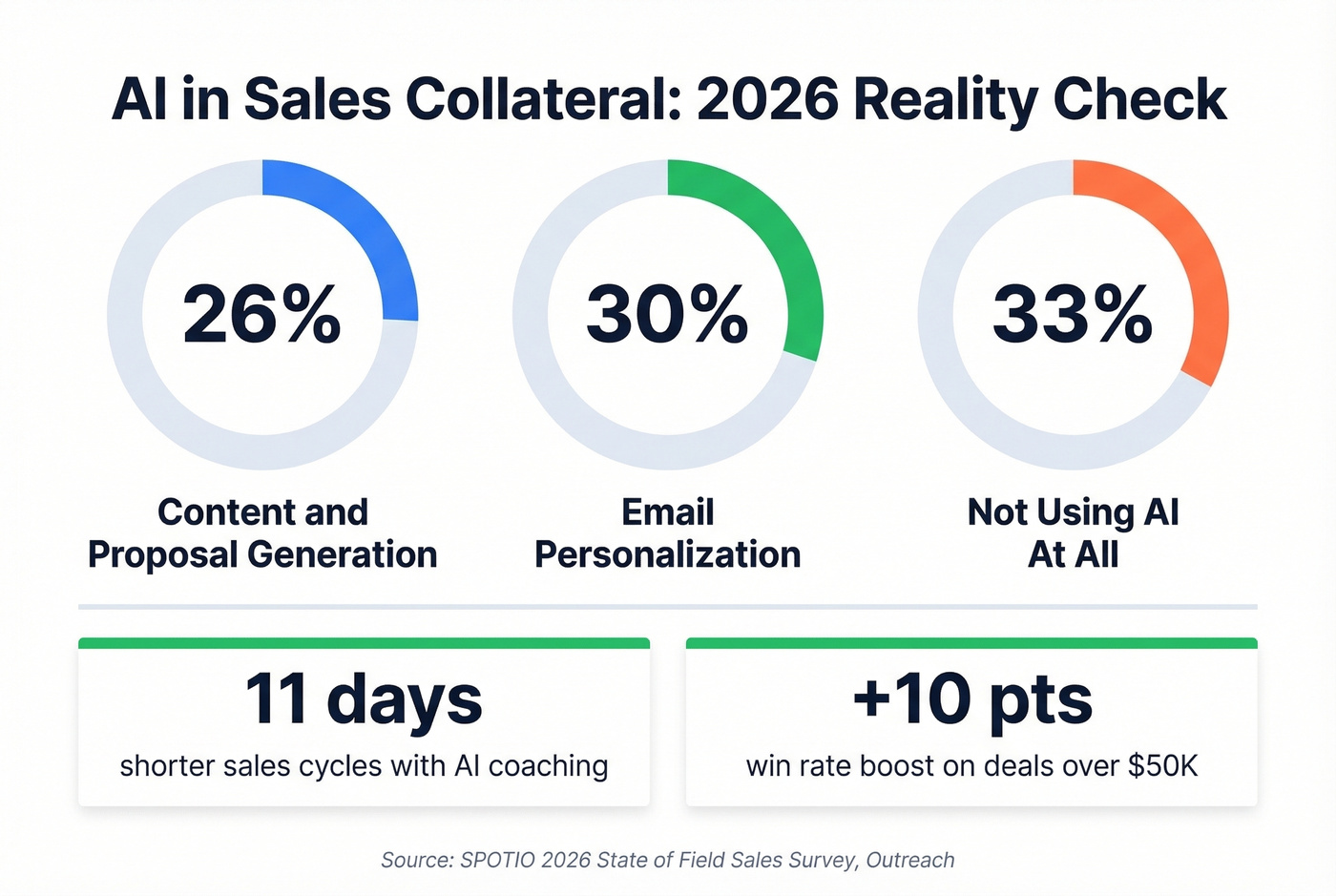
AI-powered enablement cuts production time in half. Teams using AI to generate first drafts of proposals and customize decks per prospect close deals faster - Outreach's data shows AI coaching shaves 11 days off sales cycles and boosts win rates by up to 10 percentage points on deals over $50K.
Let's be honest: if your average deal size is under $15K, you don't need an enterprise enablement platform or AI-generated proposals. You need six solid assets, clean contact data, and a rep who follows up. The AI arms race in B2B sales content is real, but it's solving a problem most SMBs don't have yet. Skip the $50K platform and invest in getting the basics right first.
Static PDFs are dead for complex B2B deals. The shift toward dynamic formats - digital sales rooms where buying committees can access, share, and interact with content - is growing fast. For a $150K deal with six stakeholders, a shared digital room beats emailing PDFs into the void. (If you're evaluating this format, start with a digital sales room checklist.)
Tools Worth Considering
Three tiers, depending on your team size and budget:
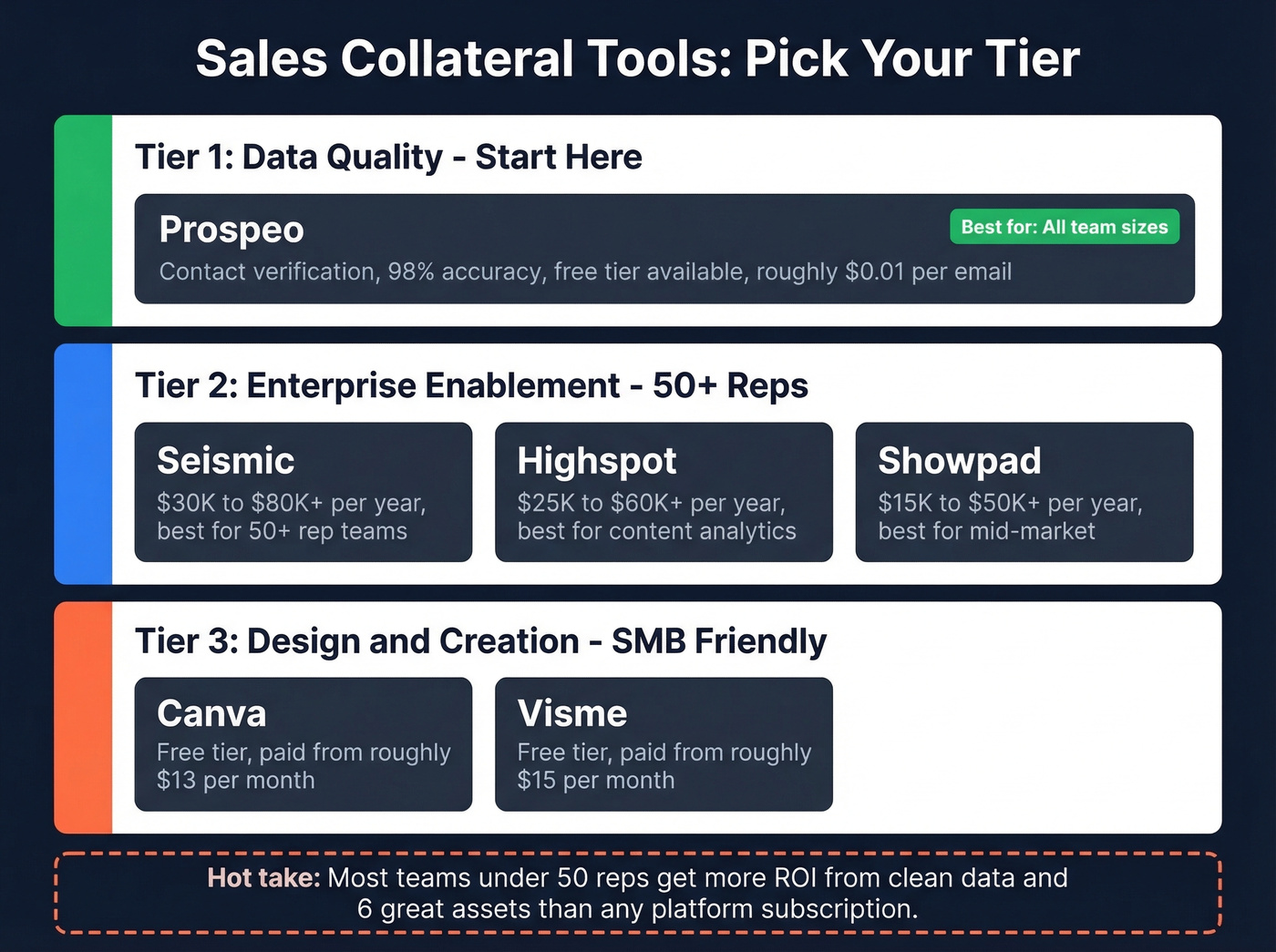
| Category | Tool | Best For | Pricing |
|---|---|---|---|
| Data quality | Prospeo | Contact verification | Free tier; ~$0.01/email |
| Enterprise enablement | Seismic | 50+ rep teams | ~$30K-$80K+/yr |
| Enterprise enablement | Highspot | Content analytics | ~$25K-$60K+/yr |
| Enterprise enablement | Showpad | Mid-market enablement | ~$15K-$50K+/yr |
| Design/creation | Canva | SMB design | Free; paid from ~$13/mo |
| Design/creation | Visme | Interactive content | Free; paid from ~$15/mo |
Enterprise enablement platforms are worth it past 50 reps. Below that, you're overpaying for features your team won't adopt. The fact that every enablement platform hides pricing behind a "request demo" wall tells you everything about how they view SMBs.
In our experience, most teams under 50 reps get more ROI from clean data and a handful of well-built assets than from any platform subscription. I've watched teams spend six figures on Seismic only to have reps ignore it because nobody built the content worth putting in there.
If you're building the outbound motion around these assets, pair them with tight sales follow-up templates and a clear sequence management process.
Great collateral needs the right audience. Prospeo's 30+ search filters - buyer intent, job changes, technographics, headcount growth - let you match each asset to the exact persona and buying stage. 300M+ profiles, 98% email accuracy, refreshed every 7 days so your champion always gets current contact data.
Send the right collateral to verified decision-makers, not dead leads.
FAQ
What's the difference between sales and marketing collateral?
Sales collateral advances specific deals - case studies, proposals, pricing sheets sent to identified prospects. Marketing collateral drives top-of-funnel awareness - blog posts, social content, ads. Sales closes; marketing attracts. The overlap happens at the consideration stage with assets like webinars and whitepapers.
How many assets does a B2B team actually need?
Start with six: one case study per persona, a product one-pager, an ROI calculator, a battle card, a proposal template, and a demo video. Most teams over-build and under-distribute. Six well-crafted, regularly updated assets outperform a library of 50 stale ones every time.
What's the most effective type?
Case studies and ROI calculators consistently influence the most pipeline. Case studies provide social proof from recognizable companies; ROI calculators let buyers build their own internal business case - which is what actually gets budget approved.
How do I know if my collateral is working?
Track pipeline influence and win rate correlation by asset type - not downloads. Compare which assets appear in closed-won vs. closed-lost deals. If an asset shows up in 60%+ of won deals, double down on it.
How do I make sure collateral reaches the right prospects?
Verify your contact data before distributing. Invalid emails mean your materials bounce silently - you'll never know they didn't arrive. Prospeo's 5-step verification process catches invalid addresses, spam traps, and catch-all domains at 98% accuracy, with a free tier of 75 emails per month for smaller teams.