

The 10 Best Sales Databases for 2026: Real Pricing, Real Accuracy
B2B contact data decays at 2.1% per month. That's roughly 22.5% of your database going stale every year. Email addresses decay 23-30% annually, 18% of phone numbers change each year, and poor data quality costs organizations an average of $12.9M per year. Your reps? They're burning about 500 hours a year validating contact info instead of selling. The sales database you pick isn't a minor tooling decision. It's the foundation everything else sits on.
Here's a shift worth paying attention to: practitioners are moving away from volume-based prospecting. The consensus on r/sales and outbound communities is that "big databases" lead to declining reply rates and deliverability hits from outdated or overused contacts - teams win by stacking intent signals (job changes, funding rounds, hiring surges) on top of smaller, fresher contact lists. The "biggest database wins" era is over. The $863.2M B2B data market, projected to hit $3.2B by 2030, now has enough competitors that you don't have to overpay for a bloated platform just to get accurate emails and phone numbers.
We evaluated these 10 tools across accuracy, refresh cycle, pricing transparency, compliance, and integration depth - weighted toward data quality, because that's what actually drives outbound performance. If you’re building a full outbound stack, it also helps to map your database choice to your sales prospecting techniques and workflow.
Our Picks at a Glance
| Tool | Best For | Starting Price | Key Stat |
|---|---|---|---|
| Prospeo | Email accuracy & freshness | Free (75 emails/mo) | 98% email accuracy, 7-day refresh |
| ZoomInfo | Enterprise teams with budget | ~$15K/yr | 321M+ contacts, deepest feature set |
| Apollo.io | Free-tier starting point | Free, paid from $49/mo | 275M+ contacts, built-in sequencing |
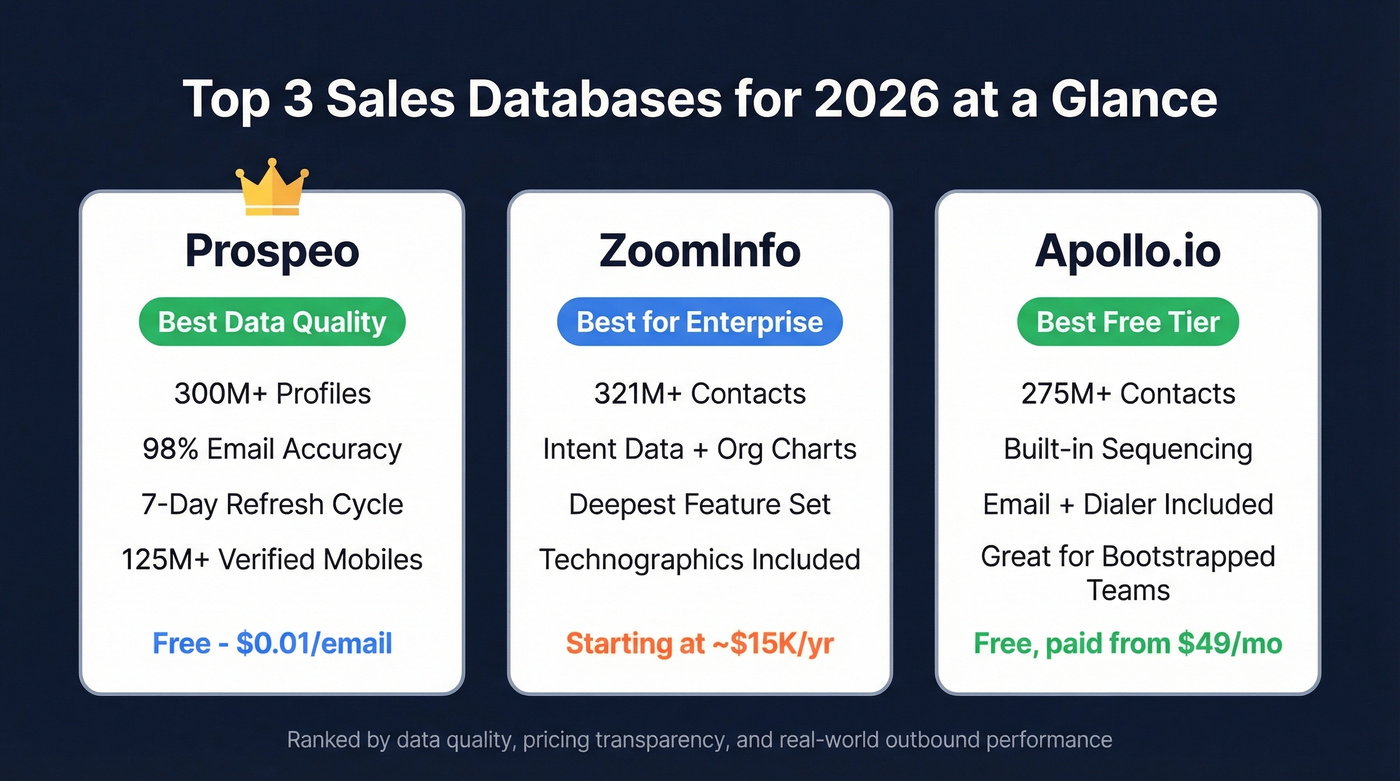
Prospeo wins on data quality and transparent pricing. ZoomInfo wins on breadth and enterprise workflows. Apollo wins on accessibility. Everything else depends on your region, budget, and channel mix.
What Makes a Sales Database Worth It
Not all sales databases are equal, and the biggest one isn't automatically the best. A modern contact database isn't a purchased list - purchased lists are static, unverified, and often non-compliant. Modern platforms verify in real time and enforce opt-outs. Five criteria separate the contenders:
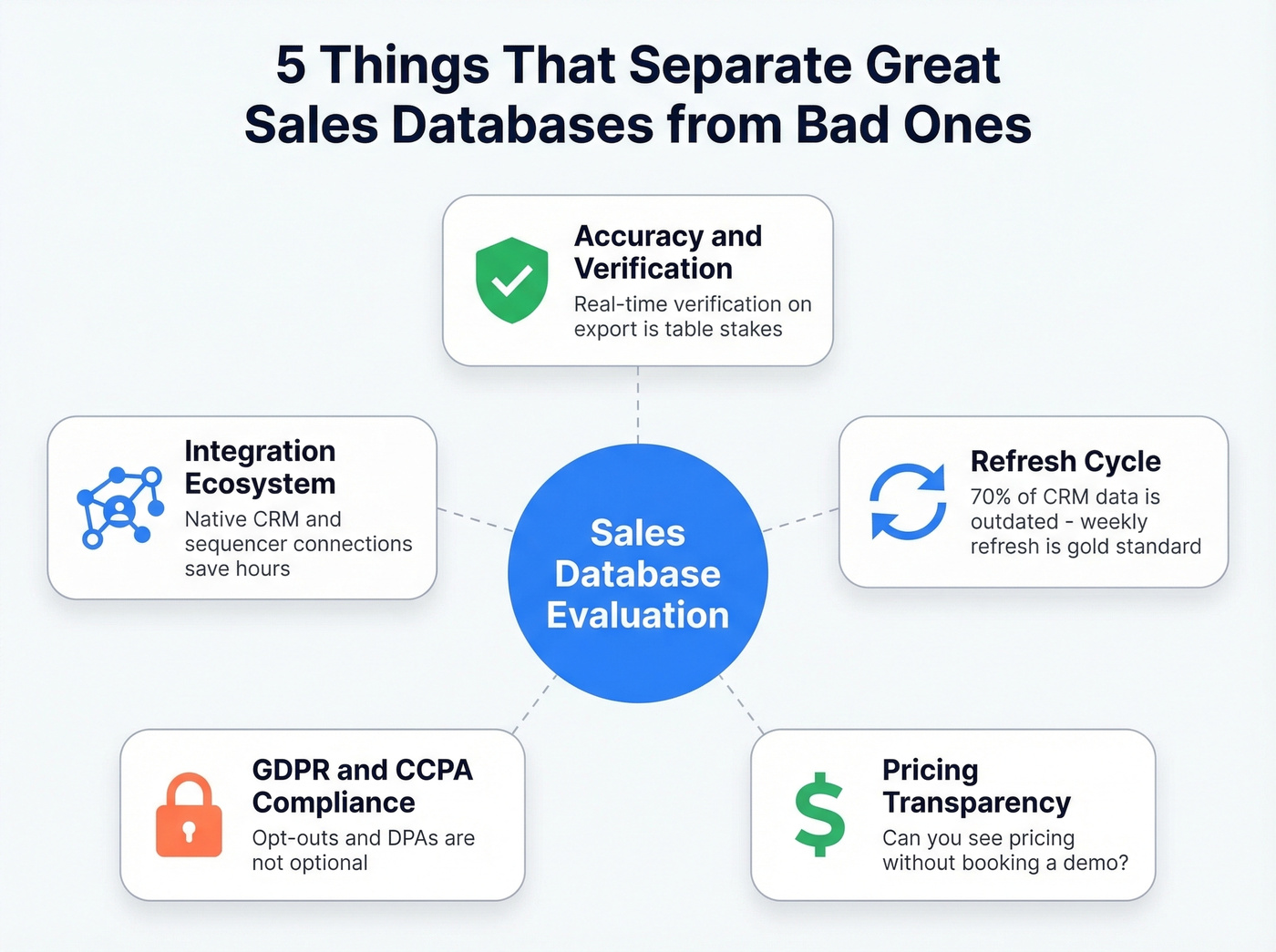
Accuracy and verification method. How does the vendor verify emails and phones? Real-time verification on export is table stakes. Anything less means you're paying for data you can't trust. Ask whether they use proprietary infrastructure or just resell third-party data. (If you want to go deeper on verification, compare options in our guide to data enrichment services.)
Refresh cycle. 70% of CRM data is outdated at any given time. If your vendor refreshes quarterly - or worse, never - you're building campaigns on a decaying foundation. Weekly refresh is the gold standard.
Pricing model transparency. Can you see pricing on the website, or do you need to "book a demo" and sit through a 45-minute pitch? Credit-based models are easier to predict than seat-based contracts with hidden overages. If you’re trying to sanity-check cost per lead, it helps to benchmark against other free lead generation tools too.
Compliance. GDPR and CCPA aren't optional. If you're selling into the EU, your vendor needs to enforce opt-outs and offer DPAs. Don't learn this the hard way.
Integration ecosystem. Your contact data needs to feed your CRM and sequencer without manual CSV gymnastics. Native integrations with Salesforce, HubSpot, and your outbound tools save hours every week - especially if you’re standardizing your sequence management process.

The 10 Best Sales Databases for 2026
1. Prospeo
Use this if you care more about data quality than feature count. Prospeo's 300M+ professional profiles come with 98% email accuracy and 125M+ verified mobile numbers that hit a 30% pickup rate. The 7-day data refresh cycle is the fastest we've seen - most competitors refresh every 4-6 weeks.
Real results back this up. Snyk's 50-person AE team dropped bounce rates from 35-40% to under 5% and generated 200+ new opportunities per month after switching. Meritt tripled their pipeline from $100K to $300K per week. Those aren't hypothetical projections - they're production numbers from teams running serious outbound.
Pricing: Free tier gives you 75 verified emails per month. Paid plans run about $0.01 per email - no annual contracts, no sales calls required. That's roughly 90% cheaper per lead than ZoomInfo.
Skip this if you want a single platform to replace your entire GTM stack. Prospeo is purpose-built as the data layer - pair it with your sequencer and CRM for a stack that outperforms any all-in-one. (For a broader tool stack, see our roundup of SDR tools.)

2. ZoomInfo
Starts around $15,000 per year for 1-3 seats. That's the entry point, and it only goes up.
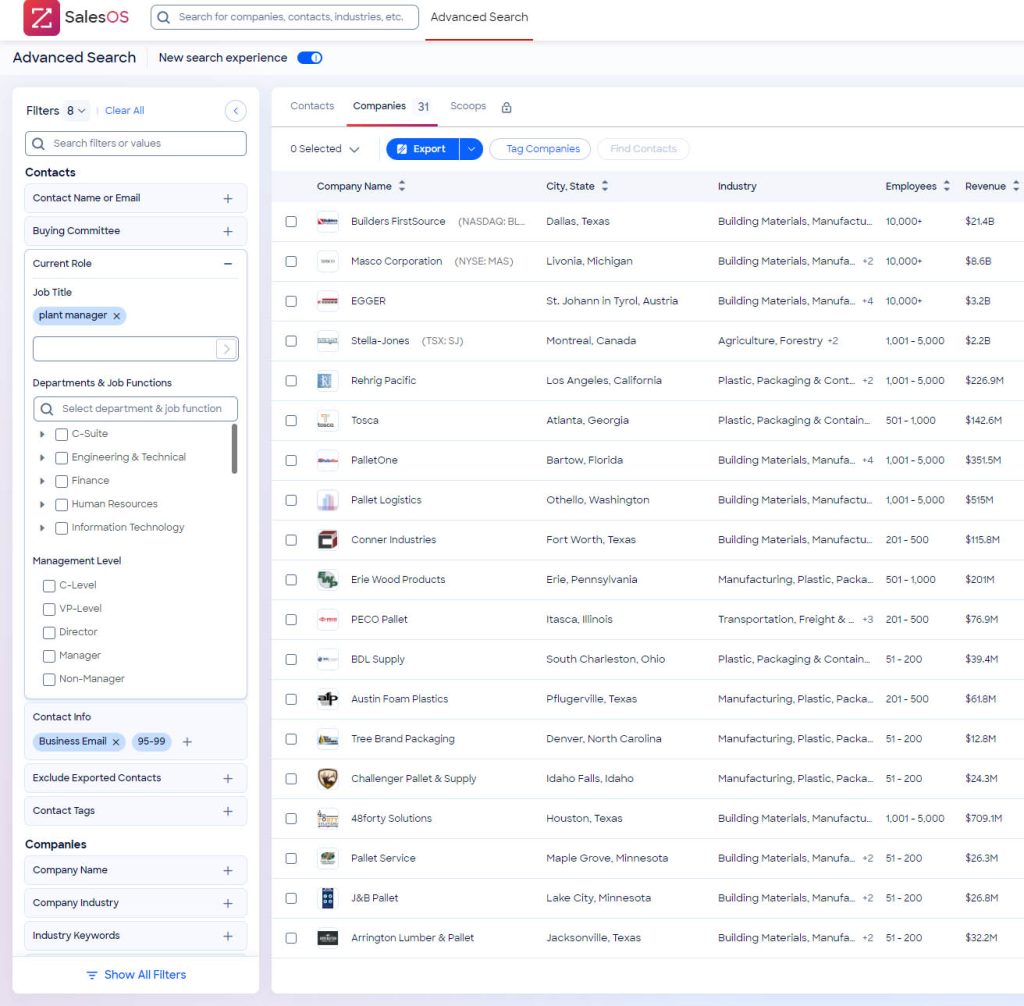
ZoomInfo is the 800-pound gorilla of B2B data for a reason: 321M+ contacts across 104M+ company profiles, plus intent data, org charts, technographics, and a deep set of enterprise modules. If you're an enterprise org that needs everything under one roof, nothing else matches the breadth.
Professional plans run $15K-$18K/year. Advanced jumps to $22K-$28K. Elite - which is what most mid-market teams actually need - lands at $35K-$45K+. Credit top-ups, mid-contract seat additions, and 10-20% renewal uplifts mean your year-two cost is almost always higher than year one. The #1 complaint on Reddit? Paying for modules that never get activated.
Here's the thing: ZoomInfo is still the best all-in-one platform. But most teams don't need all-in-one. If your team is under 10 reps or your average deal size doesn't justify a $15K+ annual data line item, you're subsidizing features you'll never touch.
3. Apollo.io
Free. That's the word that gets 275M+ contacts and built-in email sequencing into the hands of every bootstrapped SDR team on the planet. Apollo's free tier is a strong starting point, and paid plans from $49/user/month (billed annually) are reasonable for what you get. If you’re optimizing outreach performance, pair your database with proven sales follow-up templates.
4. Cognism
Why it wins: EMEA mobile numbers. Cognism's Diamond Data is a top source for verified European direct dials, and their 400M contact database is strong for teams selling into Europe.
The tradeoff: Pricing is enterprise-grade. Vendr benchmarks put a 5-user Grow plan at ~$22,500/year and Elevate at ~$37,500/year. The "unlimited" access is governed by fair-use caps - around 2,000 records per user per month. Annual contracts only, and onboarding can run $2K-$5K extra. If you need Salesforce enrichment, buy credits in 1,000-unit increments rather than the full Enrich module - Vendr data shows this saves ~$17K/year for teams using under 12,000 credits.
Negotiate hard. Grow discounts of 28-43% and Elevate discounts of 36-52% are common.
5. Lusha
Lusha's 245M+ contacts make it a fast, low-friction way to grab contact details. The 4.3/5 G2 rating across 1,618 reviews reflects solid adoption in mid-market teams. Pricing starts at $36/user/month, which undercuts most competitors.
The catch: data inaccuracy is the most common complaint on G2. If you're running high-volume outbound, you'll want a verification layer on top. Lusha works best as a quick-grab tool for individual reps, not as your primary database for multi-channel sequences at scale.
6. UpLead
UpLead earns its 4.7/5 G2 rating across 824 reviews. Plans start at $99/month. The database is smaller than the big players, and missing or outdated contacts surface as the main con in reviews. Think of UpLead as a quality-over-quantity play for budget-conscious teams who'd rather have 500 solid contacts than 5,000 questionable ones.
7. Lead411
Lead411 is a budget-friendly option starting at $49/month. Nothing flashy, but it's a decent tool to test alongside your current provider if you want to compare data quality without a big commitment.
8. SalesIntel
SalesIntel targets teams that want higher-confidence contact data and support for more demanding outbound workflows. Custom pricing commonly lands around $1,000-$2,500/month for small teams - worth a look if human-verified data matters to your use case.
9. Hunter.io
Hunter is email-only - no phone numbers, no intent data, no company intelligence. What it does, it does well: find and verify professional email addresses. Free plan available, paid from $34/month. If email is your only outbound channel, Hunter keeps things simple and cheap. (If you’re comparing similar tools, see our list of Hunter alternatives.)
10. RocketReach
RocketReach is a solid generalist with broad global reach. Email-only plans start at $39/month; adding phone numbers bumps you to $99/month. It's a useful fallback, but it doesn't specialize enough to beat the leaders in any single category.

You just read that bad data costs orgs $12.9M per year and reps waste 500 hours validating contacts. Prospeo's 7-day refresh cycle and 98% email accuracy eliminate both problems - at $0.01 per email, 90% cheaper than ZoomInfo.
Stop building campaigns on a decaying database. Start with 75 free verified emails.
Pricing Comparison
Here's what most "best sales databases" articles won't give you - actual dollar ranges instead of "contact sales."
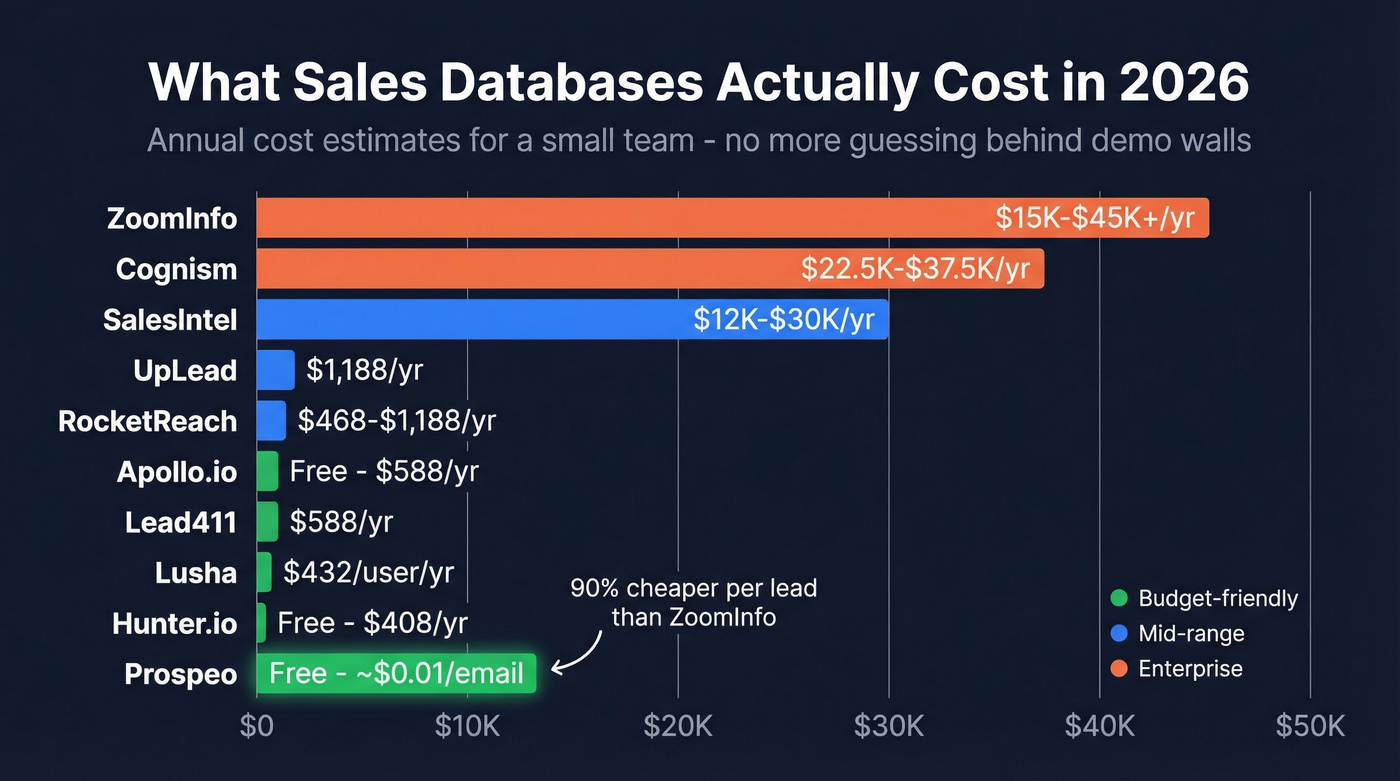
| Tool | Starting Price | Contract | Credit Model | Watch Out For |
|---|---|---|---|---|
| ZoomInfo | ~$15K/yr | Annual only | Bulk credits | Renewal uplifts, unused add-ons |
| Apollo.io | Free / $49/mo | Monthly available | Credits + seats | Overused contacts at scale |
| Cognism | ~$22.5K/yr (5 users) | Annual only | Fair-use caps | Onboarding fees, API overages |
| Lusha | $36/user/mo | Monthly available | Credits per user | Verification layer needed |
| UpLead | $99/mo | Monthly available | Credits | Smaller database |
| Lead411 | $49/mo | Monthly available | Credits | Limited integrations |
| SalesIntel | ~$1K-$2.5K/mo | Annual typical | Custom | Add-on services |
| Hunter.io | Free / $34/mo | Monthly available | Credits | Email only - no phones |
| RocketReach | $39/mo (email only) | Monthly available | Lookups | $99/mo for phones |
Database Size vs. Data Quality
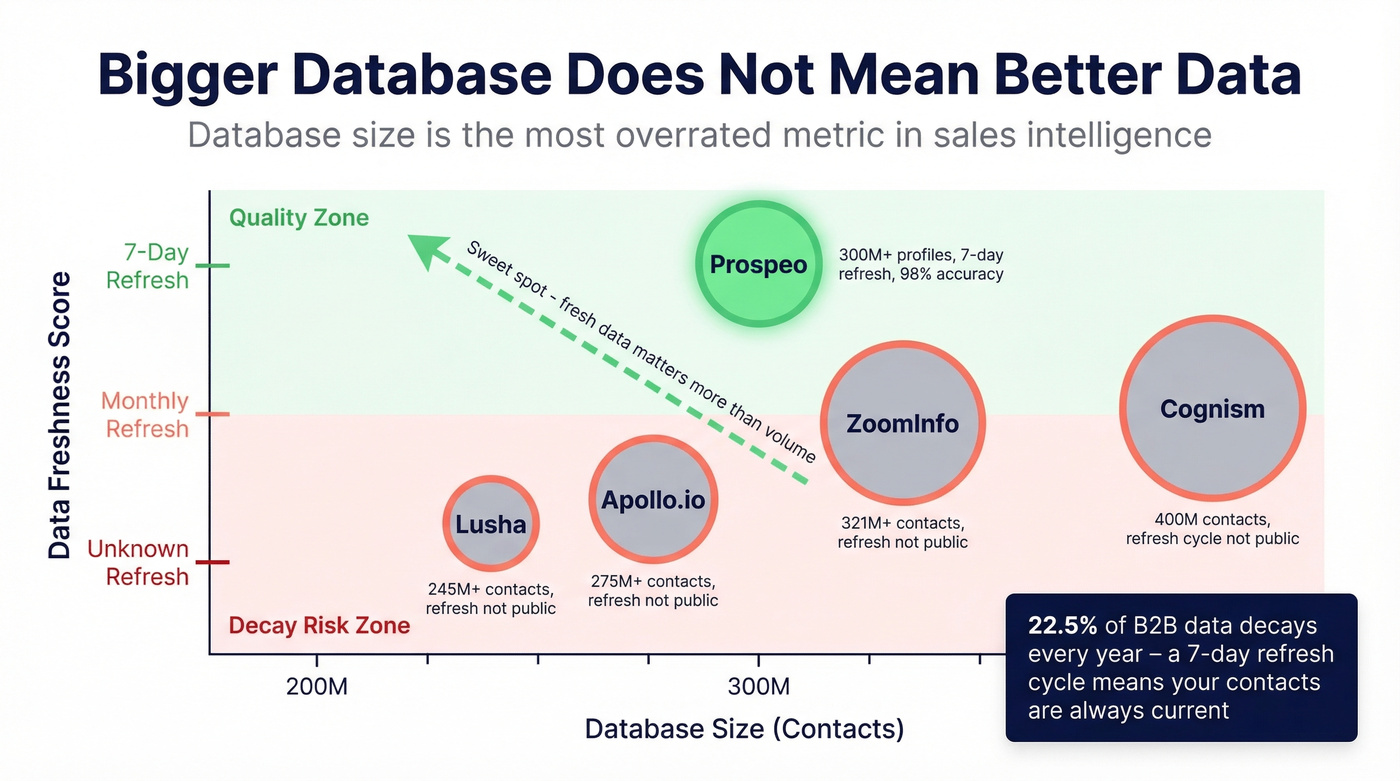
Database size is the most overrated metric in sales intelligence. A vendor can claim 400M contacts, but if 22.5% decay annually and they refresh every six weeks, you're working with stale data by default.
| Tool | Profiles | Verified Emails | Verified Mobiles | Refresh Cycle |
|---|---|---|---|---|
| Prospeo | 300M+ | 143M+ | 125M+ | 7 days |
| ZoomInfo | 321M+ | Included | Included | Not public |
| Cognism | 400M | Included | Diamond Data (premium) | Not public |
| Apollo.io | 275M+ | Included | Limited | Not public |
| Lusha | 245M+ | Included | Included | Not public |
| UpLead | Not public | Included | Limited | On export |
Cognism's 400M number is the biggest, but a 7-day refresh means 300M+ profiles are meaningfully fresher than a larger database that updates monthly. We've run bake-offs where the "biggest database" lost because half the emails bounced on the first sequence. Freshness beats size every time.
Mistakes That Kill Your ROI
Even the best B2B contact database can't save you from bad process. Here are the five mistakes that drain your ROI fastest.
Manual lead entry still plagues a third of companies. Research shows that many organizations still move some or all data manually between systems. Every manual touchpoint is a chance for typos, duplicates, and missing fields. If your platform has a native CRM integration, use it. (If you’re auditing your stack, start with the basics: examples of a CRM.)
CRM and marketing systems running on separate tracks is the second killer. When sales feeds Salesforce while marketing runs a separate HubSpot instance, you're building two divergent views of the same prospects. Sync them or accept that half your team is working with outdated information.
Skipping verification entirely is how you tank your domain reputation. Look - exporting 10,000 contacts and loading them straight into your sequencer without a verification step is reckless. Run everything through verification before it hits your outbound tool. Catch-all handling and spam-trap removal aren't nice-to-haves; they're requirements. If you need a deeper playbook, start with our email deliverability guide.
Ignoring data decay is the slow bleed. That list you built six months ago? About 12-13% of it is already wrong. Quarterly cleaning is the minimum; weekly refresh is the standard you should demand from your vendor.
Buying more seats than you need is the enterprise tax nobody talks about. Enterprise contracts love to bundle 10 seats when only 4 reps actually use the tool. Audit usage before renewal. Every single time.
Snyk cut bounce rates from 35% to under 5% and generated 200+ opportunities per month. Meritt tripled pipeline to $300K/week. The difference was switching to a sales database with 300M+ profiles refreshed weekly, not monthly.
See why 15,000+ companies replaced their stale sales database with Prospeo.
FAQ
What is a sales database?
A sales database is a platform that provides verified B2B contact information - emails, phone numbers, job titles, and company data - for prospecting. Modern platforms layer intent signals, technographics, and CRM integrations on top to help teams target the right buyers at the right time.
CRM vs. sales lead database - what's the difference?
A CRM stores data about people you already know - existing contacts, deals in progress, customer history. A sales lead database helps you find new prospects you haven't contacted yet. Most teams need both, feeding the database's output into the CRM.
Is buying B2B contact data legal?
Yes, when the provider complies with GDPR, CCPA, and local privacy regulations. Look for enforced opt-out mechanisms and available DPAs. Prospeo, Cognism, and ZoomInfo all handle compliance at the platform level - if your vendor doesn't, that's a red flag.
How often should you clean your contact data?
At minimum quarterly. B2B contact data decays 2.1% per month, meaning roughly a quarter of your records go stale each year. Tools with a 7-day refresh cycle handle this automatically so you're not manually scrubbing lists.
How much does a sales database cost?
From free - both Apollo and Prospeo offer free tiers - to $45,000+ per year for ZoomInfo Elite. Most mid-market teams land in the $100-$500/month range. The real question isn't the sticker price. It's cost per verified, usable contact.