

Sales Email Examples That Actually Get Replies (Based on 28M+ Emails)
The average rep sends 344 cold emails to book one meeting. That's not a typo - it's what Gong found after analyzing 28M+ cold emails. You know the feeling: spend an hour crafting the perfect message, hit send 200 times, and watch your inbox stay empty. The average reply rate across cold email campaigns sits at 3.43% in 2026. Most sales email examples floating around the internet won't move that number.
The ones below will, because they're built on what the data actually says works - not what sounds good in a blog post.
The Short Version
Here's the thesis: you don't need 55 templates. You need four good ones and clean data. Three rules matter more than anything else:
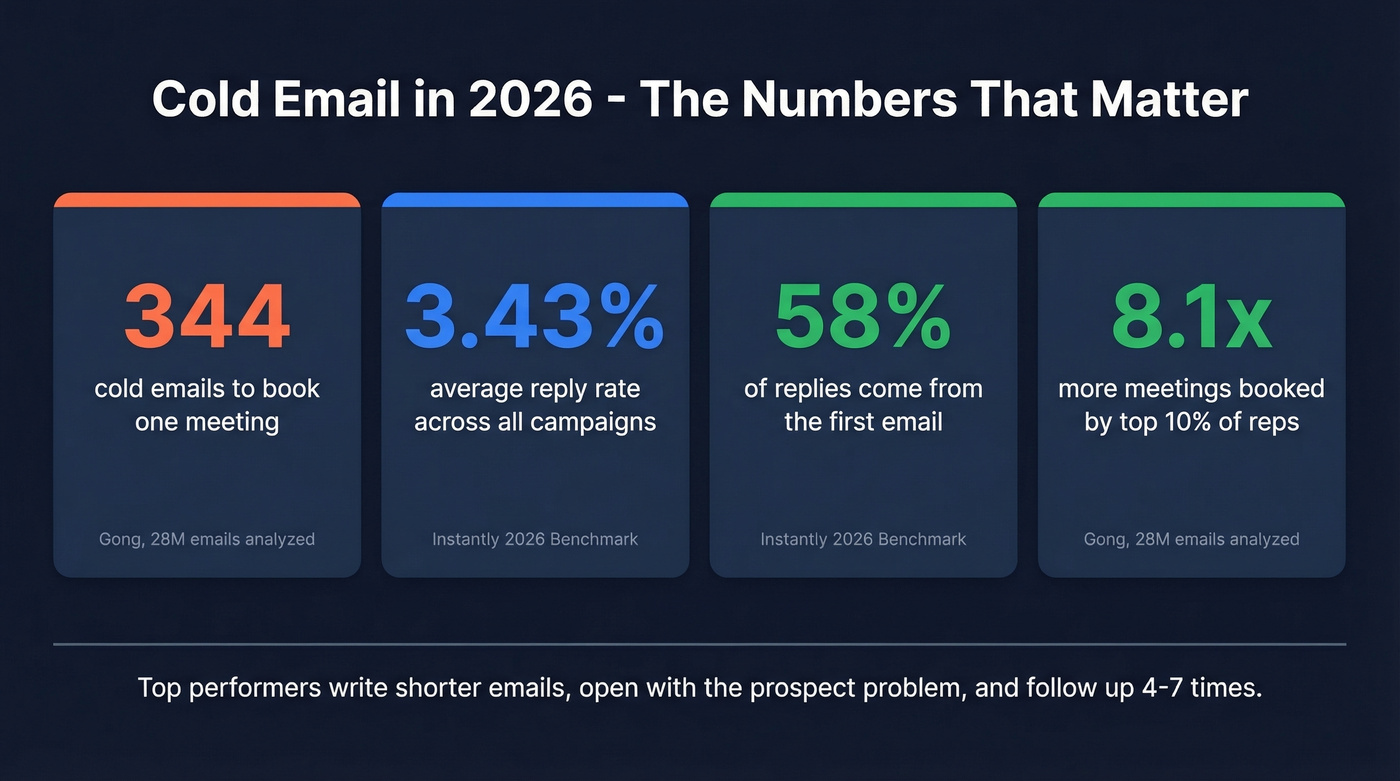
- 3-4 sentences, typically under 80-100 words. The highest-converting sales emails are short.
- No pitching. Emails that pitch a product drop reply rates by up to 57%. Lead with the prospect's problem, not your features.
- Soft CTA. "Worth a conversation?" beats "Book 15 minutes on my calendar Tuesday."
The benchmark reality: 58% of replies come from email #1. Top 10% of senders break 10% reply rates. You're not competing against the average - you're competing against the 50 other cold emails your prospect got this week.
What the Data Says (and What Kills Replies)
The 28M-email dataset and Instantly's 2026 benchmarks paint a clear picture.
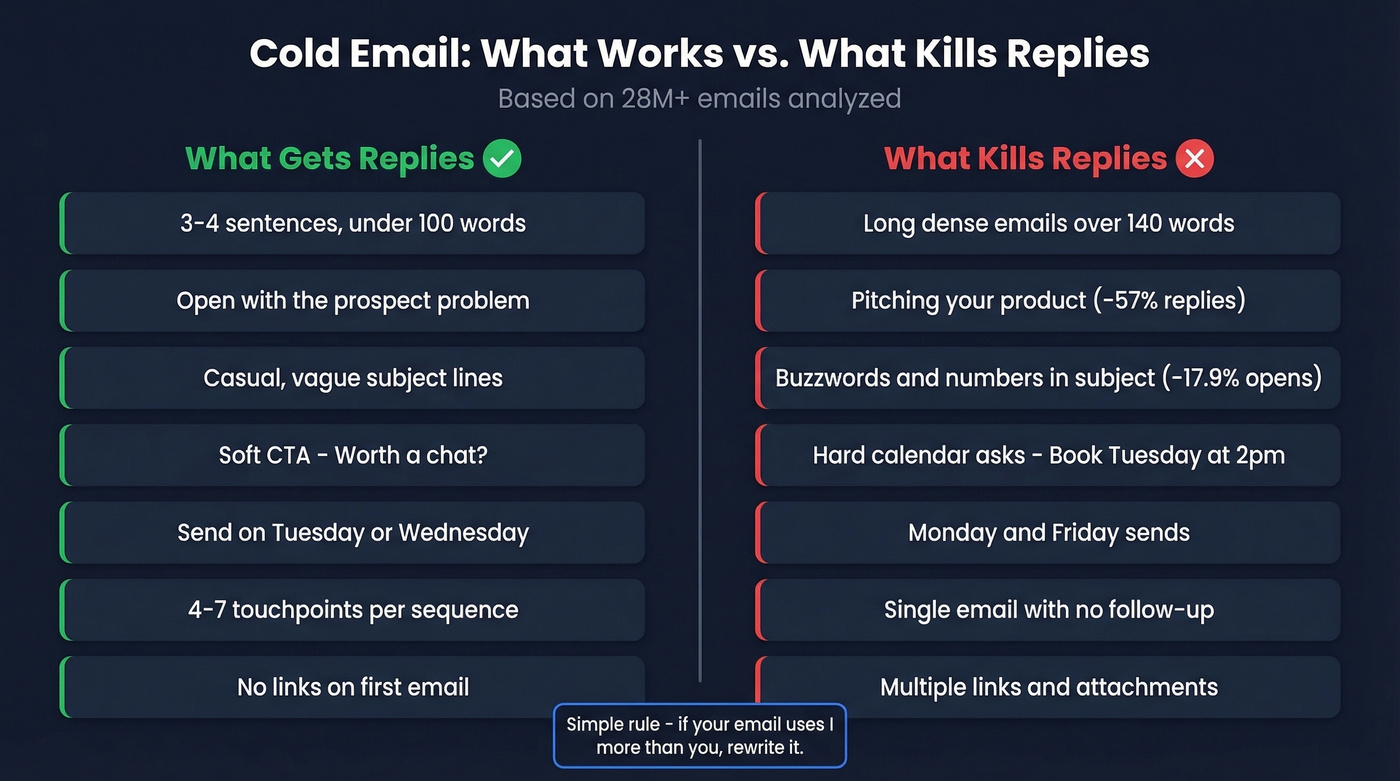
| What Works | What Kills Replies |
|---|---|
| 3-4 sentences, under ~80-100 words | Long, dense emails (~140+ words) |
| Problem-first opening | Pitching your product (-57% replies) |
| Casual, vague subject lines | Buzzwords/numbers in subject (-17.9% opens) |
| Soft CTA ("Worth a chat?") | Hard calendar asks |
| Tue-Wed send timing | Monday/Friday sends |
| 4-7 touchpoints per sequence | Single email, no follow-up |
| No links on first touch | Multiple links + attachments |
A simple rule: if your email uses "I" more than "you," rewrite it. Prospects respond to messages that feel like they're about them.
The top performers in the dataset book 8.1x more meetings than average reps. They're writing shorter, opening with the prospect's problem, and following up consistently. We've seen the same pattern across our own outbound - the emails that feel like a conversation starter always outperform the ones that read like a pitch deck.

15 Templates by Scenario
Every template below is filled in - no bracket placeholders. Each one follows the data: short, problem-first, soft CTA.
Cold Outreach (First Touch)
Template 1: The Problem Opener
Hi Sarah,
Most VP Sales at Series B SaaS companies tell us ramping new reps takes 6+ months. We helped Acme Co cut that to 11 weeks.
Worth a quick conversation?
- Jake
38 words. Leads with a problem the prospect likely has, drops one specific proof point, closes with a low-commitment ask. Use this when you have a clear, common pain point for the prospect's role and a concrete result to back it up.
Template 2: The Observation Hook
Hi Marcus,
Noticed your team just opened a second SDR pod - congrats. When teams scale outbound that fast, pipeline reporting usually breaks before quota does.
We rebuilt reporting for three companies in your space last quarter. Happy to share what we found if it's useful.
- Priya
Context, specific outcome, soft offer. No pitch, no feature list. This mirrors the format practitioners on r/copywriting report is driving replies right now. A congrats email tied to a trigger event works because it shows you've done your homework. Use this when you spot a trigger event - new hire, funding round, expansion - on the prospect's company.
Template 3: The Direct Approach
Hi Dana,
You handle demand gen at Bolt - I'd bet pipeline attribution across paid and organic is a headache. We solve that. Interested in seeing how?
- Chris
Modeled on a Reddit practitioner who books 6-7 meetings/week off 100-500 prospects/week. Under 40 words. Proof that brevity wins. Use this when you're confident in the pain point and want to cut straight to it.
Here's the thing: if you're selling a simpler, lower-friction offer, you probably don't need a 12-step nurture sequence. A direct email like Template 3, sent to a verified address with a relevant problem statement, will outperform any elaborate drip campaign. Complexity is a crutch for weak targeting.
Follow-Up Sequence
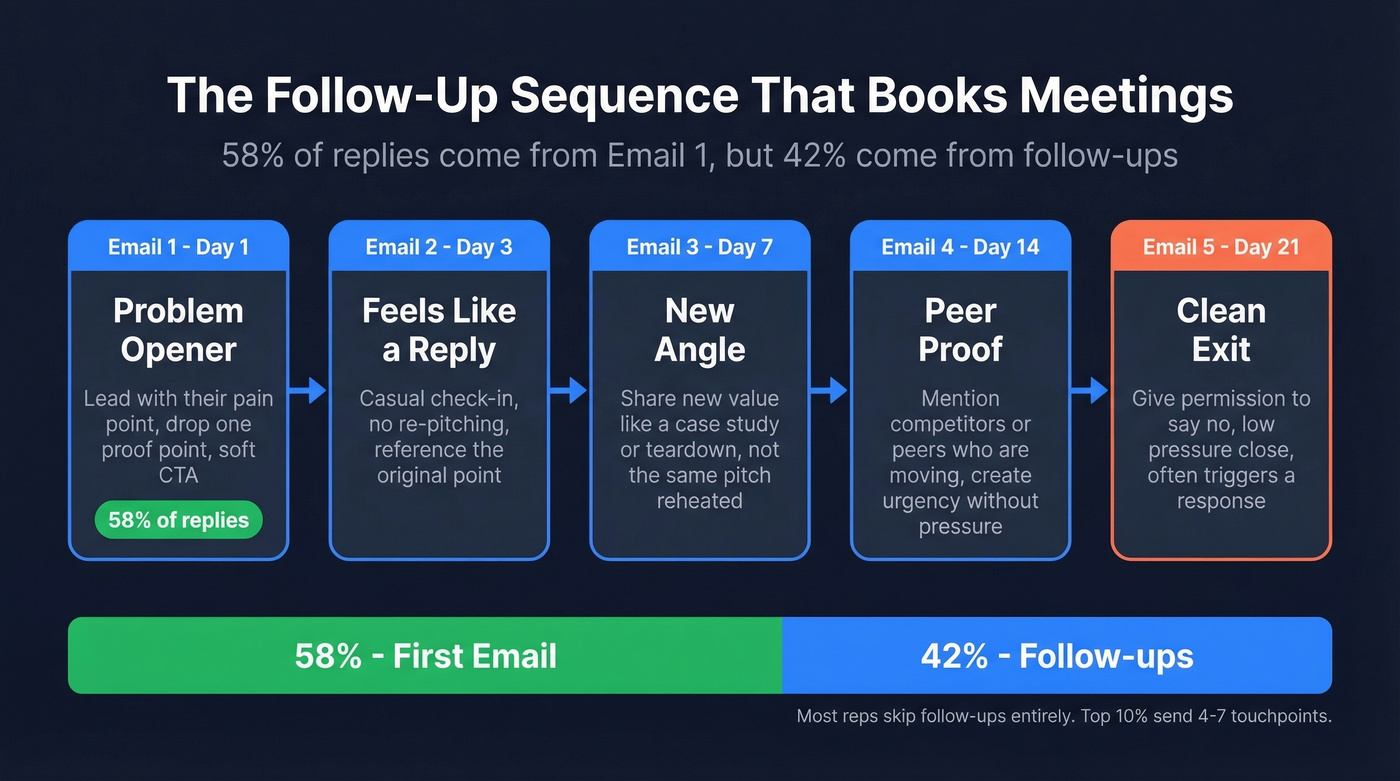
Follow-ups contribute 42% of total replies, yet most reps either skip them or just reheat the original pitch. Each touchpoint needs its own reason to exist.
Also consider multi-threading - reaching 2-3 people on the same account. A practitioner on r/sales noted that threading across an org dramatically increases response rates because you're no longer betting everything on one person's inbox. We've tested this ourselves and the difference is real: multi-threaded accounts convert at roughly double the rate of single-contact sequences.
Template 4: The "Feels Like a Reply"
Hi Sarah,
Circling back - did the rep ramp time point land? Happy to drop it if the timing's off.
Follow-ups that feel like a natural reply outperform formal follow-ups by ~30%. No re-pitching, just a check-in. Use this when your first email got opens but no reply.
Template 5: The New Angle
Hi Sarah,
Different angle - we just published a teardown of how Bolt's competitor restructured their SDR team. Thought you'd find it interesting regardless of whether we talk.
Adds new value instead of repeating the first email. Use this when you have a relevant content asset to share.
Template 6: The Clean Exit
Hi Sarah,
Last note from me on this. If rep ramp time isn't a priority right now, totally get it. If it is - I'm here.
Low pressure, respects the prospect's time. Giving someone permission to say no often triggers a response - even if it's "not now, try me in Q4." Pro tip: add a one-line reply mechanic like "Reply '1' if interested, '2' if bad timing" to make responding effortless.
Meeting Request
Template 7: The Soft Ask
Hi Jordan,
Your team's hiring three AEs this quarter - onboarding at that pace usually surfaces gaps. We've helped similar teams fix that in 2 weeks.
Worth a 15-minute conversation to see if it applies?
Template 8: The Time-Boxed Ask
Hi Jordan,
Quick one - would a 10-minute call next week make sense to see if we can help with your onboarding bottleneck? If not, no worries at all.
"Worth a conversation?" and "Would X make sense?" consistently outperform "Let's book a call Tuesday at 2pm." Soft CTAs lower the perceived commitment. Use these when you've had at least one prior touchpoint or have a strong trigger event.
Referral / Warm Intro
Template 9: The Mutual Connection
Hi Alex,
Lisa Chen on your ops team suggested I reach out. We helped her previous company cut CRM data cleanup from 12 hours/week to under 2. She thought you'd be dealing with something similar at Ramp.
Open to a quick chat?
Template 10: The Internal Referral
Hi Alex,
Your colleague Mike in engineering mentioned your team's evaluating new data providers. We work with 3 companies in your space - happy to share what we're seeing if it's useful.
Social proof belongs in the email body, not the subject line - that's a direct finding from the 28M-email study. Name-dropping a real connection in the first sentence earns the read.
Post-Demo Follow-Up
Template 11: The Recap
Hi Taylor,
Great conversation today. To recap: you're looking to cut list-building from 6 hours to under 1, and need verified mobiles for your EMEA push. We covered both - next step is a pilot with your SDR team.
I'll send the proposal by Thursday. Sound good?
Template 12: The Resource Drop
Hi Taylor,
Following up on our call - attached the case study from Bolt we discussed. Let me know if Friday works to loop in your VP and map out next steps.
One clear CTA. Recap what matters to them, then propose the next step. Don't make them guess what happens next.
Re-Engagement
Template 13: The New Value Angle
Hi Sarah,
It's been a few months since we last connected. Since then, we shipped a new integration with HubSpot that's cutting enrichment time in half for teams like yours. Worth revisiting?
Re-approach every few months with a genuinely new reason to talk. Same old pitch reheated doesn't work.
Template 14: The Breakup Reversal
Hi Sarah,
Closed your file a while back, but just saw your team posted three new SDR roles. If outbound data quality is part of that conversation, I've got some numbers that'll save you time. If not - congrats on the growth either way.
This one works because it references a real, observable change. Skip it if you don't have a genuine trigger event to point to.
Template 15: The Peer Proof
Hi Sarah,
Two companies in your space signed on last month. Both were dealing with the same enrichment bottleneck you mentioned in Q2. Happy to share what changed if you're curious.
Peer proof creates urgency without being pushy. The implicit message: your competitors are moving.
Subject Lines That Get Opens
Subject lines are where most cold emails die. Casual and vague beats formal and descriptive every time.
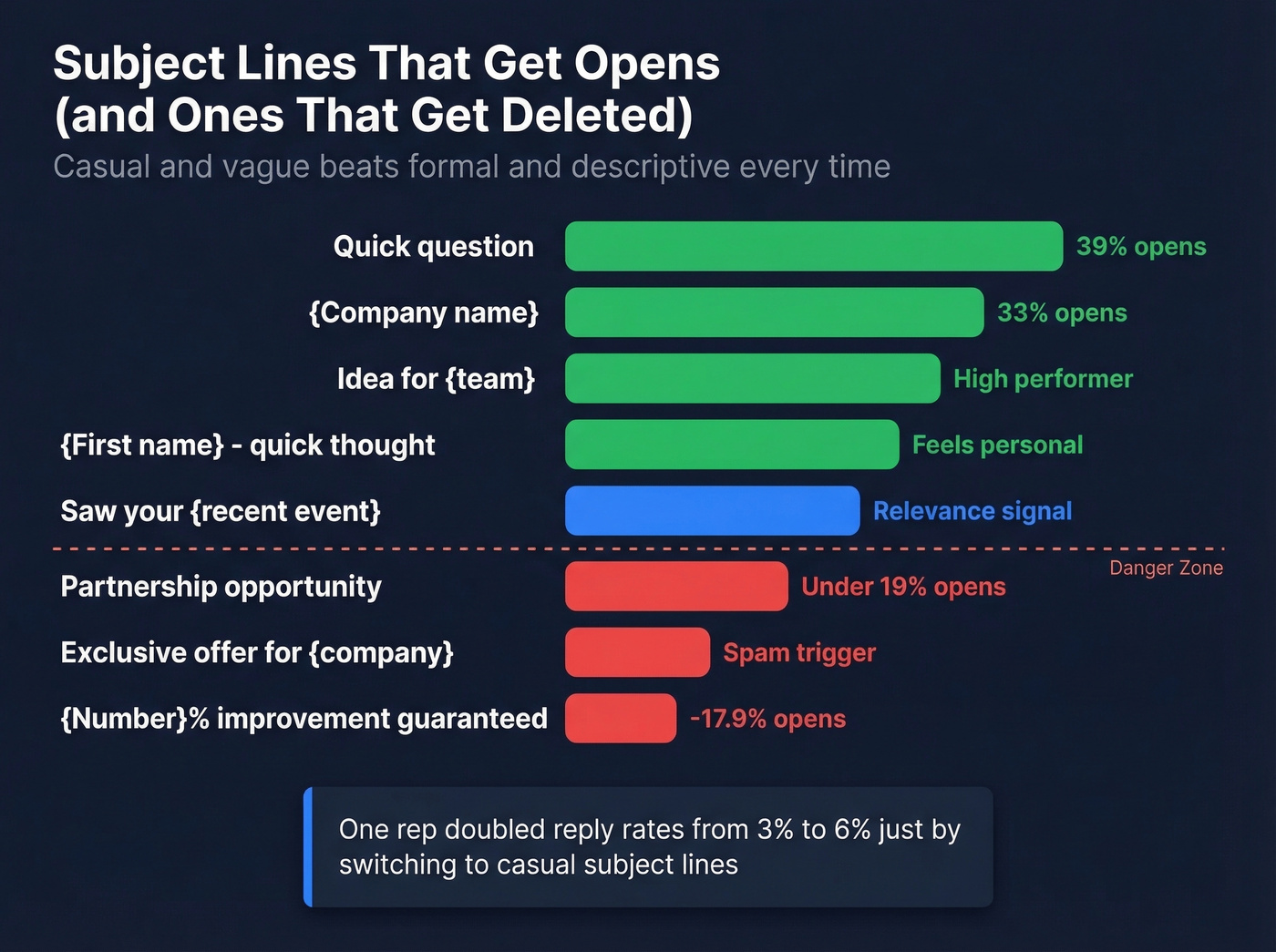
| Subject Line | Performance |
|---|---|
| Quick question | 39% opens (practitioner test) |
| {Company name} | 33% opens (practitioner test) |
| Idea for {team/dept} | High performer - casual, vague |
| {First name} - quick thought | Feels personal, low-effort open |
| Saw your {recent event} | Relevance signal, not salesy |
| Partnership opportunity | <19% opens - avoid |
| Exclusive offer for {company} | Spam trigger - avoid |
| {Number}% improvement guaranteed | Buzzwords + numbers = -17.9% opens |
If you want more options to test, pull from these subject lines and rotate them in small batches. The practitioner who doubled their reply rate from 3% to 6% attributed a 16% improvement in opens just from switching to casual subject lines. The consensus on r/sales is blunt: salesy subject lines get auto-deleted.

You just read that reps send 344 cold emails to book one meeting. Bad data is half the problem - 35% bounce rates destroy your domain before your copy even gets a chance. Prospeo delivers 98% verified email accuracy with a 7-day refresh cycle, so every template above actually lands in the inbox.
Fix the data first. The copy only works if it arrives.
Personalize by Buyer Seniority
Personalization isn't just "Hi {first_name}." An analysis of 30,000+ prospecting emails found that the right type of personalization depends entirely on who you're emailing.
| Persona | Best Approach | Expected Lift | Example |
|---|---|---|---|
| IC / Non-manager | Individual-based | >2X replies | "Saw your post on ABM..." |
| Manager | Individual or company | 50-100% lift | "Your team just expanded..." |
| Director+ / Exec | Company-based | 3X replies | "Congrats on the Series C..." |
| Any seniority | Industry-based | +88% replies | "3 companies in your space..." |
| Any seniority | Activity-based | 3X meetings | "Noticed you attended {event}..." |
87% of buyers say sales emails don't address a relevant challenge. That's the gap. Individual-based personalization - referencing someone's post or career move - crushes it for ICs but barely moves the needle for executives. Executives respond to company-level signals: funding rounds, leadership changes, expansion news.
Activity-based personalization - referencing intent signals like content downloads, event attendance, or product research - can 3X scheduled meetings. Pulling this off requires knowing which accounts are actively researching your category, which is where intent data tools like Prospeo's Bombora-powered tracking across 15,000 topics become genuinely useful. You can tailor your first line to what the account is already researching instead of guessing.
Using Templates Without Sounding Robotic
The best template is one you never send verbatim. Templates give you structure; personalization gives you replies.
Start with a template from the scenarios above that matches your situation. Replace every generic line with a detail specific to the prospect's company, role, or recent activity. Then A/B test two versions - change one variable at a time so you actually know what moved the needle. Track which versions improve conversions and retire the ones that don't perform after 200+ sends.
Let's be honest: the reps writing the best outbound treat templates as starting frameworks, not finished products. If you're copy-pasting the same email to 500 people and wondering why nobody replies, the template isn't the problem. Your targeting is.
The Deliverability Checklist
None of these templates matter if your emails land in spam. A practitioner on r/Entrepreneur rebuilt their entire outreach infrastructure and went from 3% to 6% reply rates. Their full stack cost about $420/month across domains, tools, and verification - and it generated 16 qualified leads/month. Most of the improvement came from deliverability, not copy.
Quick distinction: delivery means the server accepted your email. Deliverability means it hit the inbox, not spam. 70% of emails show at least one spam-related issue.
Your checklist:
- SPF, DKIM, DMARC - all three configured. Non-negotiable under Google/Yahoo's bulk sender rules. (If you need a deeper walkthrough, use this email deliverability guide.)
- Spam complaints under 0.3%. Monitor via Gmail Postmaster Tools.
- Bounces under 2%. Cross this line and your domain reputation tanks. Recovery takes weeks. (More detail: email bounce rate.)
- Domain warmup. Start new domains at 5-10 emails/day, ramp over 4-6 weeks.
- Multiple domains. The practitioner above went from 3 to 7 domains, max 26 emails per domain per day.
- One-click unsubscribe (RFC 8058 headers). Required.
- CAN-SPAM/GDPR compliance. Physical address, opt-out honored within 10 days, legitimate basis for processing EU contacts.
- No links on first touch. Some mail systems flag external links from unknown senders.
- Verify every email address before sending. This is the upstream lever that makes everything else work. (See: AI Email Checker.)
The best template in the world bounces if the email address is wrong. In our experience, the deliverability lever moves the needle more than copy tweaks ever will. Prospeo's 5-step verification catches invalid addresses, spam traps, and honeypots before they enter your sequence - 98% email accuracy with catch-all domain handling and a 7-day data refresh cycle. Snyk's team dropped their bounce rate from 35-40% to under 5% after switching, and their AE-sourced pipeline jumped 180%.
The free tier gives you 75 email verifications/month to start.
Multi-threading across 2-3 contacts per account doubles conversion rates - but only if you have verified emails for each one. Prospeo gives you 300M+ profiles with 30+ filters to find every decision-maker on the account, at $0.01 per verified email. No bounces, no burned domains.
Send those follow-ups to real inboxes. 75 free emails to start.
Should You Use AI to Write Outreach?
49% of B2B marketers now use generative AI to create emails. Tools like ChatGPT ($20/mo), Jasper ($39/mo), and Copy.ai ($49/mo) can generate first drafts and subject line variations fast.
But generic AI output is automated mediocrity. If your prospect can tell it's AI-written, you've already lost. Use AI for the first draft and A/B test variations, then edit ruthlessly for specificity - replace every generic line with something only you could write about that specific prospect. The templates above work because they're specific. AI gives you speed; you add the relevance. (More: AI for Sales Emails.)
Skip AI-generated outreach entirely if you're sending fewer than 50 emails a week. At that volume, you're better off spending the time on manual personalization. The ROI on AI writing tools only kicks in when you're operating at scale and have a strong editing process to catch the generic stuff before it ships.
FAQ
How long should a sales email be?
Three to four sentences, typically under 80-100 words. The 28M-email study found the highest reply rates come from short emails, and Instantly's 2026 benchmarks confirm top campaigns keep copy under 80 words.
What's a good cold email reply rate in 2026?
The average is 3.43%. Top quartile hits 5.5%+, and the top 10% of senders break 10%. If you're below 3%, fix your deliverability and targeting before rewriting copy.
How many follow-ups should I send?
Four to seven touchpoints is the sweet spot. Follow-ups contribute 42% of total replies. Each one needs a new angle - resending the same message signals laziness, not persistence.
Do I need to verify emails before sending?
Yes. Bounces above 2% damage your domain reputation, and recovery takes weeks. Prospeo's free tier lets you verify 75 emails/month to keep your list clean before every campaign.
What subject lines get the best open rates?
Casual, vague lines win. "Quick question" pulled 39% opens in practitioner testing, while "Partnership opportunity" dropped below 19%. Avoid buzzwords and numbers - they reduce opens by up to 17.9%.