

Sales Enablement Automation: Workflows, Tools, and Pricing for 2026
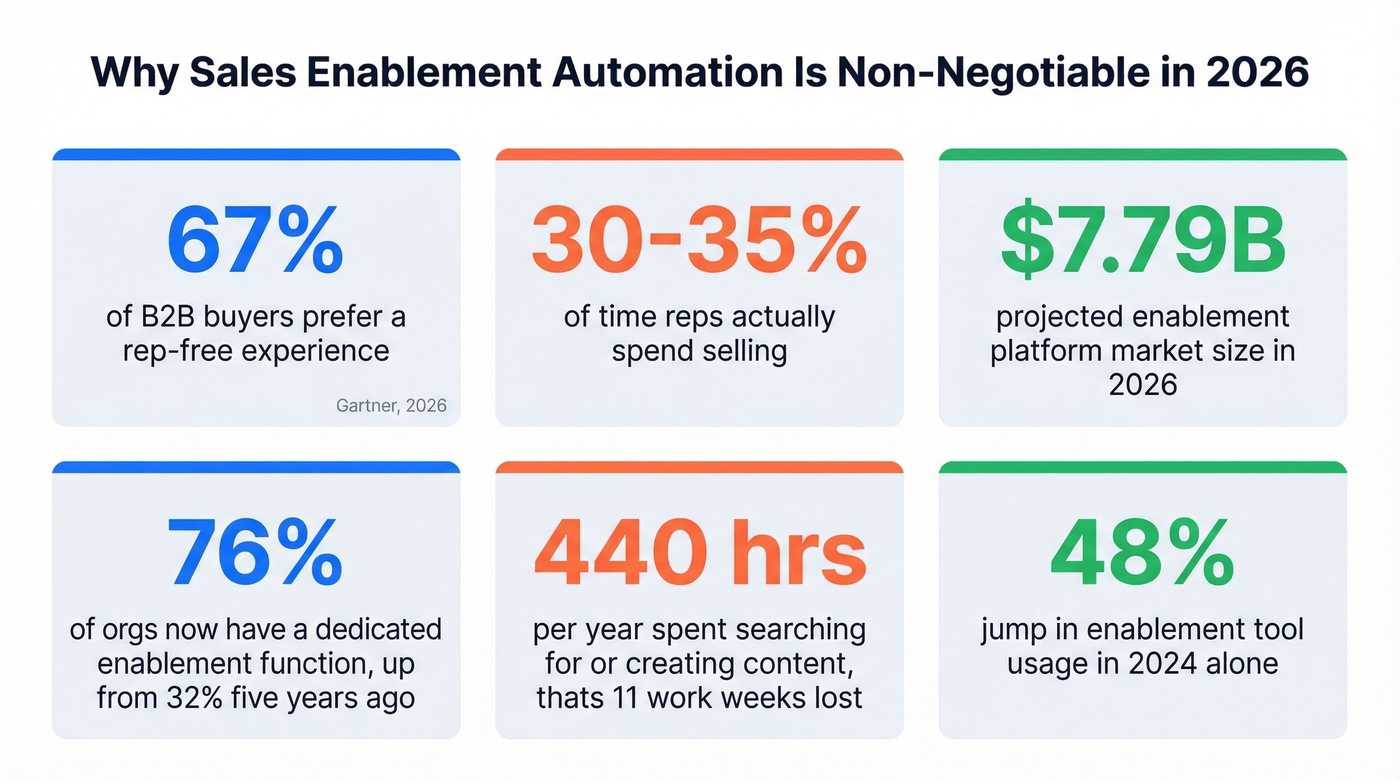
A sales director posted on r/sales looking for a "one-stop shop" enablement library. Their reality? Playbooks in Google Docs, deal data in HubSpot, product specs in Jira, and reps spending more time hunting for content than actually selling. Reps spend only 30-35% of their time selling. The rest disappears into admin, searching for collateral, and manually updating CRMs - and only 30% of marketing content ever gets used because reps can't find it and end up recreating 40% of what already exists.
Sales enablement automation fixes this, but only if you build it on the right foundation.
What You Need (Quick Version)
Most teams over-buy enterprise platforms and under-invest in data quality. Pick a CRM, a data platform, and a sequence tool - that's your core stack. Everything else is a nice-to-have until you've nailed those three.
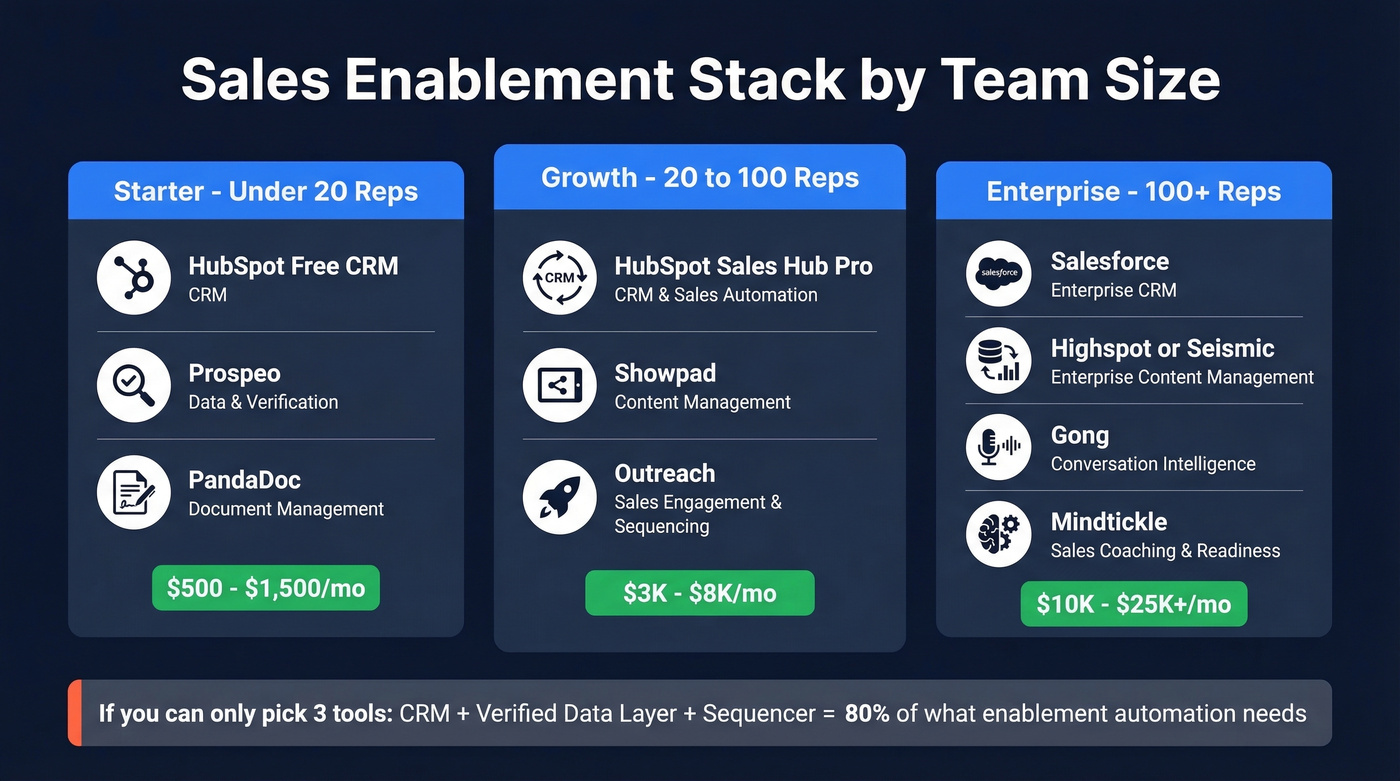
| Team Size | Core Stack | Monthly Cost |
|---|---|---|
| Under 20 reps | HubSpot free CRM + Prospeo + PandaDoc | ~$500-1,500 |
| 20-100 reps | HubSpot Sales Hub Pro + Showpad + Outreach | ~$3K-8K |
| 100+ reps | Salesforce + Highspot/Seismic + Gong + Mindtickle | ~$10K-25K+ |
If you could only pick three tools, make them a CRM, a verified data layer, and a sequencer. That combination covers 80% of what enablement automation actually needs to do.
Why Automation Isn't Optional Anymore
The buyer has changed faster than most sales orgs have adapted. A Gartner survey of 646 B2B buyers found that 67% prefer a rep-free experience, and 45% used AI during a recent purchase. Buyers are self-educating, comparing, and shortlisting before they ever talk to your team. If your enablement stack can't serve up relevant case studies and competitive pricing the moment a prospect is comparing vendors - triggered automatically - you're losing deals to competitors who can.
That's where real-time enablement becomes critical: surfacing the right content at the exact moment a buyer signals interest, without waiting for a rep to manually dig through a shared drive.
The market reflects this urgency. The sales enablement platform market hit $6.58B in 2025, is projected to reach $7.79B this year, and is on track for $35.68B by 2035 at an 18.42% CAGR. Enablement tool usage jumped 48% in 2024, 76% of organizations now have a dedicated enablement function (up from 32% five years ago), and three in four reps say these tools prepare them to meet quota.
AI Is Accelerating the Shift
The newest enablement platforms don't just store content - they assemble it dynamically. Gartner recommends building modular content blocks that AI can stitch into custom decks, meeting prep briefs, and follow-up emails based on deal context. AI coaching tools run role-play simulations with reps before live calls. AI-driven next-best-action engines analyze your pipeline and tell reps which deal to work and what to send - turning passive content libraries into active selling assistants.
If your stack doesn't have an AI layer yet, it will within 18 months. Plan accordingly.
Vendor Consolidation Watch
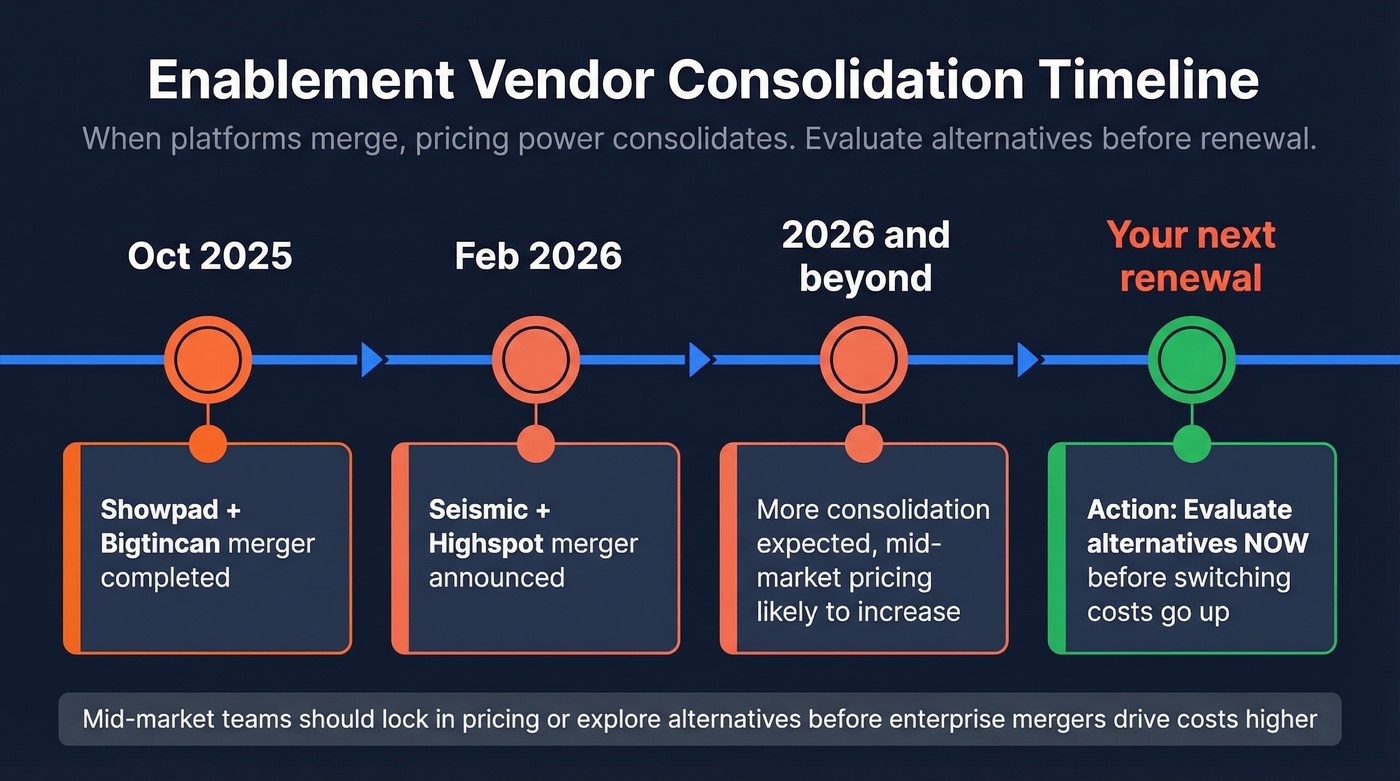
The vendor landscape is consolidating fast. Seismic and Highspot announced their merger in Feb 2026. Showpad and Bigtincan completed theirs in Oct 2025. When enterprise platforms merge, pricing power consolidates with them. Mid-market teams should evaluate alternatives now, before contract renewals get more expensive and switching costs go up.
What to Automate First
Teams spend 440 hours per year just searching for or creating content. That's 11 work weeks of lost selling time.
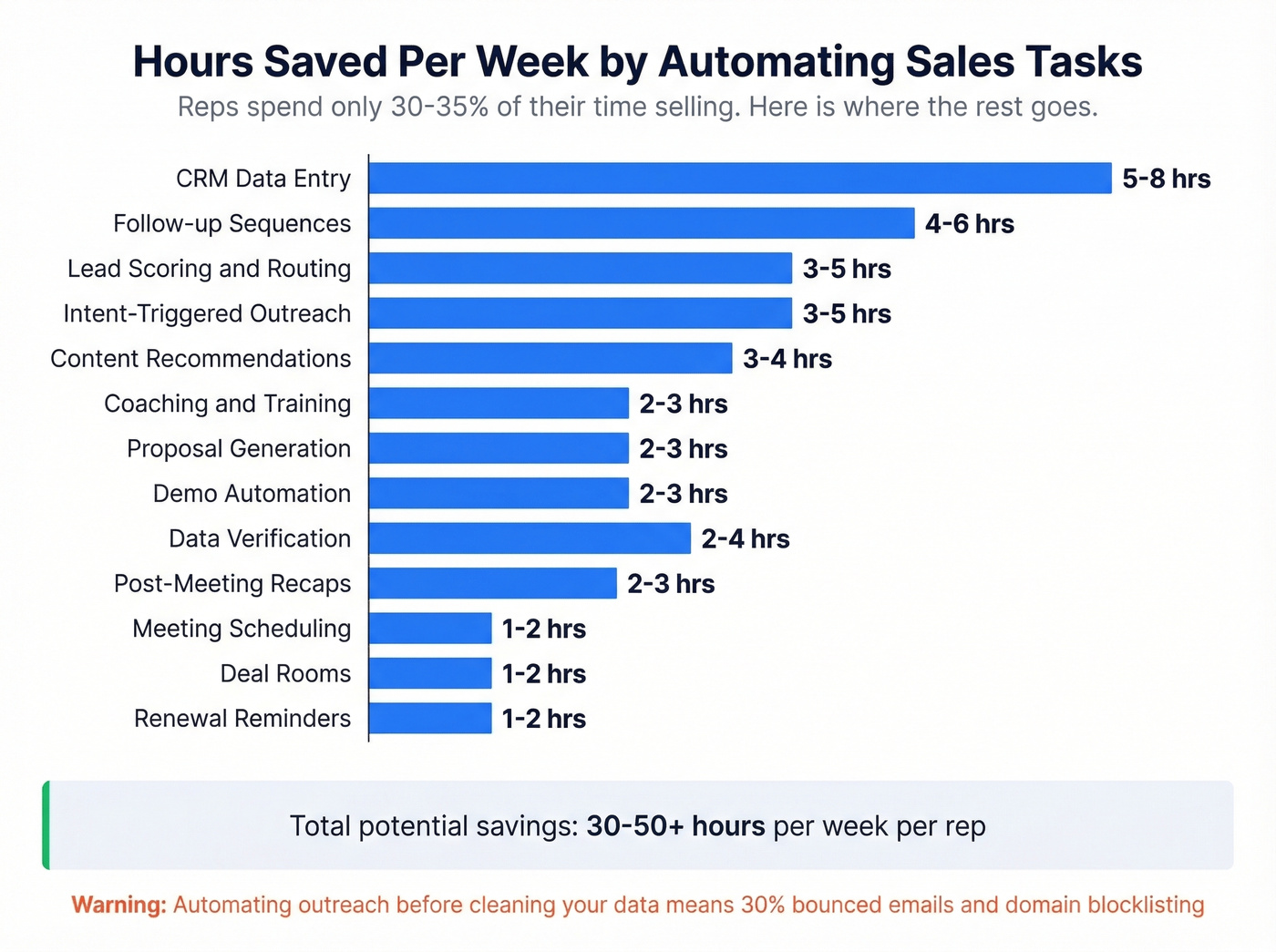
Here's what to automate first, ranked by impact:
| Task | What It Replaces | Tool Category | Est. Time Saved |
|---|---|---|---|
| CRM data entry | Manual logging | CRM + AI | 5-8 hrs/week |
| Lead scoring & routing | Spreadsheet triage | CRM + enrichment | 3-5 hrs/week |
| Follow-up sequences | Manual emails | Sequencer | 4-6 hrs/week |
| Content recommendations | Slack asks | Enablement platform | 3-4 hrs/week |
| Proposal generation | Copy-paste docs | CPQ / doc tool | 2-3 hrs/week |
| Demo automation | Live demos for every lead | Interactive demo platform | 2-3 hrs/week |
| Meeting scheduling | Email ping-pong | Scheduler | 1-2 hrs/week |
| Coaching & training | Ad hoc ride-alongs | LMS / conversation intel | 2-3 hrs/week |
| Deal rooms | Email attachments | Digital sales room | 1-2 hrs/week |
| Data verification | Bounced emails | Enrichment tool | 2-4 hrs/week |
| Intent-triggered outreach | Cold guessing | Intent + sequencer | 3-5 hrs/week |
| Renewal reminders | Calendar alerts | CRM workflow | 1-2 hrs/week |
| Post-meeting recaps | Manual notes | AI notetaker | 2-3 hrs/week |
On Reddit, practitioners praise deal rooms like Aligned for mutual action plans and engagement signals, but warn that heavier tools like DealHub can overwhelm small teams. Start lightweight and upgrade when deal complexity demands it.
The biggest mistake we see? Teams automate outreach before cleaning their data. You can build the most elegant sequence in the world - it doesn't matter if 30% of your emails bounce. Worse, high bounce rates trigger ESP penalties that blocklist your domain. Once you're on a blocklist, every automated sequence you built becomes worthless overnight.
5 Workflows You Can Build This Week
These aren't theoretical. Each one can be wired up in a CRM or automation tool within a few hours.
Intent-Triggered Outreach
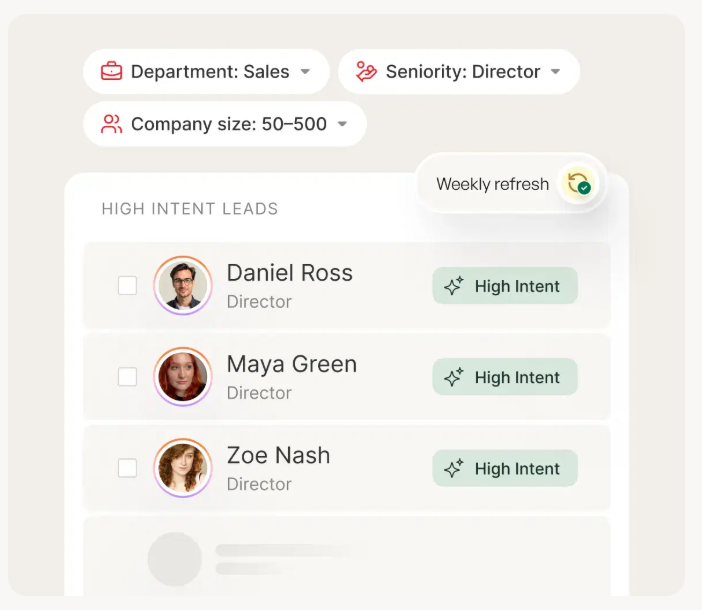
Intent data is the most underused automation trigger in enablement. Most teams have it bundled in their data platform and never wire it into workflows.
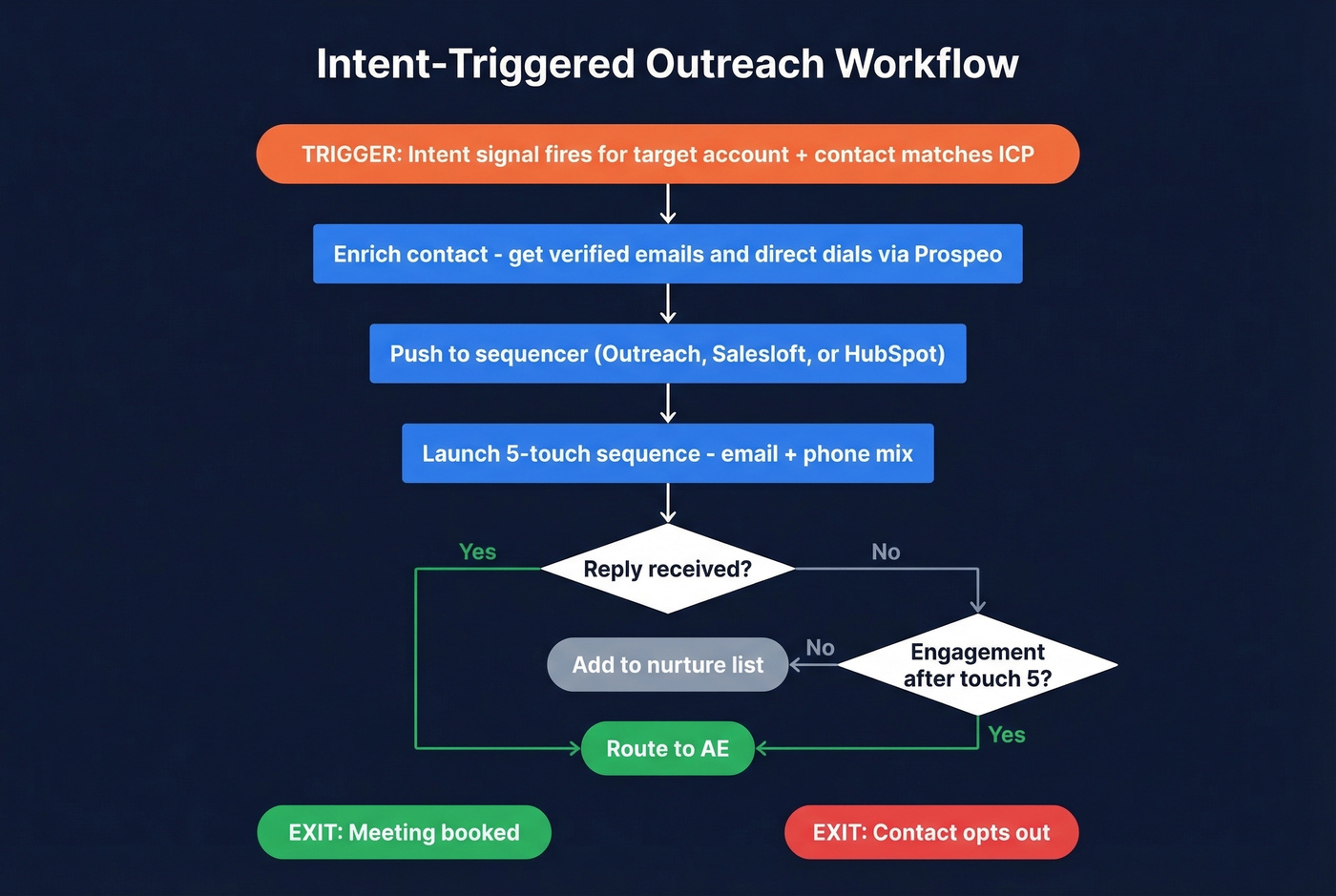
Trigger: Bombora intent signal fires for a target account + contact matches ICP criteria.
Actions: Enrich the contact to get verified emails and direct dials. Push to your sequencer (Outreach, Salesloft, or HubSpot sequences). Launch a 5-touch sequence mixing email and phone.
Branch logic: If reply, route to AE. If no engagement after touch 5, add to nurture.
Exit: Meeting booked or contact opts out.
Setup hint: In HubSpot, go to Workflows > Create > Contact-based, and use the "Contact property" trigger filtered by intent score. In Salesforce, use Flow Builder with a Platform Event trigger from your intent data provider. The goal is getting the right message to the right prospect within minutes of an intent signal, not days.
Closed-Lost Win-Back
This one's for teams sitting on a graveyard of closed-lost deals - which is every team.
Trigger: Deal marked closed-lost with reason "timing" or "budget."
Actions: Wait 60 days. Send a re-engagement email referencing the original conversation. If click or reply, create a rep task to follow up personally.
Branch logic: Reply means reopen deal. No response after 2 touches means suppress for 90 days.
Exit: Deal reopened or contact unsubscribed.
Setup hint: HubSpot Workflows > Deal-based > Trigger on "Deal stage is Closed Lost" with a delay action. Salesforce Flow handles the same with a scheduled path.
Renewal Reminder Cadence
Renewals are the easiest revenue to lose through negligence. This workflow makes forgetting impossible.
Trigger: Renewal date minus 90 days.
Actions: Send 90-day heads-up to customer success. At 60 days, send renewal proposal via PandaDoc. At 30 days, escalate to finance if no PO received.
Branch logic: PO received means close renewal. No PO at 15 days means alert VP of Sales.
Exit: Renewal closed or churned.
New Rep Onboarding
The average enterprise rep takes 3+ months to ramp. This workflow cuts that by automating the administrative scaffolding so managers can focus on coaching.
Trigger: New user added to CRM.
Actions: Auto-assign training modules in your LMS (Mindtickle or Spekit). Grant content library access. Schedule check-ins at day 7, 14, and 30.
Branch logic: Training incomplete at day 14 triggers a manager alert. All modules complete unlocks advanced content.
Exit: 30-day ramp complete.
Setup hint: Use Zapier to connect your HRIS new-hire event to your LMS and CRM simultaneously. For a ready-made structure, adapt a 30-60-90 day plan to your onboarding workflow.
Customer Health Pulse
Trigger: Product usage drops below threshold or no login for 30 days.
Actions: Send activation email with quick-win tips. If no response in 7 days, escalate to CS with a call task.
Branch logic: Re-engagement returns the account to normal monitoring. No response creates a churn risk ticket.
Exit: Usage recovers or CS intervenes.
Setup hint: Most product analytics tools (Pendo, Amplitude) can push usage events to your CRM via webhook or Zapier.

You read it above: automating outreach before cleaning your data is the #1 enablement mistake. Prospeo's 5-step verification delivers 98% email accuracy with a 7-day refresh cycle - so every automated sequence hits real inboxes, not blocklists.
Fix your data layer before you automate another sequence.
Tools and Pricing for 2026
| Tool | Category | Price Range | Best For | Key Limitation |
|---|---|---|---|---|
| Prospeo | Data & enrichment | Free-~$39+/mo | Verified data foundation | Credit-based usage |
| HubSpot Sales Hub | CRM + sequences | Free-~$90+/user/mo | SMB to mid-market | Expensive at scale |
| Salesforce Sales Cloud | CRM + AI | ~$25-$330/user/mo | Enterprise | Steep learning curve |
| Highspot/Seismic | Content enablement | Custom (~$70K-$180K+/yr) | Enterprise content | Heavy implementation |
| Showpad | Content enablement | Custom (~$42K-$108K/yr) | Mid-market content | Implementation effort |
| Outreach | Sequences | ~$100+/user/mo | High-volume outbound | Complex admin setup |
| Salesloft | Sequences | ~$75-125/user/mo | Mid-market sequences | Onboarding fees |
| Gong | Conversation intel | ~$100-150/user/mo | Call coaching | Needs consistent call volume |
| Mindtickle | Coaching/training | ~$30-50/user/mo | Rep readiness | Longer rollout |
| PandaDoc | Proposals/docs | Free-$49/user/mo | Proposals & e-sign | Limited CRM depth |
| Spekit | In-app guidance | ~$25+/user/mo | Just-in-time training | Narrow use case |
| Zapier | Workflow glue | Free-~$20-70+/mo | Connecting everything | No native CRM |
Tool-by-Tool Breakdown
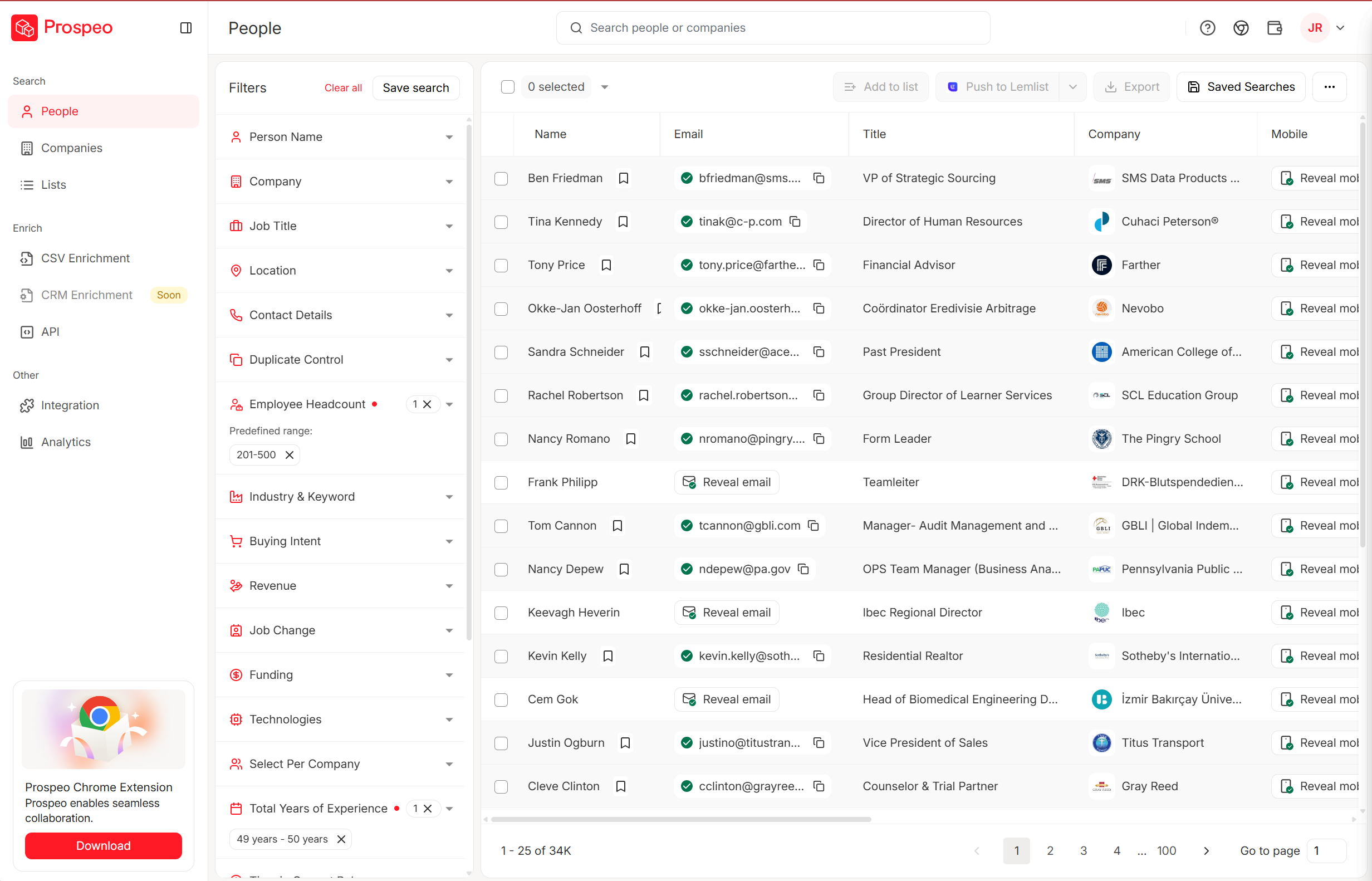
Prospeo is the data layer that makes everything else work. The database covers 300M+ professional profiles with 98% email accuracy, plus 143M+ verified emails and 125M+ verified mobile numbers. Data refreshes every 7 days - the industry average is six weeks, which means most platforms serve you stale contacts by the time reps actually use them. At ~$0.01 per email, it's a fraction of what ZoomInfo charges for comparable data. The free tier gives you 75 verified emails per month plus 100 Chrome extension credits, enough to audit your existing database before committing. Snyk's 50-person AE team saw bounce rates drop from 35-40% to under 5% after switching, with AE-sourced pipeline up 180%.
HubSpot Sales Hub is the best CRM for teams under 100 reps who don't want to hire a Salesforce admin. The free tier is genuinely useful, and paid plans start around $90/user/month for Sales Hub Professional with sequences, playbooks, and forecasting. It gets expensive past 100 seats - that's when Salesforce starts making financial sense. If you're still comparing options, here are more examples of a CRM with real pricing.
Salesforce Sales Cloud remains the enterprise default for a reason: the ecosystem is unmatched. Einstein AI now handles lead scoring, opportunity insights, and automated activity capture. The tradeoff is complexity. Budget 2-3 months for implementation and at least one dedicated admin. (If you're budgeting, see a deeper Salesforce pricing breakdown.)
Highspot/Seismic (now merging) typically run $70,000-$180,000+/year contracts with $15,000-$50,000+ implementation fees. Post-merger, expect less pricing flexibility. These platforms shine at content governance and analytics for 100+ rep teams - below that threshold, you're paying for features you won't use.
Showpad (now merged with Bigtincan) is the mid-market alternative at $42,000-$108,000/year, with lighter implementation around $2K+ and a 2-4 month rollout. If the Highspot/Seismic merger pushes pricing up, Showpad becomes the obvious fallback.
Outreach vs. Salesloft - the Reddit consensus is clear: Outreach for high-volume outbound shops that need granular analytics, Salesloft for teams that want a cleaner UX and tighter CRM integration. Salesloft typically starts around $75-$125/user/month; Outreach runs ~$100+/user/month. Pick based on your CRM. Salesloft integrates more smoothly with Salesforce, Outreach edges ahead with HubSpot. If you want plug-and-play messaging, keep a set of sales follow-up templates on hand for sequences.
Gong shines once you have consistent call volume. Below that, you won't get enough coaching signal to justify the spend. At $100-150/user/month, don't buy it until your call volume warrants it.
Mindtickle is the best dedicated training platform for sales teams, with AI role-play and certification tracking. At $30-50/user/month, it's worth it for teams with high rep turnover or complex products.
PandaDoc handles proposals, quotes, and e-signatures at a price point ($19-49/user/month) that makes dedicated CPQ tools unnecessary for most mid-market teams. The free tier covers basic document workflows.
Spekit delivers just-in-time training inside the tools reps already use. At ~$25+/user/month, it's a surgical buy for teams with CRM adoption problems.
Zapier is the duct tape that holds non-enterprise stacks together. The free tier handles basic automations; paid plans start around $20-70+/month depending on volume. If you're not on Salesforce or HubSpot Enterprise, you need Zapier.
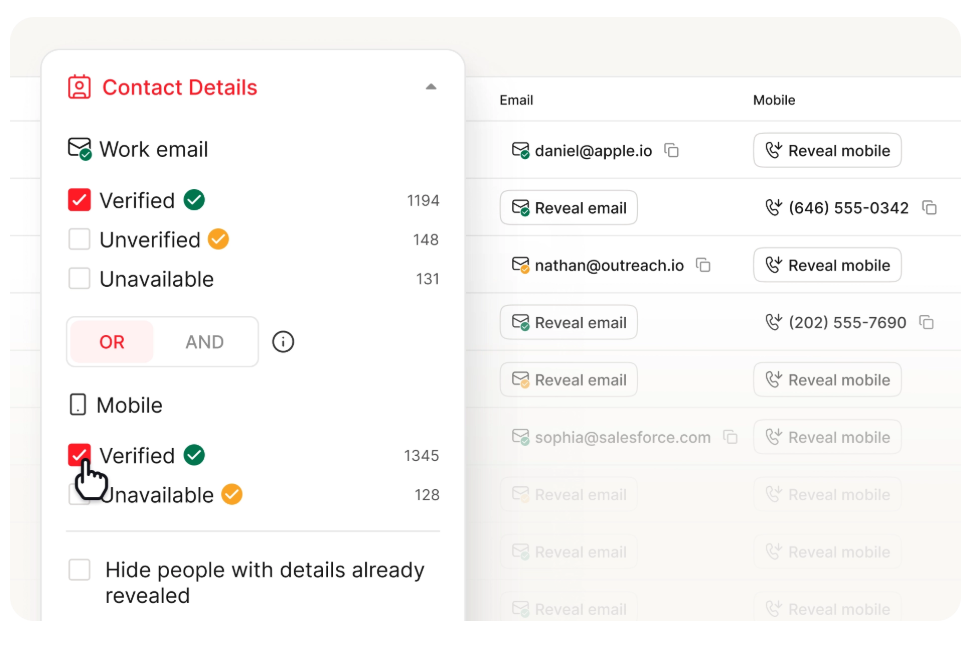
Intent-triggered outreach only works when enrichment returns real contact data. Prospeo covers 300M+ profiles with 92% API match rates and 125M+ verified mobiles - plug it into HubSpot, Salesforce, or Clay and fire sequences within minutes of an intent signal.
Stop losing deals to stale data between the intent signal and the first touch.
Choosing the Right Stack by Team Size
Here's the stat that should guide your buying: 91% of sales orgs use 3+ enablement tools, and the average stack is 10+. But 43% of those tools see less than 50% adoption. Three tools you actually use beats ten you don't.
Hot take: If your average deal size is under $15K, you don't need an enterprise enablement platform. Period. A $90K Seismic contract with 35% adoption is $58,500/year in shelfware. That money buys a full-time SDR who'll generate more pipeline than any content management system.
Under 20 reps (~$500-1,500/mo): HubSpot free CRM + a verified data layer + PandaDoc. Add Zapier if you need to connect anything. Skip enterprise enablement platforms entirely.
20-100 reps (~$3K-8K/mo): HubSpot Sales Hub Pro or Salesforce Essentials + Outreach or Salesloft + Showpad. Add Gong when you have enough call volume to make coaching insights meaningful.
100+ reps (~$10K-25K+/mo): Salesforce Enterprise + Highspot/Seismic + Gong + Mindtickle. At this scale, the 3-4 month implementation timeline for enterprise platforms is justified by the content governance and analytics you get back. Showpad's 2-4 month rollout is the faster alternative if you need to move quickly.
4 KPIs That Prove It's Working
Don't automate without measuring. Track these four metrics quarterly:
- Rep ramp time. How many days from hire to first closed deal? Automation should cut this by 20-30%. If it doesn't, your onboarding workflow needs work.
- Win rate on forecasted deals. Teams with mature enablement automation see 49% higher win rates on forecasted deals. If yours isn't moving, your content recommendations aren't reaching reps at the right stage.
- Sales cycle length. Automated follow-ups and deal rooms should compress your cycle by 10-15%. If it's flat, check whether reps are actually using the tools.
- Content utilization rate. If less than 50% of your enablement content is being accessed, you have a discovery problem - not a content problem. Fix search and recommendations before creating more collateral.
6 Mistakes That Kill Your Automation
1. Automating broken processes. If your lead routing logic is wrong manually, automating it just makes it wrong faster. Fix the process first.
2. Skipping data cleanup. Here's the thing - automating outreach to unverified emails burns your domain at scale. Meritt's team was running a 35% bounce rate before they cleaned their database. Pipeline tripled from $100K to $300K/week once bounce rates dropped below 4%. Verify before you automate. (If you're troubleshooting, start with email bounce rate benchmarks and fixes.)
3. Buying enterprise when you need mid-market. We've seen teams sign $90K Seismic contracts and hit 35% adoption. Match the tool to your team size and actually measure usage before renewing.
4. No change management. The best automation in the world fails if reps don't trust it. Budget time for training, feedback loops, and iteration. Spekit exists specifically for this problem.
5. Over-automating human touchpoints. Not every interaction should be a template. Executive-level outreach, complex negotiations, and relationship-building moments need a human voice. Real-time enablement can surface talking points and competitive intel during a live call, but the rep still needs to deliver them with judgment.
6. Ignoring adoption metrics. If 43% of your tools are underutilized, you don't have an enablement problem - you have a change management problem. Track login rates, feature usage, and rep satisfaction quarterly.
FAQ
How long before sales enablement automation shows ROI?
Most teams see measurable time savings within 4-6 weeks and pipeline impact within one quarter. For every $1 invested in automation, expect roughly $8 in return. The fastest wins come from automating CRM data entry and follow-up sequences - those two alone can reclaim 10+ hours per rep per week.
What's the best free enablement tool stack?
HubSpot's free CRM for pipeline management, Prospeo's free tier for 75 verified emails per month, and PandaDoc's free plan for proposals. Together, that's a functional stack at zero cost - enough to run a small outbound operation before investing in paid tools.
Do I need a dedicated enablement platform?
Under 50 reps, usually not. A CRM + data tool + sequencer covers 80% of enablement needs at a fraction of the cost. Dedicated platforms like Highspot or Showpad justify their $42K-$180K/year price tag at 50+ reps, where content governance, analytics, and compliance become real requirements. For teams below that threshold, skip it and invest in the tools your reps will actually open every day.
What's the difference between AI and rule-based automation?
Rule-based follows deterministic logic: if lead score exceeds 80, route to AE. AI uses pattern recognition to recommend next-best actions, surface content, or flag coaching opportunities. Our recommendation is to start with rule-based workflows and layer in AI as your data matures - that's where you get capabilities like dynamic content assembly and live call coaching prompts.
Can I automate enablement without a CRM?
Don't try. A CRM is the data backbone for every automation trigger and outcome log. Without it, your workflows have no trigger source and no way to measure results. HubSpot's free CRM removes the budget objection entirely - start there and upgrade when you outgrow it.
Let's be direct: clean your data first, then automate. Every workflow, every sequence, and every AI recommendation in your sales enablement automation stack is only as good as the contacts feeding it. Get that right, and the rest follows.