

Sales Enablement Content Types: Fewer Assets, Better Results
Between 60% and 70% of sales enablement content never gets used. SiriusDecisions identified that pattern years ago, and it hasn't improved much since. One rep on r/B2BSaaS put it bluntly: they're "constantly getting buried in docs, decks, updates, must-read crap that really doesn't help anyone." In a market projected to hit $8.79 billion by 2029, most of that spend produces shelf-ware.
The right sales enablement content types fix this - but only if you build fewer, sharper assets that reps actually reach for mid-deal.
What You Need (Quick Version)
✅ Competitive battlecard ✅ Sales playbook ✅ Verified prospect data ✅ Map everything to awareness → consideration → decision ✅ Kill anything unopened for 90 days
Here's a stat that should make you uncomfortable: 50% of all prospect engagement comes from just 10% of enablement content. Most of your library is dead weight. Audit before you create.
Content Types That Move Deals
Let's be honest - most teams don't have a content problem. They have a curation problem. The companies we've seen win at enablement have 15-20 assets that get used constantly, not 200 that collect dust. Below are the types worth building, split into what reps use behind the scenes and what buyers actually see.
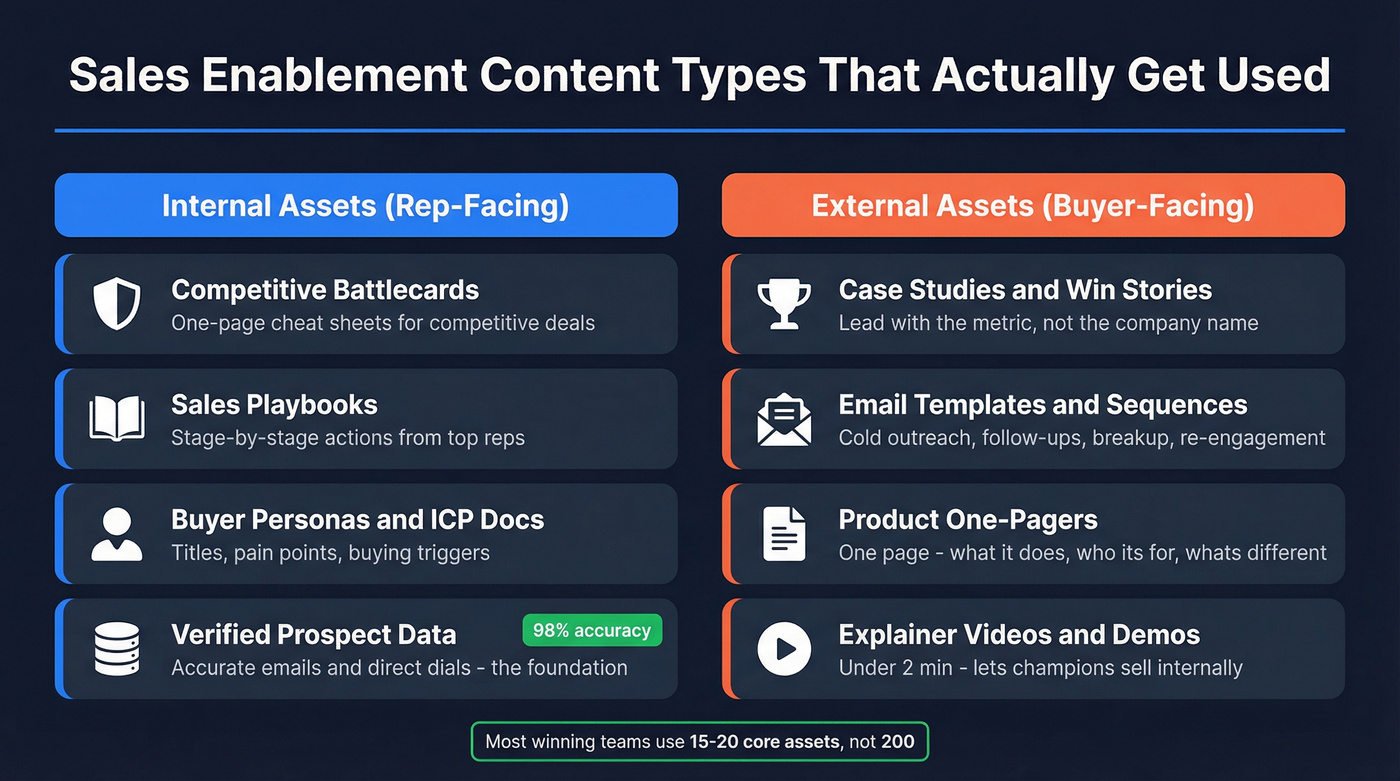
Internal Assets
Competitive Battlecards are the single most requested enablement asset, and the one most teams get wrong. A good battlecard isn't a feature comparison matrix. It's a one-page cheat sheet that coaches reps through a competitive deal. Based on patterns from Dock.us's battlecard library, the best cards anchor on persona at the top, embed discovery questions like "Ask about their migration timeline," include a blunt comparison table for replacement deals, and offer talk tracks that reframe weaknesses as strengths. Update it regularly or it's useless.
Sales Playbooks codify what top reps already do: ICP definition, qualification criteria, objection handling, stage-by-stage actions. "Build rapport" isn't a playbook step. "Reference their Q3 earnings call and ask about the hiring freeze" is.
Buyer Personas & ICP Documents define who you're selling to - titles, pain points, buying triggers, common objections. Without them, your battlecards target the wrong competitor and your sequences use the wrong language.
Verified Prospect Data is the piece nobody thinks of as "content," but it's foundational. The best playbook in the world can't save a call to a wrong number. Accurate emails and direct dials are the infrastructure everything else runs on. Prospeo delivers 98% email accuracy across 143M+ verified emails and 125M+ verified mobile numbers, refreshed every 7 days - so when your reps pull a list, the contacts actually pick up.

External Assets
Case Studies & Win Stories - Lead with the metric, not the company name. "Pipeline tripled from $100K to $300K/week" beats "Acme Corp loves us." Organize by industry and deal size so reps grab the right one fast.
Email Templates & Sequences - Include templates for cold outreach, follow-ups, breakup emails, and re-engagement. Test subject lines regularly. Retire anything that stops performing. (If you need a starting point, use proven sales follow-up templates and iterate from there.)
Product One-Pagers are the leave-behind after a demo or discovery call. One page, three sections: what it does, who it's for, what makes it different. If your one-pager needs a scroll bar, it's a brochure.
Explainer Videos & Demos - 95% of B2B buyers say video plays a role in their purchase decision. Short explainer videos under 2 minutes let champions sell internally without scheduling another call. This is the asset that works while your reps sleep.

Every enablement asset you build - battlecards, playbooks, sequences - depends on reaching the right person. Prospeo gives your reps 143M+ verified emails at 98% accuracy and 125M+ direct dials, refreshed every 7 days. That's the foundational content type most teams forget.
Stop enabling reps with great scripts and bad phone numbers.
Map Content to the Buyer Journey
64% of buyers say the winning vendor's content had a significant impact on their decision. With 78% preferring self-service journeys and deals averaging 12.4 touchpoints, you need the right asset at the right moment - not just the right asset in a vacuum.
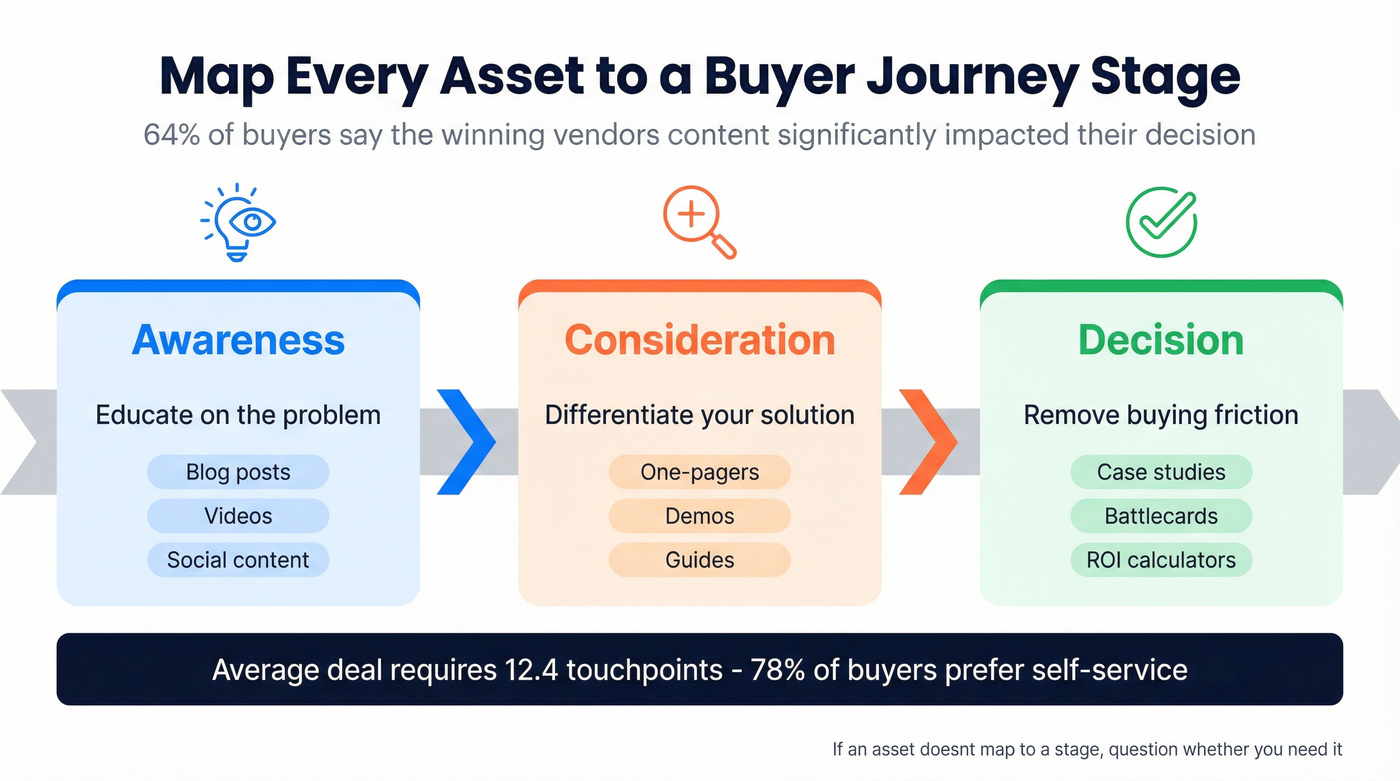
| Stage | Content Types | Goal |
|---|---|---|
| Awareness | Blog posts, videos, social | Educate on the problem |
| Consideration | One-pagers, demos, guides | Differentiate your solution |
| Decision | Case studies, battlecards, ROI calcs | Remove buying friction |
If an asset doesn't map cleanly to a stage, question whether you need it at all.
Why Most Enablement Content Fails
Reps spend 3 to 11 hours per week hunting for answers about tools, processes, and product info - leaving only about 30% of their time for actual selling. The content exists. They just can't find it, don't trust it, or it's outdated. And 65% of marketers can't tell which content types are effective, so they keep producing everything.
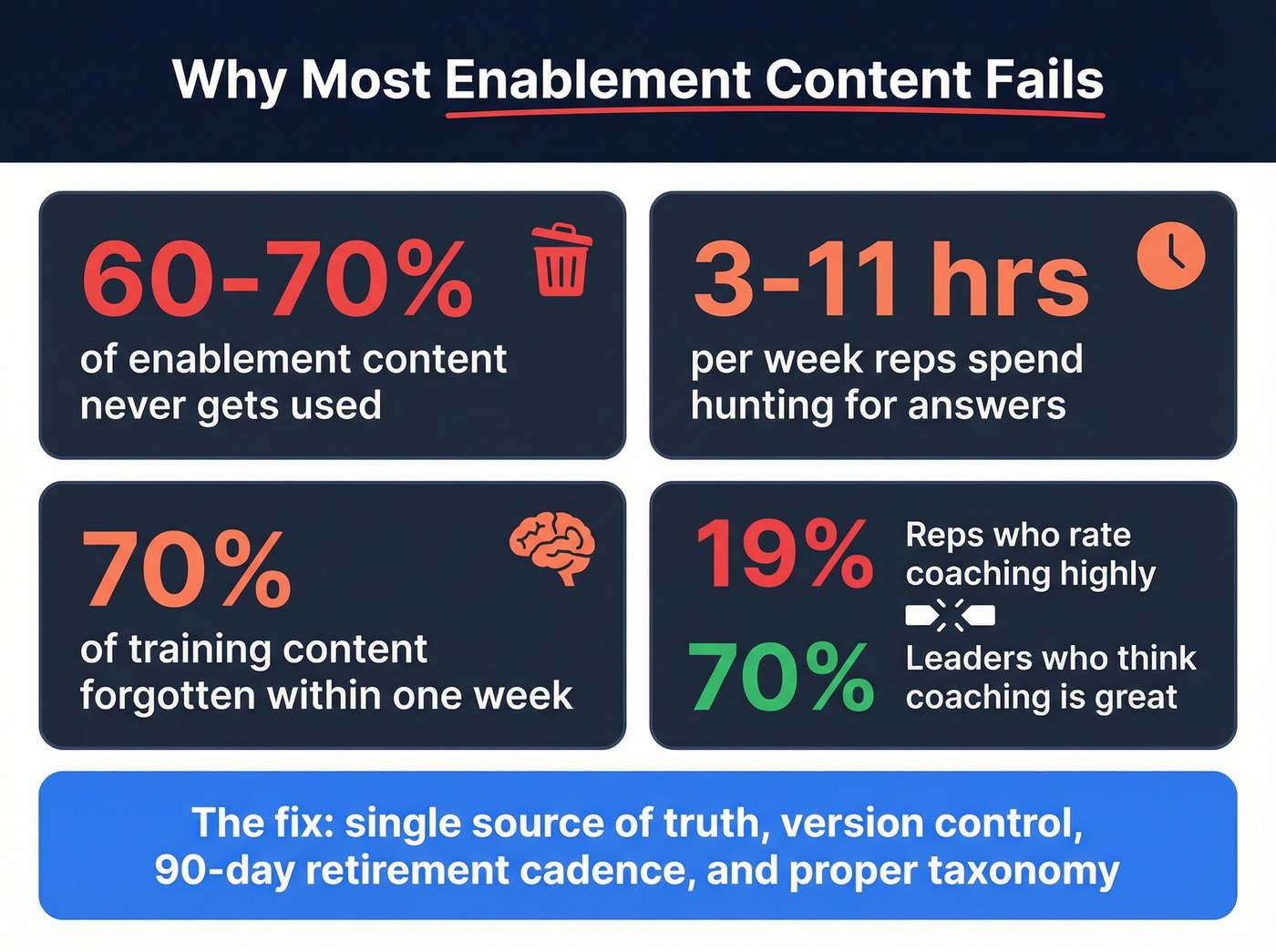
There's also a coaching perception gap that quietly kills adoption. Only 19% of reps rate the coaching they receive highly, while 70% of leaders think they're doing a great job. That disconnect means leadership keeps producing content reps don't value.
Another silent killer: enablement materials that contradict your brand story. When battlecards say one thing and marketing says another, buyers notice. We've seen teams with 500+ assets where reps use fewer than 20. The governance fix is straightforward:
- Single source of truth - one platform, not five Google Drives
- Version control - automatic propagation, no "final_v3_REAL" files
- Retirement cadence - archive anything untouched for 90 days
- Taxonomy - tag by content type, deal stage, and persona
What's Changing in 2026
Reps forget 70% of training content within a week without reinforcement. That's not a people problem - it's a delivery problem. Curriculum-based enablement is giving way to just-in-time delivery: surfacing the right asset during a live deal, not in a Monday morning session nobody remembers by Wednesday.
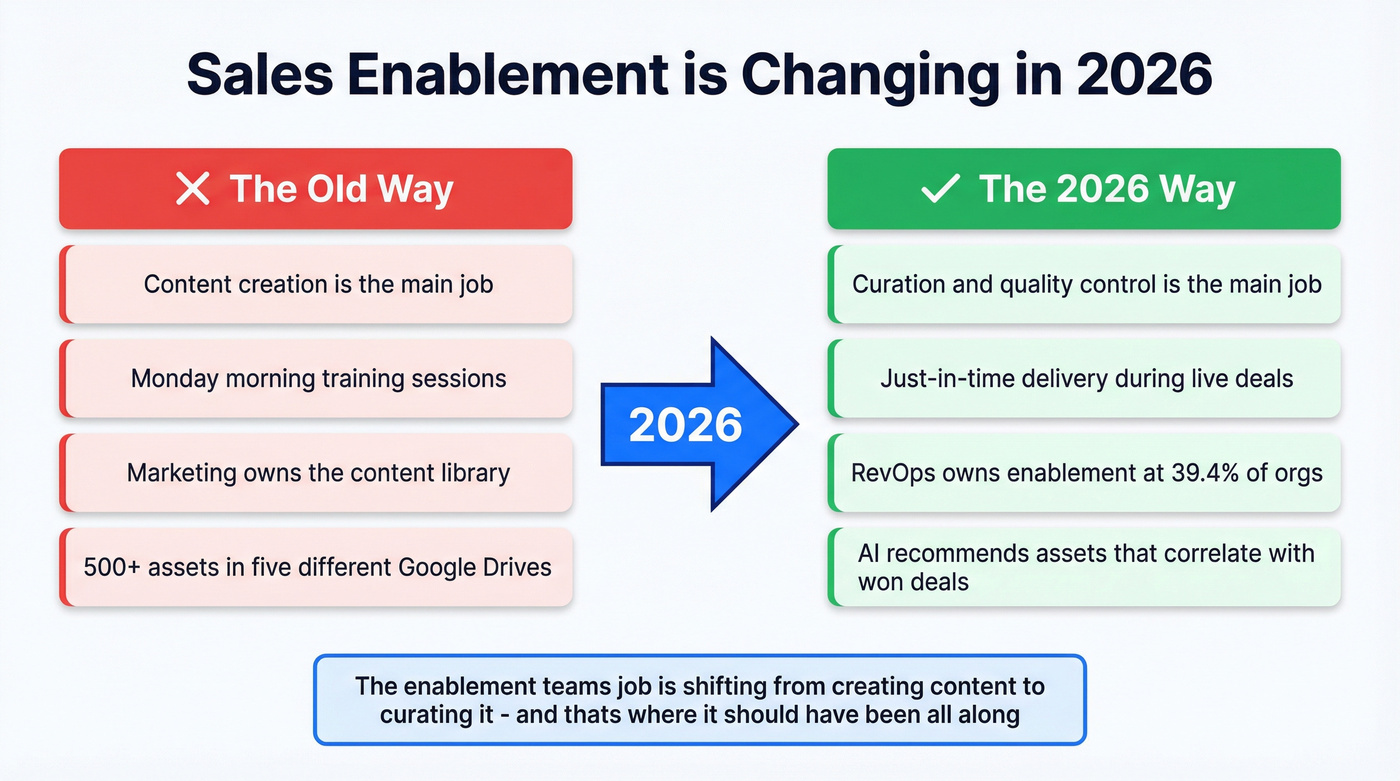
RevOps now owns enablement at 39.4% of organizations. If your content library still reports to marketing, you're in the minority.
AI content intelligence is accelerating this shift. Platforms analyze which materials correlate with won deals and recommend them in real time. First drafts of case studies, sequences, and proposal sections get generated automatically. The enablement team's job is moving from content creation to curation and quality control - which, frankly, is where it should've been all along. (This is also where data-driven selling and clean sales operations metrics start to matter more than ever.)
You just mapped content to every deal stage. Now make sure reps can actually reach buyers at each one. Prospeo's free tier includes 75 verified emails and 100 Chrome extension credits per month - no contracts, no sales calls, $0.01 per email after that.
The best enablement stack starts with data that connects.
FAQ
What's the difference between enablement content and content marketing?
Content marketing attracts inbound leads through blogs and SEO. Enablement content arms reps to convert those leads into revenue. One fills the top of the funnel; the other closes it. Think of marketing content as demand gen and enablement assets as deal-acceleration tools.
How many enablement assets does a team actually need?
Start with three: a competitive battlecard, a sales playbook, and verified prospect data. Most high-performing teams operate with 15-20 core assets. Add more only when reps consistently request them and you can measure adoption against win rates.
How do you measure enablement content effectiveness?
Track content adoption rate, win rate on deals where specific assets were shared, and sales cycle length. Industry benchmarks for the most-tracked metrics: content adoption at 50%, quota attainment at 43.1%, win rate at 42.2%. Double down on what correlates with closed deals and retire the rest.
What's a good free tool for verified prospect data?
Prospeo's free tier includes 75 verified emails and 100 Chrome extension credits per month - no contracts required. For comparison, Hunter offers 25 searches/month but caps enrichment. If accurate contact data is a core enablement need, 98% email accuracy and a 7-day refresh cycle make for a strong starting point.