

The Sales Enablement Process Nobody Actually Gives You
Every guide on sales enablement starts with the same 300-word definition you already know. Then it lists "best practices" that sound great in a slide deck but tell you nothing about what to actually do on Monday morning.
Here's the thing: companies with a formal sales enablement process hit a 49% win rate on forecasted deals versus 42.5% without one. That gap isn't about knowing what enablement is - it's about having a repeatable process that turns enablement from a vague function into the plumbing that actually makes revenue teams work. Seven stages, with the inputs, outputs, and ownership that make it run.
What You Need in the First 30 Days
If you're building a sales enablement program from scratch, do three things:
- Write a one-page charter. Define what enablement owns, what it doesn't, and how you'll measure success.
- Fix onboarding. It's the fastest path to measurable impact - shorter ramp time shows up in pipeline within a quarter.
- Instrument your CRM to track enablement-influenced pipeline. If you can't tie enablement activity to revenue, you'll lose budget by Q3.
Everything else - platforms, AI, playbooks - can wait. Only 22% of enablement budget goes to technology, which is why process, governance, and manager reinforcement usually create the biggest early gains. 65% of sales leaders who outperformed revenue targets have a dedicated enablement person or team. But headcount without a charter is just overhead.
The 7-Stage Enablement Framework
Most enablement teams operate in a fog of ad hoc requests. A rep needs a battlecard. Product marketing wants a new deck rolled out. The VP of Sales asks for "more training." Without structured processes, enablement becomes a reactive service desk - and that's the fastest way to get the function defunded.
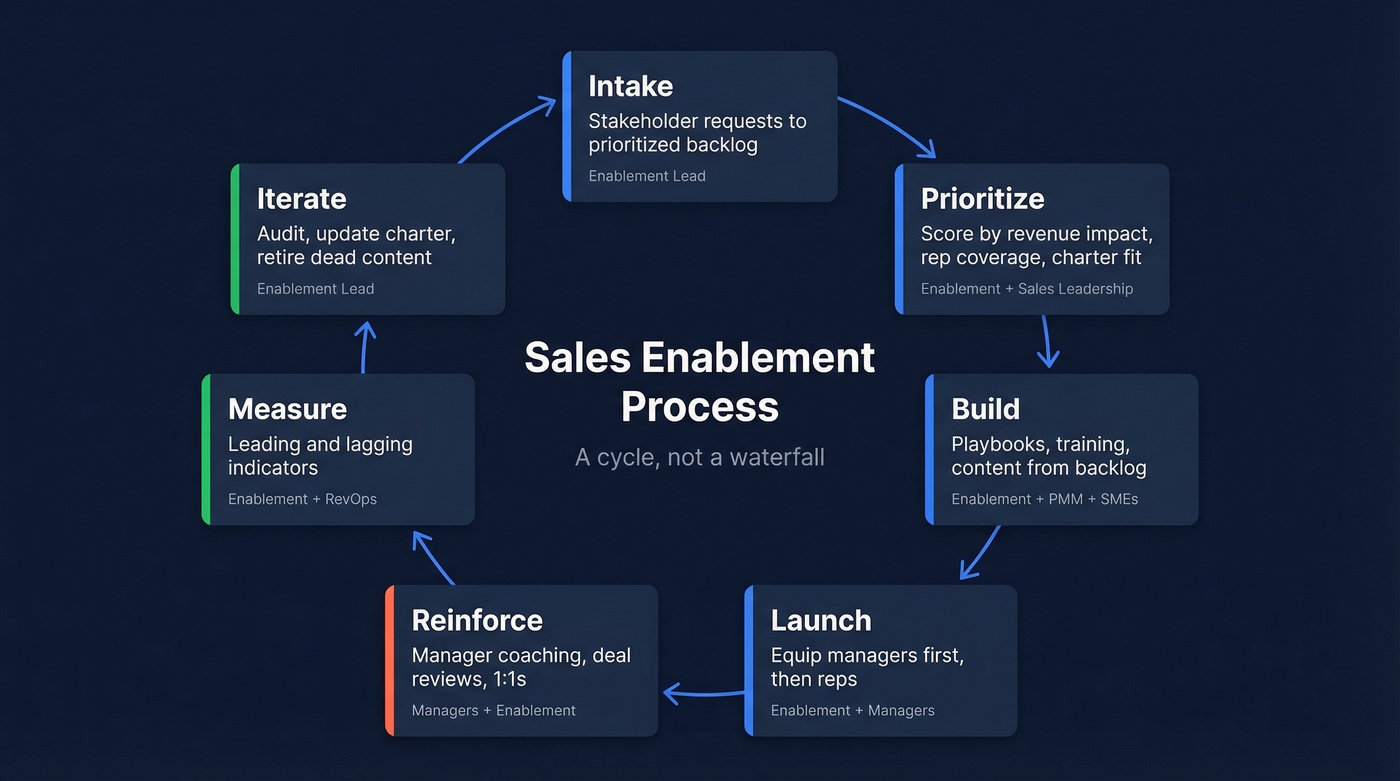
Here's the framework we use. It's a cycle, not a waterfall.
| Stage | Owner | Key Input | Key Output |
|---|---|---|---|
| Intake | Enablement lead | Stakeholder requests | Prioritized backlog |
| Prioritize | Enablement + sales leadership | Revenue impact, rep coverage | Quarterly roadmap |
| Build | Enablement + PMM + SMEs | Prioritized items | Playbooks, training, content |
| Launch | Enablement + managers | Finished assets | Equipped reps + clean data |
| Reinforce | Managers + enablement | Coaching guides | Reps actually doing it differently |
| Measure | Enablement + RevOps | CRM data, adoption metrics | Impact report |
| Iterate | Enablement lead | Measurement results | Updated charter + retired content |
Intake
Without a formal intake system, enablement turns into reactive order-taking - fielding every request that lands in Slack and losing control of priorities. Build a simple intake form. It doesn't need to be fancy: a shared form that captures the request, the business problem it solves, the number of reps affected, and the deadline.
The point isn't bureaucracy. It's visibility. You can't prioritize what you can't see, and you can't set boundaries if every request arrives as a DM from a sales director.
Prioritize
Not every request deserves a sprint. Score incoming work against three criteria: revenue impact (does this move pipeline or win rate?), rep coverage (does this affect 5 reps or 50?), and alignment to your charter (is this actually enablement's job?).
This is where boundary-setting matters most. Research on common enablement failures flags the pattern clearly: teams that skip prioritization criteria end up doing misaligned work with diluted impact. Your quarterly roadmap should have a "not doing" column that's just as explicit as the "doing" column.
Build
This is where most teams spend all their time - and it's actually stage three, not stage one. What you build should flow directly from your prioritized backlog, not from a PMM's content calendar or a VP's pet project.
Sellers using enablement content are 58% more likely to outperform peers, but only when the content is relevant, findable, and built for how reps actually sell. A strong playbook follows the Salesforce structure: strategies and tactics by deal stage, buyer personas, talk tracks and email templates, competitive analysis, and customer proof points. Use the Highspot charter checklist as a quality gate - does every asset have a defined content type, a home, an update frequency, and a KPI it supports? If not, you're creating content that gets orphaned within weeks.
Launch
Most enablement teams treat launch as a distribution event. Send the email, post in Slack, do the all-hands walkthrough. Done.
That's not launch. The sales manager is your most powerful enablement tool. As one revenue enablement leader put it, managers are the multiplier for coaching skill gaps, driving AI adoption, and sustaining change management. Launch means equipping managers to reinforce the material in 1:1s and deal reviews - not just blasting content to reps.
Even well-coached reps hit a wall when the data underneath their outreach is wrong, though. If 30% of their emails bounce, they can't reach the people they're trained to sell to. We've seen teams invest months in playbook development only to watch execution fall apart because reps were working off stale contact lists. Treat data quality as enablement infrastructure, not a separate problem. (If you're diagnosing bounce issues, start with bounce rate benchmarks and email deliverability.)
Reinforce
Without reinforcement, 87% of new skills are forgotten within a month. That's not a training problem - it's a design problem.
Reinforcement lives in the manager layer: deal reviews where reps practice the new messaging, 1:1 coaching sessions that reference the playbook, pipeline reviews that use the new qualification criteria. Enablement's job is to arm managers with coaching guides and talk tracks that make reinforcement easy. If you're not changing behavior over weeks and months, you're just hosting webinars.
Measure
This is where most enablement teams either panic or hand-wave. The key distinction is leading versus lagging indicators. Leading indicators like content adoption, training completion, and coaching frequency tell you whether enablement is being used. Lagging indicators like win rate, quota attainment, and cycle length tell you whether it's working.
Content adoption is the #1 leading indicator - 50% of enablement teams track it. Start there.
Iterate
Every quarter, audit your content library, review measurement data, and update your charter. The governance lifecycle runs: audit, create, approve, distribute, measure, retire. That last step - retire - is the one everyone skips. Dead content clutters your repository, confuses reps, and makes the whole system feel unreliable.
Enablement content needs maintenance cycles, not just launches.
The Enablement Charter
Your charter is a one-page document that prevents 80% of the political problems enablement teams face. It's also the single most important artifact when you're figuring out how to implement sales enablement for the first time.
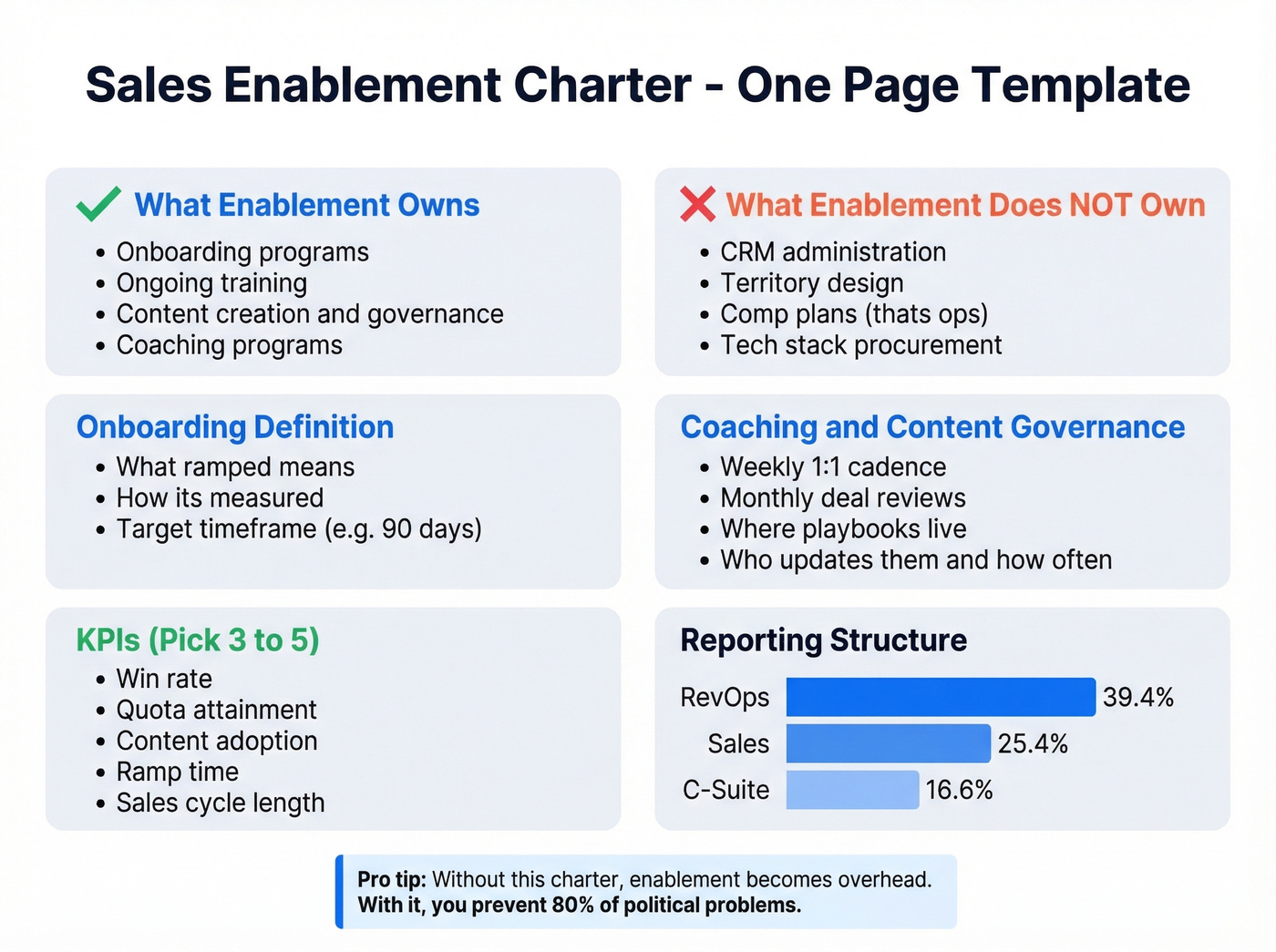
What to include:
- What enablement owns: onboarding, ongoing training, content creation, coaching programs
- What enablement doesn't own: CRM administration, territory design, comp plans - that's ops
- Onboarding definition: what "ramped" means, measured how, in what timeframe
- Coaching cadence and content governance: weekly 1:1s, monthly deal reviews, where battlecards and playbooks live, who updates them, and how often
- KPIs: the 3-5 metrics you'll report on
- Reporting structure: who enablement reports to and why
That last point matters more than people think. Sales Enablement Landscape data shows enablement reports to RevOps in 39.4% of organizations, Sales in 25.4%, and the C-Suite in 16.6%. Where you sit determines what you can influence. Teams reporting to RevOps tend to have better measurement infrastructure. Teams reporting to Sales get faster feedback loops. Neither is wrong, but you need to know which trade-off you're making.

You just read it: reps hit a wall when 30% of emails bounce. Prospeo delivers 98% email accuracy with a 7-day refresh cycle, so your enablement investments actually reach real buyers. No stale lists undercutting your playbooks.
Don't let bad data sabotage months of enablement work.
How to Measure Enablement Impact
Measurement is where enablement either earns its budget or loses it.
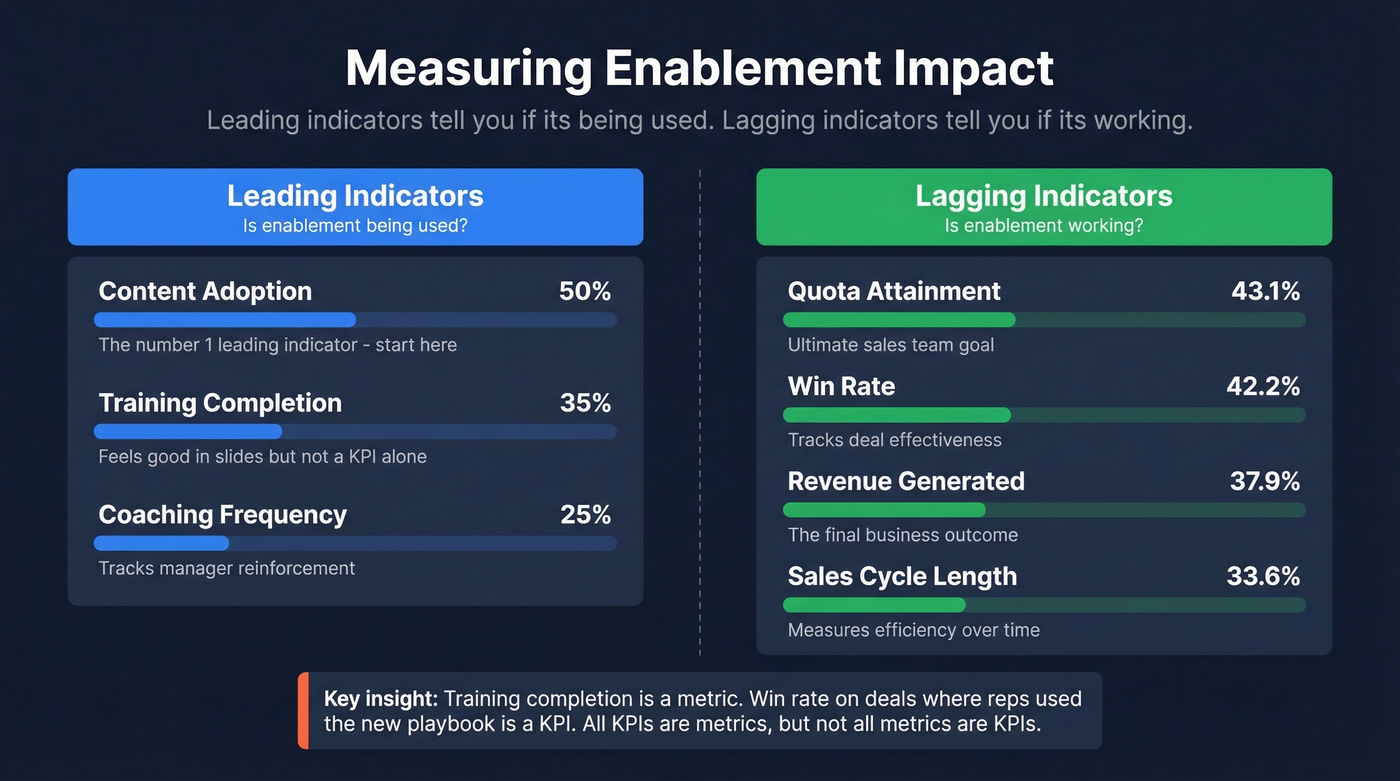
| Indicator Type | Examples | What It Tells You |
|---|---|---|
| Leading | Content adoption, training completion, coaching frequency | Whether enablement is being used |
| Lagging | Win rate, quota attainment, cycle length, ramp time | Whether enablement is working |
The most common metrics teams track: content adoption (50%), quota attainment (43.1%), win rate (42.2%), revenue generated (37.9%), and sales cycle length (33.6%).
Most teams fail here because they measure activity, not outcomes. Training completion rates feel good in a slide deck, but they don't tell you whether reps are selling differently. The Presicci KPI framework makes a useful distinction: all KPIs are metrics, but not all metrics are KPIs. "Training completion" is a metric. "Win rate on deals where reps used the new playbook" is a KPI.
The attribution problem is real, but it's solvable. Spekit published a concrete case study on cross-sell enablement that tracked outcomes within a 120-day window - participants who created at least one opportunity within 90 days, content touches correlated with earlier opportunity logging, and reinforcement quiz passers among early adopters. Define your outcome window upfront and instrument your CRM to capture the linkage between enablement activity and pipeline creation.
You won't get perfect attribution in year one. But you can get directional attribution that's strong enough to defend your budget. Start with content adoption as your leading indicator and win rate as your lagging indicator. Add complexity later.
Why Most Enablement Programs Fail
We've seen these patterns kill enablement programs repeatedly. Ask any enablement professional in r/salesoperations or r/sales what kills their program, and the top answer is always the same: leadership treats enablement as a content factory, not a strategic function.
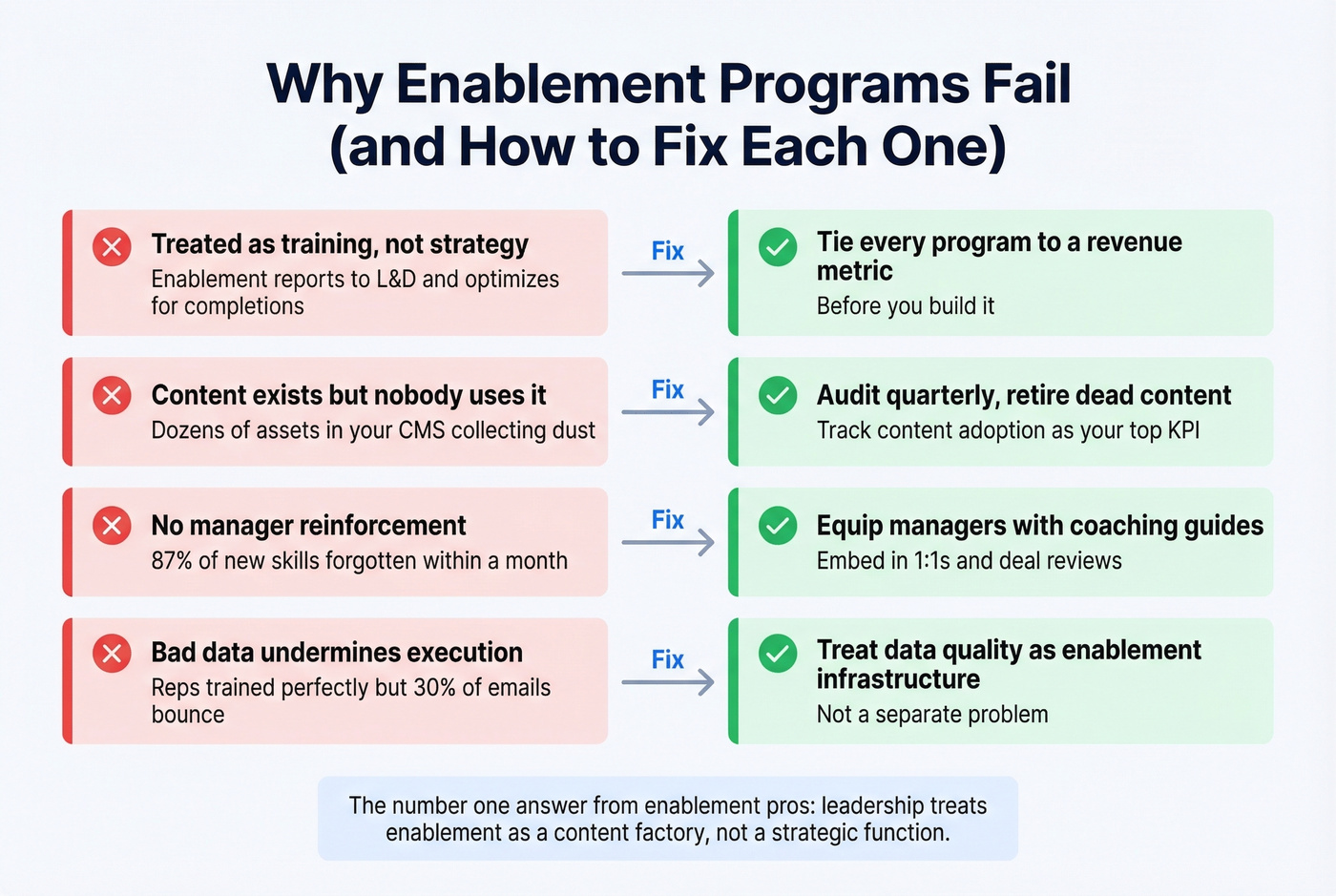
Enablement is treated as training, not strategy. When enablement reports into L&D or HR, it optimizes for training completions rather than revenue outcomes. The fix: tie every program to a revenue metric before you build it.
Content exists but nobody uses it. You've got dozens of assets in your content management system and reps still build their own decks. The fix: involve reps in the build stage, distribute through managers not email blasts, and retire anything that isn't being used.
Teams measure activity, not outcomes. Attendance rates, NPS scores on training sessions, number of assets created - none of these tell you whether enablement is moving revenue. The fix: instrument your CRM to track enablement-influenced pipeline from day one.
No intake or prioritization means reactive order-taking. Without a backlog and scoring criteria, enablement does whatever the loudest stakeholder asks for. The fix: implement the intake and prioritize stages from the framework above.
The data layer gets ignored. You can build the best playbooks and run the sharpest training programs, but if reps are working off stale contact data with high bounce rates, execution falls apart at the point of contact. A tool like Prospeo verifies emails in real time with 98% accuracy and refreshes data every 7 days, so reps spend time selling instead of chasing dead leads.
How to Enable Sales Teams with AI
AI doesn't replace the enablement framework - it accelerates specific stages. The mistake most teams make is applying AI to broken workflows, which just makes bad processes faster.
Let's break down where AI actually maps to the framework:
- Prioritize - Predictive scoring to identify which deals and segments deserve enablement investment
- Build - Content personalization and generation, drafting first versions of battlecards, email templates, and talk tracks
- Reinforce - Conversation intelligence and AI coaching simulations; teams using AI coaching see 14% higher win rates
- Iterate - Admin automation for CRM updates, call summaries, and content usage analytics
The implementation sequence matters. Start with high-drag workflows - the stuff reps hate doing manually. Clean your content library first, set governance rules for AI-generated content, then pilot with a small team before rolling out. By 2026, 65% of B2B sales organizations will have transitioned to data-driven decision making using technology that unites workflow, data, and analytics. But the technology only works if the process underneath it is sound.
Where Enablement Is Heading
The biggest shift right now is the move from sales enablement to revenue enablement. More than 50% of CSOs expect enablement to support marketing and customer success within the next three years. Companies that make this pivot are 75% more likely to exceed targets on seller revenue, cross-sell, and revenue growth.
Buyer enablement is the next frontier. ROI calculators, mutual action plans, digital sales rooms, and self-service buying portals respond to the reality that 75% of B2B buyers prefer a rep-free experience. But 43% of buyers who go fully self-service report higher purchase regret. An effective enablement program in 2026 needs to serve both the buyer who wants autonomy and the buyer who needs guidance - and know which is which.
Skip the platform if your average deal size is under $15k. You probably don't need Seismic or Highspot yet. You need a charter, a good onboarding program, and a manager who actually coaches. Most teams buy the platform before they've figured out what content reps actually need - and then wonder why adoption is low.
49% of sellers believe their current skills will be outdated within two to three years. Sales readiness isn't a one-time program. A strong sales enablement process is about building the muscle for continuous adaptation - not shipping a playbook and moving on. (If you’re formalizing rep ramp, use a 30-60-90 day plan and align it to sales training reinforcement.)
Stage 4 - Launch - fails when reps can't reach the people they're trained to sell to. Prospeo gives your enabled reps 300M+ verified contacts, 125M+ direct dials, and 30+ filters to find exactly the right buyers. At $0.01 per email, data quality stops being a budget fight.
Equip your reps with contacts that actually connect.
FAQ
What's the difference between enablement and sales operations?
Enablement equips reps with content, training, and coaching to sell more effectively. Operations builds the infrastructure - CRM configuration, territory design, compensation plans, reporting. Think of enablement as "what to say and how to sell" and operations as "where to sell and how to get paid." They share data but own different outcomes.
How big should an enablement team be?
The industry benchmark is roughly one enablement professional per 10-15 reps. Most organizations start with a single person. A clear charter matters more than headcount - one enablement lead with defined ownership and measurement infrastructure outperforms a five-person team operating without a charter.
What tools do you actually need to start?
At minimum: a CRM like Salesforce or HubSpot, a content repository, and a data verification tool to ensure reps reach prospects with accurate emails and direct dials. Enablement platforms like Highspot, Seismic, or Allego help at scale but aren't required early on. Get the process right first.
How long until you see results?
Quick wins - onboarding improvements, content adoption lifts - show within 30-60 days. Revenue impact like win rate changes and shorter sales cycles typically takes 90-120 days to attribute with confidence. Define your outcome window upfront so you're measuring against a timeline, not hoping for anecdotal wins.
What's the first step when building from scratch?
Start with the charter. Before you buy tools or create content, define what enablement owns, how success will be measured, and who the function reports to. Then fix onboarding - it delivers the fastest measurable impact and gives you credibility to expand the program's scope in subsequent quarters.