

How to Build a Sales Enablement Team That Actually Moves Revenue
You just hired 10 reps and ramp time doubled because everyone's selling a different story. Research shows reps sell anywhere from 25 to 75 versions of the company pitch due to content drift and legacy messaging. Pipeline looks healthy on paper, but 400 deals are sitting in MQL for over 300 days.
That's not a training problem. That's a sales enablement team problem - or more precisely, the absence of one.
The enablement platform market is projected to hit $8.79B by 2029, yet most enablement teams are just 2-4 people. Here's how to build one that earns its budget.
The Short Version
- First hire: Enablement Program Manager - a rep whisperer with operator DNA
- Reports to: CRO or RevOps, not Sales
- Metric philosophy: One funnel conversion per quarter, not training completion
- If outbound is the bottleneck: Fix data quality before adding headcount
What Enablement Actually Owns
The fastest way to kill an enablement function is to let it become a dumping ground for every "can you train the team on this?" request. Enablement isn't Sales Ops, which handles process, territory, comp, and CRM governance. It isn't Product Marketing, which owns positioning and competitive intel. And it isn't RevOps, which runs systems and data flow.
Think of enablement like a product team. It owns rep readiness - onboarding, coaching, content, playbooks - and ships "releases" that improve how sellers sell. The first thing any enablement leader should do is write a charter that defines scope boundaries. Without one, you'll spend 80% of your time on reactive requests that have nothing to do with moving pipeline.
Three Org Models (and When Each Wins)
Choosing the right sales enablement team structure depends on your company's stage, sales complexity, and how mature your adjacent functions are.
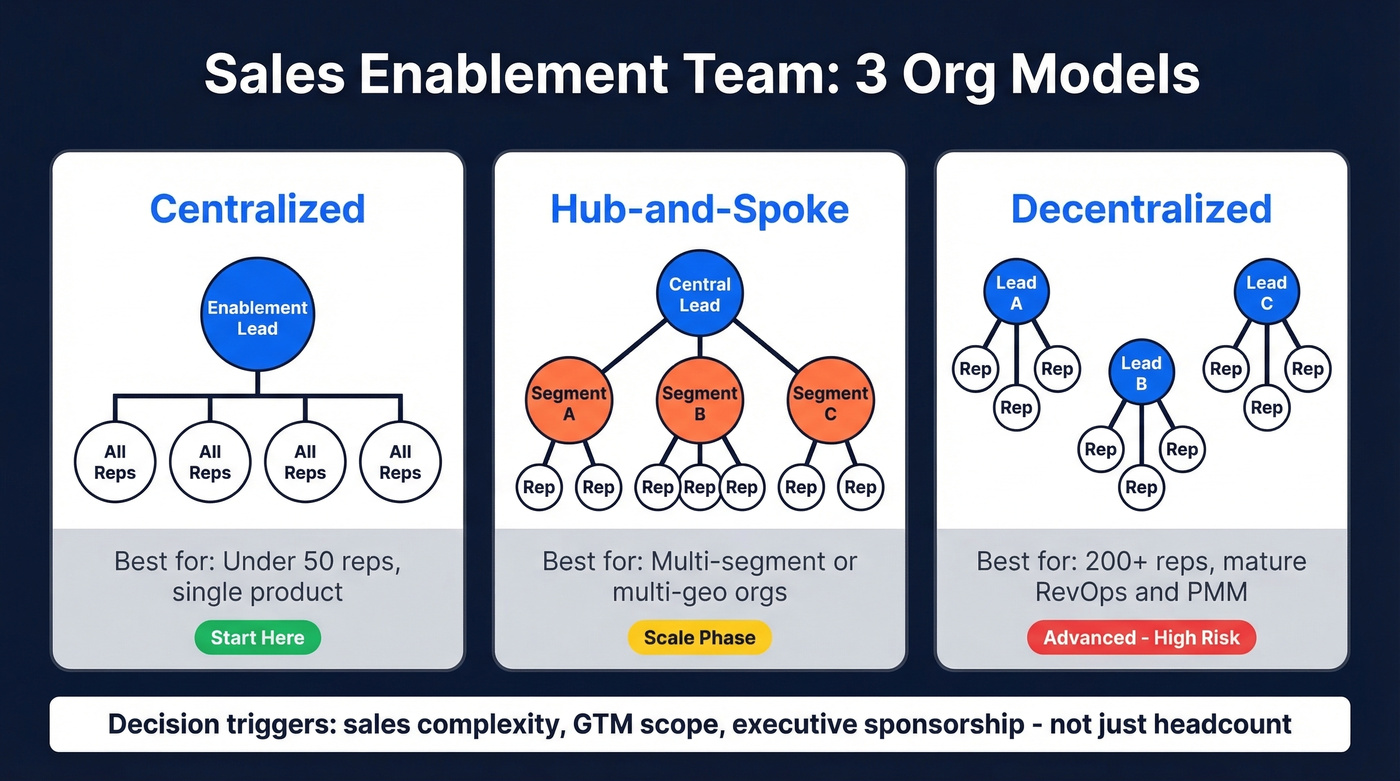
| Model | Best For | Watch Out |
|---|---|---|
| Centralized | Early enablement, <50 reps, single product | Can feel disconnected from field |
| Hub-and-spoke | Multi-segment or multi-geo orgs | Requires strong central lead |
| Decentralized | 200+ reps, mature RevOps/PMM | Consistency breaks down fast |
Centralized is the right default for most teams building from scratch - it forces consistency in tools, taxonomy, and measurement. Hub-and-spoke makes sense once you're running multiple sales motions across geographies, where a single central team can't stay close enough to every segment's reality. Decentralized only works when RevOps and PMM are already mature enough to hold the center together, and even then, we've seen it fragment within two quarters without strong governance.
The decision triggers aren't just about headcount. Sales complexity, GTM scope, and executive sponsorship all factor in.
When to Hire (Stage-Based Triggers)
The trigger for your first enablement hire isn't a headcount threshold. It's product-market fit. Once you've found PMF and start scaling reps, inconsistency appears almost immediately.
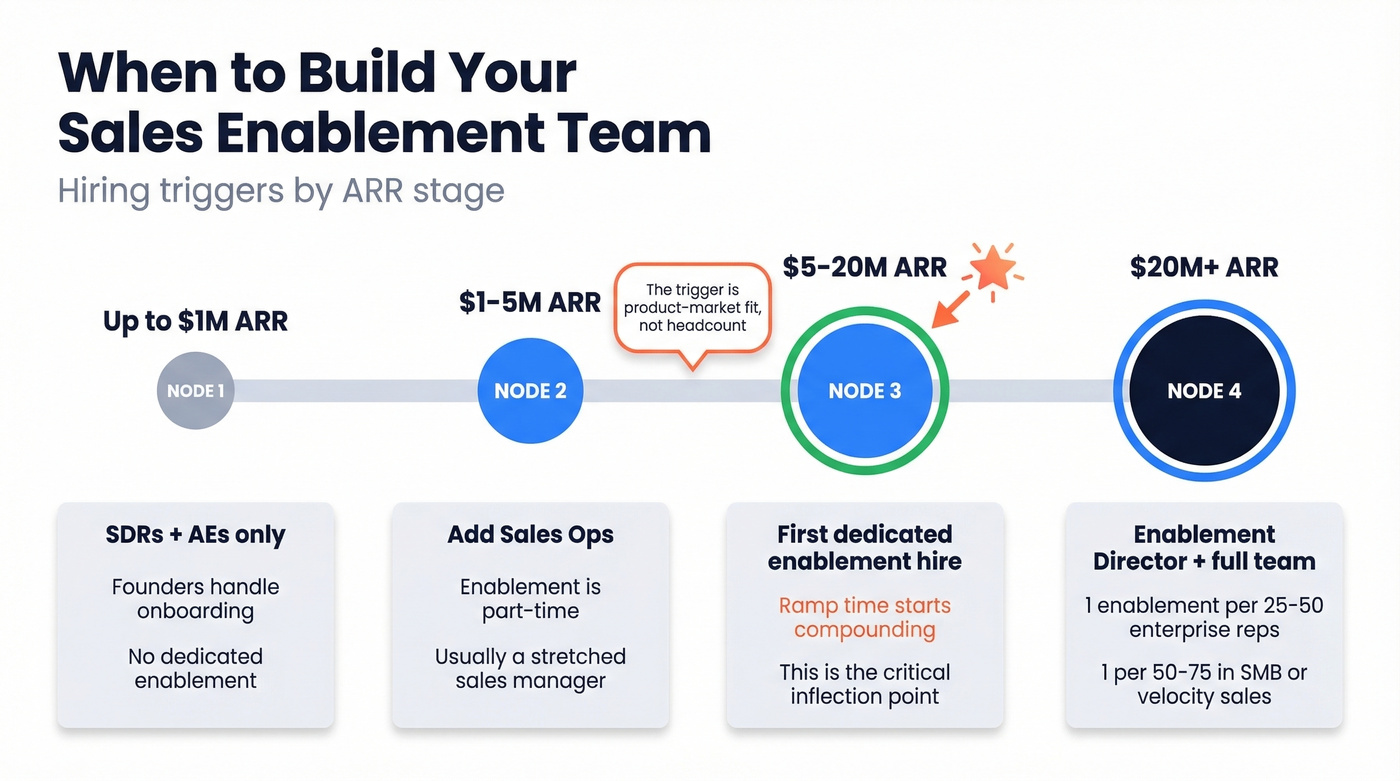
- Up to $1M ARR: SDRs + AEs. No dedicated enablement. Founders handle onboarding.
- $1-5M ARR: Add Sales Ops. Enablement is part-time, usually owned by a sales manager who's already stretched thin.
- $5-20M ARR: First dedicated enablement hire. Ramp time starts compounding against you here.
- $20M+ ARR: Enablement Director + full team.
For ratios, plan roughly 1 enablement person per 25-50 enterprise sellers, or 1 per 50-75 in SMB/velocity sales.

You mentioned outbound as a bottleneck. Before adding enablement headcount, fix the data your reps are working. Prospeo delivers 98% email accuracy and 125M+ verified mobiles - at $0.01/email. Teams using Prospeo book 26% more meetings than ZoomInfo users.
Stop enabling reps to send emails that bounce.
Core Roles to Hire First
Don't build a 10-person org chart on day one. Understanding the essential sales enablement team roles helps you hire in the right sequence - you need three hires, in this order:
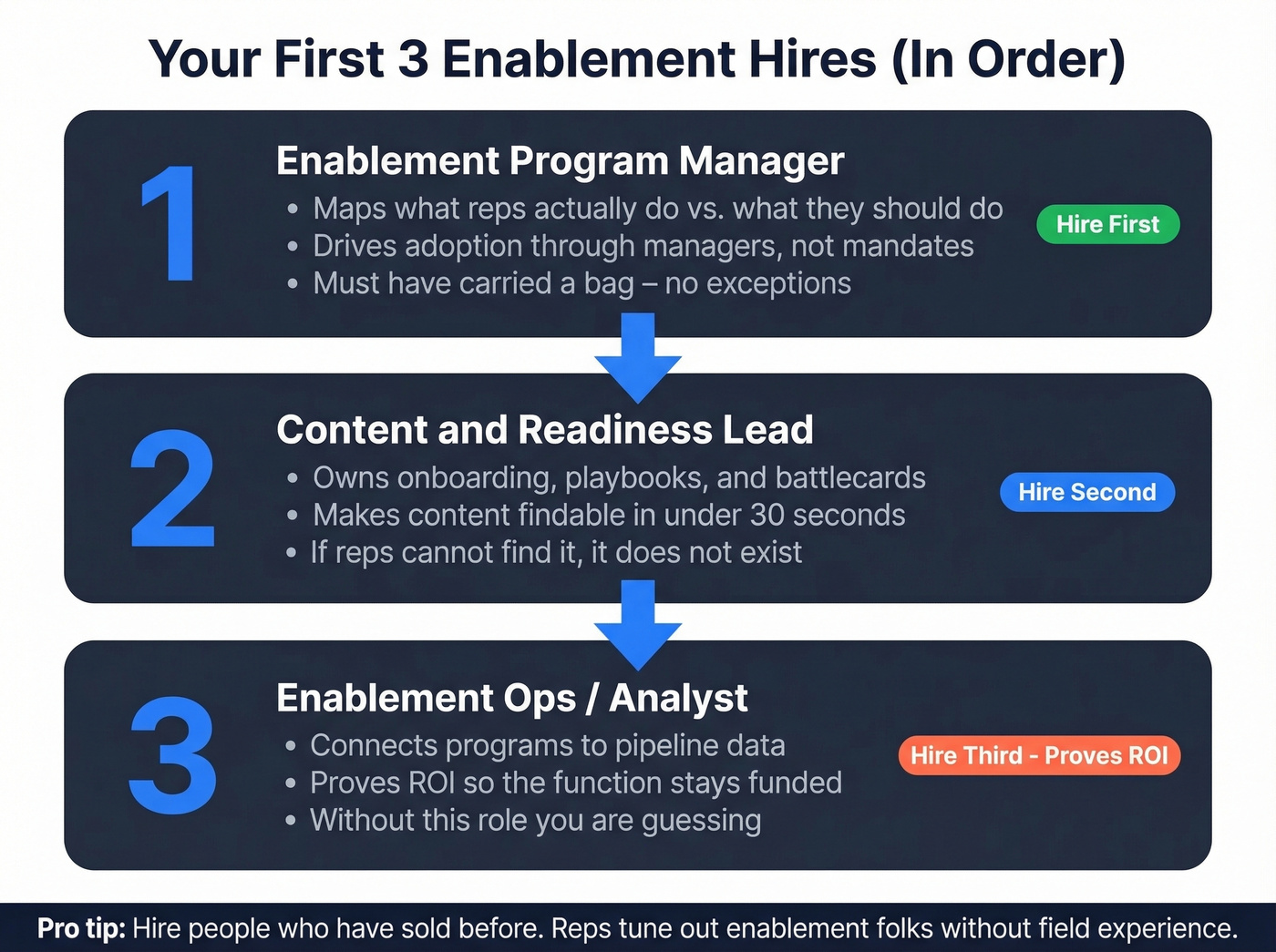
1. Enablement Program Manager. Maps what reps actually do, builds the golden path for what they should do, and drives adoption through managers. Must have carried a bag. The consensus on r/sales is blunt: enablement people without sales experience lose credibility fast, and reps will tune them out within weeks.
2. Content/Readiness Lead. Owns onboarding materials, playbooks, and competitive battlecards. Here's the thing - if reps can't find the right asset in 30 seconds, it doesn't exist to them. This person builds the system that makes content findable, not just available.
3. Enablement Ops/Analyst. Connects programs to pipeline data. Proves ROI. Without this role, you're guessing whether anything you shipped actually moved a number.
Where Enablement Should Report
Where enablement reports determines what it becomes. Heading into 2026, the data breaks down like this: RevOps at 39.4%, Sales at 25.4%, C-suite at 16.6%, Marketing at 5.2%, and the rest scattered across Product Marketing, HR, and other functions.
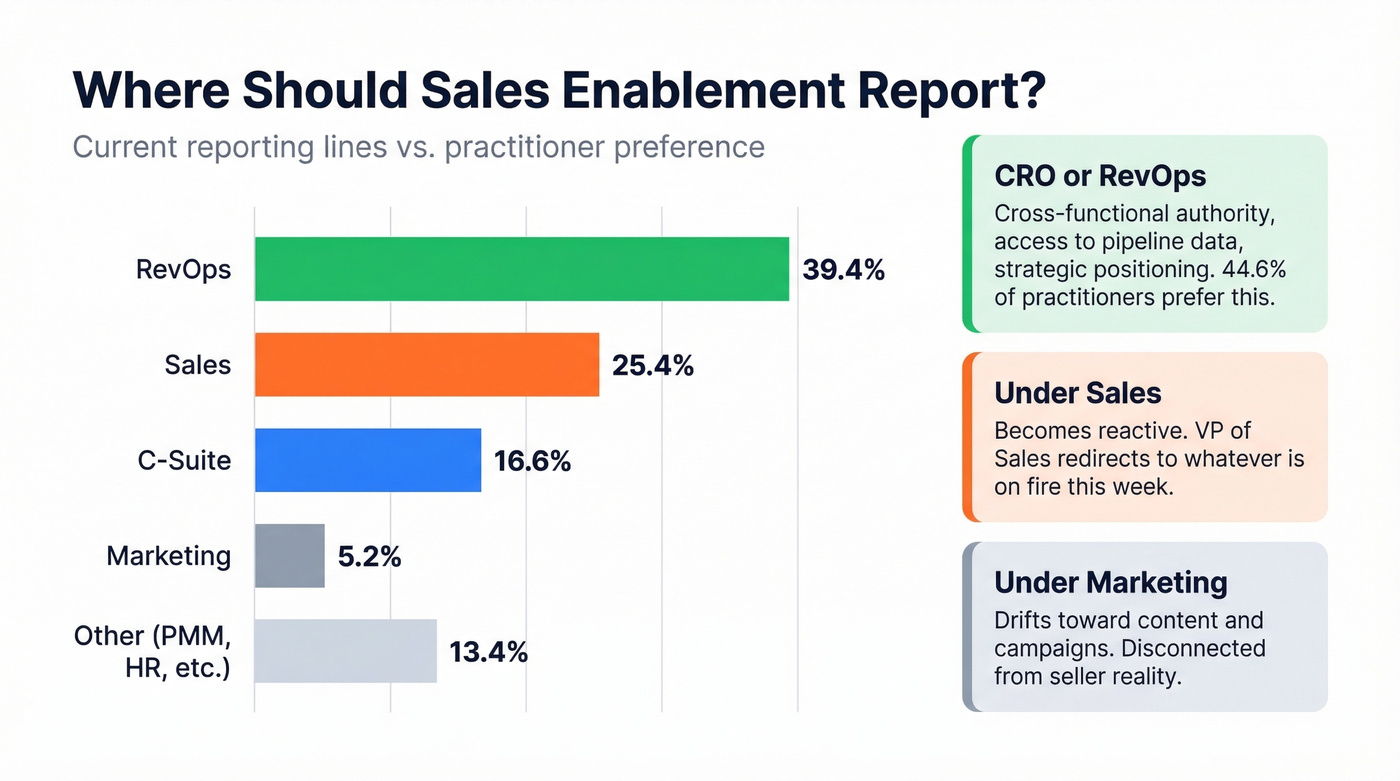
Under Sales, enablement becomes reactive by default. The VP of Sales has quota pressure and will redirect enablement toward whatever's on fire this week. Strategic work dies on the vine. Under Marketing, enablement drifts toward content and campaigns - useful, but disconnected from seller reality.
CRO or RevOps gives enablement the authority to set standards, access to data, and a cross-functional view of the buyer lifecycle. It's telling that 44.6% of practitioners say they'd prefer reporting to the C-suite. Reporting line is one of the most overlooked structural decisions, and getting it wrong constrains everything downstream.
What to Measure
Stop measuring training completion. Measure one funnel conversion you're fixing this quarter. Everything else is noise.
| Metric | % of Teams Using |
|---|---|
| Content adoption | 50% |
| Quota attainment | 43.1% |
| Win rate | 42.2% |
| Revenue generated | 37.9% |
| Sales cycle length | 33.6% |
Content adoption is the most tracked metric, but it's a leading indicator at best. The metrics that keep enablement funded are quota attainment, win rate, and revenue. Pick one funnel conversion that's broken - discovery-to-demo, demo-to-proposal, wherever your leak is - and tie your quarterly program to moving that number. In our experience, teams that anchor to a single conversion metric in their first quarter build credibility faster than those who try to boil the ocean with a 12-metric dashboard nobody reads.
Why Enablement Functions Fail
The first enablement leader in a startup has what practitioners call a "woodchipper" job - high chaos, high expectations, and no playbook. Gong's VP of GTM Enablement identified four failure patterns we've seen play out repeatedly:
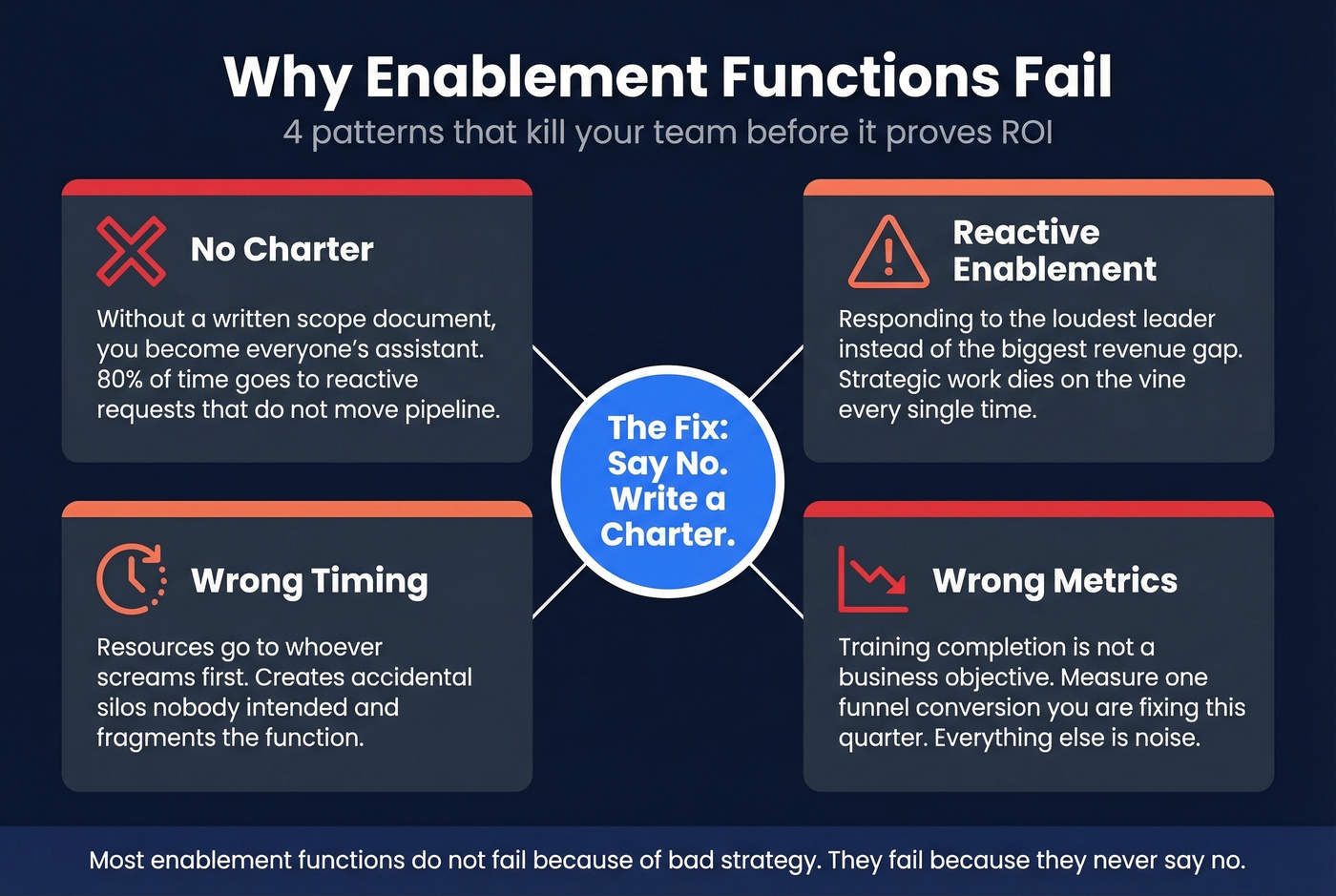
- No charter. Without a written scope, you're everyone's assistant.
- Reactive enablement. Responding to the loudest leader, not the biggest revenue gap.
- Wrong timing. Resources go to whoever screams first, creating silos nobody intended.
- Wrong metrics. Training completion is not a business objective. Full stop.
Let's be honest: most enablement functions don't fail because of bad strategy. They fail because they never say no. A charter isn't a nice-to-have - it's the single document that separates a strategic function from a help desk.
The Tech Stack That Moves Metrics
Most enablement orgs need four tool categories. Enterprise enablement platforms like Seismic or Highspot often land around ~$360-$960/user/year on annual contracts. Conversation intelligence like Gong is similarly enterprise-priced, often ~$1,200-$2,400+/user/year depending on package. CRM goes without saying. For buyer-facing enablement like digital sales rooms, practitioners on Reddit mention Trumpet and Dock for small teams, Aligned for mutual action plans.
The fourth category - data and enrichment - is where we see teams stumble hardest. Enablement programs fail when outbound lists are wrong: bounces rise, connect rates drop, reps stop trusting the process, and coaching experiments become unmeasurable. You can't evaluate whether a new talk track works if half the calls never connect because the phone numbers are dead. We ran into this exact scenario with a client who'd built a solid coaching program but couldn't prove it worked because their contact data was bouncing at 35%.
Prospeo's 98% email accuracy, 125M+ verified mobile numbers with a 30% pickup rate, and 7-day data refresh cycle solve this at a fraction of what enterprise tools charge - self-serve, no contracts, free tier to start. It's the cheapest piece of the stack and the one that makes everything else measurable.
Your enablement analyst needs pipeline data that's actually clean. Prospeo's CRM enrichment returns 50+ data points per contact with a 92% match rate - refreshed every 7 days, not every 6 weeks. That's the foundation your enablement metrics dashboard deserves.
Give your enablement team data worth building programs on.
FAQ
How big should a sales enablement team be?
Most teams run 2-4 people (33.8%), and one-person teams are nearly as common at 31%. Start lean, prove ROI on one funnel metric, then use that data to justify headcount. Ratio benchmarks: 1 enablement hire per 25-50 enterprise reps.
What does enablement do vs. sales operations?
Enablement owns rep readiness - onboarding, coaching, content, playbooks. Sales Ops owns process, territory design, comp, and CRM governance. They overlap on metrics, but enablement makes sellers better while Ops makes the system work.
How does data quality affect enablement outcomes?
Bad contact data tanks connect rates and makes coaching experiments unmeasurable. If half your calls don't connect, you can't tell whether a new framework works or your list is garbage. Cleaning up data quality is often the single highest-ROI move an enablement team can make in its first quarter.
What's the best reporting line for enablement?
CRO or RevOps - chosen by 39.4% of orgs and preferred by 44.6% of practitioners. Reporting under Sales makes enablement reactive; under Marketing it drifts toward content. RevOps gives cross-functional authority and direct access to pipeline data.