

How to Write a Sales Follow-Up Email After No Response
You sent 200 cold emails. Seventeen replies. The other 183? Nothing. Now you're staring at your sequencer wondering how many follow-ups it takes before you cross from persistent to annoying.
Belkins analyzed 16.5 million cold emails across 93 business domains and found the highest reply rate - 8.4% - comes from a single email. Each additional follow-up has diminishing returns, and sending four or more triples your spam and unsubscribe risk. Two to three strategic follow-ups is the practical ceiling for most cold sequences. After that, you're hurting your domain more than helping your pipeline.
Why They're Not Responding
Silence isn't rejection. It's an unspoken objection. GMass breaks non-response into five hidden objections, and every follow-up should address at least one:
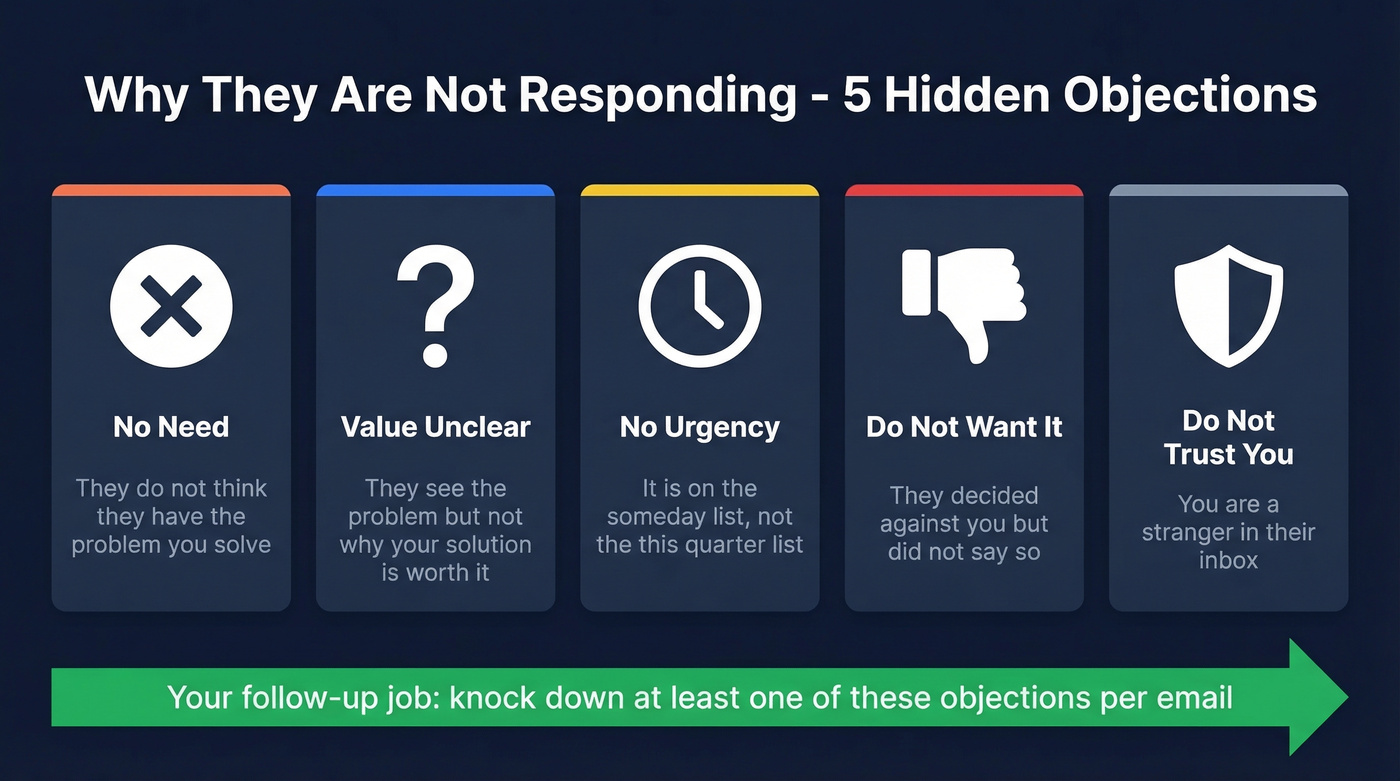
- No need. They don't think they have the problem you solve.
- Value unclear. They see the problem but not why your solution is worth the effort.
- No urgency. It's on the "someday" list, not the "this quarter" list.
- Don't want it. They've decided against you - they just didn't say so.
- Don't trust you. You're a stranger in their inbox.
Your follow-up's job isn't to "check in." It's to knock down whichever objection is keeping them quiet. And sometimes silence isn't an objection at all - it's a bad email address. If your bounce rate is above 2%, run your list through Prospeo before writing another word.
How Many Follow-Ups Actually Work
The Belkins dataset gets interesting when you break it by company size. Small businesses (2-50 employees) start at 9.2% reply rate, dip to 8% on the first follow-up, then tick back up to 8.4% on the second. Founders show a different curve: 6.64% initial, 6.66% after one, 6.94% after two, then down to 5.75% on the third and 3.01% on the fourth.
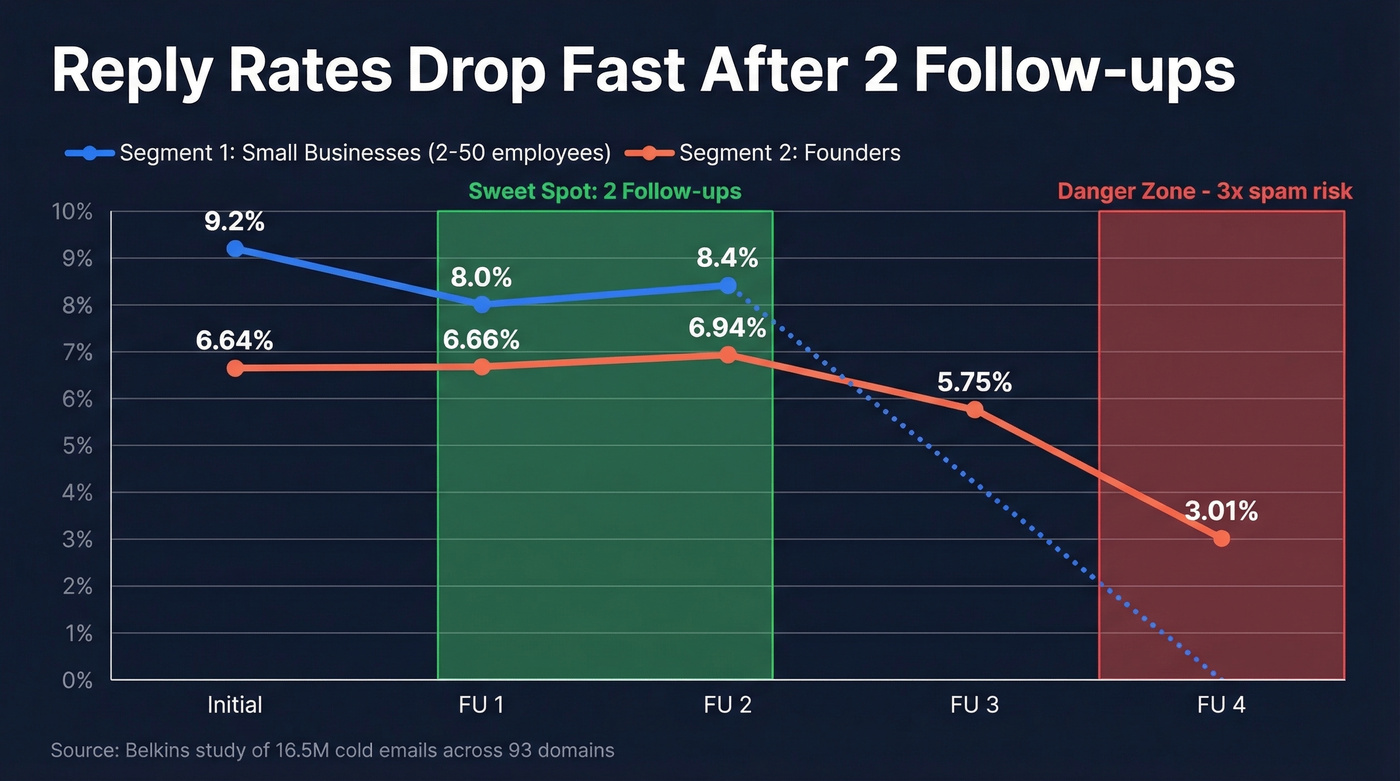
We've watched this pattern play out across dozens of campaigns. Two follow-ups is the sweet spot for most segments. Three is defensible if your first two added genuine value. Four is where you start burning domain reputation.
Follow-Up Email Templates That Earn Replies
Every template below follows one rule: each follow-up adds something new. No "just bumping this" - that's the fastest way to get archived. And 47% of recipients decide to open based on the subject line alone, so every subject here is short, specific, and earns the click.
After Initial Outreach (No Reply)
Subject: Re: [original subject]
Hi {{firstName}}, I know {{companyName}} is [specific challenge based on their industry]. Wanted to share a quick example - [similar company] cut [metric] by [result] in [timeframe] using [your approach]. Worth a 15-minute call this week?
New proof point, specific to their world. Replying in the same thread feels like a conversation, not a mass blast.
After a Demo or Meeting
This one doesn't need a fancy template. Reference something they actually said, attach the resource that addresses it, and propose a next step. The magic is in the specificity - "You mentioned X, so I pulled together Y" proves you listened and separates you from every rep sending canned sequences.
After Sending a Proposal
Subject: Quick question on the proposal
Hi {{firstName}}, what's the biggest concern coming up as you review the proposal? Happy to jump on a 10-minute call before your [decision date/internal meeting].
Borrowed from a Reddit practitioner thread - asking "what's the biggest concern" invites honesty instead of silence.
The "New Value" Follow-Up
Skip the template entirely. Find a relevant industry stat, article, or news item that connects to their challenge. Send it with one line of context and one line offering to talk. You're not following up - you're being useful. This is the kind of follow-up after no response that actually earns replies because it leads with value instead of asking for attention.
After a Voicemail
Subject: Just left you a voicemail
Hi {{firstName}}, would Tuesday at 2pm or Wednesday at 10am work for a quick call? If neither, reply with a time that does.
Two specific time slots reduce friction. The scheduling frame gives them a concrete reason to reply.
The Breakup Email
Subject: Should I close your file?
Keep breakup subjects short and unambiguous. The A/B/C/D format from GrowLeads is a clean way to get a fast answer:
A) Interested, bad timing - circle back in Q3 B) Wrong person - try someone else C) Not interested - stop emailing D) Let's talk - send me times
"Just reply with a letter. Takes 2 seconds." Even a "C" is valuable - it cleans your pipeline and protects sender reputation.
One formatting note: keep every follow-up in plain text. No images, no HTML templates. Emails that look "real" outperform marketing-style layouts in cold outreach every time.

A brilliant follow-up sequence is worthless when 35% of your emails bounce. Prospeo's 5-step verification delivers 98% email accuracy - so every follow-up actually lands in the inbox. At $0.01 per email, cleaning your list costs less than one wasted send.
Fix your list before you fix your copy.
The QVC Framework
If none of those templates fit, use the QVC formula from SalesHigher: Question, Value, CTA. Three to five sentences total. Open with a question relevant to their world - not "My name is..." which immediately signals a stranger selling. Follow with one sentence of value. Close with a single, low-friction ask.
This also works as a ChatGPT prompt structure if you're using AI to draft follow-ups. It keeps the output focused. The best follow-up email doesn't feel like a follow-up at all. It feels like someone with something useful to say.
Optimal Follow-Up Cadence
Sybill's framework recommends 7-10 touches over 10-14 days for cold prospects, and 4-7 touches within a week for warm leads who've gone quiet:
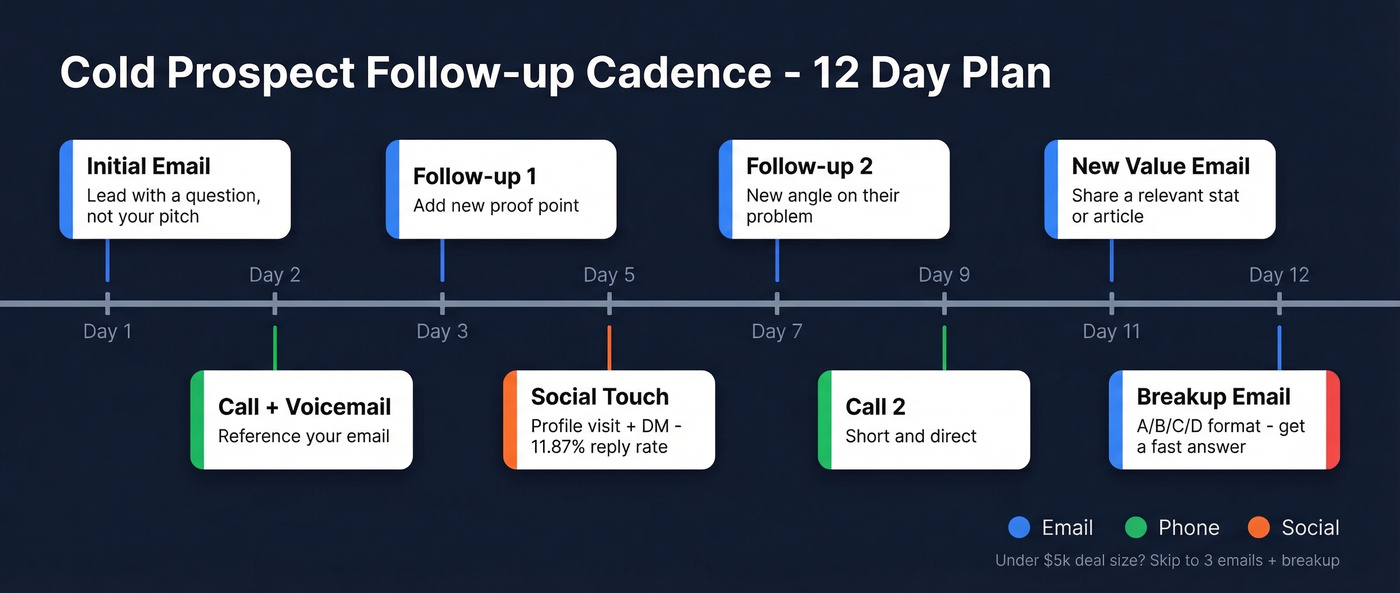
| Day | Touch | Channel |
|---|---|---|
| 1 | Initial email | |
| 2 | Call + voicemail | Phone |
| 3 | Follow-up #1 | |
| 5 | Social touch | Social |
| 7 | Follow-up #2 | |
| 9 | Call #2 | Phone |
| 11 | New value email | |
| 12 | Breakup email |
Trigger-based timing beats "best day of week" every time. A job change, a funding round, a new hire in their department - these are better signals than "Tuesday at 9am." Belkins found that combining a social profile visit with a direct message hit an 11.87% reply rate, outperforming email-only sequences.
Here's the thing: if your average deal size is under $5k, you probably don't need an 8-touch sequence. Three emails and a breakup. Spend the saved time fixing your targeting instead.
Protect Your Domain First
None of this matters if your emails aren't reaching the inbox. SuperSend's deliverability benchmarks are clear: keep bounce rate under 2%, spam complaints under 0.1%, and never exceed 50 emails per day from a single inbox. SPF, DKIM, and DMARC are non-negotiable. New inboxes need 6+ weeks of warm-up before hitting that 50/day ceiling.
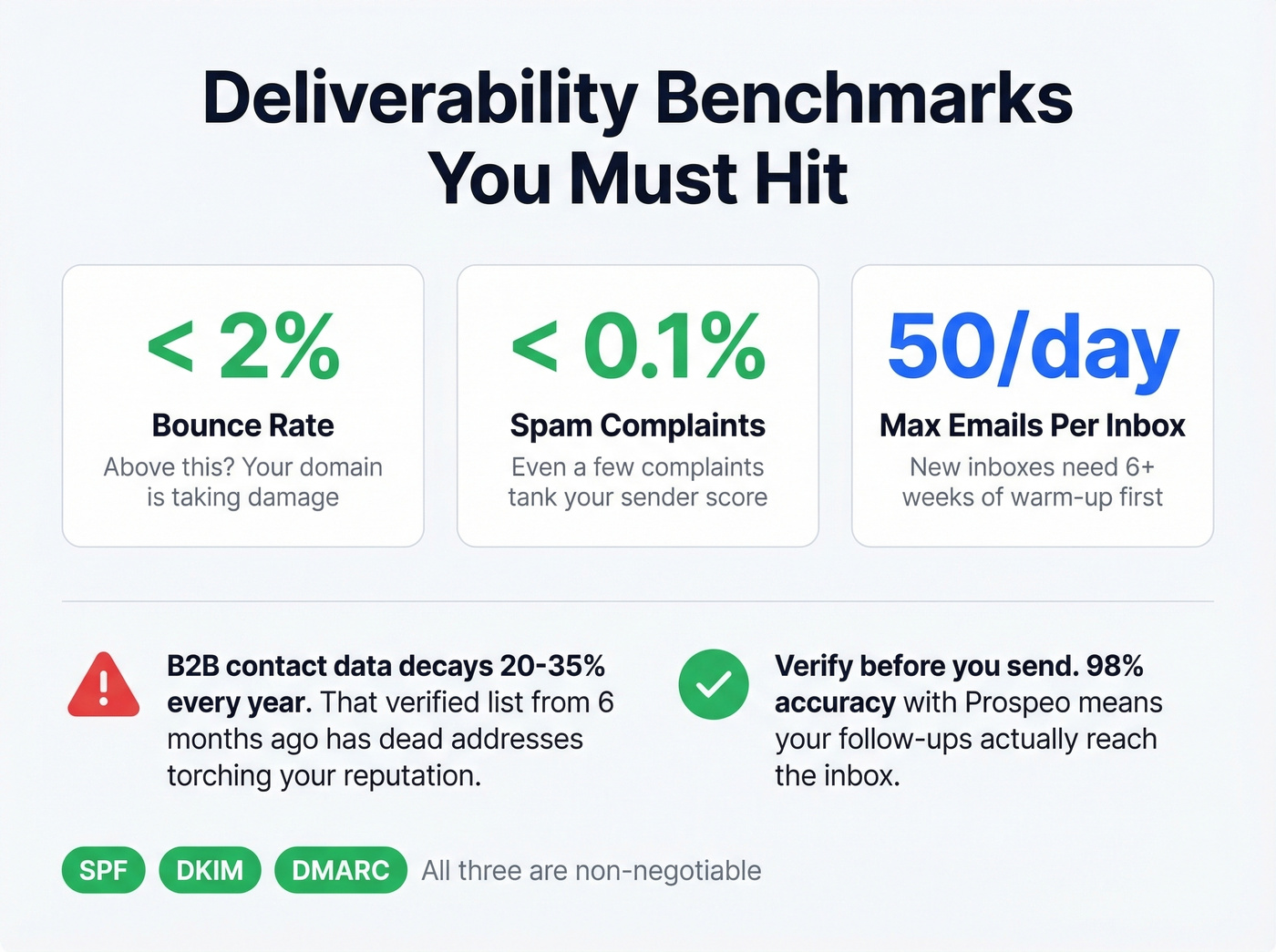
B2B contact databases decay 20-35% every year. That "verified" list from six months ago? A chunk of those addresses are dead, and every bounce chips away at your sender score. We've seen teams rewrite their entire follow-up sequence three times before realizing the real problem was a 7% bounce rate torching their domain. Run your list through Prospeo's verification before launching any sequence - 98% email accuracy on a 7-day data refresh cycle catches the bad addresses that tank deliverability. The free tier gives you 75 verifications per month, enough to test whether your list is the real problem.

Trigger-based follow-ups outperform scheduled ones - but only if you have fresh data. Prospeo refreshes 300M+ profiles every 7 days, so you catch job changes, promotions, and funding rounds before your competitors do. That's the timing signal no cadence tool can give you.
Stop following up on stale data. Start with signals that are 7 days fresh.
FAQ
How long should I wait before following up?
Two to three business days for cold prospects, one to two days for warm leads who've gone quiet after a demo or proposal. Trigger-based timing - like a prospect's job change or funding announcement - consistently outperforms fixed calendar rules.
Should I reply in the same thread or start a new one?
Same thread for the first two follow-ups. It preserves context and feels conversational. Switch to a new subject line for the breakup email - a fresh subject resets attention and typically lifts open rates 10-15% on that final touch.
How do I know my follow-ups are actually reaching the inbox?
Check your bounce rate first. If it's above 2%, you're damaging deliverability and no template will save you. Verify your list before launching any sequence. Even the best-written sales follow-up email after no response is worthless if it lands in spam.
What's the biggest mistake in follow-up emails?
Sending "just checking in" with zero new value. Every follow-up must add something - a case study, a relevant stat, a new angle on their problem. The Belkins 16.5M-email study shows reply rates drop sharply after the second touch when messages repeat the same ask without new context.