

Follow Up Email After No Response: What 28.5M Emails Reveal
Stop sending more follow-ups. Start sending better first emails.
Across 16.5 million cold emails analyzed by Belkins and [12 million outreach emails studied](https://backlinko.com/email-outreach-study) by Backlinko, the highest reply rate - 8.4% - came from the initial send in Belkins' dataset, not the third nudge. That means your follow up email after no response probably isn't your real problem. Your first email is.
Here's what actually moves the needle:
- Verify emails before sending - bad data kills sequences before copy matters
- Cap follow-ups at 3 (4+ emails more than triple spam complaint risk)
- Each follow-up adds new value - never "just checking in"
- Front-load your best messaging into email one
What 28.5M Emails Actually Show About Follow-Ups
One follow-up boosts replies by 65.8%. But returns drop fast, and risk climbs faster.
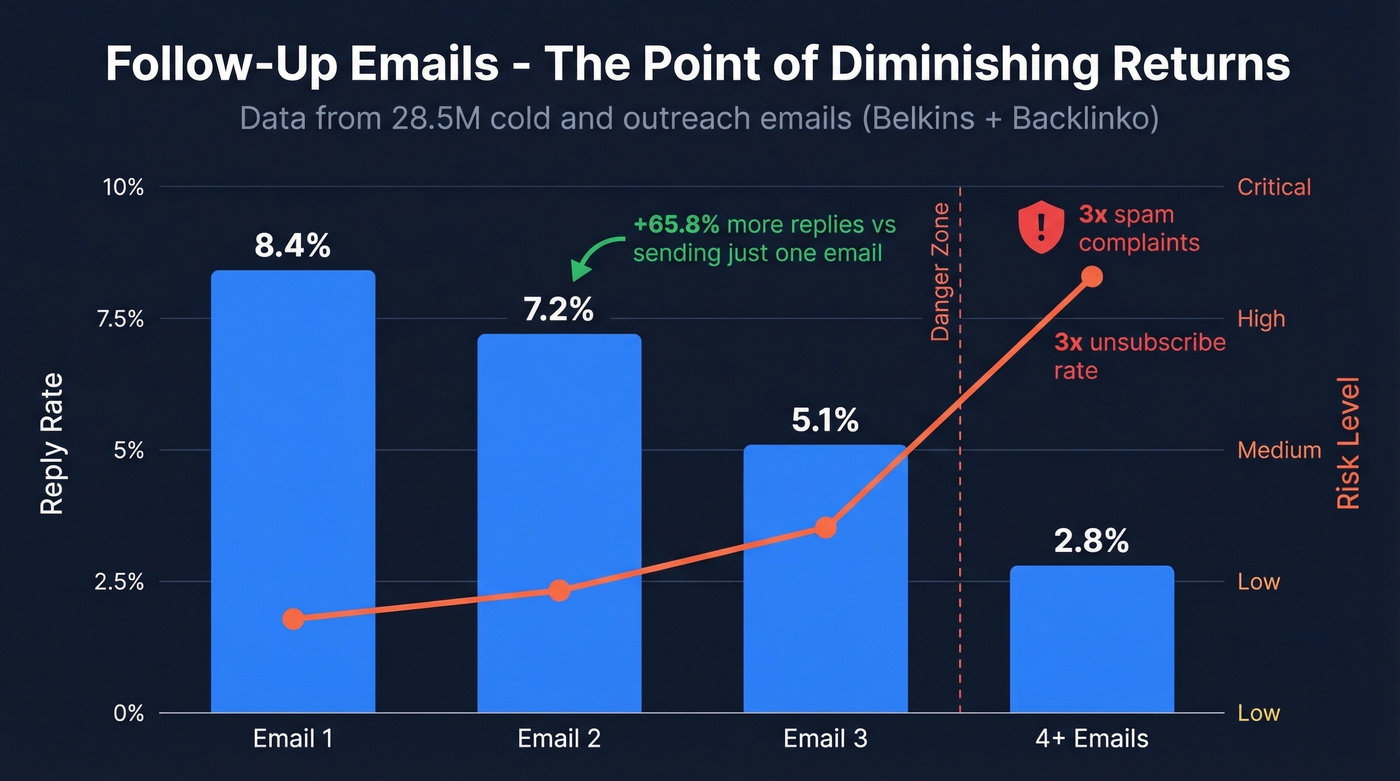
Belkins' 16.5M cold email study found the best performance came from a single email at 8.4%, with reply rates declining on each subsequent send. Backlinko's 12M outreach email analysis tells a complementary story: emailing the same contact multiple times leads to 2x more responses, and a single follow-up can boost replies by 65.8%. So one follow-up is almost always worth it. Two or three can work. Four is where things break.
Belkins also found that sending 4+ emails in a sequence triples unsubscribe rate and more than triples spam complaint risk. That's your ceiling if you care about email deliverability.
Company size matters here too. SMBs with 2-50 employees start around 9.2% reply rates and can tolerate a couple of follow-ups. Enterprise contacts at 1,000+ employees ghost quickly and punish persistence. We've seen this pattern repeatedly in our own outreach - the bigger the company, the shorter the leash.
The Objection-Mapping Framework
Most follow-ups fail because they repeat the same pitch louder. Here's the thing: if someone ignored your first email, saying the same thing again with "just bumping this up" isn't a strategy. It's laziness.
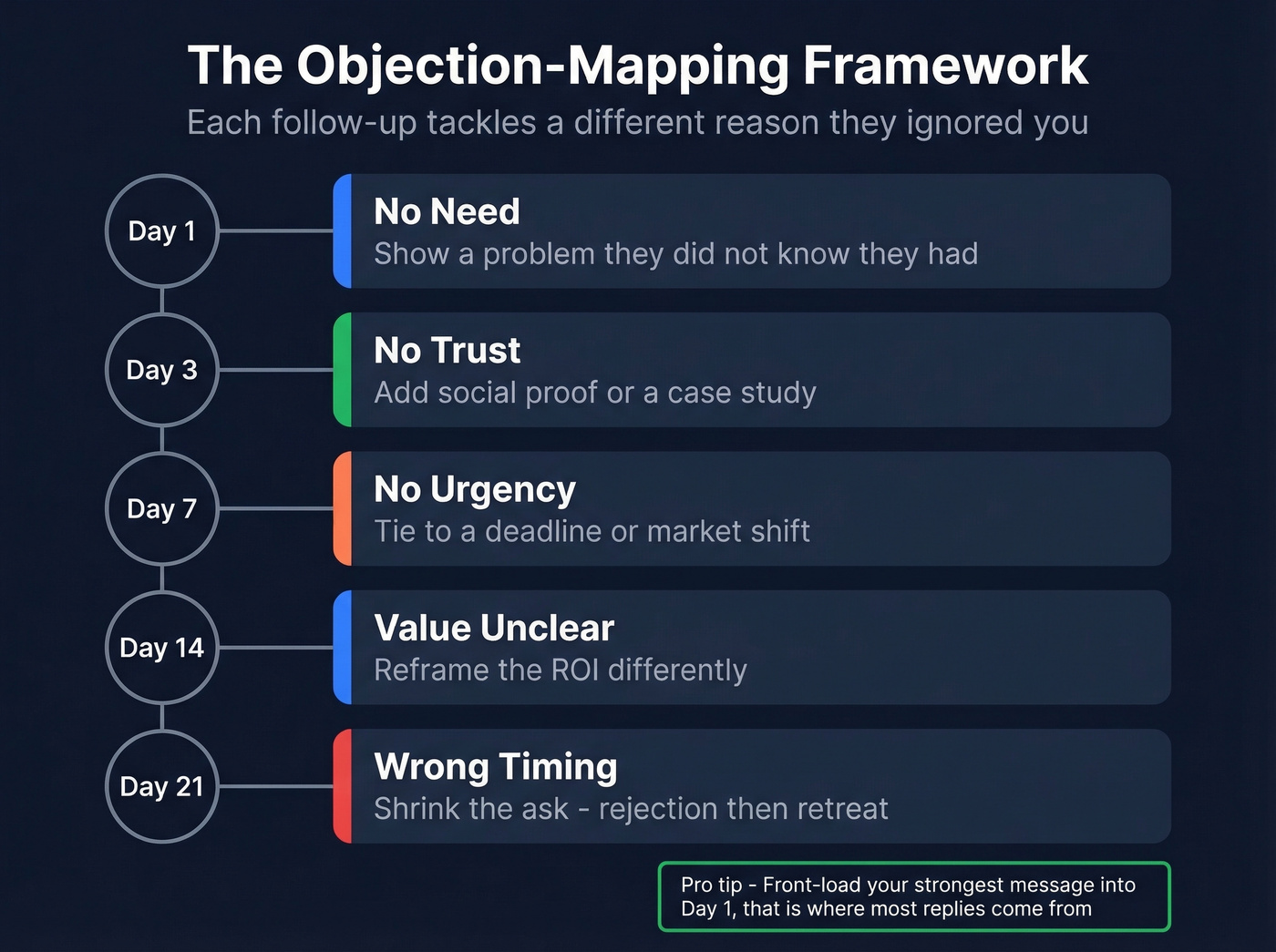
Instead, map each follow-up to a different objection:
- No need - show a problem they didn't know they had
- No trust - add social proof or a case study
- No urgency - tie to a deadline or market shift
- Value unclear - reframe the ROI differently
- Wrong timing - acknowledge it, offer a lower-friction next step
Space sends on a widening schedule: Day 1, Day 3, Day 7, Day 14, Day 21. Front-load your strongest messaging into the earliest touchpoints, because that's where most of your replies will come from anyway.
For the final email, use rejection-then-retreat - shrink the ask from "Can we book 30 minutes?" to "Would you point me to the right person?" The concession triggers reciprocity, and it gives your prospect an easy way to help without committing to anything.
5 Templates That Actually Get Replies
Every template below is plain text, under five lines, and sounds like a person wrote it. Use them as starting points, but keep the plain-text format - HTML templates in cold outreach are a deliverability risk.
If you want more options, start with these Sales Follow-Up patterns.
Sales Follow-Up (Day 3)
"Hi [Name], I shared some thoughts on [specific problem] last week. Since then, [Company X] published a report showing [relevant stat]. Thought it might change the math for your team. Worth a quick look?"
Proposal Follow-Up (Day 5)
"Hi [Name], wanted to flag one thing - [specific section] has a deadline tied to [event/quarter]. Happy to adjust scope if the timing's off."
Job Application Follow-Up (Day 7)
"Hi [Name], following up on my application for [role]. I noticed [company] just [launched/announced something]. I worked on something similar at [previous company] - happy to share what we learned."
Cold Outreach Follow-Up (Day 3)
"[Competitor or peer company] cut [metric] by [number] using [approach]. If that's relevant to your team, I can share the breakdown. If not, no worries."
Breakup Email (Day 14-21)
"I'll assume the timing's off. If [problem] comes back on your radar, I'm easy to find. Is there someone else on your team I should connect with?"
Notice what all five have in common: they're short, they add something new, and they give the recipient an easy out. No guilt trips. No "I haven't heard back from you" passive aggression.

Meritt dropped their bounce rate from 35% to under 4% and tripled pipeline to $300K/week - just by switching to verified contact data. Prospeo's 5-step verification catches spam traps, honeypots, and catch-all domains before they wreck your sender reputation.
Fix your list before you fix your follow-up copy.
Subject Lines That Get Opened
47% of recipients decide to open based on the subject line alone, and 69% decide to report spam based on it. Those two stats should terrify you into caring about this.
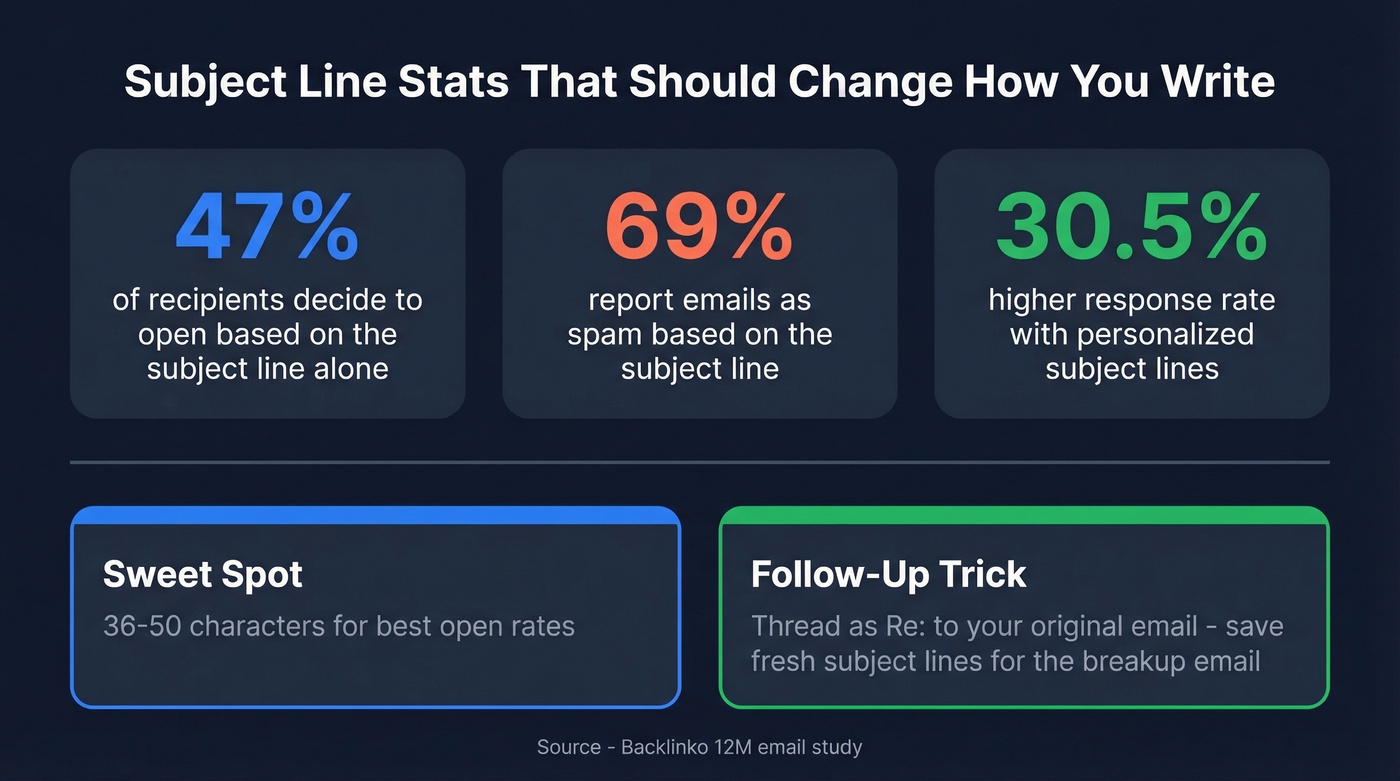
Keep subject lines between 36-50 characters - that's the sweet spot from Backlinko's 12M-email dataset. Personalized subject lines correlate with 30.5% higher response rates.
For follow-ups, thread as a "Re:" to your original email. It signals continuity and avoids inbox filters treating it as a new cold message. Save a fresh subject line for your breakup email - that's when a pattern interrupt actually helps.
If you need a bigger swipe file, pull from these email subject line examples.
Why Your Follow-Ups Land in Spam
The invisible reason follow-ups fail isn't your copy. It's your data.
If your bounce rate exceeds 2%, inbox providers start treating your domain like a risk before anyone reads word one. Your SPF, DKIM, and DMARC records need to be configured correctly - if they aren't, stop everything else and fix them first. Beyond authentication, keep spam complaints under 0.1%, disable open-rate tracking pixels for cold sequences (they hurt deliverability more than the data is worth), and use a secondary domain for cold outreach to protect your primary. Space sends 2-5 minutes apart instead of blasting in bulk.
But none of that matters if you're emailing dead addresses. In our experience, list quality is the single biggest lever most teams ignore. Prospeo's 5-step verification process handles catch-all domains, removes spam traps and honeypots, and delivers 98% email accuracy. One customer, Meritt, dropped their bounce rate from 35% to under 4% after switching to verified lists - and their pipeline tripled from $100K to $300K per week. The free tier covers 75 emails plus 100 Chrome extension credits per month, enough to test before committing.
If you’re rebuilding your outbound list from scratch, how to generate an email list is the fastest place to start.

When to Stop and Switch Channels
A thread on r/b2bmarketing asked what to do with the "97%" who never respond. The consensus wasn't "send more emails."
After three unanswered follow-ups, you're past diminishing returns and approaching domain damage. Switch channels instead. Belkins found that a message-plus-profile-visit combo hit 11.87% reply rates - higher than any email follow-up in their dataset. Backlinko's data shows reaching out to multiple contacts at the same organization boosts response rates by 93%.
Let's be honest: most teams don't have a follow-up problem. They have a first-email problem wrapped in bad data. Fixing list quality and rewriting email one beats adding a fourth or fifth nudge to a sequence no one asked for. If you've sent three solid, value-adding follow-ups and heard nothing, that prospect is telling you something. Listen.
Skip the channel-switching playbook entirely if you haven't verified your list first. Calling a wrong number or messaging the wrong person on social is just as wasteful as emailing a dead address.
If you’re building a broader outbound motion, these sales prospecting techniques help you diversify beyond email.
After three unanswered emails, the data says to switch channels. Prospeo gives you 125M+ verified mobile numbers with a 30% pickup rate - so when email silence hits, you have a direct dial ready.
Stop following up into the void. Call them instead.
2026 Cold Email Benchmarks
| Metric | Typical Range | Good |
|---|---|---|
| Open rate | 27-35% | 40%+ |
| Reply rate | 5-6% | 10%+ |
| Positive reply | 2-4% | 5%+ |
| Meeting booked | 1-2% | 3%+ |
| Bounce rate | Under 5% | Under 1% |
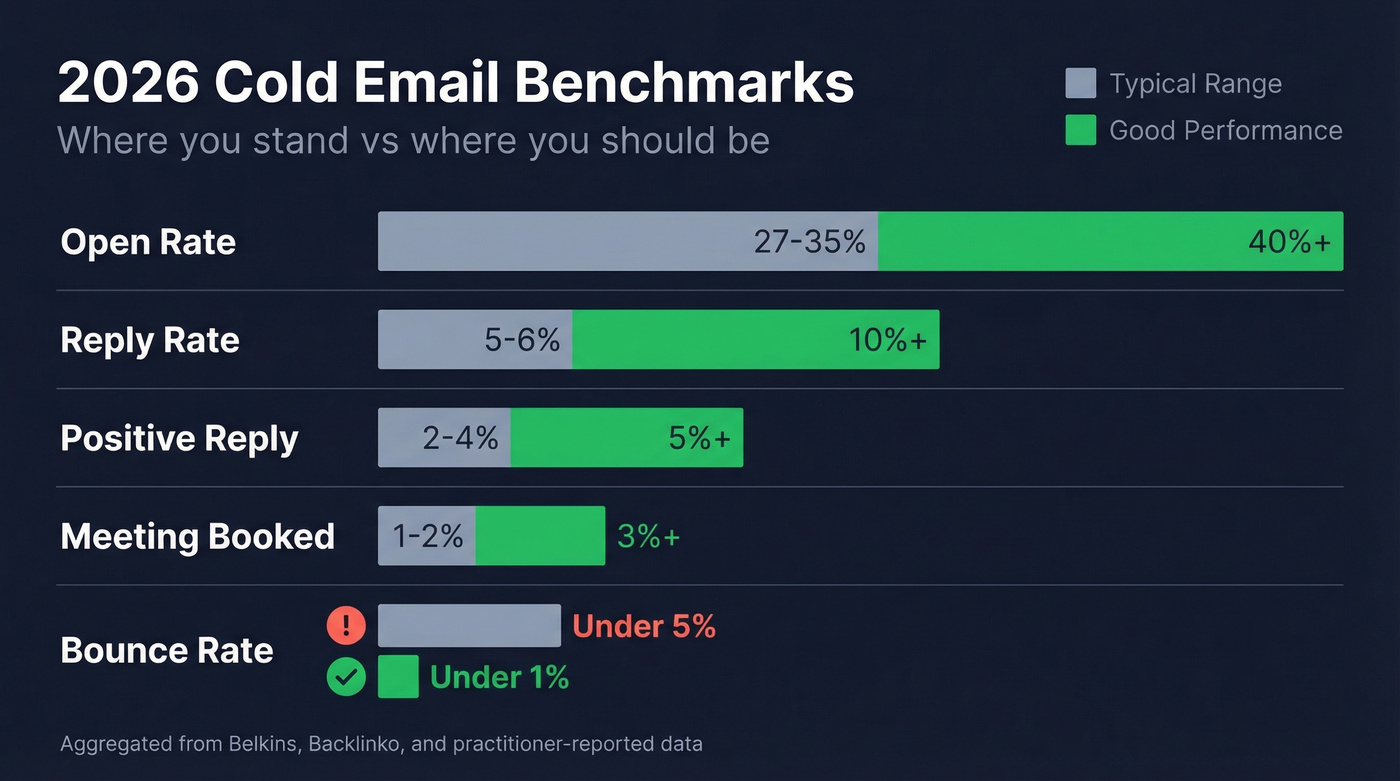
Ranges aggregated from Belkins, Backlinko, and practitioner-reported data.
To pressure-test your numbers, compare against these 2026 benchmarks.
FAQ
How many follow-up emails should I send?
One to three. Belkins' 16.5M-email study shows 4+ emails triple unsubscribe rate and more than triple spam complaint risk. Enterprise contacts punish persistence fastest - once you've got nothing new to say, stop and switch to phone or social.
How long should I wait before following up?
Two to three business days for the first follow-up, then widen the gap: Day 7, Day 14, Day 21. Most replies come from the first touchpoint, so front-load your strongest value into email one rather than saving it for later.
What if emails aren't bouncing but I still get zero replies?
Check deliverability first - SPF, DKIM, and DMARC must be configured. Keep bounce rates under 2% and spam complaints under 0.1%. Verify your list to catch invalid addresses that don't hard-bounce but still erode sender reputation. Then audit your opener - in Belkins' dataset, the highest reply rate came from the initial send, not the follow-ups. Your first email is doing the heavy lifting whether you realize it or not.