

Email Response Rate: 2026 Benchmarks and How to Fix Yours
Only 1 in 8 outreach emails gets a reply. That's from a Backlinko/Pitchbox study of 12 million emails - and that dataset includes warmer outreach like link building, PR, and partnerships. For pure cold sales email, the picture is bleaker. One analysis of 16.5M cold emails found reply rates declined from 6.8% in 2023 to 5.8% in 2024, about a 15% year-over-year drop. Understanding your email response rate - and what actually moves it - is the difference between a pipeline that compounds and one that stalls.
The quick version: Most reply-rate problems are data and deliverability problems, not copy problems. Verify your list (bounce rate under 2%), cap sending at 25-30 emails per mailbox per day, kill open-tracking pixels, and keep cold emails under 80 words. Fix those four things before you touch a subject line.
What Is Email Response Rate?
Email response rate measures how many recipients reply to your outreach:
Unique human replies / delivered emails x 100
Use delivered emails as your denominator - sent minus hard bounces, not total sent. Strip out auto-replies, out-of-office messages, and system notices. A "not interested" counts. An OOO doesn't.
There's also a critical distinction between total reply rate and positive reply rate. Some teams report a top-line number that lumps in every reply, including objections and unsubscribe requests, while others only count replies expressing genuine interest. One practitioner sent 147,000 cold emails and reported a 1.2% positive reply rate (1,764 conversations) leading to 40 calls. Know which number you're tracking before you benchmark.
2026 Benchmarks by Study
Four major studies produce four different numbers. Here's why:
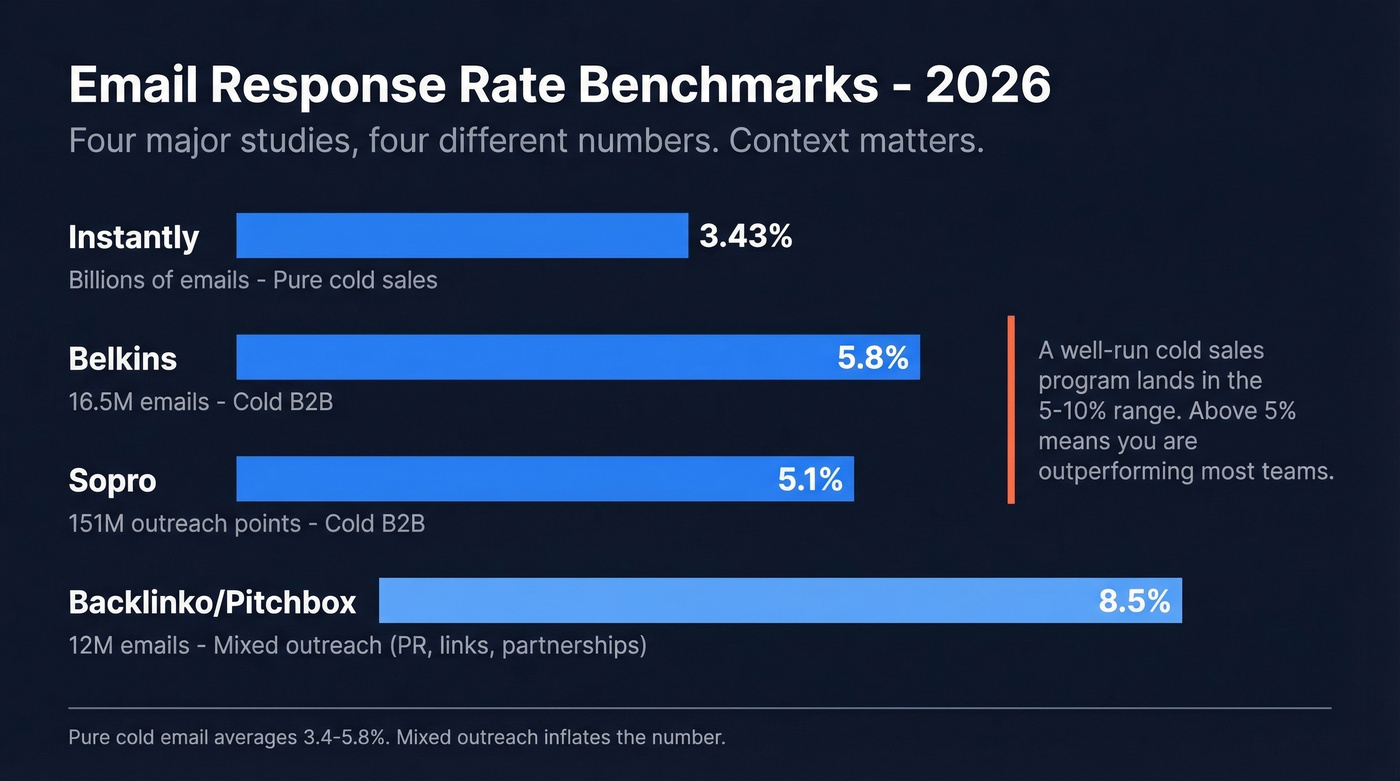
| Source | Avg Reply Rate | Dataset | Type |
|---|---|---|---|
| Instantly | 3.43% | Billions | Cold sales |
| Belkins | 5.8% | 16.5M emails | Cold B2B |
| Sopro | 5.1% | 151M outreach points | Cold B2B |
| Backlinko/Pitchbox | 8.5% | 12M emails | Mixed outreach |
Backlinko's 8.5% reflects mixed outreach - link building, PR pitches, partnerships. Instantly's 3.43% captures pure cold at massive scale. A well-run cold sales program lands in the 5-10% range, and 5-8% is excellent.
Teams watching reply rates over the last couple of years generally agree on the direction: what felt "normal" in 2023 is harder to sustain now, and 8-10% is increasingly treated as a win in tougher segments.
On Instantly's platform, the top quartile hits 5.5%+ and the top 10% exceeds 10.7%. If you're consistently above 5%, you're outperforming most teams. Below 2%, the problem almost certainly isn't your copy.

Every bounced email tanks your sender reputation, which tanks inbox placement, which kills reply rates. Prospeo's 5-step verification with catch-all handling and spam-trap removal delivers 98% email accuracy - refreshed every 7 days, not every 6 weeks. Meritt dropped bounce rates from 35% to under 4% and tripled their pipeline.
Stop losing replies to bad data. Start with emails that actually land.
What Actually Drives Reply Rates
Most teams obsess over copy when the real gains are upstream. Here are the levers, ranked by impact.
If you want the full infrastructure-first system, see our guide to B2B cold emailing.
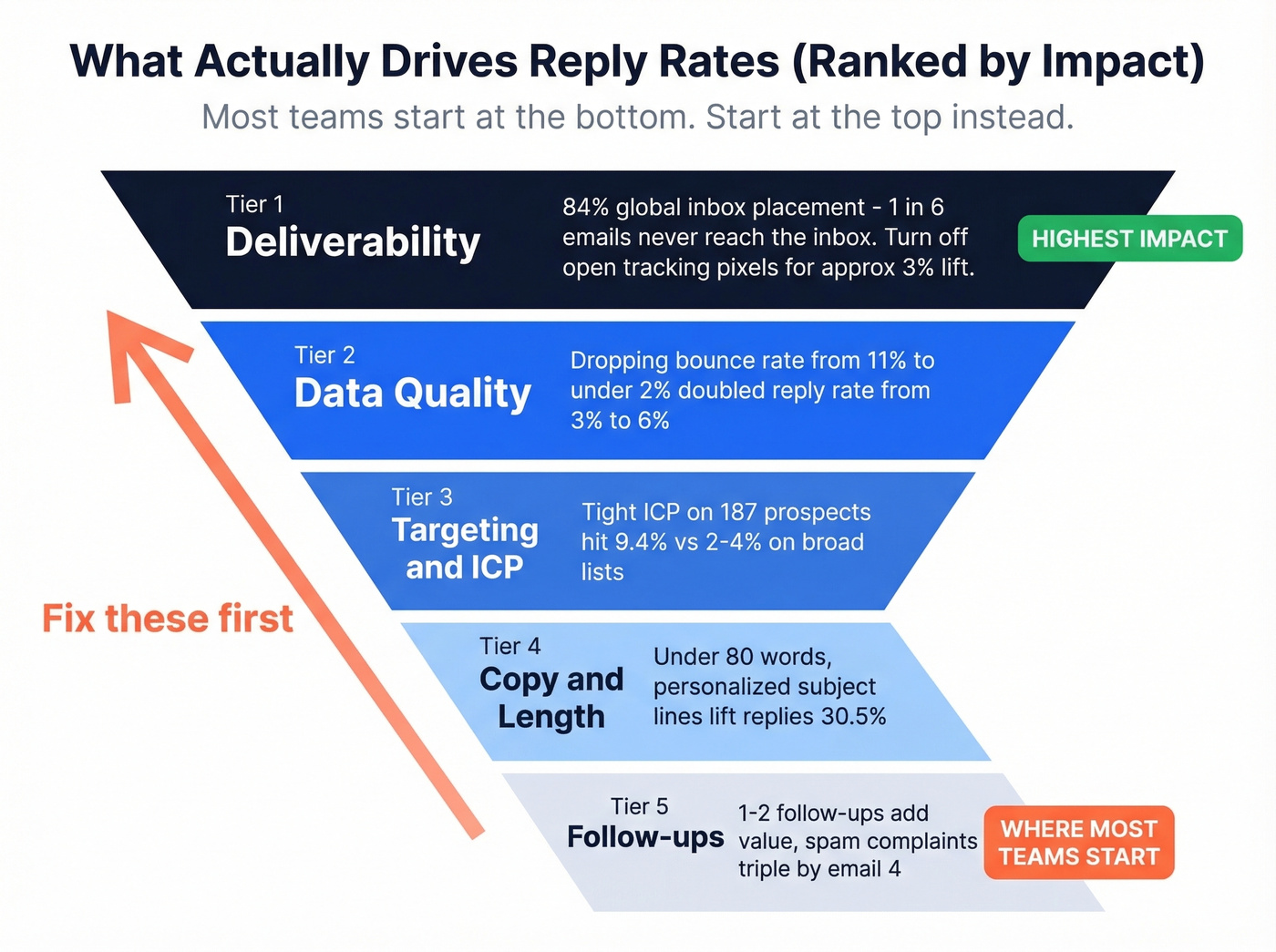
Deliverability
Global inbox placement runs about 84% - one in six emails never reaches the inbox. Microsoft is the worst offender at 75.6% inbox placement, with 14.6% landing in spam. If roughly 15% of your Outlook-bound emails hit spam, your effective reply rate on that segment drops 15% before anyone reads a word.
Domain warm-up now takes 6-8 weeks, up from roughly 3 weeks a couple of years ago - another reason reputation damage is so costly. Quick win: turn off open-tracking pixels. A 16.5M-email dataset showed ~3% higher response rates without them. We've seen this firsthand. Open tracking is the single most common self-inflicted wound in cold outreach, and the deliverability hit isn't worth the vanity metric.
If you're still dialing in setup, use a cold email infrastructure checklist before you scale.
Data Quality
This is the highest-leverage fix most teams ignore.
A practitioner on r/Entrepreneur rebuilt their list hygiene process, dropped bounce rate from 11% to under 2%, and watched reply rate double from 3% to 6%. High bounce rates destroy sender reputation, which tanks deliverability, which kills replies. It's a cascade, and it starts with the data.
The same 16.5M-email dataset reinforces this: emailing 10+ contacts at one company drops reply rates to 3.8% versus 7.8% for 1-2 contacts. Bad data doesn't just waste sends - it actively damages your ability to reach anyone.
Prospeo runs every address through 5-step verification with catch-all handling, spam-trap removal, and honeypot filtering, refreshing data every 7 days. At 98% email accuracy, you're sending to real inboxes, not dead ends. Meritt cut bounce rates from 35% to under 4% after switching, and Stack Optimize maintains 94%+ deliverability across all clients.
For a deeper breakdown of list hygiene, see common data quality issues and how to verify if an email is valid.
Targeting and ICP
A B2B SaaS team on Reddit tightened their ICP and watched reply rates jump from 2-4% to 9.4% on 187 prospects. Smaller, tighter lists of 50-200 contacts consistently outperform massive blasts. Let's be honest - most "spray and pray" campaigns aren't a volume problem. They're a targeting problem disguised as a volume problem.
If you need a structured way to define who you’re emailing, start with B2B target market analysis.
Copy and Length
Here's the cold email copy checklist that actually moves the needle:
- Under 80 words. Belkins found emails with 6-8 sentences hit a 6.9% reply rate. Emails under 200 words outperform longer ones across the board. (More frameworks: cold email format.)
- Subject lines of 36-50 characters. Personalized subject lines lift responses by +30.5%; personalized body copy adds +32.7%. If you want swipeable options, use these email subject line examples.
- Real triggers, not mail-merge tokens. Job postings, funding rounds, new hires - not "Hey {first_name}, love what {company} is doing." (More on this: how to personalize cold emails.)
Follow-Ups
In mixed outreach data, one follow-up boosted replies by 65.8%. On Instantly's platform, 58% of replies come from step 1 and 42% from follow-ups. That said, one B2B SaaS team found ~70% of their replies came on touches 2-3 - sequence design and audience warmth matter more than a fixed rule.
If you’re rebuilding your cadence, use these follow-up campaign examples as a starting point.
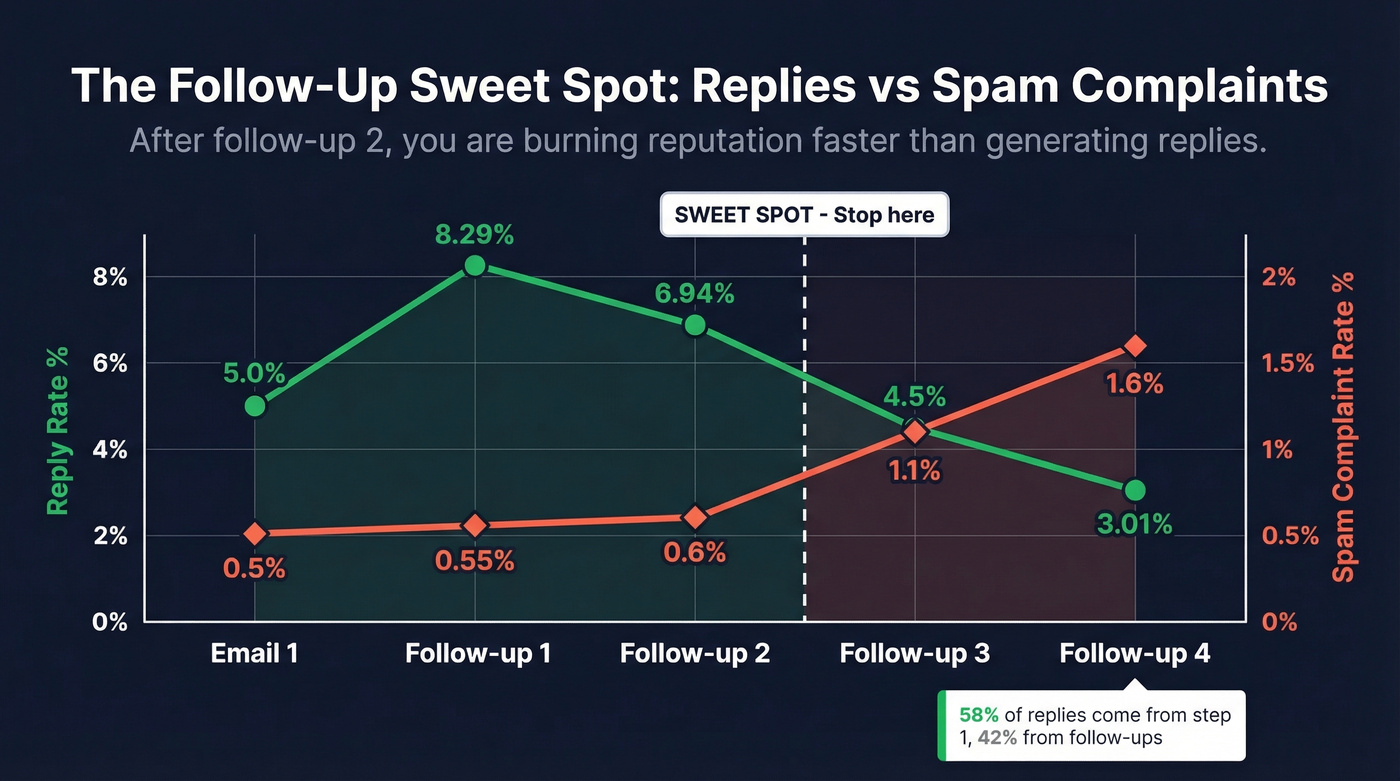
Here's the thing: spam complaints triple by the 4th email, from 0.5% to 1.6%. The founder persona pattern shows replies peak at follow-up #2 (6.94%) then crater to 3.01% by follow-up #4. The sweet spot is 1-2 follow-ups that add new value. After 3, you're burning domain reputation faster than you're generating replies.
Real-World Case Studies
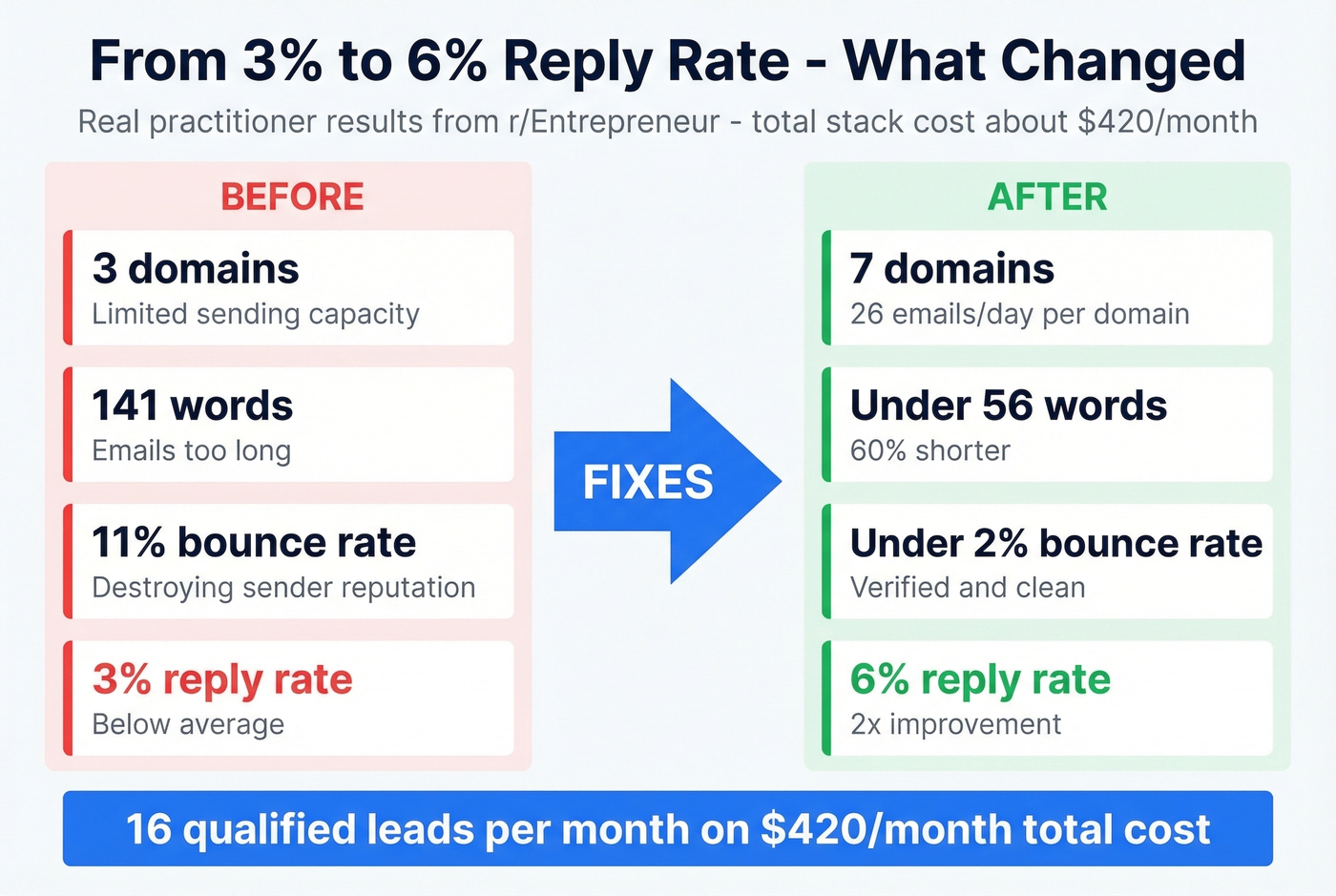
A practitioner on r/Entrepreneur went from 3% to 6% by expanding from 3 to 7 domains, capping at 26 emails/day per domain, cutting email length from 141 to under 56 words, and dropping bounce rate from 11% to under 2%. Total stack cost: ~$420/month. Result: 16 qualified leads per month.
If you’re pressure-testing whether cold is worth it in your segment, see do cold emails work.
Another practitioner sent 147,000 cold emails at a 1.2% positive reply rate - then switched to warm outreach (joining existing conversations) and hit 34%. Cold versus warm is the single biggest variable in reply rates. If your average deal size is under $10k, you probably can't afford a sub-3% reply rate on cold. Fix your data or go warm.
For the tactical differences, compare cold email vs warm email.
Mistakes That Kill Your Replies
Sending without verifying is the most expensive mistake in cold email. A bounce rate above 2% means your domain is slowly dying, and every unverified send accelerates the damage. Equally destructive are "just bumping this" follow-ups with zero new value - they train recipients to ignore you and train spam filters to flag you.
For a full teardown of what to stop doing, see cold email mistakes.
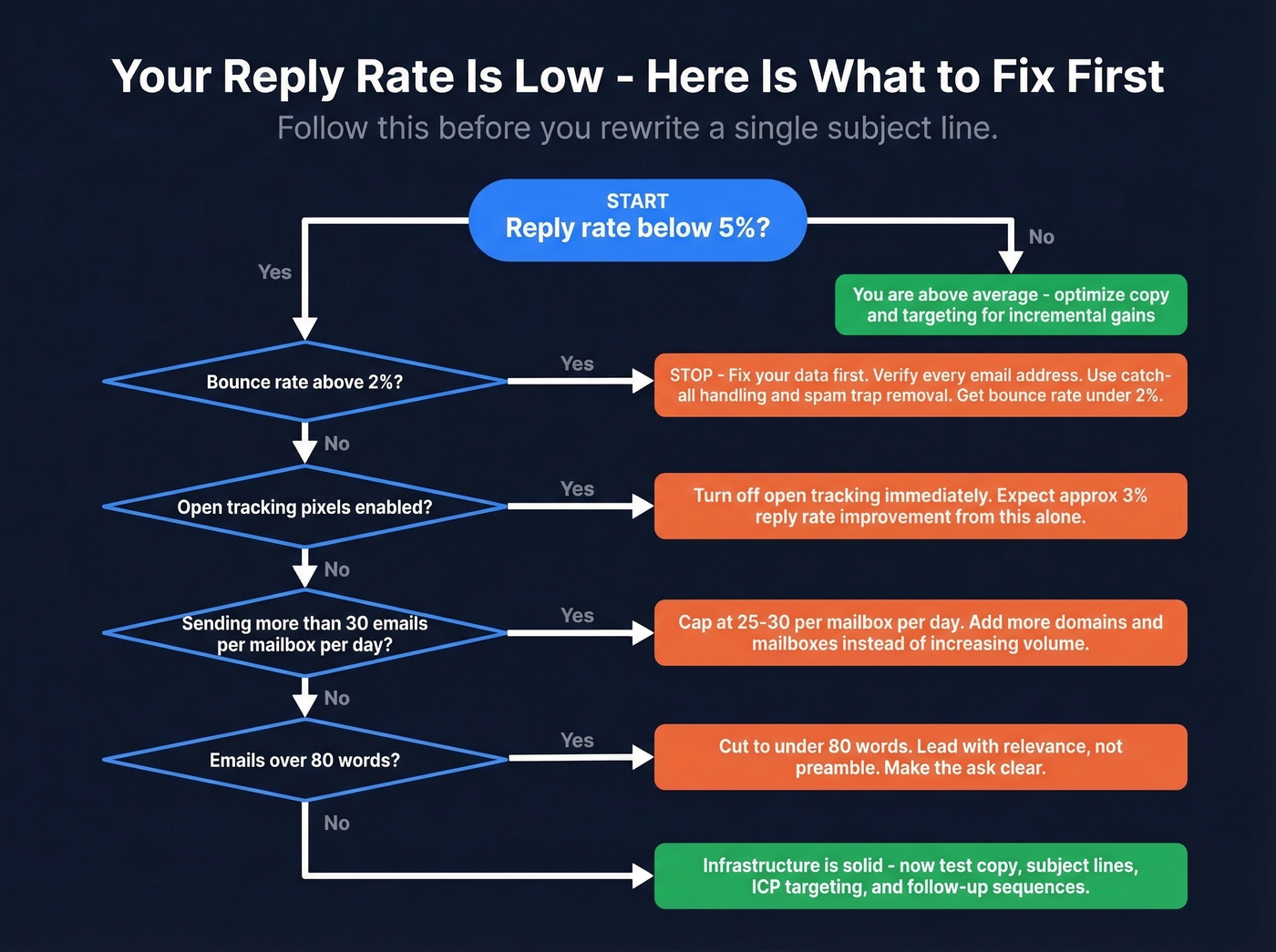
Skip the Tuesday-Thursday-only sending advice you see everywhere. Friday actually performs well in several datasets. And writing emails over 80 words? That's costing you replies you'll never know about. In our experience, teams that fix infrastructure first see 2-3x the lift of teams that A/B test subject lines on a broken foundation. If you're below 2% reply rate and your first instinct is to rewrite your opener, stop. Check your bounce rate instead.
Tighter ICP lists beat massive blasts every time - the data above proves it. Prospeo gives you 30+ filters including buyer intent, technographics, job changes, and headcount growth across 300M+ profiles. Build lists of 50-200 perfectly targeted prospects instead of blasting 10,000 dead ends.
The fastest way to double your reply rate is to halve your list and nail your targeting.
FAQ
What's a good cold email response rate?
For cold B2B sales, 5-8% is excellent. The overall average sits between 3.4% and 5.8% depending on the study. If you're consistently above 10%, your list likely isn't truly cold - which is fine, but benchmark accordingly.
How do I calculate email response rate?
Divide unique human replies by delivered emails, then multiply by 100. Use delivered (sent minus hard bounces) as the denominator, not total sent. Exclude auto-replies and out-of-office messages. Count each lead once even if they reply multiple times.
What's the fastest way to improve reply rates?
Start with data quality and deliverability - not copy. Verify your list to keep bounce rates under 2%, cap sending at 25-30 emails per mailbox per day, and turn off open-tracking pixels. These infrastructure fixes typically produce bigger lifts than subject line tweaks.
Does email length affect response rates?
Yes - significantly. Emails under 80 words consistently outperform longer messages in cold outreach. Belkins found that 6-8 sentence emails hit a 6.9% reply rate, while longer emails saw diminishing returns. Cut the preamble, lead with relevance, and make the ask clear.