

5 Follow-Up Campaign Examples You Can Steal Today
Most "follow-up email examples" give you a single template and call it a day. That's a brick, not a house. What you need are complete follow up campaign examples - multi-touch sequences with timing, channel logic, and a reason behind every send. Here are five that cover the majority of outbound and lifecycle scenarios.
If you only build one, make it the cold outreach sequence. It teaches you the mechanics for everything else.
The benchmarks: The average cold email reply rate is 3.43%, with top performers hitting 10.7%+. 42% of all replies come from follow-ups, not the first email. And none of it works if your emails bounce - verify your list first, then build the sequence.
| Metric | Average | Top Performers |
|---|---|---|
| Reply rate | 3.43% | 10.7%+ |
| Open rate | 27.2% | 40%+ |
| Replies from follow-ups | 42% | - |
| Bounce rate (target) | <1% | Never >3% |
The 5 Campaigns
Cold Outreach (5-Touch Email Sequence)
The workhorse of sales follow-up campaigns. Five emails over three weeks, each earning its place.
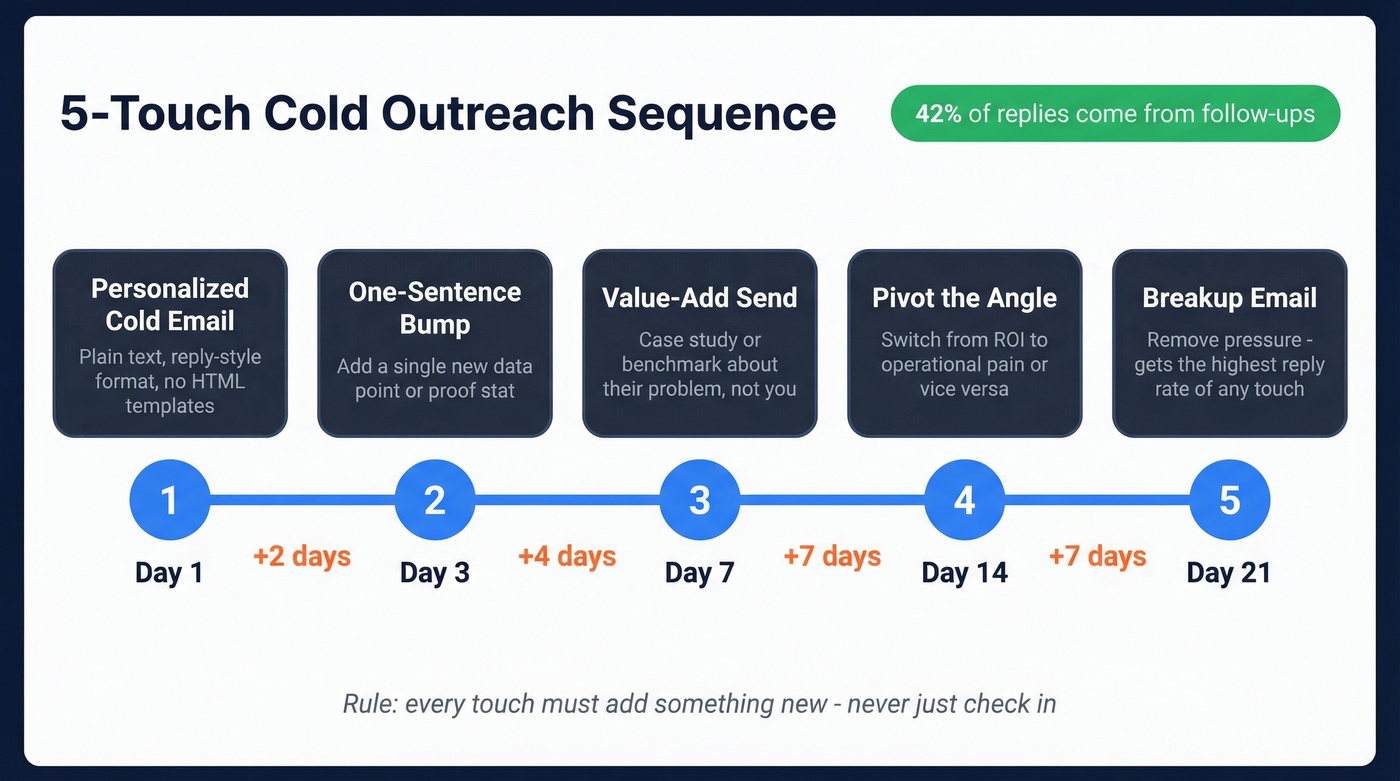
Day 1: Short, personalized cold email. Plain text, reply-style formatting - no HTML templates. Emails that look like a quick note from a colleague outperform formal layouts by ~30%. One pro tip from r/GrowthHacking that I've seen work surprisingly well: adding "Sent from my iPhone" to the signature. It signals brevity and informality, and reply rates jump.
Day 3: One-sentence bump with a single new data point. "Forgot to mention - we helped [similar company] cut [metric] by X%."
Day 7: Value-add. A relevant case study or benchmark about their problem, not about you.
Day 14: Pivot the angle. If you led with ROI, try operational pain. Same prospect, different objection.
Day 21: Breakup email. "Looks like timing isn't right - I'll close this thread." In our experience, breakup emails get the highest reply rate of any touch because they remove pressure.
The cardinal rule: each touch must add something new. "Just checking in" is the fastest way to get archived.
Post-Demo (3-Touch Sequence)
Shorter, warmer, and more direct. The prospect already knows you.
Same day: Recap within 24 hours. Summarize the discussion, confirm next steps, attach anything promised.
Day 3: Send the ROI calculator, case study, or one-pager addressing their biggest objection. Don't just say "following up."
Day 7: A common r/sales tactic is scheduling-oriented language here: "Finalizing my calendar for next week - does Thursday at 2pm work to loop in your VP?" Specific, low-friction, easy to say yes to.
Multi-Channel Outbound
Single-channel cold email gets 2-5% response rates. Coordinated multi-channel campaigns hit 15-25%. Here's the thing: multi-channel sounds impressive, but it isn't worth the complexity for teams under five reps. If you have the headcount, here's the cadence:
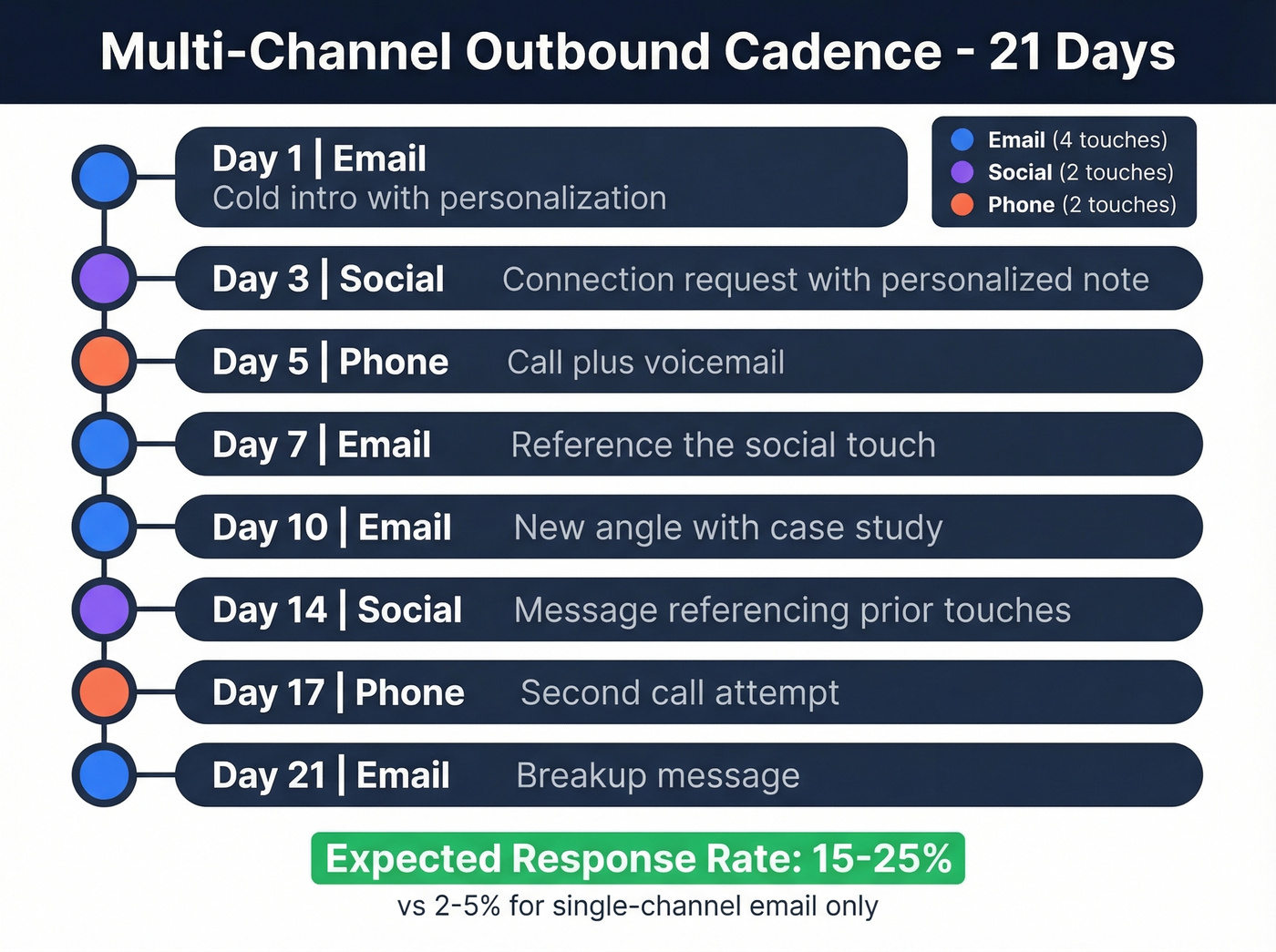
| Day | Channel | Action |
|---|---|---|
| 1 | Cold intro | |
| 3 | Social | Connection request + personalized note |
| 5 | Phone | Call + voicemail |
| 7 | Reference the social touch | |
| 10 | New angle, case study | |
| 14 | Social | Message referencing prior touches |
| 17 | Phone | Second call |
| 21 | Breakup |
When a prospect sees your name across inbox, social feed, and voicemail in the same week, you shift from "random cold email" to "someone I keep hearing from." That familiarity compounds.
Onboarding / Activation (6-Part Sequence)
This isn't sales outreach - it's product adoption. Clay runs a 6-part onboarding sequence with numbered subject lines (1/6, 2/6, etc.) that walk users through progressive steps. The numbered format sets expectations and creates completion momentum.
The critical difference: onboarding emails should be behavior-triggered, not time-triggered. If someone hasn't completed step 2, don't send step 3. Single CTA per email. Intercom built product usage scoring into their expansion sequences and saw a 218% increase in expansion pipeline.
Win-Back / Re-Engagement
Win-back campaigns are usually the hardest of these five to make work. Only invest here if your deal size justifies re-engaging cold accounts. If it does, here's the structure:
Day 1: Lead with a pivot - new feature, new pricing, a relevant industry shift. Something that makes "now" different from "then."
Day 7: Educational value. Act-On ran structured education sequences for churned accounts and saw a 25% retention improvement.
Day 14: Breakup with an open door. "If priorities have shifted, totally understand. If [specific trigger] comes up again, here's where to find us."
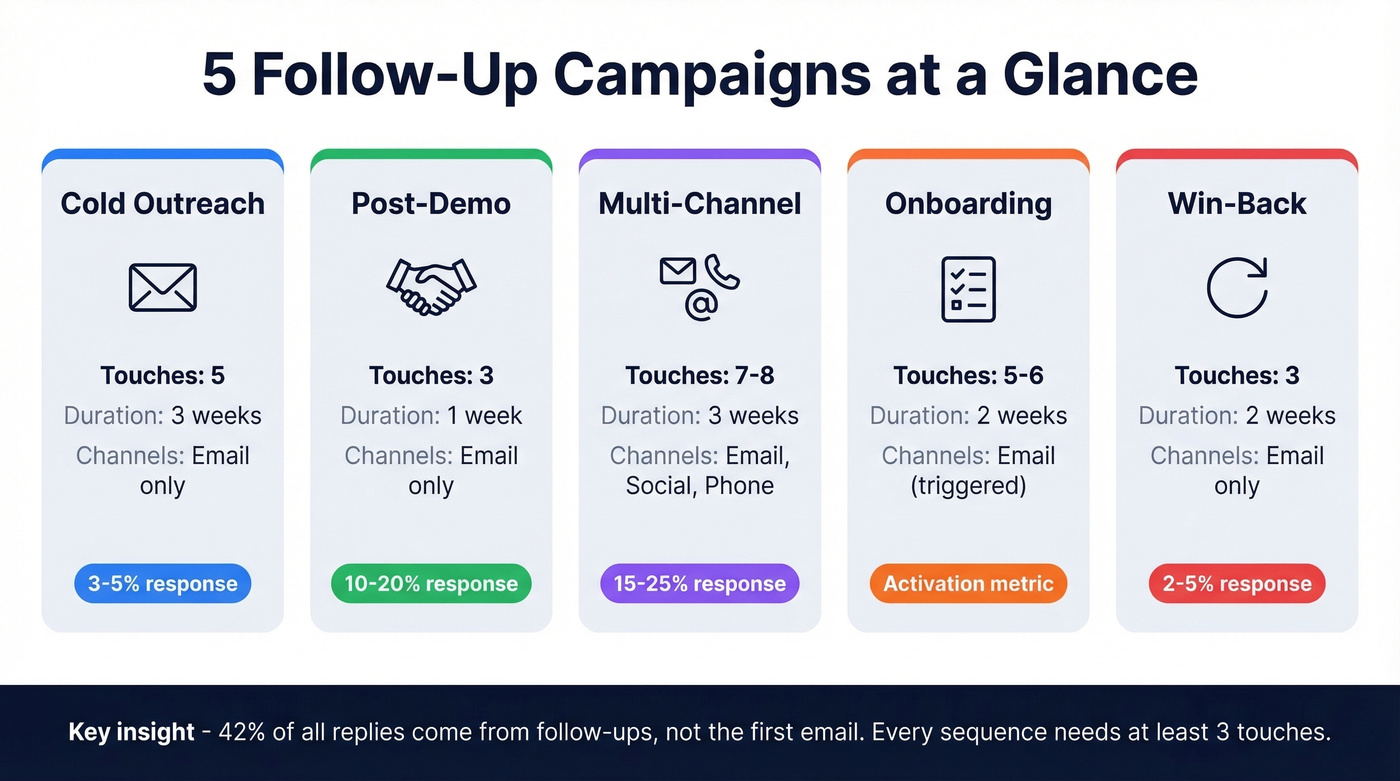
Campaign Summary
| Campaign | Touches | Duration | Channels | Expected Response |
|---|---|---|---|---|
| Cold Outreach | 5 | 3 weeks | 3-5% | |
| Post-Demo | 3 | 1 week | 10-20% | |
| Multi-Channel | 7-8 | 3 weeks | Email + Social + Call | 15-25% |
| Onboarding | 5-6 | 2 weeks | Email (triggered) | N/A (activation) |
| Win-Back | 3 | 2 weeks | 2-5% |

Every follow-up campaign in this guide assumes your emails actually land. One bounce rate spike above 3% and your sender reputation tanks - killing the entire sequence. Prospeo verifies emails with 98% accuracy on a 7-day refresh cycle, so you're never emailing stale contacts.
Don't build a 5-touch sequence on bad data. Verify first.
Mistakes That Kill Follow-Up Sequences
Every follow-up needs to earn its send. "Just checking in" with no new value is the number one killer. Repeating the same angle is number two - if touch 1 was about ROI, touch 2 needs a different objection. HTML-heavy emails with tracking pixels tank deliverability; plain text wins for cold outreach. And launching without verifying contact data doesn't just waste sends - it actively damages your sender reputation. We've seen bounce rates above 3% derail deliverability fast.
If you need copy you can plug in fast, start with proven sales follow-up templates and adapt the angle per touch.
Deliverability Rules
Here's the thing: your campaign is only as good as your infrastructure. Gmail's spam complaint threshold is 0.1% - exceed that and you're getting filtered.
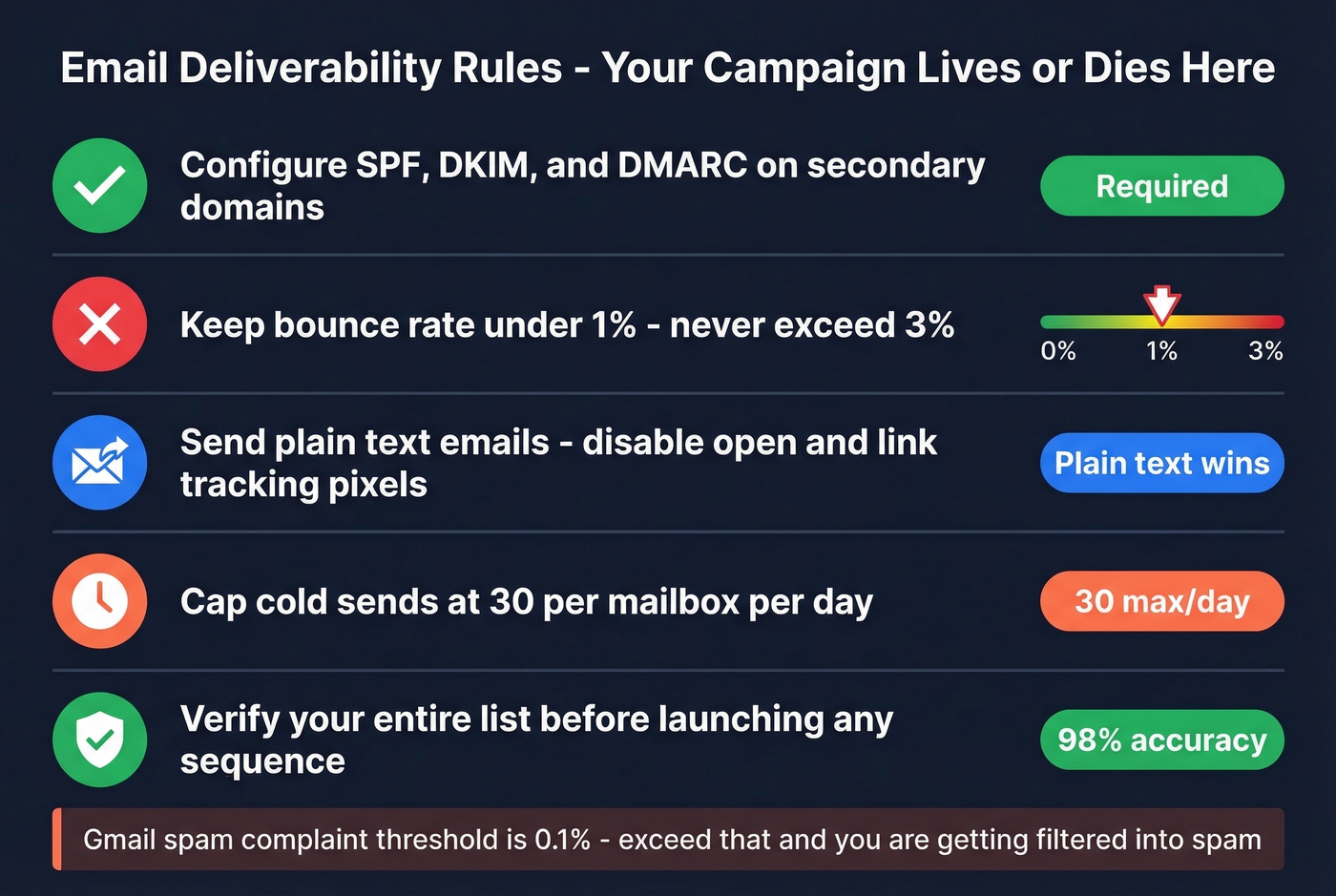
- Send from secondary domains with SPF, DKIM, and DMARC configured
- Keep bounce rates under 1% (and never above 3%) - track your email bounce rate
- Plain text emails, disable open/link tracking pixels - see why email tracking pixels can hurt deliverability
- Cap cold sends at 30 per mailbox per day - manage safe email velocity
- Randomize send times with 2-5 minute spacing - align with the best time to send cold emails
Verify your list before launching. Prospeo checks emails in real-time with 98% accuracy and refreshes data every 7 days - so you're not emailing contacts who changed jobs last month. Meritt cut their bounce rate from 35% to under 4% after switching, and their pipeline tripled.

Meritt ran follow-up campaigns on unverified data and hit 35% bounce rates. After switching to Prospeo, bounces dropped under 4% and pipeline tripled from $100K to $300K per week - same team, same sequences, better data.
Your cadence is only as good as the emails behind it. Start at $0.01 per verified email.
FAQ
How many follow-up emails should I send?
Four to seven touchpoints is the sweet spot for most outbound sequences. Follow-ups capture 42% of all replies - stopping after one email leaves nearly half your potential responses on the table. Start with five touches and adjust based on your reply-rate data.
What's the best spacing between follow-ups?
Start at 2-3 days between your first and second touch, then extend to 4-7 days for later emails. Tuesday through Wednesday consistently shows the highest engagement. Avoid back-to-back days for cold outreach - it feels aggressive and triggers spam complaints.
How do I stop follow-ups from landing in spam?
Keep bounce rates under 1% by verifying emails before sending - Prospeo handles this automatically with 98% accuracy across 143M+ verified addresses. Use secondary domains, configure SPF/DKIM/DMARC, send plain text, and stay under 30 cold emails per mailbox per day.
Do these follow up campaign examples work for small teams?
Yes - the cold outreach and post-demo sequences require zero special tooling beyond a sending platform. Skip the multi-channel cadence until you have five or more reps. Start with the 5-touch email sequence, measure reply rates after 200 sends, and iterate from there.