

Cold Email Format: What Actually Gets Replies in 2026
You've probably read 17 cold email templates and still can't crack a 5% reply rate. Templates aren't your problem. The average cold email reply rate sits around 3.43%, and the gap between that average and the top performers hitting 5.5% - with the elite tier clearing 10.7% - isn't copy. It's format: structure, length, technical setup, and the dozen invisible decisions that determine whether your email lands in an inbox or a spam folder.
The right cold email format is scaffolding that makes good copy work. Get it wrong and the best subject line in the world dies in a promotions tab.
What You Need (Quick Version)
- Plain text only. No HTML templates, no images, no branded footers.
- 25-75 words for your first email. Under 80 for any email in the sequence.
- One soft CTA. "Worth a conversation?" beats "Book 15 minutes on my calendar." (More examples: email call to action.)
- Subject line under 45 characters. 6-10 words, personalized. (If you need ideas, see cold email subject line examples.)
- Send from a secondary domain with SPF, DKIM, and DMARC configured.
- Warm up for 21 days before sending cold outreach. (Tooling options: unlimited email warmup.)
- Micro-campaigns of 20-50 recipients, not 2,000-person blasts. (Related: targeted email campaigns.)
Anatomy of a Cold Email
A properly formatted cold email has five parts and zero fat. Here's the skeleton every message should follow:
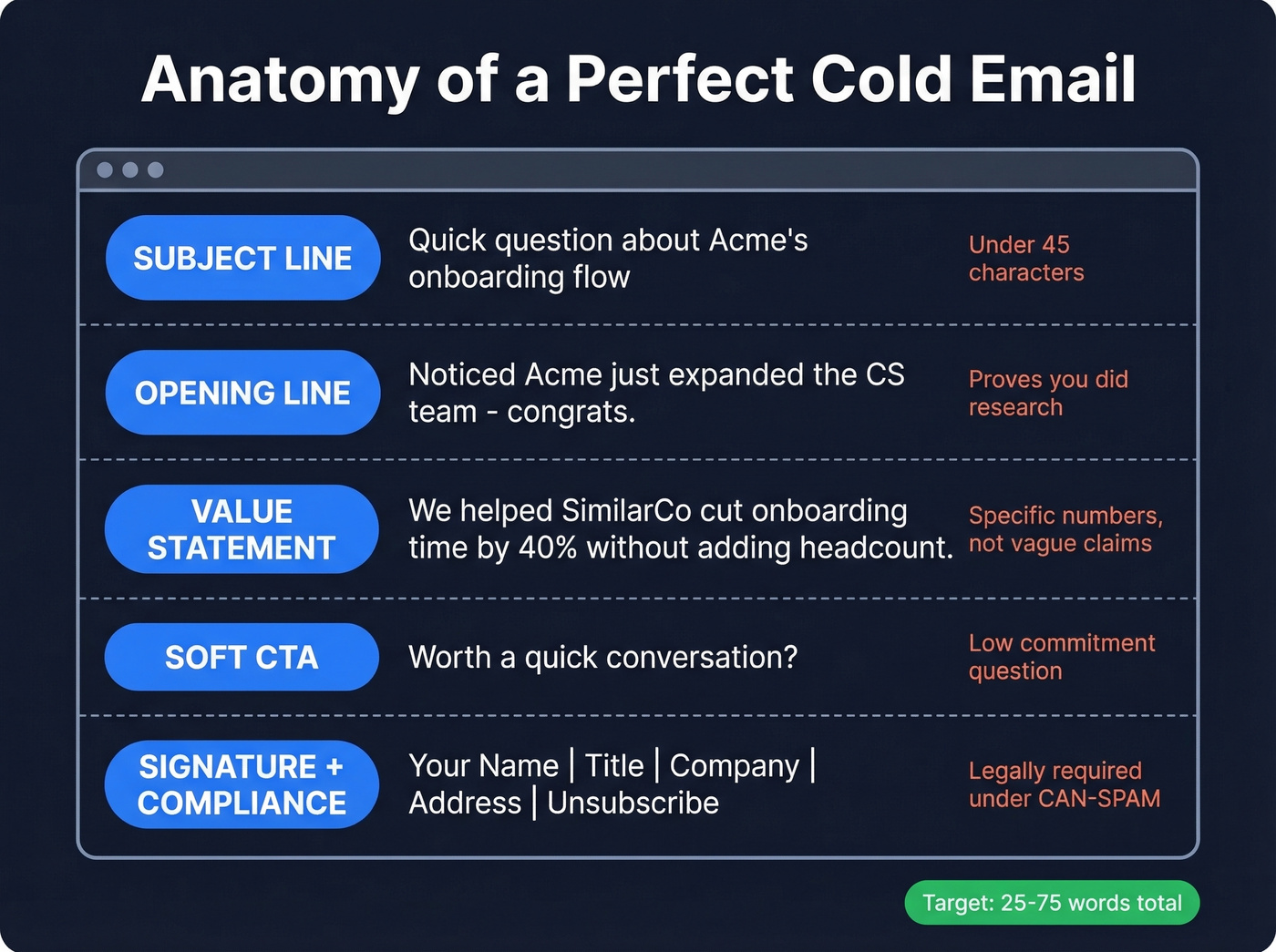
Subject: Quick question about [Company]'s onboarding flow

Hey [First Name],

Noticed [Company] just expanded the CS team - congrats.
We helped [Similar Company] cut onboarding time by 40%
without adding headcount.

Worth a quick conversation?

-- [Your Name]
[Title] | [Company]
[Physical Address]
[Unsubscribe link]
Each piece earns the next sentence.
Subject line. Under 45 characters. Lowercase, conversational, specific to the recipient. No "RE:" tricks, no ALL CAPS, no emojis.
Opening line. One sentence that proves you did 30 seconds of research. This isn't flattery - it's context that earns the next sentence, and it's the single most underrated skill in outbound. (If you want a system for this, start with personalized outreach.)
Value statement. One to two sentences connecting their situation to a result you've delivered. Specific numbers beat vague claims every time. "Cut onboarding time by 40%" lands harder than "improve your onboarding process."
CTA. A single, low-commitment question. "Worth a conversation?" or "Open to hearing more?" - not "Let me know when you're free for a 30-minute demo." The softer the ask, the higher the reply rate.
Signature and compliance. Your name, title, company. Physical address and unsubscribe link aren't optional - they're legally required under CAN-SPAM.
That entire email runs about 45 words. That's intentional.
Subject Line Rules
Subject lines are the highest-leverage formatting decision you'll make. The average B2B cold email open rate hovers around 27.7%, so even small improvements compound fast across a full sequence. (Benchmarks: what is a good email open rate.)
Personalized subject lines get 50% higher open rates than generic ones. That means the recipient's company name, a reference to their role, or a specific trigger event - not just mail-merging their first name.
Keep it to 6-10 words. Instantly's data puts 6-10-word subject lines at roughly 21% open rates, outperforming longer alternatives. Stay under 45 characters total so the full line renders on mobile, where 47% of recipients check email first. Numbers in subject lines boosted opens by up to 113% in one analysis - "3 ideas for [Company]'s Q3 pipeline" outperforms "Some ideas for your pipeline." Questions lift opens by about 21%, because they create a micro-curiosity gap without feeling clickbaity.
A/B test relentlessly. Teams that test subject lines see up to 49% improvement in open rates. Run two variants per campaign, pick the winner after 50-100 sends, and roll it forward. (If you want a deeper workflow, use email preview text A/B testing.)
How Long Should a Cold Email Be?
There's a persistent myth that cold emails should be 50-125 words. That guidance traces back to a Boomerang study from 2016 that mixed cold outreach with warm emails, internal messages, and newsletters. It's not wrong for email in general - it's wrong for cold email specifically.
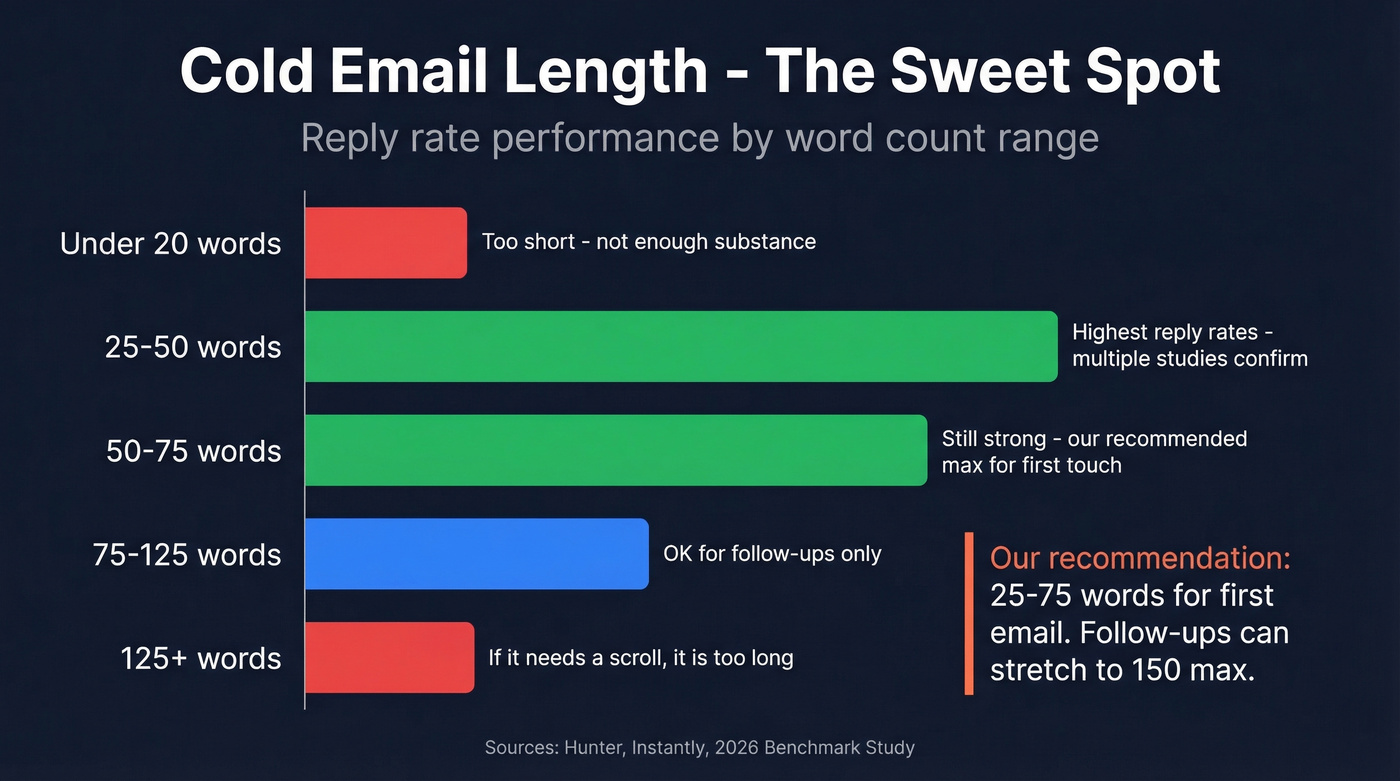
When you look at studies focused exclusively on cold outreach, the numbers converge much lower. Multiple analyses point to 25-50 words as the sweet spot. Hunter's data narrows it further to 20-39 words. The largest 2026 benchmark study found that best-performing campaigns keep emails under 80 words.
Here's the thing: cutting emails down to 40-60 words is often the single biggest driver of reply rate improvement, ahead of subject line changes, send time optimization, or personalization tactics.
Our recommendation: 25-75 words for the first email. That's enough for context, value, and a CTA - nothing more. Follow-ups can stretch to around 150 words max, but shorter still wins. Under 20 words tends to underperform because there's not enough substance to justify a reply. (For follow-up structure, see cold email follow-up templates.)
If your cold email needs a scroll, it's too long.
Plain Text vs HTML
This one isn't close.
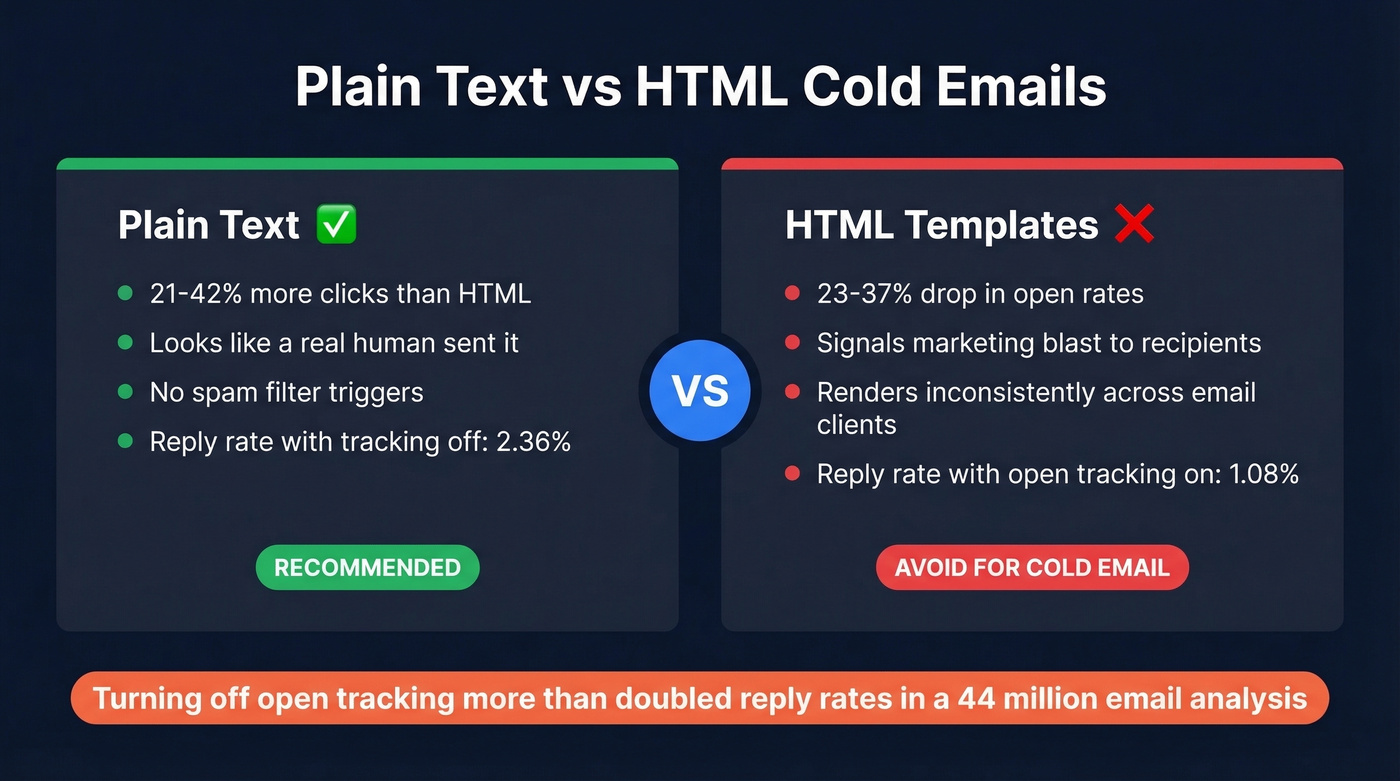
Plain text emails generate 21%-42% more clicks than HTML alternatives. HTML emails with images and GIFs see a 23%-37% drop in open rates. The reasons are mechanical: HTML-heavy emails trigger spam filters, render inconsistently across clients, and signal "marketing blast" to recipients who've been trained to ignore them.
Turning off open tracking - which requires an invisible HTML pixel - more than doubled reply rates in a 44M-email analysis: 2.36% vs 1.08%. That's a massive delta for a single formatting decision. Open tracking gives you vanity metrics. Turning it off gives you replies. (Technical deep dive: email tracking pixel.)
The consensus on r/b2bmarketing is blunt: branded templates are over. If your cold email looks like it came from a marketing automation platform, it gets archived. If it looks like a human typed it in a normal inbox, it gets read.
Our take: Most teams would get better results deleting their Mailchimp-designed templates today and sending plain text from a warmed-up inbox tomorrow. The "professional" look is actively hurting you.

The perfect cold email format means nothing if it bounces. Prospeo's 98% email accuracy and 5-step verification ensure every message you craft actually reaches a real inbox - not a spam trap or dead address.
Stop perfecting emails that never get delivered.
Frameworks That Drive Replies
You don't need a dozen frameworks. You need one that fits your situation, executed in under 75 words. (If you want the full sequence view, see B2B cold email sequence.)
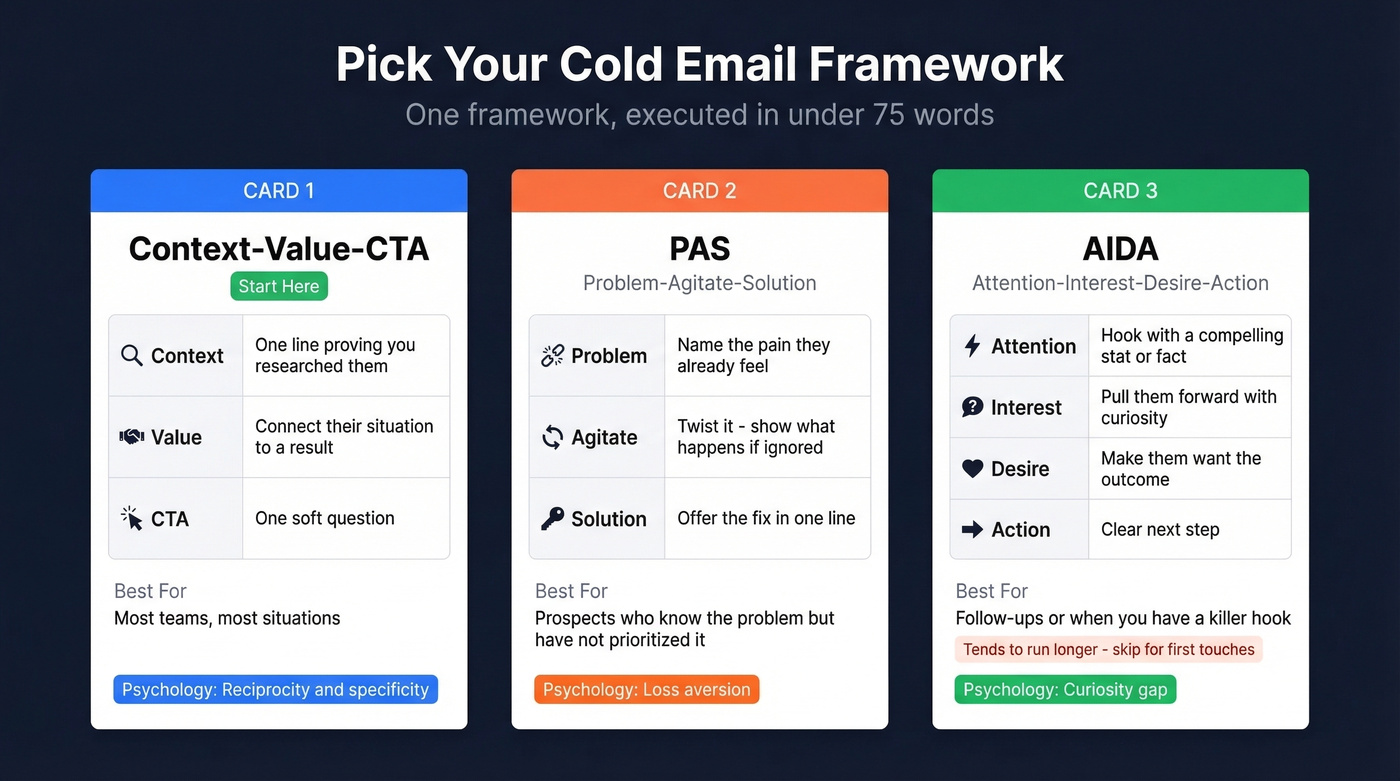
Context-Value-CTA (Start Here)
The simplest framework and the one we recommend for most teams. One line of context proving you researched the prospect. One line of value connecting their situation to a result. One soft CTA. It works because of reciprocity and specificity - you gave them something (proof you did homework), so they feel a pull to give something back.
Noticed [Company] just opened 3 AE roles - looks like pipeline is the priority this quarter. We helped [Similar Company] add $200K/month in qualified pipeline without scaling the SDR team. Worth a quick chat?
About 45 words. Every sentence earns the next one.
PAS (Problem-Agitate-Solution)
Better for prospects who know they have a problem but haven't prioritized solving it. PAS works because of loss aversion - people are more motivated to avoid pain than to chase gains. Name the pain, twist it slightly, then offer the fix. Keep the "agitate" to one sentence.
Hiring 3 SDRs to fix pipeline sounds great until ramp time eats Q3. [Similar Company] added $150K/month in pipeline without a single new hire. Open to a 10-minute walkthrough?
AIDA (Attention-Interest-Desire-Action)
The classic direct-response framework. The opening line hooks attention, and each subsequent line pulls the reader forward through a curiosity gap. It tends to run longer, so use it for follow-ups or when you have a genuinely compelling hook. Skip this one for first touches where brevity matters most.
[Company]'s competitors are booking 40% more demos this quarter. The difference isn't headcount - it's how they source pipeline. Want to see the playbook?
Deliverability Setup
Your email structure doesn't matter if it never reaches the inbox. This is the infrastructure checklist that separates teams landing in Primary from teams rotting in Spam. (Full walkthrough: email deliverability guide.)
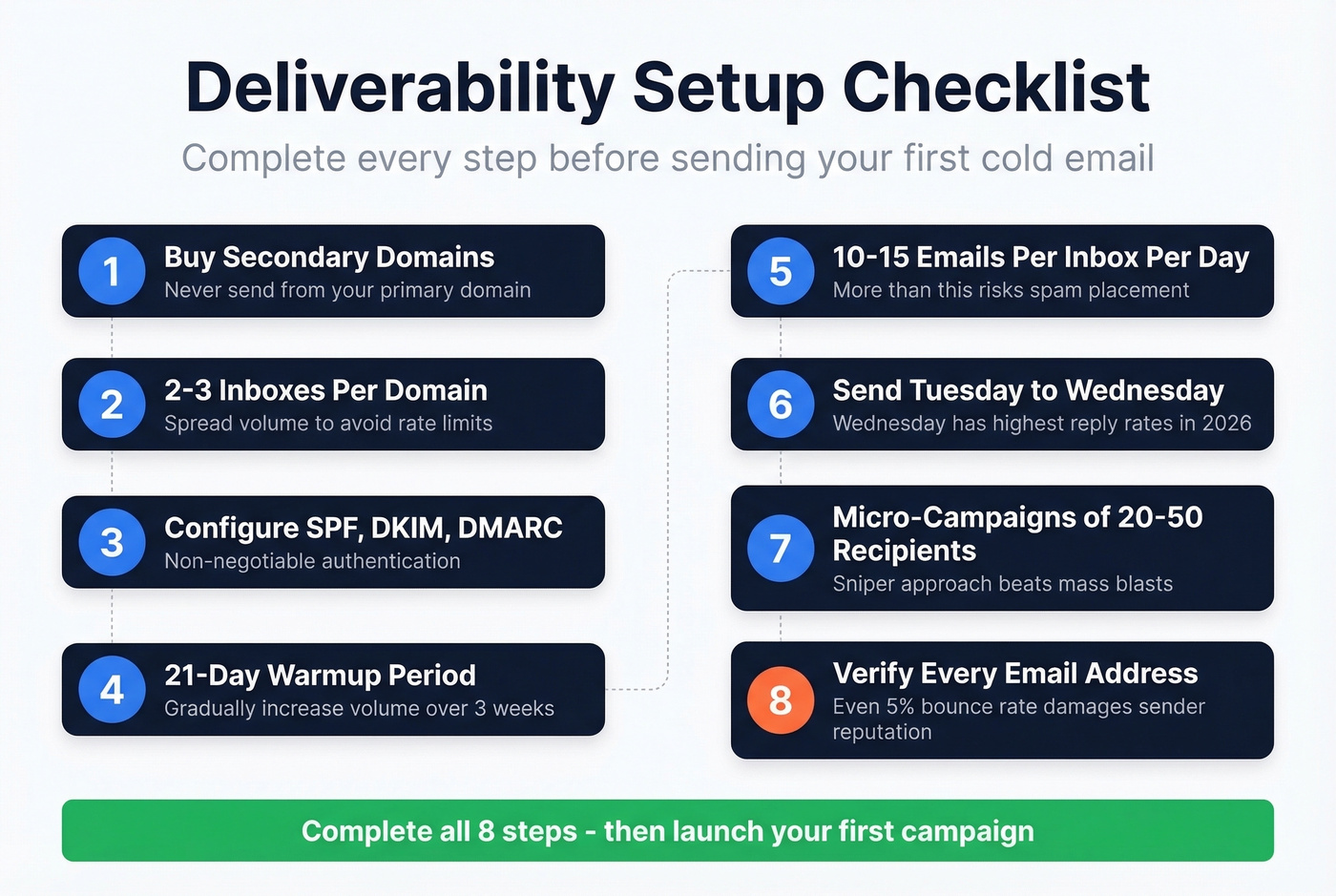
Never send from your primary domain. Buy secondary domains - variations of your main domain - dedicated to outbound. If a domain gets burned, your company email stays clean.
2-3 inboxes per domain. Spread volume across mailboxes to avoid triggering rate limits.
10-15 emails per inbox per day. More than that and you're asking for spam placement. (More on limits: email velocity.)
SPF, DKIM, and DMARC on every domain. Non-negotiable. If you don't know what these are, your IT team does. Get them configured before you send a single email. (If you need to validate setup, use how to verify DKIM is working.)
21-day warmup. Gradually increase sending volume over three weeks. Keep warmup running even after you launch campaigns.
Send Tuesday through Wednesday. Wednesday has the highest reply rates per the largest 2026 benchmark data. Monday inboxes are too crowded; Thursday and Friday attention drops off. (More data: best time to send cold emails.)
Micro-campaigns of 20-50 recipients. The sniper approach - small, highly targeted segments with tailored messaging - beats 2,000-person blasts every time.
Verify every address before adding it to your sequence. Even a 5% bounce rate compounds into sender reputation damage that takes weeks to recover from. Prospeo's 5-step verification catches spam traps, honeypots, and catch-all domains before they do damage, and the free tier gives you 75 email verifications per month to test the workflow.
We've seen teams nail every other element on this list and still land in spam because 8% of their list was invalid. Deliverability is a chain - one weak link breaks it.
Verify Before You Send
We see this constantly: a team spends weeks crafting the perfect message, perfecting copy, subject lines, and sequence timing. They launch. Bounce rate hits 15%. Sender reputation craters. Replies dry up.
The copy was never the problem - the list was.
Meritt experienced exactly this. Their bounce rate was running 35% before they switched to verified data. After implementing proper verification, bounces dropped under 4% and pipeline tripled to $300K/week. That's not a formatting win or a copywriting win. It's a data quality win, and it dwarfed everything else they tried.
Your format can be perfect. Your copy can be sharp. None of it matters if 10% of your list bounces.
You just learned that micro-campaigns of 20-50 recipients outperform blasts. Prospeo's 30+ search filters - buyer intent, job changes, headcount growth - let you build hyper-targeted lists at $0.01/email so every send is worth sending.
Build the list your cold email format deserves.
Compliance Elements
These aren't suggestions - they're legal requirements baked into every outbound message you send.
CAN-SPAM (US): Valid physical postal address and a clear unsubscribe mechanism in every email. Process opt-out requests within 10 business days. Penalties run up to $53,088 per non-compliant email.
GDPR (EU/UK): Requires legitimate interest or consent as a legal basis for outreach. Recipients can request data deletion at any time. Penalties reach EUR 20M or 4% of global annual turnover.
CASL (Canada): Requires express or implied consent before sending. Honor unsubscribe requests within 10 business days and retain opt-out records for a minimum of 3 years.
The practical takeaway: every cold email needs a physical address and an unsubscribe link in the footer. Skip these and you're not just risking spam placement - you're risking five-figure fines per email.
Format Mistakes to Avoid
Multiple CTAs. One ask per email. "Book a call, check out our case study, and reply with your thoughts" is three asks. Pick one.
No unsubscribe link. Legally required and practically smart - it reduces spam complaints that torch your sender reputation.
HTML-heavy design with images. Triggers spam filters and screams "marketing email." If it looks designed, it gets deleted.
Too many links. More than one link plus unsubscribe raises spam scores. One link max in the body.
Sending from your primary domain. One bad campaign can destroy your company's email deliverability for months. Always use secondary domains.
No SPF/DKIM/DMARC records. Email providers check these. Missing authentication equals spam folder.
Skipping warmup. A brand-new domain sending 50 emails on day one gets flagged immediately. Budget three weeks minimum.
Not verifying your list. Even a 5% bounce rate compounds into sender reputation damage that takes weeks to recover from. Let's be honest - this is the mistake we see kill the most campaigns, and it's the easiest one to fix.
FAQ
What's the best cold email format for B2B?
Plain text, 25-75 words, with a personalized subject line under 45 characters. Use the Context-Value-CTA framework: one line of research-backed context, one line connecting their situation to a result, and one soft CTA. Send from a warmed-up secondary domain with full authentication.
How long should a cold email be?
Keep your first email to 25-75 words. Hunter's data shows 20-39 words performing best, and the largest 2026 benchmark confirms under 80 words as the ceiling. Follow-ups can stretch to 150 words, but shorter still wins. If it requires scrolling, it's too long.
Should I use HTML or plain text?
Plain text. It generates 21-42% more clicks and avoids spam filters that flag HTML-heavy messages. Turning off open tracking - which requires HTML - more than doubled reply rates in a 44M-email analysis: 2.36% vs 1.08%.
How many follow-ups should I send?
Send 4-7 touchpoints, spaced 3-4 days apart. 58% of replies come from the first email, but 42% come from follow-ups - stopping after one message leaves nearly half your potential replies on the table.
How do I stop cold emails from going to spam?
Use secondary domains with SPF, DKIM, and DMARC configured. Warm up for 21 days. Send 10-15 emails per inbox per day. Keep campaigns to 20-50 recipients. Verify every address before sending - even a small percentage of bounces compounds into reputation damage that tanks deliverability for weeks.