

Cold Email vs Warm Email: 2026 Data, Real Costs, and the Right Strategy
An SDR team sends 5,000 cold emails in their first month. They get 12 replies, an 11% bounce rate, and their primary domain tanks so hard that even internal emails start landing in spam. We've seen this exact scenario play out dozens of times, and it's never a cold email problem - it's an infrastructure and data quality problem. The cold email vs warm email debate misses the point entirely. Cold creates pipeline. Warm converts it. The teams that treat them as sequential stages, not either/or choices, are the ones booking meetings consistently.
Quick Verdict
Cold email generates pipeline. Warm email converts it. You need both, in sequence. Most guides frame them as competing strategies, which is useless if you don't have 500 warm leads sitting in your CRM. You probably don't. Start cold, build warm.
And if you're weighing cold calls versus cold emails, the answer depends on your market - but email scales in ways phone calls never will.
Definitions That Actually Matter
Cold email is outbound to strangers - people who've never heard of you, never visited your site, never opted into anything. It's B2B prospecting at scale, and it's how most startups and agencies fill the top of their funnel. Think of it as a cold call delivered asynchronously, minus the awkward silence.
Warm email goes to people who've already interacted with you. They replied to a previous message, downloaded a whitepaper, attended a webinar, signed up for a trial, or had a conversation at a conference. The relationship exists, even if it's thin.
2026 Benchmarks Side by Side
| Metric | Cold Email | Warm Email |
|---|---|---|
| Reply rate | 3.43% avg | 10-30% |
| Top-quartile reply | 5.5%+ | N/A |
| Conversion rate | 0.2-2% | Up to 7x higher |
| Email marketing ROI | $36-40 per $1 | Same channel |
| Time to first send | 21+ days warm-up | Immediate |
| Scalability | Hundreds/day | Limited by list |
| Monthly cost | ~$420 stack | Minimal |
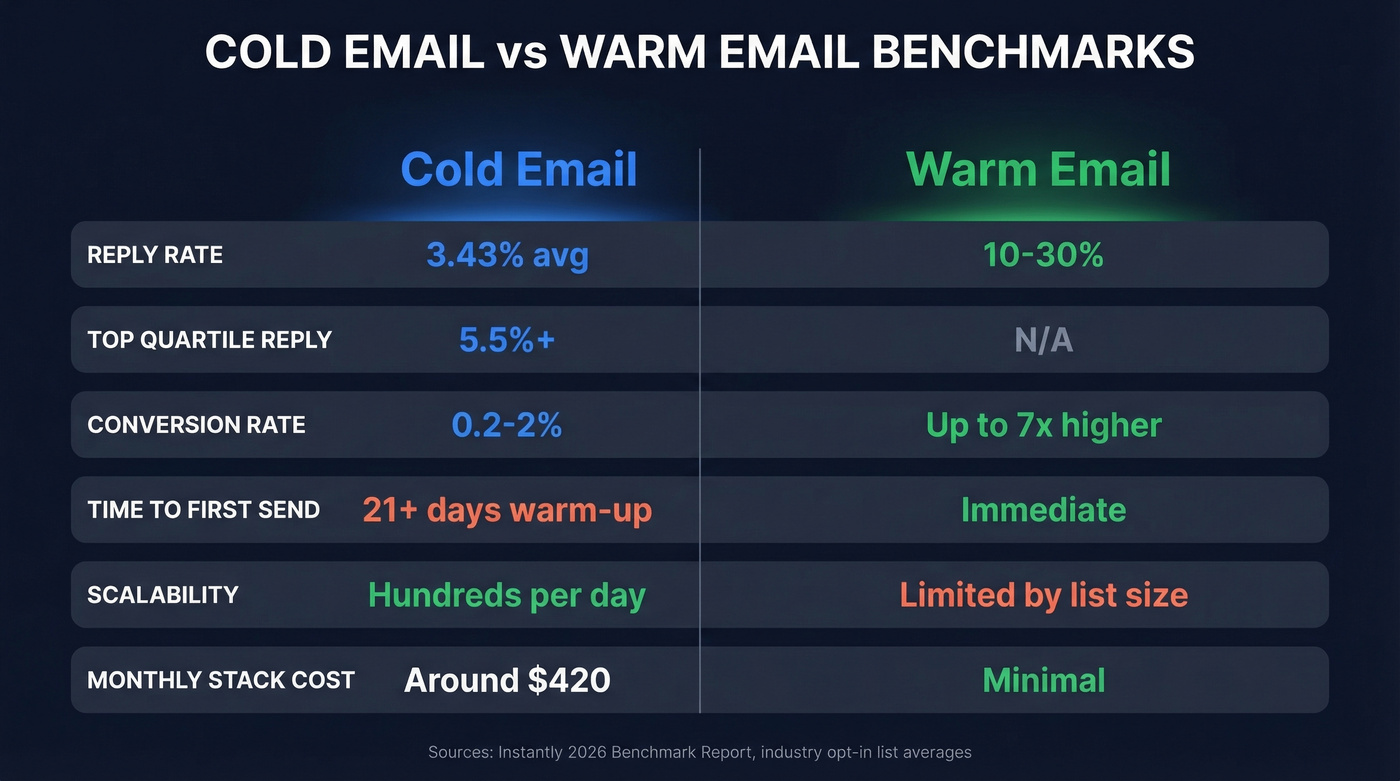
Cold email benchmarks come from Instantly's 2026 report analyzing billions of interactions. The $420/month figure reflects one operator's full stack - domains, sending tools, verification - so your costs will vary based on volume and tooling. Warm benchmarks are industry ranges from opt-in and nurture lists.
What Makes Cold Email Work
Infrastructure First, Copy Second
The consensus on r/coldemail is blunt: "write better copy" is useless advice without technical setup. SPF, DKIM, and DMARC aren't optional. You need 3-5 secondary domains (never your primary), a 21-day warm-up period, and custom tracking domains that add 15-20% deliverability over generic ones. Proper infrastructure pushes inbox placement to ~87%, versus 60-70% without it. If you want the full technical checklist, start with an email deliverability audit and confirm your DMARC alignment is correct.
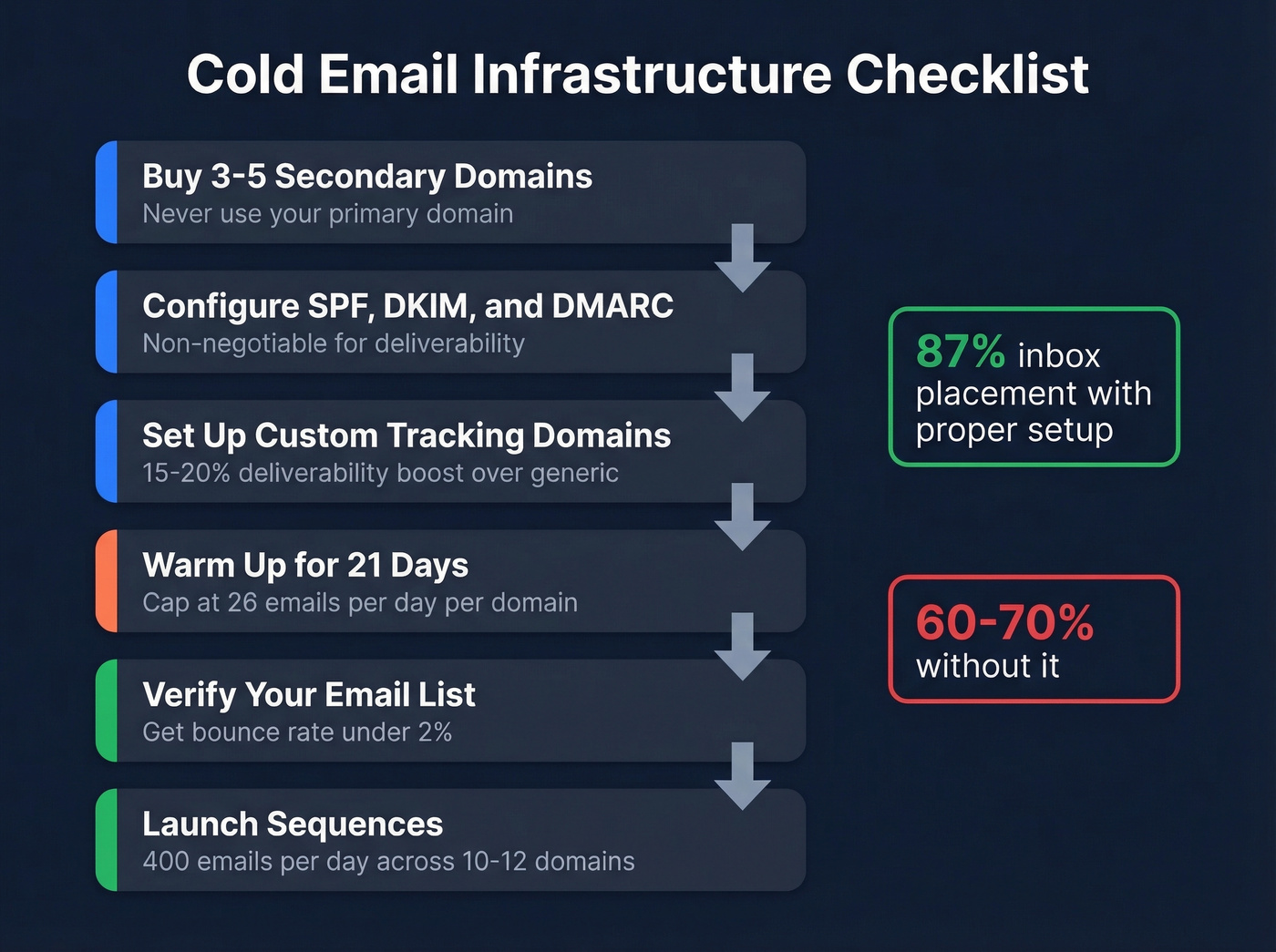
One practitioner on r/Entrepreneur shared their full rebuild: they went from 3 domains to 7, capped each at 26 emails/day, and watched their reply rate double from 3% to 6%. Total stack cost? $420/month for 16 qualified leads. At scale, 400 emails/day across 10-12 domains produces roughly 12,000 sends/month. At a 3% reply rate, that's 360 replies - expect about half to be genuinely usable. Keep bounce rates under 2% and complaint rates under 0.1%, or inbox providers will throttle you regardless of how good your subject lines are. (If you're troubleshooting, this email bounce rate guide breaks down the benchmarks and fixes.)
List Quality Is the Highest-Leverage Investment
That same operator's single biggest improvement wasn't copy or timing - it was dropping their bounce rate from 11% to under 2% by ditching purchased lists and verifying everything. Bad data is the fastest way to kill a cold email campaign. Full stop.
Prospeo's 5-step verification process handles catch-all domains, spam-trap removal, and honeypot filtering, delivering 98% email accuracy across 300M+ professional profiles. The free tier gives you 75 verified emails per month - enough to test before committing a dollar. If you're comparing vendors, see our breakdown of data enrichment services and email list providers for outbound.
Brevity, Personalization, Timing
Best-performing cold emails run under 80 words per Instantly's data. The Reddit operator above shortened theirs from 141 words to under 56 and spent roughly 3 minutes per email personalizing the first line with specific company details - a time investment that compounds when your list is clean. Tuesday and Wednesday are peak send days (here’s the data-backed best time to send cold emails).
Here's the thing: most teams obsess over subject lines and ignore timing signals. A mediocre email sent to a company that just raised a Series B will outperform a beautifully crafted email sent to a company with zero buying intent. Prioritize when and who over what you say. Trigger-based cold emails can pull 3x higher response rates than the same message sent randomly. If you need a starting point, use these cold email subject line examples and a proven B2B cold email sequence structure.
58% of all replies come from step 1, but don't skip follow-ups. The sweet spot is 4-7 touchpoints. Sequences with 4-6 emails see up to 50% higher reply rates than single-touch sends. Front-load your best message, then follow up with brevity and new angles. (For plug-and-play copy, grab these cold email follow-up templates.)

The article says it clearly: dropping bounce rates from 11% to under 2% was the single biggest lever for doubling reply rates. Prospeo's 5-step verification delivers 98% email accuracy across 300M+ profiles - with catch-all handling, spam-trap removal, and honeypot filtering built in. At $0.01 per email, cleaning your list costs less than a single bounced send costs your domain reputation.
Stop burning domains. Start with data that actually connects.
Cold Email Beats Cold Calling for Scale
Many teams still debate whether to replace cold calling with email entirely. The reality is nuanced: an email-plus-call combo often outperforms either channel alone. But if you're forced to choose, cold email wins on unit economics. A single SDR can send 400 personalized emails a day across warmed domains; that same rep maxes out at 60-80 phone dials. If you’re building a calling motion too, this cold calling system guide lays out the stack and process.
The pairing works best as a sequence: send the cold email first, then follow up with a phone call 24-48 hours later referencing the email. Reps who use this approach report significantly higher connect rates because the prospect has already seen their name. Cold email vs paid ads is a similar story - paid ads build awareness, but cold email drives direct conversations at a fraction of the cost-per-meeting for most B2B niches.
Bulk vs Drip vs Automated Sends
Not all cold outreach is the same. Understanding the difference helps you pick the right sending strategy.
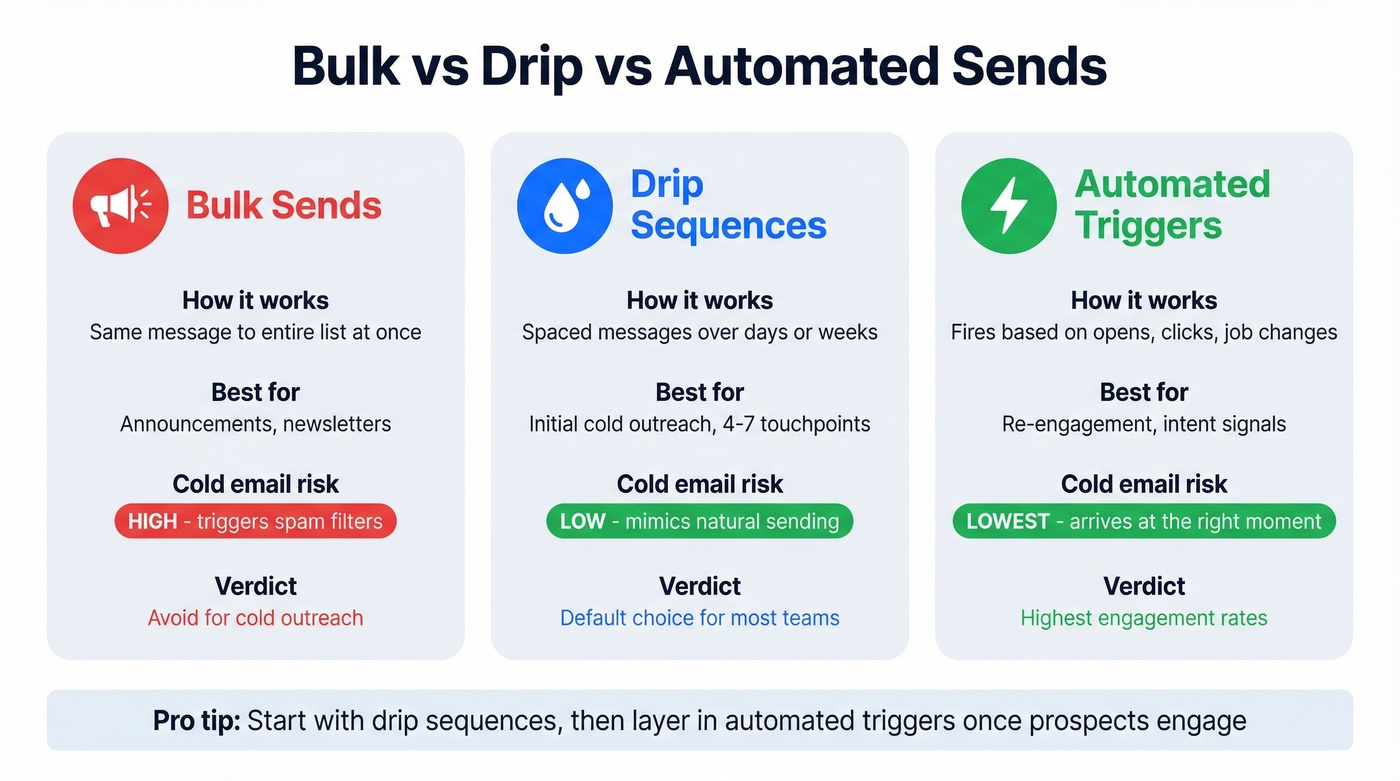
Bulk sends blast the same message to a large list simultaneously. Useful for announcements, terrible for cold outreach - inbox providers flag sudden volume spikes and you'll land in spam before lunch. (If you’re doing high volume, read the bulk email threshold guide.)
Drip sequences space messages over days or weeks, gradually warming the prospect. This is the standard for cold email campaigns with 4-7 touchpoints, and it's what most teams should default to.
Automated emails trigger based on prospect behavior - opens, clicks, replies, or external signals like job changes. These blend cold and warm approaches and typically see the highest engagement because they arrive when the prospect is already paying attention.
Most successful cold email programs use drip sequences for initial outreach, then shift to behavior-triggered automation once a prospect engages. One common mistake we see constantly: teams using Mailchimp for cold emails. Mailchimp is designed for opt-in marketing lists and will suspend accounts sending unsolicited outreach. Use a dedicated cold email tool like Instantly, Smartlead, or Woodpecker instead. If you’re evaluating tooling, start with our roundup of SDR tools.
When Warm Email Wins
Warm email response rates run 10-30%, with conversion rates up to 7x higher than cold. When you're emailing webinar attendees, trial users, or people who replied to a previous sequence, trust already exists. Sales cycles shorten. Objections soften. Inbound leads cost 62% less than outbound according to HubSpot research.
But let's be honest - 200 warm contacts isn't a pipeline. Warm email needs cold outreach to feed the top of the funnel. You can't nurture leads you don't have.
Compliance in 60 Seconds
CAN-SPAM (US): Accurate sender info, no deceptive subject lines, identify the message as commercial where required, functional unsubscribe link honored within 10 business days, valid physical address. Penalty: $50,120 per email.
GDPR + ePrivacy (EU): Legitimate interest basis for relevant B2B outreach, identify sender and explain data source, provide clear opt-out. Penalty: up to EUR 20M or 4% of global revenue.
CCPA (California): $7,500 per violation.
Cold email is legal. Spam isn't. Know the difference.
The Right Strategy: Use Both
Cold email is how you start conversations with strangers. Warm email is how you close them. They're sequential, not competing - and that's the real takeaway from the cold email vs warm email comparison.
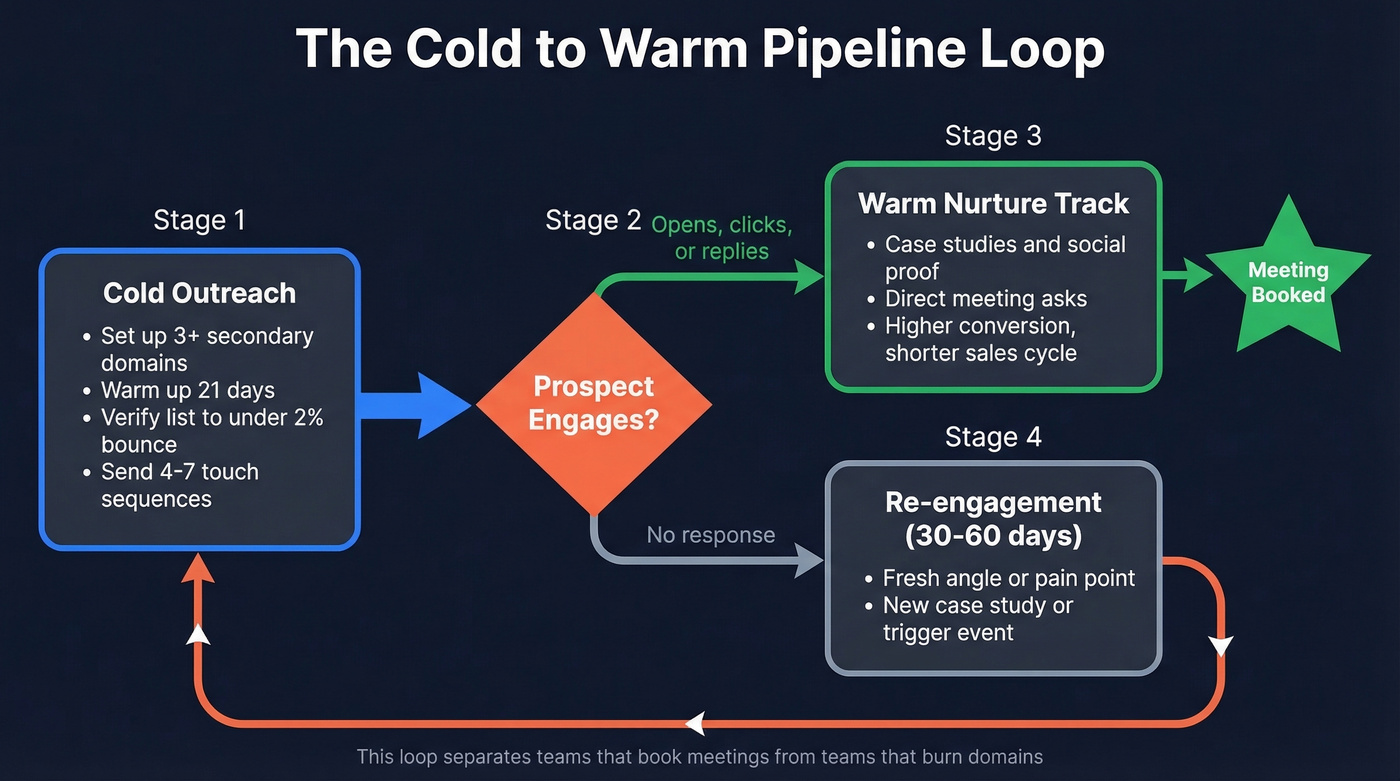
The operational playbook: set up 3+ secondary domains, warm them for 21 days, verify your list, and launch cold sequences. Everyone who opens, clicks, or replies moves into a warm nurture track with case studies, social proof, and direct asks. Non-responders get a re-engagement sequence after 30-60 days with a fresh angle - new pain point, new case study, new trigger event. This loop is what separates teams that book meetings from teams that burn domains.
Skip this if you already have a steady inbound engine generating hundreds of qualified leads monthly. For everyone else, set up your first secondary domains this week, verify your first list, and send your first sequence by next month.
Trigger-based cold emails pull 3x higher response rates - but only if you know *when* to send. Prospeo tracks 15,000 intent topics, job changes, funding rounds, and headcount growth so your cold outreach lands when buyers are actually in-market. Layer intent signals with 30+ filters and turn cold emails into warm conversations before the first reply.
Send cold emails that arrive at exactly the right moment.
FAQ
Which converts better - cold or warm email?
Warm email converts up to 7x better than cold, but the comparison is misleading. Cold email fills the funnel that warm email converts. Without cold outreach, most B2B teams don't have enough warm contacts to sustain pipeline. Use cold to generate leads, warm to close them.
What's a good cold email reply rate in 2026?
The average is 3.43% based on Instantly's 2026 benchmark report. Top-quartile campaigns hit 5.5%+, and the top 10% reach 10.7%+. If you're below 2%, the problem is almost certainly infrastructure or data quality - cutting bounce rates from double digits to under 2% is often the single change that turns a campaign around.
Is cold email legal?
Yes, in most countries. CAN-SPAM requires accurate sender info, a physical address, and a working unsubscribe link. GDPR allows B2B cold email under legitimate interest with proper opt-out. Penalties for violations are steep - up to $50,120 per email under CAN-SPAM.
Should I use cold email or cold calling?
Cold email beats cold calling for sheer scalability - one rep can reach 400 prospects per day via email versus 60-80 by phone. The best approach combines both: send the email first, then follow up with a call 24-48 hours later. If headcount forces a choice, email delivers more conversations per dollar for most B2B teams.