

Sales Funnel Tutorial With Actual Numbers
You launched a landing page last week. Traffic's trickling in. Nobody's converting, and you can't tell whether the problem is your offer, your audience, or the page itself. Reddit's r/GrowthHacking is full of people in the same spot - they've consumed every guru's funnel course and still can't map it to their actual business.
That's the gap in every sales funnel tutorial out there: concepts without numbers. Let's fix that.
What You Need (Quick Version)
- The only math that matters: 100 leads x 30% qualification rate x 40% close rate = 12 deals. Work backward from your revenue target.
- The unsexy foundation: Your funnel's ceiling is your data quality. If a third of your emails bounce, nothing downstream matters. (If you’re not sure what “bad” looks like, start with bounce rate benchmarks.)
- Start free: Systeme.io's free plan handles pages and sequences. For outbound contact data, Prospeo's free tier covers 75 verified emails a month - enough to test whether outbound belongs in your funnel.
Sales Funnel Basics: The 5 Stages
Forget the 47-stage frameworks. Five stages cover it.
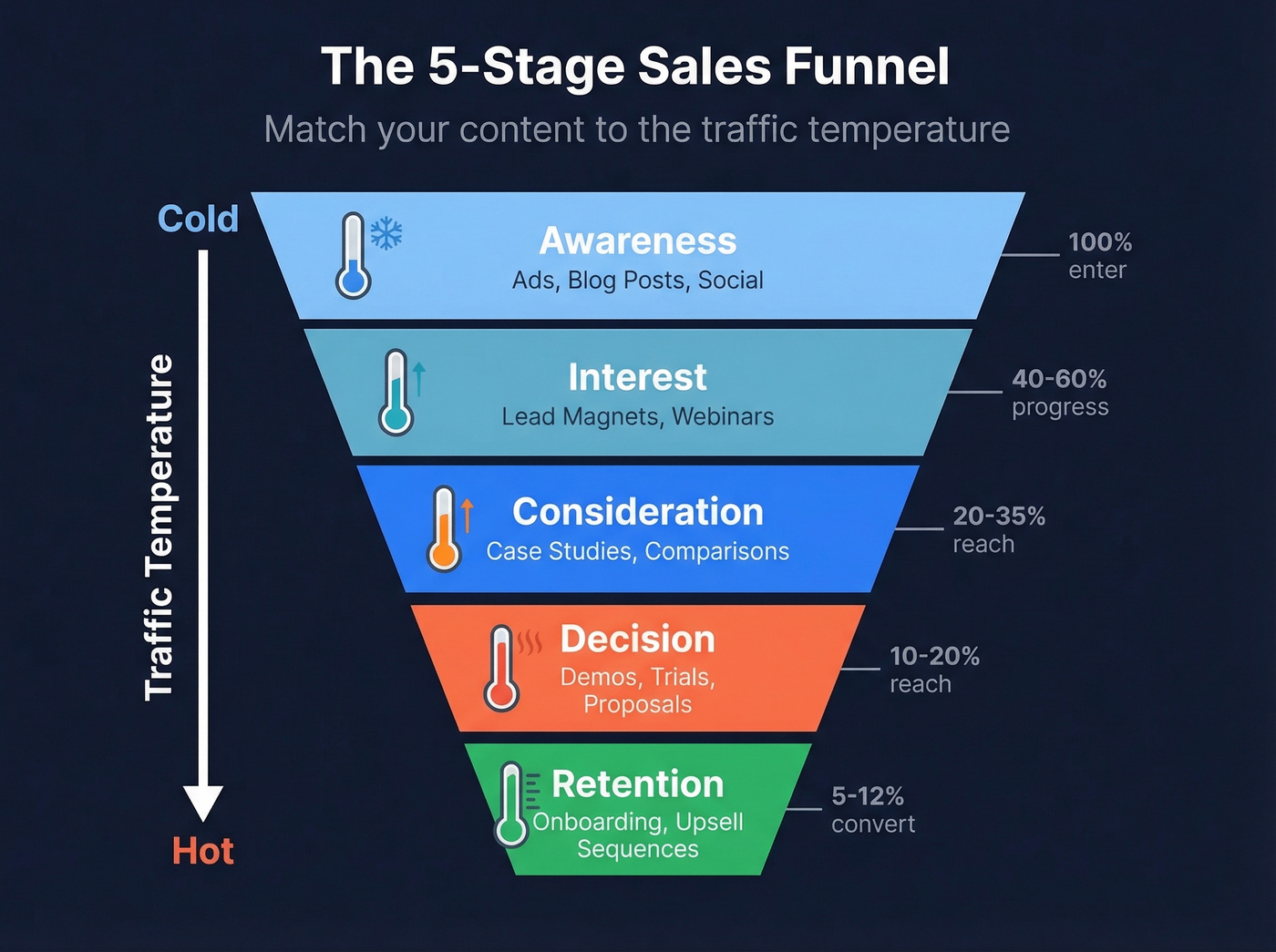
| Stage | Traffic Temp | Content Type |
|---|---|---|
| Awareness | Cold | Ads, blog posts, social |
| Interest | Warming | Lead magnets, webinars |
| Consideration | Warm | Case studies, comparisons |
| Decision | Hot | Demos, trials, proposals |
| Retention | Customer | Onboarding, upsell sequences |
Cold traffic doesn't know you exist. Warm traffic knows your name but hasn't committed. Hot traffic is comparing you to one or two alternatives - every piece of content you create should match the temperature of the person seeing it.
Funnel Benchmarks by Industry
Here are stage-by-stage conversion rates from FirstPageSage's benchmark report:
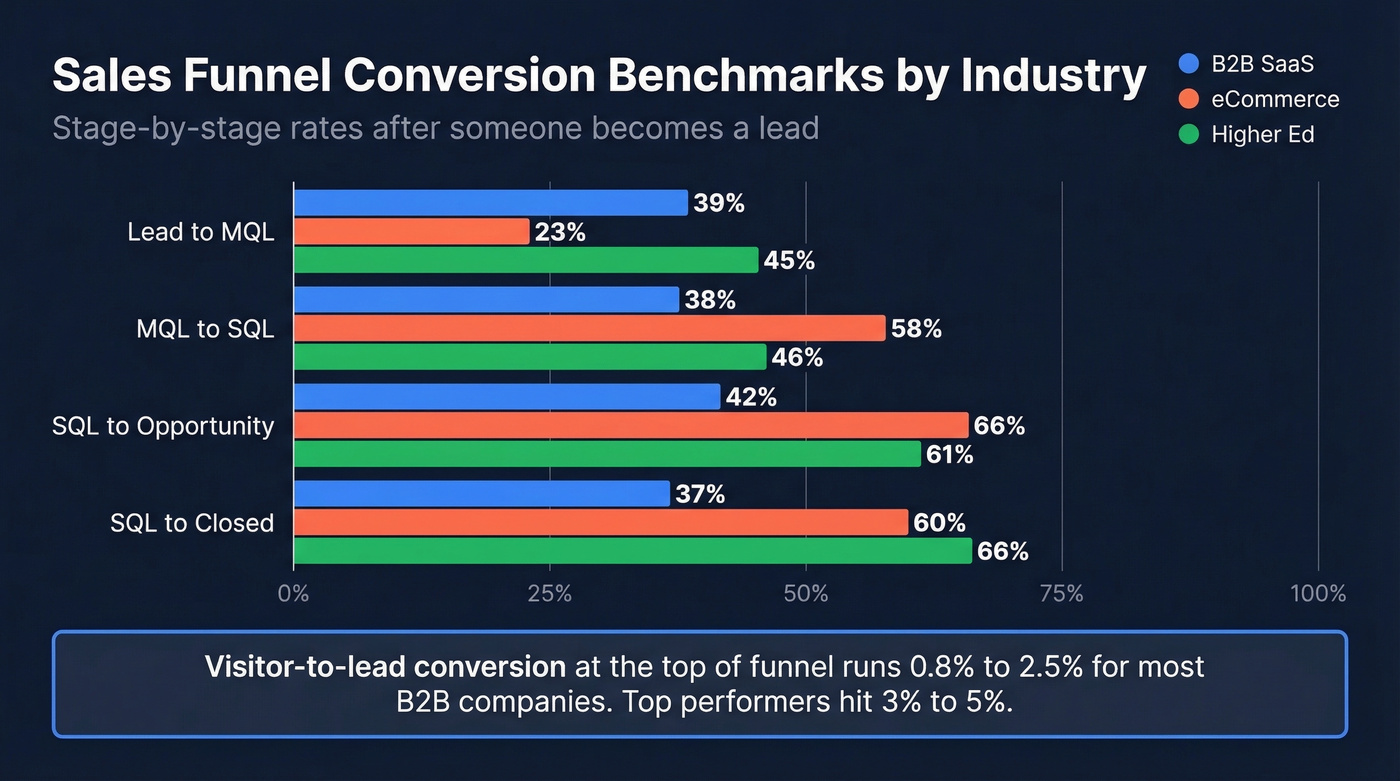
| Industry | Lead to MQL | MQL to SQL | SQL to Opp | SQL to Closed |
|---|---|---|---|---|
| B2B SaaS | 39% | 38% | 42% | 37% |
| eCommerce | 23% | 58% | 66% | 60% |
| Higher Ed | 45% | 46% | 61% | 66% |
These rates happen after someone becomes a lead. The visitor-to-lead conversion at the very top runs 0.8-2.5% for most B2B companies, with top performers hitting 3-5%. If your numbers fall below these ranges, you've found your bottleneck. The average sales win rate hovers around 47% - use that as your sanity check when forecasting.
How to Build a Sales Funnel in 5 Steps
1. Define Your Audience and Offer
Start with your ICP, not your product. Who are you selling to, what's their pain, and what's the one offer that makes them stop scrolling?
Cold audiences need education. Warm audiences need proof. Hot audiences need a reason to act now. If you're trying to serve all three with the same landing page, that's probably why nothing's converting.
2. Drive Traffic
Three channels feed a funnel: traffic you own (email list, community), traffic you earn (SEO, social), and traffic you buy (paid ads). For B2B, outbound is the underrated fourth option - and it's where most funnels quietly die.
We've watched teams pour money into ad spend while 35% of their outbound emails bounce, tanking domain reputation before a single prospect reads a message. One customer, Meritt, dropped their bounce rate from 35% to under 4% after switching to verified contact data - and tripled their pipeline from $100K to $300K per week. The lesson isn't "buy our tool." It's that data quality is a prerequisite, not an optimization. (If you’re building outbound from scratch, start with these sales prospecting techniques.)
3. Capture Leads
Your opt-in page is the funnel's front door. The evergreen funnel case study below hit a 30% opt-in rate - a strong benchmark.
The formula: one clear promise, one lead magnet that delivers immediate value, one form. Remove everything else. Every extra field you add drops conversion by roughly 11%, according to HubSpot's form research.
4. Nurture With Email
Here's the thing: 44% of salespeople give up after one follow-up. It takes at least 5 touchpoints to close a sale. That gap is where most funnels leak revenue. (If you need a starting point, use these sales follow-up templates.)
A simple 3-step sequence works - personalized follow-up on day one, a gentle nudge at day three, and a final push at one week. Personalized emails deliver 6x higher transaction rates than generic blasts, so don't template your way through this. Use trigger-based sends (pricing page visits, webinar attendance) over pure time-based drips. Nurtured leads make 47% larger purchases than non-nurtured ones. The nurture isn't optional.
5. Convert and Retain
Decision-stage prospects need urgency - limited-time offers, deadline-driven bonuses, or simply a clear "here's what happens next" CTA. But don't stop at the first sale.
In the case study below, 45% of total revenue came from the backend nurture sequence targeting people who didn't buy initially. In our experience, retention is never a nice-to-have. It's where the real margin lives. (To pressure-test retention, run a quick churn analysis.)

You just saw the math: 100 leads × 30% × 40% = 12 deals. But that formula collapses when a third of your emails bounce. Prospeo delivers 98% email accuracy on a 7-day refresh cycle - so every lead entering your funnel is actually reachable.
Stop feeding dead emails into a funnel you spent weeks building.
Real Funnel Case Study: $27,813 in 2 Months
Here are the actual numbers from a documented evergreen funnel:
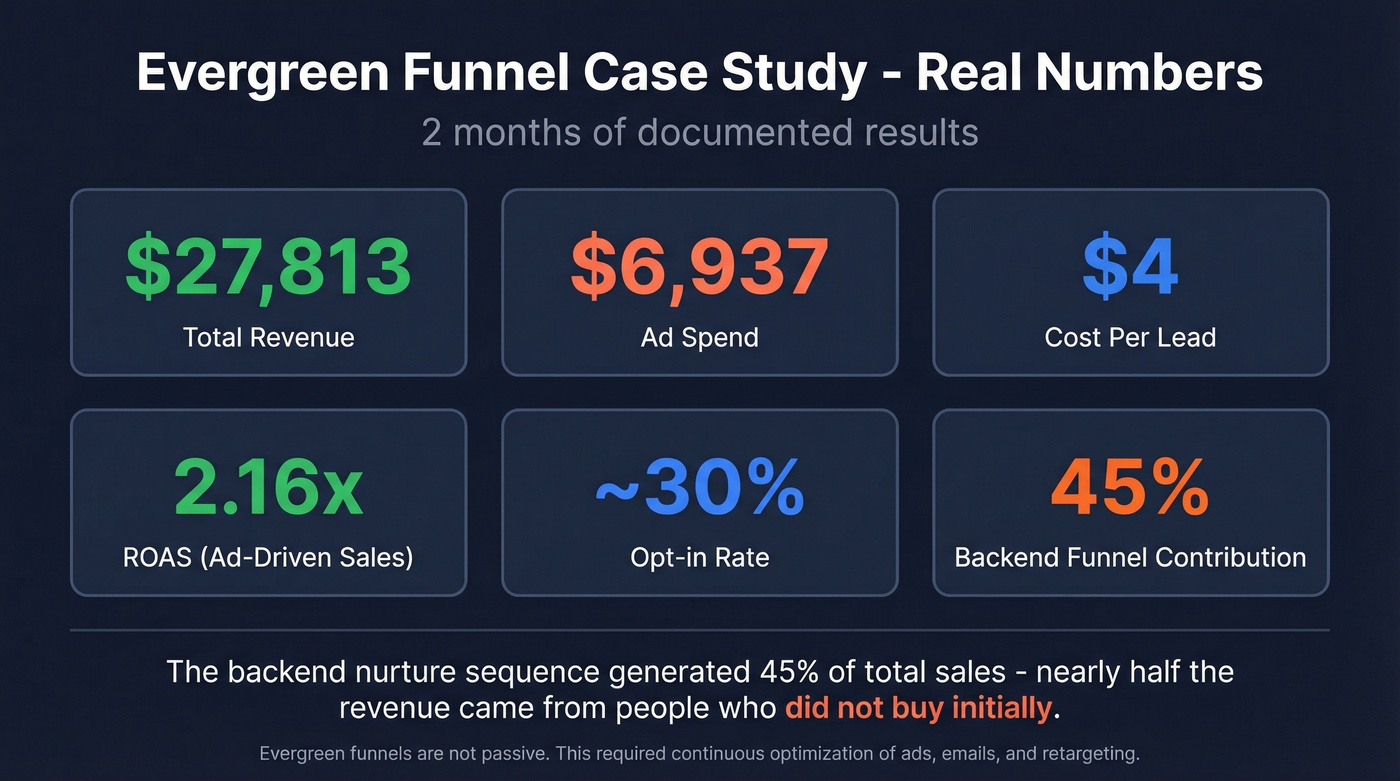
- Total revenue: $27,813
- Ad spend: $6,937
- Cost per lead: $4
- ROAS (ad-driven sales): 2.16x
- Opt-in rate: ~30%
- Backend funnel contribution: 45% of total sales
The takeaway isn't that you should copy this exact setup. It's that evergreen funnels aren't passive. This one required continuous optimization - tweaking ad creative, adjusting email sequences, and retargeting opt-ins who didn't convert. The "set it and forget it" promise is a myth.
How to Measure Your Funnel
Three formulas cover 80% of funnel measurement:
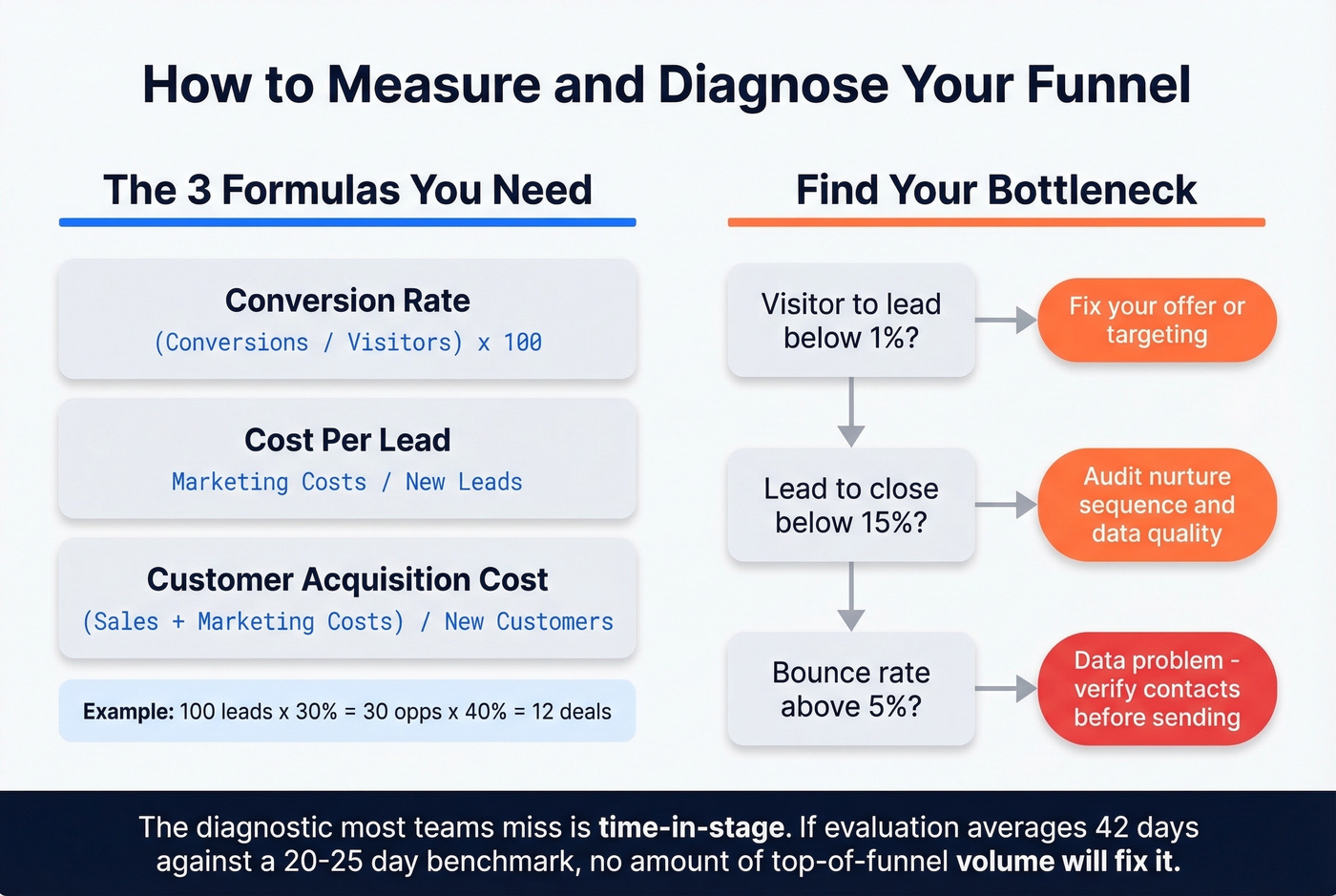
- Conversion Rate = (Conversions / Visitors) x 100
- Cost Per Lead = Marketing Costs / New Leads
- CAC = (Total Sales + Marketing Costs) / New Customers
For forecasting: 100 leads x 30% = 30 opportunities x 40% = 12 deals. Work backward from your revenue target to figure out how many leads you need at the top. (If you want a deeper KPI list, track funnel metrics by stage.)
The diagnostic most teams miss is time-in-stage. If your evaluation stage averages 42 days against a 20-25 day benchmark, no amount of top-of-funnel volume will fix it. And before optimizing copy or sequences, check your data. If your bounce rate exceeds 5%, you've got a data problem, not a messaging problem.
Funnel vs. Flywheel
Salesforce's own blog credits Jim Collins's Good to Great with the flywheel model. That's a misattribution - HubSpot and Brian Halligan popularized the Attract-Engage-Delight flywheel for marketing. Collins wrote about organizational momentum, which is a different concept entirely.
The debate is overblown. If your average deal size is under $10K, you probably don't need to agonize over framework theology. Use a funnel for acquisition, adopt flywheel thinking for retention. They're complementary, not competing religions.
Best Funnel-Building Tools
Systeme.io's free plan is the obvious starting point for first-timers. ClickFunnels is where you graduate when you need advanced split testing and order bumps.
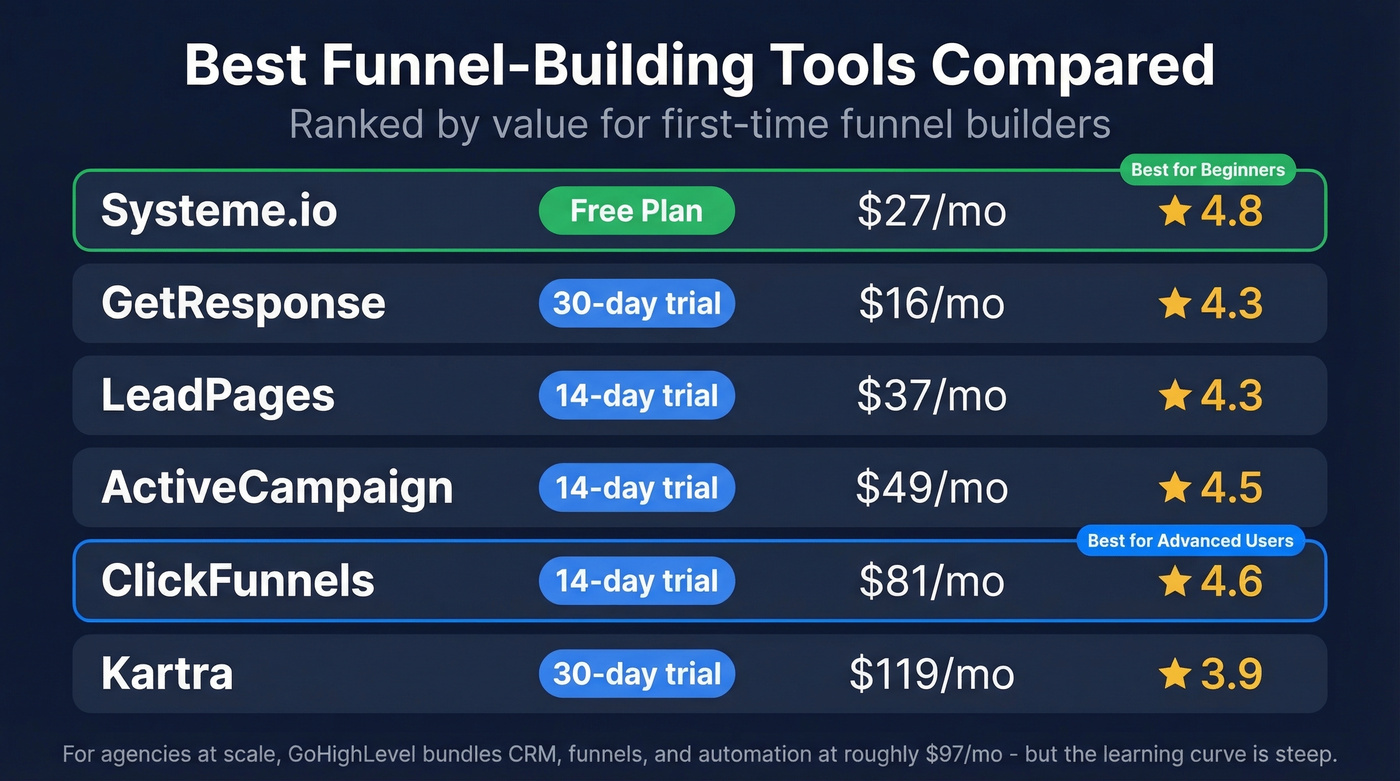
| Tool | Free Plan/Trial | Starting Price | G2 Rating |
|---|---|---|---|
| Systeme.io | Free plan | $27/mo | 4.8/5 |
| GetResponse | 30-day trial | $16/mo | 4.3/5 |
| LeadPages | 14-day trial | $37/mo | 4.3/5 |
| ActiveCampaign | 14-day trial | $49/mo | 4.5/5 |
| ClickFunnels | 14-day trial | $81/mo | 4.6/5 |
| Kartra | 30-day trial | $119/mo | 3.9/5 |
For agencies running client funnels at scale, GoHighLevel bundles CRM, funnels, and automation into one platform at roughly $97/mo - but the learning curve is steep. Skip it if you're building your first funnel. (If you’re comparing stacks, start with these sales funnel automation tools.)
Meritt tripled their pipeline from $100K to $300K/week after dropping their bounce rate from 35% to under 4%. Your funnel's nurture sequence, retargeting, and close rate all depend on reaching real people. Prospeo gives you verified emails and direct dials across 300M+ profiles - starting free.
Fill the top of your funnel with contacts that actually convert.
FAQ
What's the difference between a marketing funnel and a sales funnel?
Marketing funnels cover awareness through lead capture; sales funnels pick up from qualified lead through closed deal. Most teams treat them as one continuous pipeline - the labels matter less than tracking conversion between each stage.
How long does it take to build a sales funnel?
A basic funnel - landing page, email sequence, offer page - takes one to two weeks. Optimization is ongoing. The case study above required months of tweaking to hit $27K in revenue.
What's the best free tool for building a sales funnel?
Systeme.io offers a genuinely usable free plan for pages and automation. For outbound contact data, Prospeo's free tier gives you 75 verified emails per month - enough to test outbound without spending a dollar.
How do I fix a funnel with low conversion rates?
Start by identifying the leaky stage. If visitor-to-lead conversion is below 1%, your offer or targeting needs work. If lead-to-close is below 15%, audit your nurture sequence and data quality. Bounce rates above 5% signal a data problem - verify contacts before sending.
This sales funnel tutorial walked you through the benchmarks, tools, and formulas that separate funnels that convert from funnels that just look pretty. Now it's time to build yours.