

Sales Handling Objections: What 300M+ Cold Calls Reveal About What Actually Works
Run a post-mortem on your lost deals and you'll find the same brutal pattern: 61% died from buyer indecision, not competitor losses. Reps aren't getting outsold. They're getting stalled by objections they don't know how to move past.
Up to 70% of reps miss quota, average B2B win rates sit at 17-20%, and top performers are 843% more likely to overcome objections than their peers. That's not one skill among many - it's the single highest-leverage skill separating quota-crushers from everyone else.
The Cheat Sheet
- The top 5 objections account for 74% of all objections. Master 5 responses, not 50.
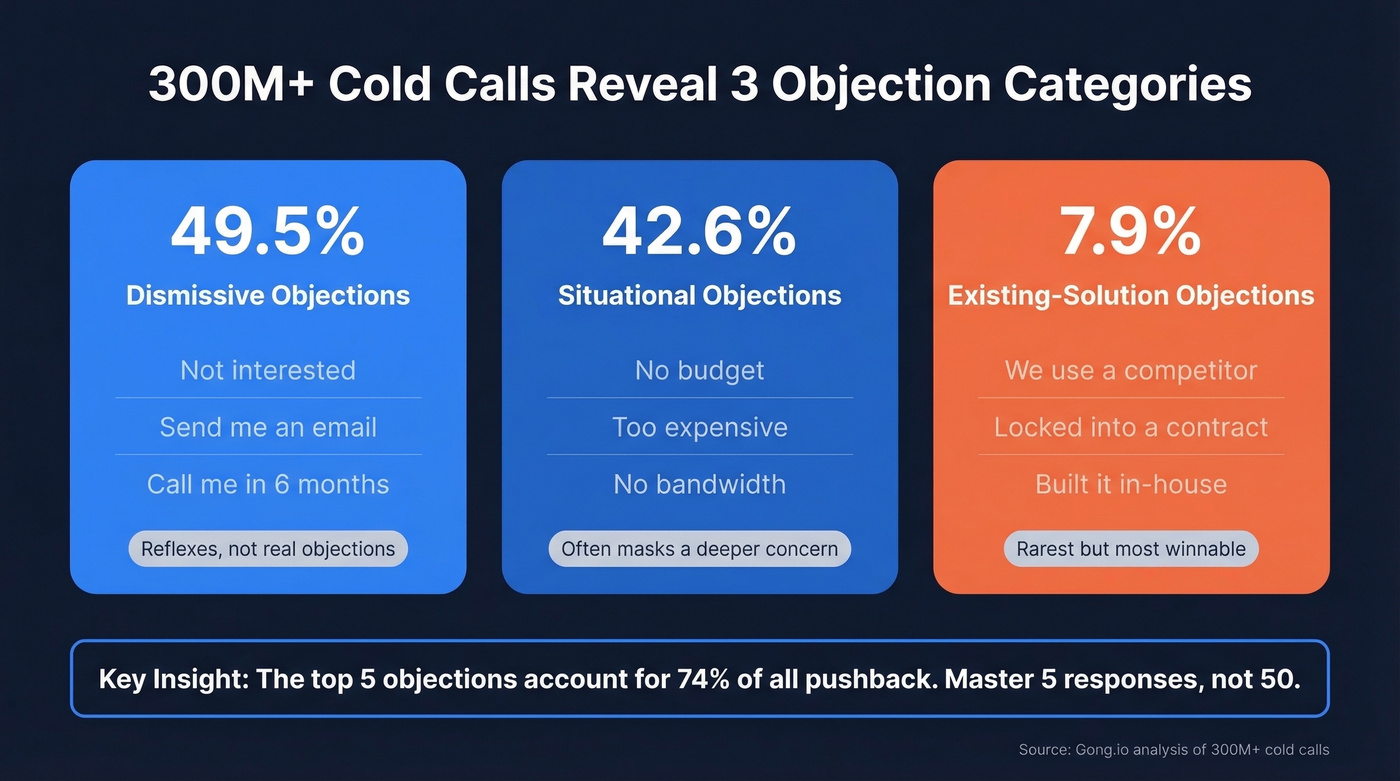
- Objections fall into 3 categories: dismissive (49.5%), situational (42.6%), and existing-solution (7.9%). Each requires a different playbook.
- Top reps pause longer after hearing an objection. Average reps launch into a 21-second monologue.
- The first objection is almost never the real objection. Dig before you respond.
- 49.5% of objections are dismissive reflexes - many disappear entirely when you're calling verified decision-makers instead of wrong numbers.
The framework comparison table in Section 5 maps specific techniques to specific deal stages. Jump there if you already know the basics.
What 300M+ Cold Calls Reveal
Gong analyzed [300M+ cold calls](https://www.gong.io/blog/the-hidden-power-of-cold-calling-insights-from-300m-calls) and found that objections aren't the chaotic, unpredictable mess most reps treat them as. They cluster into three clean categories.
Dismissive objections make up 49.5%. "Not interested." "Send me an email." "Call me in 6 months." These aren't real objections - they're reflexes. The prospect is trying to end the conversation before it starts.
Situational objections account for 42.6%. "No budget." "Too expensive." "No bandwidth." These sound specific but often mask a deeper concern the prospect hasn't articulated yet.
Existing-solution objections are just 7.9%. "We use [competitor]." "Locked into a contract." "Built it in-house." These are the rarest but often the most winnable - the prospect has already acknowledged the problem exists.
That 74% concentration in the top 5 objections is the key insight. Some methodologies break objections into 9+ categories. That's overkill - the three-category model backed by Gong's data is more actionable under pressure. Drill five responses until they're automatic, then build from there.
Scripts for Common Objections
Dismissive Objections (49.5%)
You're 30 seconds into a cold call and the prospect says "Not interested" before you've finished your opener. This isn't an objection - it's a reflex. Gong's recommended approach: be disarmingly blunt.
"Not interested": "Totally fair - you don't know enough to be interested yet. Can I have 20 seconds to tell you why I called, and you can decide if it's worth continuing?"
"Send me an email": "Happy to. So I don't send you something generic - what's the one thing that would make you actually open it?"
"Is this a cold call?": "It absolutely is. I'm calling because [specific reason tied to their company]. Does that land, or am I off base?"
The pattern: acknowledge the dismissal without fighting it, then redirect with a question that forces a real answer. Humor and directness cut through the reflex faster than any polished pitch.
Situational Objections (42.6%)
These sound concrete but rarely are. HubSpot's research documents a case where a prospect said "too expensive" - but the real concern was product durability. Price was the smoke screen. The actual objection was risk.
Here's what a bad response looks like versus a good one for the most common situational objection:
"No budget" ❌ Bad: "We have flexible payment plans." (You just accepted the frame that budget is the real issue.) ✅ Good: "When you mention budget, are we talking zero flexibility, or is this about where to prioritize spend? Because if [specific outcome] saves your team 10 hours a week, that's a different conversation."
The diagnostic question refuses to accept the stated objection at face value. You're not answering "no budget" - you're finding out whether it's actually a priority objection, a timing objection, or a value objection wearing a budget costume.
"Too expensive": "Compared to what? I ask because 'expensive' usually means the value isn't clear yet - and that's on me to fix."
"Not a fit": "Help me understand what 'fit' looks like for you. What would a solution need to do to earn a second look?"
Existing-Solution Objections (7.9%)
You're in a demo and the prospect says "We're locked into a contract until next year." Most reps hear this as a dead end. It's actually an opening - they just told you they have the problem and they've already paid to solve it.
Gong's framework for these: agree, ask a trap question, sell the test drive. Never throw mud at the competitor.
"Locked into a contract": "Makes sense. Most of our customers started evaluating us 3-4 months before their renewal. When does yours come up? I'd rather give you a proper comparison than a rushed one."
"Built it in-house": "That tells me your team is serious about this problem. What's the maintenance cost looking like? Because the teams that build in-house usually have strong opinions about what they'd do differently."
Late-Stage Risk Objections
One category the standard frameworks miss: macro-level risk objections that surface late in deals. "We're in a spending freeze." "The board wants us to hold off on new vendors." These aren't budget objections - they're organizational fear.
The move here is to reframe risk. A spending freeze doesn't mean zero spending; it means every dollar needs stronger justification. Shift from "here's why you should buy" to "here's the cost of waiting." Quantify what inaction costs per month - lost pipeline, manual hours, churn from the problem you solve. Give your champion the internal business case they need to push through the freeze. At this stage, handling objections is less about persuasion and more about arming your internal advocate with data.

Half of all objections are dismissive reflexes - "not interested" from gatekeepers and wrong numbers. When you're calling verified decision-makers with 98% accurate emails and direct dials that hit a 30% pickup rate, you skip the reflexes and start real conversations.
Eliminate half your objections before you even pick up the phone.
Which Framework Should Your Team Use?
Five frameworks dominate sales training. They all work - but they work in different situations. Using the wrong one at the wrong stage is like bringing a discovery script to a negotiation.
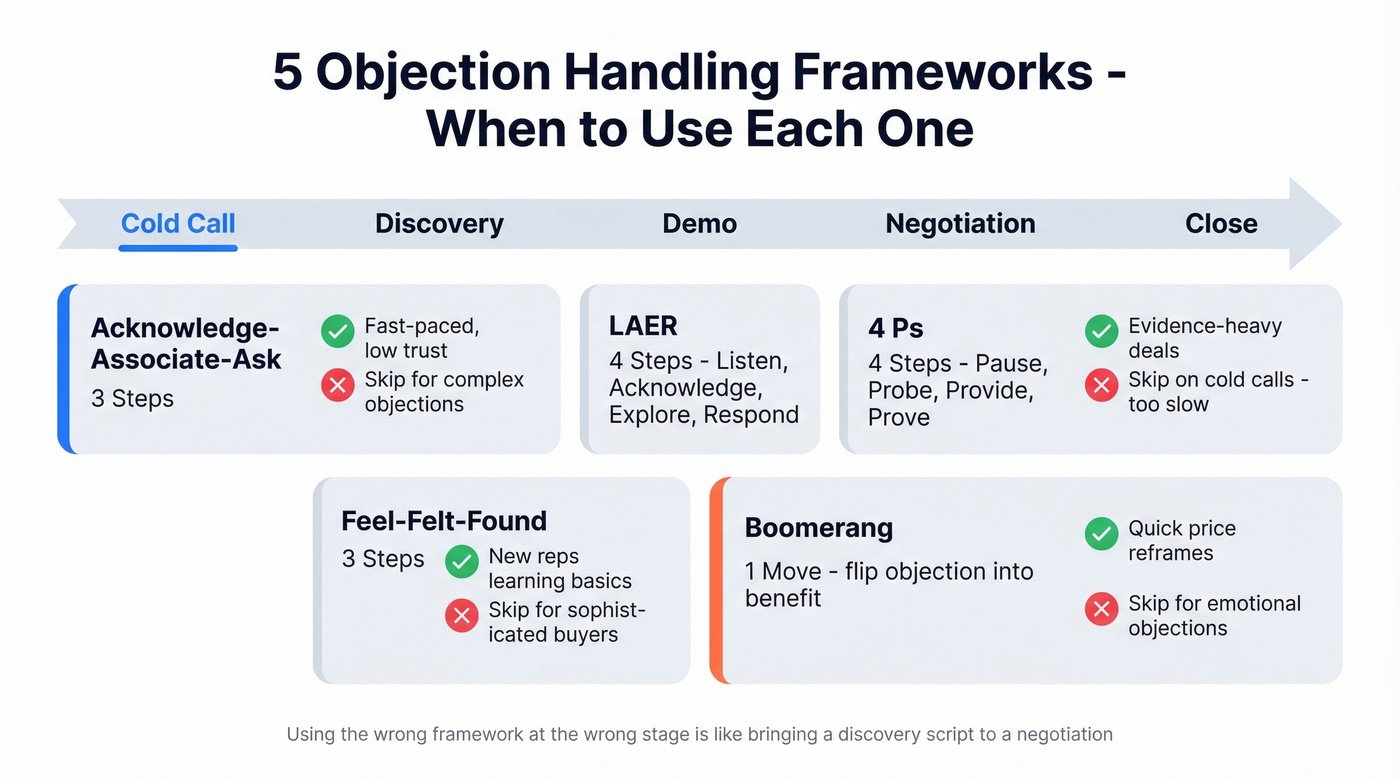
| Framework | Best For | Steps | When to Use | When to Skip |
|---|---|---|---|---|
| Acknowledge-Associate-Ask | Cold calls | 3 steps | Fast-paced, low-trust | Complex objections |
| Feel-Felt-Found | New reps learning the basics | 3 steps | Any stage | Sophisticated buyers |
| LAER | Discovery and demos | 4 steps | Time to probe | Cold calls (too slow) |
| 4 Ps | Negotiation | 4 steps | Evidence-heavy deals | Early-stage calls |
| Boomerang | Quick price reframes | 1 move | Turning objection to benefit | Emotional objections |
For cold calls, Acknowledge-Associate-Ask wins because it's fast. You don't have 90 seconds to run through a four-step framework when the prospect is already reaching for the hang-up button.
For discovery and demos, LAER (Listen, Acknowledge, Explore, Respond) gives you room to probe. The "Explore" step is where deals are saved - it's where you find out "too expensive" actually means "I'm worried this won't work."
For negotiation, the 4 Ps (Pause, Probe, Provide, Prove) works because you can bring evidence. Case studies, ROI calculators, competitive benchmarks - this is where preparation pays off. For reps who are new to overcoming buyer pushback, Feel-Felt-Found is the easiest to memorize and deploy under pressure. It's not sophisticated, but it buys time and shows empathy, which is often enough.
Boomerang is the simplest - you take the objection itself and reframe it as a reason to buy. "You're too expensive" becomes "That's because we include [X] that competitors charge extra for." Use it sparingly; it can feel dismissive if overused.
What Top Reps Do Differently
Gong's analysis of 67,149 demo call recordings reveals something counterintuitive: the best objection handlers don't have better answers. They have better timing.
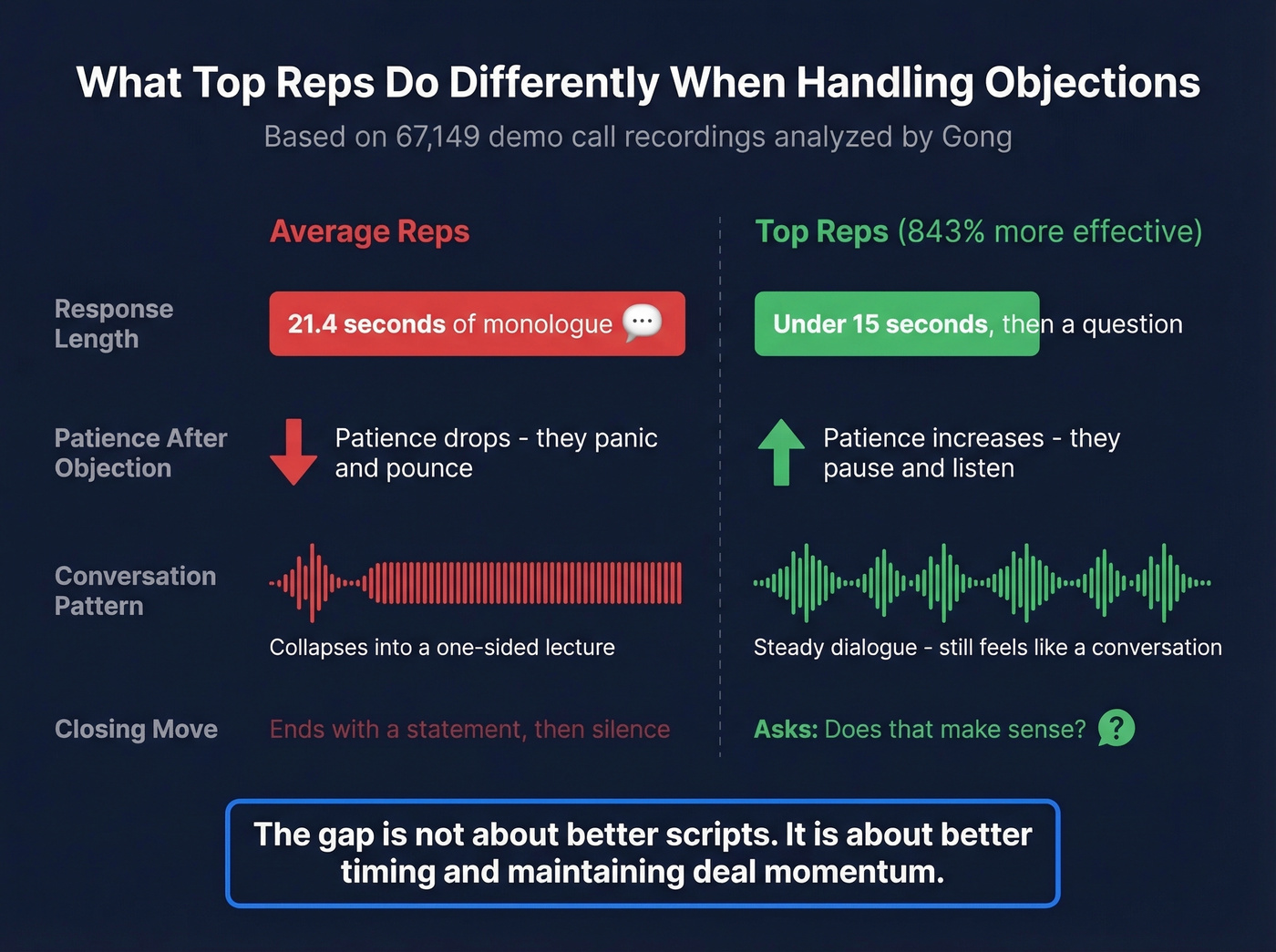
Here's the thing. That 21.45-second monologue isn't just a benchmark - it's what happens when reps panic. Average reps respond to an objection with a knee-jerk data dump that addresses the wrong concern. Top reps pause longer. Their "patience score" goes up when they hear an objection, while average reps' patience drops. They resist the urge to pounce.
The speaker-switch pattern tells the same story. In successful objection-handling moments, the back-and-forth dialogue pace stays steady - it still feels like a conversation. When average reps hit an objection, dialogue pace collapses into a one-sided lecture. We've seen this firsthand reviewing call recordings with our own team: the moment a rep starts monologuing, you can almost hear the prospect mentally check out.
One finding that surprises sales coaches: top reps close their objection responses with "Does that make sense?" far more often than average reps. Not elegant. But it forces the prospect to re-engage instead of sitting in silence.
The 843% gap between top and average performers isn't about memorizing more scripts. It's about maintaining deal momentum - navigating buyer resistance without breaking rapport.
How to Actually Practice
Reading scripts isn't practice. Record yourself responding to the top 5 objections. Review the recordings for monologue length - target under 15 seconds, not 21. Count how many questions you ask versus statements you make. Then pair with a colleague for live roleplay, because the discomfort of practice is exactly what makes real calls feel natural.
6 Mistakes That Kill Deals
Most objection-handling training focuses on what to say. The data says when you respond and whether you follow up matter more than the words themselves.
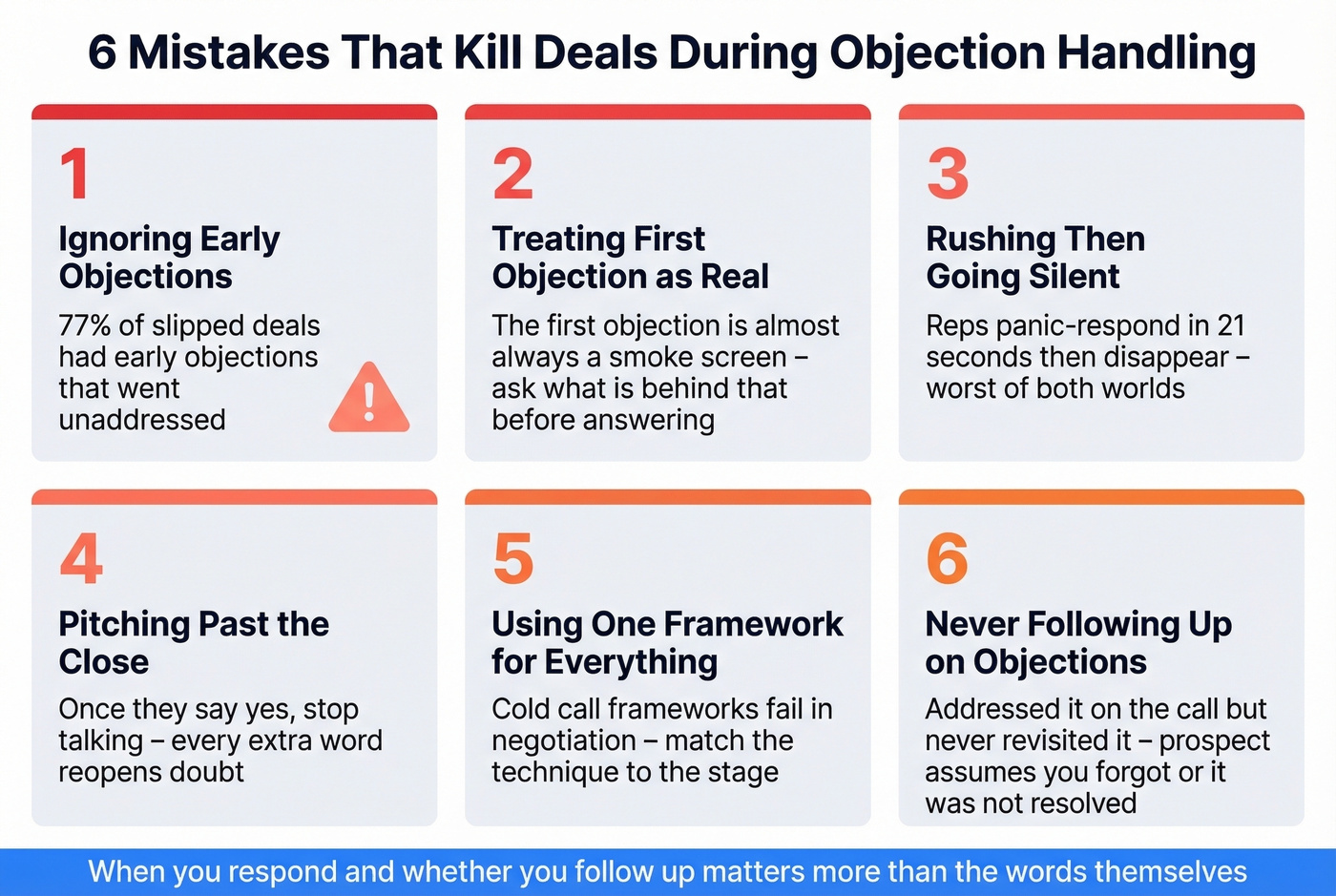
1. Ignoring early objections until they kill the deal. Seventy-seven percent of slipped deals had early objections that went unaddressed. Reps heard the pushback, noted it mentally, and moved on - hoping it would resolve itself. It didn't. Surface objections early, address them early, or watch them metastasize.
2. Treating the first objection as the real objection. It almost never is. The first objection is a smoke screen - a socially acceptable way to slow things down. Ask "what's behind that?" before you answer anything.
3. Rushing to respond, then going silent for a week. That 21-second monologue is a warning sign, but the bigger killer is what happens after. More than 7 days of inactivity after an objection cuts win rates by 65%. Send the case study that night. Book the next call before you hang up. Momentum is everything. If you need a system, keep a set of sales follow-up templates ready to deploy the same day.
4. Getting defensive or argumentative. The moment you argue with a prospect, you've lost. Even if you're right. Defensiveness increases resistance and undermines the trust you built earlier in the conversation.
5. Discounting too fast. The instinct to drop price at the first sign of pushback is strong - and expensive. Leading with ROI and unique value before touching price protects margins and signals confidence. Discounting first tells the prospect your original price was inflated.
6. Missing the emotional driver. I once watched a rep lose a deal by getting "feature happy" - stacking capabilities and specs while completely missing the buyer's emotional motivation. The prospect didn't care about features. They cared about looking smart to their VP. Answer the logical objection, sure. But find the emotional one first.
Fix Your Data Before Your Pitch
Buying committees now run 6-10 stakeholders deep, and for deals over $50K, multi-threading across those stakeholders boosts win rates by 130%. But multi-threading only works if you can actually reach verified decision-makers. And 78% of enterprise buyers shortlist products they already knew - which means reaching the right person early isn't just about reducing dismissive objections, it's about making the shortlist at all.
Let's be honest: half the "not interested" brush-offs reps face aren't real objections. They're the result of calling the wrong person, hitting a stale number, or reaching someone who changed roles two months ago. Cleaning up your contact data eliminates a huge chunk of dismissive objections before they happen. If you're tightening your outbound motion, pair this with proven sales prospecting techniques so your reps spend time on the right accounts.
Prospeo's 98% email accuracy and 125M+ verified mobile numbers on a 7-day refresh cycle mean your reps spend less time navigating gatekeepers and more time in real conversations - the kind where objection-handling skills actually matter. This is the same logic behind using data enrichment services and a reliable sales prospecting database to keep records current.

The proof: Snyk's 50-person AE team cut their bounce rate from 35-40% to under 5% after switching to verified contact data. AE-sourced pipeline jumped 180%, generating 200+ new opportunities per month. If bounce is still hurting you, start with email bounce rate fundamentals and an email deliverability guide to fix the root causes.
The best objection-handling framework won't save a deal built on bad data. Prospeo gives your reps 300M+ verified profiles with direct dials and 98% email accuracy - so every conversation starts with the right person, not a gatekeeper reflex.
Arm your reps with real buyer data at $0.01 per lead.
FAQ
What are the 4 types of sales objections?
The classic taxonomy is BANT: Budget, Authority, Need, and Timing. But Gong's data-driven breakdown - dismissive (49.5%), situational (42.6%), and existing-solution (7.9%) - is more actionable for cold calls because it tells you how to respond, not just what category to file the objection under.
What is the LAER framework?
LAER stands for Listen, Acknowledge, Explore, Respond. It's the go-to framework for handling objections during discovery and demo calls where you have time to probe the real concern. The "Explore" step separates it from simpler frameworks - it forces diagnostic questions instead of scripted answers.
How many objections should reps prepare for?
Five. Gong's data shows the top 5 objections account for 74% of all pushback reps encounter. Drill those five until the responses are automatic, then expand. Trying to prepare for every possible scenario leads to shallow preparation that crumbles under pressure.
What tools help reps reduce dismissive objections?
Reaching verified decision-makers directly eliminates many dismissive objections caused by wrong numbers and gatekeepers. Pair accurate contact data with intent signals to prioritize accounts already researching your category, and you'll spend less time on reflexive brush-offs and more time in real conversations.