

How to Run Sales Huddles That Don't Waste Selling Time
Two huddles a day. Thirty minutes each. Plus Slack KPI check-ins every morning and three hours of manager meetings per week. That's a real cadence a sales rep posted on r/sales, genuinely asking if it was "too much." It is. Sales huddles were supposed to be 10-minute alignment pulses - somewhere along the way, they became a 60-minute daily tax on selling time, and your team resents it.
Here's how to fix that.
What Is a Sales Huddle?
A sales huddle isn't a sales meeting. It's not a pipeline review, a forecast call, or a scrum ceremony. It's a short, high-energy daily check-in - typically 10 to 15 minutes - where reps share their top priority, surface blockers, and celebrate a quick win.
The distinction matters because the wrong label invites the wrong behavior. A sales meeting digs into strategy and deal mechanics. A standup tracks sprint progress. A huddle is lighter than both: a daily rhythm that keeps the team aligned without eating into selling hours. Research from Gallup shows teams running daily standups are 21% more likely to hit project goals on time and see a 17% lift in employee engagement. But that ROI evaporates the moment your 10-minute check-in bloats into a 30-minute meeting where three people monologue about their calendars.
The 15-Minute Huddle Script
This is the agenda we've seen work best across SDR and AE teams. Print it, pin it in Slack, tape it to the conference room wall. Ruthless timeboxing is everything.
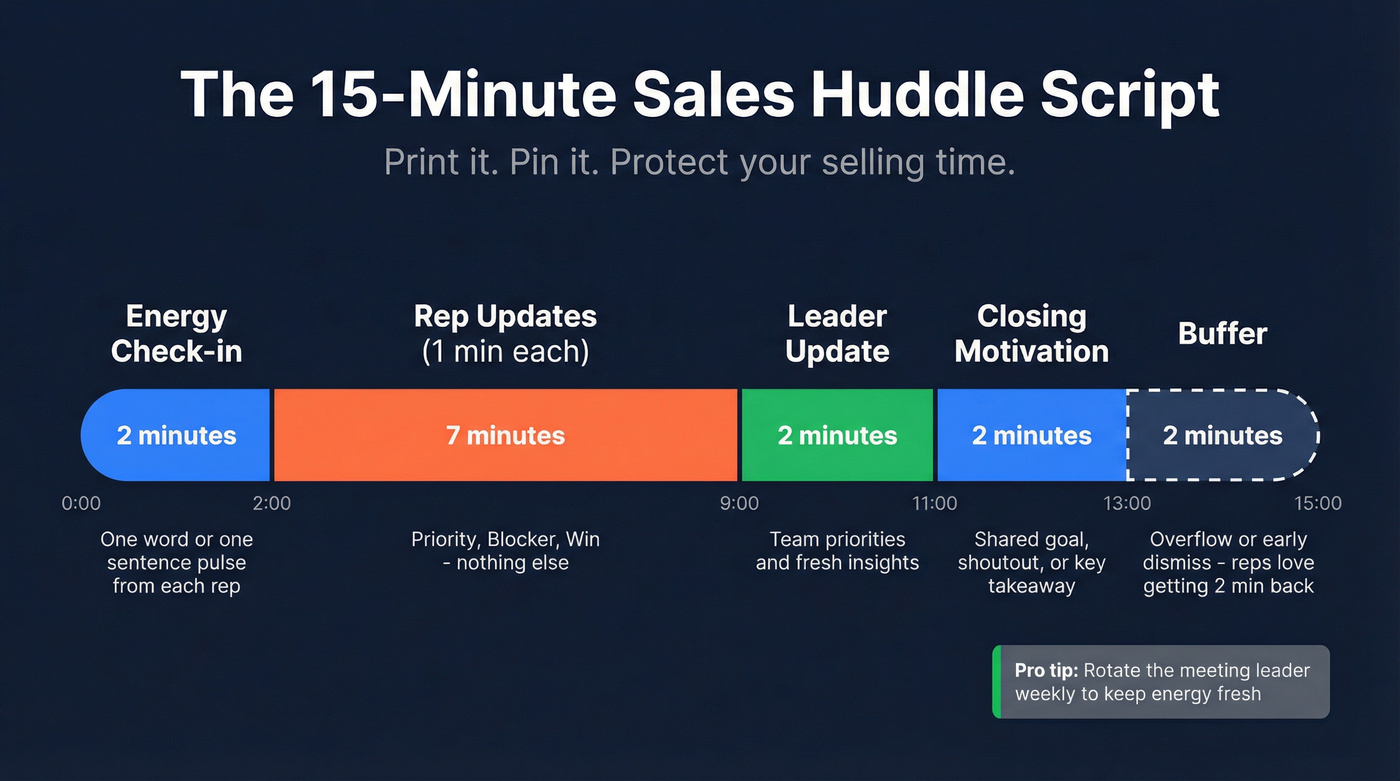
| Minute | Block | What Happens |
|---|---|---|
| 0:00-2:00 | Energy check-in | Quick pulse - one word or sentence |
| 2:00-9:00 | Rep updates (1 min each) | Priority, blocker, win |
| 9:00-11:00 | Leader update | Team priorities + insights |
| 11:00-13:00 | Closing motivation | Shared goal reminder, shoutout, or key takeaway |
| 13:00-15:00 | Buffer | Overflow or early dismiss - reps love getting 2 minutes back |
Rotate the meeting leader weekly. It builds ownership and keeps the energy from going stale. If you let any single block expand, the whole thing collapses - and within a week, your "quick huddle" is a 25-minute slog nobody wants to attend.
Five Huddle Ideas to Rotate Weekly
Running the same format every day is how huddles die. We've found the objection drill gets the most engagement by far, but rotate all five to keep reps sharp:
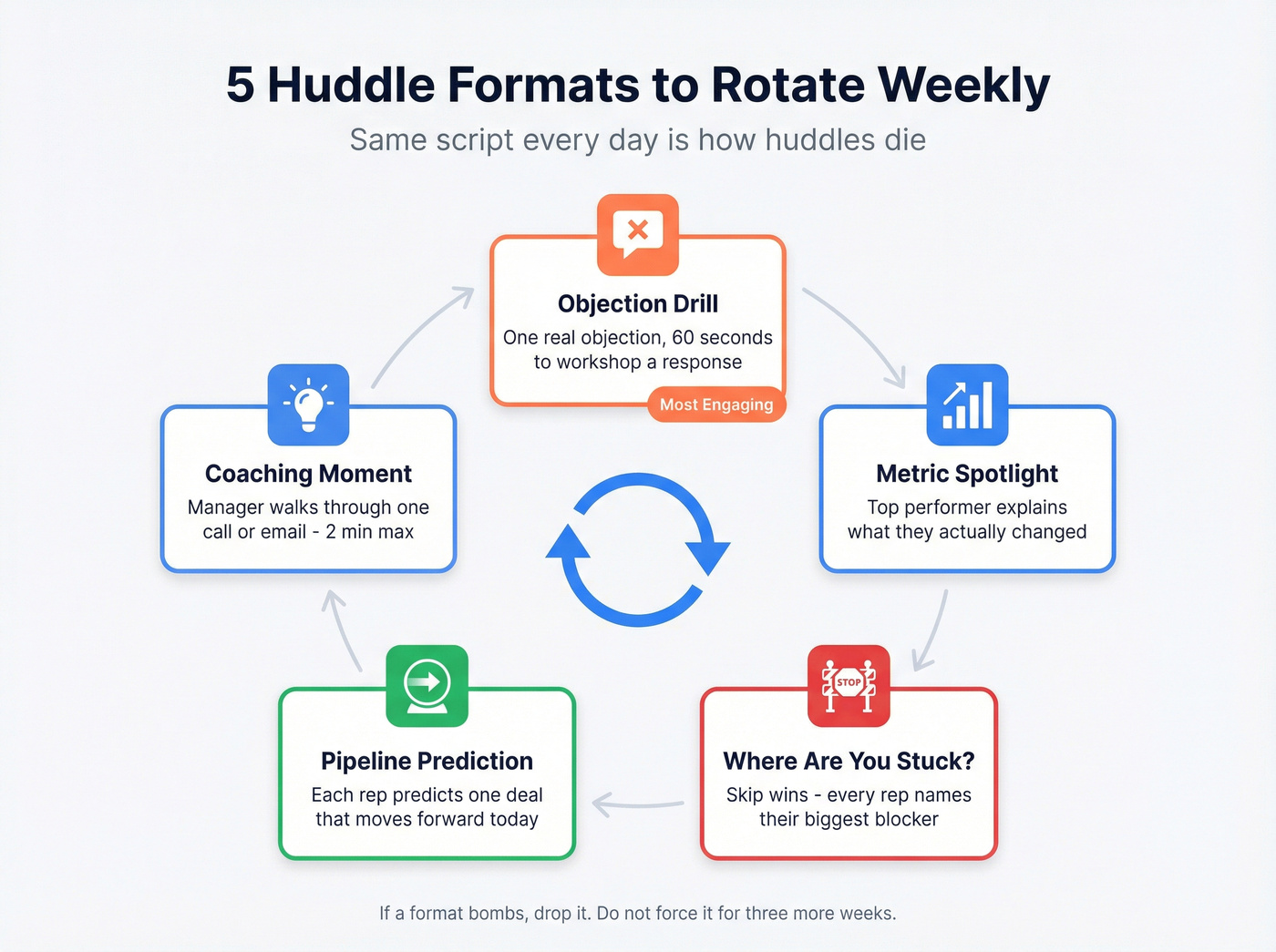
Objection drill. One rep shares a real objection from yesterday. The team has 60 seconds to workshop a response. Fast, practical, builds muscle memory. This one alone has saved more deals on our team than any formal training session.
Metric spotlight. Pick one number - connect rate, meetings booked, email replies - and let the top performer explain what they did differently. No theory, just "here's what I actually changed." (If your team needs better outreach fundamentals, keep a few sales prospecting techniques handy.)
"Where are you stuck?" round. Skip wins entirely. Every rep names their biggest blocker. The leader's job is to remove at least one before lunch.
Pipeline prediction. Each rep predicts one deal that'll move forward today. Creates accountability and gives the manager a real-time read on pipeline confidence without turning the huddle into a forecast call.
Coaching moment. The manager picks one call snippet or email from the previous day and walks through what worked. Two minutes, max. If you can't make the point in two minutes, save it for your 1:1.

"Bad data" shouldn't be a recurring blocker in your huddles. Prospeo's 98% email accuracy and 125M+ verified mobile numbers - refreshed every 7 days - mean your reps spend huddle time talking about deals, not disconnected numbers.
Eliminate your team's #1 blocker for $0.01 per verified email.
The Only Metrics Worth Reviewing
Here's the thing: if you're reviewing more than six numbers in a 10-minute standup, you're running a pipeline review in disguise. These are the only metrics that belong on a huddle scoreboard.
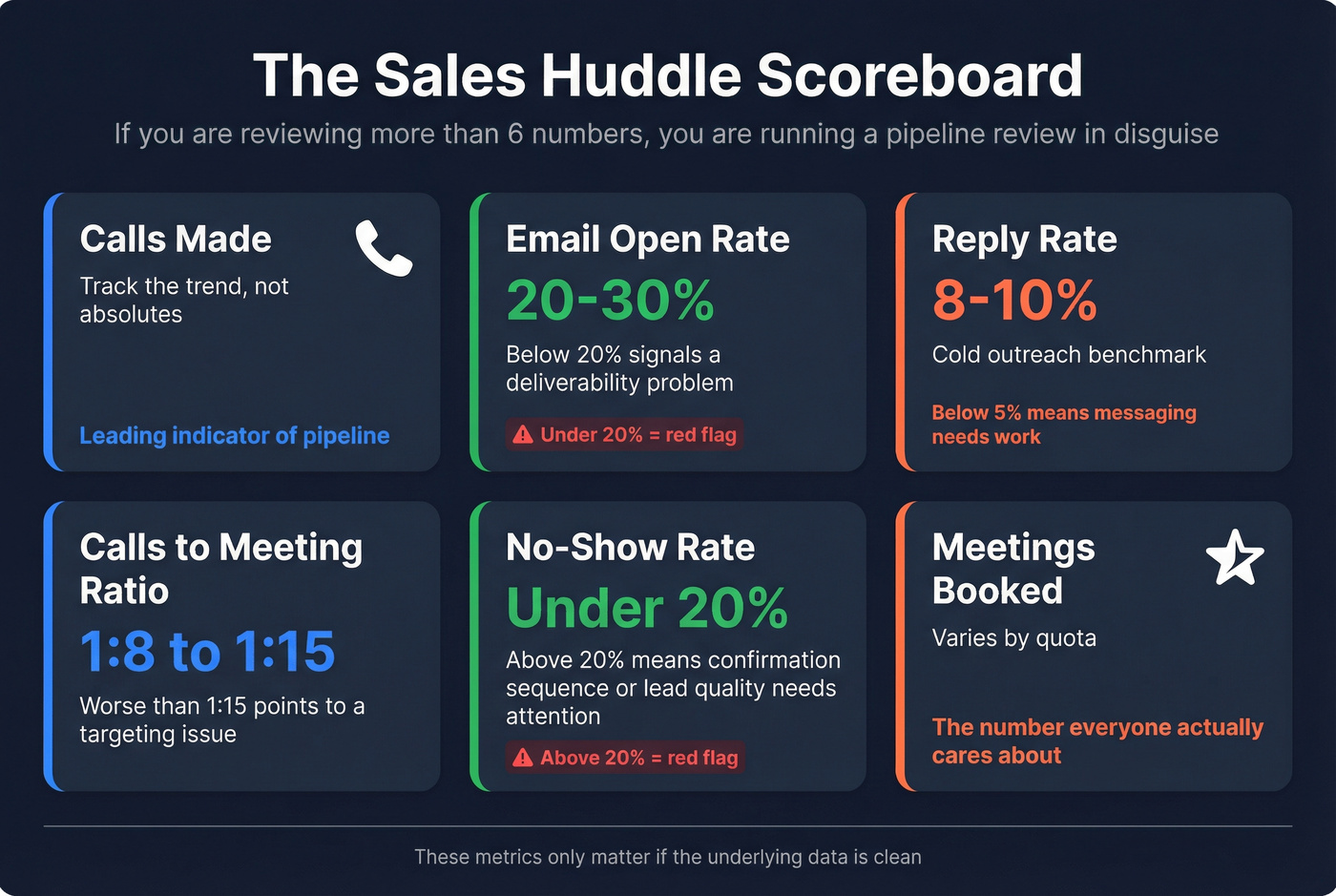
| Metric | Benchmark | Why It Matters |
|---|---|---|
| Calls made | Track trend, not absolutes | Leading indicator of pipeline |
| Email open rate | 20-30% | Below 20% signals a deliverability problem |
| Reply rate | 8-10% for cold outreach | Below 5% means your messaging needs work |
| Calls-to-meeting ratio | 1:8 to 1:15 | Worse than 1:15 points to a targeting issue |
| No-show rate | Under 20% | Above 20% means your confirmation sequence or lead quality needs attention |
| Meetings booked | Varies by quota | The number everyone actually cares about |
These metrics are only meaningful if the underlying data is clean. If half your dials hit disconnected numbers, your scoreboard is fiction. Prospeo's 98% email accuracy and 125M+ verified mobile numbers - refreshed every 7 days - mean the activity numbers your reps report reflect actual effort, not data decay. (If you're trying to fix the root cause, compare data enrichment services and build a repeatable lead enrichment workflow.)

Five Ways to Kill Your Huddle
Letting it run long. Set a hard stop at 15 minutes. That Reddit rep sitting through two 30-minute sessions daily? That's an hour of selling time gone - every single day.
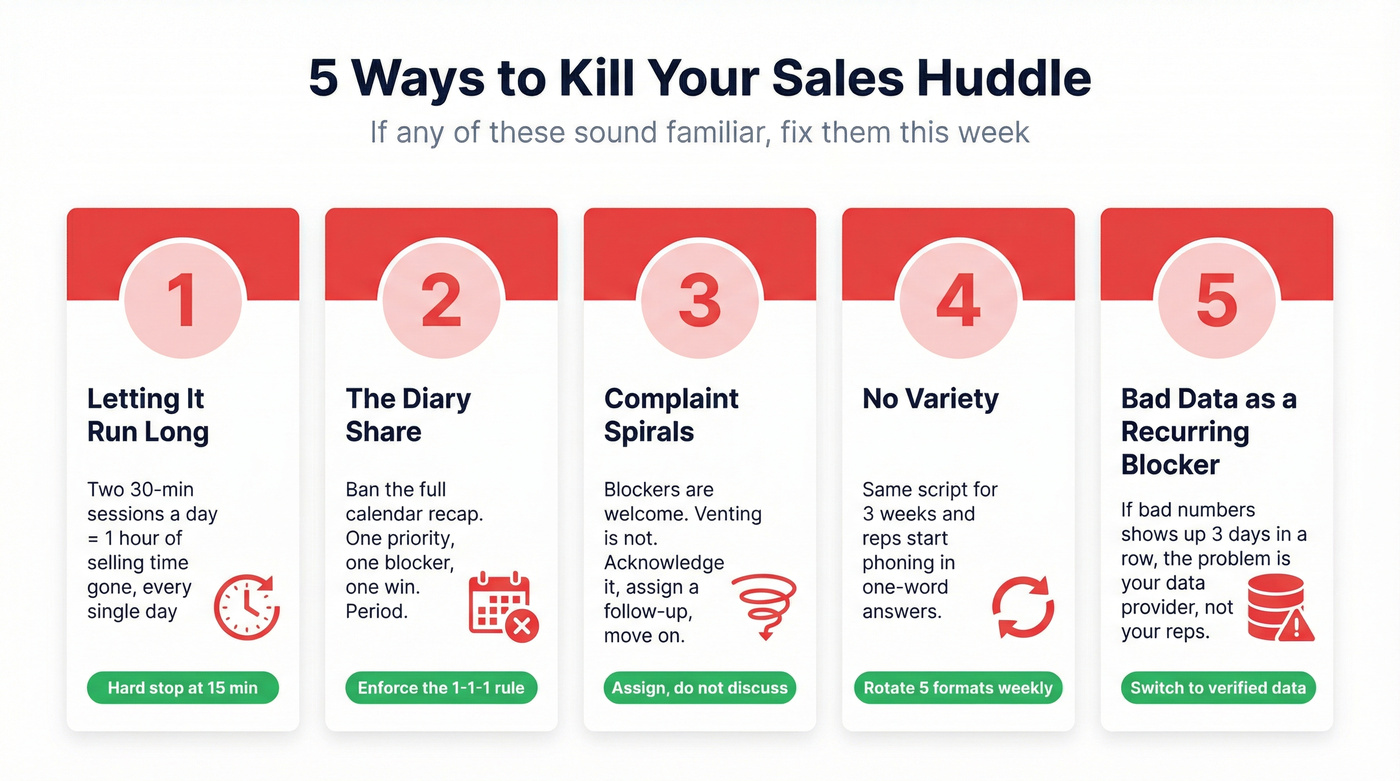
Turning it into a diary share. Ban "here's everything in my calendar today." One priority, one blocker, one win. Period.
Allowing complaint spirals. Blockers are welcome. Venting isn't. If a rep raises a problem, acknowledge it and assign a follow-up. No group commiseration sessions. (This is also where strong sales leadership shows up.)
No variety. Same script for three weeks and reps start phoning in one-word answers. Rotate the five themes above.
Bad data as a recurring blocker. If "bad numbers" shows up three days in a row, the problem isn't your reps - it's your data provider.
Let's be honest about something most huddle guides skip: the most valuable part of a huddle isn't wins. It's blockers. If nobody reports a blocker for two days straight, something's wrong. Either reps aren't being honest, or the huddle isn't safe enough for honesty. Both are leadership problems worth fixing before you tweak anything else about your sales cadence.
Huddle Health Check
After two weeks of daily standups, ask yourself three questions:
- Are blockers getting resolved within 24 hours? If not, reps will stop raising them - and the huddle loses its entire point.
- Do reps voluntarily share wins, or only when prompted? Voluntary sharing means the huddle feels like their space, not a reporting exercise.
- Has anyone asked to skip? One skip request is normal. Three means the format needs a reset.
If you can answer all three favorably, your morning rhythm is healthy. If not, revisit the script and themes before adding more meetings to the calendar. Don't layer on a second daily sync to fix a broken first one - that's how you end up as a cautionary tale on Reddit.
Running Sales Huddles for Remote Teams
With roughly 45% of workers now in a hybrid model, the "everyone in the conference room at 8:45" huddle doesn't always work.
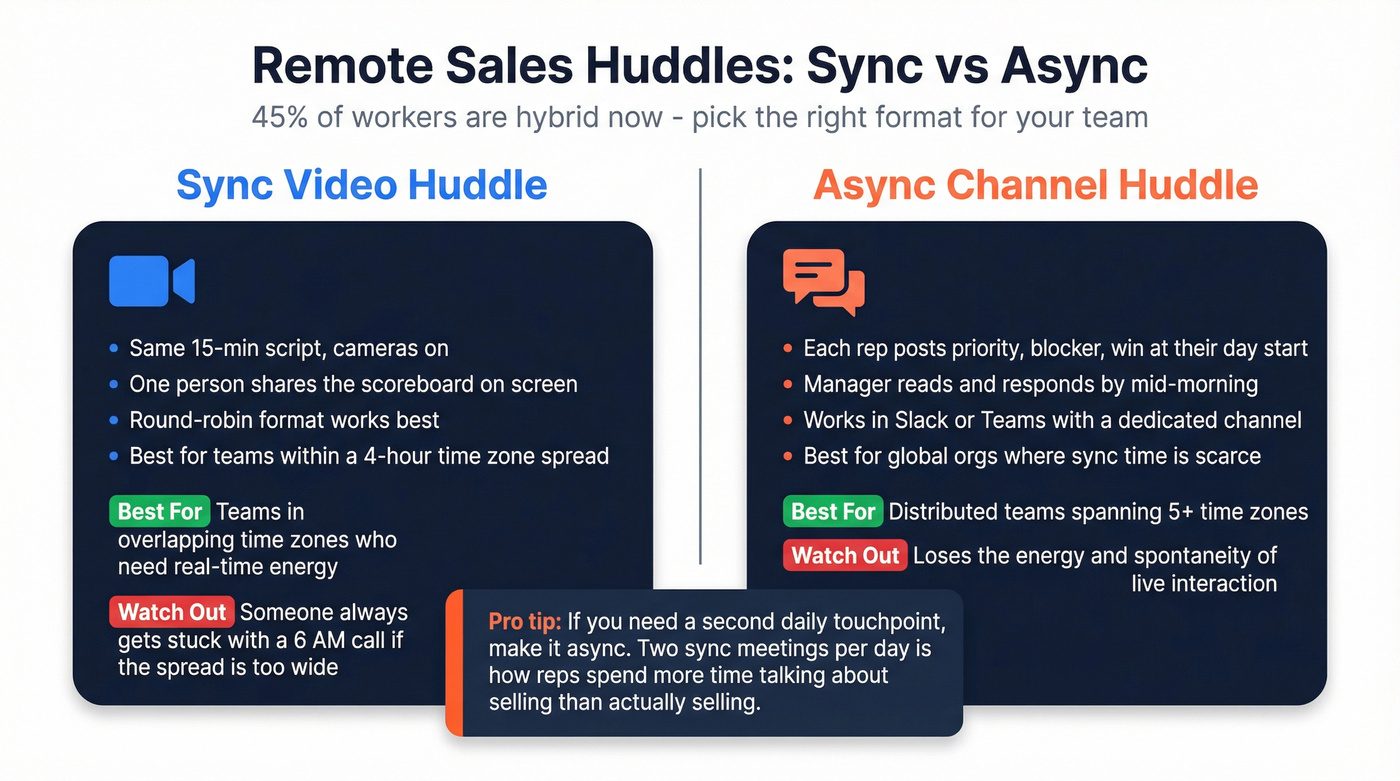
Sync huddle on video: Same 15-minute script, cameras on, one person shares their screen with the scoreboard. Round-robin works best - "walk the board" gets clunky across time zones. Skip this format if your team spans more than a 4-hour time zone spread; someone always gets stuck with a 6 AM call, and resentment builds fast.
Async huddle in a channel: Each rep posts their priority, blocker, and win in a dedicated Slack or Teams channel at the start of their workday. The manager reads and responds by mid-morning. Asana's distributed team playbook supports this format, and it works well for global orgs where synchronous time is scarce. (If you want to tighten the rest of your remote cadence, borrow a few remote sales meeting tips.)
For teams that need a second daily touchpoint, make it async. Two synchronous meetings per day is how you end up with reps who spend more time talking about selling than actually selling.
Your huddle scoreboard is only as good as the data behind it. If connect rates and reply rates are built on stale contacts, you're coaching off fiction. Prospeo's 7-day refresh cycle and 30% mobile pickup rate give your metrics real meaning.
Turn your scoreboard from fiction into a forecasting tool.
FAQ
Should sales huddles be daily or weekly?
Start daily for 30 days, then decide. Daily cadence builds the habit and surfaces blockers before they cost you deals. Scale back to three times a week once the rhythm is established - weekly is too infrequent, and by Friday the blocker from Monday has already killed a deal.
What's the ideal huddle size?
Cap at 8-10 reps. Beyond that, split into pods. Each person gets roughly one minute for their update; more than 10 and you either blow past 15 minutes or reps stop paying attention. Smaller groups also make it safer to share real blockers instead of polished status updates.
What if bad data keeps blocking reps?
Switch to a verified data source with a weekly refresh cycle. Prospeo's 98% email accuracy and 7-day refresh - versus the 6-week industry average - mean reps spend huddle time on strategy instead of reporting bounced emails and disconnected numbers.
How do you keep morning standups engaging?
Rotate five formats weekly: objection drills, metric spotlights, blocker rounds, pipeline predictions, and coaching moments. Variety prevents the one-word-answer fatigue that kills most daily check-ins within a month. And if a format bombs, drop it - don't force it for another three weeks out of obligation.