Sales Intelligence for Manufacturing: The Guide Generic Vendors Won't Write
Your best sales engineer is retiring in 18 months. He's got 200 accounts in his head, knows which plant managers pick up the phone, and can smell a capex cycle from an earnings call. Nobody's captured any of it.
That's the manufacturing intelligence gap - and sales intelligence is how you close it. Thirty percent of manufacturers expect at least 16% of their sales and engineering workforce to retire within five years. Forty-three percent still run configure-price-quote on Excel spreadsheets. This isn't just a revenue tool; it's a knowledge preservation strategy, and most teams are already behind.
What You Need (Quick Version)
Three things, stacked by priority:
- Verified contact data for plant-level decision-makers. You can't act on any buying signal without a direct dial for the operations VP who controls the budget.
- Manufacturing-specific intent signals. Sourcing behavior on industrial directories, not whitepaper downloads. Demandbase or Bombora paired with IndustryNet.
- Your ERP connected to your CRM. Ordering patterns, service tickets, and credit holds predict churn better than any third-party signal.
Why Manufacturing Differs from SaaS
Most sales intelligence platforms were built for SaaS companies selling $30K ARR deals on 90-day cycles. Manufacturing doesn't work that way.
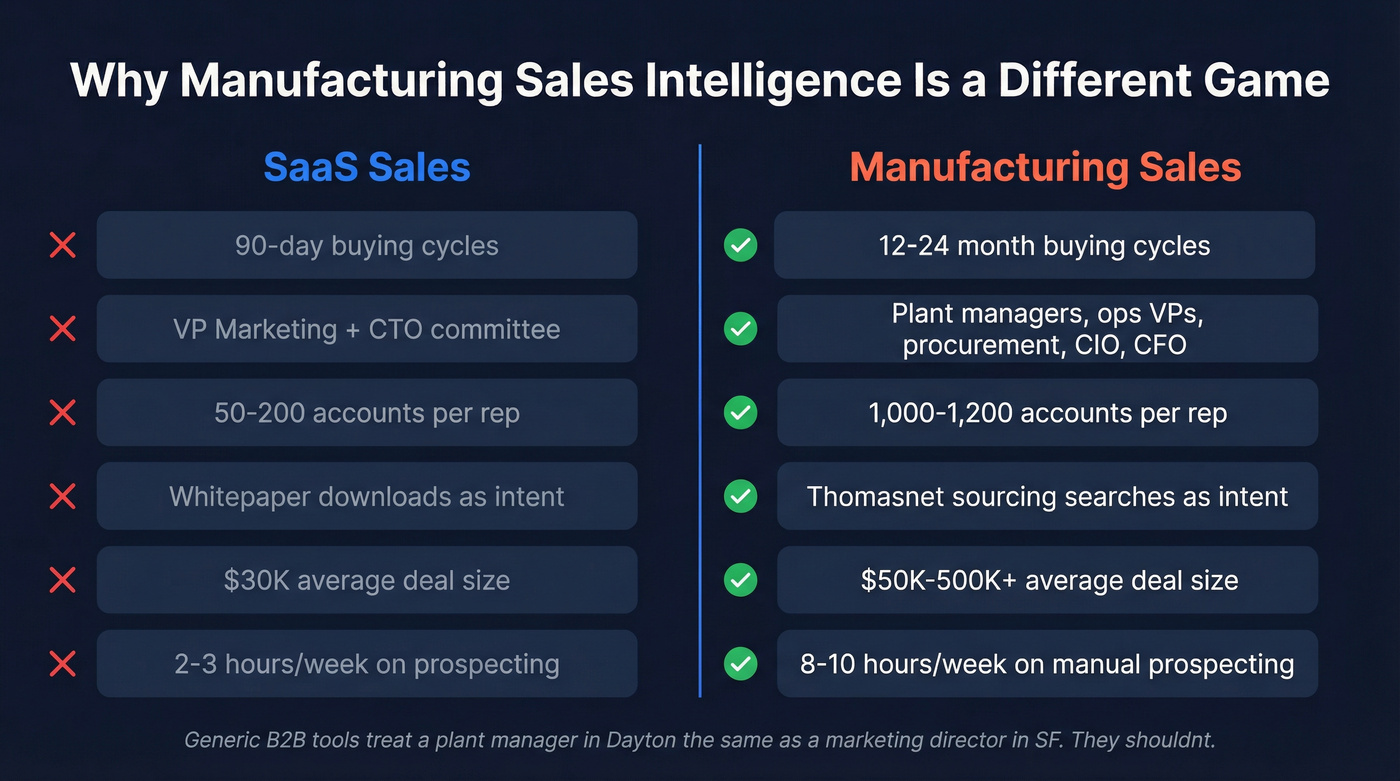
Manufacturing buying cycles run 12-24 months. The buying committee isn't a VP of Marketing and a CTO - it's plant managers, operations VPs, procurement directors, CIOs, and CFOs, each with different approval thresholds tied to capex budgets. A single rep might manage 1,000-1,200 accounts, spending 8-10 hours per week on manual prospecting and CRM admin. That's a full workday every week just keeping the pipeline organized, before a single call gets made.
Here's the thing: generic B2B intelligence tools treat a plant manager in Dayton the same as a marketing director in San Francisco. The plant manager doesn't download whitepapers or attend webinars. She searches Thomasnet for replacement parts and talks to the rep who shows up when the line goes down. Manufacturing sales teams on r/sales and industry forums consistently report that generic B2B databases miss plant-level contacts entirely - and that tracks with everything we've seen. Your intelligence stack needs to reflect that reality.
Buying Signals Worth Tracking
Forget content consumption metrics. These are the triggers that actually predict manufacturing purchase intent.
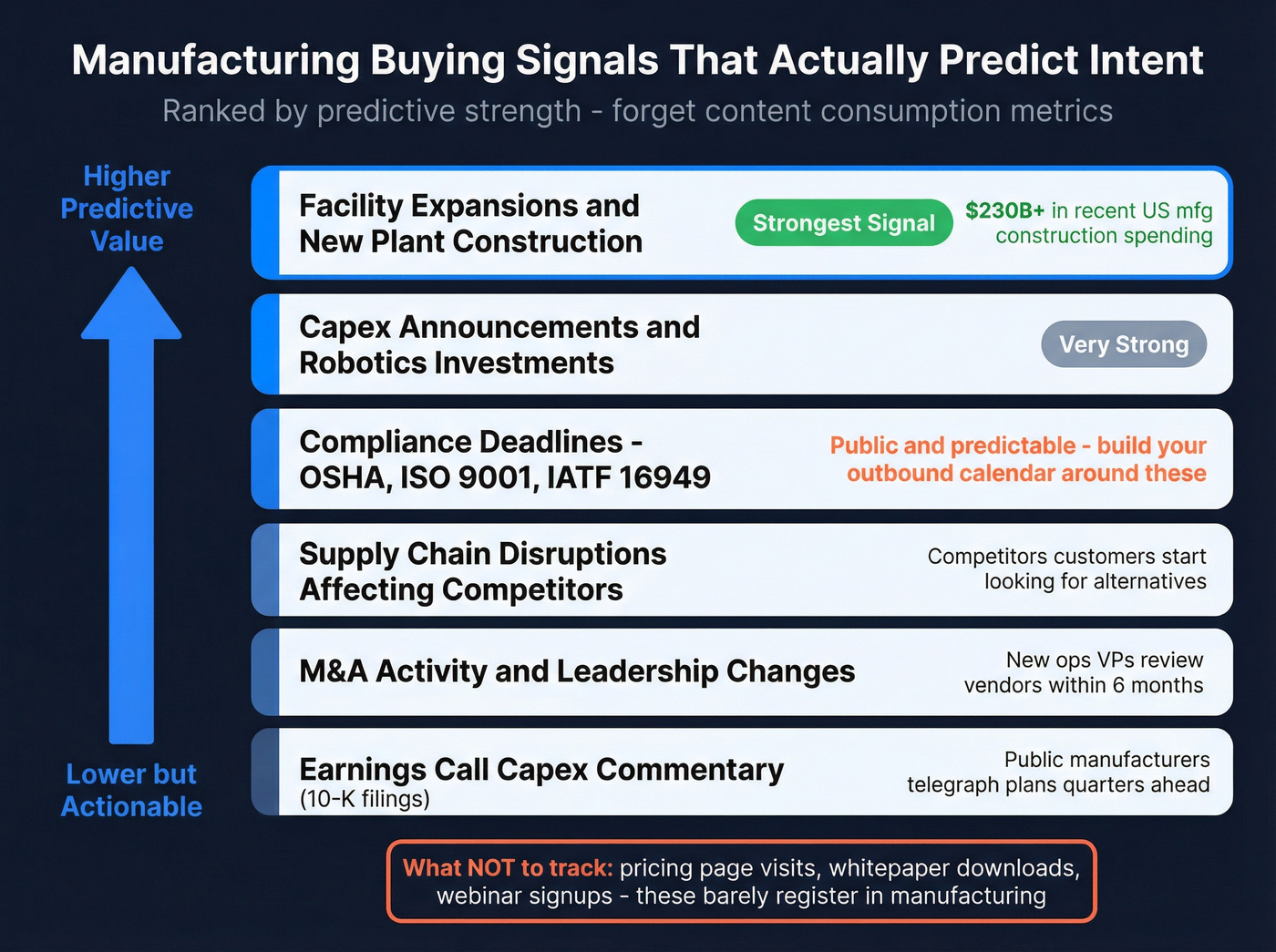
Facility expansions and new plant construction remain the strongest signal. U.S. manufacturing construction spending surpassed $230B in recent years, and that level of buildout drives demand for equipment, automation, and industrial suppliers across every tier. Capex announcements, robotics investments, and Industry 4.0 upgrades follow closely behind.
Compliance deadlines are underrated. OSHA regulations, ISO 9001 certifications, IATF 16949 requirements - they're public and predictable. Build your outbound calendar around them.
Three more signals worth monitoring: supply chain disruptions that send competitors' customers looking for alternatives, M&A activity and leadership changes (new operations VPs almost always review vendor relationships within six months), and earnings call commentary where public manufacturers telegraph capex plans quarters in advance.
The best industrial sales teams build monitoring workflows around these signals, not around who visited their pricing page.

Every buying signal is useless without a direct line to the plant manager who controls the budget. Prospeo covers 300M+ profiles with 98% email accuracy and 125M+ verified mobiles - including the operations VPs and procurement directors that generic databases miss entirely.
Stop losing deals because you can't reach the plant floor.
Industrial Intent Data
Generic intent data tracks content consumption across B2B publisher networks. Manufacturing intent tracks sourcing behavior - what industrial buyers actually search for when they need a supplier.
IndustryNet aggregates real search activity from industrial buyers across 11,000+ product and service categories, surfaced as demand trends with 18-month trend windows. This isn't predictive modeling. It's actual sourcing behavior, anonymized and aggregated. Thomasnet operates a similar ecosystem with more than 1.3 million buyers, engineers, and MROs evaluating suppliers - one manufacturer generated a $1.5 million opportunity after acting on Thomasnet's buyer intent data.
Bombora covers 15,000 intent topics and works as a broader signal layer, but it's fundamentally tracking content consumption. Useful, but not the same as watching a procurement director search for "CNC machining services, ISO 9001 certified, Midwest."
Your ERP Is an Intelligence Asset
The most underused intelligence tool in manufacturing isn't a platform you buy. It's the ERP you already own.
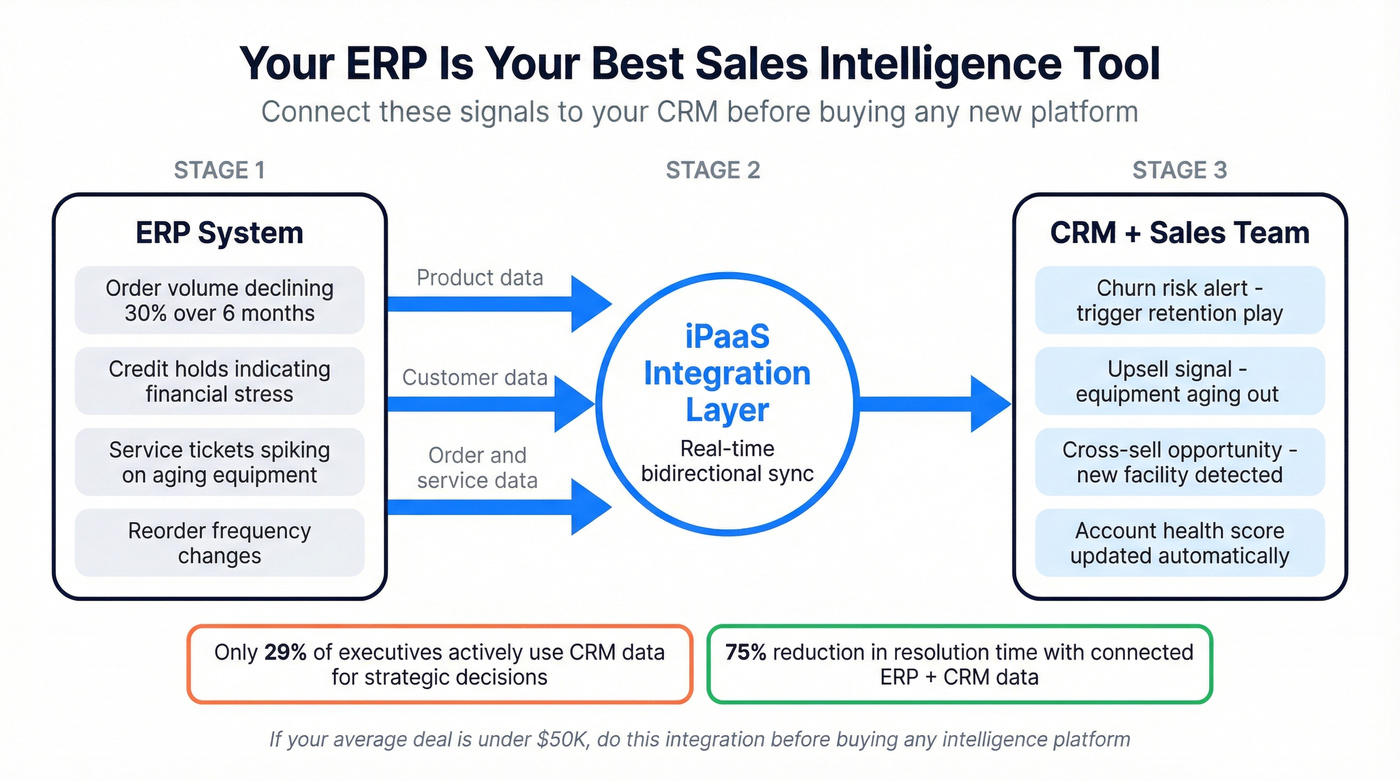
Customer-facing teams spend 12-15 hours per week switching between systems and manually reconciling data. Meanwhile, the ERP quietly records signals that should trigger sales plays: a key account ordering 30% less over six months, credit holds indicating financial stress, service tickets spiking on aging equipment. We've talked to industrial teams sitting on goldmines of churn-prediction data that nobody on the revenue side ever sees.
Versori's iPaaS marketplace for Syspro offers 25+ pre-built integrations across industrial systems, with real-time bidirectional sync between platforms like CRM and ERP. The Syspro + SugarCRM integration demonstrates what's possible - a 75% reduction in resolution time through connected product, customer, order, and service data. Yet only 29% of executives actively use CRM data for strategic decisions. The data's there. Nobody's looking at it.
Let's be honest: if your average deal size is under $50K and you haven't connected your ERP to your CRM, you'll get more ROI from that integration than from any intelligence platform on this list. Do that first.
Tools That Work for Manufacturing
Most B2B data platforms were built for tech companies selling to other tech companies. Here's how the major players perform when you need to reach a plant manager at a facility that doesn't have a marketing department.
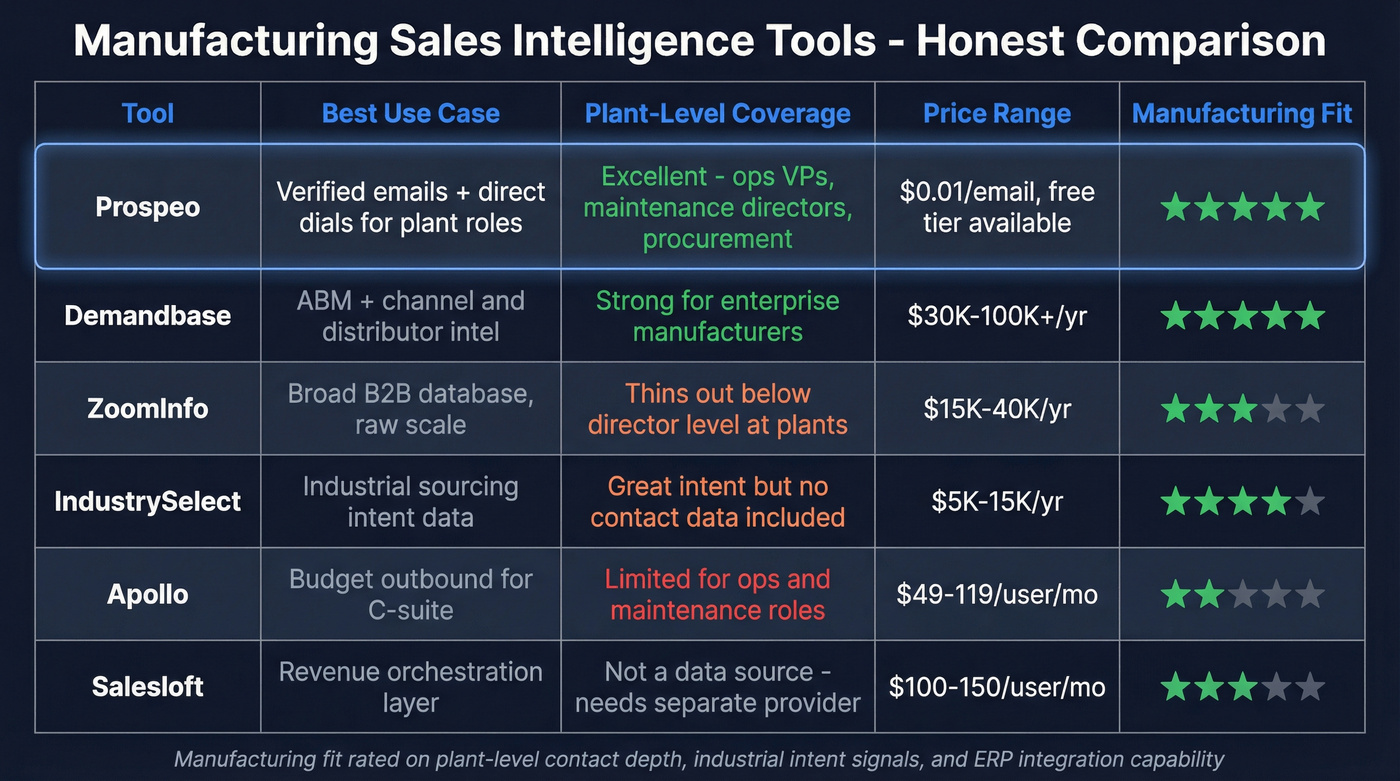
| Tool | Best For | Manufacturing Fit | Approx. Pricing |
|---|---|---|---|
| Prospeo | Verified emails + dials | ★★★★★ | ~$0.01/email; free tier |
| Demandbase | ABM + channel intel | ★★★★★ | $30K-100K+/yr |
| ZoomInfo | Broad B2B database | ★★★☆☆ | $15K-40K/yr |
| IndustrySelect | Industrial intent | ★★★★☆ | ~$5K-15K/yr |
| Apollo | Budget outbound | ★★☆☆☆ | $49-119/user/mo |
| Salesloft | Revenue orchestration | ★★★☆☆ | ~$100-150/user/mo |
Prospeo
Use this if you need verified contact data for plant-level roles that other databases miss - operations VPs, maintenance directors, procurement managers at specific facilities. The database covers 300M+ profiles with 98% email accuracy and 125M+ verified mobile numbers hitting a 30% pickup rate. The 7-day data refresh cycle matters when B2B contact data decays roughly 30% per year.
Thirty-plus search filters let you layer intent data from Bombora's 15,000 topics with criteria like revenue, headcount growth, department headcount, job changes, and technographics to find in-market buyers at specific facility types. At roughly $0.01 per email compared to ZoomInfo's ~$1/lead, the unit economics work even for smaller industrial teams. Teams like Snyk dropped bounce rates from 35-40% to under 5% after switching, and that deliverability improvement compounds across every sequence you run.
In our experience, the biggest win for manufacturing teams is the mobile number coverage. Plant managers aren't sitting at desks refreshing their inbox - they're on the floor. A 30% pickup rate on verified mobiles changes the outreach math entirely when your ICP rarely checks email during business hours.
Skip this if you need a full ABM orchestration platform with advertising and web personalization. Pair it with Demandbase for the orchestration layer.
Demandbase
Use this if you sell through distributors or dealers and need channel intelligence alongside direct account targeting. Manufacturing customers include Molex, Panasonic, and Thermo Fisher Scientific. The platform's data integrity features clean and enrich CRM data automatically - critical when your Salesforce instance has three different spellings of the same plant location.
Where Demandbase wins over ZoomInfo: pre-RFP timing intelligence and channel/distributor discovery. Where ZoomInfo wins: broader database and lower entry price for enterprise buyers.
Skip this if your budget is under $30K/year or you don't have a dedicated ABM operator. Demandbase requires real implementation effort to deliver value.
ZoomInfo
ZoomInfo's 420M+ contact profiles are hard to beat on raw scale. Professional runs around $14,995/year for 3 users, and Elite is around $39,995/year with premium features like intent signals included. But we've consistently found coverage thins out below the director level at manufacturing sites - it's optimized for SaaS and tech org charts, not shop floors. ZoomInfo Lite (10 downloads/month) is worth testing to see how well it covers your ICP before committing.
IndustrySelect
Best paired with a contact data provider and a sequencing tool. IndustrySelect tracks real buyer search activity across 11,000+ product and service categories with 18-month trend windows showing demand shifts. It's the intelligence layer that tells you who's looking - you still need a separate tool to find their direct dial and run the outreach. Pricing falls in the $5K-15K/year range depending on categories and geographies.
Apollo & SalesLoft
Apollo's free tier and $49-119/user/month plans make it the most accessible entry point, but contact depth for plant-level industrial roles is limited. If your ICP is mostly C-suite at mid-market manufacturers, it works fine. For anyone targeting operations and maintenance managers at individual plants, you'll hit walls fast.
Salesloft ($100-150/user/month) is a revenue orchestration layer, not a data source. Solid for managing complex manufacturing cycles with multiple stakeholders, but you'll need a separate data provider feeding it.
Manufacturing contact data decays 30% per year. Prospeo refreshes every 7 days - not every 6 weeks like ZoomInfo or Apollo. Layer Bombora intent across 15,000 topics with 30+ filters to find facilities actively investing in capex, automation, or new suppliers.
Get the freshest industrial contact data at $0.01 per email.
The ROI Math
Across 15+ machine manufacturers and industrial distributors, AI-powered sales intelligence deployments recovered roughly 10 hours per rep per week and produced a 20-30% conversion lift. One published ROI scenario puts the platform cost at $69,600/year against 14-34x return and $1M+ in incremental revenue. A separate case showed one industrial manufacturer identifying 10,000 new potential customers through predictive prospecting, with an 18% conversion rate increase.
I'll put it bluntly: the sales intelligence market is projected to hit $10 billion by 2032. Manufacturing companies that wait aren't saving money - they're falling behind competitors who already have these tools deployed. Building a sales intelligence stack tailored to manufacturing realities isn't optional anymore for industrial teams that want to compete.
FAQ
Is sales intelligence worth it for a small manufacturing team?
Even a 5-person team benefits. If each rep recovers 5 hours per week and converts 20% more pipeline, the tool pays for itself within a quarter. Start with a free tier to test plant-level contact coverage before committing budget.
What makes manufacturing intent data different from SaaS intent?
Manufacturing intent tracks sourcing behavior, not content downloads. Engineers searching Thomasnet for suppliers, procurement teams comparing products on IndustryNet, and facility expansion permits filed with local authorities are all stronger buying signals than blog visits or whitepaper clicks.
How do I connect our ERP to intelligence tools?
Start with iPaaS connectors - platforms like Versori offer 25+ pre-built integrations for industrial systems. Prioritize two data flows first: ordering pattern changes and service ticket escalations flowing into your CRM as alerts. Most teams see measurable ROI within 90 days of connecting these two signals.