


The Best iPlum Alternatives for 2026: What to Actually Switch To
You're a therapist. You just sent a client a session reminder through iPlum. It looked like it went through - no error message, no bounce notification. But the client never got it, and you didn't find out until they no-showed. Now you're Googling iPlum alternatives at 9 PM on a Tuesday.
That scenario isn't hypothetical. It's pulled almost verbatim from r/therapists, where one practitioner called iPlum "extremely unreliable" after texts stopped going through with an "invalid location" error - silently, with zero warning. The fix? Delete the entire app and reinstall it, losing their complete text history in the process.
iPlum sits at 4.3/5 on G2 from 196 reviews, and its $8.99/mo starting price is genuinely hard to beat. But a cheap phone system that silently drops messages isn't cheap - it's expensive in ways that don't show up on an invoice.
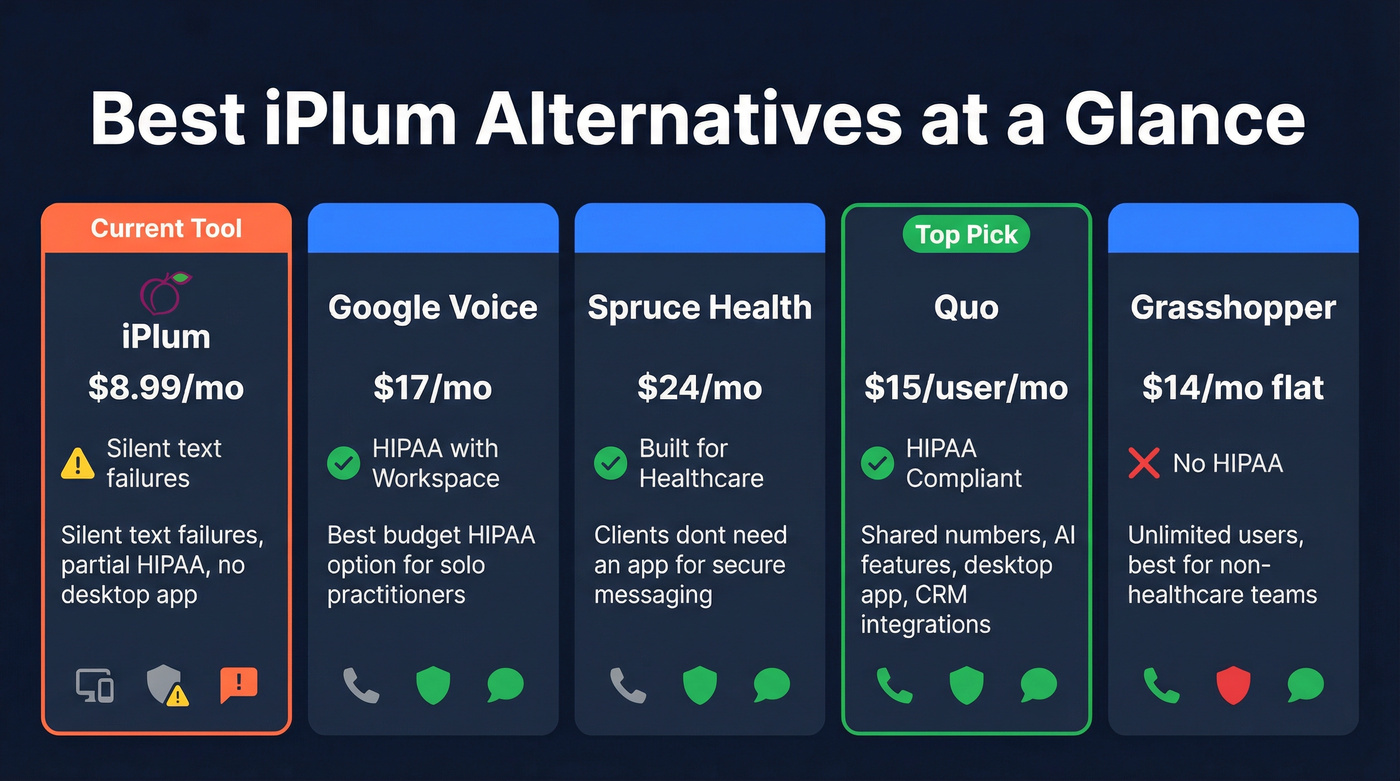
Our Picks (TL;DR)
| Use Case | Pick | Why |
|---|---|---|
| Solo therapist, HIPAA on a budget | Google Voice + Workspace ($17/mo) | HIPAA compliant, dead simple - most guides won't tell you this |
| Healthcare practice with clinical tools | Spruce Health ($24/mo) | Built for healthcare from day one, not a business phone with a BAA bolted on |
| Growing team, best all-around | Quo ($15/user/mo annual) | Modern UX, shared numbers, AI features, HIPAA compliant |
| Non-healthcare budget pick | Grasshopper ($14/mo flat) | Unlimited users, flat rate, 7-day free trial |
Why People Are Switching from iPlum
iPlum's core promise - a secure second line on your personal phone - is solid in theory. The problems are in execution.
Unreliable Texting with Silent Failures
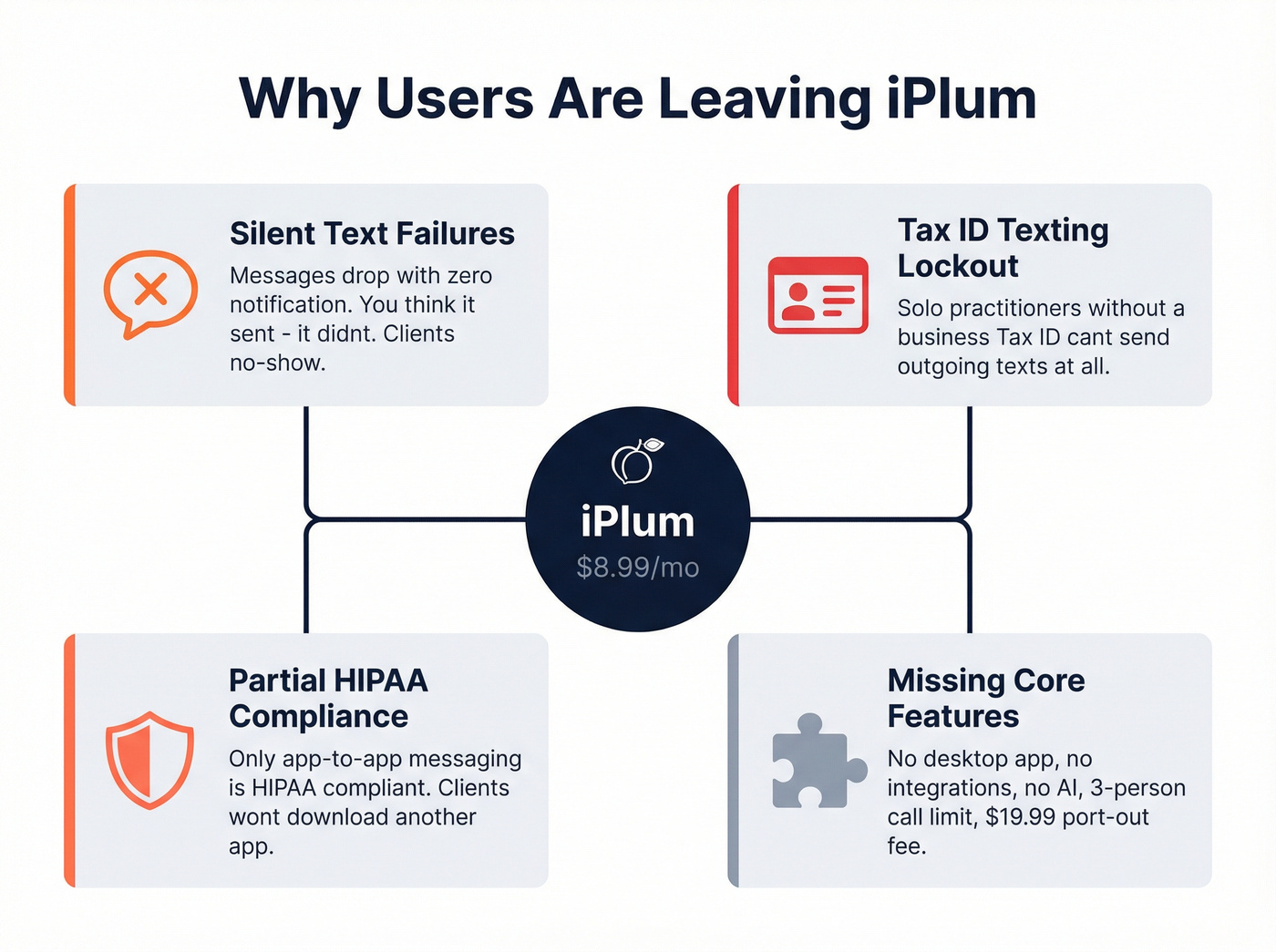
This is the dealbreaker.
Multiple therapists on Reddit report texts that simply stop going through without any notification. One practitioner lost their entire text history after having to delete and redownload the app just to restore basic texting functionality. The app is "glitchy in general," requiring workarounds that healthcare professionals shouldn't have to think about.
The silent failure part is what makes this dangerous. If you get an error message, you can resend. If you get nothing, you assume the message was delivered. In a clinical context, that's not just annoying - it's a liability.
The Tax ID Texting Lockout
iPlum now requires a business Tax ID to send outgoing texts, thanks to TCR (The Campaign Registry) anti-spam policies. On paper, this makes sense. In practice, it locks out solo practitioners, 1099 contractors, and anyone without a formal business entity. If you're a therapist working as an independent contractor - which describes a huge chunk of iPlum's user base - you can't text. The feature you're paying for doesn't work.
iPlum's solution is essentially "get a Tax ID," which isn't helpful when you're a sole practitioner who files on a Schedule C.
The "Partial HIPAA" Problem
iPlum offers a BAA and encrypted calling, which gets it past the "HIPAA compliant" marketing threshold. But dig deeper and the picture gets murkier. iPlum's own website acknowledges that regular SMS texting through the app isn't HIPAA compliant - only app-to-app messaging qualifies. That means your clients need to download the iPlum app for secure texting.
Here's the thing: therapists consistently report that clients won't do this. And without Audit logs or fully encrypted voicemail storage, iPlum's HIPAA compliance is more "partial" than the marketing suggests.
Missing Features That Should Be Standard
The feature gaps are surprising for a product that's been around this long:
- No desktop app - just a mobile app and web portal
- 3-participant call limit - three-way calling doubles as both conference calling and call transfer
- No integrations - no Zapier, no Slack, no CRM sync
- No AI features - no call summaries, no transcription on base plans, no voice agents
- $19.99 port-out fee - want to leave? That'll cost you
- Group texts require a plan upgrade and are stored for only 12 months
- Shared numbers work in the web portal but not the mobile app
For $8.99/mo, some of these are forgivable. But when competitors at $15/mo include AI transcription, CRM integrations, and desktop apps, the value equation shifts fast.

Tired of tools that silently fail? Your phone system shouldn't drop messages - and your email data shouldn't bounce. Prospeo delivers 98% email accuracy with a 7-day refresh cycle, so your outreach actually lands.
Stop guessing whether your messages got through. Start with verified data.
What to Look for in an iPlum Alternative
Before you start comparing feature matrices, answer two questions: Do you need HIPAA compliance? And do you need more than a second line?
If you're in healthcare, your checklist looks like this:
- Real HIPAA compliance - Does the vendor sign a BAA? Is it automatic or do you have to ask? Are calls, texts, and voicemails all encrypted?
- Client experience - Do your clients need to download an app for secure messaging? If yes, assume they won't.
- Texting reliability - Can you send texts without a business Tax ID? Do messages actually arrive?
- Audit logs - If you're ever audited, can you pull a complete communication record?
For everyone else, focus on:
- Pricing model - Per-user pricing scales fast. Flat-rate plans (Grasshopper, Talkroute) save money for small teams.
- Integrations - If you're using a CRM, your phone system should talk to it.
- Number porting - How easy is it to bring your existing number? iPlum charges $19.99 to port out; most competitors port in for free.
- Desktop app - If you spend 8 hours at a computer, a mobile-only phone system is a productivity tax.
The Best iPlum Alternatives for 2026
Quo (Formerly OpenPhone) - Best for Growing Teams
Quo is the tool I'd recommend to most teams switching from iPlum, and G2 agrees - it's their #1 ranked alternative. The company raised $105M and rebranded from OpenPhone in September 2025, signaling heavy product investment rather than coasting.

At $15/user/mo on annual billing, it's nearly double iPlum's base price. But you're getting a fundamentally different product: shared phone numbers on all plans, a real desktop app, HubSpot and Salesforce integrations on Business+, and Sona AI agent on all plans (with 1,000 free credits) plus AI call summaries and transcripts on Business+. HIPAA compliant with BAA available. Business plan runs $23/user/mo annual for CRM integrations; Scale hits $35/user/mo for advanced features.
If iPlum is a flip phone, Quo is a smartphone. The price difference reflects a genuine capability gap.
Spruce Health - Best for Healthcare Practices
Use this if: You're a healthcare practice that wants clinical tools built into your phone system - secure messaging, video telemedicine, clinical questionnaires, e-fax, and a BAA that's automatic on every plan.
Skip this if: You need call queues, conference calling beyond one additional participant, or you're not in healthcare.
Spruce starts at $24/user/mo for Basic, jumping to $49/user/mo for Communicator (which adds auto-attendant/IVR, desk phones, and after-hours triage). The critical difference from iPlum: clients don't need to download an app for secure messaging. That alone solves the biggest complaint therapists have about iPlum's "HIPAA-compliant texting."
The 14-day free trial with no credit card required makes it easy to test. If you're running a mental health practice, Spruce solves the problem iPlum keeps failing at.
Google Voice - Best Budget HIPAA Option
Here's the contrarian take most guides get wrong: Google Voice is HIPAA compliant.
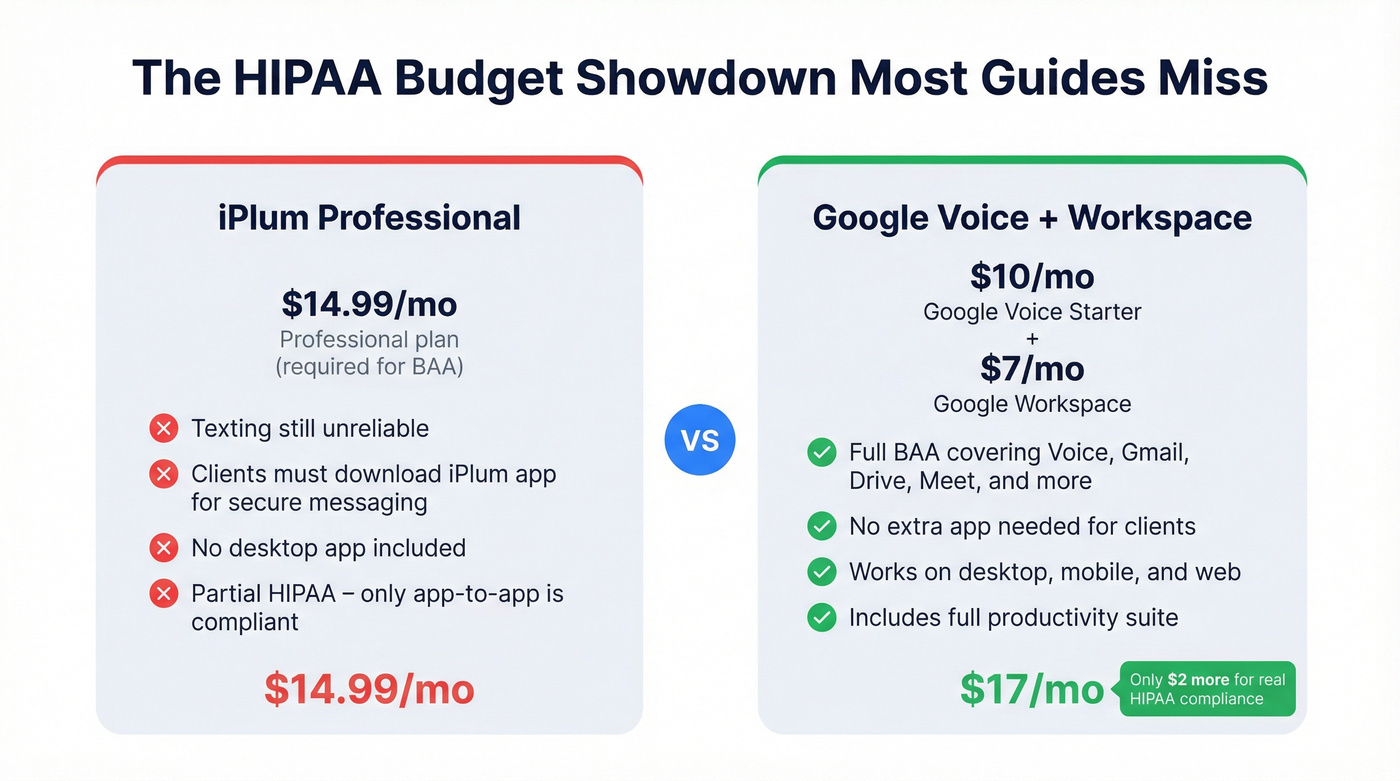
Google signs a BAA covering Voice, Gmail, Drive, Meet, Calendar, Chat, Keep, Vault, and more - the full Workspace suite. The total cost is $17/user/mo ($10 for Voice Starter + $7 for Workspace). That makes it the cheapest HIPAA-compliant phone option on this list - cheaper than iPlum's Professional plan at $14.99/mo, which is the tier you need for iPlum's BAA.
The therapist who posted on Reddit about regretting not using Google Voice instead of iPlum? They were right to be frustrated.
The real limitations: you can't distinguish personal vs. work calls on the same device (a genuine annoyance for therapists using personal phones), there's no standalone product (Workspace subscription is mandatory), and call routing is basic compared to dedicated VoIP platforms. But for a solo practitioner who needs a HIPAA-compliant second line and already lives in Google's ecosystem, this is the obvious starting point.
Dialpad - Best for AI Features
Dialpad is the pick if AI features matter more than anything else. At $15/user/mo, you get real-time AI transcription on every plan - DialpadGPT is trained on 7B+ minutes of conversational data, and the call summaries are genuinely useful, not the generic fluff you get from most competitors. HIPAA compliant with BAA. Local numbers in 70+ countries.
The downsides: phone support isn't available on all plans (frustrating when your phone system is the thing that's broken), and CRM integrations are locked behind the $25/mo Pro plan, which also has seat minimums that punish small teams. For healthcare teams that need both HIPAA compliance and AI-powered documentation, Dialpad is a strong contender.
Grasshopper - Best Flat-Rate Budget Option
Use this if: You're a non-healthcare small business that wants unlimited users on a single flat rate. At $14/mo annual with unlimited users, Grasshopper is the cheapest way to give your whole team a professional phone presence.
Skip this if: You need HIPAA compliance. Grasshopper is NOT HIPAA compliant - full stop. No BAA, no encryption guarantees. Healthcare users must look elsewhere. This is the most important caveat in this entire article, because Grasshopper's pricing is tempting enough that someone will try to rationalize it.
The 7-day free trial requires no credit card. For non-regulated small businesses, it's the obvious budget pick.
Talkroute - Best for Small Teams Needing HIPAA
Talkroute flies under the radar, but it checks boxes that matter. The Basic plan runs $19/mo for one user, Plus is $39/mo for three users, and Pro is $59/mo for ten - flat-rate pricing, not per-user. BAA available on all plans. And here's the detail I appreciate: Talkroute absorbs taxes, USF fees, and regulatory surcharges instead of passing them through. No surprise line items on your invoice.
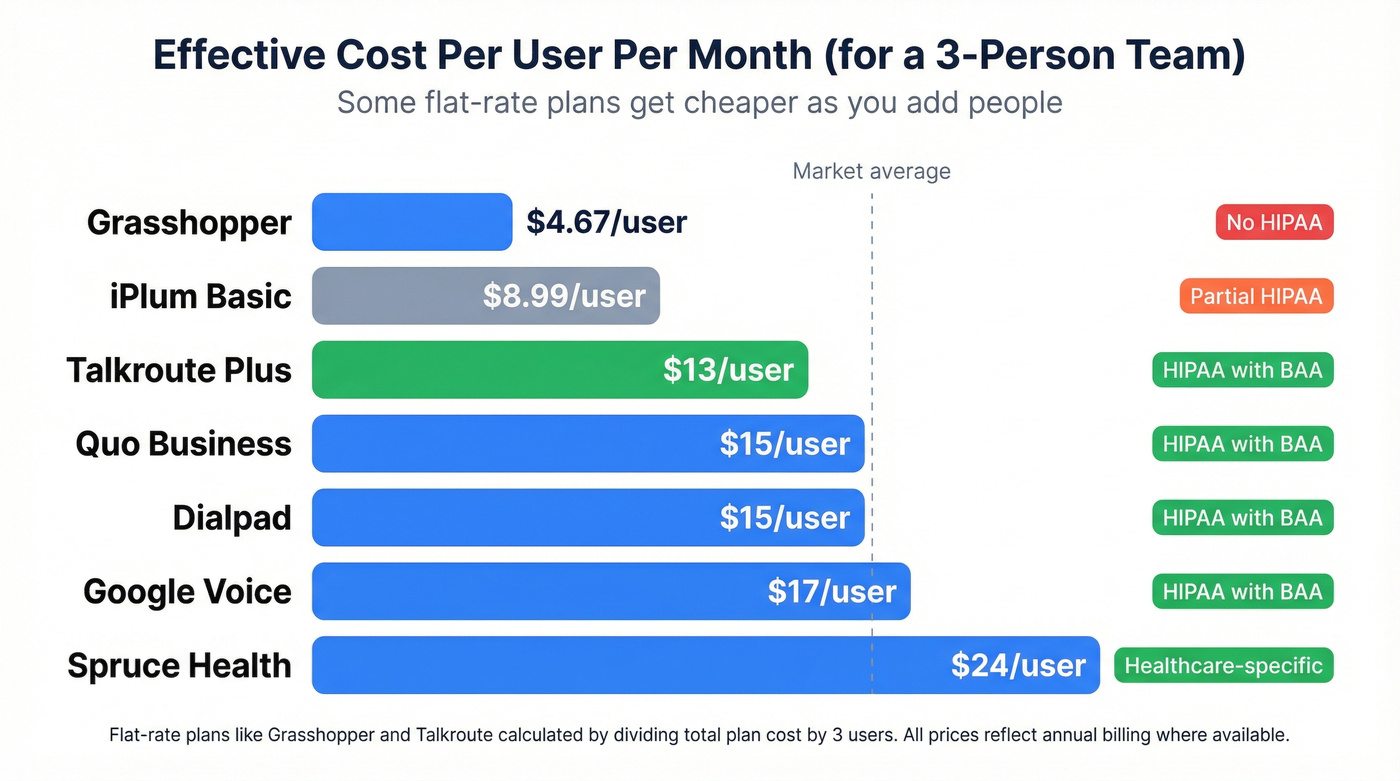
The 7-day free trial lets you test before committing. For a small healthcare practice with 2-5 people, the Plus plan at $39/mo ($13/user effectively) is hard to beat on value.
RingCentral - Best for Larger Organizations
RingCentral is the enterprise answer. HITRUST certified - the gold standard for healthcare security, a level above basic HIPAA compliance. 300+ integrations including EHR systems. Core plan at $20/user/mo annual is competitive for what you get.
The catch: add-ons destroy the value proposition. AI Receptionist ($39/mo), SMS Booster ($25/mo), Call Queues Booster ($35/mo) - a "simple" setup can balloon fast. Monthly billing jumps to $30/user/mo for Core. If you're a medical office with 20+ staff and need desk phones, EHR integration, and HITRUST certification, it's the right call. For everyone else, you're paying for infrastructure you won't use.
Phone.com - Modular and Affordable
Phone.com starts at ~$15/user/mo annual with an optional HIPAA BAA and SOC 2 compliance. The modular approach lets you add features like live receptionist service and ProSIM cellular mobility ($10/mo) without upgrading your entire plan. Solid if you want granular control over what you're paying for.
MightyCall - Good Features, Bad Minimums
MightyCall's Core plan runs $20/user/mo annual with unlimited calling, SMS/MMS, three business numbers, integrations, and API access. The problem: a 3-user minimum on every plan. That's $60/mo minimum before you've made a single call.
For solo practitioners - iPlum's core audience - this is an instant disqualifier.
Ooma - Solid Mid-Range
Ooma Office Essentials starts at $19.95/user/mo with a traditional VoIP feel and desk phone support. Reliable and straightforward, but nothing about it stands out for iPlum's typical user base. Best for teams that want physical desk phones and a familiar office phone experience.
RingRX - Niche Solo Practitioner Pick
RingRX Lite at $15/user/mo includes fax, HIPAA compliance, and a BAA - purpose-built for solo healthcare practitioners. If you're a therapist who still needs to send and receive faxes (and in healthcare, you probably do), RingRX is the most affordable way to get phone + fax + HIPAA in one package.
Nextiva - Unified Communications for Medical Offices
Nextiva bundles voice, video, chat, and basic CRM starting at ~$25/user/mo. HIPAA compliant and better suited for medical offices with 10+ users who want unified communications without stitching together multiple tools. For smaller teams, it's more platform than you need.
Other Alternatives Worth Knowing
A few tools that didn't make the main list but are worth a look depending on your situation:
- Unitel Voice ($9.99/mo) - flat-rate pricing similar to Grasshopper, solid for solopreneurs who want a virtual number without complexity. Not HIPAA compliant.
- eVoice ($14/mo) - another virtual phone system with auto-attendant and call routing. Offers HIPAA-ready plans for healthcare users.
- Telzio - usage-based pricing model that works well for low-volume callers. Healthcare-focused, with a notable case study from Espree Health deploying it across their clinical operations.
Pricing Comparison: iPlum vs. Every Alternative
Here's every option side by side, with iPlum as the baseline. Annual pricing where available - that's how most people should buy.
| Tool | Annual Price | Monthly Price | HIPAA | Free Trial |
|---|---|---|---|---|
| iPlum | $8.99/user | $13.99/user | Partial | No |
| Quo | $15/user | $19/user | Yes | 7 days |
| Spruce Health | $24/user | $24/user | Yes | 14 days |
| Google Voice | $17/user* | $17/user* | Yes | No |
| Dialpad | $15/user | $15/user | Yes | 14 days |
| Grasshopper | $14 flat | ~$18 flat | No | 7 days |
| Talkroute | $19 (1 user) | $19 (1 user) | Yes | 7 days |
| RingCentral | $20/user | $30/user | Yes | 14 days |
| Phone.com | ~$15/user | ~$18/user | Optional | 30-day guarantee |
| MightyCall | $20/user (3 min.) | $25/user (3 min.) | No | 7 days |
| Ooma | $19.95/user | $19.95/user | No | 30-day guarantee |
| RingRX | $15/user | $15/user | Yes | Yes |
| Nextiva | ~$25/user | ~$30/user | Yes | 7 days |
*Google Voice: $10 Voice + $7 Workspace = $17/user/mo total
HIPAA Compliance: How iPlum Compares to Competitors
"HIPAA compliant" is one of the most abused phrases in healthcare SaaS. A vendor can slap it on their homepage if they offer encryption and a BAA - even if their voicemail storage isn't encrypted and they don't maintain audit logs. The actual requirements include end-to-end encryption, access controls, audit trails, secure storage, breach notification protocols, and a signed Business Associate Agreement.
And here's the detail everyone glosses over: SMS texting is never inherently HIPAA compliant. Standard text messages travel through carrier networks without encryption. Any vendor claiming "HIPAA-compliant texting" via regular SMS is either misleading you or has a very specific technical implementation worth scrutinizing.
| Tool | HIPAA | BAA | Encrypted Texts | Client App Needed |
|---|---|---|---|---|
| iPlum | Partial | Yes (Pro+) | App-to-app only | Yes |
| Quo | Yes | Yes | In-app | No |
| Spruce Health | Yes | Auto, all plans | In-app | No |
| Google Voice | Yes | Yes (Workspace) | Limited | No |
| Dialpad | Yes | Yes | In-app | No |
| Talkroute | Yes | Yes, all plans | Yes | No |
| RingCentral | Yes (HITRUST) | Yes | Yes | No |
| Phone.com | Yes | Optional add-on | Yes | No |
| RingRX | Yes | Yes | Yes* | No |
| Grasshopper | No | No | No | N/A |
| Nextiva | Yes | Yes | Yes | No |
*RingRX claims regular SMS is HIPAA compliant, which is worth questioning given industry consensus that standard SMS can't be fully secured.
The takeaway: if HIPAA matters, Grasshopper is off the table. Google Voice is on the table (with Workspace). And iPlum's compliance has real gaps that Spruce, Quo, and Talkroute don't share.
How to Port Your Number Out of iPlum
iPlum charges $19.99 to port your number out. Annoying but not unusual. The process itself is where it gets complicated.
- Don't cancel iPlum first. Your number needs to be active on iPlum for the port to work. Cancel after the port completes.
- Request the port from your new provider. Quo, Grasshopper, Dialpad, and most others handle incoming ports for free.
- Watch for the physical phone routing issue. Some users report needing to route their iPlum number to a physical phone first before porting to another VoIP provider. This adds a step and can extend the timeline.
- Expect 1-2 weeks. VoIP-to-VoIP ports are usually faster than carrier ports, but iPlum's process isn't the quickest.
- Keep both services running during the transition. You don't want to miss calls during the porting window.
The $19.99 fee is a minor tax on leaving. The real cost is the 1-2 weeks of uncertainty. Plan accordingly.
Which iPlum Alternative Is Right for You?
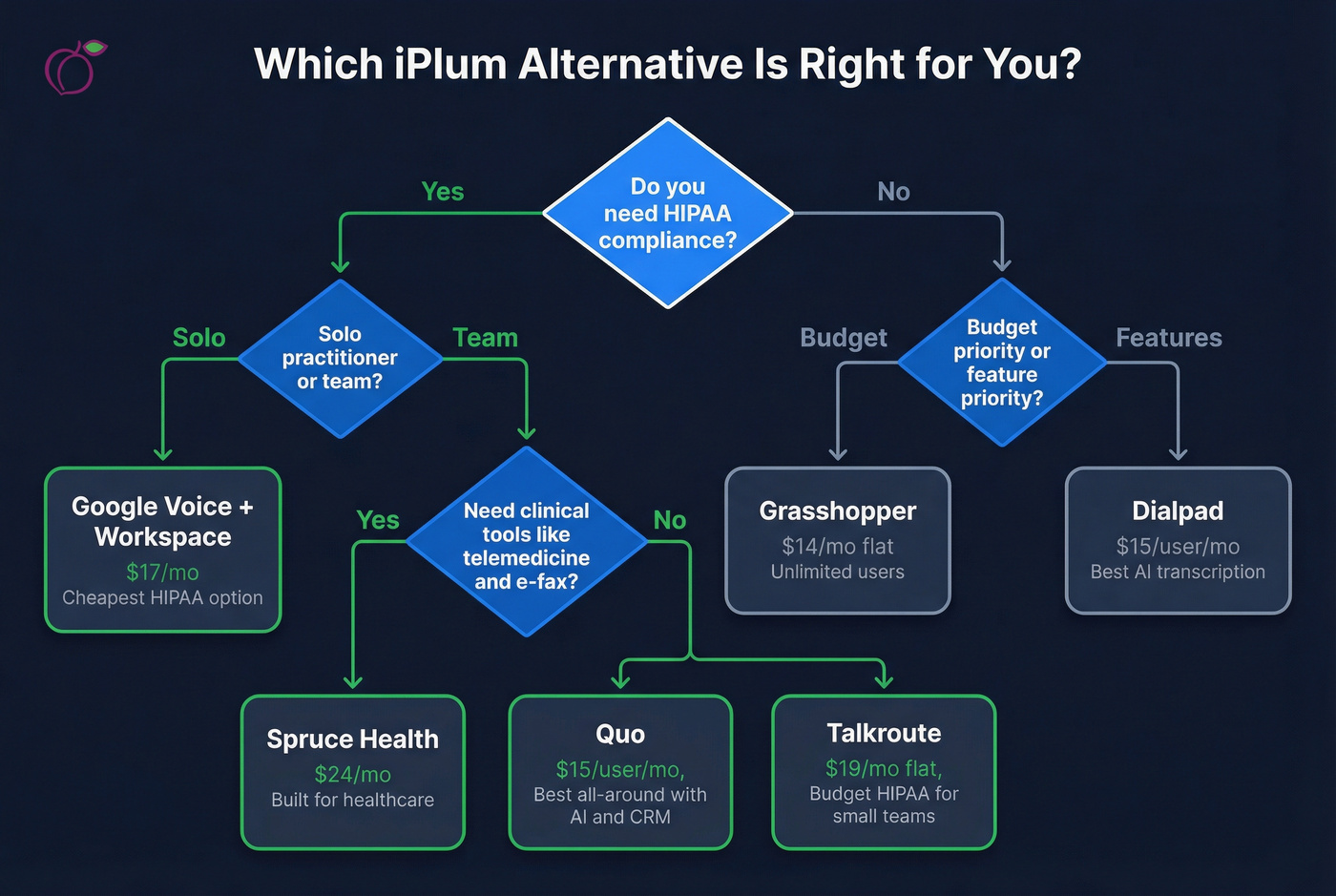
You don't need 13 alternatives. You need one.
Answer two questions: Do you need HIPAA? Do you need more than a second line?
Solo therapist on a budget -> Google Voice ($17/mo) if you're already in Google's ecosystem. Spruce Health ($24/mo) if you want clinical tools built in. Both are HIPAA compliant without requiring clients to download an app.
Small practice, 2-5 people -> Talkroute Plus ($39/mo for 3 users) is the best value for HIPAA-compliant teams. Quo ($15/user/mo) wins if you need CRM integrations and shared numbers.
Growing business, 10+ people -> RingCentral for HITRUST certification and enterprise features. Dialpad if AI transcription and call intelligence matter more than integration breadth.
Non-healthcare small business -> Grasshopper ($14/mo flat, unlimited users) is the no-brainer budget pick. Quo if you need integrations and shared numbers.
Outbound sales team -> Dialpad or Quo for the phone system. I've seen teams burn through entire call blocks dialing disconnected numbers because they trusted an unverified list. Pair your VoIP with verified contact data - 125M+ verified mobiles and 98% email accuracy mean your reps spend time talking, not listening to "this number is no longer in service."
If you're building lists from scratch, start with a B2B phone number workflow and keep your pipeline clean with strong data quality checks.
Look, here's my honest take to close on: the phone system itself matters less than you think. Quo, Dialpad, Talkroute - they're all competent. The bigger variable is whether your contacts are accurate, your workflows are integrated, and your compliance is real. If you're a solo practitioner closing deals under five figures, you probably don't need anything fancier than Google Voice. Pick the tool that solves your actual bottleneck, not the one with the longest feature list.
If you're also running cold outreach, align your dialing with a modern B2B sales stack and a deliverability-safe cold email outreach tools setup.
If you're upgrading your practice's phone system, upgrade your prospecting data too. Prospeo gives you 143M+ verified emails at ~$0.01 each - no silent failures, no mystery bounces, no $19.99 exit fees.
Reliable tools deserve reliable data. Try 100 free credits today.
FAQ
Is iPlum actually HIPAA compliant?
Only partially. iPlum offers a BAA and encrypted calling but lacks audit logs and fully encrypted voicemail storage. Its "HIPAA-compliant texting" only works app-to-app - both parties need the iPlum app installed. Regular SMS through iPlum isn't HIPAA compliant, meaning the texting feature most people use doesn't meet the standard.
Can I port my phone number out of iPlum?
Yes, but it costs $19.99 and takes 1-2 weeks. You may need to route your number to a physical phone before porting to another VoIP provider. Start the port request with your new provider before canceling iPlum - your number must remain active during the transfer.
What's the cheapest HIPAA-compliant alternative to iPlum?
Google Voice at $17/user/month ($10 Voice + $7 Workspace). Google signs a BAA covering Voice, Gmail, Drive, and Meet - the most affordable HIPAA-compliant option that most comparison guides overlook. RingRX Lite at $15/user/month is also competitive if you need fax included.
Do I need a Tax ID to text on iPlum?
Yes. iPlum's TCR policy requires a business Tax ID for outgoing texts. Solo practitioners and 1099 contractors without a formal business entity are effectively locked out of texting - the feature they're paying for. This is the single biggest reason therapists and independent professionals are looking for replacements.
Which iPlum alternative has the best AI features?
Dialpad, by a wide margin. DialpadGPT is trained on 7B+ minutes of conversational data, delivering real-time AI transcription on every plan starting at $15/user/mo. Quo's Sona AI agent is solid too, but the most advanced AI features require higher-tier plans.