

The Sales Intelligence Market in 2026: What the Data Actually Says
Your VP of Sales needs a market slide for the board deck. You search "sales intelligence market size," open four analyst reports, and get four different numbers. Fortune Business Insights says $5.37B. Mordor Intelligence says $4.99B. Precedence Research lands somewhere else entirely. Now you're reconciling spreadsheets instead of buying software.
The numbers diverge because category boundaries are fuzzy. But the directional story is clear - and that's what actually matters for buying decisions.
Market Size at a Glance
We synthesized four major analyst reports so you don't have to. For 2026, the sales intelligence market sits at roughly $5.0-$5.4B, with Mordor's estimate at the low end and Fortune's at the high end. The spread reflects different category definitions - some firms include services revenue and API access, others count only software licenses.
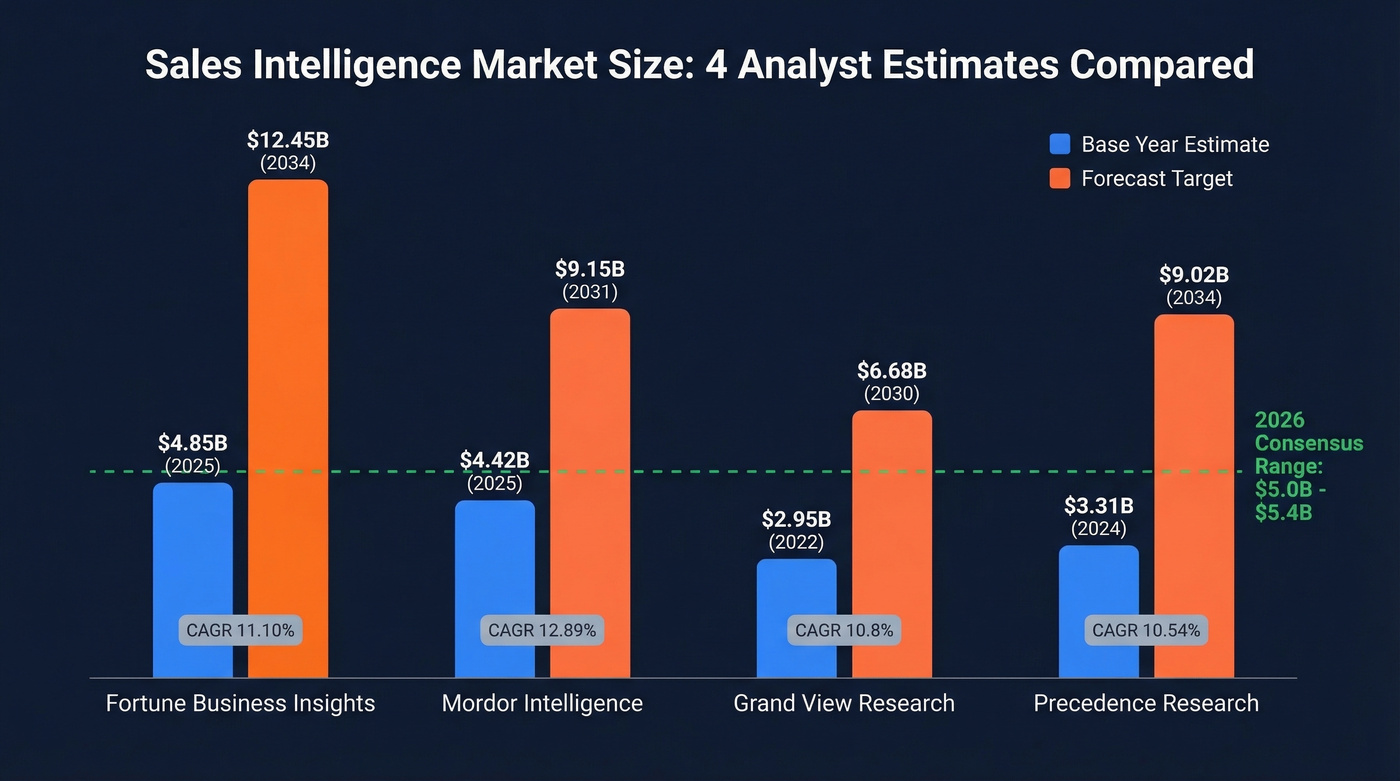
| Analyst Firm | Base Year Estimate | Forecast Target | CAGR |
|---|---|---|---|
| Fortune Business Insights | $4.85B (2025) | $12.45B (2034) | 11.10% |
| Mordor Intelligence | $4.42B (2025) | $9.15B (2031) | 12.89% |
| Grand View Research | $2.95B (2022) | $6.68B (2030) | 10.8% |
| Precedence Research | $3.31B (2024) | $9.02B (2034) | 10.54% |
North America holds roughly 40-42% of the market in 2026, with APAC growing fastest at 14.86% CAGR. Cloud deployment accounts for 82.05% of the market, large enterprises represent 61.63% of spend, and annual subscriptions drive 59.03% of revenue. If you're building that board deck, use the $5.0-$5.4B range, cite ~11-13% CAGR, and note that AI agents and signal-based selling are the two trends your board will ask about next.
Sales Intelligence vs. CRM vs. Revenue Intelligence
| CRM | Sales Intelligence | Revenue Intelligence |
|---|---|---|
| Internal system of record | External prospect data + insights | Unified cross-functional AI layer |
| Pipeline tracking, deal management | Firmographics, intent, contact data | Forecasting, risk signals, next-best actions |
| Salesforce, HubSpot | ZoomInfo, Apollo, Cognism | Gong, Clari, 6sense |
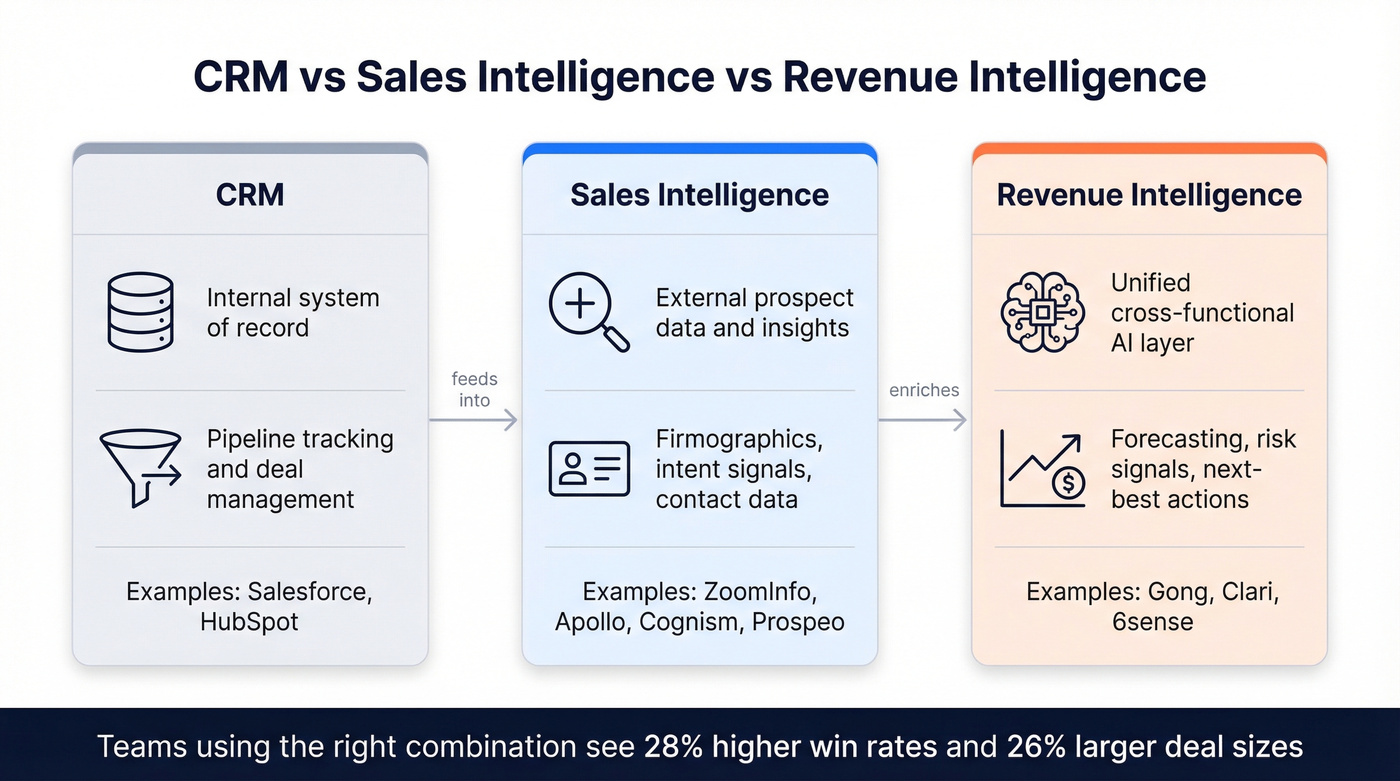
These categories blur more every year. CRM is where deals live. Sales intelligence is how you find the people behind those deals. Revenue intelligence tries to unify everything with AI. Companies using the right combination report 28% higher win rates and 26% larger deal sizes - but getting the stack wrong means paying for overlapping features across three or four tools that don't talk to each other.
What's Driving Growth
Three forces are reshaping this space simultaneously: AI/ML predictive analytics (adding an estimated +4.1% to the market's CAGR), RevOps convergence (+3.7%), and advanced targeting (+3.2%).
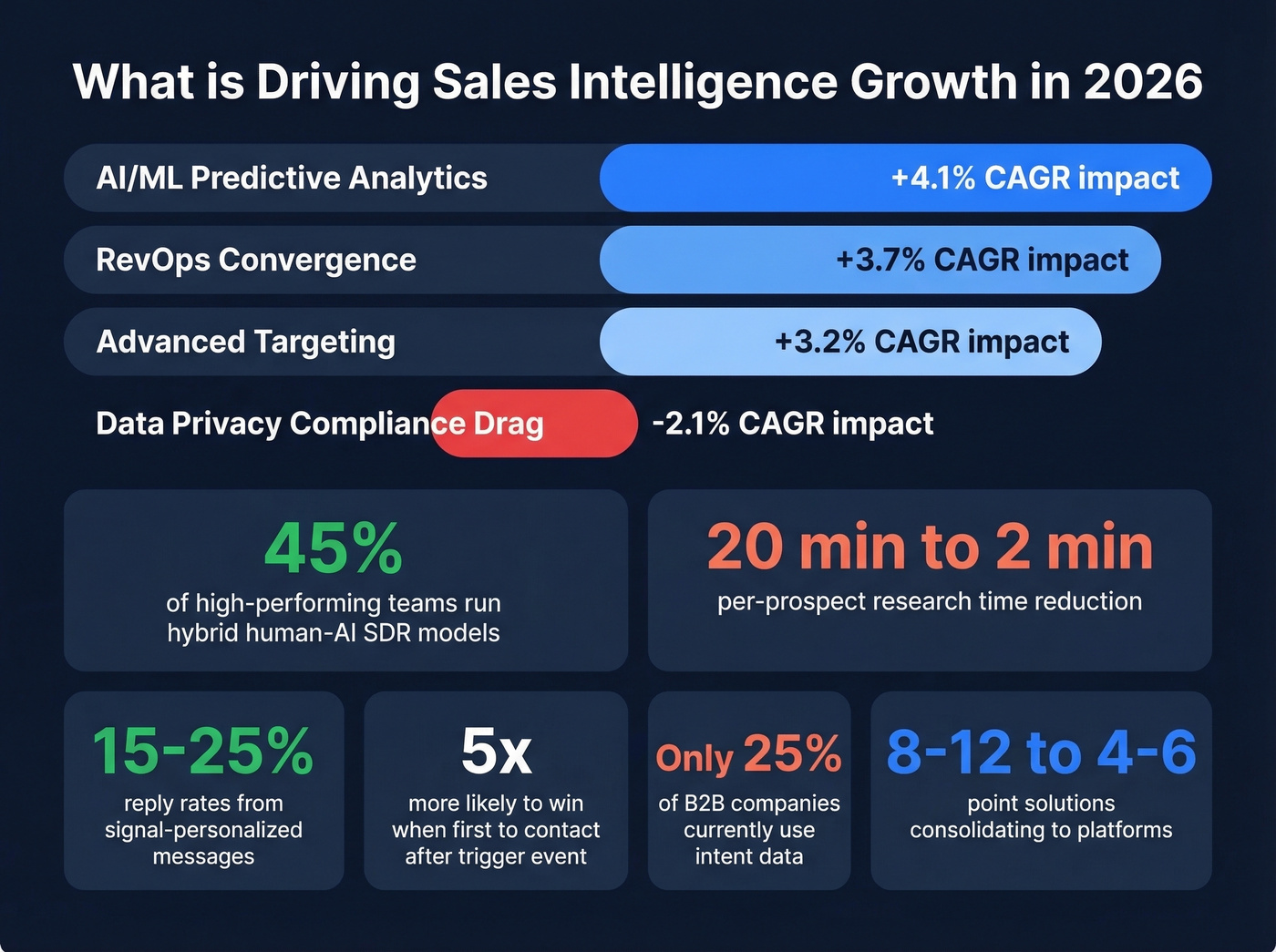
Here's what that looks like on the ground. About 45% of high-performing sales teams now run hybrid human-AI SDR models. LivePerson cut per-prospect research from 20 minutes to 2 minutes. Signal-personalized messages hit 15-25% reply rates versus the 3-5% cold email average, and the first seller to contact a prospect after a trigger event is 5x more likely to win. Yet only 25% of B2B companies currently use intent data - that gap between early adopters and everyone else is where the growth lives.
Consolidation is accelerating too. Organizations are collapsing from 8-12 point solutions to 4-6 platforms. ZoomInfo's Copilot and Apollo's built-in engagement workflows represent the platform play; specialists respond by embedding deeper into data warehouses and core GTM systems. As one r/SaaS thread put it, buyers increasingly question whether "another data subscription actually moves the needle" when the real bottleneck is response rates, not research volume.
Let's be honest: if your average deal size is under $15k, you almost certainly don't need a $40k/year enterprise platform. The real gap for most teams is in workflow automation, intent signals, and refresh cadence - not just having a big database.

You just read that data decays 30% annually and the industry average refresh is 6 weeks. Prospeo refreshes every 7 days - giving your AI agents and SDRs data that's actually current. 300M+ profiles, 98% email accuracy, intent data across 15,000 topics, starting at $0.01/email with no annual contract.
Stop paying enterprise prices for six-week-old data.
The Data Quality Problem Nobody Wants to Talk About
None of the AI-powered features matter if the underlying data is garbage.
B2B contact records decay roughly 30% annually. Meanwhile, 26% of organizational data is untrustworthy, and 89% of data leaders with AI in production have seen inaccurate outputs. The average enterprise runs 897 applications with only 29% connected. In our experience testing dozens of providers, data freshness - not database size - is the single biggest differentiator between tools right now. When your enrichment data is six weeks stale, your AI agents are just confidently wrong at scale. That's why we've seen teams switch from household-name providers to smaller platforms with faster refresh cycles and end up with better results, not worse.
Regulatory Landscape
The compliance picture got materially more complex in 2026. The DOJ's Bulk Data Rule regulates transactions involving bulk personal data with foreign persons, and Maryland's Online Data Privacy Act prohibits selling sensitive personal data regardless of consent - a significant shift for data brokers. Connecticut expanded sensitive data definitions effective July 2026, the EU AI Act's high-risk system requirements roll out through 2027, and CCPA enforcement continues ramping with automated decision-making regs set for January 2027.
Data privacy compliance subtracts an estimated 2.1% from the market's CAGR. Real drag, but it also creates a moat for vendors that invest in compliance infrastructure early. For buyers evaluating sales intelligence software, a vendor's compliance posture now matters as much as its data coverage. Skip any provider that can't produce a DPA on request or clearly explain their opt-out enforcement.
Key Players and What to Budget
| Tool | Segment | Typical Annual Cost | Database Size |
|---|---|---|---|
| ZoomInfo | Enterprise | $15K-$40K+/yr | 420M+ profiles |
| Prospeo | Self-serve / accuracy | Free-~$0.01/email | 300M+ profiles |
| Cognism | Mid-market / EMEA | ~$12K-$36K/yr | 400M+ profiles |
| 6sense | Enterprise ABM | $30K-$100K+/yr | Not public |
| Demandbase | Enterprise ABM | $30K-$100K+/yr | Not public |
| Apollo | Self-serve / SMB | Free-$99/mo/user | 275M+ contacts |
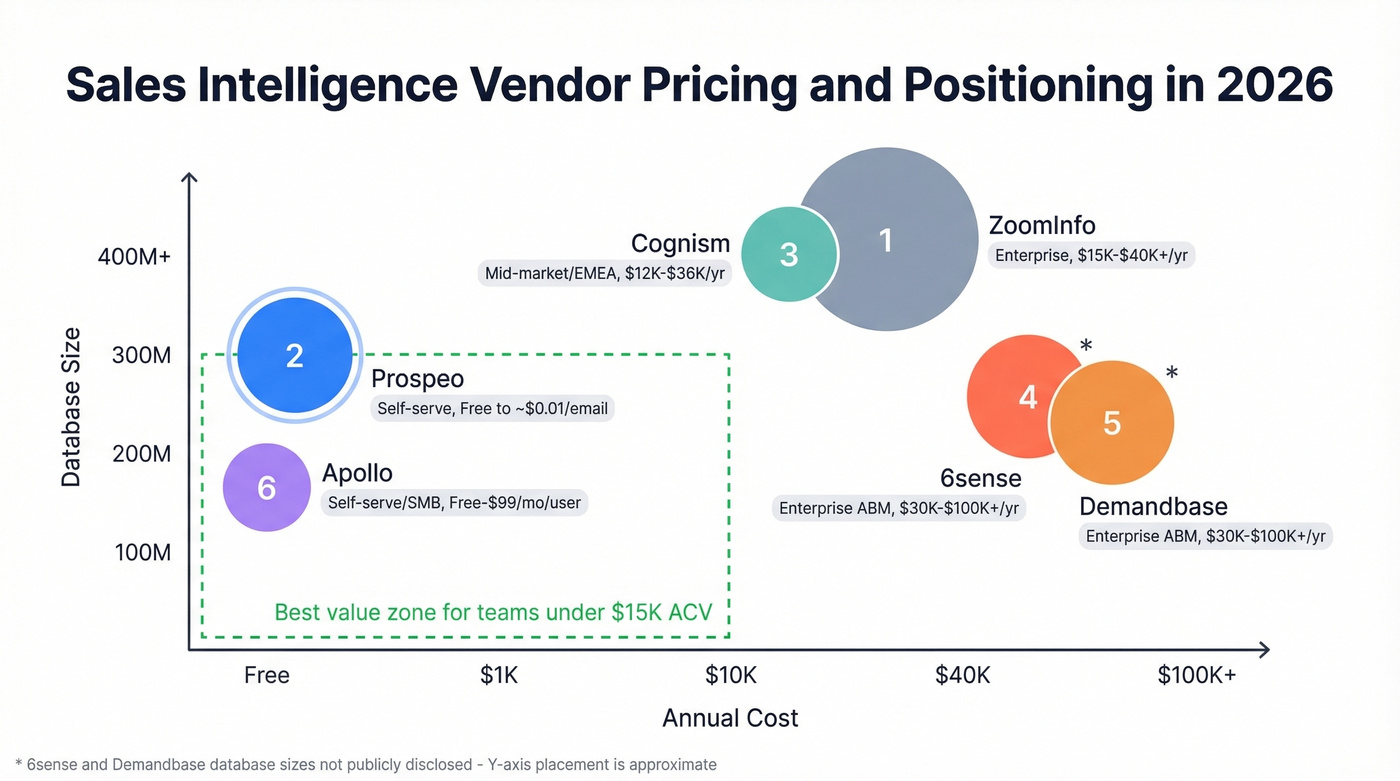
The pricing gap between enterprise and self-serve is itself a market trend worth watching. ZoomInfo's database runs 70M+ direct dials and 174M+ verified emails - genuinely massive. But a 10-seat contract with intent data can run $40-60K/year, and we've talked to plenty of teams locked into annual deals they regret within three months.
For teams that need accurate contact data without enterprise overhead, Prospeo offers 300M+ profiles with 98% email accuracy on a 7-day refresh cycle, 125M+ verified mobile numbers, and intent data covering 15,000 topics via Bombora - starting free with no annual contracts. Teams like GreyScout saw bounce rates drop from 38% to under 4% and pipeline increase 140% after switching. Dun & Bradstreet and Bombora round out the ecosystem for teams layering multiple data sources.
If you're comparing vendors, start with your sales prospecting motion, then map requirements to a short list of sales prospecting databases and lead enrichment workflows.
The $5B sales intelligence market is consolidating around platforms that combine contact data, intent signals, and workflow automation. Prospeo delivers all three - 125M+ verified mobiles, Bombora intent data, and native integrations with HubSpot, Salesforce, and every major sequencer - without the $40K annual lock-in.
Get enterprise-grade sales intelligence without the enterprise contract.
FAQ
How big is the sales intelligence market in 2026?
Analyst estimates converge around $5.0B to $5.4B for 2026, with most forecasts projecting $9B-$12B+ by the early 2030s at roughly 11-13% CAGR. The range reflects different category definitions across firms like Fortune Business Insights and Mordor Intelligence.
What's the difference between sales intelligence and revenue intelligence?
Sales intelligence delivers external prospect data - verified emails, firmographics, intent signals - to help reps find and prioritize buyers. Revenue intelligence unifies internal data across teams with AI-driven forecasting and deal-risk scoring. Most mid-market and enterprise teams need both layers working together.
Which regions are growing fastest?
APAC leads regional growth at 14.86% CAGR, driven by expanding B2B SaaS adoption in India, Southeast Asia, and Australia. North America still holds roughly 40-42% of total market share, while EMEA growth is tempered by stricter GDPR enforcement and the EU AI Act rollout.