

Sales Leadership vs Sales Management: What the Data Actually Shows
It's absurd, when you think about it. A company takes its best closer - the person who crushed $1.2M in ARR last year - promotes them into management, hands them a team of eight, and acts surprised when half those reps miss quota within two quarters. 60% of new sales managers fail within their first 18 months. Not because they're bad at sales, but because nobody taught them the difference between sales leadership and sales management.
One Reddit thread captured the other side perfectly - a rep describing their managers as people who "attend meetings and poorly micromanage" while contributing nothing to actual deals. The data backs up that frustration: 69% of salespeople who exceeded annual quota rated their sales manager as excellent. Not the product, not the comp plan, not the territory. The manager is the single biggest variable.
The Short Version
Management is systems, process, and accountability. Leadership is vision, coaching, and development. Most orgs over-index on management and starve leadership, which is why 84% of reps missed quota last year and frontline turnover keeps climbing. A Fortune 100 study of 605 agents found that manager leadership style didn't show a significant difference in sales outcomes - but manager performance mattered enormously.
If you only read one section, make it the framework below.
The Core Distinction
Every article on this topic tells you "leaders inspire, managers execute" and stops there. That's useless. The real question is what a sales leader does differently at 9am on Tuesday versus what a sales manager does.
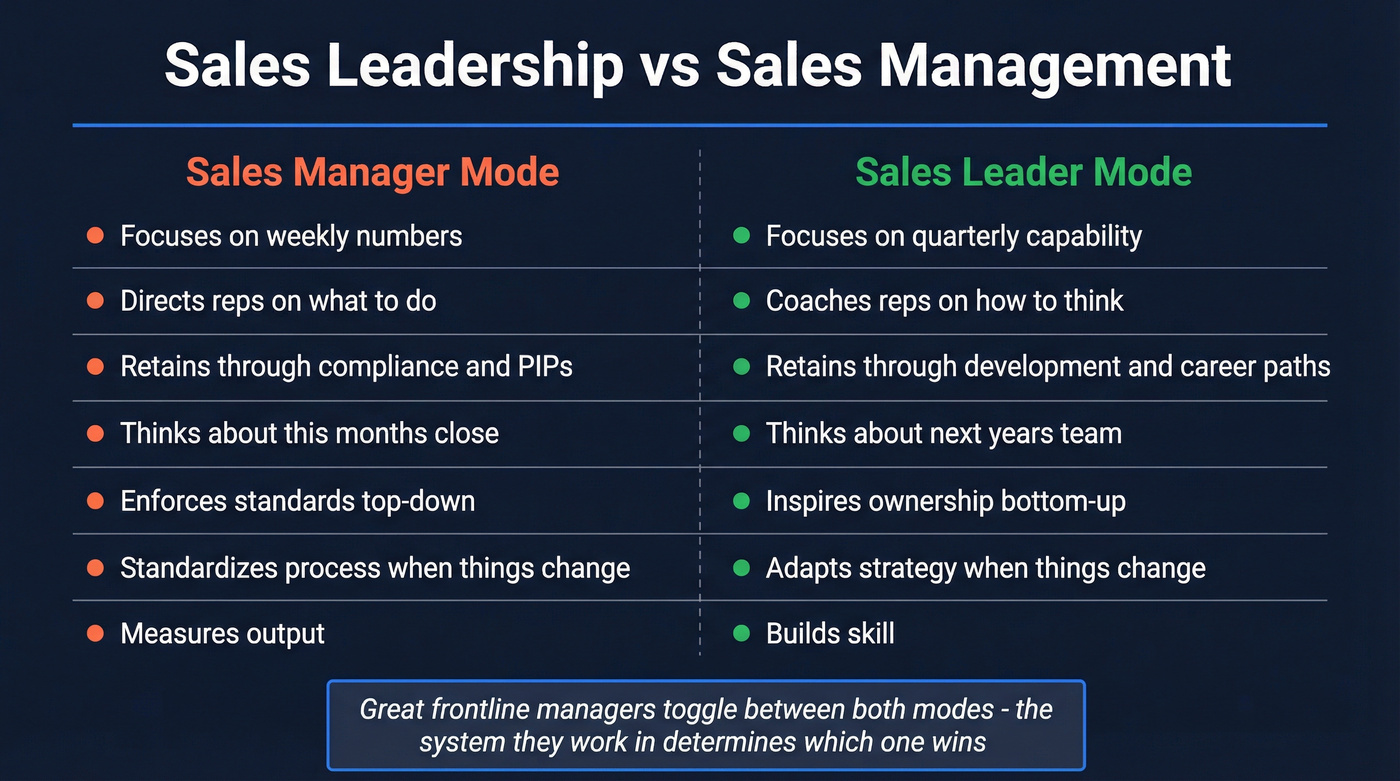
| Dimension | Sales Manager | Sales Leader |
|---|---|---|
| Focus | Weekly numbers | Quarterly capability |
| Default mode | Directing reps | Coaching reps |
| Retention lever | Compliance + PIPs | Development + career path |
| Time horizon | This month's close | Next year's team |
| Communication | Enforce standards | Inspire ownership |
| Change response | Standardize process | Adapt strategy |
| Rep development | Measure output | Build skill |
The manager asks "why didn't you hit 50 dials today?" The leader asks "what's blocking you from getting the right conversations?" Same team, same quota, completely different outcome over 12 months.
These aren't two separate job titles. They're two modes the same person needs to toggle between. The problem is that most frontline managers default to the left column because it's measurable, comfortable, and what their VP of Sales asks about on Monday morning calls.
Here's the thing: most CROs will tell you they want "sales leaders." Then they build comp plans, dashboards, and Monday reviews that reward pure management behavior. The system produces exactly what it incentivizes.
Why It Costs Real Money
This isn't a soft-skills debate. The gap between leading and managing shows up in dollars.
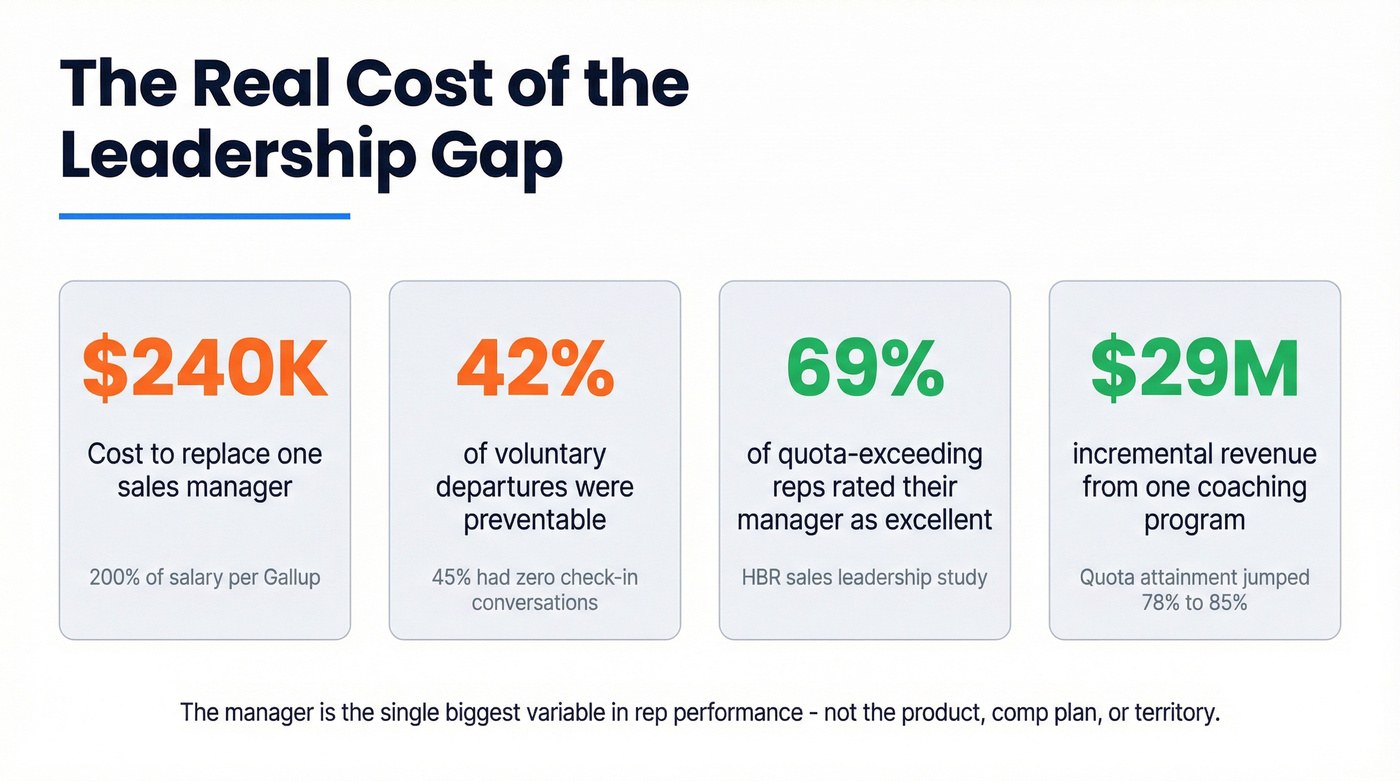
Gallup's retention research puts the cost of replacing leaders and managers at roughly 200% of their salary. For someone earning $120K, that's $240K in recruiting, ramp, and lost productivity. And 42% of employees who voluntarily left said their departure was preventable - 45% said neither their manager nor any leader had a single proactive conversation about their satisfaction, performance, or future in the three months before they walked.
That's not a leadership philosophy problem. That's a $240K conversation that nobody had.
Investing in leadership development pays back fast. One independently verified case study tracked 500+ sales executives and managers through a coaching-focused program. Quota attainment climbed from 78% to 85%. Revenue per rep jumped 14%. The company attributed $29M in incremental revenue to the initiative, verified by the ROI Institute.
The correlation between manager quality and organizational health is almost absurdly strong. HBR found that 56% of salespeople who rated their organization as excellent also rated their manager as excellent. Among those who rated their org as average? Only 3% said the same about their manager. Three percent.

You can't coach reps to quota if they're wasting 4-6 hours a week hunting for contact data. Prospeo gives your team 300M+ profiles with 98% email accuracy and 125M+ verified mobiles - so your managers spend Monday mornings on coaching, not cleaning spreadsheets.
Leaders build pipeline. Let Prospeo handle the prospecting data.
What the Research Shows
A Fortune 100 study published through Tarleton State University tracked an 18-month dataset covering 605 sales agents across 7,692 leadership interactions. The findings challenge some assumptions.
Director-level coaching style mattered significantly - coaching-oriented, employee-centric approaches correlated with stronger engagement and productivity. But at the manager level, leadership style showed no significant difference in sales outcomes. What did matter was whether the manager was a high performer themselves. High-performing managers directly boosted agent performance regardless of their "style."
The study also surfaced a tenure paradox: longer-tenured directors had a negative direct effect on performance, likely because they set unrealistic expectations based on their own experience.
The coaching data tells a consistent story. Formal coaching programs drive 91.2% quota attainment versus 84.7% for informal coaching. Reps with excellent coaching are 50% more likely to hit quota. We've seen this pattern play out repeatedly - the teams that treat coaching as a system, not an afterthought, consistently outperform.
The Promotion Trap
Comp and Time Reality
Let's be honest about something most leadership articles won't touch: the economics of moving into management often don't make sense.
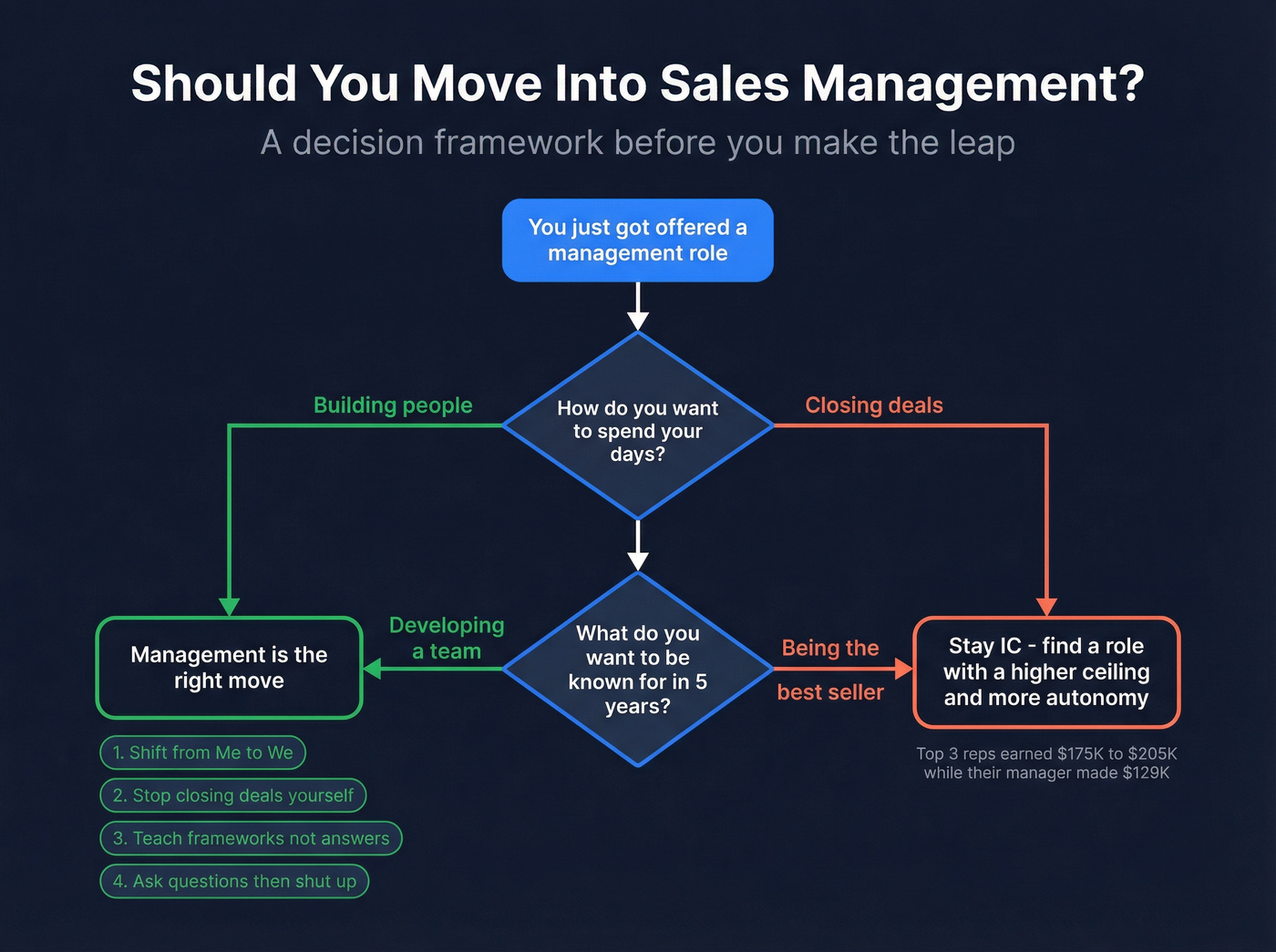
One detailed Reddit breakdown laid out the math. The manager was pacing at $129K while the top three reps earned $175K, $189K, and $205K. The manager worked longer hours, had less freedom, and was effectively doing two full-time jobs - their own responsibilities plus jumping on rep calls, building strategies, and digging through KPIs every morning and evening. This is the "team lead" trap HBR documented back in 1964: a manager who solves every problem for their reps teaches dependence, not capability.
Before making the leap, evaluate two things: how you want to spend your time day-to-day, and what you want to be known for in five years. If both answers point toward building people rather than closing deals, management is the right move. If not, staying in an IC role with a higher ceiling is the smarter play.
Mindset Shifts Required
The transition from top seller to effective leader requires at least four shifts:
- Me to We. Your success metric changes from personal quota to team output.
- Best seller to building best sellers. The instinct to jump on a deal and close it yourself is the exact wrong move.
- Doer to enabler. Stop crafting the perfect email for your rep. Teach them the framework instead.
- Talking to listening. The best closers talk. The best coaches ask questions and shut up.
A medical device company case study illustrates what happens without these shifts. Top sellers promoted to Sales Manager burned out or left within a year. The gaps weren't in product knowledge - they were in managing diverse performance levels and communicating strategically upward. The company eventually built a program with 3 weeks of development spread over 3 months, plus a capstone business simulation. That kind of investment is rare, and the companies that make it have a massive advantage over those that just hand someone a new title and a Slack channel.
A Practical Framework
The Three Levers
Every rep's performance sits on three levers:
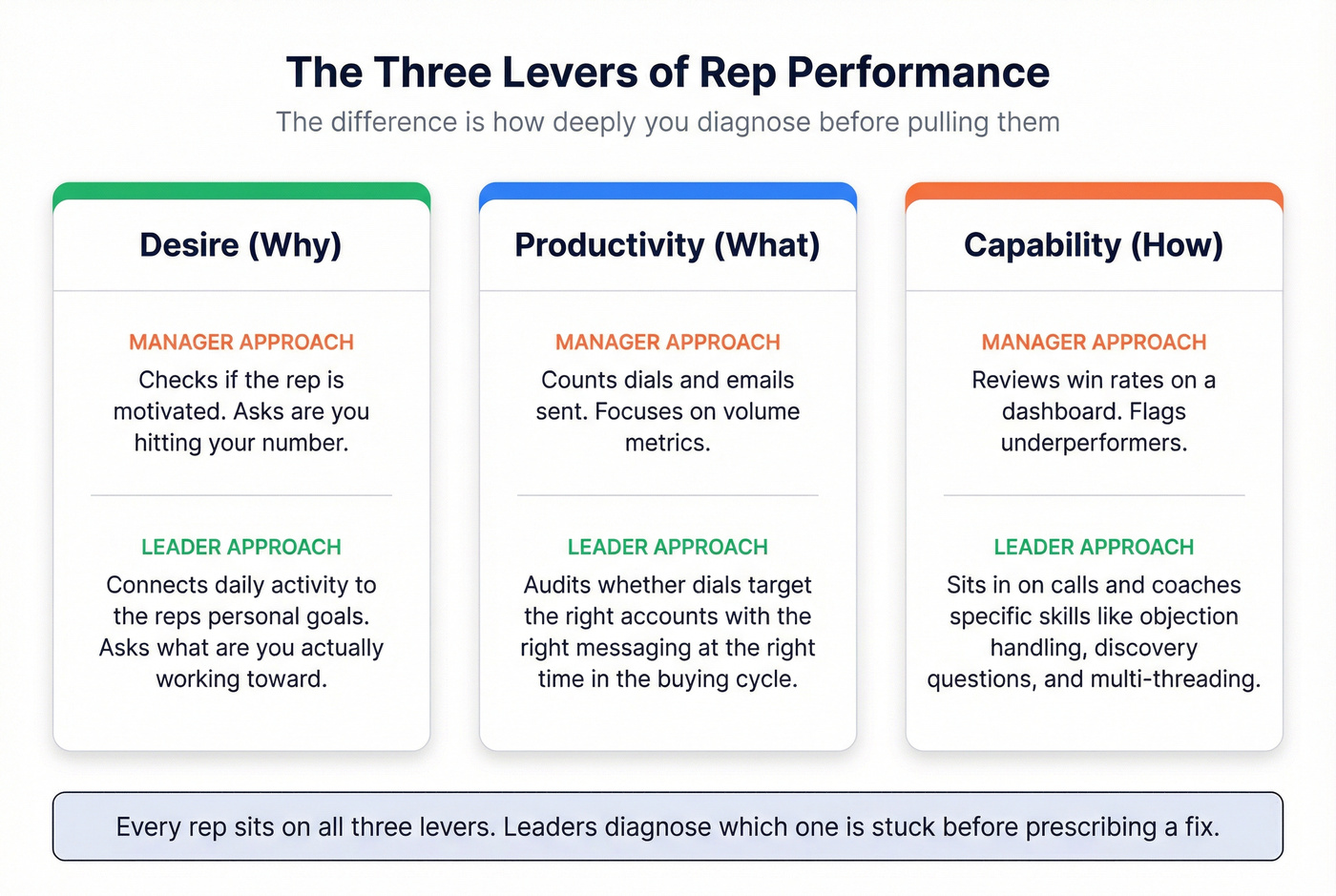
Desire (Why): A manager checks if the rep is "motivated." A leader connects daily activity to the rep's personal goals - what they're actually working toward, not just the number on the board.
Productivity (What): A manager counts dials. A leader audits whether those dials target the right accounts, with the right messaging, at the right time in the buying cycle.
Capability (How): A manager reviews win rates. A leader sits in on calls and coaches specific skills - objection handling, discovery questions, multi-threading.
The difference isn't which levers you pull. It's how deeply you diagnose before pulling them.
Weekly Coaching with GROW
The GROW model - Goal, Reality, Options, Will - remains the most practical coaching framework for weekly 1:1s. Set a specific goal for the conversation. Explore the current reality without judgment. Generate options together. Lock in a commitment.
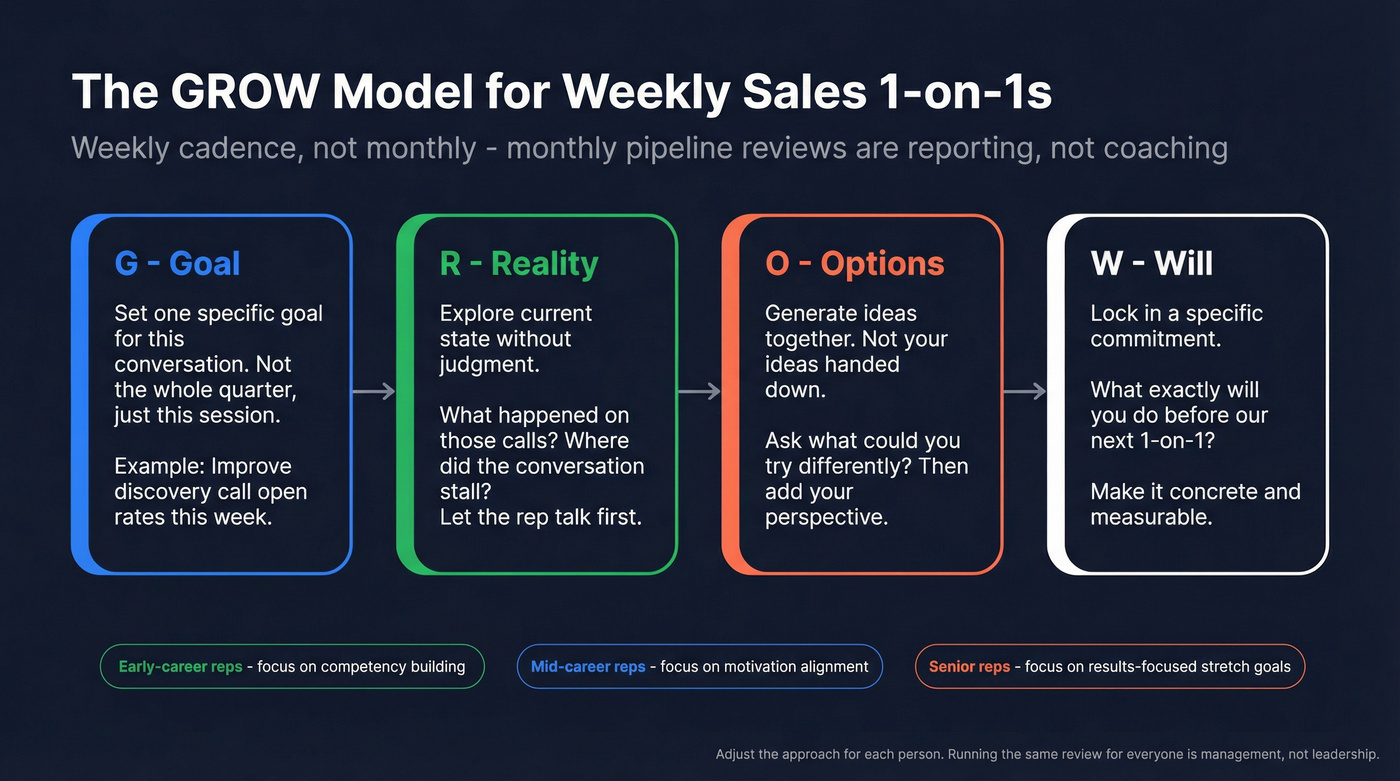
Weekly cadence is ideal. Monthly pipeline reviews aren't coaching - they're reporting. Research on career-stage personalization shows that early-career reps need competency building, mid-career reps need motivation alignment, and senior reps need results-focused stretch goals. A leader adjusts the approach for each person. A manager runs the same review for everyone.
Skip the GROW model if your 1:1s are already productive and your reps are hitting quota. Don't add process for the sake of process - that's management cosplaying as leadership.
The Modern Complication
81% of sales teams now use AI in some form, and 45% of sales professionals say they're overwhelmed by the number of tools in their stack. Reps spend roughly a third of their time actually selling. The rest goes to admin, data entry, and toggling between platforms.
This is where the tension between leading and managing gets practical. A manager responds to low activity numbers by adding another dashboard. A leader asks why reps are spending two hours a day on data cleanup instead of conversations.
The most common version of this problem we see is teams running outbound sequences on bad data. Reps send 200 emails, 40 bounce, deliverability tanks, and the manager blames "effort." A leader fixes the input. Tools like Prospeo exist for exactly this scenario - if your reps can't trust their contact data, no amount of coaching fixes the pipeline.
If you're trying to systematize outbound, start with sales prospecting techniques and a clean lead generation workflow before you add more tools.
The data is clear: reps with excellent managers are 50% more likely to hit quota. But even the best sales leader can't fix a 35% bounce rate from bad contact data. Prospeo's 7-day refresh cycle and 5-step verification keep bounce rates under 4% - so your team's outreach actually lands.
Stop letting stale data undermine your leadership. Fix it for $0.01 per email.
FAQ
What's the difference between a sales leader and a sales manager?
Management is systems, metrics, and accountability - hitting this month's number. Leadership is coaching, vision, and development - building next year's team. The best frontline leaders toggle between both modes, spending 30-50% of their time on coaching rather than running pipeline reviews exclusively.
What KPIs separate leaders from managers?
Managers track revenue and activity metrics like dials and demos booked. Leaders track retention rate, new-hire ramp time, and percentage of reps at quota - the upstream inputs that drive downstream revenue. Teams with formal coaching programs hit 91.2% quota attainment vs. 84.7% without.
How do I transition from sales manager to sales leader?
Start with a weekly 1:1 coaching cadence using the GROW framework. Shift from solving problems for reps to asking questions that help them solve problems themselves. If more than 50% of your time goes to admin and forecasting, you're managing - not leading yet.
What tools help new sales leaders coach more effectively?
CRM dashboards, conversation intelligence platforms, and clean contact data are the foundation. Pair a data platform like Prospeo with a tool like Gong or Chorus for call review and you cover both inputs and execution - so coaching conversations focus on skill, not data hygiene.