

The Sales Management Process That Top Teams Actually Follow
Ask any sales team to walk you through their process, and you'll hear "it depends" within 30 seconds. As one r/CRM thread put it, teams claim their process is fine until you ask them to walk through a real deal. Missed follow-ups, weird forecasts, founders stuck in every deal - these aren't signs of a bad team. They're signs of a missing sales management process.
[Fewer than 50% of sales reps](https://www.forrester.com/blogs/your-companys-quota-attainment-is-probably-around-50-and-thats-not-a-bad-thing/) have hit quota annually since 2017, yet 90% of companies with formalized processes are top performers. The gap between "we have a process" and actually having one is where most revenue dies.
The Five Non-Negotiables
If you don't have all five, you don't have a real operating system - you have a collection of habits.
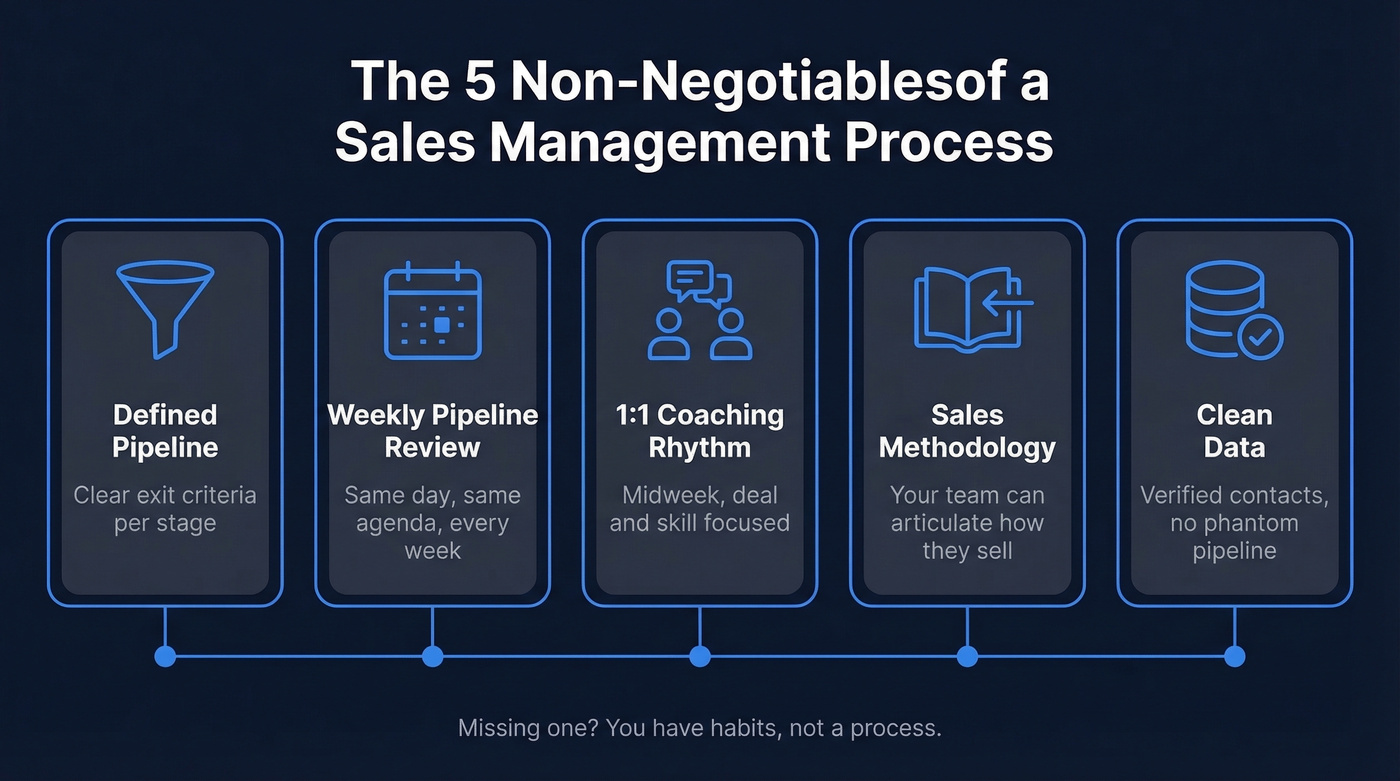
- A defined pipeline with exit criteria per stage. Every deal needs clear gates. No deal advances because a rep "feels good about it."
- A weekly pipeline review cadence. Not monthly. Not "when we have time." Weekly, same day, same agenda.
- A 1:1 coaching rhythm. Midweek, focused on deals and skills - not status updates.
- A sales methodology your team can articulate. If your AEs can't explain how they sell, they're winging it.
- Clean data feeding every stage. Bad contact data creates phantom pipeline that inflates forecasts and wastes rep time.
Companies that implement structured management practices see up to 20% higher productivity. Here's how to build each one.
What Does a Sales Management Process Actually Include?
A sales management process is the operating system that turns individual selling talent into repeatable, scalable revenue. It's not a CRM workflow or a pipeline dashboard - it's the full set of decisions, rhythms, and structures that determine whether your team hits number. With 80% of B2B sales interactions now happening in digital channels, the system you build needs to work across screens, not just conference rooms.
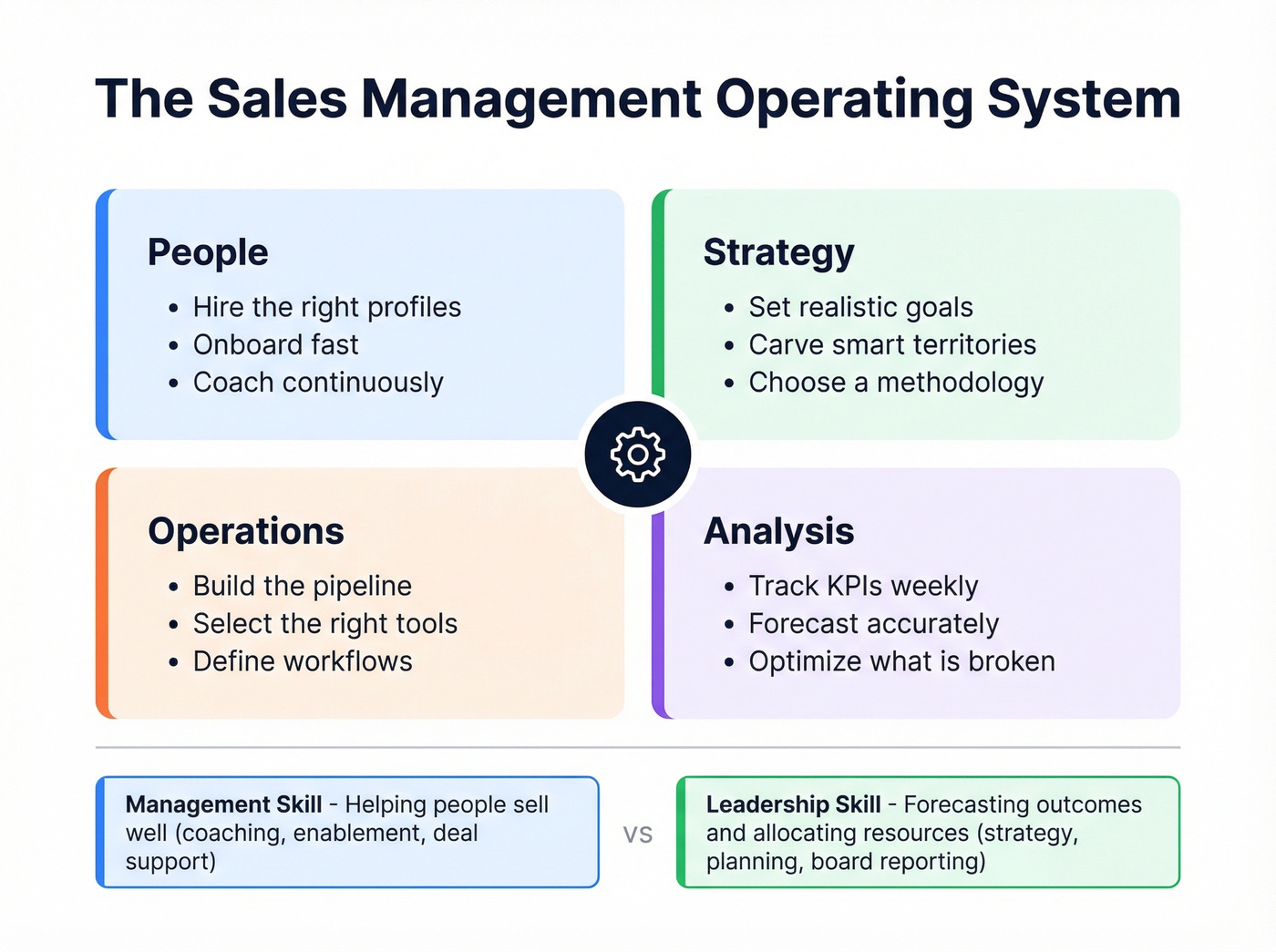
It rests on four pillars:
- People - hiring the right profiles, onboarding them fast, coaching them continuously.
- Strategy - setting goals, carving territories, choosing a methodology.
- Operations - building the pipeline, selecting tools, defining workflows.
- Analysis - tracking KPIs, forecasting accurately, optimizing what isn't working.
There's a distinction most articles miss. Helping people sell well is a management skill. Forecasting outcomes and allocating resources is a leadership skill. The best sales orgs need both, but they're different muscles entirely. A frontline manager who's great at coaching deals might be terrible at building a forecast the board trusts. Your process needs to account for both, and understanding the split between operational, strategic, and analytical management helps you identify which muscles your org is missing.
The Step-by-Step Framework
Set Goals and Plan Territories
Only 52% of CEOs actually believe in their own growth plans. That disconnect between the board deck and reality is where territory planning falls apart. Leaders who nail their go-to-market strategy are 2x more likely to meet or exceed revenue expectations.
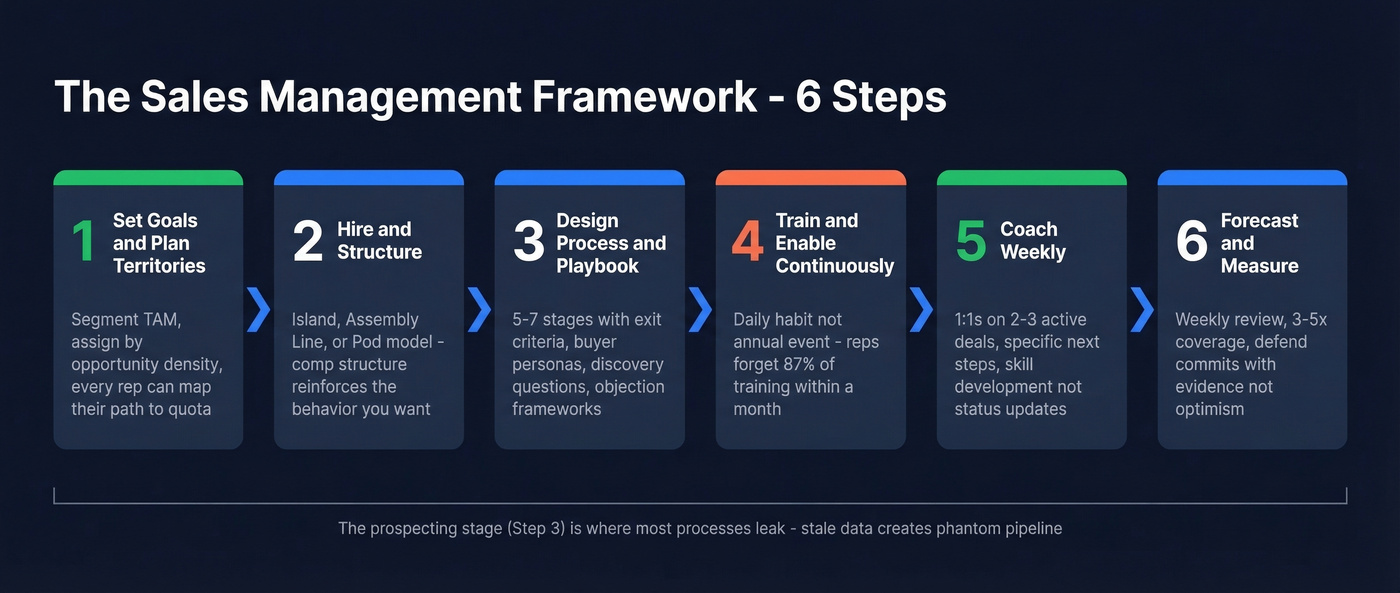
Start with your total addressable market, segment it by geography, vertical, or account size, and assign territories based on realistic opportunity density - not just headcount. Every rep should be able to calculate their path to quota on a whiteboard. If they can't, your territory plan is a wish list.
Hire and Structure the Team
Three org models dominate B2B sales: the Island model where each rep handles the full cycle, the Assembly Line with SDR-to-AE-to-CSM handoffs, and the Pod model where small cross-functional teams own a segment end-to-end.
For teams selling deals under five figures, the Assembly Line creates velocity. For complex enterprise sales, Pods reduce handoff friction. Whichever you pick, build your compensation structure to reinforce the behavior you want - if you comp on bookings but care about retention, don't be surprised when reps close bad-fit deals. Plan for 3-6 months of ramp time depending on deal complexity, and front-load onboarding with live deal exposure rather than slide decks. Nobody learned to sell from a PowerPoint.
Design Your Process and Playbook
Your sales process is the sequence of stages a deal moves through. Your playbook is the instruction manual for how reps execute each stage. They're different documents, and you need both.
The process should have 5-7 stages with explicit exit criteria. A deal doesn't move from "Discovery" to "Evaluation" because the rep had a good call - it moves because the prospect confirmed budget authority and timeline. Review stage conversion rates monthly. If deals stall at a specific gate, the exit criteria are probably wrong. Adjust and retest. Your playbook should include buyer personas, discovery questions, objection handling frameworks, and messaging templates.
Here's the thing: the prospecting stage is where most processes leak. If reps are working off stale contact data, they're building pipeline on bounced emails and disconnected numbers. Tools like Prospeo that verify emails and mobile numbers in real time - with a 7-day data refresh cycle - keep the contacts entering your pipeline real, not phantom leads inflating your forecast.
Train and Enable Continuously
One-off training events are a waste of money. B2B reps forget 70% of training within a week and up to 87% within a month. That expensive SKO you ran in January? By February, most of it's gone.
The fix is continuous enablement - short, focused reinforcement woven into the weekly rhythm. Role-plays on real deals. Call reviews with specific feedback. The consensus on r/SaaSSales backs this up: many AEs know what to do but can't articulate why they do it. That's a training gap, not a talent gap. Treat enablement as a daily habit, not an annual event.
Coach Weekly, Not Quarterly
Sales coaching drives a 28% higher win rate and 88% increase in productivity. Those aren't marginal gains - they're the difference between a team that hits 90% of quota and one that hits 115%.
Weekly 1:1s focused on 2-3 active deals, with specific coaching on what to do next. Not status updates. Not pipeline scrubs disguised as coaching. Actual skill development tied to real opportunities.
One practitioner principle worth stealing: name everything. Name your coaching cadence, name your pipeline stages, name your weekly review. When something has a name, it becomes real and harder to skip.
Forecast and Measure
79% of sales organizations miss their forecast by more than 10%. That's not a rounding error - it's a planning crisis.
| Performance Tier | Forecast Accuracy |
|---|---|
| World-class | 80-95% |
| Average B2B | 50-70% |
| Lagging | Below 50% |
A healthy pipeline typically carries 3-5x quota coverage. Below 3x, you're relying on heroics. Above 5x, your qualification is too loose.
Companies that review forecasts weekly are 31% more likely to close deals. The weekly review isn't optional - it's the single highest-leverage meeting on your calendar. Build it around deal-level inspection, not roll-up summaries. Ask reps to defend their commit number with evidence, not optimism. Every forecast conversation should tie back to observable buyer actions, not rep sentiment. That's what outcomes-based sales management actually looks like in practice.

Phantom pipeline kills forecasts. When reps prospect with stale data, every stage downstream gets polluted - inflated coverage ratios, missed forecasts, wasted coaching time. Prospeo refreshes 300M+ profiles every 7 days with 98% email accuracy, so the deals entering your pipeline are real.
Stop managing a pipeline built on bounced emails.
The Weekly Rhythm That Works
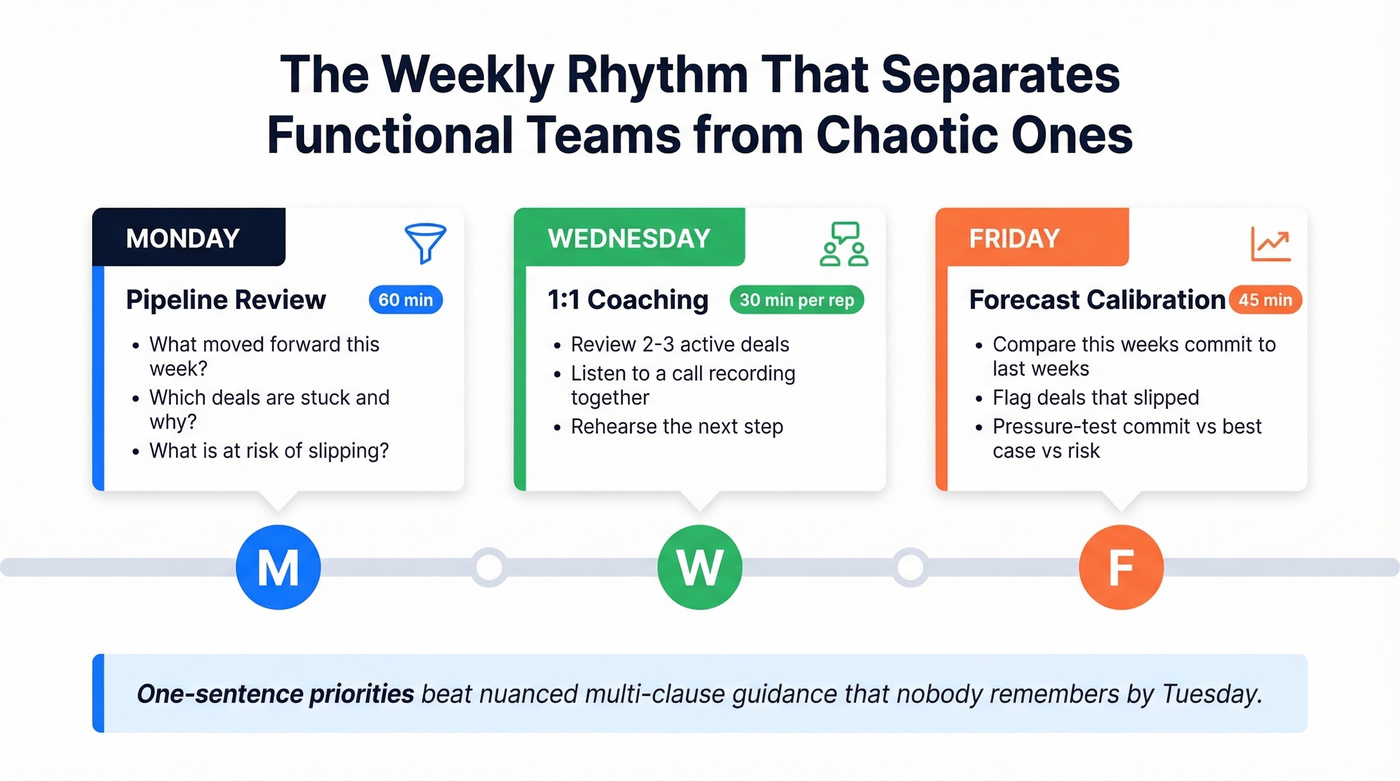
A process without a cadence is just a document nobody reads. In our experience, the Monday pipeline review is the meeting that separates functional teams from chaotic ones.
| Day | Activity | Duration | Focus |
|---|---|---|---|
| Monday | Pipeline review | 60 min | Stage movement, stuck deals |
| Wednesday | 1:1 coaching | 30 min/rep | 2-3 active deals, skills |
| Friday | Forecast calibration | 45 min | Commit vs. best case vs. risk |
The Monday review is about pipeline health - what moved, what's stuck, what's at risk. Give clear, simple direction and repeat it weekly. One-sentence priorities beat nuanced multi-clause guidance that nobody remembers by Tuesday.
Wednesday coaching is deal-specific and skill-specific. Review a call recording, walk through an email thread, rehearse a next step. This isn't a status update.
Friday calibration is where you pressure-test the forecast. Compare this week's commit to last week's. Flag deals that slipped. When you manage with this kind of weekly discipline, problems surface in days instead of quarters.
Document everything. It matters enormously when the board asks how you run your team. And if your operating rhythm depends on you personally running every review, coaching every rep, and building every forecast, you've built a system that breaks the moment you take a vacation. Sustainability beats heroics every time.
Pick a Sales Methodology
Your methodology is the "how" behind your process. Pick one, train on it relentlessly, and hold reps accountable to using it.
| Methodology | Origin | Best For |
|---|---|---|
| SPIN Selling | 35,000 calls, 20+ countries (Rackham) | Consultative, complex sales |
| Challenger | 6,000 reps, 90 companies (Dixon & Adamson) | Mid-market, insight-led |
| MEDDIC | Enterprise qualification framework | Enterprise, long cycles |
Let's be honest: the methodology matters less than the commitment. MEDDIC for enterprise, Challenger for mid-market, SPIN for consultative - pick one and go all in. The worst outcome is a team that "kind of uses Challenger" but can't explain what a teaching pitch actually looks like. A methodology half-adopted is worse than no methodology at all, because it creates the illusion of rigor without the substance.
Mistakes That Kill Quarters
Measuring activity without quality context. Reps spend about 25% of their time actually selling. Tracking dials and emails without tracking conversation quality just optimizes the wrong 75%.
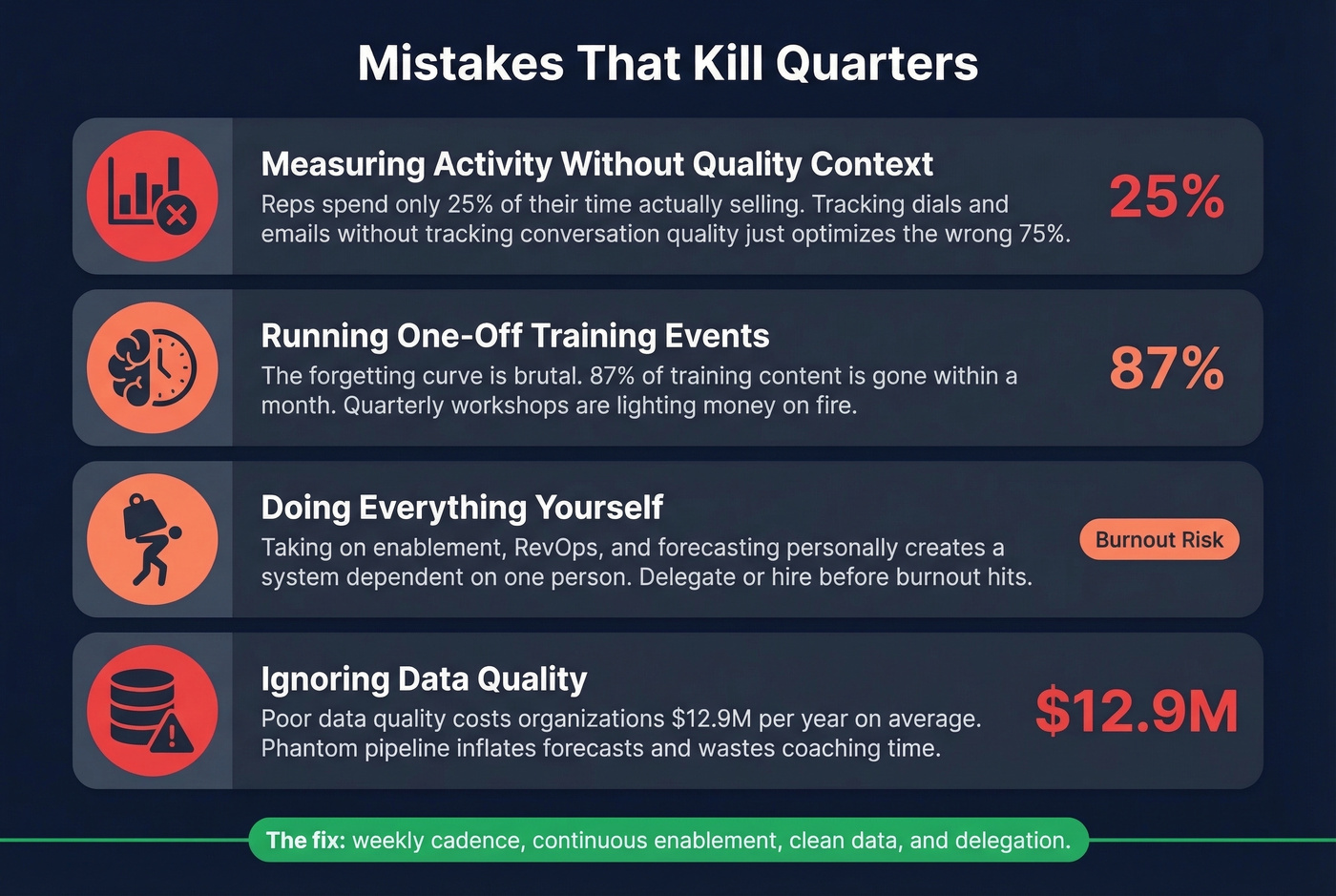
Running one-off training events. The forgetting curve is brutal - 87% gone in a month. If your enablement strategy is a quarterly workshop, you're lighting money on fire.
Doing everything yourself. Taking on enablement, RevOps, and forecasting personally works short-term but creates a system dependent on one person. I've watched managers burn out this way more than once. Delegate or hire before it catches up with you.
Ignoring data quality. Poor data quality costs organizations $12.9 million annually. Bad contact data creates phantom pipeline - deals that look real but are built on emails that bounce and numbers that don't connect. Verifying contacts before they enter your CRM is 10x cheaper than cleaning up the mess after. (If you need a starting point, data enrichment can help fill gaps fast.)
Tolerating consistent underperformance. Every quarter you keep a rep at 40% of quota, you're paying full OTE for half a territory. Address it with coaching first, a PIP second, and a transition third. Waiting helps nobody.
Skip the temptation to fix all five at once. Pick the one that's costing you the most revenue right now and start there.
AI and Sales Management in 2026
If reps only spend 25% of their time selling, AI's biggest promise isn't replacing sellers - it's giving them back the other 75%. Early adopters are seeing 30%+ improvement in win rates, and the gains come from reimagining workflows, not just automating existing ones.
A 2025 neuroscience study by Dr. Carmen Simon found that AI coaching helped sellers remember 50% more information after 48 hours compared to human coaching. But human coaching increased motivation, engagement, and well-being. The practical split is clear: let your AI coach the deal, let your manager coach the rep.
We've seen teams layer AI onto broken processes and wonder why nothing improved. AI amplifies whatever system you already have. If your foundation is broken - bad data, unclear stages, no coaching rhythm - AI just automates the mess faster. Fix the foundation first. Then layer in AI for call analysis, deal scoring, and forecast modeling.
The teams getting real results in 2026 aren't the ones with the fanciest AI stack. They're the ones who had a solid sales management process before AI showed up. (If you're building the stack, start with generative AI sales tools that support your cadence.)
You just built exit criteria, coaching cadences, and forecast models. None of it matters if reps spend 4-6 hours a week chasing wrong numbers. Prospeo gives your team 125M+ verified mobiles with a 30% pickup rate and verified emails for $0.01 each - so reps execute the process instead of hunting for contacts.
Give your reps data that matches the process you built.
FAQ
What are the four pillars of sales management?
People, strategy, operations, and analysis. People covers hiring and coaching. Strategy includes goals, territories, and methodology. Operations means pipeline, tools, and workflows. Analysis is your KPIs, forecasting, and continuous optimization. Every effective process needs all four working together - miss one and the others compensate with heroics.
How often should you review your sales forecast?
Weekly. Companies that review forecasts weekly are 31% more likely to close deals. Add a monthly calibration session to catch systemic issues like deal slippage patterns or stage inflation. Quarterly reviews are too late - by the time you spot a problem, the quarter's already lost.
What is outcomes-based sales management?
Outcomes-based sales management shifts focus from activity metrics - calls made, emails sent - to measurable buyer actions and deal results. Instead of asking "did the rep make 50 dials," you ask "did the prospect confirm budget authority and agree to a technical evaluation." It ties coaching and forecasting to observable outcomes rather than effort, producing more accurate pipelines and higher win rates.
How do you fix bad data in your sales pipeline?
Verify contact data before it enters your CRM - retroactive cleanup is 10x more expensive than prevention. Build verification into your prospecting workflow so every contact that hits your CRM is someone you can actually reach. Prospeo validates emails and mobile numbers in real time with 98% accuracy, catching bounces and disconnected numbers before they become phantom pipeline.