

Sales Management Skills That Actually Matter in 2026
A RevOps lead we know ran a coaching audit last quarter. Ninety-four percent of managers on the team said they coached regularly. When she surveyed the reps, 53% said they got coaching quarterly or less. That gap - between what managers think they're doing and what reps actually experience - explains more about missed quota than any CRM dashboard ever will.
Here's the uncomfortable truth: 84% of sales reps didn't meet quota in recent industry surveys. Only about 3 in 10 sales managers are effective at getting maximum performance from their teams. And 65% of organizations don't even evaluate coaching skills when they promote someone into management. They take the best closer, hand them a team, and wonder why the numbers crater.
Spend five minutes on r/sales and you'll see a common complaint: managers function mainly as a "buffer between us and upper management." That's not management - that's insulation. Star seller to competent manager requires an entirely different skill set, and most companies skip the training that bridges the gap.
The skills that fix this aren't mysterious. They're just rarely prioritized.
The Three Skills That Matter Most
Every guide lists 15 abilities like a shopping list. That's useless. Nail these three and the rest follows.
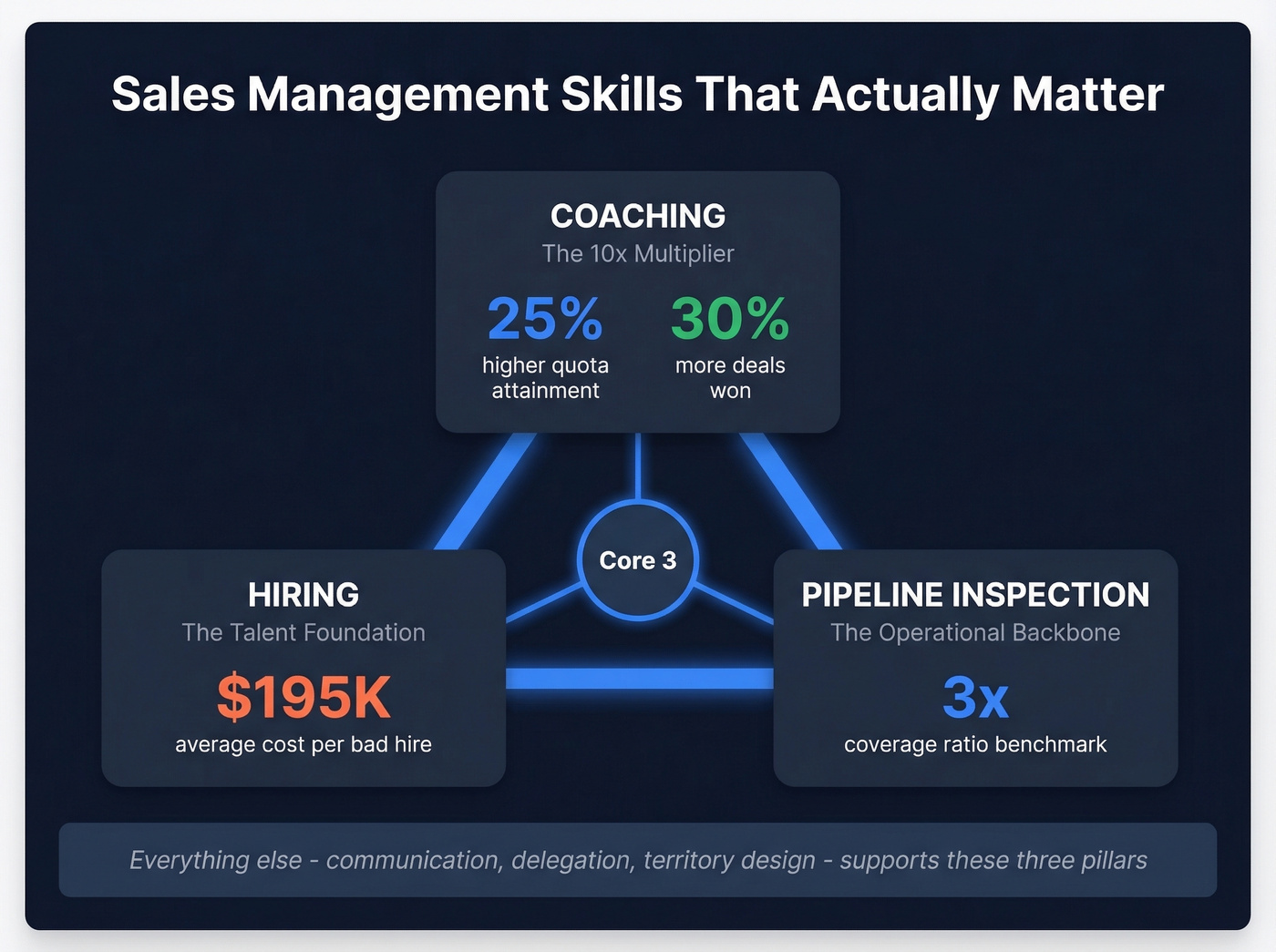
Coaching is the only 10x multiplier. Weekly coaching drives 25% higher quota attainment and 30% more deals won, yet only 26% of reps receive weekly coaching and 37% rarely or never receive personalized feedback. This is the single biggest gap in sales leadership.
Hiring is second because you can't coach talent that isn't there. Replacing a rep costs roughly 0.5x to 1.5x base salary - often up to ~$195,000 per rep. Get this wrong and coaching becomes triage.
Pipeline inspection is the operational backbone. Without disciplined pipeline reviews, forecasts are fiction and coaching has no data to work from.
The PAUSE coaching framework below gives first-time managers a repeatable model to start with. Everything else - sales communication, delegation, territory design - supports these three pillars.
Foundational Skills Every Manager Needs
Coaching and Developing Reps
This is the skill. Not one of many - the one that multiplies everything else.
The data is unambiguous. Reps who receive weekly coaching hit quota 25% more often and close 30% more deals. Sales training ROI is 353%, or roughly $4.53 back for every $1 invested. Top-performing managers are 51% more likely to have regular ongoing coaching cadences and 40% more likely to be skilled at leading those sessions. Meanwhile, Gartner found that coaches spend less than 10% of their time actively coaching. The perception gap is staggering: 94% of managers say coaching is part of their process, while 53% of reps say they receive it quarterly or less.
Frequency matters, but quality matters more. RAIN Group found that coaching frequency alone doesn't differentiate top performers for deal coaching - coaching skill and session quality do. Weekly cadence is the floor; the PAUSE framework ensures each session actually moves the needle.
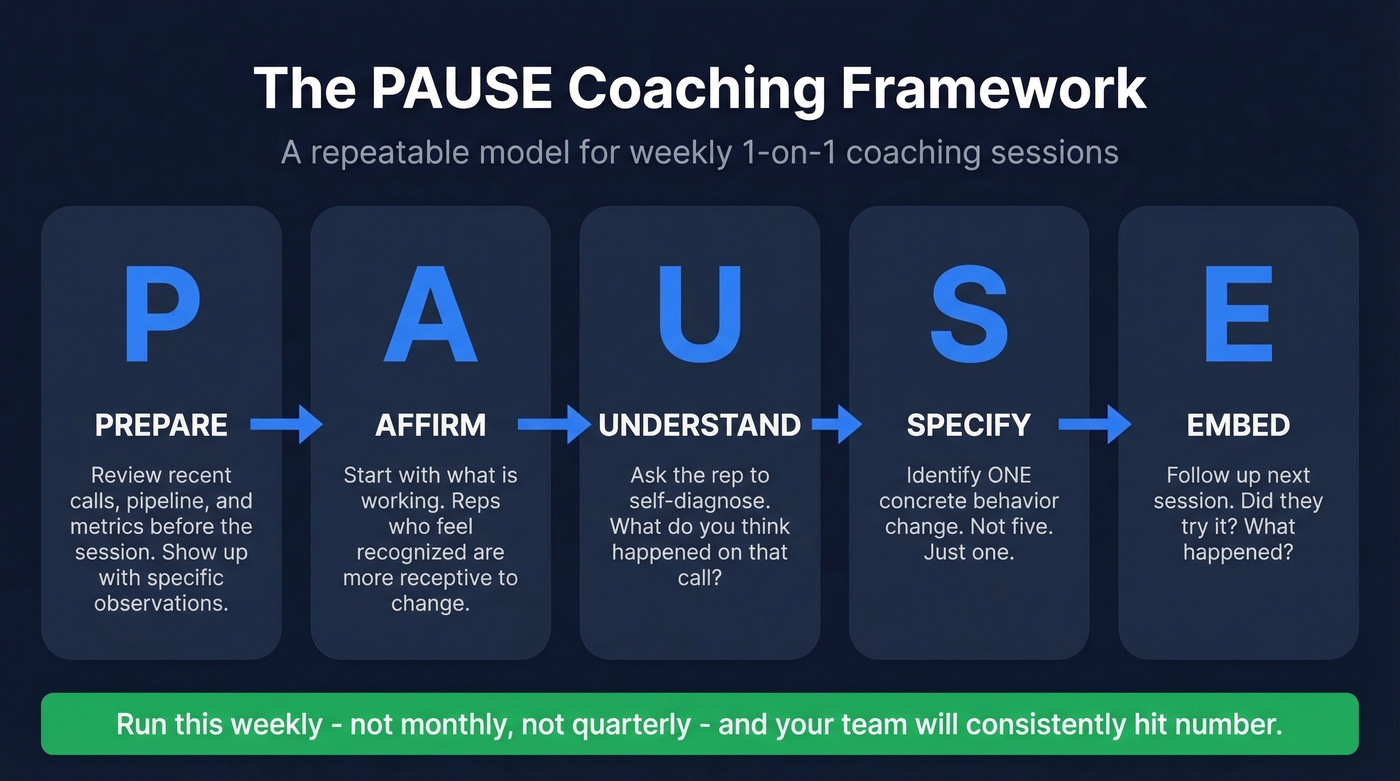
The PAUSE framework from Challenger gives new managers a repeatable model:
- Prepare - Review the rep's recent calls, pipeline, and metrics before the session. Show up with specific observations, not generic advice.
- Affirm - Start with what's working. Reps who feel recognized are more receptive to change.
- Understand - Ask the rep to self-diagnose. "What do you think happened on that discovery call?" beats "Here's what you did wrong."
- Specify - Identify one concrete behavior change. Not five. One. "Next call, pause after your pricing slide and let the silence work."
- Embed - Follow up in the next session. Did they try it? What happened? Coaching without follow-through is just conversation.
In our experience, the managers who run this weekly - not monthly, not quarterly - are the ones whose teams consistently hit number.
Hiring and Talent Assessment
Look for this: Coachability, curiosity, and process discipline. Ask candidates to role-play a discovery call, then give them feedback and have them redo it. How they respond to coaching in real time tells you more than any resume.
Skip experience as a primary filter. The Sales Management Association found that 65% of organizations don't evaluate coaching skills when promoting or hiring managers - they default to tenure and quota history. Experience doesn't equal performance.
The cost of getting this wrong is brutal. Seller turnover runs around 35%, and replacement cost commonly lands at 0.5x-1.5x base salary. Every bad hire is a six-figure mistake that compounds across the team.
Communication and Active Listening
Managers ranked adaptability as the most crucial soft skill at 44%, ahead of curiosity at 28%, resilience at 18%, and empathy at 8%. That ranking makes sense in a hybrid world where informal learning has largely disappeared.
The best sales managers don't just communicate clearly - they listen structurally. They catch the difference between a rep saying "the deal is progressing" and a rep who can articulate the specific next step, the stakeholder map, and the timeline. You can't coach what you don't hear.
Leadership and Motivation
Here's my hot take: AI is going to handle more of the tactical coaching fast. A 2026 neuroscience study by Dr. Carmen Simon found that sellers receiving AI-coach feedback remembered 50% more content after 48 hours compared to human feedback. But human coaching improved something AI couldn't touch - relaxation and motivation.
Lauren Bailey from Factor 8 put it perfectly: "Let your AI coach the deal. Let your manager coach the rep."
The motivational dimension - helping a rep push through a brutal quarter, rebuilding confidence after a lost deal, connecting daily activity to career trajectory - remains stubbornly human. Motivation isn't a personality trait. It's a skill that can be manufactured through deliberate recognition, goal alignment, and career-path conversations. Managers who outsource this to dashboards and automated nudges lose their teams slowly, then all at once.
Delegation and Trust-Building
Forty percent of sellers frequently deviate from the sales process. Only 20% of managers believe deals follow a repeatable process.
The instinct is to micromanage. Inspect every deal, sit on every call, rewrite every proposal. But the data says the opposite works better. Set clear guardrails - stage criteria, required fields, minimum discovery questions - then step back. Inspect the pipeline, not the person. When reps feel trusted within a framework, process adherence actually goes up because they understand the why behind the structure.
Operational Skills for Day-to-Day Execution
Pipeline Management and Forecasting
Sellers spend roughly 25% of their time actually selling to customers. Salesforce puts the non-selling task load at 60% of a rep's week. Your job as a manager is to protect selling time while maintaining pipeline visibility.
Let's break this into two buckets. Forecasting covers late-stage deals likely to close this quarter. Forward pipeline is the early-stage development that shapes future forecasts. Most managers over-index on the former and neglect the latter - then wonder why next quarter looks empty.
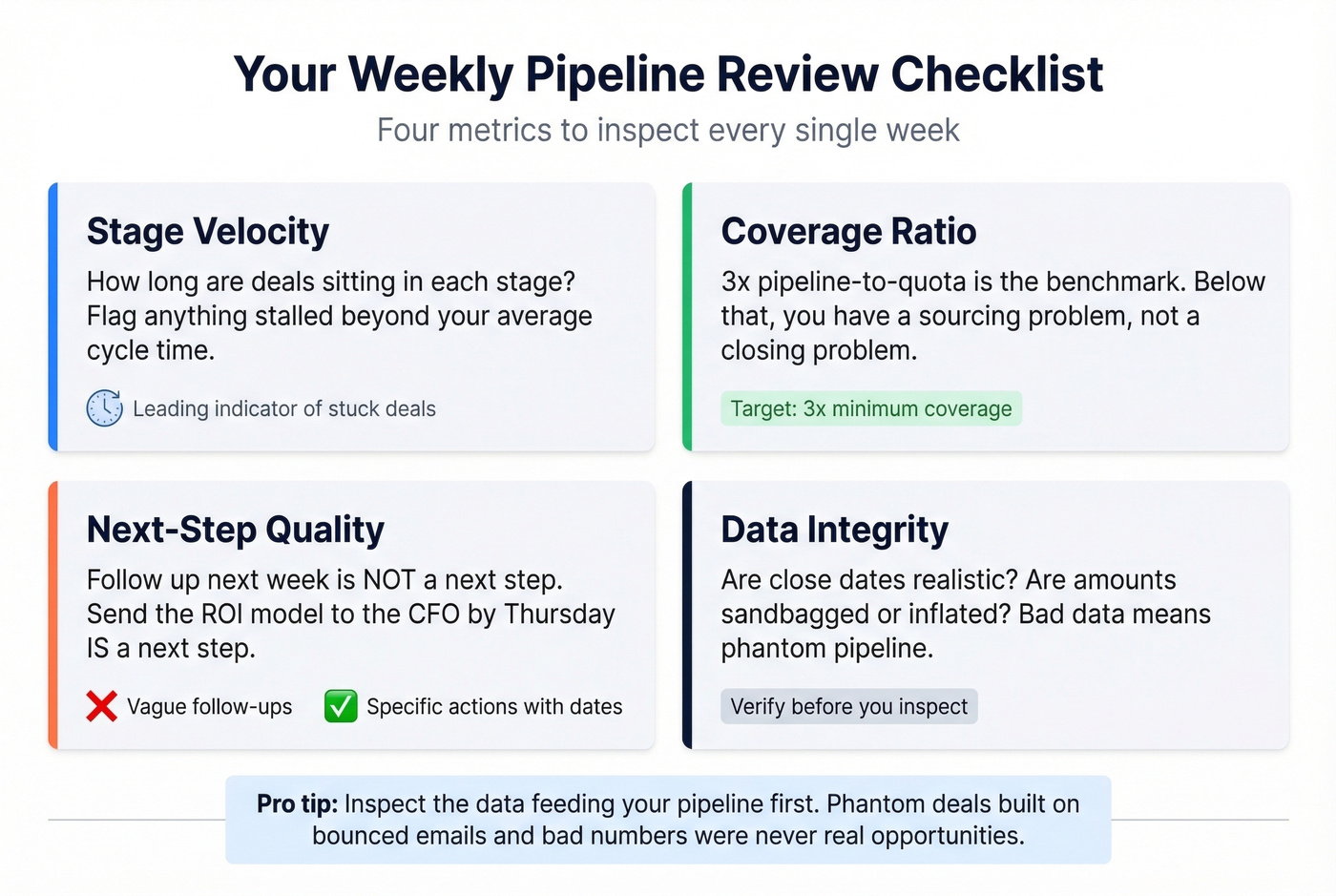
A weekly pipeline cadence should cover:
- Stage velocity - How long are deals sitting in each stage? Anything stalled beyond your average cycle time gets flagged.
- Coverage ratio - 3x pipeline-to-quota is the standard benchmark. Below that, you've got a sourcing problem, not a closing problem.
- Next-step quality - "Follow up next week" isn't a next step. "Send the ROI model to the CFO by Thursday" is.
- Data integrity - Are close dates realistic? Are amounts sandbagged or inflated?
Before you inspect the pipeline, inspect the data feeding it. Bad contact data means phantom pipeline - deals built on bounced emails and disconnected numbers that were never real opportunities. Prospeo catches invalid emails before they inflate your forecast, saving your team from chasing ghosts during pipeline reviews.
Performance Management and KPIs
Top-performing managers are 51% more likely to maintain regular, ongoing coaching - and that coaching is anchored to specific metrics, not vibes. The mistake most managers make is reviewing KPIs monthly when the damage is already done.
A weekly KPI rhythm should track activity metrics like calls, emails, and meetings booked as leading indicators. Layer in conversion rates from meeting-to-opportunity and opportunity-to-close for efficiency signals. Track pipeline created - new dollars entering the funnel this week - alongside deal progression to see which opportunities moved forward versus stalled. Monitor quota attainment pace so reps know whether they're tracking to monthly and quarterly targets.
Measure weekly. Coach off the trends. Don't wait for the end-of-month post-mortem when the quarter is already decided.
Onboarding and Ramp Management
Structured onboarding retains 50% more new hires, cuts ramp time by up to 34%, and drives 54% higher engagement. Meanwhile, 20% of reps churn within their first 45 days due to poor training and unclear expectations.
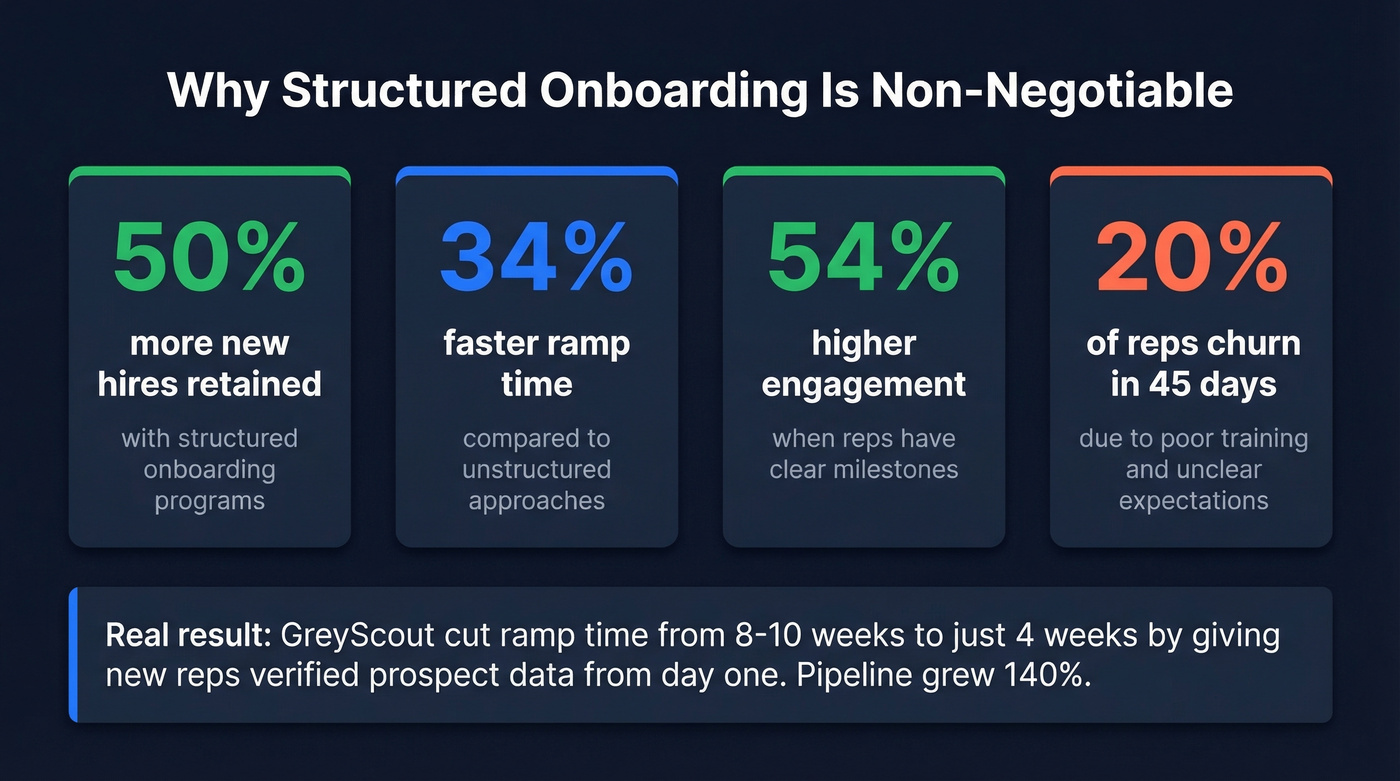
We've seen this play out firsthand. GreyScout doubled their sales team from 2 to 5 reps and cut ramp time from 8-10 weeks to 4 by giving new reps verified prospect data from day one. Pipeline grew 140%. When onboarding starts with clean data, reps trust the tools and the process faster - they're booking meetings in week two instead of spending week six cleaning up a garbage list.
The best onboarding programs combine a structured curriculum covering product knowledge, ICP definition, and objection handling with immediate access to quality tools and data, plus a 30/60/90 day milestone framework with coaching checkpoints at each stage.
Territory and Process Design
Territory design isn't just geography anymore. Modern territories are defined by accounts, verticals, intent signals, and company attributes - a mid-market AE might own "Series B-C SaaS companies in North America showing hiring intent for sales roles" rather than "the Southeast."
Bain's 2026 research makes a critical point: meaningful gains come from redesigning the sales process top to bottom, not automating existing ones. Automating a broken territory model just breaks it faster at scale. Leaders who nail their go-to-market strategy are 2x more likely to meet or exceed revenue expectations, with 74% achieving or surpassing goals.
For teams that struggle with territory balance, the problem usually isn't the sellers. If 40% of your reps are deviating from the process, the process is probably broken.

Coaching only works when reps reach real buyers. Bad data turns great coaching into wasted effort - reps practice perfect discovery calls, then emails bounce. Prospeo delivers 98% email accuracy and 125M+ verified mobiles so your team's improved skills actually connect with decision-makers.
Stop coaching reps into a wall of bounced emails.
AI-Era Sales Management Skills
AI Workflow Adoption
81% of sales teams are now using AI in some form. 41% have fully implemented AI workflows, and 40% are still experimenting. Sellers with AI tools are 3.7x more likely to meet quota.
But here's the gap nobody talks about: only 6% of sellers use AI for task prioritization, and 55% say they lack the right AI toolset to prospect, manage deals, or forecast effectively. The tools exist. The adoption doesn't. Early adopters who redesigned their sales processes around AI saw 30%+ improvement in win rates - but the key phrase is "redesigned around," not "bolted onto."
Gartner predicts that 30% of sales professionals will develop significant deficiencies in social selling skills due to overreliance on AI and automation. The manager's role isn't to push AI adoption blindly - it's to be the workflow architect. Which tasks get automated? Which stay human? Where does AI augment the rep versus replace their judgment? These are management decisions, not IT decisions.
Data Quality as a Leadership Discipline
Your SDR team is burning through 500 dials a day but booking 3 meetings a week. You pull the data and realize 40% of the phone numbers are disconnected. That's not a performance problem - it's a data problem. And it's the manager's responsibility to fix it.
74% of AI-using sales teams are prioritizing data hygiene to support their AI workflows. Bain identified data quality and governance as a primary barrier to AI-driven sales productivity. Every AI tool, every forecast model, every pipeline report is only as good as the data underneath it.
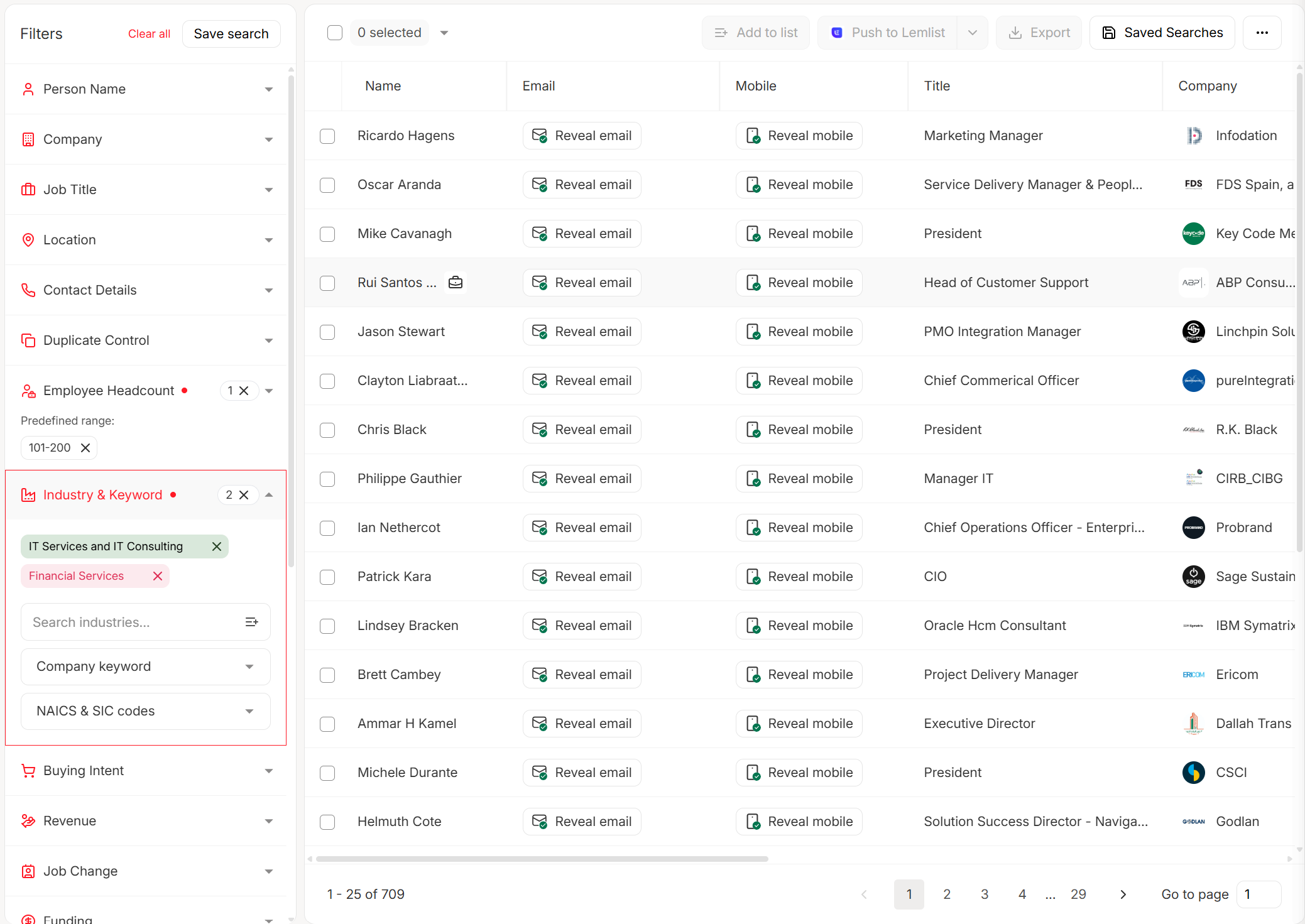
Data quality is now a management responsibility, not an ops afterthought. Prospeo makes enforcement automatic - 98% email accuracy, 125M+ verified mobile numbers, and a 7-day refresh cycle that keeps CRM data current while the industry average sits at 6 weeks. When your reps work clean lists, every coaching session, pipeline review, and forecast is built on a foundation that actually holds.
Pipeline inspection is meaningless when half your contacts are outdated. Prospeo refreshes every record on a 7-day cycle - not the 6-week industry average - so your forecast reflects reality and your reps spend that 25% selling time on live opportunities.
Give your pipeline the data discipline it deserves.
Remote and Hybrid Team Management
Hybrid and remote work eliminated the hallway conversation, the overheard objection handling, the casual "hey, how'd that call go?" that used to drive informal learning. For sales managers, structured coaching isn't optional anymore - it's the only coaching channel that exists.
Schedule video 1:1s at the same time every week - consistency matters more than duration. Use async call reviews through tools like Gong or Chorus so reps get feedback without waiting for the next live session. Virtual ride-alongs, where you silently observe a Zoom discovery call and debrief afterward, replace the desk-side coaching that disappeared with the office.
The neuroscience research on AI vs. human coaching points to a practical split for remote teams. AI coaching excels at deal mechanics - call scoring, email optimization, next-best-action recommendations. Human coaching excels at motivation, confidence, and the emotional resilience that gets reps through a tough quarter. The best remote managers use both deliberately: AI tools for the tactical layer, live 1:1s for the human layer. Neither replaces the other.
Common Mistakes to Avoid
| Mistake | Why It Hurts | The Fix |
|---|---|---|
| Assuming everyone works like you | One playbook doesn't fit all | Measure KPIs weekly, coach to individual gaps |
| Hiring on experience alone | Tenure ≠ performance | Assess coachability and curiosity in interviews |
| Delaying necessary firings | Drags morale; sets a low bar | Set clear 30/60/90 benchmarks; act when missed |
| Relying on activity over results | Masks real problems | Track conversion rates alongside volume |
| Micromanaging instead of leading | Kills trust and doesn't scale | Set guardrails, inspect pipeline not people |
| Neglecting continuous development | Skills atrophy; markets shift | Weekly coaching + quarterly skill assessments |
| Ignoring data and tech quality | Bad data poisons every decision | Own your team's data quality and tool stack |
Real talk: the most common mistake on this list is the first one. Managers who were top reps default to coaching everyone the way they sold. It doesn't work. The rep who needs help with discovery isn't the same as the rep who can't negotiate. Individualized coaching is harder, but it's the only kind that moves numbers.
How to Develop These Skills
Certifications are supplementary. Your reps don't care about your letters - they care whether you can help them close. That said, structured programs accelerate the learning curve, especially for first-time managers making the jump from individual contributor.
| Certification | Provider | Prerequisites | Est. Cost |
|---|---|---|---|
| CPSL | NASP | 3+ yrs leadership, exam | $1,500-$3,000 |
| CSLP | Sales Mgmt Association | Membership + coursework | $800-$2,000 |
| Strategic Sales Mgmt | AMA | None | $2,000-$3,500 |
| Sales Manager Cert | Sandler Training | None | $1,500-$5,000 |
| Sales Manager Cert | RAIN Group | None | $1,000-$3,000 |
| CSE | SMEI | Experience + exam | $500-$1,500 |
The best development path combines formal training with deliberate practice. Pick one framework - PAUSE is a strong starting point - run it for 90 days, and measure the impact on rep performance. Then layer in operational skills like forecasting, territory design, and KPI cadence as you build confidence in the coaching foundation.
FAQ
What's the most important sales management skill?
Coaching. Reps who receive weekly coaching hit quota 25% more often and close 30% more deals. The PAUSE framework gives new managers a repeatable model. Everything else works better when coaching is the foundation.
How do you transition from top rep to sales manager?
Recognize that selling and managing require entirely different competencies. Start by learning a coaching framework, establishing a weekly 1:1 cadence, and resisting the urge to close deals for your reps. Pipeline inspection, hiring judgment, and structured communication will matter far more than your personal close rate.
What tools do sales managers need in 2026?
A CRM like Salesforce or HubSpot for pipeline visibility, a conversation intelligence platform like Gong for call review, and a verified data source like Prospeo to ensure reps work clean prospect lists with 98% email accuracy. AI coaching agents are gaining traction too - 36% of sales teams with agents already use them for rep development.
How much does it cost to replace a sales rep?
Roughly 0.5x to 1.5x base salary - often up to ~$195,000 per rep when you factor in recruiting, onboarding, and lost productivity. With average seller turnover around 35%, investing in coaching and structured onboarding is significantly cheaper than replacing talent.