

Sales Motion Meaning: What It Is, Why It Matters, and How to Choose Yours
A RevOps lead we know spent six months "building a sales motion" that was really just a spreadsheet of call scripts and a prayer. The pipeline stayed flat. The problem wasn't effort - nobody on the team could pin down what a sales motion actually meant, let alone design one that matched their deal size and buyer journey.
Let's fix that.
The Definition That Actually Helps
A sales motion is the repeatable path your team takes to find, engage, and close buyers. Dock defines it well: "the path a sales team takes to reach prospects, move them through the sales cycle, and close deals."
But it isn't a document in your Google Drive. It's the living combination of your sales process, methodology, roles, tools, and measurement - all working as a system. Your process tells reps what to do. Your methodology tells them how to think. The motion is the machine connecting both to actual pipeline.
A motion only exists when it's repeatable. If every deal follows a different path, you don't have a motion. You have improvisation. And improvisation doesn't scale.
What You Need (Quick Version)
Most companies don't have a sales motion. They have a sales habit - whatever worked last quarter, repeated without examination. If your average deal is under $5K, start with product-led or self-serve. Between $5K and $25K, go hybrid. Above $25K, invest in sales-led. The rest of this article gives you the benchmarks, decision framework, and failure modes to get it right.
Motion vs. Process vs. Play vs. Methodology
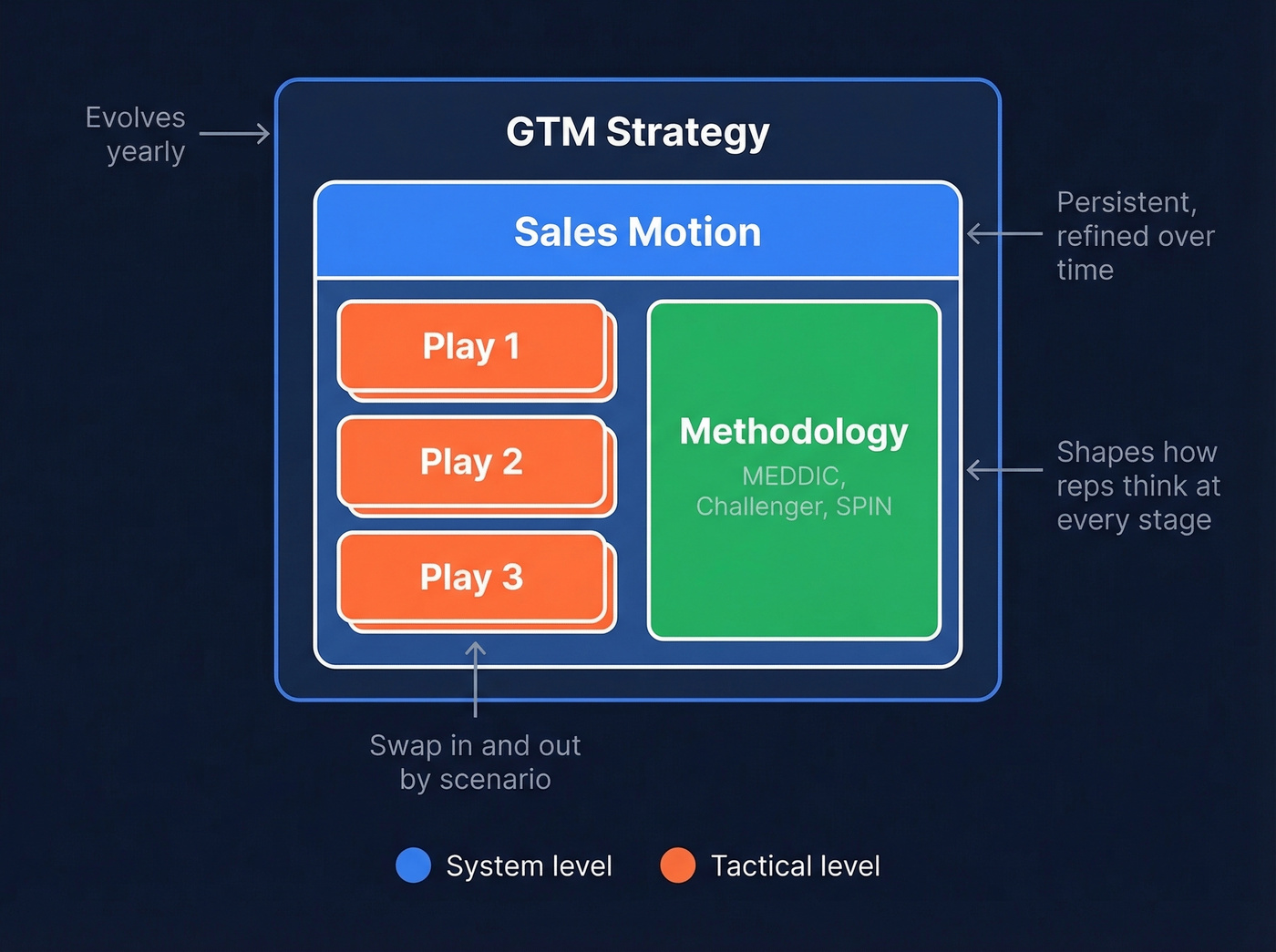
These terms get used interchangeably, and it causes real confusion. They're nested layers, not synonyms.
| Concept | What It Is | Persistence | Example |
|---|---|---|---|
| GTM Strategy | Full go-to-market plan | Evolves yearly | "Land mid-market SaaS" |
| Sales Motion | Repeatable selling system | Persistent, refined | Outbound + demo + close |
| Sales Play | Scenario-specific tactic | Changes by situation | "Win-back churned accounts" |
| Methodology | Principles for selling | Persistent framework | MEDDIC, Challenger, Sandler |
Your GTM strategy sits at the top. Your sales motion operationalizes the sales piece of that strategy. Sales plays are tactical actions) nested inside the motion - they change by scenario. Methodologies like MEDDIC, Sandler, or SPIN run parallel, shaping how reps think and qualify at every stage.
A useful way to think about it: you might pair Challenger selling with your outbound motion's discovery calls, then switch to SPIN for closing conversations - the methodology flexes even as the motion stays constant. The key distinction is that a motion is persistent and repeatable. Plays swap in and out. You could run the same outbound motion for two years while cycling through dozens of plays within it.
Types of Sales Motions
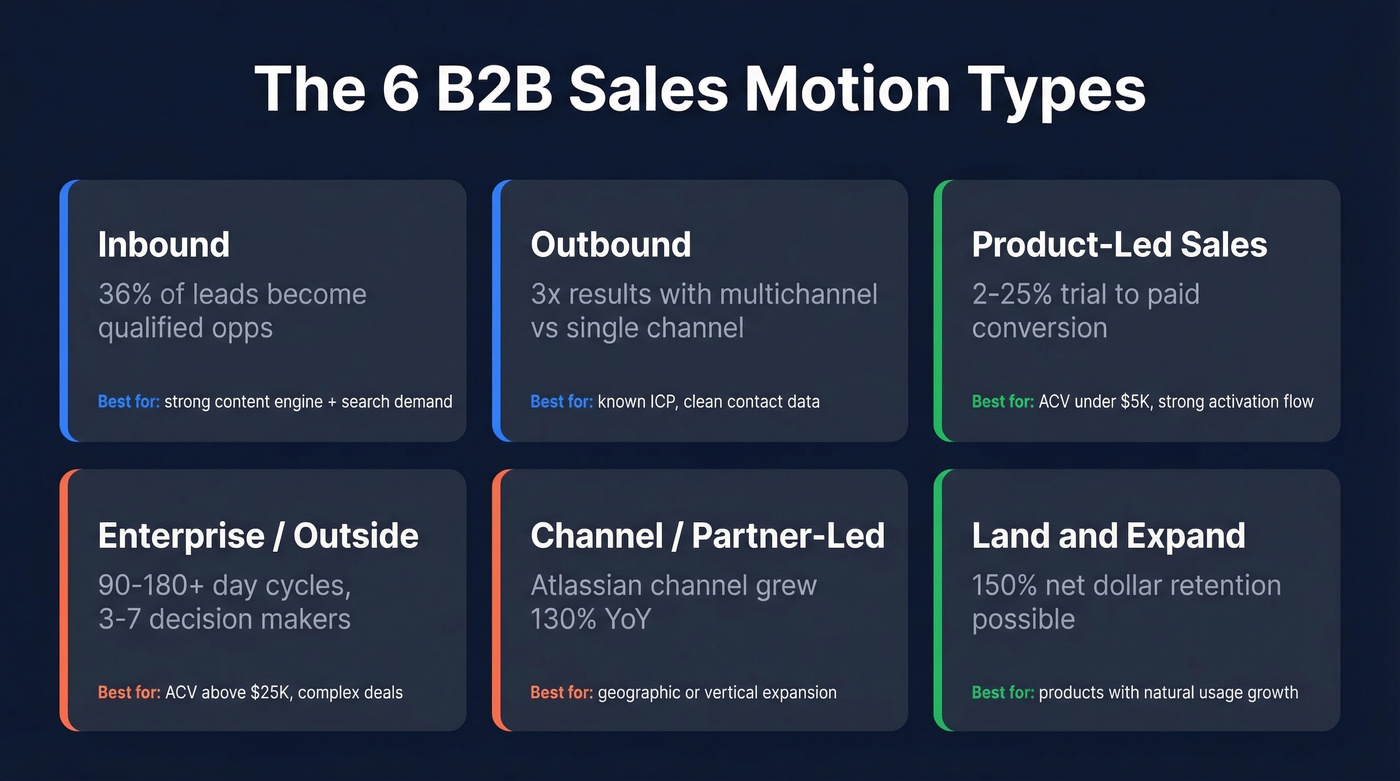
Six motion types cover the vast majority of B2B selling. Most companies run one or two.
Inbound
Marketing generates demand, leads raise their hands, sales works the qualified ones. HubSpot built a massive business on this model. The challenge is volume and quality - roughly 36% of leads become qualified opportunities, so your team spends real time sorting signal from noise. Inbound works best when your content engine is strong and your category has established search demand. Without both, you're waiting by the phone.
Outbound
Reps go find buyers instead of waiting. Here's what that looks like in practice: an SDR on r/sales shared that they booked 7 demos from roughly 58 calls in a single day doing warm outbound in B2B SaaS, then handed those demos to an AE. That's a clean assembly line - call blitz, filter junk, book demos, hand off to the closer.
Multichannel sequences (email + phone + social) generate roughly 3x the results of single-channel outreach. But an outbound motion lives or dies on data quality. If a third of your emails bounce, the motion is broken before your first call. We've seen teams rebuild their entire outbound motion only to discover the real problem was stale contact data - not the messaging, not the cadence, not the reps. Fix the data layer first.
Product-Led Sales
Users find value in the product first, then sales converts them to a paid or higher tier. 91% of SaaS companies plan to increase PLG investment, and Figma shows why: 4M+ users, 100% YoY growth from $200M to $400M ARR, and 150% net dollar retention. Teams identify product behaviors correlated with upgrade intent, flag product-qualified leads, and route them to sales.
Trial-to-paid conversion runs 2% to 25% depending on activation quality. Sales cycles average 40-84 days and can stretch to 170 for larger deals. PLG is fast but fragile - if your activation flow is weak, the whole motion collapses.
Enterprise / Outside Sales
Skip this if your average contract value is under $25K. The economics won't support it. Enterprise motions mean 90 to 180+ day cycles, buying committees of 3-7 decision-makers, and deep discovery. MEDDIC is the common qualifying methodology across these deals. Expensive to operate, but the deal sizes justify it.
Channel / Partner-Led
Atlassian reached almost $3B in ARR, and its channel sales in Q2 2022 grew 130% YoY by selling through partners instead of direct reps. This motion fits when you're expanding geographically or into verticals where partners already have relationships you'd spend years building. The tradeoff: you give up margin and direct customer relationships for speed and reach.
Land-and-Expand
Win small, grow big. Figma's 150% net dollar retention shows what's possible when expansion revenue becomes your primary growth lever. This requires a product that naturally creates more value as usage grows - and a CS team that spots expansion signals early.
If your product doesn't have a natural expansion path, don't force this motion.

You read it above: outbound motions live or die on data quality. If a third of your emails bounce, the motion is broken before your first call. Prospeo delivers 98% email accuracy with a 7-day refresh cycle - so your reps spend time selling, not chasing dead contacts.
Stop rebuilding your motion when the real problem is stale data.
How to Choose the Right Motion
| ACV Range | Recommended Motion | Why |
|---|---|---|
| Under $5K | Self-serve / PLG | Can't afford sales touch |
| $5K-$25K | Hybrid (PLG + sales) | Sales-assisted expansion |
| Above $25K | Sales-led | Complexity demands it |
| Complex committee | Sales-led (any ACV) | Multiple stakeholders |
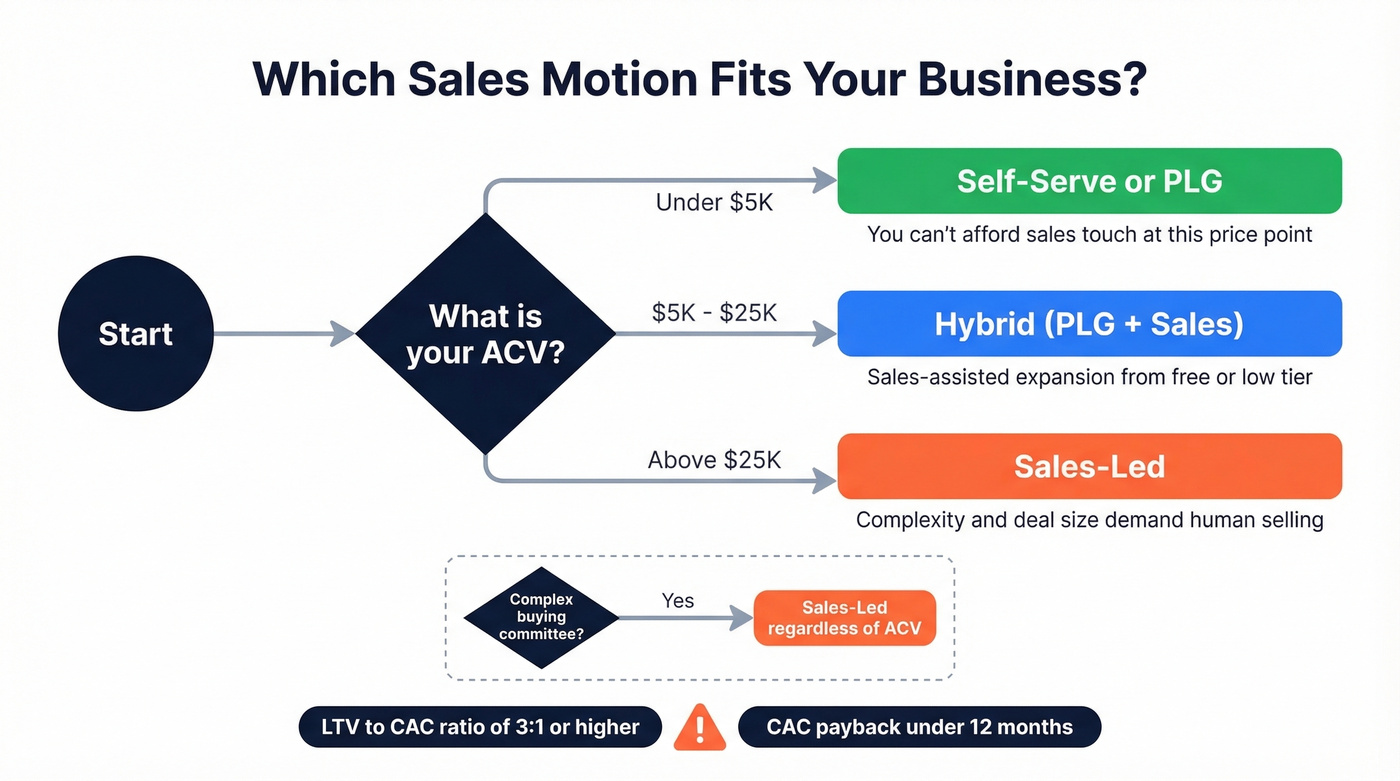
Two unit economics guardrails matter more than anything else: target an LTV:CAC ratio of at least 3:1, and keep CAC payback under 12 months. Companies now spend $2 in sales and marketing for every $1 of new ARR - a ratio that climbed 14% since 2024. If you're violating either guardrail, your motion has a structural problem regardless of type.
One heuristic that circulates heavily on r/sales: don't hire inside sales reps unless your ACV is at least $3K. Below that, the math doesn't work. A rep costs ~$15K/month fully loaded and needs to generate roughly $60K/month in bookings once ramped to justify the seat.
Here's the thing: most teams agonize over which motion to pick when they should be agonizing over whether they've actually validated one. You need one motion that works before you need two. Master a single motion until it's repeatable and profitable. Only add a second when the first generates predictable pipeline and you have the team to staff both.
How to Build a Sales Motion
The WorkLife VC founder framework lays out the clearest stage-gate model we've seen for building a motion from scratch:
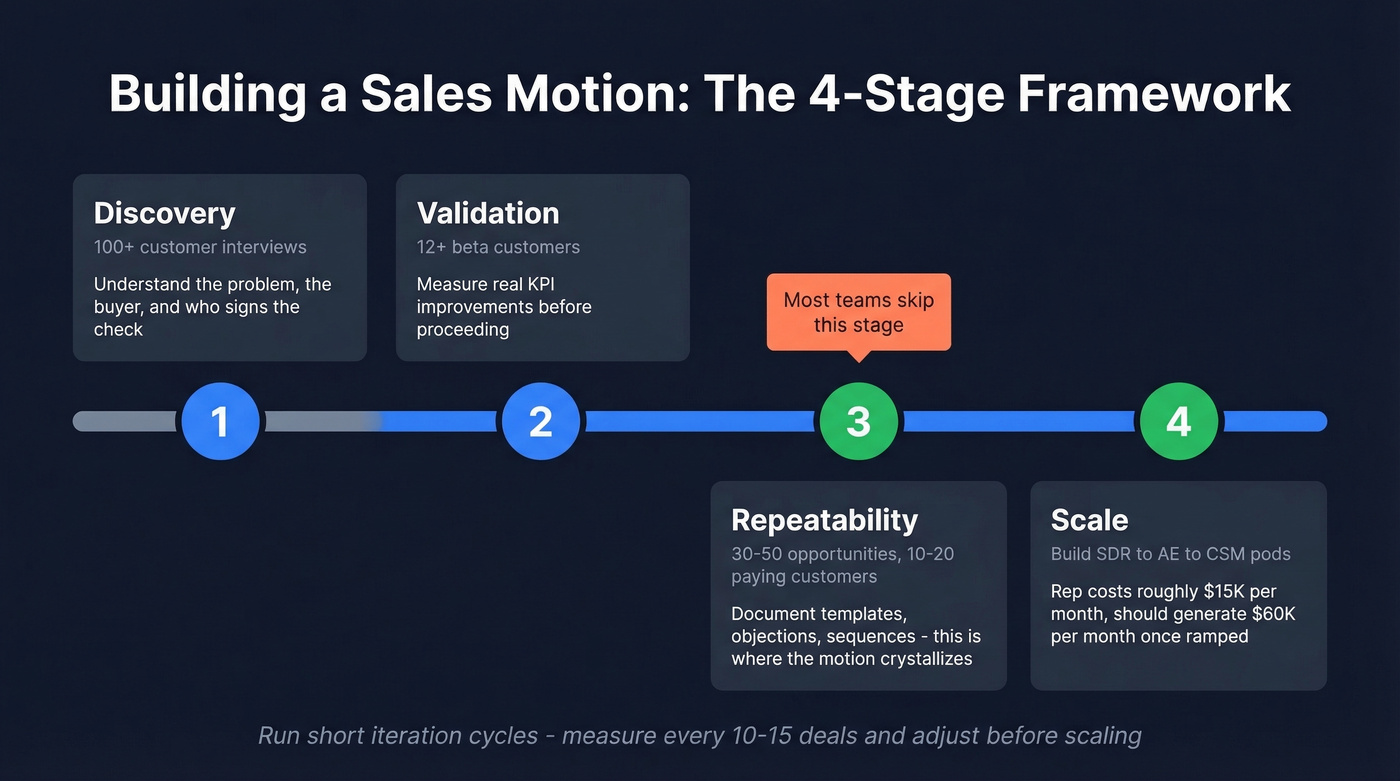
Discovery. Conduct 100+ customer interviews. Understand the problem, the buying process, and who actually signs the check. This isn't optional - it's the foundation everything else sits on.
Validation. Get 12+ beta customers and measure real KPI improvements. If you can't prove value with a dozen accounts, you aren't ready for a motion.
Repeatability. Run 30-50 sales opportunities. Close 10-20 paying customers. Document everything - templates, objection handling, decks, email sequences. This is where the motion crystallizes, and it's the stage most teams skip because it feels slow. It's supposed to feel slow.
Scale. Build pods (SDR to AE to CSM) and start replicating. A rep costs ~$15K/month and should generate ~$60K/month in bookings once ramped. Poor onboarding stretches ramp from 3 months to 6+, burning $45K-$90K before you see returns.
Adopt an agile mindset throughout: run short iteration cycles, measure what's working after every 10-15 deals, and adjust the motion before scaling something that's broken.
Mistakes That Break a Sales Motion
We've seen these patterns kill otherwise solid motions:
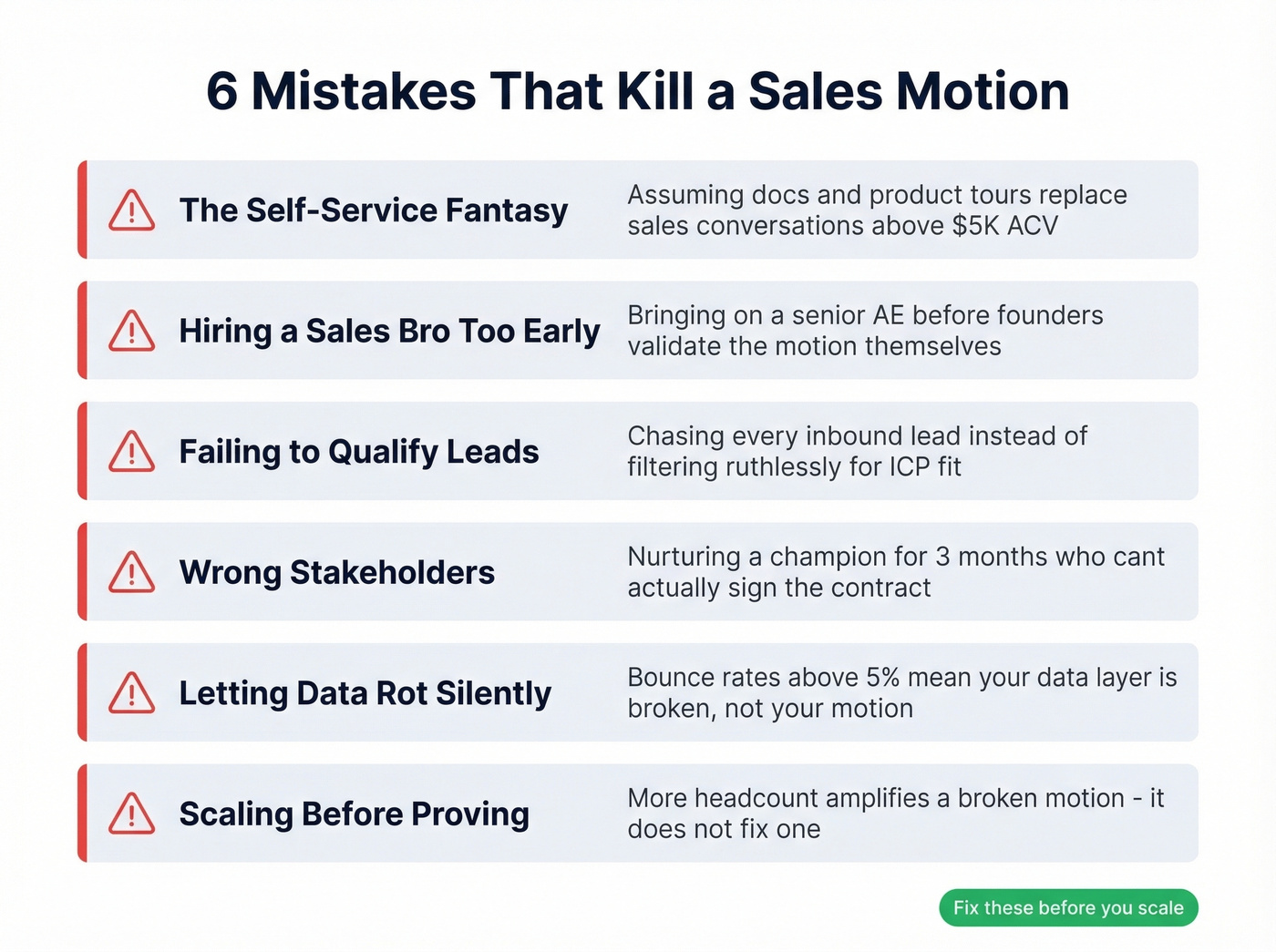
The self-service fantasy. Assuming documentation and product tours replace sales conversations. They don't - especially above $5K ACV. Someone still has to sell.
Hiring a "sales bro" too early. Bringing on a senior AE before you've validated the motion yourself means 12 months of burn with minimal revenue. Founders need to sell first. I know that's uncomfortable. Do it anyway.
Failing to qualify leads. Reps chasing every inbound lead instead of ruthlessly filtering for ICP fit. This is the fastest way to destroy pipeline velocity, and it's the most common mistake we see in early-stage teams.
Speaking to the wrong stakeholders. Spending three months nurturing a champion who can't sign the contract. With 3-7 decision-makers per B2B deal, multi-threading isn't optional - it's survival.
Letting data rot silently. Your motion might be sound while the contact data powering it has gone stale. If bounce rates creep above 5%, fix the data layer before you redesign the motion. Prospeo's 7-day data refresh cycle exists precisely because this problem is so common - most providers refresh every six weeks, and a lot can change in six weeks.
Scaling before the motion is proven. Companies in hyper-growth mode often throw reps at a pipeline problem before the underlying motion is repeatable. More headcount amplifies a broken motion. It doesn't fix one.
Stop reading about sales motions and go run 50 sales conversations. That's where the motion actually gets built.
Tools That Power a Sales Motion
Your motion is only as good as your data and tooling. Here's what the stack looks like at each layer.
CRM: HubSpot Sales Hub paid plans start around $20-$25/user/month. Salesforce Sales Cloud runs about $25-$330/user/month depending on edition. For teams under 20 reps, HubSpot is usually the right call.
Sales engagement: Outreach or Salesloft, typically $100-$200+/month per seat. These orchestrate the sequences your motion runs on. Lighter alternatives like Instantly or Lemlist work well for smaller teams running outbound at lower volume.
Prospecting data: Prospeo covers 300M+ professional profiles with 143M+ verified emails, 98% email accuracy, and 125M+ verified mobile numbers on a 7-day refresh cycle. Free tier included, paid plans run about ~$0.01/email with no contracts. For enterprise teams with bigger budgets, ZoomInfo runs $15-40K/year but includes features most mid-market teams won't touch. If you're comparing options, start with data enrichment and sales prospecting databases before you lock your stack.
Whether you're running inbound, outbound, or hybrid - every sales motion needs verified contact data to convert pipeline. Prospeo gives you 300M+ profiles, 30+ filters including buyer intent and technographics, and 125M+ verified mobiles with a 30% pickup rate. All at $0.01 per email.
Build your motion on data that actually connects reps to real buyers.
FAQ
What does sales motion mean in practice?
A sales motion is the repeatable system your team uses to find, engage, and close buyers - combining process, methodology, roles, and tools into a single operating model. If every deal follows a different path, you don't have a motion yet. The test is simple: can a new rep follow the same path and produce similar results?
How many motions should a company run?
Start with one. Master it until it's repeatable and profitable - LTV:CAC of at least 3:1, CAC payback under 12 months. Only add a second motion when the first generates predictable pipeline and you have the headcount to staff both without diluting either.
When should you change your sales motion?
When your ACV shifts significantly, your ICP changes, or your current motion's unit economics stop working. CAC payback exceeding 12 months is a clear red flag. Before overhauling the whole motion, check the infrastructure first - sometimes the contact data powering it has gone stale, not the motion itself.
What tools help run an outbound motion affordably?
Pair a CRM like HubSpot at $20-$25/user/month with a verified data provider and a sequencing tool like Instantly or Lemlist for multichannel execution. That gives you a full outbound stack under $200/month - enough to validate a motion before investing in heavier tooling.