

Best Sales Operations Tools for 2026: A Practitioner's Buying Guide
Sales reps spend 12 hours per week chasing data trapped in disconnected systems. Enterprise companies run nearly 300 SaaS tools on average, yet reps still spend 16% of their workday actually talking to customers. Roughly 30% of email addresses decay within a year, and data silos cost organizations 20-30% of annual revenue.
The fix isn't more sales operations tools - it's the right ones, wired together properly. Teams that invest in advanced sales optimization software see a 14.5% productivity increase and 23% higher win rates. Get the data layer right and everything else compounds. Get it wrong and you're building on sand.
Our Top Sales Ops Picks
| Category | Top Pick | Why | Starting Price |
|---|---|---|---|
| B2B Data & Enrichment | Prospeo | 98% email accuracy, 7-day refresh | Free tier |
| CRM | HubSpot / Salesforce | Best free tier / deepest ecosystem | Free / from ~$25/user/mo |
| Sales Engagement | Outreach | Best multi-threaded sequences | ~$100-$120/user/mo |
| Conversation Intelligence | Gong | Gold standard for call analysis | ~$1,300-$1,600/user/yr + platform fee |
| Forecasting | Clari | Most accurate AI forecasting | ~$820/user/yr |
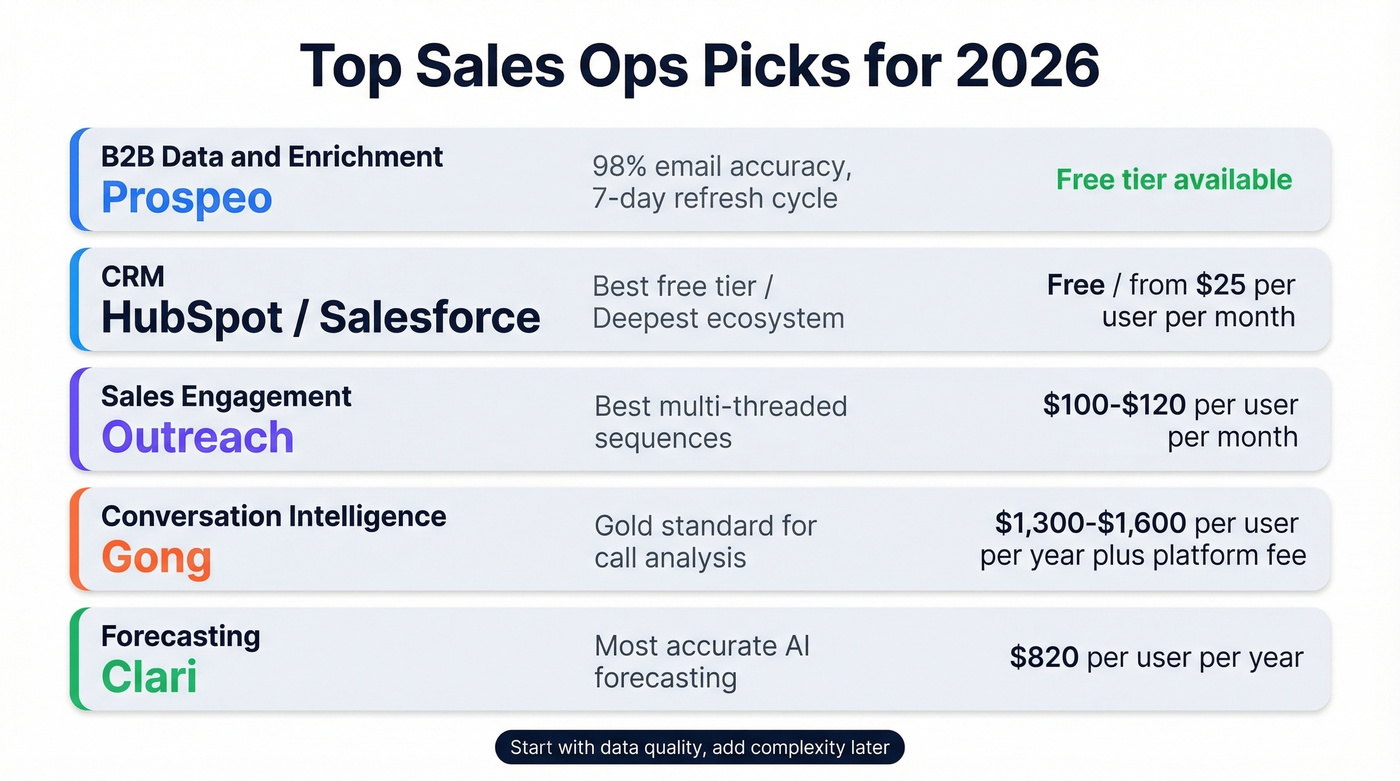
Start with data quality, add complexity later. Every tool on this list depends on accurate contact records and clean CRM data to function.
How AI Is Reshaping the Stack
A year ago, "serious outbound" required someone who could build Clay workflows - waterfall enrichment, conditional logic, multiple data providers, cleaning output, pushing to sequencers. Companies were paying $100K-$130K for GTM engineers at Series A-C companies to do exactly this.
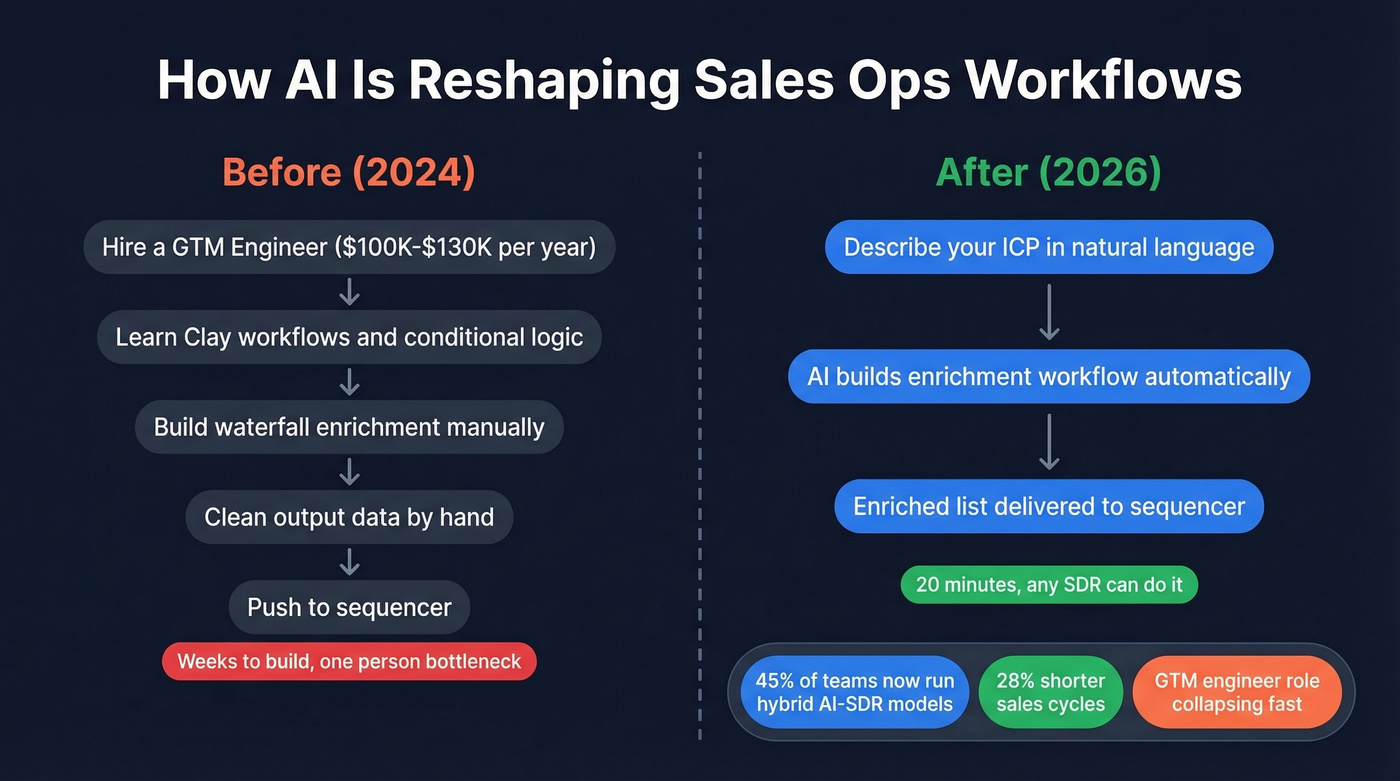
That role is collapsing fast. Clay launched Sculptor, which lets an SDR with zero Clay experience create a working enrichment workflow in about 20 minutes. Tools like Origami, Persana, and Bitscale let users describe their ICP in natural language and get enriched lists without building anything. 45% of teams now run a hybrid AI-SDR model, and early adopters report a 28% reduction in sales cycle length from account intelligence automation.
The strategic work - CRM architecture, governance, process design - remains human and is shifting under RevOps. The workflow-building grunt work that once defined sales execution technology? Getting automated at a pace that should make any GTM engineer nervous.
The 5-Layer Stack Framework
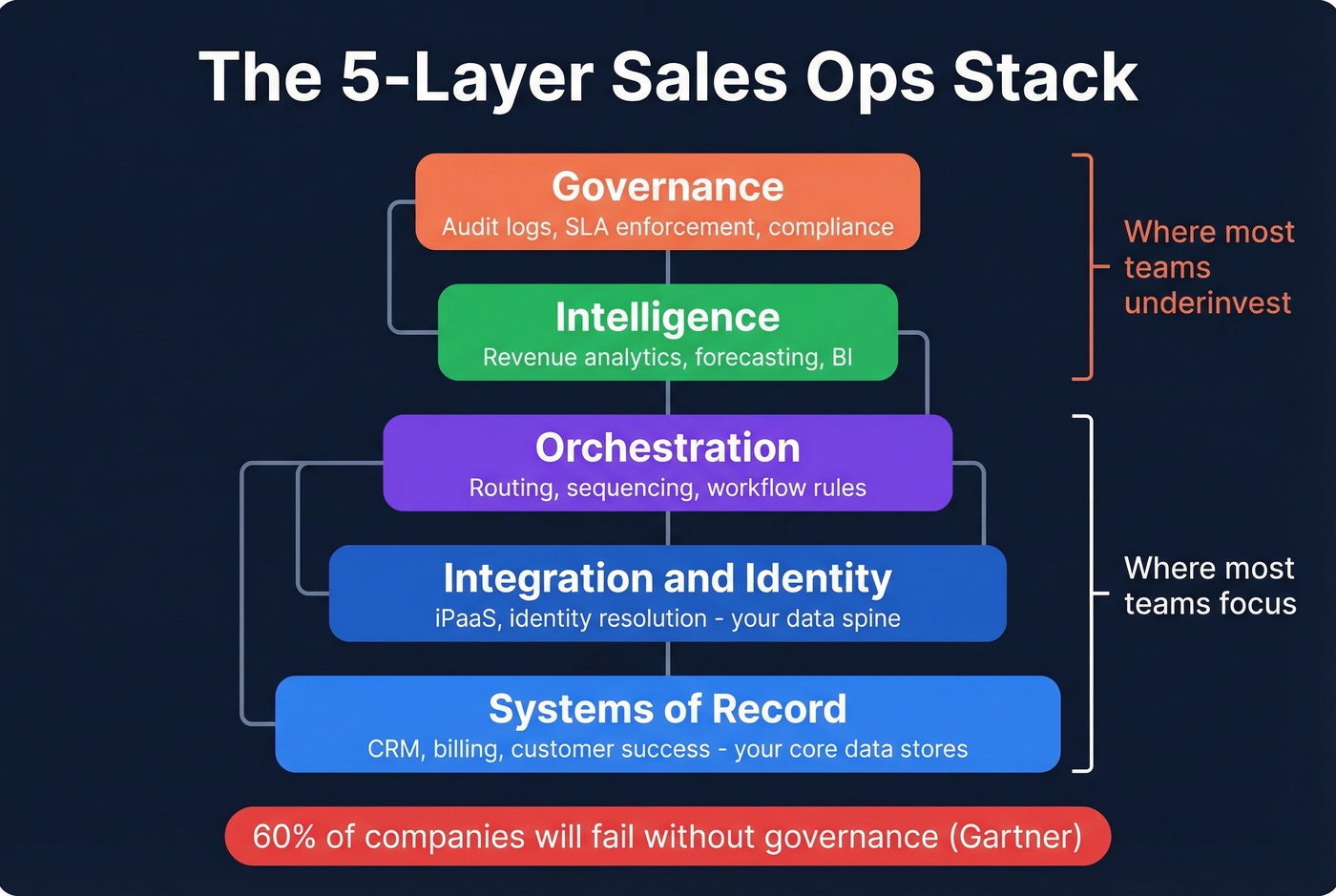
Before picking individual tools, understand where each one sits. A framework from CXToday maps the revenue operations architecture into five layers:
| Layer | Function | Examples |
|---|---|---|
| Systems of Record | Core data stores | CRM, billing, CS |
| Integration & Identity | Data spine | iPaaS, identity resolution |
| Orchestration | Workflow rules | Routing, sequencing |
| Intelligence | Insights & forecasting | Revenue analytics, BI |
| Governance | Controls & compliance | Audit logs, SLA enforcement |
The integration layer is where most teams underinvest. OpenPhone improved speed-to-lead by 67% just by tightening their integration and routing layer - no new tools, just better wiring between existing ones. Bland AI recovered 80% of previously lost pipeline by adding an orchestration layer on top of their CRM.
Gartner's warning is worth repeating: 60% of companies will fail to build an end-to-end revenue process without governance. Most teams obsess over the first three layers and completely ignore the last two. That's how you end up with a $200K stack that still misses forecast by 20%.

Every tool in your sales ops stack - your sequences, your forecasting, your conversation intelligence - depends on accurate contact data. Prospeo's 7-day refresh cycle keeps records current while competitors let data decay for 6 weeks. At $0.01/email with 98% accuracy, it's the foundation layer that makes the rest of your stack actually work.
Stop building your $200K stack on decaying data.
Best Sales Operations Software by Category
Here's the master pricing table:
| Tool | Category | Starting Price | Contract |
|---|---|---|---|
| Prospeo | Data & Enrichment | Free / ~$0.01/email | No contract |
| ZoomInfo | Data & Intelligence | ~$15,000/yr | Annual |
| Clay | Enrichment Workflows | $149/mo+ | Monthly available |
| Salesforce | CRM | from ~$25/user/mo | Annual |
| HubSpot Sales Hub | CRM | Free (paid from ~$9/user/mo) | Monthly available |
| Outreach | Sales Engagement | ~$100-$120/user/mo | Annual, 5-seat min |
| Salesloft | Sales Engagement | ~$125/user/mo | Annual, 3-seat min |
| Apollo | Data + Engagement | Free / $49/user/mo | Monthly available |
| Gong | Conversation Intel | ~$1,300-$1,600/user/yr + platform fee | 2-3 year |
| Clari | Forecasting | ~$820/user/yr | Annual |
| LeanData | Lead Routing | ~$39/user/mo | Annual |
B2B Data & Enrichment
This is the foundation layer. Get it wrong and every downstream tool - your sequences, your forecasting, your conversation intelligence - runs on bad inputs. We've seen teams spend six figures on Gong and Clari only to realize their pipeline data was garbage because nobody fixed the contact layer first.
Prospeo is where we'd start for any team that cares about data accuracy over feature bloat. The database covers 300M+ professional profiles with 98% verified email accuracy and 125M+ verified mobile numbers that deliver a 30% pickup rate. The 7-day data refresh cycle is the real differentiator - the industry average is six weeks, which means by the time most providers update a record, the person has already changed roles. CRM enrichment returns 50+ data points per contact at a 92% API match rate, and intent data covers 15,000 Bombora topics for in-market buyer signals. The Snyk team saw bounce rates drop from 35-40% to under 5% and AE-sourced pipeline jump 180% after switching. Pricing runs about $0.01 per email with a free tier, no contracts, no sales calls required.

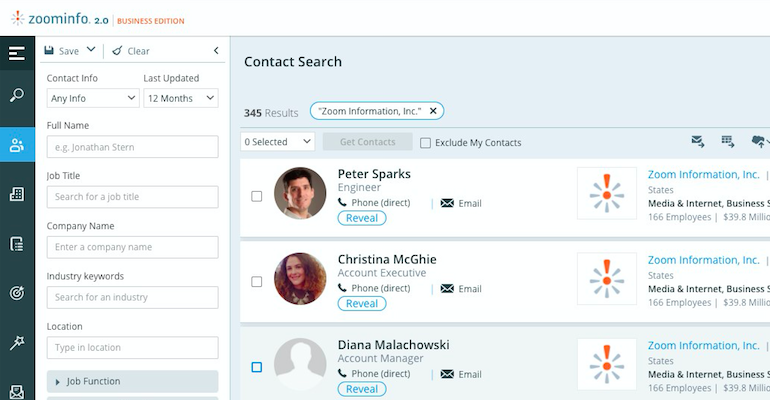
ZoomInfo remains the deepest intelligence suite on the market - intent data, org charts, technographics, website visitor tracking, all in one platform. A 10-seat contract with intent data and mobile numbers runs $15K-$40K+/year, and that's before you add modules. For enterprise teams that need the full GTM platform, it's still the default. For everyone else, you're paying for features you won't activate.
Clay is the darling of r/sales for good reason - it's the best tool for waterfall enrichment workflows, letting you chain multiple data providers and enrich leads through conditional logic. Pricing runs $149/mo+ depending on credit volume. Use Clay if you're building sophisticated enrichment automations. Skip it if you just need clean, verified contact data - that's overkill for a simple use case. (If you're going deep here, follow a step-by-step Clay workflows build.)
Snyk's 50 AEs cut bounce rates from 35-40% to under 5% and grew AE-sourced pipeline 180% - not by adding more tools, but by fixing the data layer. Prospeo's 300M+ profiles, 125M+ verified mobiles, and 15,000 Bombora intent topics give your sales ops stack the clean inputs every downstream tool needs to perform.
Run your stack on data that's refreshed weekly, not monthly.
CRM (System of Record)
The CRM decision is simpler than vendors make it sound. HubSpot Sales Hub has a genuinely useful free tier that's adequate for teams under $5M ARR - contact management, deal pipelines, email tracking, and basic reporting without spending a dollar. Paid plans run from about $9/user/mo up to ~$150/user/mo, with the jump to Professional at around ~$90-$100/user/mo being where most growing teams land. (If you want more options, compare examples of a CRM before you commit.)
Salesforce is the default past $10M ARR, and for good reason - the ecosystem is unmatched. Pricing runs roughly $25-$165/user/mo depending on tier, but the real cost is the dedicated admin you'll need. Budget for that headcount, not just the license. Salesforce without an admin is a very expensive spreadsheet. For a deeper breakdown, see Salesforce pricing.
Pipedrive ($14-$99/user/mo) works well for small sales teams that want pipeline visibility without CRM complexity.
Sales Engagement
Use Outreach if you're running high-volume, multi-threaded sequences with a Salesforce-centric org. It's the strongest platform for granular A/B testing and trigger-based branching. Pricing starts around $100/user/mo with a 5-seat minimum on annual contracts. Deals closed within 50 days hit a 47% win rate versus 20% or lower after that threshold - speed kills in the best possible way. If you're standardizing process, build around sequence management.
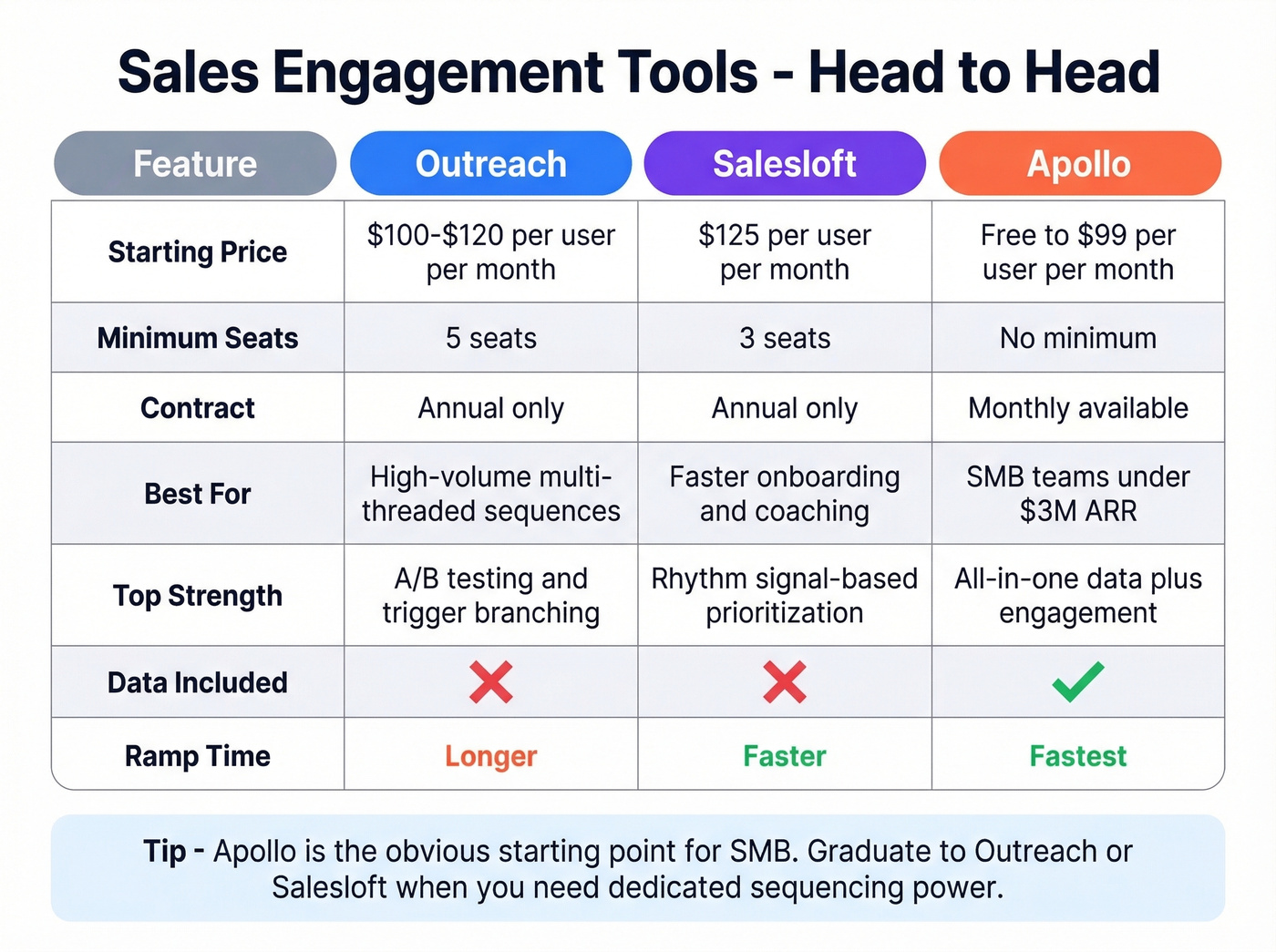
Skip Outreach if you need faster onboarding and stronger coaching visibility - that's where Salesloft wins. Essentials starts at ~$125/user/mo with a 3-seat minimum. Salesloft's Rhythm feature for signal-based prioritization is its strongest differentiator, and the consensus on r/salesengineering is that ramp time is noticeably faster.
Apollo is the budget play that combines data and engagement in one platform. Free tier to $99/user/mo, monthly billing available. It's the obvious starting point for SMB teams that can't justify separate subscriptions. The database isn't as accurate as dedicated providers, but for teams under $3M ARR, the all-in-one value is hard to beat. If you're building on a budget, start with free lead generation tools.
Conversation Intelligence
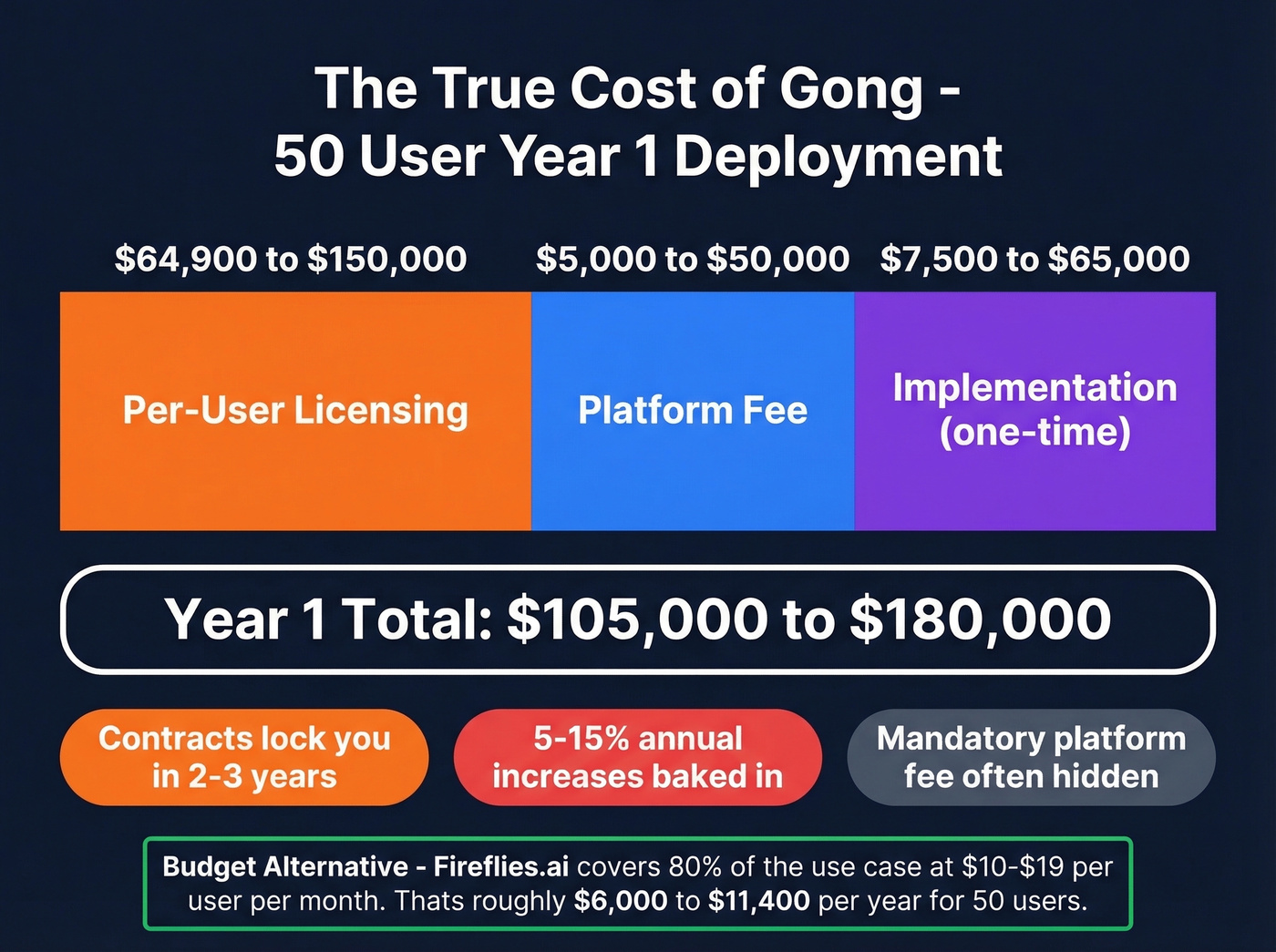
Here's the thing about Gong: it's excellent and absurdly expensive under 50 reps. The pricing has three parts that vendors love to obscure. Per-user licensing runs $1,298-$3,000/user/year for mid-market teams. Then there's a mandatory platform fee of $5,000-$50,000/year. Then implementation at $7,500-$65,000 one-time. A 50-user Year 1 deployment totals $105,000-$180,000. Contracts lock you in for 2-3 years with 5-15% annual increases baked in.

If you have the budget, Gong is the gold standard for call analysis, deal intelligence, and coaching workflows. If you don't, Fireflies.ai ($10-$19/user/mo) covers 80% of the use case - transcription, search, action items - for about 5% of the cost. In our experience, conversation intelligence is often the category that delivers the fastest measurable lift in win rates, so don't skip it entirely just because Gong is pricey.
Forecasting & Revenue Intelligence
Clari Essentials runs about $820/user/year, with Growth at ~$2,105/user/year. A 50-user Copilot deployment with add-ons totals roughly $72,678 annually. Volume discounts kick in at 75+ users.
Most teams don't need Clari until past $20M ARR. HubSpot's built-in forecasting is adequate before that, and the ROI on dedicated forecasting tools only materializes when you have enough pipeline volume and historical data to feed the models. Forecastio is a lighter alternative worth evaluating if you're in that awkward middle stage. If you're comparing vendors, use a dedicated list of sales forecasting solutions.
Let's be honest: if your average deal size is under $15K, you probably don't need anything beyond your CRM's native forecasting. The teams that get the most from Clari are the ones with complex, multi-stage deals where a single missed signal costs six figures. Everyone else is paying for precision they can't act on.
Lead Routing & Orchestration
LeanData removed pricing from its website - always a frustrating signal. Last disclosed per-user rates were $39-$59/user/mo across Standard, Advanced, and Premium tiers. Annual contracts typically land in the $25K-$120K+ range depending on tier and seat count. Budget 15-25% extra for implementation. The platform delivers 95% lead-to-account matching accuracy, which matters enormously once you're running ABM at scale. Skip it under 50 reps - manual routing works fine until then.
Workflow, Enablement & Compensation
These categories matter but are secondary to getting CRM, data, and engagement right.
Zapier (free tier, paid from $19.99/mo) and Make (free tier available) are the glue for connecting everything. Zapier is simpler; Make handles more complex automations at lower cost. Pick one and standardize on it.
For sales enablement, Highspot (~$40-$60/user/mo) is best-in-class for content management and rep coaching. Seismic (custom enterprise pricing, typically $50K+ annually) is Highspot's main competitor for 500+ rep organizations.
On the compensation side, CaptivateIQ (custom pricing, typically mid-five-figures annually for 50+ reps) and Qobra (~$20-$40/user/mo) both solve commission management. CaptivateIQ has deeper enterprise features; Qobra is the leaner European alternative with faster implementation.
Diagnosing Your Stack Before Buying
Most teams don't need a full stack overhaul - they need to fix the one thing that's dragging everything else down. We've watched companies blow $50K on a new engagement platform when the real problem was a 25% bounce rate on their contact data. Use this diagnostic before you buy anything:
| Symptom | Root Cause | Fix First |
|---|---|---|
| Bounce rates above 10% | Stale contact data | Data enrichment layer |
| Forecast missing by 20%+ | No pipeline governance | Clari or CRM forecasting rules |
| Reps booking meetings but deals stalling | No visibility into calls | Gong or Fireflies.ai |
| Leads sitting unworked for 24+ hours | Broken routing | LeanData or CRM automation |
| Reps spending hours on manual research | No enrichment workflow | Clay or API-based enrichment |
| Tech stack over $200K but low adoption | Tool sprawl, no governance | Audit and consolidate |
Recommended Stacks by Stage
| Component | Startup ($0-$5M ARR) | Scale-Up ($5M-$50M) | Enterprise ($50M+) |
|---|---|---|---|
| CRM | HubSpot Free | Salesforce | Salesforce + LeanData |
| Data | Prospeo | Prospeo + Clay | ZoomInfo + Clay |
| Engagement | Apollo | Outreach or Salesloft | Outreach + Highspot |
| Intelligence | Fireflies.ai | Gong + Clari | Full Gong + Clari suite |
| Automation | Zapier | Zapier/Make + Clay | Enterprise iPaaS |
| ~Annual Cost | $3K-$8K | $80K-$200K | $300K+ |
Best-in-class teams at the scale-up and enterprise level hit forecast accuracy in the high 80s to 90s when they combine governed data with AI-driven forecasting. Choosing the right sales ops software at each stage prevents costly rip-and-replace cycles later.
How to Choose the Right Tools
If you're evaluating 10+ tools, you've already lost. Pick one per category, integrate it, move on.
Integration beats features. Evaluate how a tool connects to your CRM before you evaluate its feature list. A brilliant standalone tool that creates data silos is worse than a mediocre one that syncs natively. The companies seeing 34% improvement in qualification accuracy aren't using fancier tools - they're using well-connected ones.
Governance isn't optional. Forecasts missing by 20%+, tech stack sprawl with low adoption, and governance theater without enforcement are the three most common failure modes. If nobody owns data quality and process compliance, no amount of sales operations tools will save you.
Data debt compounds. Every month you run on unverified contact data, your CRM gets dirtier and your engagement metrics get less trustworthy. Fix this first - everything else depends on it.
FAQ
What are sales operations tools?
Sales operations tools are software that automates the systems, data, and workflows supporting a sales team - CRM, data enrichment, engagement sequencing, forecasting, lead routing, conversation intelligence, and compensation management. Together they form the ops stack that keeps revenue teams efficient and accountable.
How much should a sales ops stack cost?
Startups can run a functional stack for $3K-$8K/year using HubSpot Free, and Apollo. Scale-ups typically spend $80K-$200K. Enterprise stacks run $300K+. The biggest cost drivers are conversation intelligence and CRM licensing.
What's the difference between sales ops and RevOps?
Sales ops focuses on the sales team's processes, tools, and data. RevOps spans sales, marketing, and customer success under a unified data model and governance framework. Most companies above $10M ARR are consolidating into RevOps.
Can AI replace sales ops roles?
AI is automating workflow-building and enrichment tasks that used to require $100K+ GTM engineers. Strategic work - CRM architecture, governance, process optimization - remains human and is increasingly owned by RevOps leaders, not automated away.
What's the best free option for small teams?
A combination of HubSpot Free for CRM, Prospeo's free tier for verified contact data, and Apollo's free plan for basic engagement covers the essentials at $0 upfront. Focus on data accuracy and CRM hygiene before investing in paid sales ops software.