

How to Build a Sales Ops Team That Actually Works
A sales ops team exists because salespeople keep getting pulled into work that isn't selling. Sales ops pros now spend 73% of their time supporting non-sales functions, up from 39% in 2019 - and that's exactly why the function gets misunderstood. The most common question we see in community threads and on r/salesoperations is simple: what does sales ops actually do?
Here's the answer: a good operations team buys back selling time and makes the number predictable. A bad one ships process and calls it "enablement."
What You Need (Quick Version)
Hire an analyst before you hire a VP. Start centralized. Track forecast accuracy and rep selling time. Fix CRM data quality before you buy more tools.
What Sales Ops Actually Does
Reps spend 28% of their time actually selling. The rest disappears into CRM updates, internal meetings, and hunting for basic account and contact info that should already be there. It's maddening - and it's the reason this function exists.
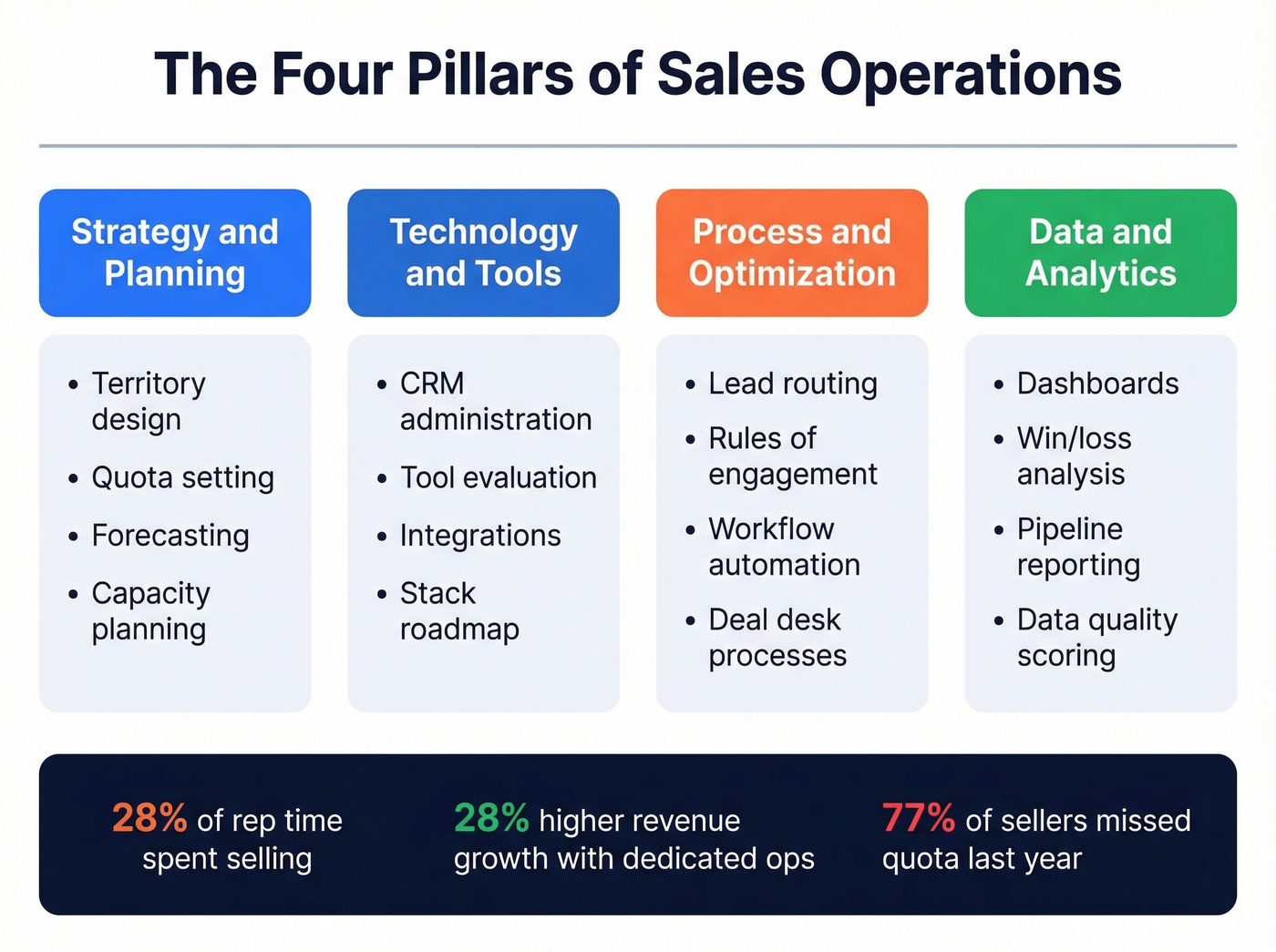
Sales ops is the team that turns that chaos into a system. It usually breaks into four pillars:
| Pillar | What It Covers |
|---|---|
| Strategy & Planning | Territory design, quota setting, forecasting |
| Technology & Tools | CRM admin, tool evaluation, integrations |
| Process & Optimization | Lead routing, rules of engagement, automation |
| Data & Analytics | Dashboards, win/loss analysis, reporting |
Two stats make the case for doing this properly: companies with dedicated sales operations see 28% higher revenue growth, and 89% of sales professionals say the function is critical to growth. Let's be honest - if your team is missing quota, and most are since 77% of sellers missed quota last year, you don't need more "hustle." You need tighter ops.
Sales Ops vs RevOps
Sales ops focuses on sales execution: territories, forecasting, comp operations, CRM hygiene, and pipeline mechanics.
RevOps is the umbrella that aligns marketing, sales, and post-sales so handoffs don't break and revenue doesn't leak. Sales ops is a pillar inside RevOps, not a rival function. Gartner expects 75% of the highest-growth companies to adopt a RevOps model by 2026 (source). If you're not there yet, build a strong sales ops team first - RevOps is harder when your sales foundation is messy.
Sales Ops Team Structure Models
Under 50 reps? Start centralized. Period. We've watched teams try a federated model at ~30 reps and end up with three forecasting methods, five definitions of "qualified," and zero trust in the dashboard.
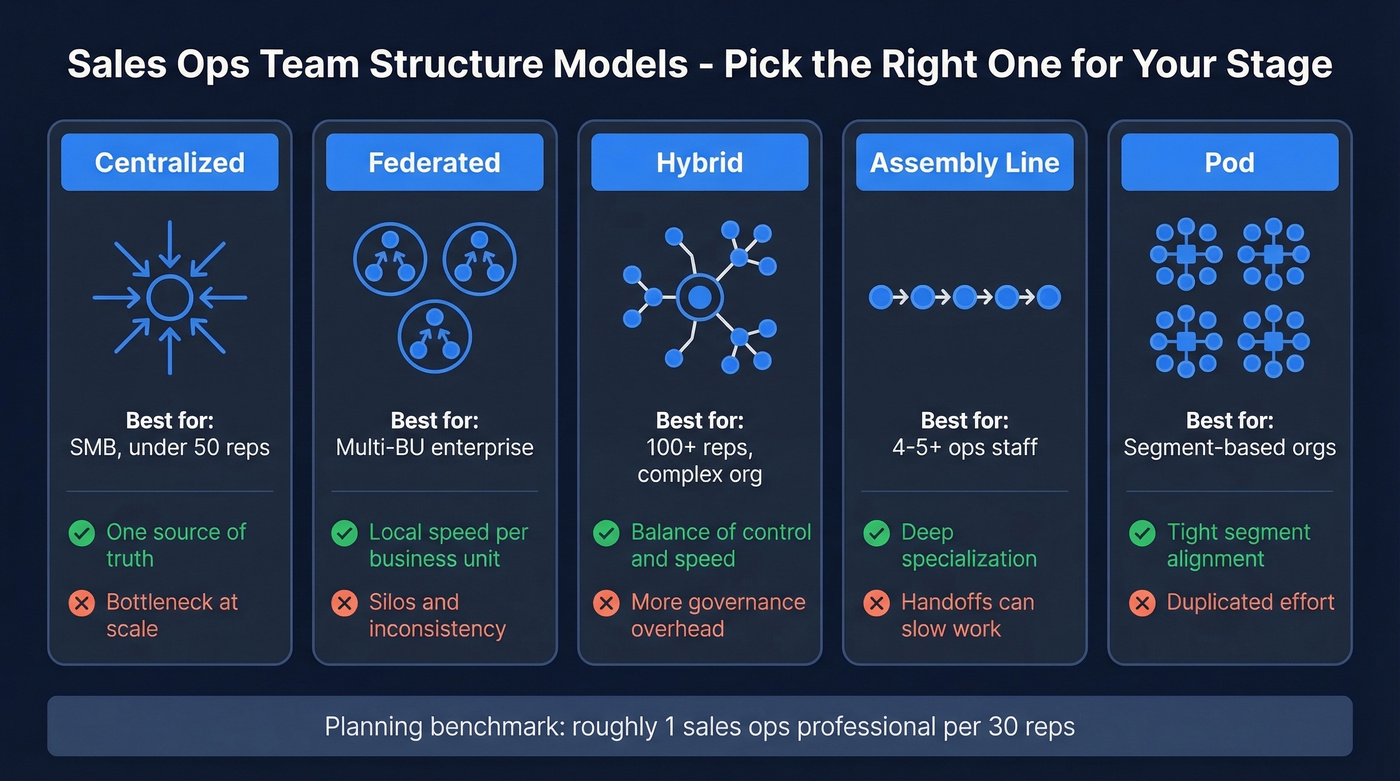
| Model | Strength | Best For | Trade-off |
|---|---|---|---|
| Centralized | One source of truth | SMB, <50 reps | Bottleneck at scale |
| Federated | Local speed per BU | Multi-BU enterprise | Silos + inconsistency |
| Hybrid | Balance of control + speed | 100+ reps, complex org | More governance work |
| Assembly Line | Deep specialization | Teams with 4-5+ ops staff | Handoffs can slow work |
| Pod | Tight segment alignment | Segment-based orgs | Duplicated effort |
A practical staffing benchmark holds up across sizes: ~1 sales ops professional per 30 reps. It's not perfect, but it's a reliable planning number when you're deciding whether to hire ops or "just one more AE."

You just read that only 35% of sales pros trust their data accuracy. That's the problem your sales ops team will inherit on day one. Prospeo returns contact data for 83% of leads with 98% email accuracy on a 7-day refresh cycle - so your ops analyst spends time building dashboards, not cleaning garbage.
Give your sales ops team data that doesn't need babysitting.
Who to Hire First
Most companies hire this backward. They bring in a senior leader before anyone can build clean reporting or fix the data. Building a sales ops team that delivers value quickly means starting with the people who can actually touch the data.
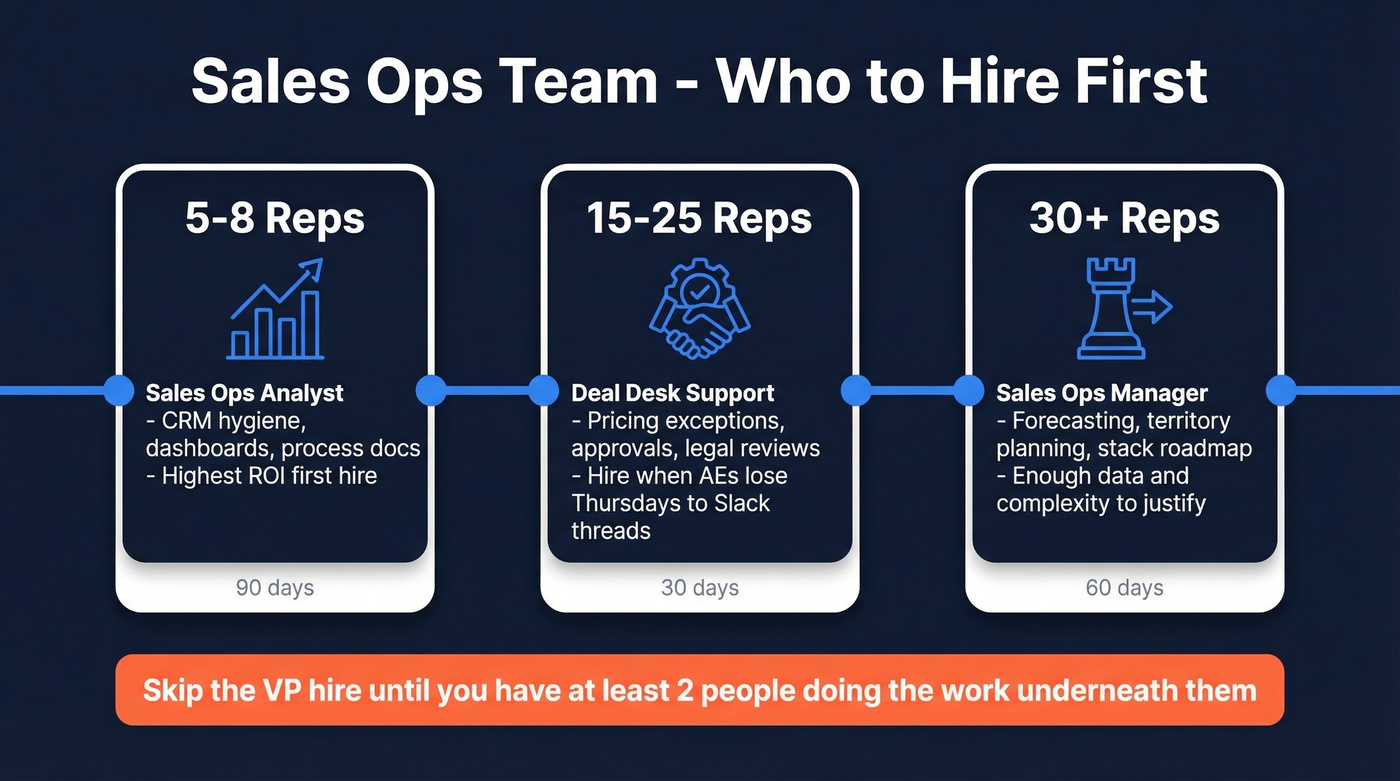
5-8 reps: Hire a sales ops analyst to own CRM hygiene, dashboards, and basic process documentation. This person will create more value in 90 days than a senior hire who needs months to figure out what's broken.
15-25 reps: Add deal desk support when pricing exceptions, approvals, and legal reviews start slowing closes. You'll know it's time because your AEs are spending half their Thursday in Slack threads about non-standard terms.
30+ reps: Bring in a sales ops manager to own forecasting, territory and quota planning, and the stack roadmap. At this point you've got enough data and enough complexity to justify someone whose full-time job is making sense of both.
Skip the VP hire until you have at least two people doing the work underneath them. A VP with no team and no clean data is just an expensive project manager.
Key Roles and KPIs
Sales operations builds the operating system - and it has to be measurable. Harvard Business Review research found that about half of top-performing sales orgs run highly structured, documented sales processes** (HBR). That's not paperwork for its own sake; it's how you scale what works and kill what doesn't.
| Role | Primary KPIs |
|---|---|
| Sales Ops Manager | Forecast accuracy, quota attainment, sales cycle length |
| Sales Ops Analyst | Data quality score, dashboard adoption, insight turnaround |
| CRM Admin | CRM adoption rate, ticket resolution time |
| Deal Desk Analyst | Deal cycle time, discount compliance |
Here's a rule we use internally: every ops role must own at least one metric tied to rep productivity or forecast accuracy. If they can't point to a number they're moving, the role is scoped wrong.
The Sales Ops Tech Stack
The average enterprise runs 897 applications, and only 29% are integrated. That's the mess your operations team inherits - so don't add shiny tools until the basics work together. Only ~35% of sales professionals fully trust their company's data accuracy, which is why "we'll fix it later" always turns into "we can't forecast."
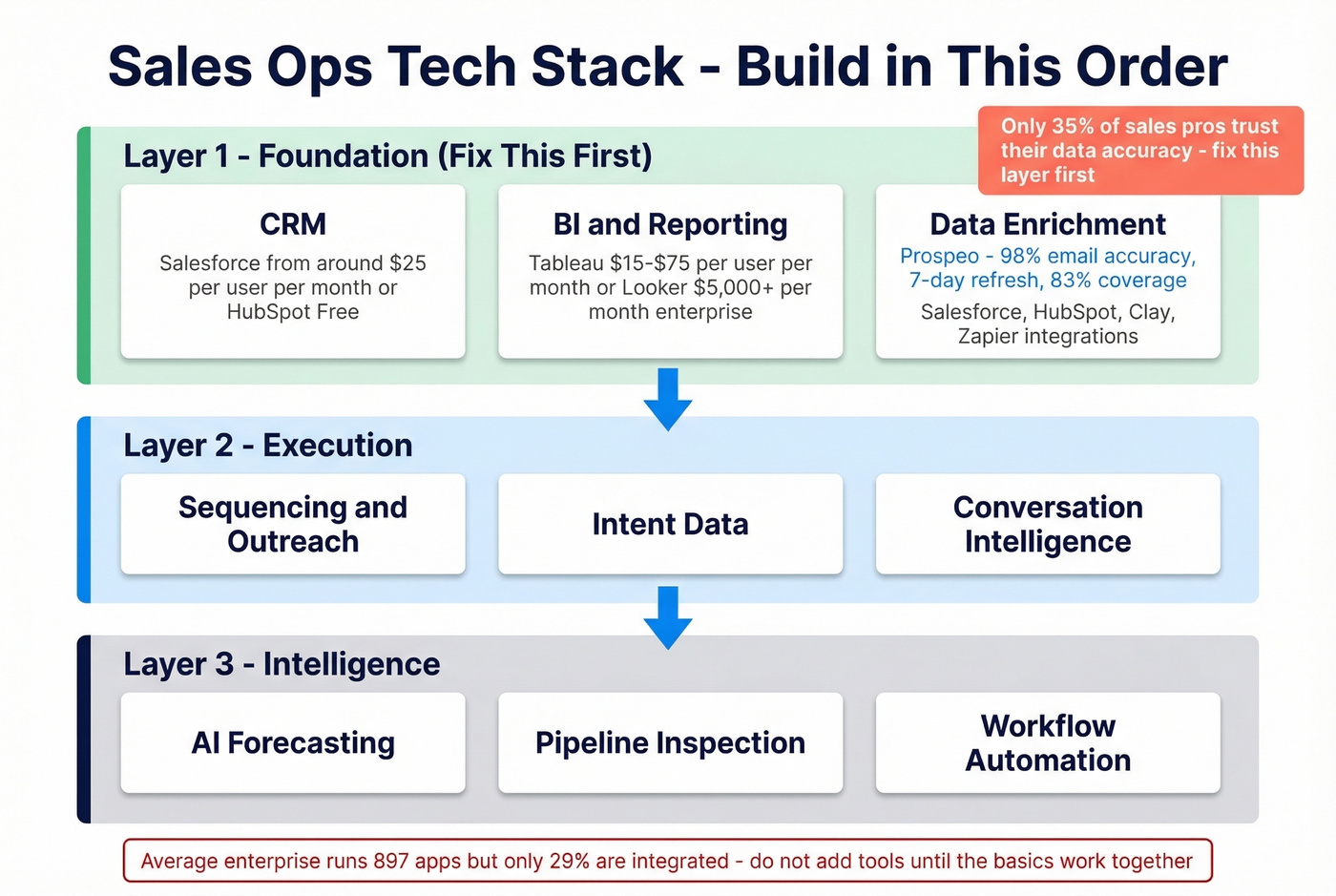
Foundation first:
- CRM: Salesforce (Starter plans run ~$25/user/month) or HubSpot's free CRM tier. Pick one and enforce it.
- BI/Reporting: Tableau typically costs ~$15-$75/user/month depending on edition. For Looker, expect annual contracts - many teams budget ~$5,000+/month for enterprise deployments.
- Data enrichment: This is where most stacks quietly fall apart, because stale contact data poisons everything downstream. Prospeo runs a 7-day refresh cycle with 98% email accuracy and returns contact data for 83% of leads, with native integrations into Salesforce, HubSpot, Clay, and Zapier so your ops analyst can wire it in without engineering help. (If you're comparing vendors, start with a shortlist of data enrichment options.)
Now layer in sequencing, intent, and conversation intelligence - after your CRM and reporting stop lying.
AI in Sales Operations
AI adoption in sales orgs jumped from 24% to 43%, but 74% of companies still aren't getting real value from it. That gap isn't a model problem. It's a data problem.
The first AI project that pays off is boring: standardize fields, fix routing logic, clean duplicates, and lock down definitions. Once your data is trustworthy, AI can help with forecasting signals, pipeline inspection, and rep workflow automation. But if you feed garbage data into a machine learning model, you just get confident garbage back faster. Fix the plumbing first.
Mistakes to Avoid
No charter. If the ops function doesn't have a written scope, everyone treats them like an admin help desk. In our experience, this is the #1 reason ops teams burn out and good analysts quit within 18 months.
Admin overload. Comp disputes and one-off reports will eat the entire week if you don't set intake rules and SLAs. We've seen analysts spend 60% of their time on ad hoc requests that could've been a self-serve dashboard.
Shadow ops. Hiring "helpers" to patch broken workflows is expensive. Fix the workflow first, then staff it.
No documentation. If one person holds the process in their head, you don't have a process - you have a single point of failure. When that person takes PTO, your forecast breaks.
Salaries and Career Path
A US Sales Ops Manager averages ~$106K base and ~$122K total compensation.
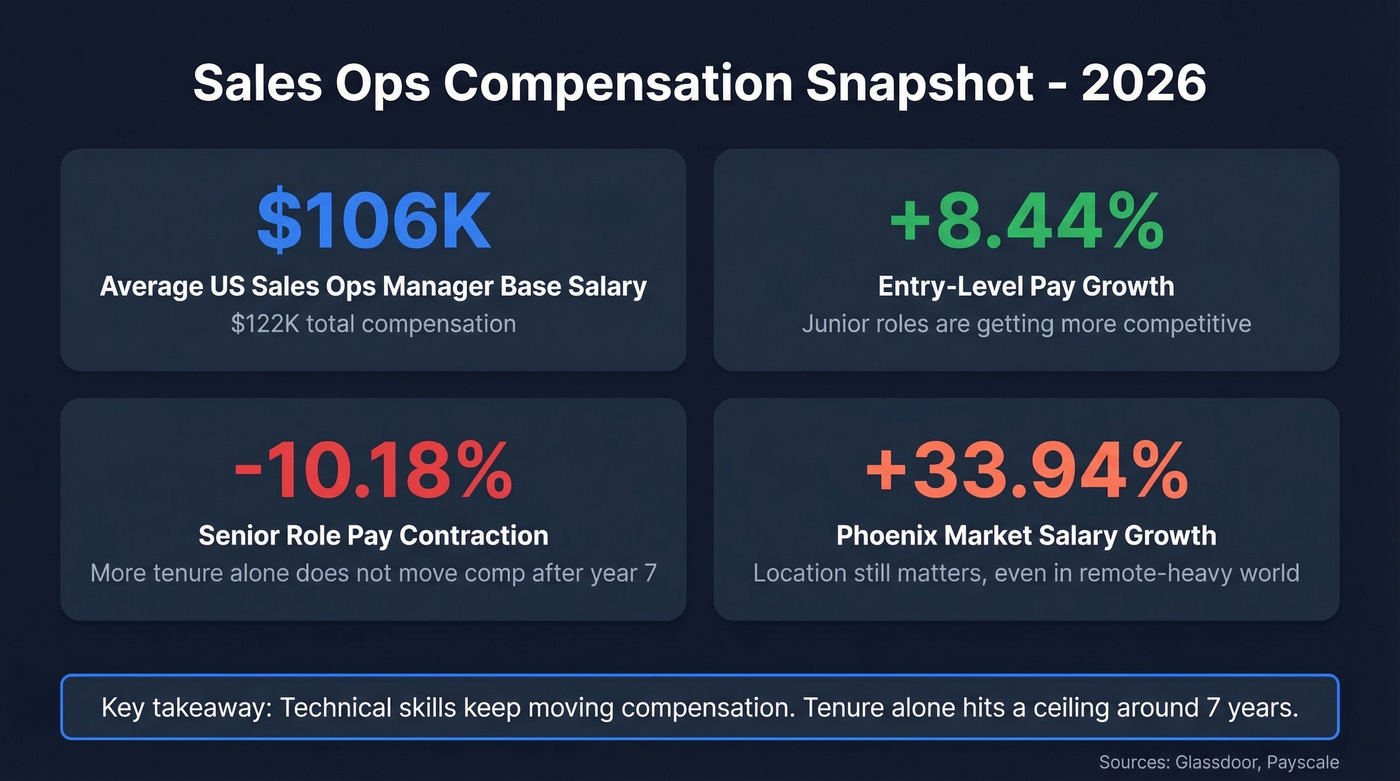
The trend worth watching: entry-level sales ops pay grew 8.44% while senior roles contracted 10.18%. There's also a real ceiling around ~7 years where "more tenure" stops moving comp; technical skills keep moving it. Phoenix was a standout market with 33.94% salary growth - proof that location still matters, even in a remote-heavy world. For the latest benchmarks, Glassdoor and Payscale are solid starting points.
A sales ops team's first job is buying back selling time. Every hour reps spend hunting for contact info is an hour lost. Prospeo integrates natively with Salesforce, HubSpot, Clay, and Zapier - so your ops analyst can wire enrichment into existing workflows without an engineering ticket, at $0.01 per email.
Stop making your ops team apologize for bad contact data.
FAQ
What's the difference between sales ops and sales enablement?
Sales ops builds the system - process, data, tools, forecasting. Sales enablement trains the team - content, coaching, onboarding. If you're choosing one first, ops wins because enablement can't scale on broken data or unreliable pipelines.
How many people does a sales ops team need?
Use 1 ops hire per 30 reps as a planning baseline. Make the first hire around 5-8 reps with an analyst, then add deal desk and management capacity as you introduce segments, regions, or complex deal cycles.
What tools should a sales ops team prioritize?
Start with a CRM, a reporting layer, and a data enrichment platform to keep contact records accurate. Get those three integrated before buying anything else - most "stack problems" are really data quality and workflow problems in disguise.
How is a sales ops team different from RevOps?
Sales ops is a subset of RevOps focused exclusively on sales execution - territories, forecasting, compensation, and CRM hygiene. RevOps spans marketing, sales, and customer success to unify the full revenue cycle. Build strong sales operations first; RevOps alignment follows.