

Sales Outsourcing: What It Costs, When It Works, and When It Doesn't
Your VP of Sales just missed quota for the second straight quarter. The board wants answers. Someone floats the idea of sales outsourcing - hand the top-of-funnel to an agency, let your AEs focus on closing, and buy yourself time to figure out the pipeline problem. It sounds clean. It rarely is.
Outsourcing your sales function can absolutely work. It can also burn $50,000, torch your domain reputation, and leave you worse off than when you started. The difference comes down to timing, data quality, and how you structure the engagement. We've watched this play out dozens of times across our customer base - here's how to get it right.
The Decision Framework (Quick Version)
Before you read another 2,500 words, here's the short answer:
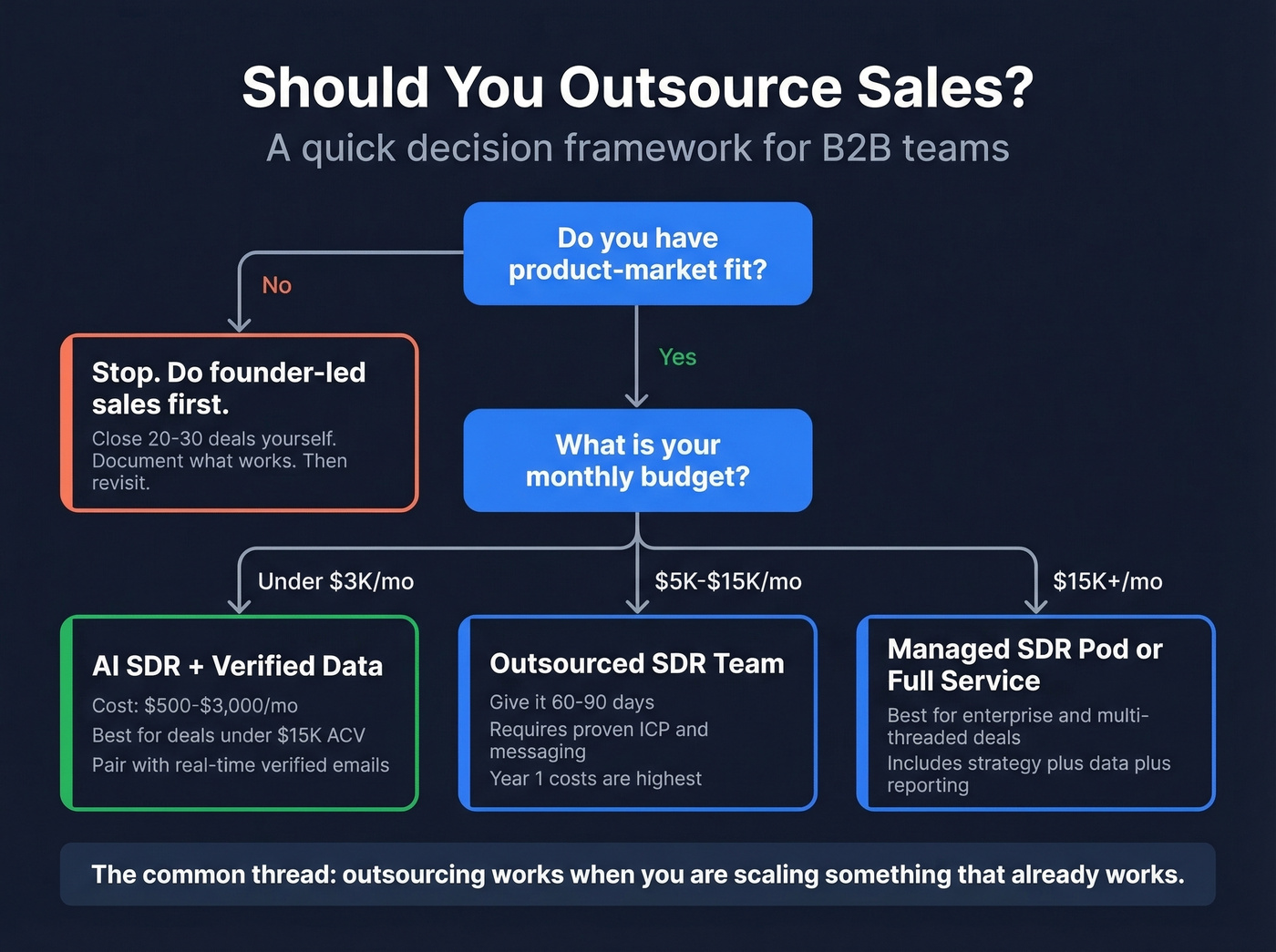
You have product-market fit and a proven ICP. Outsource SDRs to scale. Budget $5K-$15K/month and give it 60-90 days before judging results. Year-one costs are typically the highest - they drop significantly by year two as messaging and targeting sharpen.
You have PMF but limited budget. An AI SDR tool ($500-$3,000/month) paired with a verified data layer at ~$0.01/email can outperform a single outsourced rep at a fraction of the cost. This is the path most Series A teams should explore first.
You're still figuring out your ICP. Don't outsource yet. Do founder-led sales first. Close 20-30 deals yourself. Document what works. An outsourced team amplifies what works - it can't create product-market fit.
What Does Sales Outsourcing Actually Mean?
Outsourcing sales means delegating part or all of your sales process to an external team. The scope varies wildly, and the terminology has gotten muddier as the market has grown. Here's the taxonomy that actually matters:
- Outsourced SDRs - the most common model. An agency provides reps who prospect, qualify, and book meetings for your AEs. You own the close.
- Appointment setting - narrower. The agency books meetings against a target list. Less strategic, more transactional.
- Full-cycle outsourcing - the agency handles everything from prospecting through close. Rare in B2B SaaS, more common in transactional or SMB sales.
- Managed SDR pods - a hybrid where the agency provides reps, management, and tech stack as a bundled service. Think of it as renting a sales team.
- Sales-as-a-service - the broadest label. Usually means a managed pod plus strategy, data, and reporting.
The market looks different in 2026. AI SDR tools have compressed cost per lead by roughly 85%, which means the old model - pay an agency $10K/month for two junior reps making cold calls - is getting squeezed from both sides. Agencies that survive are either moving upmarket into complex, multi-threaded enterprise deals or bundling AI into their workflows. The ones still running 2019 playbooks are the ones you'll regret hiring.
When It Works vs. When It Doesn't
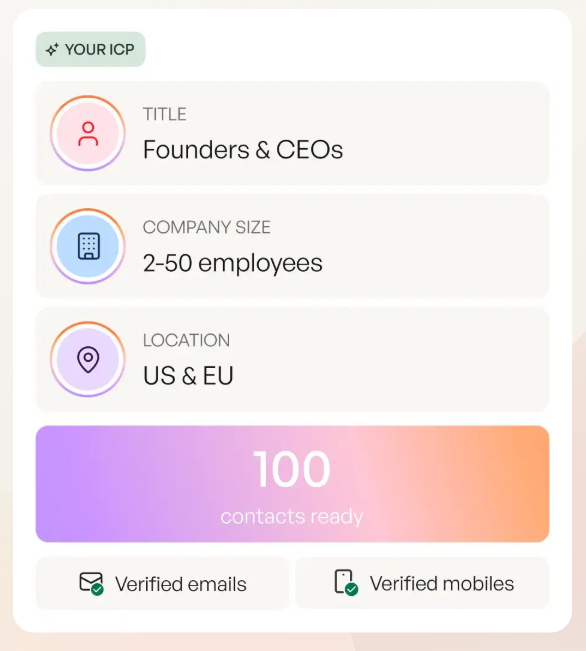
Outsource If...
You've already closed deals through founder-led or early-team sales and can articulate exactly who buys, why they buy, and what the sales cycle looks like.
You need to scale pipeline faster than you can hire. Outsourced teams can be producing in 2-4 weeks versus the 6-month timeline for hiring and ramping an in-house SDR. Or you're entering a new market or geography and need local presence without building a team from scratch. The common thread: outsourcing works when you're scaling something that already works.
Skip It If...
You haven't validated your ICP. You can't explain your value prop in two sentences. Your close rate on founder-led deals is below 10%.
A post on r/LeadGeneration describes exactly this failure mode: an agency "spammed millions of prospects in about 3-6 months," produced 3-4 decent leads, none converted, cost over $10,000, and the founder's domain was blacklisted everywhere. That's not an agency problem - it's a timing problem. The ICP wasn't defined, the offer wasn't compelling, and the agency did what agencies do: send volume.
Here's the thing: outsourcing amplifies what doesn't work just as fast as it amplifies what does. If your messaging is off, an outsourced team will send that bad messaging to 10x more people, 10x faster, and burn your domain in the process. Recovering deliverability takes months. That's a cost nobody puts in the proposal.
How Much Does It Cost?
Pricing by Model
| Model | Monthly Cost | Cost Per Meeting/Lead | Notes |
|---|---|---|---|
| In-house SDR (1 rep) | ~$8K-$12K fully loaded | Varies by vertical | ~$100K+ fully loaded/yr |
| In-house (2 SDRs + mgr) | $18.2K-$36.1K+ | Varies by vertical | Includes tools, data, overhead |
| BPO staffing | ~$2,439/rep | N/A | You manage; ~$110/rep/day |
| Managed SDR retainer | $6K-$15K | N/A | Agency manages reps + stack |
| Named agency (e.g., Belkins) | $5,500+ | N/A | Managed package starting point |
| Pay-per-meeting | Varies | $450-$650 | Incentive risk (see below) |
| Pay-per-meeting (enterprise Y1) | Varies | $3K-$5K | Drops to ~$2K Y2, ~$1K Y3 |
| Per qualified lead | Varies | $150-$600 | Complexity-dependent |
| AI SDR platform | $500-$3,000 | ~$39/lead | 85% cheaper per lead |
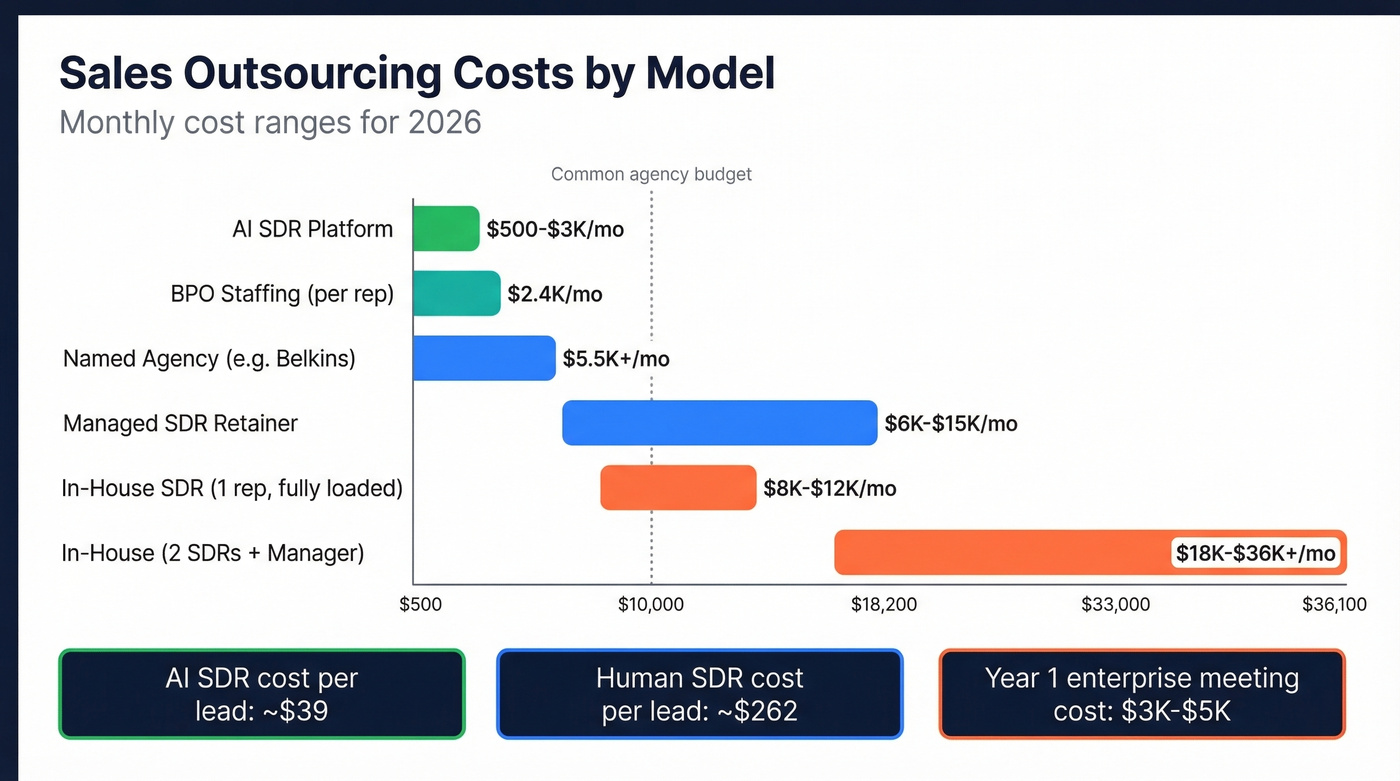
The optimization curve matters more than the starting price. Year-one costs for mid-market and enterprise outsourcing typically run $3,000-$5,000 per meeting booked. By year two, that drops to roughly $2,000 as messaging, targeting, and processes sharpen. Year three can hit $1,000 or lower, and mature programs eventually reach ~$250 per meeting. The agencies that don't show you this curve are the ones hoping you'll churn before you reach it.
In-House vs. Outsourced - The Real Math
The sticker shock of outsourcing fades when you compare it to the real cost of building in-house. A single SDR's base salary runs $60K-$70K/year, but the annualized cost per SDR exceeds $100K once you add benefits, tools, management overhead, and data subscriptions. A two-person SDR function with a manager, tech stack, and data can run $18,200-$36,100+ per month.
Then there's the time gap. Hiring takes roughly 3 months. Ramping takes another 3. That's 6 months before your first in-house SDR is fully productive. An outsourced team? Two to four weeks.
For companies that need pipeline now - post-funding, pre-board-meeting, entering a new vertical - that speed difference is worth the premium. The managed SDR pod model sits in the middle: providers like Bandalier offer AI-augmented SDR teams starting at $8,000/month including a performance incentive, giving you the speed of outsourcing with more control than a pure appointment-setting shop.

The #1 reason outsourced sales fails? Bad data. Burned domains, 35%+ bounce rates, blacklisted senders. Prospeo's 98% email accuracy and 7-day data refresh cycle give your outsourced team - or your AI SDR - the foundation to actually convert.
Stop paying agencies $10K/month to send emails that bounce.
The AI SDR Factor
I'll be direct: if your average deal size is under $15K, you probably don't need a $10K/month agency at all. An AI SDR paired with verified data will get you 80% of the way there at 20% of the cost. Save the agency budget for when you're selling six-figure enterprise deals where relationships actually move the needle.
AI vs. Human SDR Economics
The math has changed dramatically. A fully loaded human SDR costs $75K-$110K/year. An AI SDR platform runs $15K-$35K/year - some as low as $500/month. Cost per lead drops from roughly $262 (human) to $39 (AI). Payback period compresses from 8.7 months to 3.2 months.
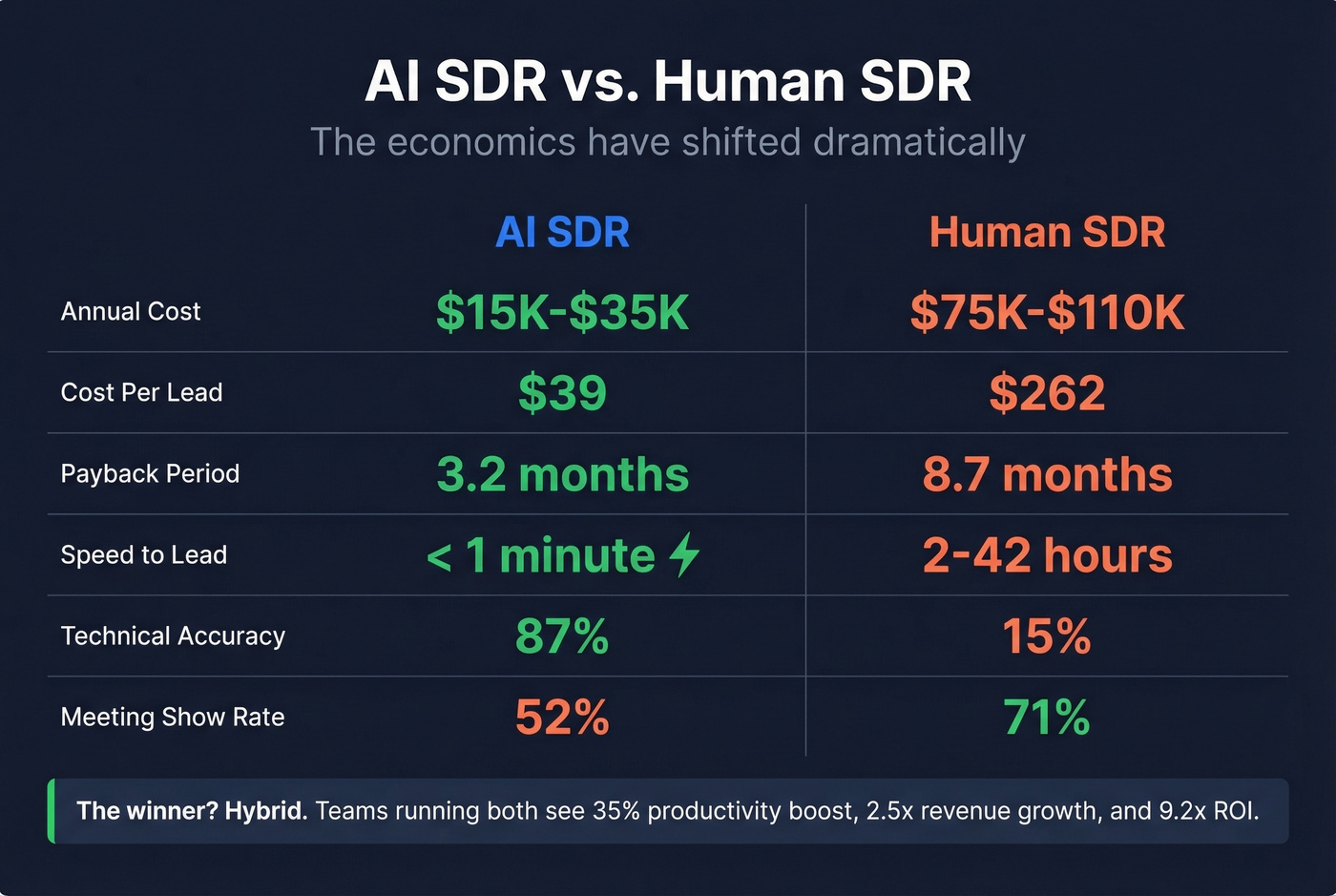
Speed-to-lead is where AI really separates. Responding within 1 minute boosts conversion rates by 391%. Human SDRs average 2-42 hours. AI responds instantly, every time.
45% of teams were already running hybrid AI-SDR models as of late 2025. That number's higher now and climbing fast.
Why Hybrid Wins
Pure AI isn't the answer either. An experiment by AI Agenix found that human SDRs generated $147K in revenue versus $56K for AI. Meeting show rates were 71% for humans versus 52% for AI. Humans still win on relationship-building and complex deal navigation.
The hybrid model outperforms both. Teams running AI for volume and research alongside humans for relationships and complex deals see a 35% productivity boost, 2.5x revenue growth, and 9.2x ROI. There's also a product knowledge angle that's underappreciated - AI SDRs answer technical questions correctly 87% of the time versus 15% for human SDRs. That's not a typo. Most human SDRs don't deeply understand what they're selling.
Of course, AI SDRs are only as good as the data feeding them. Pair any AI SDR tool with real-time verified contacts from Prospeo to avoid the garbage-in, garbage-out problem that silently kills automated outreach - 98% email accuracy and a 7-day refresh cycle mean your sequences hit real inboxes, not dead ends.
Five Mistakes That Kill Outsourced Sales
Set-and-forget management. You sign the contract, hand over your ICP doc, and disappear. Three months later, the outsourced reps sound like outsiders because they are. They don't know about the product update you shipped last week or the competitor that just raised a round. Ongoing enablement isn't optional.
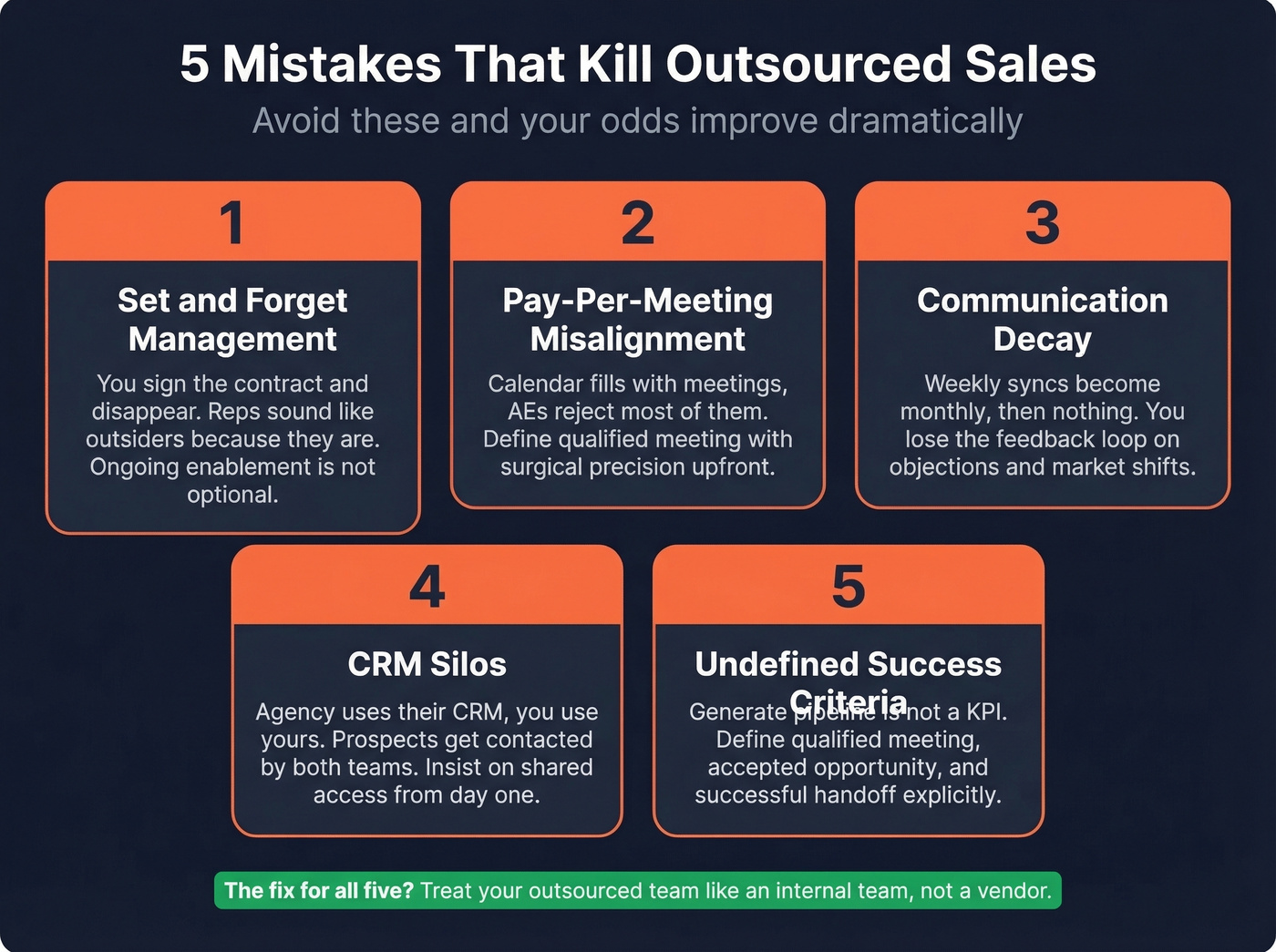
Pay-per-meeting incentive misalignment. Your calendar fills with 12 meetings in month two. Eight get rejected by AEs. Pay-per-meeting models incentivize volume over quality, and unless you define "qualified meeting" with surgical precision upfront, you'll get exactly what you're paying for - meetings, not pipeline.
Communication decay. It starts with weekly syncs. Then biweekly. Then monthly. Then you realize you haven't spoken to your agency in six weeks and they've been running a messaging playbook from Q1. You lose the feedback loop on objections, competitive intel, and market shifts. That loop is the entire point.
CRM silos. The agency uses their CRM. You use yours. Nobody syncs them properly. Prospects get contacted by both teams. Handoffs break. Insist on shared CRM access from day one - this is non-negotiable. (If you need a quick reference point, use these examples of a CRM to align on what “shared access” should look like.)
Undefined success criteria. "Generate pipeline" isn't a KPI. Without explicit definitions for what counts as a qualified meeting, an accepted opportunity, and a successful handoff, you'll end up with garbage pipeline that technically meets loose criteria while your AEs waste hours on dead-end conversations.
The Data Problem Nobody Mentions
Here's a stat that should terrify anyone signing an outsourcing contract: off-the-shelf databases show 28% contact decay within six months. Roughly a quarter of the contacts your outsourced team is dialing or emailing are already dead - wrong company, wrong role, bounced email, disconnected number.
Bad data doesn't just waste time. It actively damages you. Bounced emails tank your sender reputation. Dead dials burn through call budgets. And if your outsourced team is sending high-volume sequences from your domain using stale lists, you're paying thousands per meeting to reach disconnected numbers while your domain slides toward blacklists. If you want the deeper mechanics, this email deliverability guide breaks down what actually moves reputation.

This is where most outsourcing engagements quietly fail, and nobody diagnoses it correctly. The agency blames your ICP. You blame the agency. The real culprit is data that was stale before the first email went out. In our experience, the single highest-leverage fix for an underperforming outsourced team isn't changing the messaging or swapping reps - it's upgrading the data underneath. Stack Optimize built from $0 to $1M ARR using Prospeo's 300M+ professional profiles on a 7-day refresh cycle as their data backbone, maintaining 94%+ deliverability across all clients.
How to Evaluate a Provider
The evaluation criteria most buyers use - case studies, testimonials, "years in business" - are the wrong ones. Here's what actually predicts success.
AE acceptance rate is the single most important metric. What percentage of meetings booked by the agency get accepted by your AEs as genuinely qualified? Benchmark: 80%+. Below that, you're paying for noise. (If you’re pressure-testing your funnel, compare against these sales pipeline benchmarks.)
Show-up rates. Booked meetings that don't happen are worse than no meetings - they waste AE time and create false pipeline. Ask for historical show rates by industry vertical.
Deliverability practices. How do they warm domains? What's their bounce rate threshold for pausing campaigns? Do they monitor blacklists? If they can't answer these in detail, walk away. You can sanity-check their approach with email reputation tools and a clear email bounce rate target.
Data sourcing methodology. Ask where their contact data comes from and how often it's refreshed. The average SDR tech stack costs $30K+/year, and data quality is the biggest variable in that spend. If you’re comparing vendors, start with these data enrichment services.
SDR tenure and employment model. Industry average tenure is 14 months. Ask whether reps are W-2 employees or contractors - W-2 teams typically have lower turnover and better training. High turnover means your account gets a new rep every few months, and each one starts from scratch.
Compliance and security. Ask about GDPR/CCPA compliance, data handling practices, and whether offshore reps meet your security standards. For teams selling into regulated industries, this isn't optional.
Contract flexibility. Most agencies push 3-6 month minimums. Push for a 30-60 day pilot before committing longer. Any agency confident in their results will agree.
Red flags to watch for: won't share data sources, no deliverability monitoring, vague KPIs, no pilot option, and the biggest one - they can't tell you their AE acceptance rate because they don't track it.
How to Structure Your Contract
Outsourcing partnerships fail due to bad contracts more than bad vendors. Vague scope causes 60% of contract disputes. Let's break down the six pillars every agreement needs.
Scope and deliverables. Define exactly what the agency is responsible for - number of reps, daily activity targets, channels used, ICP parameters, and what constitutes a "deliverable." Ambiguity here is where engagements die. If you need a baseline for activity expectations, use these sales activities examples.
SLAs and KPIs. Tie compensation to outcomes: minimum show rate, AE acceptance rate, SQL definition, weekly reporting cadence, and monthly business reviews. Write these into the contract, not a side deck.
Pricing model alignment. Pay-per-meeting is the worst pricing model for most B2B companies because it incentivizes quantity over quality every time. Retainer plus performance bonus is the better structure. Build in milestone-based payments with holdbacks until satisfactory delivery.
Data ownership and CRM access. Who owns the prospect list when the engagement ends? This is the clause most buyers forget and most agencies exploit. Insist on full data portability and shared CRM access throughout.
Termination and exit. 30-day notice minimum. Define what happens to in-flight conversations, prospect data, and domain assets. A clean exit clause protects you if results don't materialize after a fair evaluation period.
Performance incentives. Penalties for underperformance and bonuses for exceeding targets. If the agency won't agree to performance-based terms, that tells you everything about their confidence.
Whether you outsource SDRs or run AI-powered outbound, your cost per meeting drops when your data is clean. Prospeo delivers verified emails at ~$0.01 each with 30+ filters to nail your ICP - so every dollar you spend on sales scales further.
Build the pipeline your outsourced team promised but never delivered.
FAQ
How long before outsourced sales produces results?
Expect 60-90 days minimum for a fair evaluation. Year-one per-meeting costs typically run $3,000-$5,000 but can drop 50%+ by year two as messaging and targeting sharpen. Judging an outsourced team in week two is like judging a new hire on their first day.
What's the biggest risk of outsourcing your sales team?
Domain reputation damage from stale contact data. If your outsourced team sends high-volume emails that bounce, your domain gets blacklisted - and recovering deliverability takes months. Insist on verified data with 98%+ accuracy and active blacklist monitoring from day one.
Can I outsource sales before I have product-market fit?
No. Outsourcing amplifies what already works. If you haven't closed 20-30 deals through founder-led sales and validated your ICP, an agency will burn budget and your sender reputation without producing pipeline. Do the founder work first.
Should I hire in-house or use an outsourced sales team?
If you need pipeline within weeks, an outsourced team delivers in two to four weeks versus six months for an in-house hire. If you have runway and want institutional knowledge, build internally. Many teams outsource top-of-funnel prospecting while they hire and ramp their own closers in parallel.
Are AI SDRs replacing outsourced sales teams?
Not replacing - restructuring. The hybrid model, where AI handles volume and research while humans handle relationships and complex deals, outperforms both pure approaches. AI SDRs cost 85% less per lead but generate lower revenue per deal. The winning formula in 2026 is AI for scale, humans for nuance.