

Best Sales Pipeline Software in 2026 (Honest Picks)
"Bloated nightmare." "Slow dashboards." "Broken automations." That's how real teams on Reddit describe their sales pipeline software experience. The irony? Companies with a formal sales process see 18% greater revenue growth than those winging it. The tool isn't the problem - picking the wrong one is.
We've spent months testing these platforms, talking to sales teams who use them daily, and digging through pricing pages so you don't have to. Here's what we found.
Our Top Picks (TL;DR)
Three tools, three jobs:
- Pipedrive - Best pure pipeline CRM. Reps actually use it, which is half the battle.
- Prospeo - Best for pipeline data quality. 98% email accuracy, 143M+ verified emails, 7-day data refresh. Your pipeline's only as good as the contacts in it.
- HubSpot Sales Hub - Best free starting point. But understand the cost cliff before you commit.
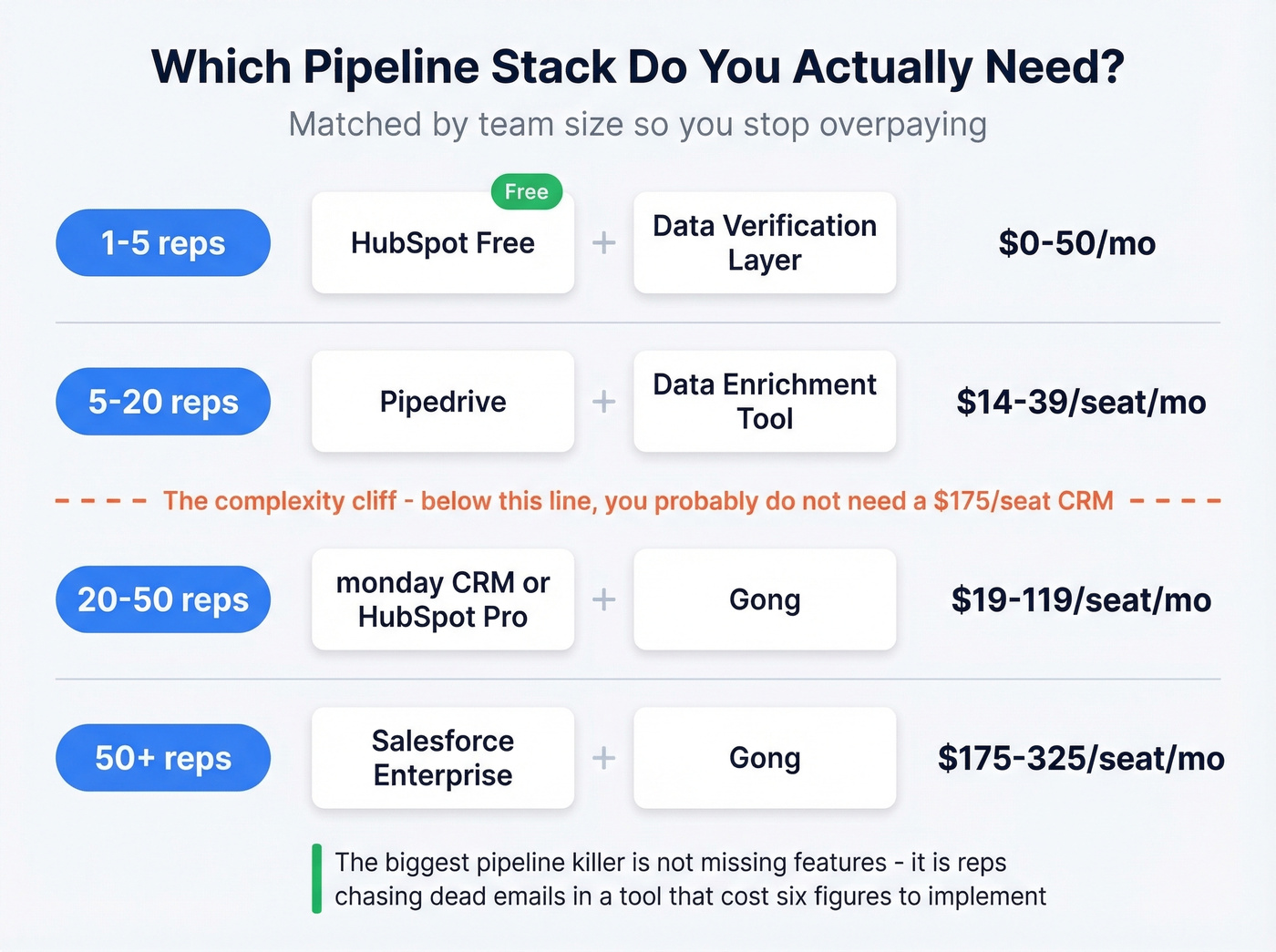
Here's how that maps to team size:
| Team Size | Recommended Stack |
|---|---|
| 1-5 reps | HubSpot Free + data verification layer |
| 5-20 reps | Pipedrive + data enrichment tool |
| 20-50 reps | monday CRM or HubSpot Pro + Gong |
| 50+ reps | Salesforce Enterprise + Gong |
Most teams under 20 reps don't need a $175/seat CRM. They need a $14/seat pipeline tool with clean data. The biggest pipeline killer we see isn't missing features - it's reps chasing dead emails and disconnected phone numbers in a tool that cost six figures to implement.
Three Types of Pipeline Tools
Not every tool in this list does the same thing. Pipeline software falls into three layers, and most teams need at least two.
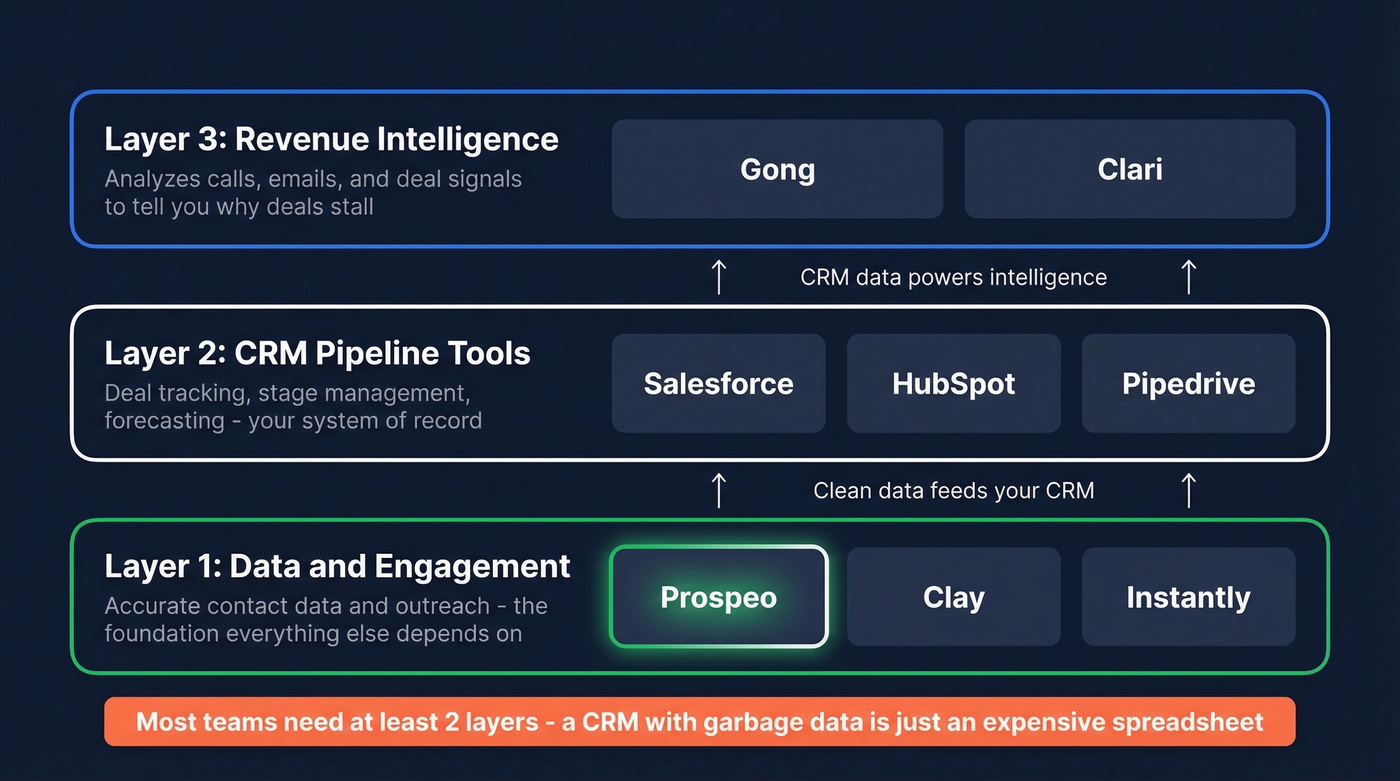
CRM-based pipeline tools handle deal tracking, stage management, and forecasting. Salesforce, HubSpot, and Pipedrive live here. This is your system of record - where deals get created, moved, and closed.
Revenue intelligence platforms like Gong and Clari sit on top of your CRM. They analyze calls, emails, and deal signals to tell you why deals stall. They don't replace your pipeline management system; they make it smarter.
Data and engagement platforms solve the upstream problem: getting accurate contact data into your pipeline and helping reps actually reach those people. Sales reps spend only 28% of their week selling. Bad data makes that number worse. The best stacks combine all three layers, because a CRM with garbage data is just an expensive spreadsheet.
Best Sales Pipeline Software Compared
Pipedrive
Pipedrive does one thing and does it well: visual pipeline management that reps don't hate. In a space full of bloated platforms, that's a genuine differentiator.
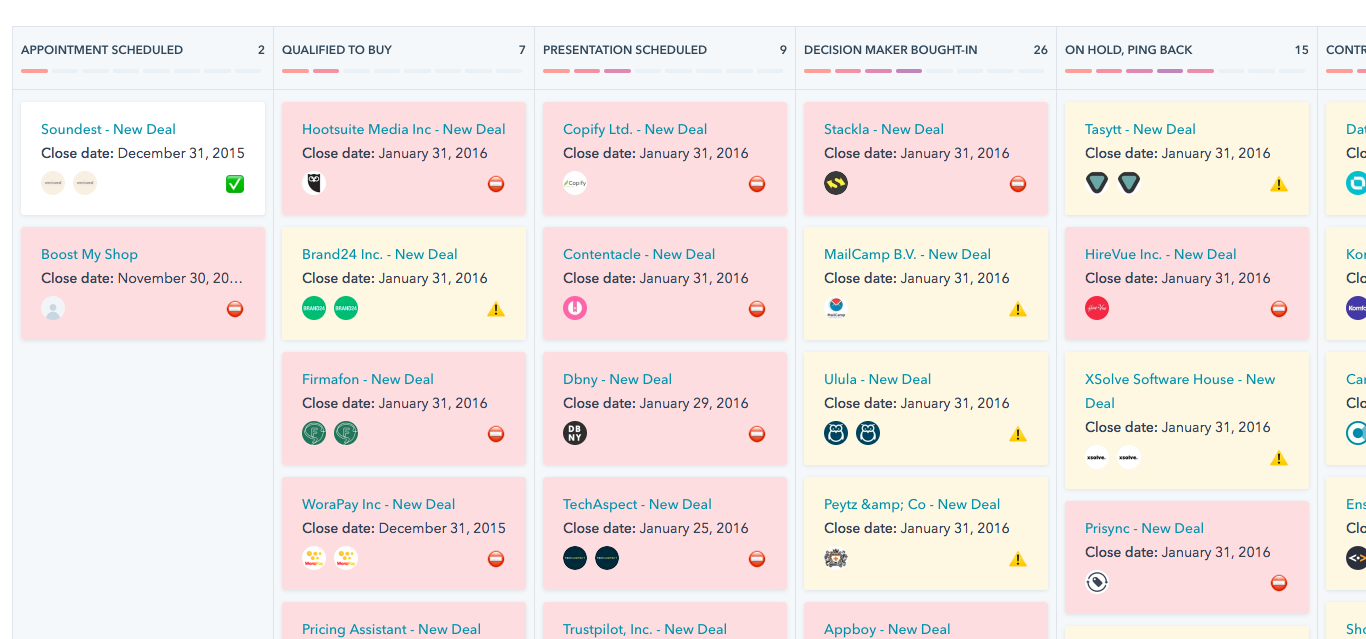
One Reddit user running an 80-person SME with 7 sales reps described the switch to Pipedrive as a turning point - specifically praising that salespeople "actually like" using it. Setup felt smooth even for a non-technical implementer, and the kanban-style pipeline view gives instant visibility without clicking through five menus. It's one of the few tools reps open voluntarily every morning, which tells you something about the UX.
The tradeoff? Reporting on lower tiers is limited, and if you need Pipedrive's phone add-on, that's an extra $24/user/month. But for teams under 20 reps who want a pipeline CRM that gets used daily, Pipedrive is the obvious pick.
Pricing: Lite $14 / Growth $39 / Premium $59 / Ultimate $79 per user/mo, billed annually. G2: 4.2/5 across 1,652 reviews.

Prospeo
Your pipeline tool tracks deals. Prospeo makes sure those deals have real contact data behind them.
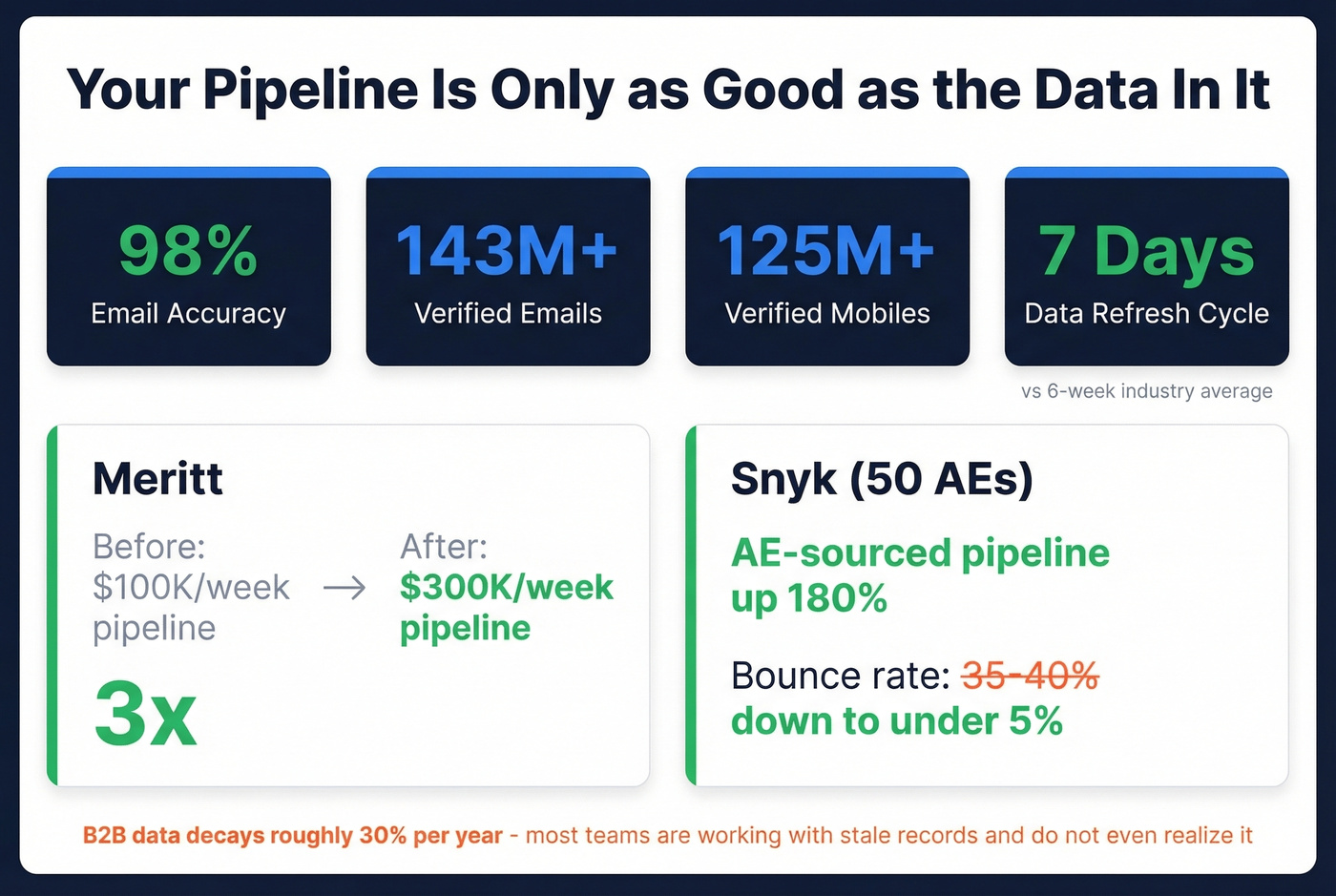
Prospeo isn't a CRM - it's the data layer that makes your pipeline platform work. The database covers 300M+ professional profiles, 143M+ verified emails with 98% accuracy, and 125M+ verified mobile numbers that hit a 30% pickup rate. Every record refreshes on a 7-day cycle, which matters because B2B data decays roughly 30% per year. The industry average refresh cycle sits around 6 weeks, so most teams are working with stale records and don't even realize it.
The platform plugs directly into Salesforce, HubSpot, Lemlist, Instantly, Clay, Zapier, and Make via native integrations. The Chrome extension - used by 40,000+ people - lets reps find verified emails and direct dials from any website without leaving their workflow. Search filters cover buyer intent, technographics, job changes, headcount growth, funding signals, and more across 30+ dimensions.
Real results: Meritt tripled pipeline from $100K to $300K/week after switching. Snyk's 50-person AE team saw AE-sourced pipeline jump 180% with bounce rates dropping from 35-40% to under 5%.
Pricing: Free tier with 75 verified emails/month, paid plans at ~$0.01/email. No contracts, cancel anytime.

HubSpot Sales Hub
HubSpot's free tier is a gateway drug - and I mean that as both a compliment and a warning.
The free plan gives you a deal pipeline, contact management, and basic templates. It's genuinely useful for a 1-3 person team getting started. The problem starts when you need sequences, custom reporting, or forecasting. Professional runs $500/month for 5 seats, plus $100 for each additional seat. Add mandatory onboarding - $1,500 for Professional, $3,500 for Enterprise - and the annual commitment on paid plans, and your "free" CRM is suddenly costing $12K+/year.
Here's the thing: if you budget for it from the start, HubSpot Pro is genuinely excellent. The sequences are solid, the reporting is deep, and the ecosystem of integrations is massive. Just don't let the free tier trick you into thinking the upgrade will be cheap.
Use this if: You're starting from zero and want a growth path. Skip this if: You need sequences now but can't stomach $500/month.
Salesforce Sales Cloud
The most powerful pipeline management platform on the market - and the most expensive mistake a small team can make.
Salesforce pricing starts deceptively low: a free tier for 2 users, Starter at $25/user/month, Pro at $100, Enterprise at $175, Unlimited at $350. But the sticker price is just the beginning. SDR-critical features like Sales Engagement run roughly $75/user/month and Conversation Intelligence adds another $50/user/month on top. Implementation runs $5K-$300K+ depending on complexity. You'll need at least a part-time admin.
We've watched teams of 15 reps spend $80K on a Salesforce implementation only to realize they needed a $14/seat tool with clean data. For 50+ rep organizations with dedicated RevOps, Salesforce is still the default for good reason - G2: 4.4/5 with 25,482 reviews. For everyone else, the TCO will eat your budget alive.
monday CRM
If your team already lives in monday.com for project management, this eliminates the "deal closed, now what?" handoff gap. Pipeline tracking plus project delivery in one workspace means the ops team sees deal context before the ink dries.
Pricing is aggressive: Basic at $9, Standard at $12, Pro at $19/seat/month billed annually with a minimum of 3 users. You'll outgrow it if you need advanced forecasting or conversation intelligence, but for teams under 30 reps who value simplicity over feature depth, monday CRM punches hard.
Freshsales
Use this if: You're a budget-conscious SMB that wants AI-powered lead scoring without paying Salesforce prices. Skip this if: You need deep customization or a massive integration ecosystem.
Free plan supports 3 users. Growth starts at $9/user/mo, Pro at $39, Enterprise at $59. The built-in Freddy AI scores leads and suggests next actions - features that cost extra on most competing platforms.
Gong
Gong isn't a pipeline CRM. It's a diagnostic layer that tells you why your pipeline is leaking.
Think of it as the MRI for your sales process. Gong captures and analyzes calls, emails, and meetings to surface coaching insights and deal risk signals. It connects to your CRM rather than replacing it. Pricing is custom but typically lands between $100-$150/user/month based on team size and contract length. Worth it for teams of 20+ reps where deal inspection and coaching drive real revenue impact. Below that threshold, the ROI math gets shaky.
Zoho CRM
Zoho makes the most sense when you're already bought into the Zoho ecosystem - Zoho Desk, Zoho Campaigns, Zoho Analytics all share data natively. As a standalone CRM, it's competent but unremarkable. Free tier available for up to 3 users; paid plans run from $14/user/month on Standard to $52/user/month on Ultimate. The AI assistant Zia offers lead scoring and anomaly detection, though in our experience it's a step behind Freshsales' Freddy. G2: 4.0/5 across 2,470 reviews.
Close
Your inside sales team lives on the phone. Close was built for exactly that.
It bundles calling, SMS, and email sequences into the CRM itself - no add-ons, no third-party dialers, no duct tape. The built-in power dialer and predictive dialer are the standout features. Pricing runs from $29/user/month on Startup to $149/user/month on Enterprise. Skip it entirely if you're field sales or need heavy marketing automation.
Salesmate
Salesmate is Close's quieter cousin - similar built-in calling and pipeline management, but at a lower price point with a friendlier UI for non-technical teams. Less known, but for 5-10 rep teams that want calling + pipeline without Close's price tag, it's worth a serious look. Plans range from $23/user/month to $63/user/month.
A Note on Pipeline CRM
You'll see Pipeline CRM (formerly PipelineDeals) ranking for this keyword. It's a simple, affordable tool for very small teams, but the limited integration ecosystem and smaller user community make it hard to recommend over Pipedrive or monday CRM at similar price points.

Bad data is the #1 pipeline killer. Reps chase dead emails and disconnected numbers while deals rot in your CRM. Prospeo's 143M+ verified emails (98% accuracy) and 125M+ verified mobiles refresh every 7 days - not the 6-week industry average.
Stop managing a pipeline full of ghost contacts.
Pricing Comparison
Hidden costs matter more than sticker prices. Here's what you'll actually pay:
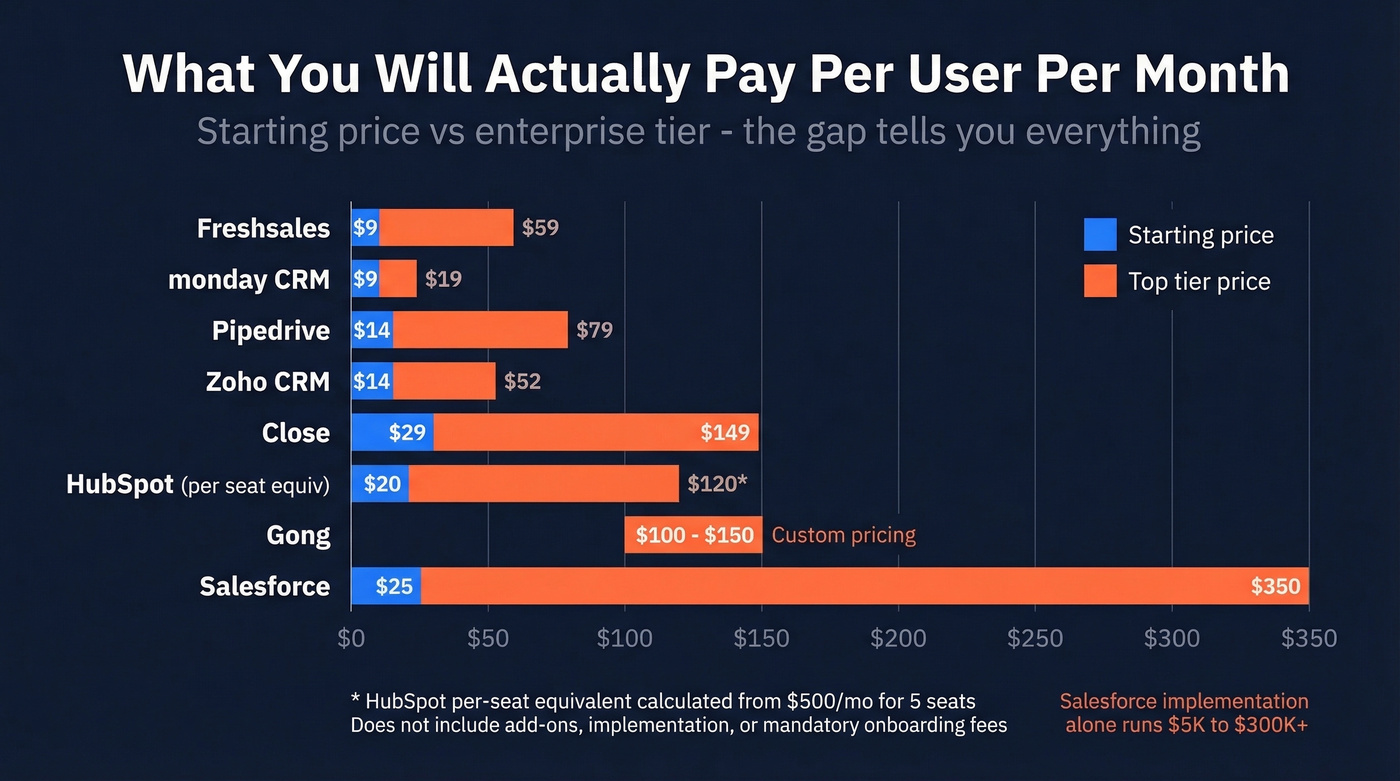
| Tool | Free Tier? | Starting Price | Paid Range | Enterprise |
|---|---|---|---|---|
| Pipedrive | No | $14/user/mo | $39-$59/user/mo | $79/user/mo |
| HubSpot | Yes | $20/seat/mo | $500/mo for 5 seats | $1,200/mo for 10 seats |
| Salesforce | Yes (2 users) | $25/user/mo | $100-$175/user/mo | $350/user/mo |
| monday CRM | No | $9/seat/mo | $12-$19/seat/mo | Custom |
| Freshsales | Yes (3 users) | $9/user/mo | $39/user/mo | $59/user/mo |
| Gong | No | ~$100/user/mo | Custom | Custom |
| Zoho CRM | Yes | $14/user/mo | $23-$40/user/mo | $52/user/mo |
| Close | No | $29/user/mo | $99/user/mo | $149/user/mo |
| Salesmate | No | $23/user/mo | $40/user/mo | $63/user/mo |
What the table doesn't show: Pipedrive's phone add-on costs $24/user/month. HubSpot charges mandatory onboarding fees of $1,500 for Professional and $3,500 for Enterprise. Salesforce implementation runs $5K-$300K+ and you'll need a dedicated admin. Gong requires a separate CRM. monday CRM has a 3-seat minimum. Factor these into your real budget before comparing sticker prices.
Pipeline Metrics That Matter
Software won't save a pipeline you can't measure. Here are the benchmarks worth tracking:
| Metric | Benchmark |
|---|---|
| Pipeline coverage ratio | 3x-5x quota |
| Median sales cycle | 84 days, optimal range 46-75 days |
| Median deal size | $26,265 |
| Win rate | 20-30% |
| Lead-to-customer | 2-5% |
For B2B SaaS specifically, First Page Sage's conversion benchmarks break down the funnel: Lead to MQL at 39%, MQL to SQL at 38%, SQL to Opportunity at 42%, SQL to Closed at 37%. If your numbers fall significantly below these, the problem isn't your pipeline tool - it's your process or your data.
Sales cycles are running 21% longer than they were in 2020. That makes pipeline velocity and stage conversion tracking more important than ever. Below 3x coverage? You don't have enough deals. Above 5x? Your pipeline is probably bloated with stale opportunities that'll never close.
What No Pipeline Tool Can Fix
Let's be honest: no tool fixes three things.
Bad data. B2B contact data decays roughly 30% per year. People change jobs, companies get acquired, phone numbers rotate. If your pipeline is full of dead emails and disconnected numbers, your reps are wasting hours chasing ghosts - and remember, they're already spending only 28% of their week selling on actual selling. Reps lose nearly two full days a week to non-selling tasks, and bad data makes that worse. No amount of AI scoring helps when the underlying contacts are wrong.
An undefined ICP. Pipeline software visualizes your deals. It doesn't tell you whether you're chasing the right accounts. If your team can't articulate who they sell to in two sentences, a better CRM won't help. (If you need a framework, start with an ideal customer profile.)
No sales process. A kanban board with five stages isn't a sales process. It's a to-do list with colors. You need defined exit criteria, clear next actions, and consistent qualification standards before software adds value. (If you're rebuilding yours, use a sales process optimization checklist.)
The fix for the data problem is a dedicated verification layer that refreshes contacts on a weekly cycle so reps reach real people with working emails and direct dials. Pair that with any CRM on this list and you solve the upstream problem that no pipeline management tool addresses on its own. (If you're troubleshooting bounces, start with email bounce rate benchmarks and fixes.)

Meritt tripled pipeline from $100K to $300K/week. Snyk's 50 AEs saw 180% more pipeline with bounce rates dropping from 40% to under 5%. The difference wasn't a better CRM - it was better data feeding the CRM they already had.
Plug 98% accurate data into your pipeline software for $0.01/email.
How to Choose the Right Tool
Four questions before you buy:
- How many reps? Under 10, don't overthink it - Pipedrive or HubSpot Free. Over 50, you're probably stuck with Salesforce whether you like it or not.
- What's your real budget? Include implementation, onboarding, add-ons, and admin time. A $25/user CRM with $75K in implementation costs isn't a $25 CRM.
- Do you need intelligence or just tracking? If deals stall and you don't know why, add Gong. If you just need pipeline visibility, a CRM alone works.
- Is your contact data clean? If your bounce rate is above 5%, fix your data before you upgrade your CRM. The best sales pipeline software in the world can't close deals with wrong phone numbers. (A quick win: run a lead enrichment pass before outreach.)
FAQ
What's the best free pipeline tool?
HubSpot Free gives you a deal pipeline and contact management at zero cost. Freshsales Free supports up to 3 users with AI scoring included. For either option, pair your CRM with a data verification layer to ensure the contacts in your pipeline are actually reachable.
How long does implementation take?
Pipedrive and monday CRM take 1-2 days for most teams. HubSpot Professional requires 1-2 weeks plus mandatory onboarding at $1,500+. Salesforce Enterprise runs 4-12 weeks with implementation costs ranging from $5K to $300K+ depending on complexity.
Can AI replace my pipeline tool?
Not yet. AI enhances pipeline management through lead scoring, forecasting, and coaching insights - but it still needs a system of record and clean data to work from. Think of AI as the intelligence layer, not the replacement.
What's a healthy pipeline coverage ratio?
Aim for 3x-5x your quota target. Below 3x means you don't have enough deals to hit your number. Above 5x often signals a bloated pipeline full of stale opportunities that need pruning, not celebrating.
How do I keep pipeline data accurate?
B2B data decays roughly 30% annually. Use a data platform with a weekly refresh cycle to keep emails and phone numbers current, and run quarterly pipeline hygiene audits to remove dead deals and outdated contacts.