

Sales Pipeline Tracking: Benchmarks, Playbook, and Data Foundation
It's Thursday afternoon. You're building the board deck, and the pipeline number looks great - $2.4M in open opportunities. Then you start clicking into deals. One hasn't had activity in six weeks. Another has a contact who left the company in January. A third bounced on the last two email sequences. Your real pipeline isn't $2.4M. It's maybe $1.1M, and you're presenting in 18 hours.
This is why sales pipeline tracking matters more than the number itself.
63% of sales managers say their organization does a poor job managing its pipeline. With the average B2B deal now involving [13 decision-makers] and 80% of buyer interactions happening digitally, the complexity isn't getting easier.
What Is Sales Pipeline Tracking?
Sales pipeline tracking is the discipline of monitoring every deal through defined stages - from first touch to closed-won - and measuring the health of that progression in real time. It's how you keep track of sales at every level, from individual rep performance to the full revenue picture.
Most people blur the distinction: your pipeline tracks sales actions and deal progression. Your funnel tracks the buyer's journey and conversion rates at each stage. They're complementary views of the same revenue engine, but confusing them leads to muddled metrics. When someone says "our pipeline is healthy," they should mean deals are advancing through well-defined stages with clear next steps - not just that the top of the funnel looks full.
89% of revenue organizations now use AI in their pipeline workflows, up from 34% in 2023. The tooling has evolved fast. But AI can't fix a pipeline built on stale contacts and vague stage definitions.
The 7 Pipeline Stages
Vague stages produce unreliable metrics. The fix is binary entry and exit criteria - a deal either meets the criteria or it doesn't. No judgment calls.
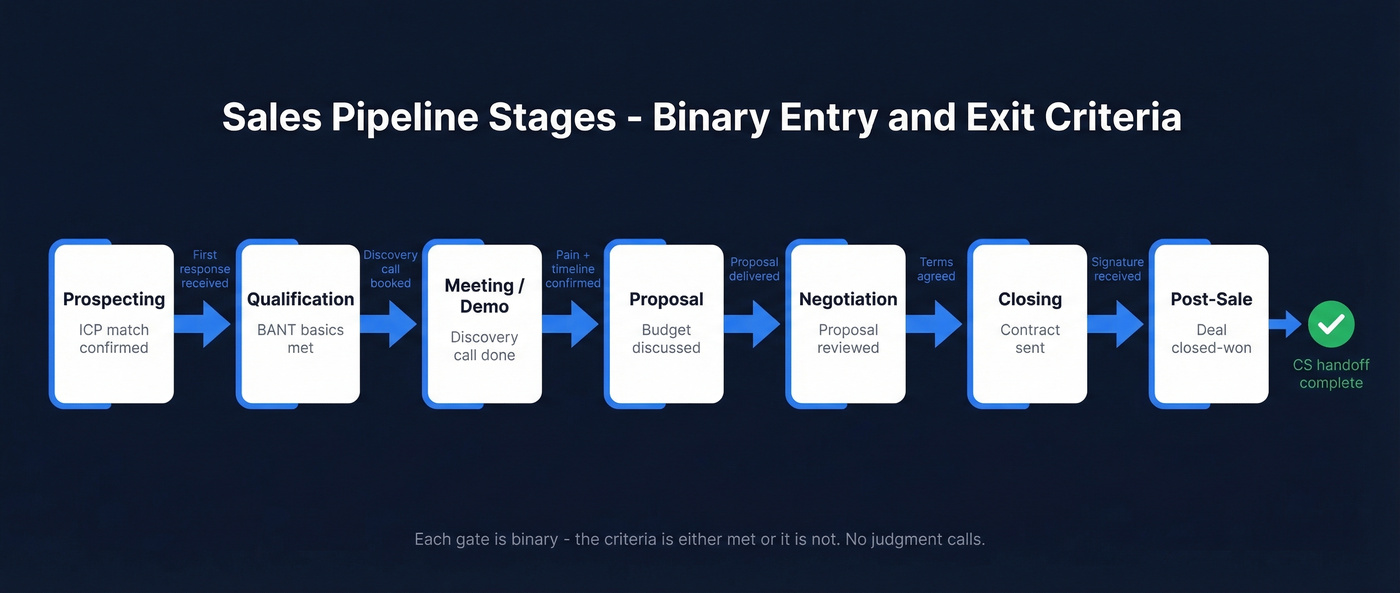
| Stage | Entry Criteria | Exit Criteria |
|---|---|---|
| Prospecting | ICP match confirmed | First response received |
| Qualification | BANT basics met | Discovery call booked |
| Meeting/Demo | Discovery call completed | Pain + timeline confirmed |
| Proposal | Budget range discussed | Proposal delivered |
| Negotiation | Proposal reviewed | Terms agreed |
| Closing | Contract sent | Signature received |
| Post-Sale | Deal closed-won | Handoff to CS complete |
The key insight from AddToCRM's pipeline guide: replace subjective stages with binary ones. "Discovery Call Booked" is binary - it either happened or it didn't. "Contacted" is not. A rep who left a voicemail and sent one email could mark a deal as "Contacted," and now you've got phantom pipeline.
For qualification, BANT (Budget, Authority, Need, Timeline) remains the most practical framework. You don't need all four confirmed to advance a deal, but you need at least two - and Authority should always be one of them. Deals without a confirmed decision-maker stall at negotiation, and by then you've invested weeks of selling time with no one who can actually sign.
Key Pipeline Metrics
Six metrics tell you almost everything about pipeline health. Together they give you a complete system to track sales progress from first touch to closed-won.
Win rate is the simplest: closed-won deals divided by total deals in a period. If you closed 15 out of 100 opportunities last quarter, your win rate is 15%. Useful, but it hides where deals die.
Stage conversion rate is where diagnostics get real. The formula: deals progressing to next stage / deals entering current stage. If 50 deals enter discovery and 20 progress, that's 40%. Track this per stage and you'll find your bottleneck within a week.
Average deal size deserves its own tracking because it shapes every other calculation. It's already embedded in the velocity formula below, but monitoring it independently reveals whether you're moving upmarket, whether discounting is creeping in, or whether a particular segment is dragging down your numbers.
Pipeline velocity measures how fast revenue moves through your pipeline: (number of deals x average deal value x win rate) / sales cycle length in days. This single number tells you your daily revenue generation capacity.
Pipeline coverage ratio is the one most teams get wrong. The old rule of thumb was 3x quota. That's not enough anymore. Current best practice is 4-6x quota to account for slippage, stalled deals, and the inevitable losses that come with complex B2B sales.
Sales cycle length matters because 27% of reps say long sales cycles are their biggest barrier to hitting quota. Here's the thing: if your average cycle is 90 days but your quarter is 65 days in, any deal that entered this quarter isn't closing this quarter. Plan accordingly.
Stage-by-Stage Conversion Benchmarks
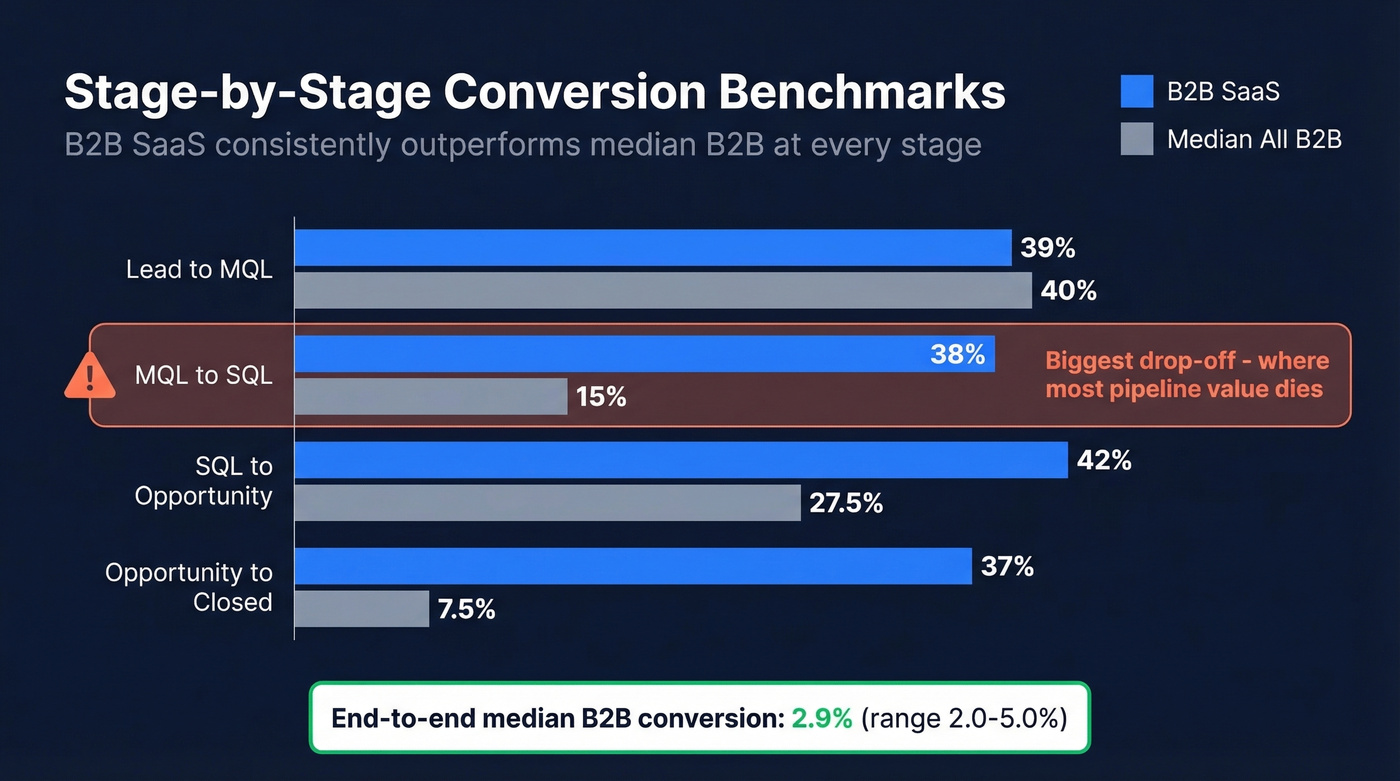
Most pipeline guides give you frameworks without numbers. Here are the actual benchmarks you need to measure your deal progression against.
| Stage Transition | B2B SaaS | Median (All B2B) |
|---|---|---|
| Lead to MQL | 39% | 35-45% |
| MQL to SQL | 38% | 12-18% |
| SQL to Opportunity | 42% | 25-30% |
| Opportunity to Closed | 37% | 6-9% |
Based on 2017-2026 data from First Page Sage, plus benchmark ranges from Martal Group and AddToCRM
The median B2B end-to-end conversion rate is 2.9%, with a typical range of 2.0-5.0%. The biggest drop-off? MQL to SQL, typically around 12-18%. That's where most pipeline value evaporates.
Late-stage losses almost always originate from earlier qualification gaps. If deals are dying at negotiation, don't default to discounting - go back and review your discovery notes. The problem is usually upstream.

That MQL-to-SQL drop-off of 12-18%? A huge chunk of it is bad contact data - bounced emails, wrong numbers, contacts who left months ago. Prospeo's 7-day data refresh cycle and 98% email accuracy mean your reps spend pipeline review time on deal strategy, not cleaning dead leads.
Stop presenting phantom pipeline built on stale contacts.
How to Run a Pipeline Review
A pipeline review is an execution meeting, not a status update. We've sat through too many 45-minute recitals of deal stages where nothing actually changes. That's a waste of everyone's time.
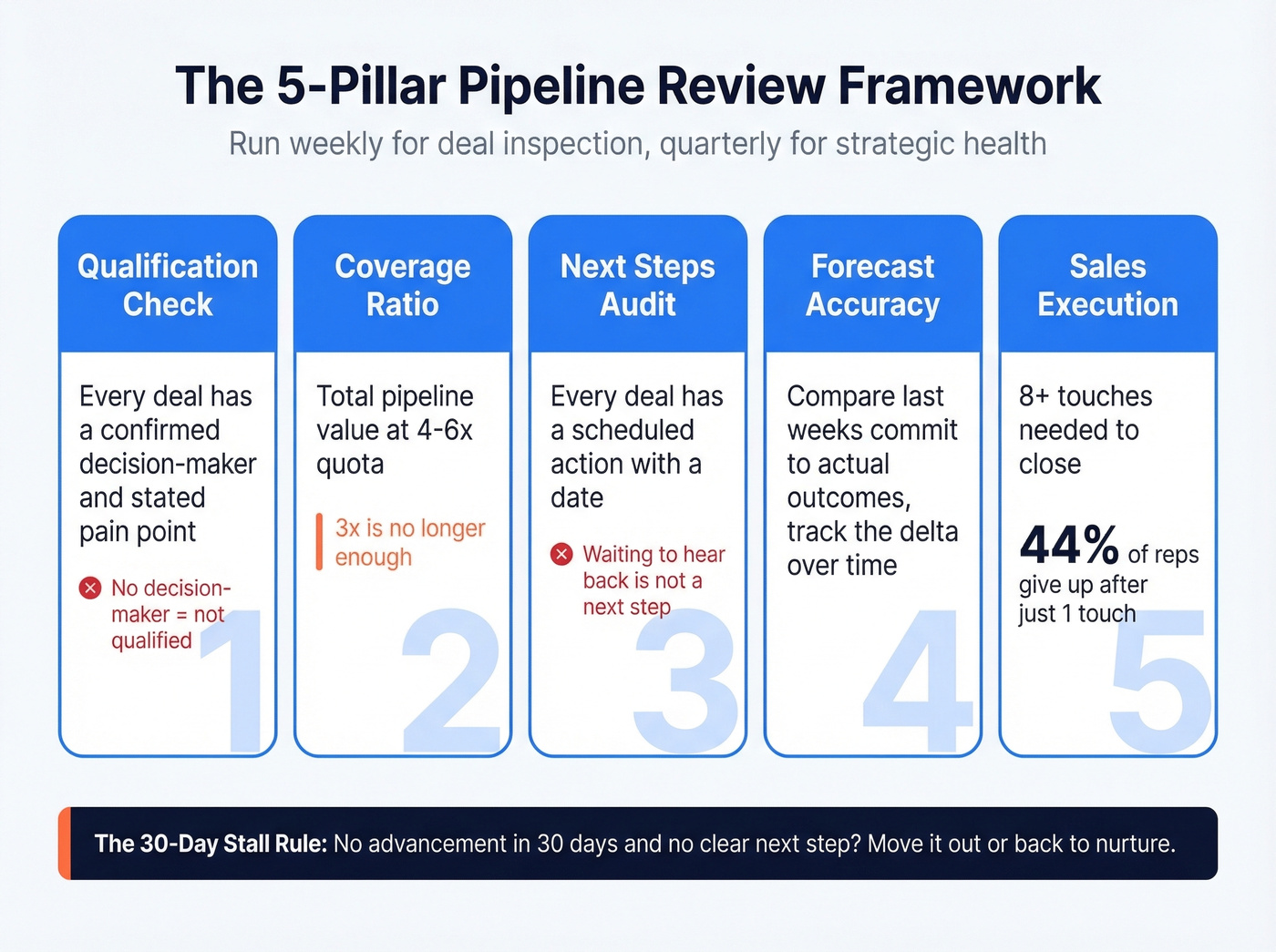
Use this 5-pillar framework weekly:
- Qualification check - Does every deal have a confirmed decision-maker and a stated pain point? If not, it's not qualified.
- Coverage ratio - Is total pipeline value at 4-6x quota? If you're at 3x, you're already behind.
- Next steps audit - Every deal needs a scheduled next action with a date. "Waiting to hear back" isn't a next step.
- Forecast accuracy - Compare last week's commit forecast to actual outcomes. Track the delta over time.
- Sales execution - Are reps following up enough? It takes 8+ touches to close a deal, yet 44% of salespeople give up after one touch.
The 30-day stall rule is non-negotiable. If a deal hasn't advanced in 30 days and has no clear next step, it's not a deal - it's a wish. Move it out of your pipeline or back to nurture. Your forecast will thank you.
Run this weekly for deal-level inspection, quarterly for strategic pipeline health. The quarterly review should zoom out to trends: are cycle times increasing? Is a particular stage becoming a bottleneck? Are win rates shifting by segment?
Common Pipeline Tracking Mistakes
Five mistakes account for most pipeline dysfunction.
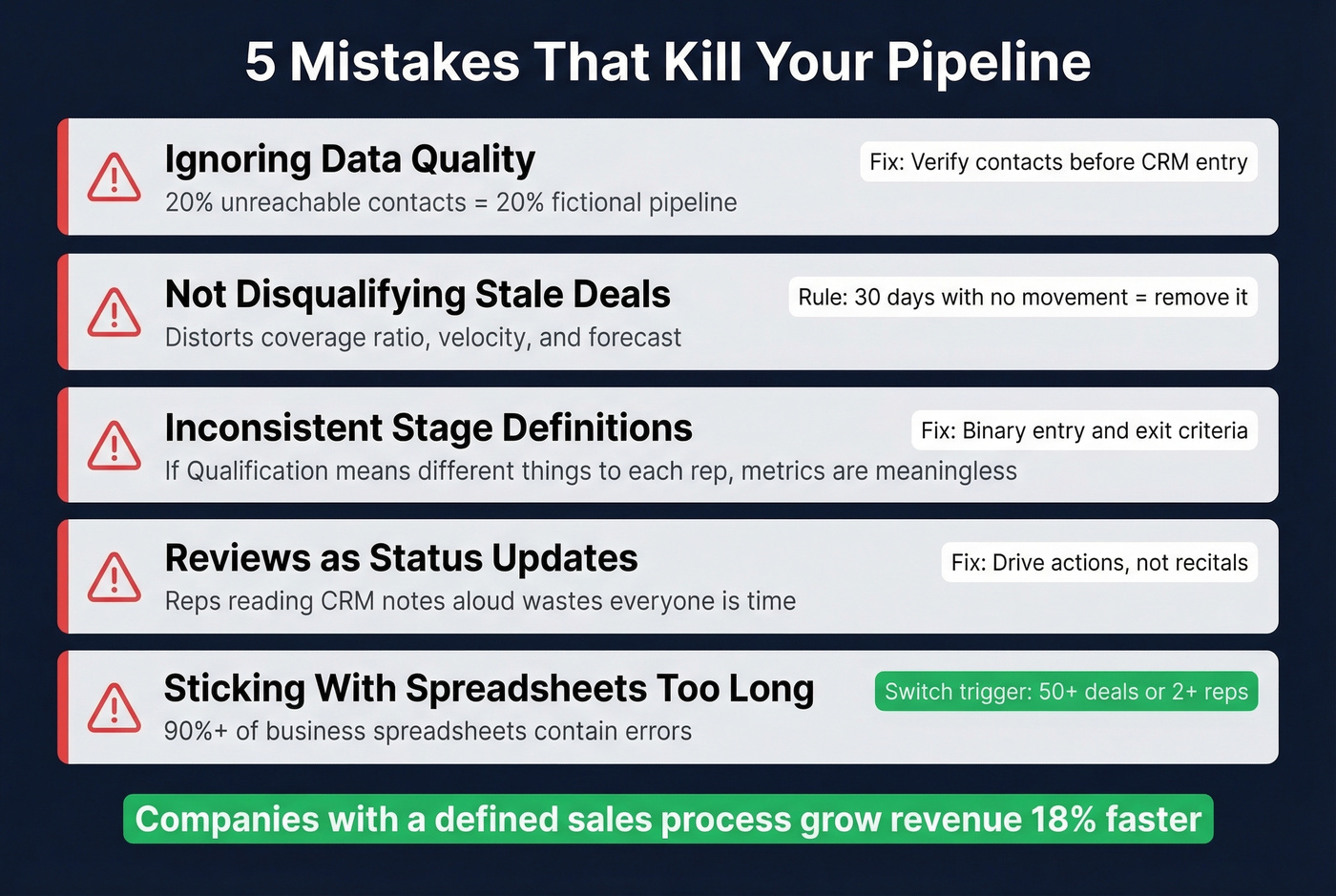
Ignoring data quality. Bounced emails and disconnected phone numbers inflate your pipeline value. If 20% of your contacts are unreachable, your pipeline is 20% fiction. Verify contacts before they enter your CRM - it's the cheapest fix with the highest ROI.
Not disqualifying stale deals. The 30-day rule exists for a reason. Every stale deal you keep in the pipeline distorts your coverage ratio, your velocity calculation, and your forecast. Be ruthless.
Inconsistent stage definitions. If "Qualification" means something different to each rep, your stage conversion metrics are meaningless. Binary criteria solve this.
Treating reviews as status updates. Pipeline reviews should drive action: re-qualify this deal, add a new thread to that account, kill this stalled opportunity. If reps are just reading CRM notes aloud, you're wasting the meeting.
Sticking with spreadsheets too long. Over 90% of business spreadsheets contain errors, and 70%+ of small businesses still rely on spreadsheets or notebooks for keeping track of sales. A practical trigger for switching: around 50 active deals or 2+ reps sharing a pipeline. Once you hit that threshold, spreadsheets don't send reminders, don't flag stale deals, and don't calculate pipeline velocity automatically.
Companies that define a clear sales process grow revenue 18% faster than those that don't. A CRM enforces that process. A spreadsheet just records it - badly, with errors, and without accountability. The cost of a basic CRM ($14-$30/seat/month for most SMB options) is trivial compared to the cost of a missed follow-up on a $30K deal.
Best Tools for Pipeline Management
A tool that tracks pipeline isn't the same as a tool that fills it. The best stacks combine both - a CRM for deal management and a data layer for contact accuracy.
| Tool | Best For | Starting Price | Key Strength |
|---|---|---|---|
| Pipedrive | SMB (<20 reps) | $14/seat/mo | Visual pipeline UX |
| HubSpot Sales Hub | Mid-market (20-50) | Free / ~$20/user/mo | Marketing + sales alignment |
| Salesforce | Enterprise (50+) | ~$25/user/mo | Customization depth |
| Prospeo | Data quality layer | Free / ~$0.01/email | 98% email accuracy |
| Zoho CRM | Budget teams | Free-~$60/user/mo | Value for money |
| Pipeline CRM | Simplicity seekers | ~$25/user/mo | Pipeline-only focus |

Pipedrive - Best Under 20 Reps
Use this if you want the cleanest visual pipeline experience on the market. Pipedrive's drag-and-drop deal management is genuinely intuitive - reps actually use it, which is half the battle with CRM adoption. Pricing runs $14/seat/mo (Lite), $39 (Growth), $59 (Premium), and $79 (Ultimate), all billed annually. Automation kicks in at the Growth tier, which is where most teams should start. Pipedrive also includes built-in AI features on higher tiers to help prioritize deals and suggest next actions. Its mobile app makes deal tracking between meetings straightforward, so reps can update stages and log activities without waiting until they're back at a desk.
Skip this if you need custom objects, advanced reporting, or marketing automation in the same platform. In our experience, Pipedrive is the best SMB pipeline CRM for teams that want simplicity. But once you hit 20+ reps or need complex reporting, you'll feel the ceiling.
HubSpot Sales Hub - Mid-Market
A 30-seat team on HubSpot Professional commonly lands in the tens of thousands per year before add-ons - and that's the number you should anchor on, not the attractive free tier. The free CRM is legitimately useful for getting started, and paid Sales Hub tiers commonly start around ~$20/user/mo (Starter), with Professional often priced around ~$100/user/mo and Enterprise around ~$150/user/mo. The real value is having deal tracking, marketing attribution, and lead handoff in one platform. For teams running 20-50 reps who want pipeline management best practices baked into the platform alongside marketing, it's the strongest mid-market option.
Skip it if you're price-sensitive at scale.
Salesforce Sales Cloud - Enterprise
Salesforce typically starts around $25/user/month for entry tiers, with common plans in the ~$80-$165/user/month range depending on edition and add-ons. It's the default for enterprise sales orgs for good reason - nothing else matches its customization depth, and Salesforce's AI features support deal scoring and win-probability insights. The platform excels at opportunity tracking across large, multi-territory teams where visibility into every deal stage is critical.
Skip it if you're under 50 reps and don't have a dedicated Salesforce admin. It's over-engineered for SMBs, and the implementation cost alone can exceed a year of Pipedrive licenses.
Prospeo - Data Quality Layer
Prospeo isn't a CRM - it's the layer that ensures the contacts feeding your pipeline are real and reachable. With 98% email accuracy, 125M+ verified mobile numbers, and a 7-day data refresh cycle versus the 6-week industry average, it solves the data quality problem that silently corrupts every pipeline metric. Meritt went from a 35% bounce rate to under 4% after switching, and their pipeline tripled from $100K to $300K/week. Free tier gives you 75 emails and 100 Chrome extension credits per month, with paid plans at ~$0.01/email. Integrates natively with Salesforce, HubSpot, Lemlist, and most major outreach tools.
For teams comparing options, it can also help to review data enrichment services and how they fit alongside verification.
Zoho CRM and Others
Zoho is a solid budget option - free for up to 3 users, paid plans commonly landing around ~$14-$60/user/month. Best for very small teams that need basic pipeline management without the price tag. Pipeline CRM (~$25-$50/user/mo) is a niche, pipeline-focused tool for teams that want simplicity over features - no marketing suite, no intent data, just clean deal tracking. Other tools worth evaluating include monday CRM for visual project-style management, Freshsales for AI-powered lead scoring (~$10-$70/user/mo), and Clari for enterprise forecasting and pipeline visibility.
The Data Quality Foundation
Most pipeline guides ignore the foundation entirely: your pipeline metrics are only as good as your contact data. You can't reliably track deal progression if half the emails in your CRM bounce.
Let's be honest - if your average deal size is above $5K, bad contact data is costing you more per quarter than your CRM subscription costs per year. When an SDR loads 200 leads into the CRM and 35 emails bounce, 40 numbers are disconnected, and 15 contacts have changed jobs, the actual pipeline is 110 - not 200. But every metric downstream - conversion rates, velocity, coverage ratio - is calculated against 200. Your entire forecast is built on fiction.
Snyk saw this firsthand. Their bounce rate was running 35-40% before they implemented real-time email verification. After: under 5%. AE-sourced pipeline jumped 180%, generating 200+ new opportunities per month. The data didn't change their sales skills - it just made their existing pipeline real.
Every metric in this article - win rate, stage conversion, velocity, coverage - becomes trustworthy only when the contacts behind those deals are verified and current. Clean data is what separates teams that track deal flow accurately from those guessing at their forecast.
If you're building a repeatable top-of-funnel engine, pair tracking with sales prospecting techniques and a consistent lead scoring model so only real opportunities enter the pipeline.
You need 4-6x coverage to hit quota, but coverage built on unverified contacts is fiction. Prospeo gives you 300M+ profiles with 30+ filters - buyer intent, job changes, headcount growth - so every deal in your pipeline has a real decision-maker attached, not a ghost.
Build pipeline coverage that survives the Thursday afternoon audit.
FAQ
What's the difference between a pipeline and a funnel?
A pipeline tracks your sales team's actions and deal progression through defined stages - it's the seller's view. A funnel tracks the buyer's journey and measures conversion rates at each stage - it's the marketing and analytics view. They're complementary frameworks for the same revenue process, and strong teams use both.
How often should you review your pipeline?
Weekly at minimum for deal-level inspection - checking next steps, stale deals, and qualification gaps. Quarterly for strategic health, including coverage ratio trends, cycle time shifts, and stage bottleneck analysis. Use the 5-pillar framework to structure every review.
What's a good pipeline coverage ratio?
Aim for 4-6x quota to account for slippage, stalled deals, and the inevitable losses in complex B2B sales. The old 3x rule is outdated. If you're consistently below 4x, you have a pipeline generation problem, not just a closing problem.
How do you calculate pipeline velocity?
Pipeline velocity = (number of deals x average deal value x win rate) / sales cycle length in days. This gives you daily revenue generation capacity. Shortening cycle length through better qualification usually has the fastest impact - faster than increasing deal size or win rate.
What's the best free tool for tracking pipeline data quality?
Prospeo's free tier (75 emails + 100 Chrome extension credits/month) is a strong option for verifying contact data before it enters your CRM. HubSpot's free CRM handles basic deal tracking, and Zoho CRM is free for up to 3 users. Pairing a free CRM with a verification layer gives you accurate sales pipeline tracking without upfront cost.