

Sales Pitching Scripts That Actually Convert in 2026
It's 9:14am on a Tuesday. You've made 12 dials, hit three voicemails, and two numbers were flat-out wrong. The sales pitching script taped to your monitor looks great on paper - but paper doesn't pick up the phone. The real game is volume times data quality times persistence.
What You Need (Quick Version)
Three things to memorize: the permission-based opener ("Appreciate I caught you out of the blue - you got a minute?"), the Validate-Isolate-Reframe objection framework, and the executive briefing meeting ask. Everything else is context. Your script is only as good as your data - verify contacts before you dial, or you're rehearsing for an audience that doesn't exist.
Sales Pitching Reality in 2026
The average cold-calling success rate is 2.3%. That's roughly one meeting per 40-45 dials, and it takes an average of 8 call attempts to reach a single prospect. Those numbers sound brutal - until you realize that top teams with strong data and coaching push that rate to 5-8%. The typical SDR makes 40-50 dials per day, books around 21 meetings per month, and roughly 68% of reps hit that target.
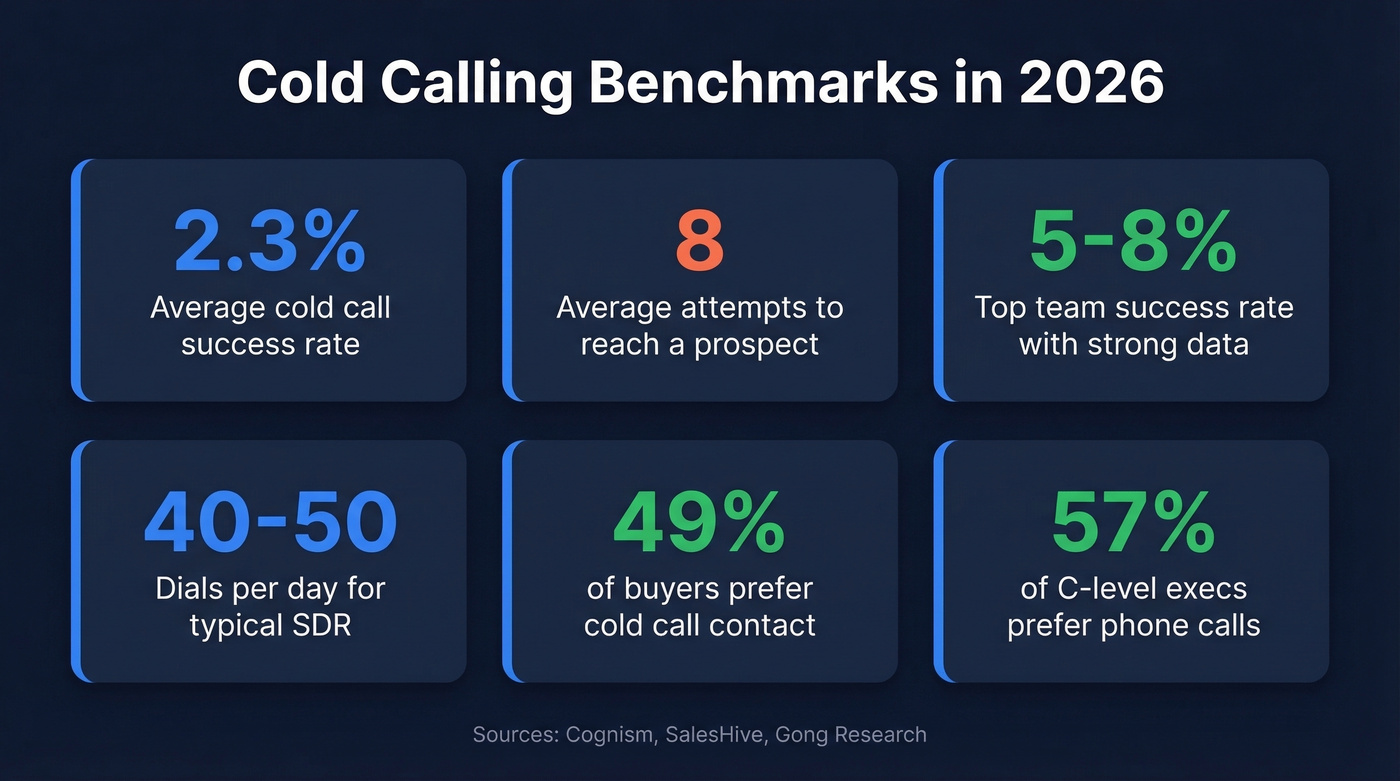
Here's what makes the gap interesting: 49% of buyers prefer being contacted via cold call, and 57% of C-level executives and VPs prefer phone over other channels. The demand for good phone conversations is there. Most reps never get to the conversation because they're dialing wrong numbers, calling at random times, or fumbling the first 15 seconds.
So do scripts work? The data says yes - when they're paired with clean data and real practice.
Connect rates depend heavily on data quality. Bad numbers tank even the best talk tracks. Teams waste huge chunks of their day on disconnected lines and dead ends before they realize the problem isn't the pitch - it's the list.
How to Write a Sales Pitch Script
Every effective pitch follows the same architecture, whether you're selling $5K SaaS seats or $500K enterprise contracts:
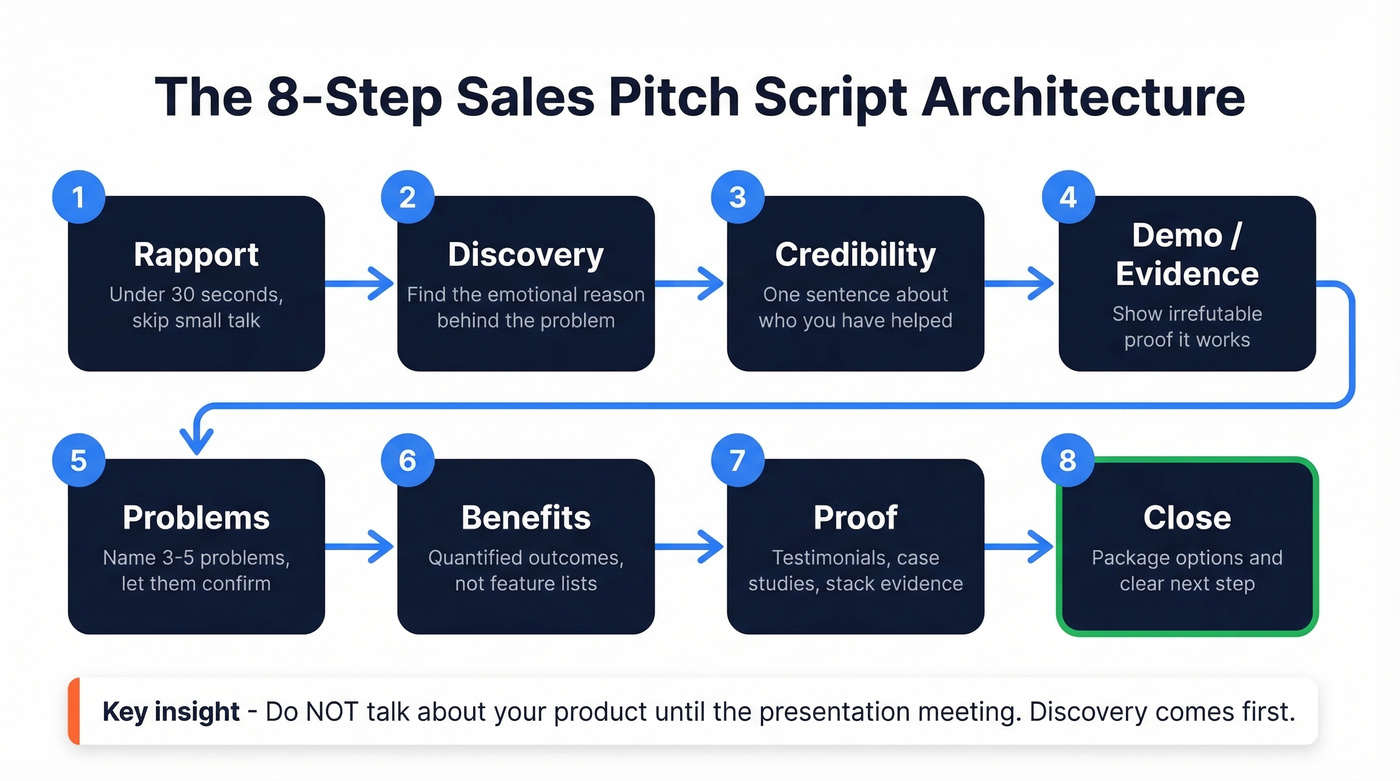
- Rapport - Skip "How's your day?" Ask what they do, what got them into it. Under 30 seconds.
- Discovery - Make them feel understood, gather info you'll reference later, and pull out the emotional reason behind the problem. This is where deals are won.
- Credibility - One sentence about who you've helped. Not a company history lesson.
- Demo/Evidence - Show, don't tell. Irrefutable proof that your thing works.
- Problems - Name 3-5 problems they're likely facing. Let them confirm.
- Benefits - "Cut onboarding time by 37%" beats "we have an onboarding module."
- Proof - Testimonials, case studies, second demo. Stack the evidence.
- Close - Package options and a clear next step.
The key insight from practitioners on r/sales: until you have the presentation meeting, avoid talking about your product, your benefits, or your company. Discovery comes first. One rep who refined this approach reported a 550% lift in average sales volume per call. Even if that number is generous, the direction is right - discovery-first scripts dramatically outperform pitch-first scripts.
7 Script Examples That Book Meetings
Cold Call (Permission Opener)
"Hey [First Name], it's [Your Name] with [Company]. Appreciate I caught you out of the blue - you got a minute?"
[Pause. Let them respond.]
"We help companies like [Their Competitor] do [your coolest feature]. The purpose of my call was to set aside a half hour later this week to share an executive briefing on [2-3 trends affecting their industry]. Does [time] on [day] work?"
[Two-second pause. Don't fill the silence.]
The permission opener works because it acknowledges the interruption and hands control to the prospect. The executive briefing ask works because it's a value trade - you're offering industry intelligence, not a product demo. Contacts refuse meetings when reps don't trade enough value for their time. Stating a clear reason for calling increases success rates by 2.1%, according to Gong research. Slow your speaking pace, stand up, and let your posture carry your tone.
Warm Follow-Up
"Hey [First Name], it's [Your Name] from [Company]. I sent you a couple emails this past week about [topic] - looks like you had a chance to open them. Wanted to put a voice to the name and see if [specific problem] is on your radar right now."
We've found that reps who call 4 times during a 2-week, 4-email outbound cadence convert at significantly higher rates. Prioritize calling people who've opened your emails 2+ times - that's intent.
If you need a plug-and-play sequence, use these follow-up templates to keep the cadence tight.
Voicemail
"[First Name], it's [Your Name] with [Company]. We help [industry] teams [one-line value prop]. I'd love 15 minutes to show you how. My number is [number] - that's [number again]."
Under 30 seconds. Say your callback number twice. That's it.
Gatekeeper
"Hi, is [First Name] available?"
Confident. Brief. Use the contact's first name - it signals familiarity. Don't pitch the gatekeeper. If they ask what it's regarding: "It's about [broad business topic]. They'll know what it's about." Friday afternoons work well for reaching VPs and C-suite because gatekeepers are typically gone.
Referral
"Hey [First Name], [Mutual Connection] suggested I reach out. They mentioned you're dealing with [specific problem], and we helped them [specific result]. Worth a 15-minute conversation?"
Lead with the name. The mutual connection does 80% of the work for you.
Email Pitch Script
Subject line: [First Name] - quick question about [specific problem]
"[First Name], we helped [Similar Company] [quantified result]. I think we can do the same for [Their Company]. Open to a 15-minute call this week?"
Three sentences max. One CTA. No attachments. No "I hope this email finds you well."
For more subject line ideas, pull from these email subject line examples.
Breakup / Final Attempt
"[First Name], I've reached out a few times and haven't heard back - totally understand you're busy. I'm going to close the loop on my end, but if [problem] becomes a priority, I'm here. Just reply to this thread."
The "closing the loop" framing gives them permission to re-engage later without awkwardness. Some of the best deals come from breakup emails replied to 3 months later.
Objection Handling Scripts
The prospect says "not interested" four seconds into your call. That's not an objection - it's a reflex. Real objections come after you've earned 30 seconds of attention. This is where knowing when to get off the script and respond to the human in front of you matters most.
If you want a deeper playbook for handling pushback, see cold call rejection.
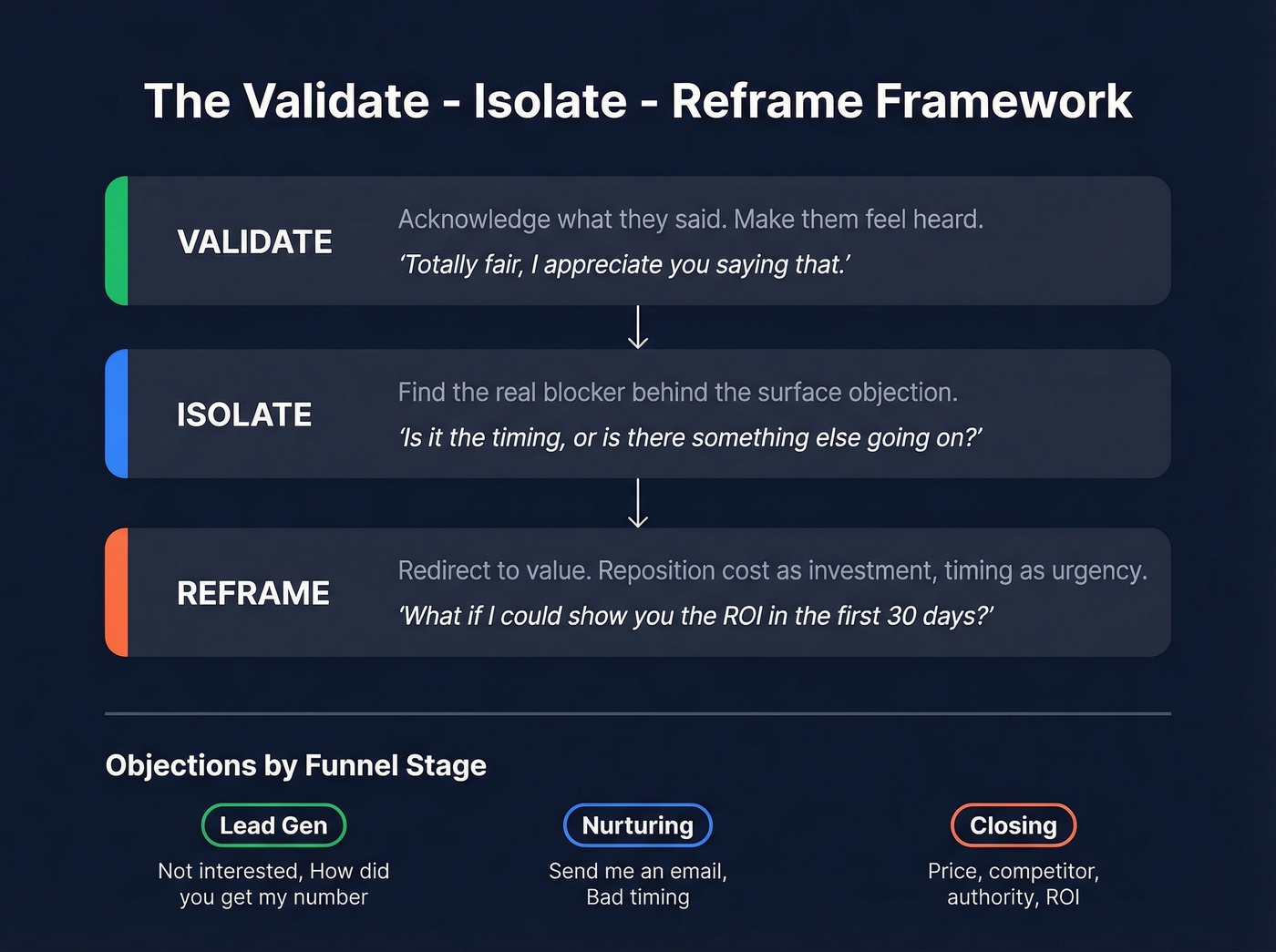
The framework that works across every objection type is Validate - Isolate - Reframe:
- Validate: Acknowledge what they said. "Totally fair."
- Isolate: Find the real blocker. "Is it the timing, or is there something else?"
- Reframe: Redirect to value. Reposition cost as investment, timing as urgency.
| Funnel Stage | Common Objections |
|---|---|
| Lead generation | "Not interested," "How'd you get my number?" |
| Nurturing | "Send me an email," "Bad timing" |
| Closing | Price, competitor, authority, ROI |
Six you'll hear every week:
"Not interested." "Totally fair - most people say that before they hear why I called. Give me 30 seconds, and if it's not relevant, I'll hang up. Deal?"
"How'd you get my number?" "Fair question. I was researching companies in [industry] dealing with [problem], and your name came up. Give me 20 seconds to explain why - if it's not relevant, I'll let you go."
"It's too expensive." "I hear you. If price wasn't an issue, is this the solution you'd choose to solve [problem]?" Then walk through ROI. The price objection is almost never about price - it's about perceived value.
"We already use [Competitor]." "Great - [Competitor] is solid for [their strength]. Where most teams hit a wall is [your differentiator]. How are you handling that today?"
"Now's not a good time." "Understood. What changes next quarter that makes it better? Because right now, [problem] is costing you roughly [X] per month in [lost revenue/wasted time]."
"Just send me an email." "Happy to. So I send you something relevant - what's the biggest challenge you're dealing with around [topic] right now?" Turn the brush-off into a discovery question.

You read it above: connect rates depend heavily on data quality. Bad numbers tank even the best talk tracks. Prospeo gives you 125M+ verified mobile numbers with a 30% pickup rate - so your script actually reaches a human.
Stop rehearsing for an audience that doesn't exist.
Industry-Specific Openers
Generic openers get generic results. Here are five verticalized openers that actually land:
| Industry | Opener |
|---|---|
| SaaS | "We helped [Company] cut onboarding time by 37%. Open to seeing if we can do the same for your team?" |
| Real Estate | "I noticed [property/building] is coming up on lease-up. We've helped similar properties in the area fill faster - worth a quick, no-pressure look?" |
| Insurance | "Quick question - if you had to file a claim tomorrow, do you feel confident you'd be fully covered?" |
| Recruiting | "You're probably not actively looking, but I've got something that might be worth two minutes of your time." |
| Financial Services | "I'm not selling anything today. I'd love 15 minutes to share a couple strategies we're seeing work for [similar firms] right now." |
The pattern is the same across all five: lead with relevance, not your product. Each opener earns the next 30 seconds.
If you're building a full outbound motion (not just a script), start with these sales prospecting techniques.
Script Mistakes That Kill Deals
Your hook is too long. Keep it to 2-3 sentences. You have 15-30 seconds before the prospect decides whether to stay or hang up.
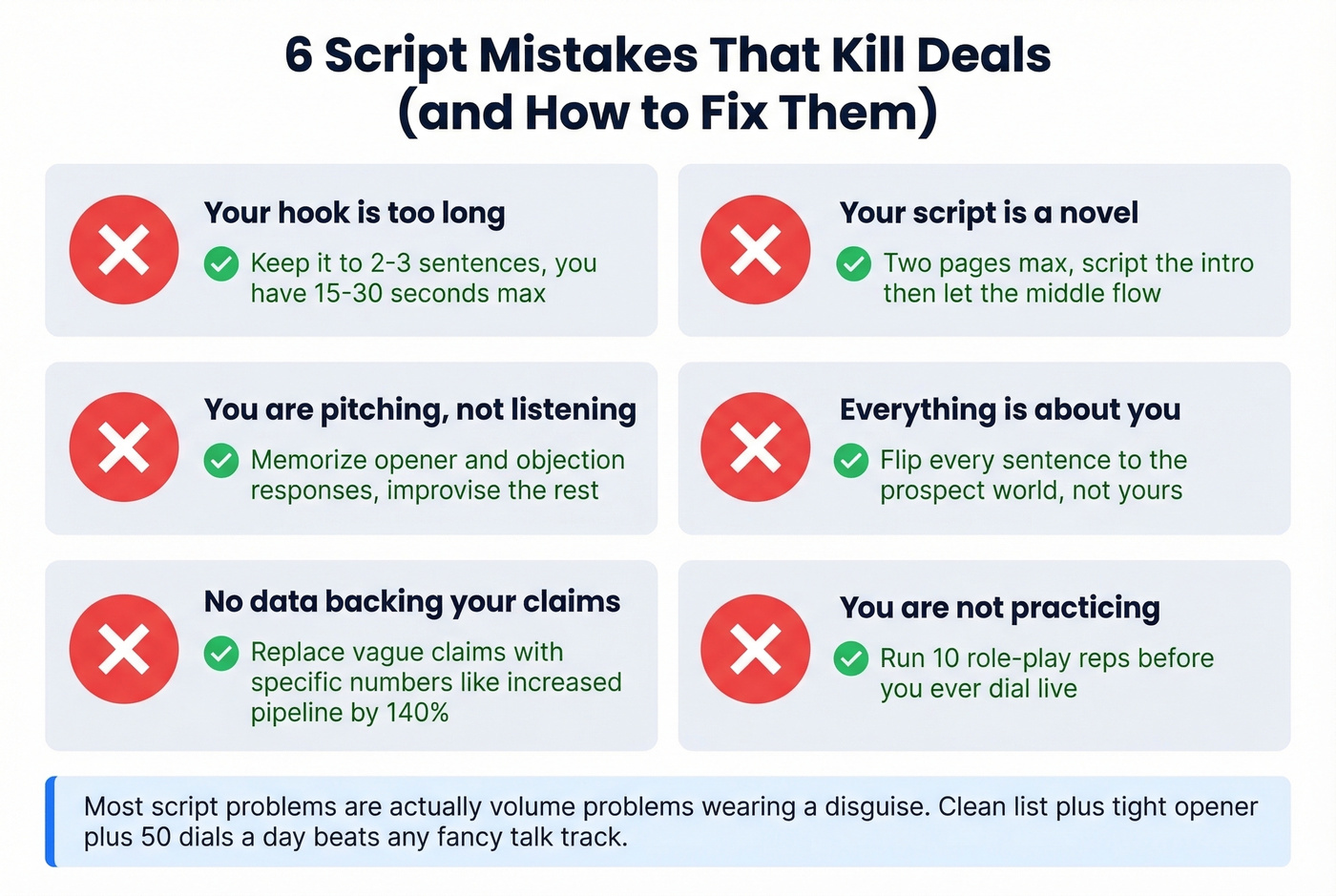
Your script is a novel. If it's longer than two pages, you've written a monologue, not a talk track. Script the intro and value prop, then let the middle flow naturally.
You're pitching, not listening. The script is a skeleton. Memorize the opener and objection responses, then improvise the rest.
Everything is about you. "We're the leading provider of..." - nobody cares. Flip every sentence to the prospect's world.
You're not backing claims with data. "We help companies grow" means nothing. "We helped [Company] increase pipeline by 140%" means everything. Data-backed pitches convert at dramatically higher rates.
You're not practicing. Run your script through 10 role-play reps before you dial live. Scripts that sound scripted get hung up on - practice makes them sound natural.
Here's the thing: if your average deal size is under $10K, you probably don't need a 3-page talk track or a $50K sales enablement platform. You need a clean list, a tight opener, and the discipline to dial 50 times a day. Most script problems are actually volume problems wearing a disguise.
Data Quality Makes or Breaks Your Script
Let's be honest - if 30% of your phone numbers are wrong, you've wiped out roughly a third of your connects and meetings before your sales pitching script even gets a chance to work. That's not a math problem. It's a morale problem. Reps who hit wrong numbers 15 times before lunch stop dialing with conviction.
In our experience, the single biggest ROI improvement for outbound teams isn't a better script - it's cleaner data. Prospeo's database covers 300M+ professional profiles with 98% email accuracy and 125M+ verified mobile numbers hitting a 30% pickup rate. Data refreshes every 7 days, not the 6-week industry average that lets numbers go stale between campaigns. You can filter by 30+ criteria including technographics, job changes, headcount growth, and 15,000 intent topics, then export a verified list straight to your sequencer.
If you're comparing vendors, start with these data enrichment services and sales prospecting databases.
The free tier gives you 75 emails per month and 100 Chrome extension credits with no contract and no credit card. Before you run any of these scripts, build a clean list. The best words in the world don't matter if nobody picks up.

The best cold call script in the world can't save a dead number. Prospeo refreshes every record every 7 days - not 6 weeks like competitors - so your SDRs spend time pitching, not chasing disconnected lines. At $0.01 per email, bad data is no longer an excuse.
Turn your 2.3% connect rate into 5-8% with data that's actually fresh.
SPIN vs MEDDICC: Which Framework Fits?
| SPIN | MEDDICC | |
|---|---|---|
| Best for | Shorter cycles, simpler deals | $100K+ multi-stakeholder deals |
| Style | Conversational, flexible | Structured qualification compass |
| Risk | Too loose for complex deals | Overkill for sub-$20K deals |
Skip MEDDICC for a $5K deal. It's designed for complex enterprise sales where you need to map decision processes, validate champions, and quantify metrics. The outbound order: Identify Pain, build Champion, develop Metrics, understand Decision Process, access Economic Buyer, clarify Paper Process.
If you're going deeper on qualification, use this MEDDIC sales qualification guide.
SPIN works better for shorter cycles where the conversation itself is the qualification. Companies with a defined sales process are 33% more likely to be high performers and see 18% more revenue growth. The methodology matters less than having one at all - if your team treats MEDDICC like a CRM checkbox exercise, it'll fail regardless.
How AI Is Changing Sales Scripts
AI tools now save reps up to 2 hours per day on call prep, follow-ups, and note-taking. Teams that adopt them report 44% higher productivity. The biggest shift is conversation intelligence: teams can review 95% of calls versus the 3% they'd catch manually, and users see a 15% increase in win rates by replicating successful talk patterns across the org.
The next frontier is dynamic scripts that branch in real time based on prospect responses - but for now, the ROI is in post-call analysis, not live prompting. Log your call outcomes in your CRM, review what's working weekly, and iterate. The tool categories worth watching: coaching platforms for practice reps, conversation intelligence for call review, and engagement platforms like Outreach and Salesloft for sequencing. None of them replace a good pitch script. They amplify one.
If you're evaluating tooling, start with these SDR tools and generative AI sales tools.
FAQ
How long should a sales pitch script be?
Two pages max - script your intro and value prop, not the full conversation. Your hook window is 15-30 seconds, so front-load the strongest language and let the middle flow naturally from discovery.
What's the average cold call success rate?
About 2.3% across B2B, meaning roughly 1 meeting per 43 dials. Top teams with verified data and structured coaching push that to 5-8%.
Should I read a script word for word?
No - use it as a talk track. Memorize the opener and objection responses, then improvise the middle. The best reps know when to leave the script and have a real conversation.
When's the best time to make sales calls?
8-9am or 4-5pm lifts connect rates by 40-70%. Friday afternoons work especially well for reaching C-suite since gatekeepers are typically gone by then.
How do I make sure I'm calling valid numbers?
Use a verified data platform before dialing. Prospeo's 125M+ verified mobiles hit a 30% pickup rate, and the free tier lets you validate a list before committing budget.