

Sales Process Template That Actually Works in Your CRM
You're staring at a blank Google Doc titled "Sales Process v1" and you already know what's going to happen. You'll sketch some stages, add a few bullet points, share it in Slack, and nobody will look at it again. 81% of sales and marketing teams never review or update their sales processes. That's not a motivation problem - it's a template problem. Most sales process template downloads are unusable PDFs with no exit criteria, no benchmarks, and no connection to the CRM where deals actually live.
What you need: exit criteria per stage, conversion benchmarks, and CRM field mapping. This article gives you all three. If you just want the template table, jump to Section 3.
Process vs Pipeline vs Funnel
Your sales process defines the steps, activities, and gates reps follow to move a buyer from "stranger" to "customer." Your pipeline is the visual representation of deals moving through those stages - process is the playbook, pipeline is the scoreboard. A funnel measures volume and conversion at each stage; a pipeline tracks individual deal progression.
Here's where most teams go wrong: they confuse a sales process with a training manual. Alexander Group found that effective process docs run 10-15 pages max. The stages should reflect buyer actions, not internal milestones. "Demo completed" is an internal event. "Prospect confirms solution fit and agrees to explore a contract" is a buyer action. Build around the buyer, not your org chart.
The 7-Stage Template
We've condensed Avoma's 9-stage framework into seven stages that work for most B2B teams, built around Vouris's three design questions: What are your deal stages? What happens inside each? How does a deal earn the right to move forward?
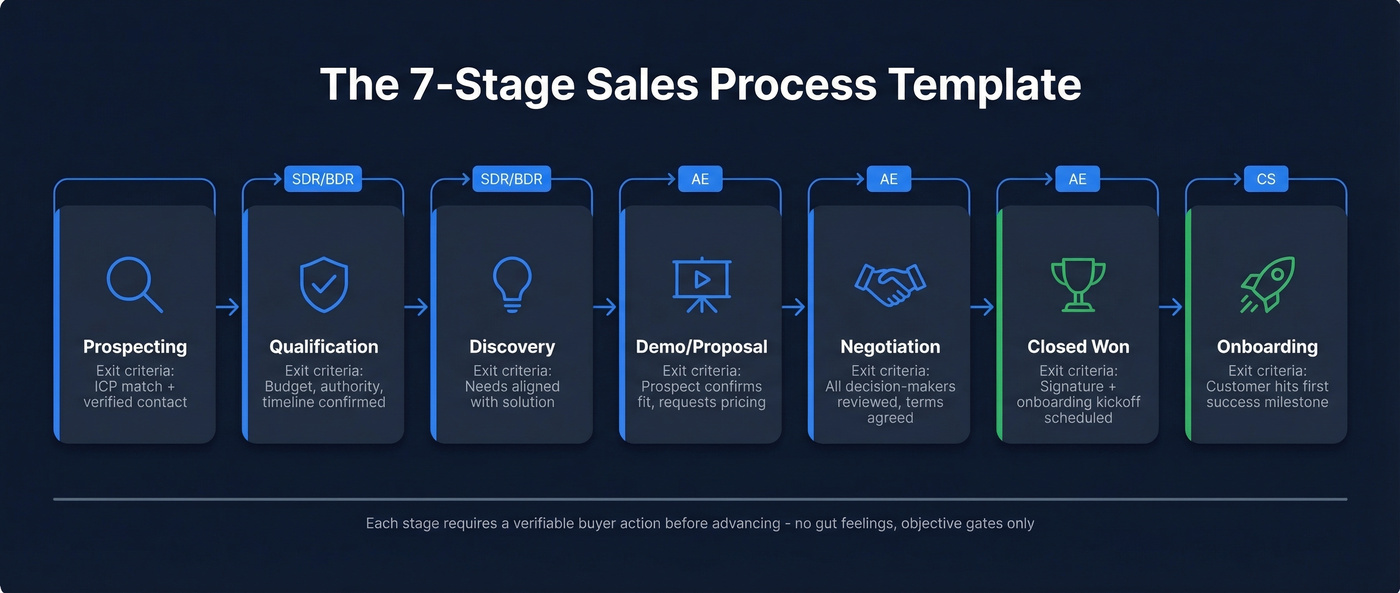
The governing principle is simple: a deal can't advance until a specific, verifiable buyer action has taken place. No gut feelings. Objective gates.
| Stage | Key Activities | Exit Criteria | CRM Fields | Owner |
|---|---|---|---|---|
| Prospecting | ICP research, list building, outreach | ICP match + verified contact | Lead source, ICP score, contact method | SDR/BDR |
| Qualification | Discovery call, BANT/MEDDIC screen | Budget, authority, timeline confirmed | Budget range, authority contact, timeline | SDR/BDR |
| Discovery | Needs analysis, stakeholder mapping | Needs aligned with solution | Pain points, stakeholder map, competitor | AE |
| Demo/Proposal | Tailored demo, proposal delivery | Prospect confirms fit, requests pricing | Demo date, proposal sent, champion name | AE |
| Negotiation | Terms discussion, procurement nav | All decision-makers reviewed, terms agreed | Discount %, legal contact, procurement stage | AE |
| Closed Won | Contract signed, handoff initiated | Signature + onboarding kickoff scheduled | Close date, contract value, CS owner | AE |
| Onboarding | Implementation, first value delivery | Customer hits first success milestone | Onboarding status, go-live date, NPS | CS |

Prospecting is where most processes quietly fail. Reps spend hours building lists only to watch 35%+ of emails bounce on the first sequence because the underlying contact data is garbage. Prospeo addresses this head-on: 98% verified email accuracy across 300M+ professional profiles on a 7-day refresh cycle, so your pipeline starts with clean contacts instead of bounced messages.
Qualification is your first real gate. The deal stays put until the prospect confirms budget exists, identifies the decision-maker, and states a timeline. Missing any one of those? The deal doesn't move.
Discovery goes deeper. You're documenting specific pain points, mapping every stakeholder, and confirming your solution actually fits. Here's what "good" looks like at this stage: the prospect can articulate their problem back to you in their own words, and you can name every person who'll influence the decision.
Demo/Proposal is where you prove it. "Great demo, we'll be in touch" doesn't count as an exit criterion - the prospect needs to verbally confirm the solution meets their needs and express intent to explore a contract. For Negotiation, all decision-makers must have reviewed the proposal. Not just your champion, but the CFO, procurement lead, whoever holds a veto.
Closed Won triggers the handoff: use a workflow to create a new deal in your onboarding pipeline automatically. And Onboarding isn't optional - including it ensures CS doesn't inherit deals blind and customers don't churn before they see value.
Stage Conversion Benchmarks
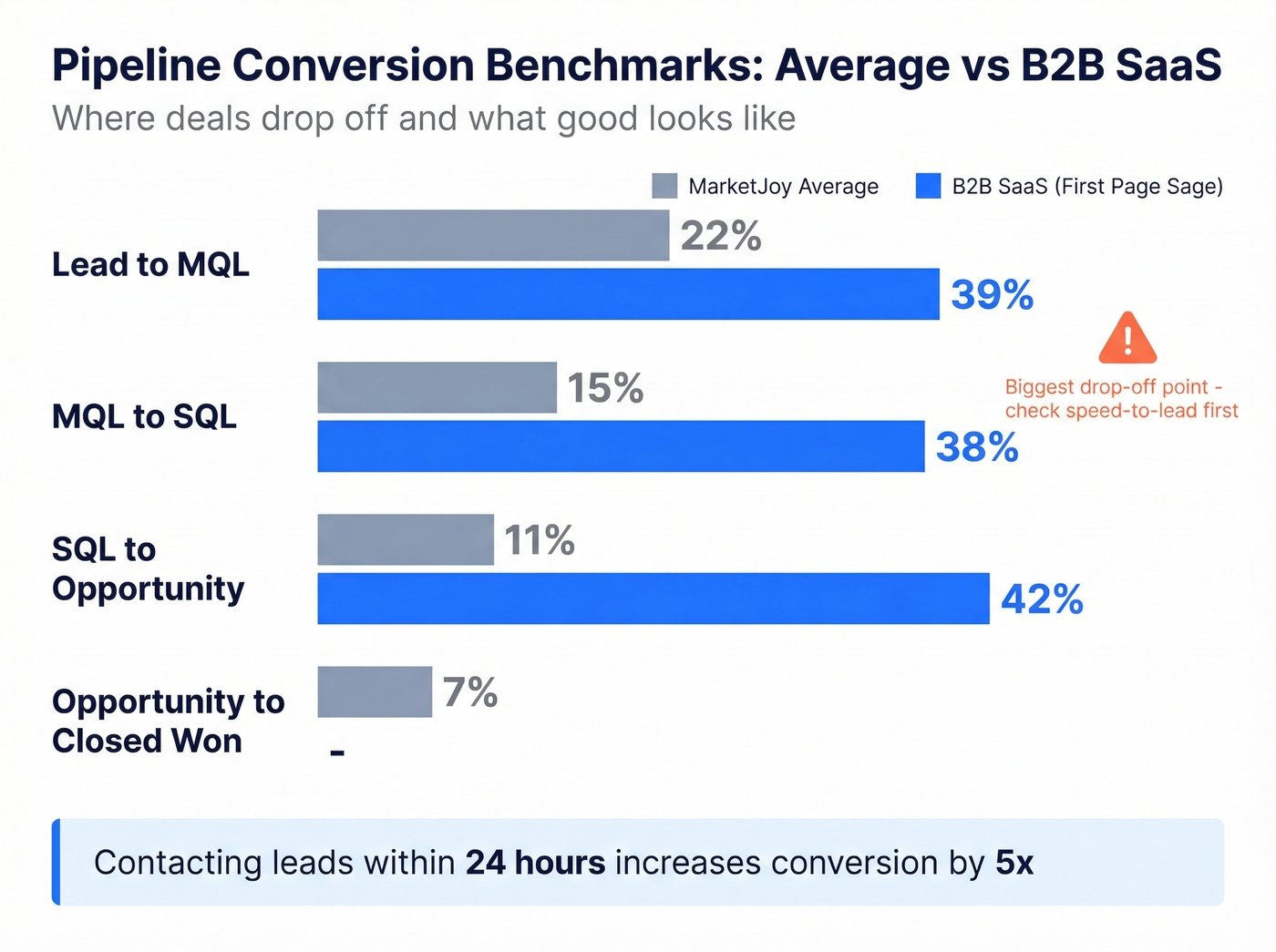
A template without benchmarks is just a wish list. Here's what "good" looks like, based on MarketJoy's aggregated pipeline data and First Page Sage's cross-industry benchmarks:
| Conversion Step | MarketJoy Avg | B2B SaaS (First Page Sage) |
|---|---|---|
| Lead to MQL | 22% | 39% |
| MQL to SQL | 15% | 38% |
| SQL to Opportunity | 11% | 42% |
| Opportunity to Closed Won | 7% | - |
The biggest drop-off in most pipelines happens at MQL to SQL. That's the handoff between marketing and sales, and it's where misaligned ICP definitions, slow follow-up, and bad contact data do the most damage. Contacting leads within 24 hours increases conversion by 5x - yet most teams let MQLs sit for days. If your MQL to SQL rate is below 15%, look at speed-to-lead before you blame marketing's targeting.
If you want a deeper view of what to track beyond stage-to-stage conversion, use a simple pipeline health scorecard alongside this table.

Your prospecting stage is the foundation of every conversion benchmark on this page. If 35% of emails bounce, no exit criteria or CRM field mapping will save your pipeline. Prospeo delivers 98% verified email accuracy across 300M+ profiles - refreshed every 7 days - so deals enter your process with clean, real contacts from day one.
Stop building your sales process on broken data.
Adapting the Template by Segment
B2B vs B2C
The seven-stage template above is built for B2B. B2C looks fundamentally different.
| Dimension | B2C | B2B |
|---|---|---|
| Cycle length | Minutes to days | 3-6 months typical |
| Touchpoints | 3-5 over ~2 weeks | 10+ over 3-6 months |
| Decision-makers | 1-2 people | Committee of 3-10+ |
| Close timeline | Often same session | 75% of deals take 4+ months |
If you're selling B2C, collapse Qualification, Discovery, and Demo into a single "Evaluate" stage. B2B teams shouldn't - compressing those steps kills forecast accuracy because you lose visibility into where deals actually stall.
SMB vs Mid-Market vs Enterprise
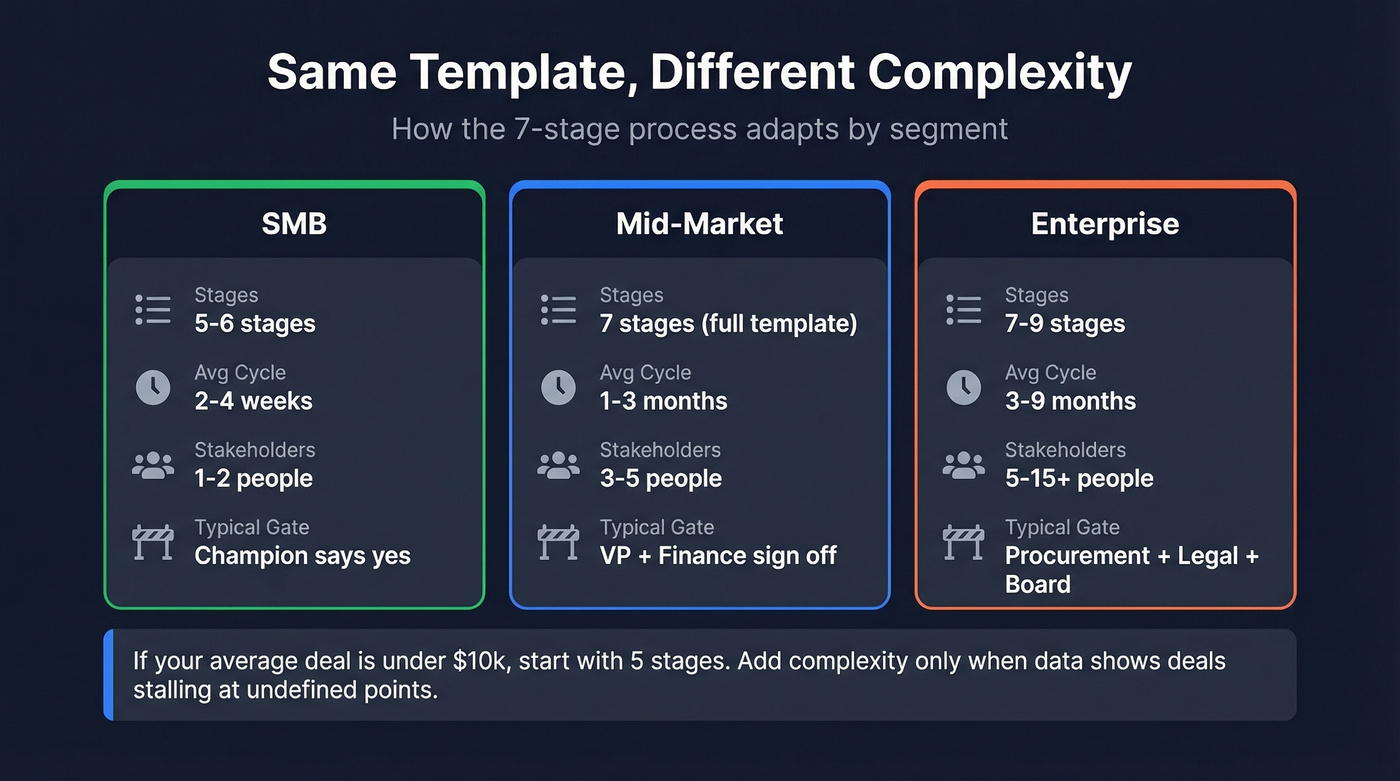
The same seven stages apply across segments, but time-in-stage and gate complexity change dramatically.
| Dimension | SMB | Mid-Market | Enterprise |
|---|---|---|---|
| Stages used | 5-6 (compress Negotiation) | 7 (full template) | 7-9 (add Procurement, Legal) |
| Avg cycle | 2-4 weeks | 1-3 months | 3-9 months |
| Stakeholders | 1-2 | 3-5 | 5-15+ |
| Typical gate | Champion says yes | VP + Finance sign off | Procurement + Legal + Board |
Look, if your average deal size is under $10k, you don't need seven stages. Compress Negotiation into Demo/Proposal and skip the formality. The overhead of enforcing seven gates on a two-week deal cycle will slow reps down more than it helps your forecast. Start with five stages and add complexity only when your data shows deals stalling at undefined points.
Choosing a Qualification Framework
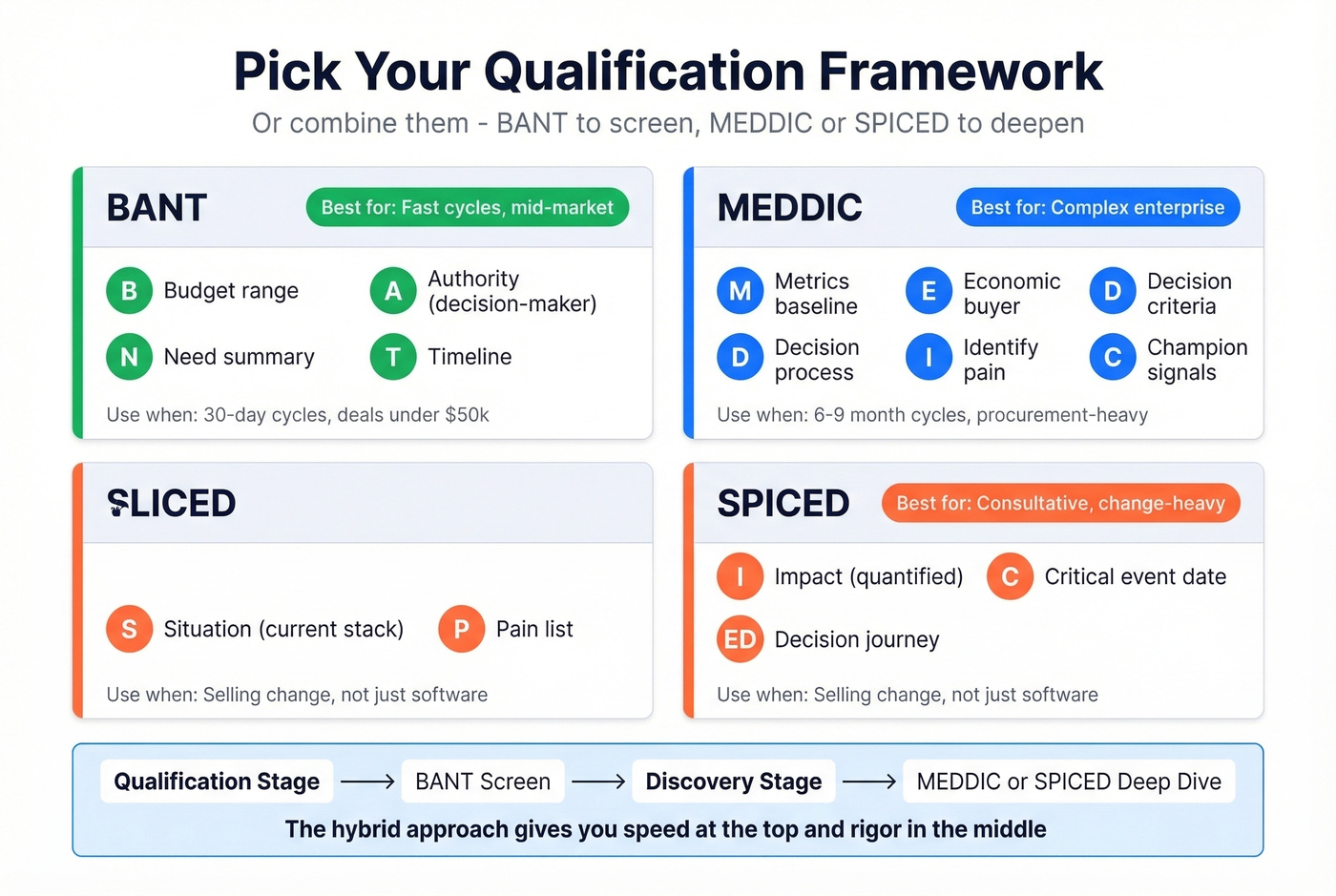
Your qualification framework determines what CRM fields you need and how reps evaluate deals at the gate.
| Framework | Best For | Key CRM Fields |
|---|---|---|
| BANT | Transactional, mid-market, fast cycles | Budget range, decision-maker, timeline, need summary |
| MEDDIC | Complex enterprise, procurement-heavy | Metrics baseline, champion signals, decision criteria, paper process |
| SPICED | Consultative, change-heavy sales | Current stack, pain list, quantified impact, critical event date |
BANT works best when you need a quick screen - does this prospect have budget, authority, need, and timeline? For a 30-day cycle selling $15k deals, BANT is plenty.
MEDDIC shines in six-to-nine-month enterprise cycles where procurement runs the show. You need to know the Metrics the buyer cares about, the Economic Buyer, the Decision Criteria, the Decision Process, the Pain, and your Champion. Each becomes a CRM field your AE must fill before advancing past Discovery.
SPICED anchors on the buyer's Situation, Pain, Impact, Critical Event, and Decision journey. It's ideal for consultative sales where you're selling change, not just software.
Here's the thing: you don't have to pick one. The hybrid approach - BANT screen at Qualification, then deepen with MEDDIC or SPICED at Discovery - gives you speed at the top and rigor in the middle. Turn CRM fields into tasks: when an AE identifies the economic buyer in MEDDIC, the CRM auto-creates a task to "Schedule CFO discussion."
If you want a ready-to-use set of questions for the MEDDIC portion, pull from these MEDDIC discovery questions.
Implementing the Template in Your CRM
Getting the template into your CRM is where most teams stall. Two non-negotiable steps: create stages as pipeline stages (not custom fields - both HubSpot and Salesforce support this natively) and enforce required fields per stage. In HubSpot, use the native required-field setting on deal stages. In Salesforce, use validation rules that fire on stage change. If a rep can't fill in "Budget Range" and "Decision-Maker Contact," the deal doesn't move to Discovery. Period.
The #1 mistake in HubSpot implementations is moving deals between pipelines - it erases movement history and breaks reporting. Instead, set a Closed Won workflow trigger to create a new deal in your onboarding pipeline, copy relevant info, and assign the CS owner automatically. We've seen this single change fix reporting for entire RevOps teams.
Beyond pipeline structure, set up lead routing rules and SLAs so inbound MQLs get assigned within minutes, not days. Audit stage distribution weekly. If 60% of your pipeline sits in "Discovery" for 30+ days, your exit criteria are too loose or reps are parking deals there to avoid scrutiny.
For contact enrichment inside your CRM, Prospeo's Salesforce and HubSpot integrations return 50+ data points per contact without reps toggling between tabs to find a phone number - which keeps the pipeline moving instead of stalling on data gaps. If you're evaluating vendors, compare options in our guide to data enrichment services.
Mistakes That Kill Adoption
Confusing process with training manual. Your sales process is a 10-15 page blueprint, not a 100-step procedures document. If reps need a table of contents to find their stage, you've overbuilt it.
Launching in isolation. A process that isn't integrated with training, coaching, incentives, and CRM enforcement dies fast. You need buy-in from enablement, RevOps, and frontline managers - not just a VP of Sales decree.
Building around internal milestones. "Demo completed" isn't an exit criterion. "Prospect confirms solution fit and requests pricing" is. Every gate should reflect a verifiable buyer action.
Skipping the gap assessment. Before you roll out a new process, measure where deals currently stall. Pull stage-to-stage conversion rates, average time-in-stage, and win/loss reasons. Without a baseline, you can't tell if the new process is working. (If you need a structured approach, start with sales process optimization.)
Never reviewing the process. Review your sales process template quarterly. Pull conversion rates and time-in-stage data. If a stage's conversion drops from your baseline, tighten the exit criteria or retrain reps on that gate. In our experience, teams that skip the quarterly review end up rebuilding from scratch within a year - and that's a much bigger time sink than a 90-minute review session.
That MQL-to-SQL drop-off? Bad contact data is the silent killer. When reps can't reach the right person within 24 hours, conversion craters. Prospeo gives you verified emails at $0.01 each and 125M+ direct dials with a 30% pickup rate - so your reps hit every exit criterion on the first attempt, not the fifth.
Close the gap between your process template and pipeline reality.
FAQ
How many stages should a sales process have?
Seven stages work for most B2B teams with deal cycles over 30 days. If your average contract value is below $8k and cycles run under three weeks, compress to five stages. Run the full template for 90 days, then let pipeline data tell you where to add or remove gates.
What's the difference between a sales process and a sales pipeline?
Your sales process defines the steps and exit criteria reps follow to advance a deal. Your pipeline is the visual snapshot of deals sitting in those stages right now. Process is the playbook; pipeline is the scoreboard. You can't build an accurate pipeline without a documented process underneath it.
How often should I update my sales process template?
Quarterly, at minimum. Pull stage-to-stage conversion rates and compare against your benchmarks. If a stage's conversion drops below baseline or average time-in-stage spikes beyond 2x the norm, that's your signal to revisit exit criteria, rep training, or data quality at that gate.
What's the best free tool for prospecting-stage data?
Prospeo's free tier includes 75 verified emails and 100 Chrome extension credits per month - enough to validate your ICP list before committing budget. For teams running real outbound campaigns, 98% email accuracy prevents the bounce-rate problems that derail early pipeline.