

The Best Sales Productivity Software in 2026: Fewer Tools, Better Results
A 10-seat sales team spends roughly $15,000-$250,000 a year on software, and the average rep still only sells for 12 hours out of a 40-hour week. The other 28 hours vanish into CRM updates, meeting scheduling, list building, tool switching, and chasing bad contact data. Meanwhile, [73% of B2B buyers](https://www.salesforce.com/sales/state-of-sales/sales-statistics/) actively dodge sellers who send irrelevant outreach.
More tools haven't fixed the problem. The right sales productivity software, chosen deliberately, will.
This article focuses on inside and hybrid sales teams. If you run a field sales org, some picks still apply, but the engagement and scheduling layers will look different for you.
Our Picks at a Glance
| Pick | Best For | Starting Price |
|---|---|---|
| Prospeo | Data accuracy & verification | Free (75 emails/mo); ~$0.01/email |
| Apollo.io | All-in-one prospecting + engagement | Free (1,200 credits/mo); $49/user/mo |
| Outreach | Enterprise sequencing | ~$100-140/user/mo (quote-based) |
| HubSpot Sales Hub | CRM + light automation | Free; paid from $15/user/mo |
Every other tool in your stack is only as good as the data feeding it. Prospeo's 98% email accuracy and 7-day refresh cycle mean your sequences, your CRM, and your reps all start from a clean foundation.
The Stack Bloat Problem
Your team hit 60% of quota last quarter despite adding two new tools. Sound familiar?
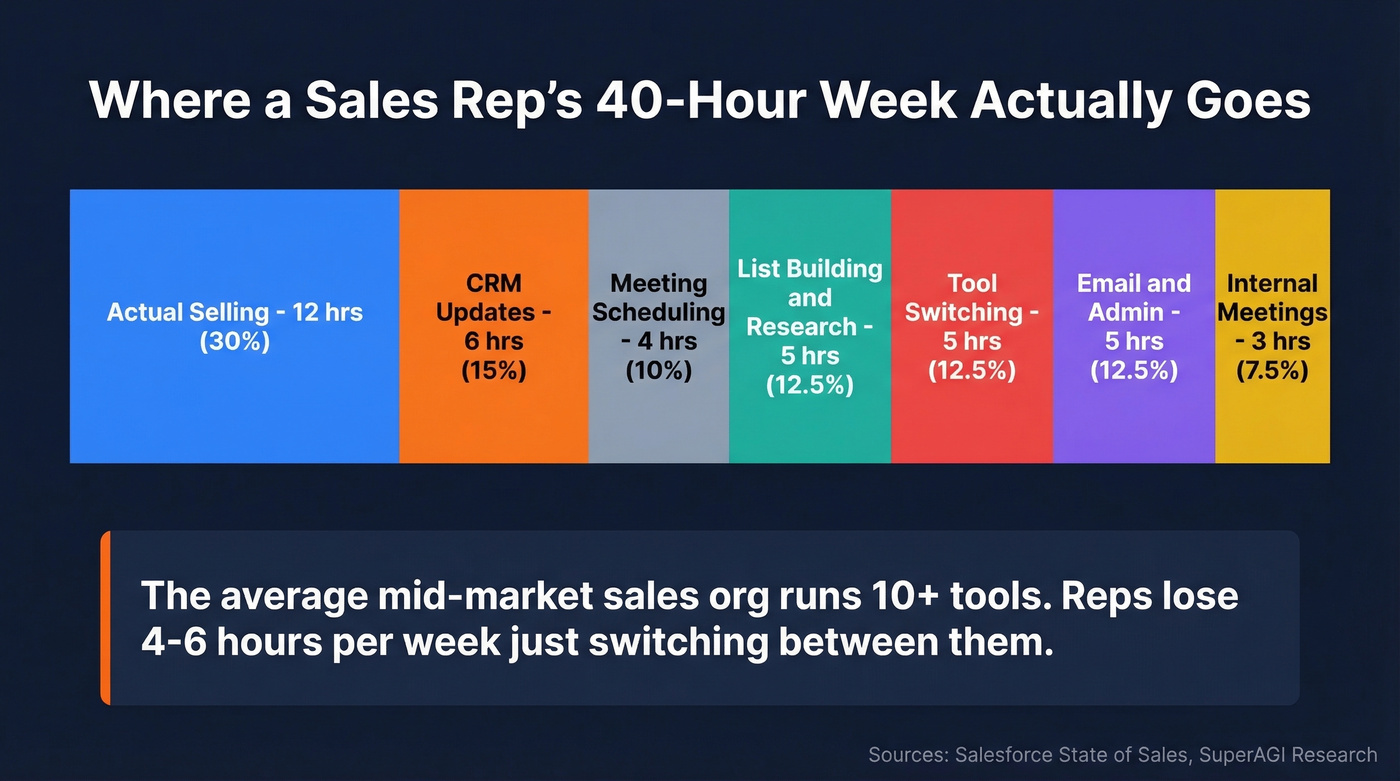
The average mid-market sales org runs 10+ tools across prospecting, engagement, CRM, conversation intelligence, scheduling, and e-signatures. Reps lose [4-6 hours per week](https://hbr.org/2022/08/how-much-time-and-energy-do-we-waste-toggling-between-applications) switching between them - context-switching that kills momentum and focus. And 57% of sales professionals say the sales cycle is getting longer, so adding another tool to a bloated stack doesn't compress that cycle. Consolidating to fewer, better-integrated platforms does.
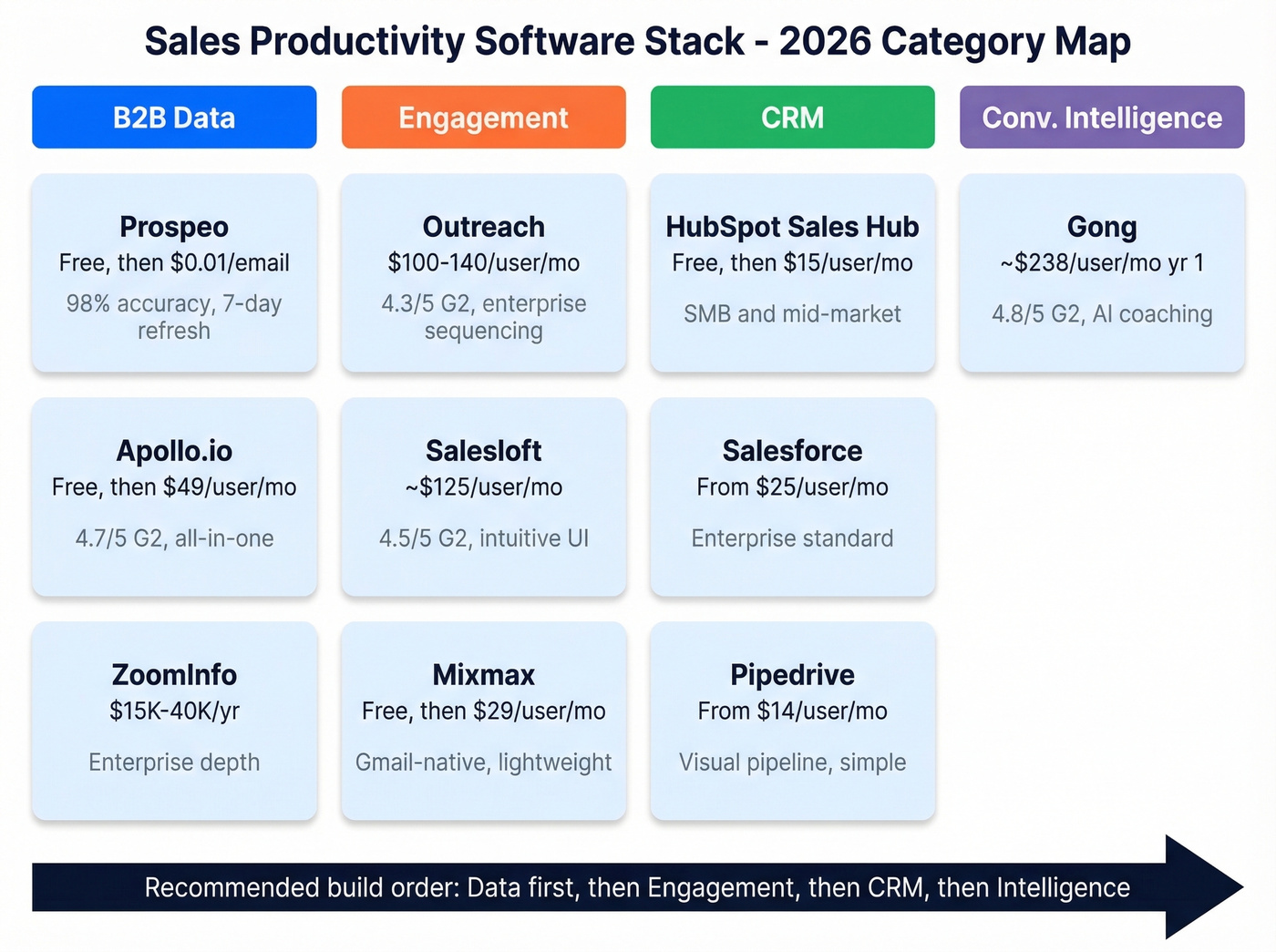
The framework that works is simple: start with accurate data, add one sequencing platform, then layer intelligence only when you have 50+ reps generating enough call volume to justify it.
The AI Layer Worth Watching
AI is reshaping how these tools work under the hood. 83% of sales teams using AI reported revenue growth in the past year, and 88% of reps with AI agents say it increases their odds of hitting targets. The practical applications that matter right now: [HubSpot's Breeze AI](https://www.hubspot.com/products/artificial-intelligence/use-cases/capture-and-qualify-sales-leads) automates lead scoring and follow-up drafting without a dedicated RevOps hire, Salesforce's Agentforce handles routine CRM tasks autonomously, and Gong's AI coaching surfaces patterns across thousands of calls that no manager could catch manually.
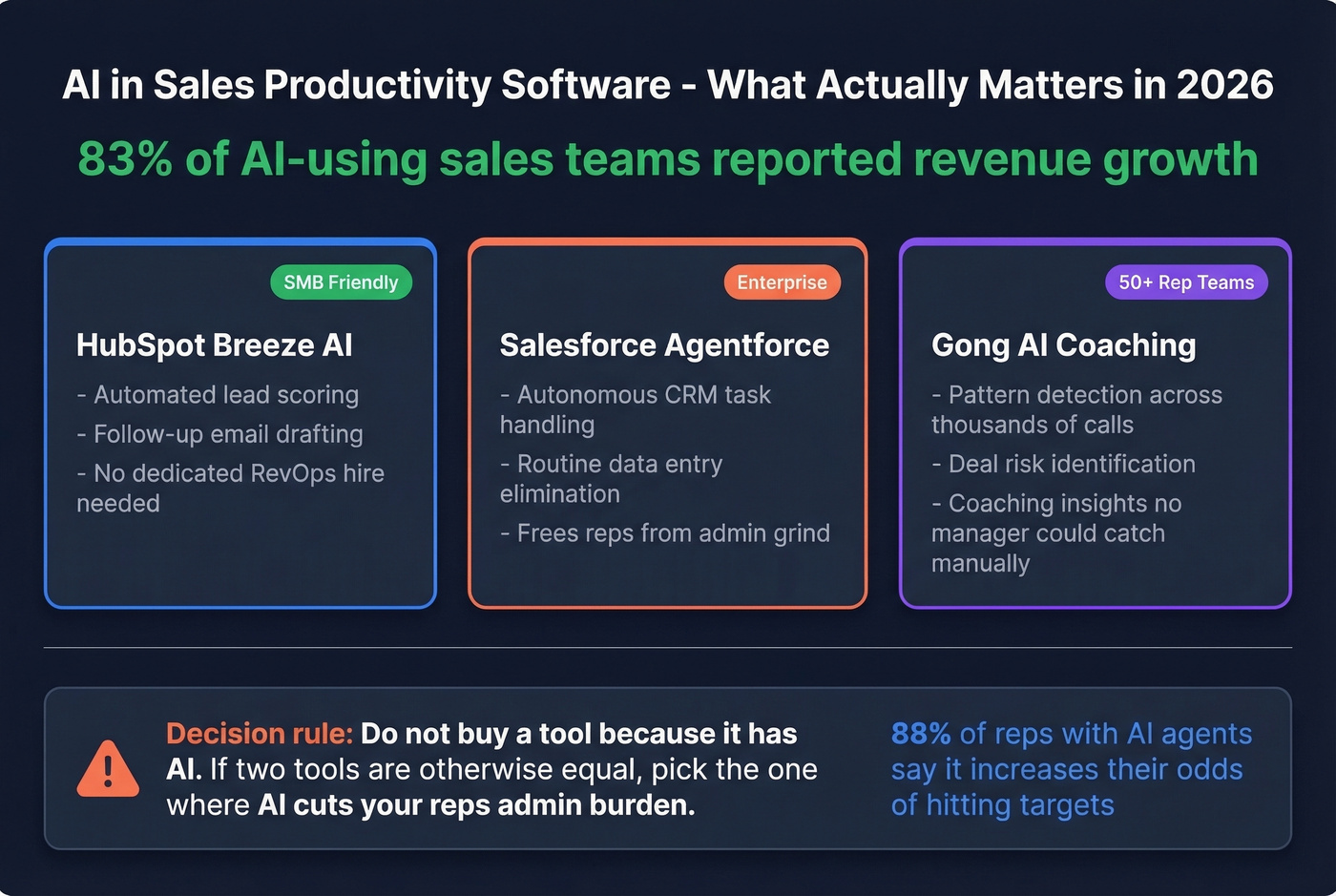
Don't buy a tool because it has AI. But if two tools are otherwise equal, pick the one where AI cuts your reps' admin burden.
Top Tools by Category
| Tool | Category | G2 Rating | Starting Price | Best For |
|---|---|---|---|---|
| Prospeo | B2B Data | - | Free; ~$0.01/email | Email accuracy & freshness |
| Apollo.io | Data + Engagement | 4.7/5 (9,235) | Free; $49/user/mo | All-in-one on a budget |
| ZoomInfo | B2B Data | - | ~$15K-40K/yr | Enterprise data |
| Outreach | Engagement | 4.3/5 (3,511) | ~$100-140/user/mo | Enterprise sequencing |
| Salesloft | Engagement | 4.5/5 (4,237) | ~$125/user/mo | Enterprise orchestration |
| Mixmax | Engagement | - | Free; $29/user/mo | Gmail-native teams |
| HubSpot Sales Hub | CRM | - | Free; $15/user/mo | SMB/mid-market CRM |
| Salesforce | CRM | - | $25/user/mo | Enterprise CRM |
| Gong | Conv. Intelligence | 4.8/5 (6,407) | ~$238/user/mo (yr 1) | Call coaching at scale |
| Calendly | Scheduling | - | Free; $10/user/mo | Meeting booking |
B2B Data & Prospecting
Prospeo
Use this if you're tired of sequences dying because 20-30% of your emails bounce. Prospeo's database covers 300M+ professional profiles with 98% email accuracy, 143M+ verified emails, and 125M+ verified mobile numbers that hit a 30% pickup rate. The 7-day data refresh cycle is one of the fastest in the market - the industry average is six weeks, which means most providers are serving you stale data by default.
If you're comparing vendors, start with email bounce rate benchmarks and what actually causes bounces in outbound.
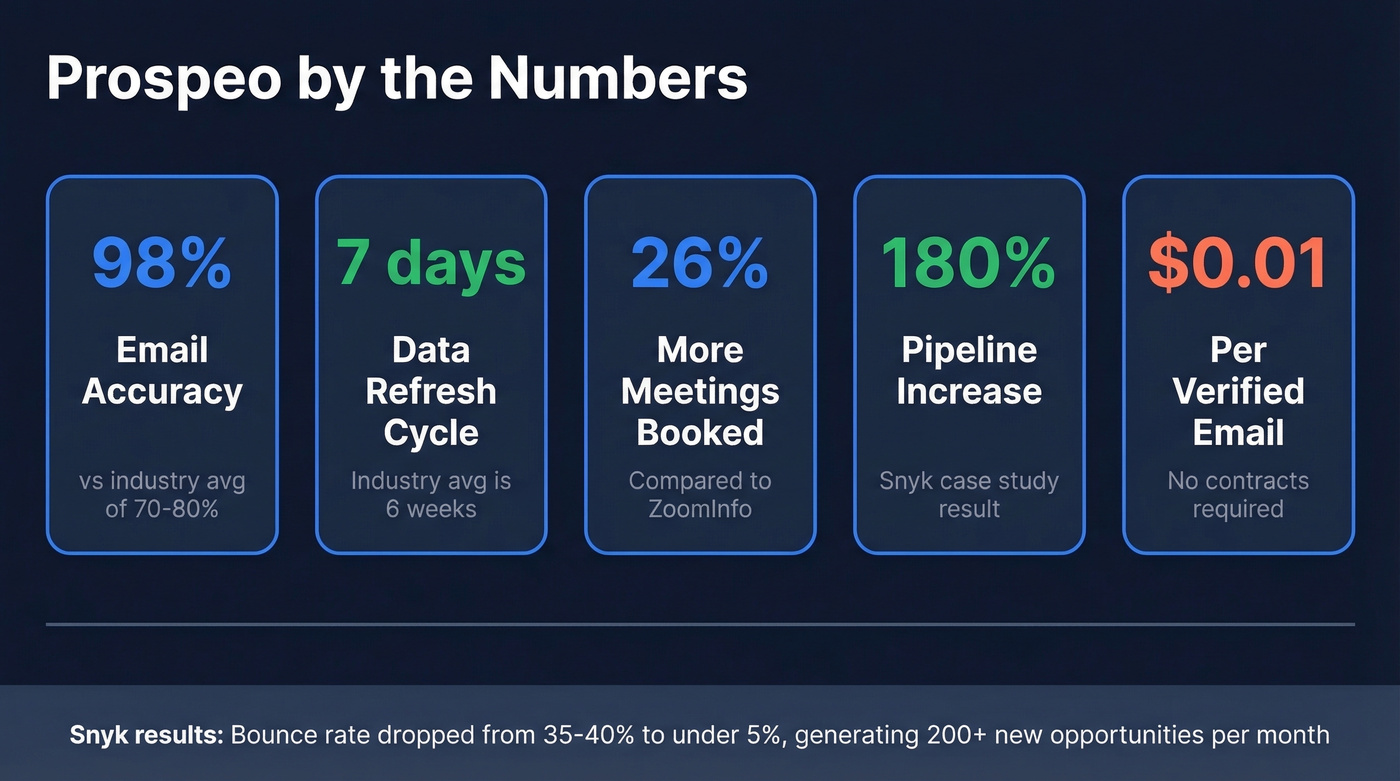
The Chrome extension (40K+ users) lets reps find verified contacts from any website or CRM directly, and intent data powered by Bombora tracks 15,000 topics so you're reaching buyers who are actually in-market. Teams book 26% more meetings compared to ZoomInfo and 35% more compared to Apollo. Snyk's 50-person AE team was running 35-40% bounce rates before switching. After moving to Prospeo, bounces dropped below 5%, AE-sourced pipeline jumped 180%, and they're generating 200+ new opportunities per month. That's not an incremental improvement - it's a completely different pipeline output.
Pair it with Outreach or Apollo for sequence management and you get best-in-class data feeding best-in-class engagement. At ~$0.01 per lead with no contracts, the ROI math is hard to argue with.


Stack bloat kills productivity, but bad data kills pipeline. Prospeo gives your sequencing tools a clean foundation: 98% email accuracy, 7-day refresh, and 125M+ verified mobiles - at $0.01/email with no contract.
Fix your data layer first. Everything else gets easier.
Apollo.io
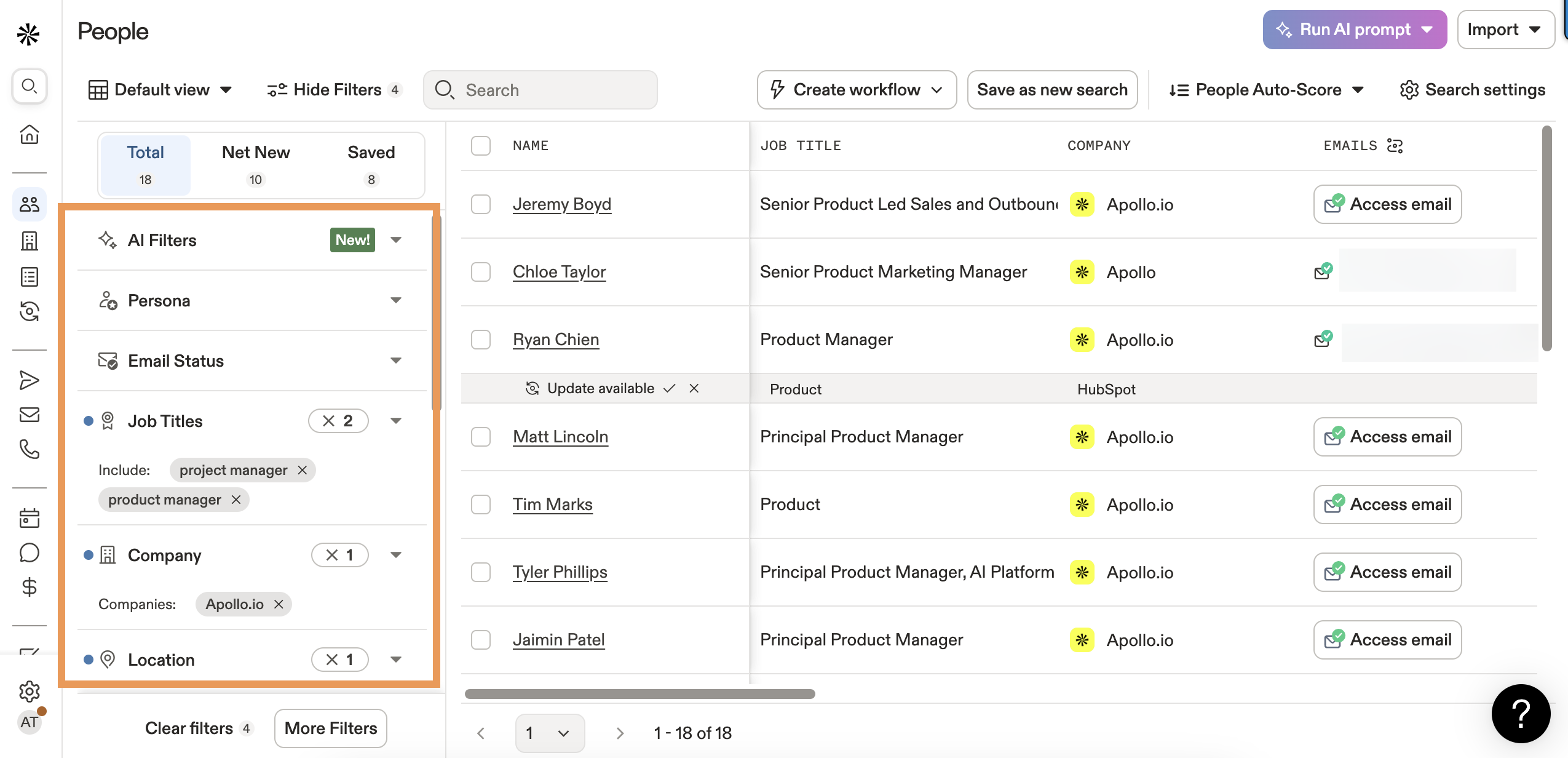
Apollo is the obvious starting point for most SMB and mid-market teams that want prospecting, enrichment, and sequencing in one platform without a five-figure annual contract. The free tier gives you 1,200 credits per month - enough to test whether the data quality works for your ICP. Paid plans run $49/user/mo (Basic, 30,000 credits), $79/user/mo (Professional, 48,000 credits), and $119/user/mo (Organization, 72,000 credits, minimum 3 seats).
The 4.7/5 G2 rating across 9,235 reviews tells you something - users genuinely like it. The built-in sequencing is solid for teams running email-heavy outbound. The credit model is the catch: high-volume teams burn through credits fast, and buying add-on packs gets expensive. We've seen teams start on the Pro plan and quietly creep toward $150+/user/mo once they factor in extra credits and enrichment.
If you're building lists on a budget, compare it against other free lead generation tools before you commit.
Skip this if you need enterprise-grade call coaching, advanced revenue intelligence, or deep Salesforce workflow automation. Apollo does a lot of things well; it doesn't do everything.
ZoomInfo
ZoomInfo is still the deepest enterprise data platform on the market. But most teams don't need enterprise-depth data - they need accurate data. ZoomInfo's database is strong for US contacts, and the platform covers intent, chat, and workflow automation. Custom pricing typically runs $15K-40K/year depending on seats and modules. The 4-6 week refresh cycle and contract lock-in are the tradeoffs. If you're a 500-person org with a dedicated RevOps team to activate every module, it makes sense. For everyone else, you're likely overpaying for features you won't touch.
If you're evaluating alternatives, start with a shortlist of sales prospecting databases and compare refresh cycles and verification.
Sales Engagement Platforms
Outreach
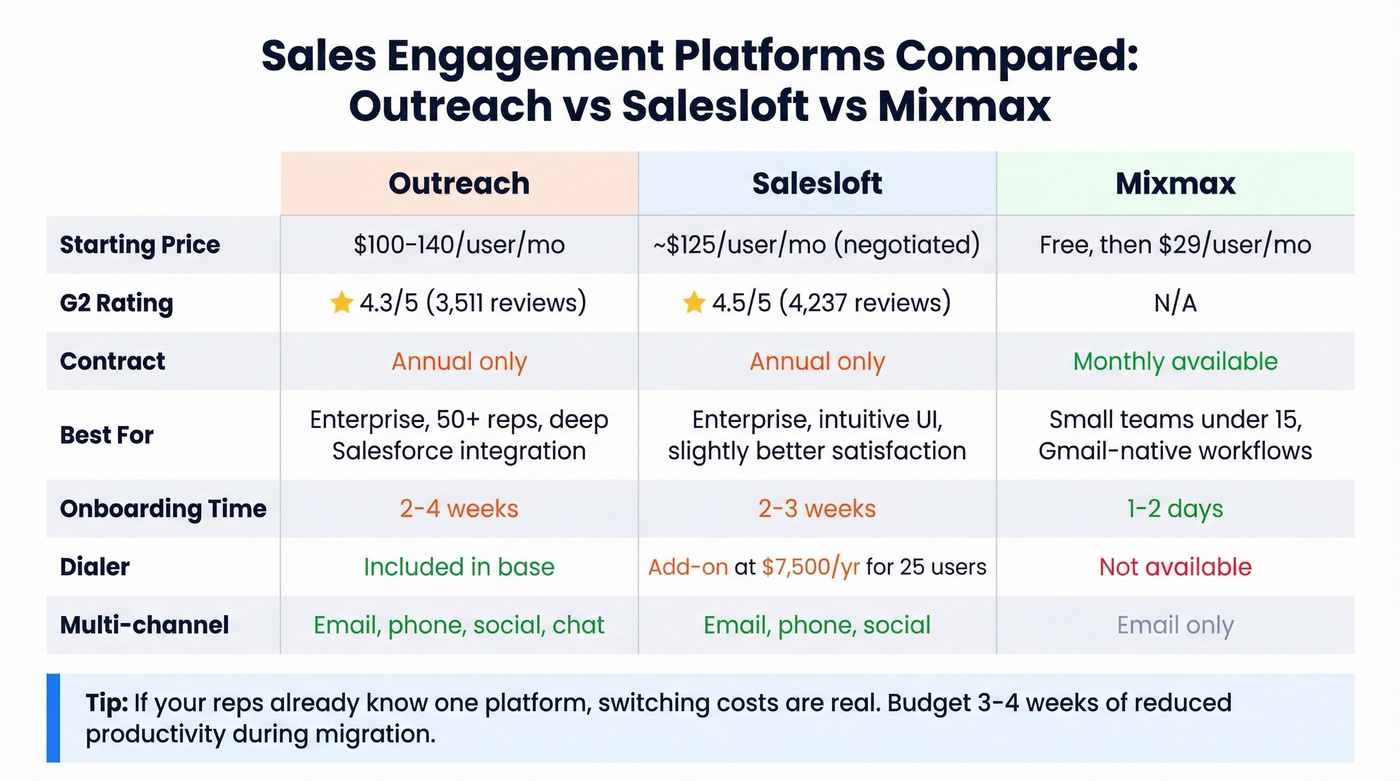
Outreach is the enterprise engagement leader, and the pricing reflects it. The Engage base module runs $100-140/user/month, with add-ons stacking on top: Meet/Kaia ($30-50/user/mo), Deal ($30-50/user/mo), Forecast ($20-40/user/mo). Implementation fees range from $5,000 to $25,000. Annual contracts only.
If you're rolling this out org-wide, follow a structured plan for implementing a sales engagement platform to avoid a messy adoption curve.
Let's do the math on a 50-user Engage deployment: that's roughly $72,000/year at list price, before negotiation. Vendr data suggests 15-35% discounts are typical, but you're still looking at $47K-$61K for sequencing alone.
The G2 rating sits at 4.3/5 across 3,511 reviews - lower than competitors partly because of pricing frustration, a steep learning curve (expect 2-4 weeks before new reps are productive), and declining support responsiveness that recent G2 reviewers have flagged repeatedly. Where Outreach earns its price: the sequencing engine is best-in-class, Salesforce integration is deep, and the analytics give managers real visibility into rep activity. Where it doesn't: the add-on model means your "engagement platform" bill can quietly double.
SalesLoft
Salesloft and Outreach are closer than either vendor wants to admit. Salesloft's Advanced tier lists at ~$180/user/month, but typical negotiation brings that down to ~$125/user/mo. The dialer is a separate add-on at $7,500/year for 25 users. The 4.5/5 G2 rating across 4,237 reviews edges out Outreach on user satisfaction, and the platform feels more intuitive out of the box.
For teams choosing between the two, it often comes down to which one your reps already know. Switching costs are real - budget 3-4 weeks of reduced productivity during migration.
Mixmax
Gmail-native, lightweight, and priced for small teams. Free tier available, paid plans from $29/user/mo. Best for teams under 15 reps who live in Gmail and don't need the complexity of Outreach or Salesloft. Not a fit for multi-channel orchestration at scale.
If you're considering other lightweight options, see these Mixmax alternatives.
CRM
HubSpot Sales Hub
The free CRM is genuinely useful - not a bait-and-switch demo. Paid plans start at $15/user/mo, and the Breeze AI features add smart lead scoring and follow-up automation without requiring a dedicated RevOps hire to configure. Best for SMB and mid-market teams that want CRM, light sequencing, and reporting in one place. The ceiling hits when you need enterprise-grade customization or complex multi-object workflows - that's where Salesforce takes over.
If you're still deciding what counts as a CRM in the first place, here are examples of a CRM with real pricing.
Salesforce Sales Cloud
If your org already runs Salesforce, you're not switching. Starts at $25/user/mo, but enterprise deployments with Einstein AI, Agentforce, and the full add-on suite run $150-300/user/mo. Agentforce is the most interesting development here: autonomous AI agents that handle routine CRM tasks, freeing reps from the data-entry grind that eats their selling time.
Starting fresh with under 50 reps? Look at HubSpot first.
Pipedrive
From $14/user/mo. Visual pipeline management that small teams love. Simple, fast, no bloat. Not built for complex enterprise workflows, and that's the point.
Conversation Intelligence
Gong
Gong's pricing is a three-part puzzle: a platform fee ($5,000-$50,000/year), per-user licenses ($1,360-$1,600/user/year depending on volume), and mandatory onboarding ($7,500-$28,500+). For a 10-user deployment, expect roughly $28,500 in year one - an effective $238/user/month.
The 4.8/5 G2 rating across 6,407 reviews is the highest on this list, and it's earned. Gong's AI-powered call analysis, deal intelligence, and coaching workflows give large teams a real edge. In our experience, Gong is worth it at 50+ reps where the pattern recognition across thousands of calls compounds. Below that threshold, it's a luxury. A 10-person team can get 80% of the value from recording calls in Zoom and doing manual reviews.
Workflow Accelerators
Calendly - Free tier, paid from $10/user/mo. Cuts the back-and-forth required to book meetings. Not glamorous, but the time savings compound across hundreds of meetings per quarter.
DocuSign - From ~$10/month. E-signatures that remove the "print, sign, scan" bottleneck from deal closing. Table stakes for any team running contracts.
Zapier - Free tier, paid from around $20/month. The glue between tools that don't natively integrate. If your CRM doesn't talk to your sequencer, Zapier bridges the gap. Essential, not optional.
Snyk's 50 AEs cut bounce rates from 35% to under 5% and added 200+ opportunities per month. Your sales productivity software stack is only as productive as the data feeding it.
Stop losing selling hours to bounced emails and dead numbers.
Real Cost of a Sales Tech Stack
Here's what a 10-person SDR team realistically spends across three stack configurations:
| Stack Tier | Tools | Annual Cost |
|---|---|---|
| Enterprise | Salesforce + Outreach + ZoomInfo + Gong | $150K-250K/yr |
| Mid-Market | HubSpot + Salesloft + Apollo + Gong | $60K-100K/yr |
| Lean/SMB | HubSpot Free + Prospeo + Apollo + Calendly | $15K-25K/yr |
The gap between enterprise and lean is 10x. Most of that delta comes from two line items: the data provider and the engagement platform.
That cost gap doesn't mean lean stacks underperform. Meritt tripled weekly pipeline from $100K to $300K after switching their data layer, while dropping bounce rates from 35% to under 4%. The enterprise stack gives you more features. The lean stack forces you to use fewer tools better - and the pipeline numbers often reflect that discipline. Smart resource allocation means your budget goes toward platforms that actually move pipeline, not shelf-ware that inflates your tech spend.
How to Build Your Stack
Solo or under 5 reps: HubSpot Free + Prospeo + Calendly. Total cost under $500/mo. You get a clean data layer, a pipeline manager, and a meeting booker. Don't add complexity until you've maxed out this setup.
10-25 reps: Add Apollo or Salesloft for sequencing, depending on whether you need a combined data+engagement tool or a dedicated sequencer. Layer Gong only if call volume justifies the spend - for most teams at this size, it doesn't yet. The tools your reps actually use daily matter more than the ones with the longest feature list.
50+ reps: This is where the enterprise stack earns its price. Salesforce + Outreach + Gong, with a strong data enrichment layer underneath. One enterprise AE in NYC described his ideal stack as Salesforce, Outreach, and Gong - with voice dictation tools cutting post-call documentation from 30+ minutes to under 5. Start with data quality, then add sequencing, then add intelligence. That order matters.
If you're formalizing your data layer, compare data enrichment services before you lock in a provider.
If your average deal size is under $10K, you probably don't need ZoomInfo-level data. The cost-per-lead math simply doesn't work when your contracts are small. A lean data layer with high accuracy will outperform an expensive one with features your team never activates.
Measuring What Matters
Track these metrics to know if your sales productivity software is actually working:
- Time spent selling - benchmark is 12 hrs/week; if you're below that, your tools are failing you
- Email bounce rate - target under 5%; anything above 10% means your data provider is the bottleneck
- Reply rate - 3-8% on cold outbound is healthy, varies by industry
- Meetings booked per rep per week - the leading indicator that matters most
- Pipeline generated per rep - the dollar output of all that activity
- Quota attainment - the only metric leadership actually cares about
If you want a tighter activity system, use these sales activities examples to standardize what reps do daily.
The first three are diagnostic: they tell you where the stack is broken. The last three are outcome metrics that tell you whether the whole machine is working. If meetings booked is strong but pipeline is weak, your targeting is off. If pipeline is strong but quota attainment is low, your closing process needs work - not your tools.
FAQ
What is sales productivity software?
Any platform that helps reps spend more time selling and less time on admin tasks. CRMs, sequencing tools, data providers, conversation intelligence, scheduling apps, and workflow automation all fall under this umbrella. The best stacks combine 3-5 of these categories without overlap.
How much does a full sales tech stack cost?
A lean 10-person stack runs $15K-25K/year; enterprise configurations reach $150K-250K/year. The data provider and engagement platform drive most of the cost.
What's the biggest productivity killer teams overlook?
Bad contact data. A 20% bounce rate tanks your domain reputation, suppresses deliverability, and makes every downstream metric worse. Snyk cut bounces from 35-40% to under 5% after fixing their data layer, and AE-sourced pipeline jumped 180%.
Do I need separate tools for prospecting and engagement?
Under 25 reps, Apollo combines both capabilities well at $49-79/user/mo. Larger teams benefit from separating the data layer from the sequencing layer for better accuracy, flexibility, and vendor leverage.
How does AI improve sales productivity in 2026?
AI automates lead scoring, follow-up drafting, CRM data entry, and call coaching - tasks that previously consumed 5-10 hours per rep per week. Teams using AI agents report 83% higher revenue growth, per Salesforce's State of Sales data.