

Sales Proposal Format: The 2026 Guide That Wins Deals
Your prospect said "send me a proposal." You've got 48 hours before their attention drifts to a competitor. The sales proposal format you choose - and the structure you follow - will determine whether that proposal gets signed or forwarded to a folder no one opens.
The average proposal-stage win rate is just 47%. In software, it drops to 22%. In finance, 19%. Less than half of proposals that reach a buyer's desk actually close, and your format, delivery, and follow-up can be the difference between "approved" and "ghosted."
What You Need (Quick Version)
Every winning sales proposal includes these 10 sections, in this order:
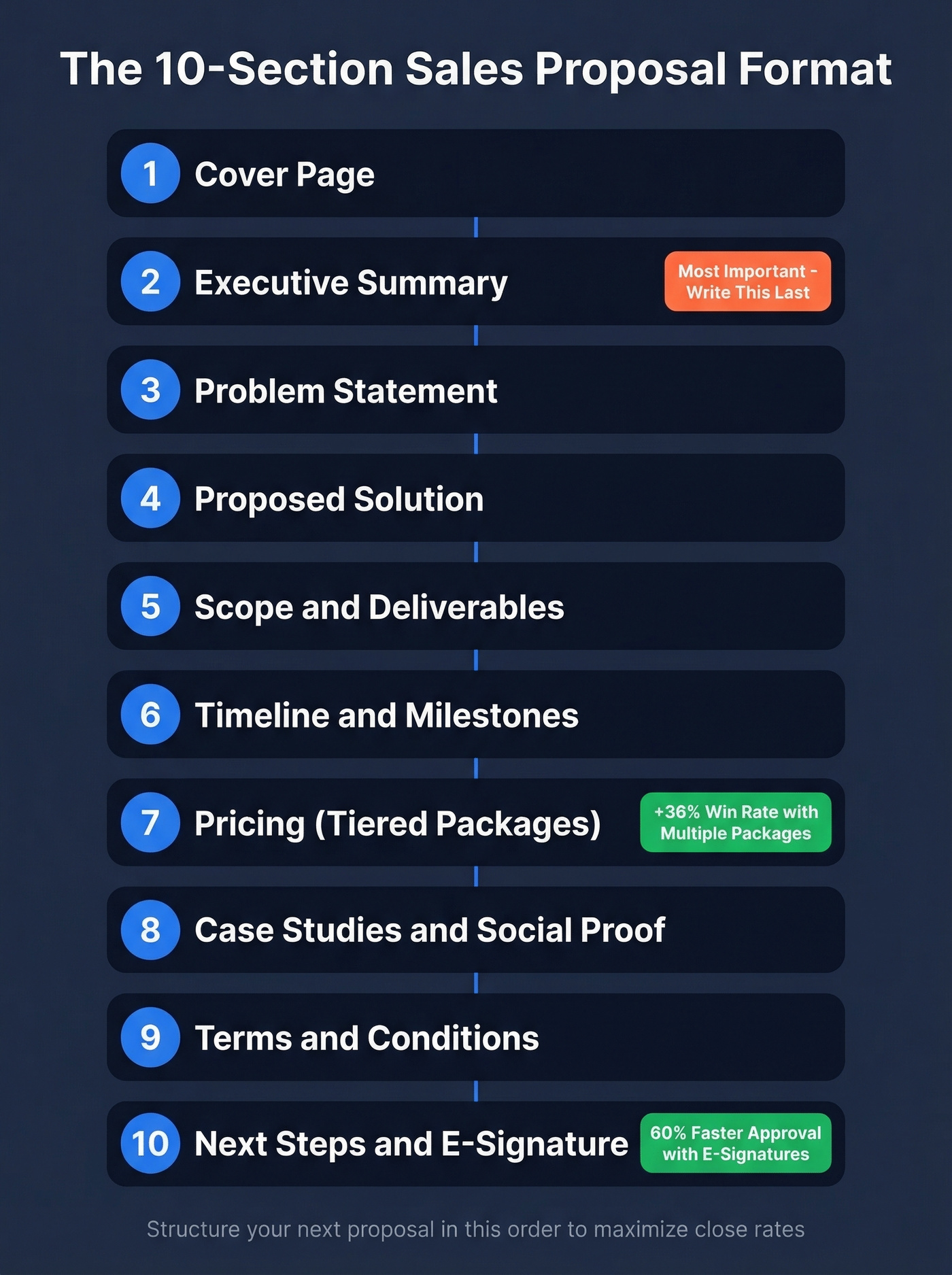
- Cover page
- Executive summary
- Problem statement
- Proposed solution
- Scope & deliverables
- Timeline & milestones
- Pricing (with tiered packages)
- Case studies & social proof
- Terms & conditions
- Next steps & e-signature
The one format decision that matters most: document vs. deck vs. interactive web proposal. PowerPoint is almost always the wrong choice. And here's the single stat that should reshape how you present pricing: offering multiple packages increases win rates by 36%. That alone is worth restructuring your pricing section today.
What a Sales Proposal Is (and Isn't)
A sales proposal is a mid-to-late pipeline document that frames your solution around the buyer's specific problem, lays out scope and pricing, and asks for a decision. It sits between discovery and contracting.
What it's not: a product spec sheet. A proposal shouldn't catalog every feature you offer - that's what demos and documentation are for. The proposal's job is to connect the buyer's pain to your solution, show what it costs, and make it easy to say yes.
Why Format Matters More in 2026
B2B buying has fundamentally changed. 80% of B2B sales interactions now happen through digital channels. The buying committee is 7 people . Buyers use 10 different interaction channels during a purchase - up from 5 in 2016. McKinsey's research reinforces this: roughly a third of buyers prefer in-person, a third prefer remote, and a third want digital self-serve, which means your proposal needs to work across all three modes.
What does this mean in practice? Your proposal gets forwarded. It gets discussed in Slack. It gets screen-shared on a Zoom call with three people you've never met. Your document needs to survive being read by stakeholders who weren't in the room when you gave the demo - clear structure, scannable sections, and a format that renders well on any screen.
The rep who sends a scannable, trackable web proposal has a real edge over the one who attaches a static Word doc.
Three Proposal Formats Compared
| Format | Best For | Watch Out For |
|---|---|---|
| Document (Word/Docs/PDF) | Simple deals, SMB | Feels static; hard to track |
| Interactive web proposal | Complex/enterprise deals | Higher learning curve |
| Slide deck (PowerPoint) | Live presentations only | Terrible for async review |
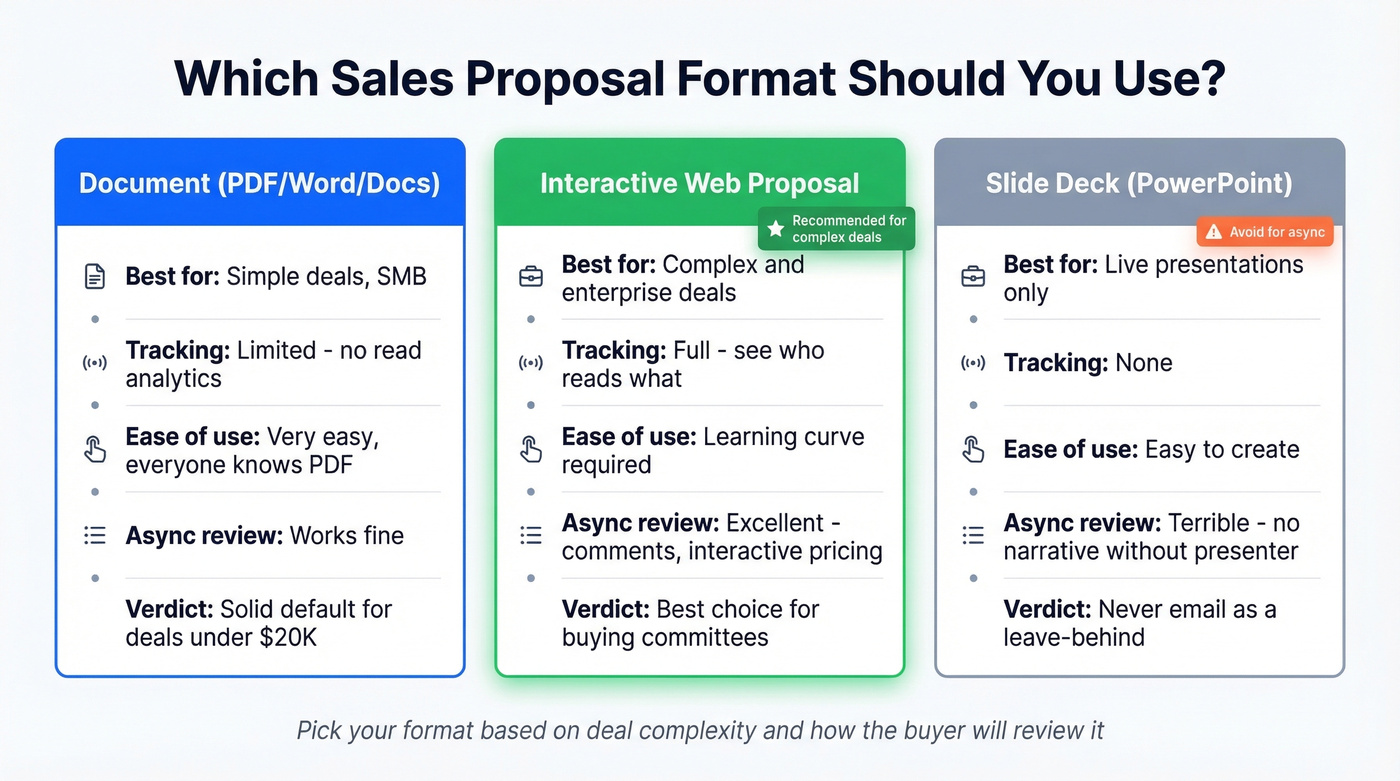
Documents work fine for straightforward, lower-ticket deals. They're familiar, easy to produce, and every buyer knows how to open a PDF. The downside is limited analytics - you don't know what they read, who they forwarded it to, or where they got stuck.
Interactive web proposals through tools like Qwilr, PandaDoc, or GetAccept are a strong fit for complex deals. They track engagement, embed interactive pricing tables, and let multiple stakeholders comment. For deals involving a buying committee, this format makes review dramatically easier.
Slide decks are for presenting live. Full stop. The moment you email a PowerPoint and expect someone to read it asynchronously, you've lost. Decks without a presenter are walls of bullet points with no narrative thread. Use them in the room, never as the leave-behind.
Here's the thing: if you sell simpler, lower-ticket deals, you don't need an interactive proposal tool. A clean PDF with tiered pricing and an e-signature link can be enough - and you'll spend zero hours learning new software.

A perfect sales proposal format means nothing if it lands in the wrong inbox. Prospeo gives you 98% verified emails and 125M+ direct dials so your proposal reaches the actual decision-maker - not a gatekeeper.
Nail the format, then nail the delivery. Start with accurate data.
Sales Proposal Structure - Section by Section
Here's the exact sales proposal outline we recommend. For quick reference, all 10 sections at a glance:
- Cover page - company name, prospect name, date, your logo
- Executive summary - the entire deal in 3-5 sentences
- Problem statement - the buyer's pain, in their own words
- Proposed solution - your 2-3 capabilities that solve it
- Scope & deliverables - what's included, what's not
- Timeline & milestones - phases with clear dates
- Pricing - 2-3 tiered packages, value-framed
- Case studies & social proof - 1-2 relevant wins
- Terms & conditions - short, readable, key terms only
- Next steps & e-signature - clear CTA, embedded signing
Let's break each one down.
Cover Page
Company name, prospect name, date, and your logo. Keep it clean and branded. This is the first thing the buyer sees, and it sets the tone for everything that follows. A sloppy cover page signals a sloppy engagement.
Executive Summary
This is the most important section. Write it last. In 3-5 sentences, summarize the prospect's problem, your proposed solution, the expected outcome, and the investment. A CFO who reads nothing else should be able to make a decision from this section alone - if they can't, you've buried the lead.
Problem Statement
Mirror the prospect's own language. If they said "our reps waste 6 hours a week on manual data entry," use those exact words. Pipedrive's research emphasizes mirroring the buyer's phrases - it proves you listened during discovery and makes the buyer feel heard. Skip this section or fill it with generic pain points, and you've already lost credibility.
Proposed Solution
Connect your product directly to the problems you just outlined. Don't list every feature you have. Focus on the 2-3 capabilities that solve their specific pain. Every sentence should answer "so what?" from the buyer's perspective.
Scope & Deliverables
Be explicit about what's included and what's not. Ambiguity here creates scope creep later and erodes trust during negotiation. Use a simple table with four columns: deliverable, description, owner, timeline. Of all the proposal elements, this one does the most to prevent post-sale disputes.
Timeline & Milestones
Break the engagement into phases with clear dates. Buyers want to know when they'll see results, not just what they're buying. Even a simple three-phase timeline - kickoff, implementation, go-live - gives the proposal forward momentum.
Pricing
This is where most proposals fail and where the biggest opportunity lives.
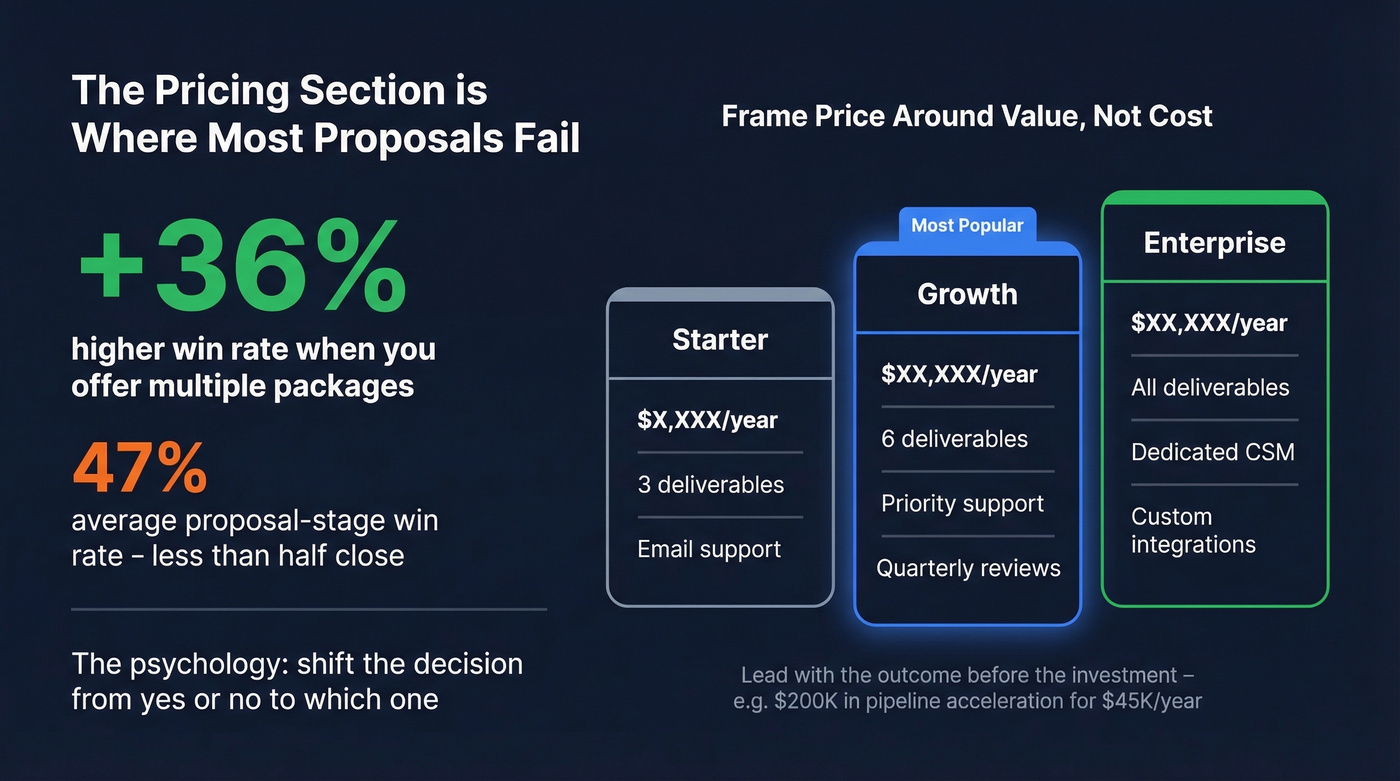
An analysis of 50,000 proposals found that offering multiple packages increased win rates by 36%. That's not a marginal improvement - that's the difference between a mediocre quarter and hitting target. Structure your pricing as 2-3 tiered packages. The psychology is simple: you shift the buyer's decision from "yes or no" to "which one." PandaDoc recommends bundling deliverables into packages and framing price around value delivered, not cost incurred. Lead with the outcome ("$200K in pipeline acceleration") before the investment ("$45,000/year"). In our experience, the three-tier approach works best for deals over $20K - below that, two options are plenty.
Case Studies & Social Proof
Include 1-2 relevant case studies, ideally from the same industry or company size. A testimonial quote, a metric, and a one-paragraph narrative is all you need. Don't bury this at the end; it reinforces the pricing section that came right before it.
Terms & Conditions
Keep this short and readable. Payment terms, contract duration, cancellation policy, and any legal requirements. If your legal team insists on 8 pages of boilerplate, put it in an appendix and summarize the key terms here.
Next Steps & E-Signature
End with a clear call to action and an embedded e-signature block. Proposals with online signatures see 60% faster client approval compared to the print-sign-scan-email workflow. Remove every friction point between "I want to buy" and "it's done."
Pre-Writing Research Checklist
The best sales proposal format in the world won't save you if you haven't done the homework. Before you write a single word, confirm these:
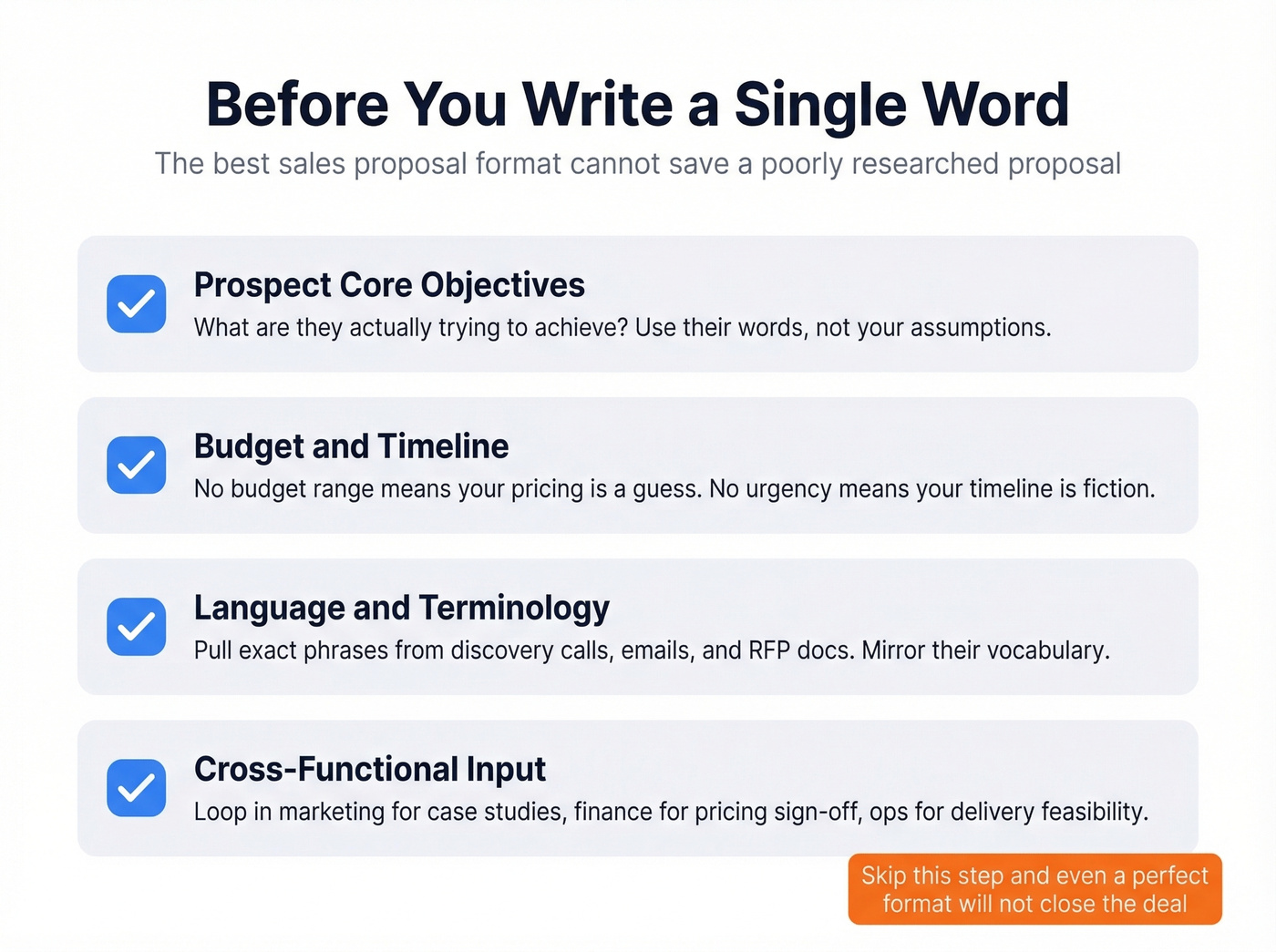
- Prospect's core objectives. What are they actually trying to achieve? Not what you think they need - what they told you they need.
- Budget and timeline. If you don't know the budget range, your pricing section is a guess. If you don't know their urgency, your timeline is fiction.
- Language and terminology. Pull phrases directly from discovery calls, emails, and any RFP documents. Mirror their vocabulary throughout.
- Cross-functional input. Loop in marketing for branding and case studies, finance for pricing sign-off, and operations for delivery feasibility before the proposal goes out.

Your proposal targets a 7-person buying committee. Prospeo's 300M+ database with 30+ filters - including job title, department, and seniority - lets you identify every stakeholder before you send. At $0.01 per email, arming your proposal with the right contacts costs less than a coffee.
Map the entire buying committee in minutes, not days.
Design & Delivery Best Practices
Brand your proposals consistently. Branded proposals signal professionalism and build trust before the buyer reads a word. Use your company colors, logo, and a clean layout. Humans process visuals roughly 60,000x faster than text, so use charts, timelines, and tables instead of dense paragraphs wherever you can.
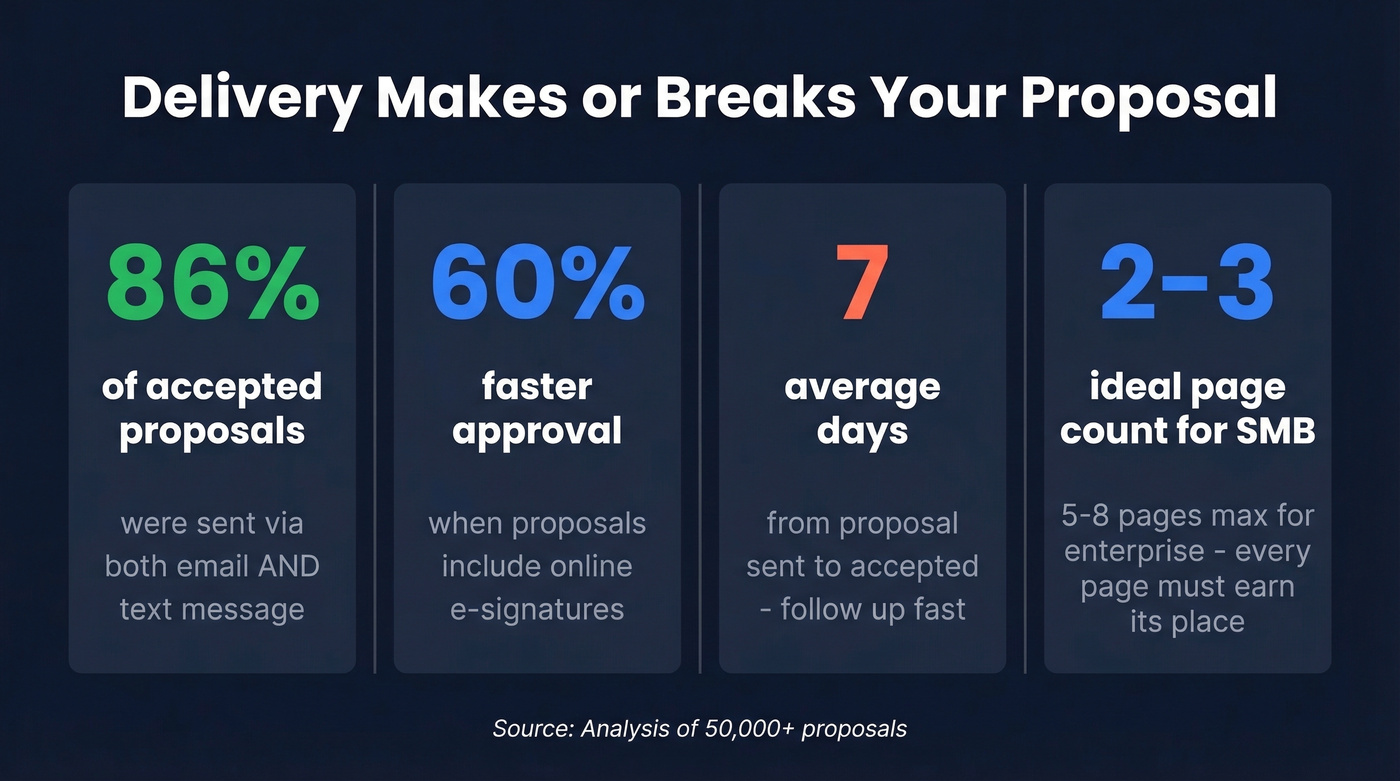
Keep it short. Accepted proposals tend to be shorter and more specific than rejected ones. For SMB deals, aim for 2-3 pages. Enterprise proposals can run 5-8 pages, but every page needs to earn its place.
Send via multiple channels. 86% of accepted proposals were delivered through both email and text. A quick text - "Just sent the proposal to your inbox, let me know if you have questions" - helps ensure it gets seen. Don't send and disappear. The average time from sent to accepted is 7.7 days, and the proposal is hottest right after sending, so follow up within 24-48 hours, not next week. If you need a repeatable cadence, use these sales follow-up templates and build a simple sequence management process.
Proposal Mistakes That Kill Deals
We've seen proposals lose six-figure deals because the CTA was "let us know your thoughts." That's not an isolated case. Here are the seven mistakes that kill deals most often.
Too long and too generic. If your proposal reads like it could be sent to any company, it will convince none of them. Personalize or lose.
Too much about you. The buyer doesn't care about your founding story or your 47 awards. They care about their problem and your solution.
Unclear benefits. Features aren't benefits. "AI-powered analytics" means nothing. "Cut reporting time from 4 hours to 20 minutes" means everything.
No structure or table of contents. A proposal without clear sections forces the buyer to hunt for information. They won't.
Weak or missing call to action. "Let us know your thoughts" isn't a CTA. "Sign below to kick off implementation on March 15" is.
Single-channel delivery. Email-only proposals get buried. Add a text, a Slack message, or a follow-up call.
No follow-up plan. Many deals go quiet after the proposal. If you don't have a follow-up cadence mapped out before you hit send, you're leaving revenue on the table. We've seen teams recover stalled deals simply by adding a three-touch follow-up sequence: day 1, day 3, day 7. (If you're rebuilding your process end-to-end, start with sales prospecting techniques and tighten your sales process optimization.)
Best Proposal Tools (With Pricing)
Reps using proposal software save up to 70% of the time they'd spend building proposals manually, yet 33% of sales teams still don't use any proposal tool. The proposal management software market is projected to hit $9B by 2035. Here's what to look at as of mid-2026.
| Tool | Best For | Starting Price | Key Feature |
|---|---|---|---|
| PandaDoc | All-around best | From $35/mo | Templates + e-sign + CRM |
| Proposify | Enterprise deals | From $45/mo | Approval workflows |
| Qwilr | Interactive proposals | From $35/mo/user | Interactive pricing pages |
| Beautiful.ai | Design-forward decks | Free trial; paid plans | AI slide design |
| Better Proposals | Budget teams | From $19/mo | Simple editor + tracking |
| GetAccept | Digital sales rooms | From $49/mo | Video + chat + e-sign |
| Canva | DIY design | Free; Pro ~$13/mo | Templates + brand kit |
| Prospero | Solo/freelance | From $10/mo | Lightweight + fast |
| Proposally.ai | Lowest cost | From $9/mo | AI-assisted drafting |
PandaDoc is a common default for teams that want templates, e-signatures, CRM sync, and analytics in one platform. Proposify tends to be preferred for enterprise-style deals where you need approval workflows and granular permissions. Qwilr is a strong option for interactive web-based proposals - when your deals involve buying committees reviewing asynchronously, it's worth a look.
For teams on a tight budget, Better Proposals at $19/mo or Proposally.ai at $9/mo get the job done without the overhead. We've seen early-stage teams run their entire proposal workflow on Canva's free tier plus a PDF. Not ideal, but it works until deal volume justifies a dedicated tool. Skip the expensive options if you're closing fewer than 10 deals a month - the ROI isn't there yet. If you're evaluating the rest of your stack too, compare SDR tools and contact management software to keep handoffs clean.
FAQ
How long should a sales proposal be?
Aim for 2-3 pages for SMB deals and 5-8 pages for enterprise. Accepted proposals tend to be shorter and more specific than rejected ones. Every page should directly address the buyer's problem, solution, or next steps - cut anything that doesn't.
Should I send a proposal as a PDF, deck, or web link?
PDFs work for simple deals under $15K. Interactive web proposals from PandaDoc or Qwilr are better for complex sales because they track engagement and support multiple reviewers. Avoid PowerPoint unless you're presenting live - decks without a presenter lose their narrative thread entirely.
How do I make sure my proposal reaches the decision-maker?
Verify every stakeholder's email before sending. With buying committees averaging 7 people, your proposal needs to reach the economic buyer, not just your day-to-day contact. Tools like Prospeo can verify emails at 98% accuracy so your proposal lands in the right inbox rather than bouncing off a dead alias.
What's the difference between a proposal and a quote?
A quote lists line items and costs. A proposal wraps pricing inside a narrative: the buyer's problem, your solution, expected outcomes, timeline, and social proof. Quotes answer "how much?" Proposals answer "why you?" Always send the proposal first, then extract a standalone quote if procurement requires one.
How many pricing options should I include?
Two to three. The 50,000-proposal analysis found that multiple packages boost win rates by 36%. Three tiers work best for deals over $20K; below that, two options keep things simple without overwhelming the buyer.